 | Acta Crystallographica Section E Acta Crystallographica Section E CRYSTALLOGRAPHIC COMMUNICATIONS |


 journal menu


organic compounds
| CRYSTALLOGRAPHIC COMMUNICATIONS |
 access
4-(1H-Benzimidazol-2-yl)benzonitrile

aOrdered Matter Science Research Center, College of Chemistry and Chemical Engineering, Southeast University, Nanjing 210096, People's Republic of China
*Correspondence e-mail: [email protected]
The molecule of the title compound, C14H9N3, is essentially planar, the dihedral angle formed by the benzimidazole ring system with the benzene ring being 3.87 (3)°. In the crystal packing, molecules are linked into zigzag chains running parallel to the b axis by intermolecular N—H⋯N hydrogen-bond interactions.
Related literature
For related literature, see: Gallagher et al. (2001![[Gallagher, J. F., Hanlon, K. & Howarth, J. (2001). Acta Cryst. C57, 1410-1414.]](../../../../../../logos/arrows/e_arr.gif "Gallagher, J. F., Hanlon, K. & Howarth, J. (2001). Acta Cryst. C57, 1410-1414.") ); Howarth & Hanlon (2001); Kazak et al. (2006); Li et al. (1998); Íkizler & Sancak (1992).
); Howarth & Hanlon (2001); Kazak et al. (2006); Li et al. (1998); Íkizler & Sancak (1992).
![[Scheme 1]](rz2211scheme1.gif)
Experimental
Crystal data
|
Refinement
|
| ||||||||||||||||||||||
 .
. Data collection: CrystalClear (Rigaku, 2005); cell refinement: CrystalClear; data reduction: CrystalClear; program(s) used to solve structure: SHELXS97 (Sheldrick, 2008); program(s) used to refine structure: SHELXL97 (Sheldrick, 2008); molecular graphics: SHELXTL (Sheldrick, 2008); software used to prepare material for publication: SHELXL97.
Supporting information
contains datablocks I, global. DOI: 10.1107/S1600536808012932/rz2211sup1.cif
Structure factors: contains datablock I. DOI: 10.1107/S1600536808012932/rz2211Isup2.hkl
4-Formylbenzonitrile (2 mmol), malononitrile (1 mmol) and benzene-1,2-diamine (1 mmol) were heated at 100°C with stirring for 5 min. The mixture was washed with dichloromethane(5 mL) and dried. A white solid was obtained after recrystallization from ethanol. 4-(1H-Benzo[d]imidazol-2-yl)benzonitrile (0.3 mmol) was placed in a thick-walled Pyrex tube. EtOH (0.3 mL) and H2O (0.3 mL) were then added, the tube was frozen with liquid N2, evacuated and flame-sealed. The tube was heated at 100°C for 2 days to give colourless crystals of the title compound.
The H atom bound to the imidazole N atom was located in a difference Fourier synthesis and refined freely. All other H atoms were placed in calculated positions and refined using a riding model approximation, with C—H = 0.93 Å and Uiso(H) = 1.2 Ueq(C).
Data collection: CrystalClear (Rigaku, 2005); cell CrystalClear (Rigaku, 2005); data reduction: CrystalClear (Rigaku, 2005); program(s) used to solve structure: SHELXS97 (Sheldrick, 2008); program(s) used to refine structure: SHELXL97 (Sheldrick, 2008); molecular graphics: SHELXTL (Sheldrick, 2008); software used to prepare material for publication: SHELXL97 (Sheldrick, 2008).
![[Figure 1]](./rz2211fig1thm.gif) | Fig. 1. The molecular structure of the title compound with the atom-numbering scheme. Displacement ellipsoids are drawn at the 30% probability level. |
| C14H9N3 | F(000) = 456 |
| Mr = 219.24 | Dx = 1.343 Mg m−3 |
| Monoclinic, P21/n | Mo Kα radiation, λ = 0.71073 Å |
| Hall symbol: -P 2yn | Cell parameters from 2461 reflections |
| a = 7.2172 (10) Å | θ = 3.2–27.5° |
| b = 11.818 (2) Å | µ = 0.08 mm−1 |
| c = 12.719 (2) Å | T = 293 K |
| β = 92.057 (7)° | Prism, colourless |
| V = 1084.1 (3) Å3 | 0.35 × 0.15 × 0.10 mm |
| Z = 4 |
| Rigaku Mercury2 (2x2 bin mode) diffractometer | 2581 independent reflections |
| Radiation source: fine-focus sealed tube | 2073 reflections with I > 2σ(I) |
| Graphite monochromator | Rint = 0.037 |
| Detector resolution: 13.6612 pixels mm-1 | θmax = 27.9°, θmin = 2.4° |
| CCD_Profile_fitting scans | h = −9→9 |
| Absorption correction: multi-scan (CrystalClear; Rigaku, 2005) | k = −15→15 |
| Tmin = 0.911, Tmax = 1.000 | l = −16→16 |
| 11203 measured reflections |
| Refinement on F2 | Secondary atom site location: difference Fourier map |
| Least-squares matrix: full | Hydrogen site location: inferred from neighbouring sites |
| R[F2 > 2σ(F2)] = 0.046 | H atoms treated by a mixture of independent and constrained refinement |
| wR(F2) = 0.118 | w = 1/[σ2(Fo2) + (0.056P)2 + 0.1336P] where P = (Fo2 + 2Fc2)/3 |
| S = 1.08 | (Δ/σ)max < 0.001 |
| 2581 reflections | Δρmax = 0.16 e Å−3 |
| 159 parameters | Δρmin = −0.17 e Å−3 |
| 0 restraints | Extinction correction: SHELXL97 (Sheldrick, 2008), Fc*=kFc[1+0.001xFc2λ3/sin(2θ)]-1/4 |
| Primary atom site location: structure-invariant direct methods | Extinction coefficient: 0.115 (7) |
| C14H9N3 | V = 1084.1 (3) Å3 |
| Mr = 219.24 | Z = 4 |
| Monoclinic, P21/n | Mo Kα radiation |
| a = 7.2172 (10) Å | µ = 0.08 mm−1 |
| b = 11.818 (2) Å | T = 293 K |
| c = 12.719 (2) Å | 0.35 × 0.15 × 0.10 mm |
| β = 92.057 (7)° |
| Rigaku Mercury2 (2x2 bin mode) diffractometer | 2581 independent reflections |
| Absorption correction: multi-scan (CrystalClear; Rigaku, 2005) | 2073 reflections with I > 2σ(I) |
| Tmin = 0.911, Tmax = 1.000 | Rint = 0.037 |
| 11203 measured reflections |
| R[F2 > 2σ(F2)] = 0.046 | 0 restraints |
| wR(F2) = 0.118 | H atoms treated by a mixture of independent and constrained refinement |
| S = 1.08 | Δρmax = 0.16 e Å−3 |
| 2581 reflections | Δρmin = −0.17 e Å−3 |
| 159 parameters |
Geometry. All e.s.d.'s (except the e.s.d. in the dihedral angle between two l.s. planes) are estimated using the full covariance matrix. The cell e.s.d.'s are taken into account individually in the estimation of e.s.d.'s in distances, angles and torsion angles; correlations between e.s.d.'s in cell parameters are only used when they are defined by crystal symmetry. An approximate (isotropic) treatment of cell e.s.d.'s is used for estimating e.s.d.'s involving l.s. planes. |
Refinement. Refinement of F2 against ALL reflections. The weighted R-factor wR and goodness of fit S are based on F2, conventional R-factors R are based on F, with F set to zero for negative F2. The threshold expression of F2 > σ(F2) is used only for calculating R-factors(gt) etc. and is not relevant to the choice of reflections for refinement. R-factors based on F2 are statistically about twice as large as those based on F, and R- factors based on ALL data will be even larger. |
| x | y | z | Uiso*/Ueq | ||
| N2 | 0.23276 (15) | 0.98417 (9) | −0.07818 (9) | 0.0381 (3) | |
| C8 | 0.14908 (17) | 0.84634 (11) | 0.06171 (10) | 0.0367 (3) | |
| N1 | 0.08189 (15) | 0.82641 (9) | −0.12784 (8) | 0.0404 (3) | |
| C7 | 0.15245 (17) | 0.88501 (10) | −0.04772 (10) | 0.0360 (3) | |
| N3 | 0.11261 (18) | 0.68424 (11) | 0.45407 (10) | 0.0543 (3) | |
| C11 | 0.13598 (18) | 0.76582 (11) | 0.26664 (10) | 0.0389 (3) | |
| C6 | 0.21340 (17) | 0.98948 (10) | −0.18604 (10) | 0.0363 (3) | |
| C9 | 0.23427 (19) | 0.90578 (12) | 0.14485 (10) | 0.0439 (3) | |
| H9A | 0.2963 | 0.9730 | 0.1315 | 0.053* | |
| C1 | 0.11833 (17) | 0.89042 (11) | −0.21590 (10) | 0.0377 (3) | |
| C5 | 0.2689 (2) | 1.06900 (11) | −0.25904 (11) | 0.0443 (3) | |
| H5A | 0.3300 | 1.1351 | −0.2384 | 0.053* | |
| C14 | 0.12508 (18) | 0.72221 (12) | 0.37201 (11) | 0.0425 (3) | |
| C13 | 0.05688 (19) | 0.74595 (12) | 0.08336 (11) | 0.0432 (3) | |
| H13A | −0.0015 | 0.7058 | 0.0287 | 0.052* | |
| C12 | 0.05122 (19) | 0.70550 (12) | 0.18459 (11) | 0.0436 (3) | |
| H12A | −0.0093 | 0.6378 | 0.1980 | 0.052* | |
| C10 | 0.2277 (2) | 0.86617 (12) | 0.24669 (11) | 0.0459 (3) | |
| H10A | 0.2846 | 0.9066 | 0.3017 | 0.055* | |
| C4 | 0.2292 (2) | 1.04531 (13) | −0.36315 (11) | 0.0496 (4) | |
| H4A | 0.2652 | 1.0964 | −0.4142 | 0.060* | |
| C3 | 0.1362 (2) | 0.94670 (13) | −0.39450 (11) | 0.0492 (4) | |
| H3A | 0.1134 | 0.9332 | −0.4658 | 0.059* | |
| C2 | 0.07759 (19) | 0.86882 (12) | −0.32224 (10) | 0.0451 (3) | |
| H2B | 0.0131 | 0.8041 | −0.3435 | 0.054* | |
| H2A | 0.281 (2) | 1.0377 (15) | −0.0336 (13) | 0.058 (5)* |
| U11 | U22 | U33 | U12 | U13 | U23 | |
| N2 | 0.0439 (6) | 0.0349 (6) | 0.0354 (6) | 0.0001 (4) | 0.0010 (5) | −0.0012 (4) |
| C8 | 0.0358 (6) | 0.0391 (7) | 0.0352 (7) | 0.0032 (5) | 0.0033 (5) | 0.0003 (5) |
| N1 | 0.0455 (6) | 0.0407 (6) | 0.0349 (6) | −0.0031 (5) | −0.0001 (4) | 0.0003 (4) |
| C7 | 0.0377 (6) | 0.0355 (6) | 0.0350 (7) | 0.0035 (5) | 0.0025 (5) | 0.0001 (5) |
| N3 | 0.0641 (8) | 0.0563 (8) | 0.0425 (7) | −0.0005 (6) | 0.0002 (6) | 0.0094 (6) |
| C11 | 0.0391 (7) | 0.0420 (7) | 0.0357 (7) | 0.0050 (5) | 0.0029 (5) | 0.0042 (5) |
| C6 | 0.0382 (6) | 0.0351 (7) | 0.0357 (7) | 0.0050 (5) | 0.0020 (5) | 0.0003 (5) |
| C9 | 0.0535 (8) | 0.0389 (7) | 0.0393 (8) | −0.0058 (6) | −0.0006 (6) | 0.0025 (5) |
| C1 | 0.0394 (6) | 0.0375 (7) | 0.0360 (7) | 0.0042 (5) | −0.0002 (5) | 0.0023 (5) |
| C5 | 0.0502 (8) | 0.0360 (7) | 0.0468 (8) | 0.0010 (6) | 0.0028 (6) | 0.0046 (6) |
| C14 | 0.0468 (8) | 0.0425 (7) | 0.0381 (7) | 0.0035 (5) | 0.0011 (6) | 0.0026 (5) |
| C13 | 0.0463 (7) | 0.0464 (8) | 0.0369 (7) | −0.0059 (6) | 0.0000 (5) | −0.0026 (6) |
| C12 | 0.0461 (7) | 0.0434 (7) | 0.0414 (7) | −0.0061 (6) | 0.0034 (6) | 0.0025 (6) |
| C10 | 0.0549 (8) | 0.0448 (8) | 0.0376 (7) | −0.0049 (6) | −0.0038 (6) | −0.0009 (6) |
| C4 | 0.0590 (9) | 0.0472 (8) | 0.0430 (8) | 0.0079 (6) | 0.0050 (6) | 0.0122 (6) |
| C3 | 0.0611 (9) | 0.0508 (8) | 0.0354 (7) | 0.0113 (7) | −0.0042 (6) | 0.0050 (6) |
| C2 | 0.0519 (8) | 0.0439 (7) | 0.0390 (7) | 0.0023 (6) | −0.0058 (6) | −0.0016 (6) |
| N2—C7 | 1.3696 (16) | C9—C10 | 1.3798 (19) |
| N2—C6 | 1.3754 (17) | C9—H9A | 0.9300 |
| N2—H2A | 0.910 (17) | C1—C2 | 1.3972 (18) |
| C8—C13 | 1.3926 (19) | C5—C4 | 1.374 (2) |
| C8—C9 | 1.3940 (19) | C5—H5A | 0.9300 |
| C8—C7 | 1.4661 (17) | C13—C12 | 1.3756 (18) |
| N1—C7 | 1.3191 (16) | C13—H13A | 0.9300 |
| N1—C1 | 1.3846 (16) | C12—H12A | 0.9300 |
| N3—C14 | 1.1427 (17) | C10—H10A | 0.9300 |
| C11—C10 | 1.3861 (19) | C4—C3 | 1.396 (2) |
| C11—C12 | 1.3877 (19) | C4—H4A | 0.9300 |
| C11—C14 | 1.4407 (18) | C3—C2 | 1.378 (2) |
| C6—C5 | 1.3901 (18) | C3—H3A | 0.9300 |
| C6—C1 | 1.4025 (18) | C2—H2B | 0.9300 |
| C7—N2—C6 | 107.00 (11) | C4—C5—C6 | 116.80 (13) |
| C7—N2—H2A | 125.0 (10) | C4—C5—H5A | 121.6 |
| C6—N2—H2A | 127.8 (10) | C6—C5—H5A | 121.6 |
| C13—C8—C9 | 118.70 (12) | N3—C14—C11 | 177.40 (16) |
| C13—C8—C7 | 118.53 (12) | C12—C13—C8 | 120.77 (13) |
| C9—C8—C7 | 122.77 (12) | C12—C13—H13A | 119.6 |
| C7—N1—C1 | 105.01 (11) | C8—C13—H13A | 119.6 |
| N1—C7—N2 | 112.72 (11) | C13—C12—C11 | 119.89 (13) |
| N1—C7—C8 | 123.42 (12) | C13—C12—H12A | 120.1 |
| N2—C7—C8 | 123.84 (11) | C11—C12—H12A | 120.1 |
| C10—C11—C12 | 120.16 (12) | C11—C10—C9 | 119.67 (13) |
| C10—C11—C14 | 121.25 (12) | C11—C10—H10A | 120.2 |
| C12—C11—C14 | 118.59 (12) | C9—C10—H10A | 120.2 |
| N2—C6—C5 | 132.50 (12) | C5—C4—C3 | 121.81 (13) |
| N2—C6—C1 | 105.27 (11) | C5—C4—H4A | 119.1 |
| C5—C6—C1 | 122.23 (12) | C3—C4—H4A | 119.1 |
| C10—C9—C8 | 120.80 (13) | C2—C3—C4 | 121.54 (14) |
| C10—C9—H9A | 119.6 | C2—C3—H3A | 119.2 |
| C8—C9—H9A | 119.6 | C4—C3—H3A | 119.2 |
| N1—C1—C2 | 130.07 (12) | C3—C2—C1 | 117.69 (13) |
| N1—C1—C6 | 110.01 (11) | C3—C2—H2B | 121.2 |
| C2—C1—C6 | 119.91 (12) | C1—C2—H2B | 121.2 |
| D—H···A | D—H | H···A | D···A | D—H···A |
| C13—H13A···N1 | 0.93 | 2.54 | 2.861 (2) | 101 |
| N2—H2A···N3i | 0.910 (17) | 2.14 (2) | 3.033 (2) | 169.1 (15) |
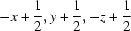
| Symmetry code: (i) −x+1/2, y+1/2, −z+1/2. |
Experimental details
| Crystal data | |
| Chemical formula | C14H9N3 |
| Mr | 219.24 |
| Crystal system, space group | Monoclinic, P21/n |
| Temperature (K) | 293 |
| a, b, c (Å) | 7.2172 (10), 11.818 (2), 12.719 (2) |
| β (°) | 92.057 (7) |
| V (Å3) | 1084.1 (3) |
| Z | 4 |
| Radiation type | Mo Kα |
| µ (mm−1) | 0.08 |
| Crystal size (mm) | 0.35 × 0.15 × 0.10 |
| Data collection | |
| Diffractometer | Rigaku Mercury2 (2x2 bin mode) diffractometer |
| Absorption correction | Multi-scan (CrystalClear; Rigaku, 2005) |
| Tmin, Tmax | 0.911, 1.000 |
| No. of measured, independent and observed [I > 2σ(I)] reflections | 11203, 2581, 2073 |
| Rint | 0.037 |
| (sin θ/λ)max (Å−1) | 0.658 |
| Refinement | |
| R[F2 > 2σ(F2)], wR(F2), S | 0.046, 0.118, 1.08 |
| No. of reflections | 2581 |
| No. of parameters | 159 |
| H-atom treatment | H atoms treated by a mixture of independent and constrained refinement |
| Δρmax, Δρmin (e Å−3) | 0.16, −0.17 |
Computer programs: CrystalClear (Rigaku, 2005), SHELXS97 (Sheldrick, 2008), SHELXL97 (Sheldrick, 2008), SHELXTL (Sheldrick, 2008).
| D—H···A | D—H | H···A | D···A | D—H···A |
| C13—H13A···N1 | 0.93 | 2.54 | 2.861 (2) | 100.7 |
| N2—H2A···N3i | 0.910 (17) | 2.14 (2) | 3.033 (2) | 169.1 (15) |
| Symmetry code: (i) −x+1/2, y+1/2, −z+1/2. |
Acknowledgements
This work was supported by a Start-up Grant from SEU to Professor Ren-Gen Xiong.
References
 Gallagher, J. F., Hanlon, K. & Howarth, J. (2001). Acta Cryst. C57, 1410–1414. Web of Science CSD CrossRef CAS IUCr Journals Google Scholar
Howarth, J. & Hanlon, K. (2001). Tetrahedron Lett. 42, 271–274. Google Scholar
Íkizler, A. A. & Sancak, K. (1992). Monatsh. Chem. 123, 257–263. Google Scholar
Kazak, C., Yilmaz, V. T., Goker, H. & Kus, C. (2006). Cryst. Res. Technol. 5, 528–532. Web of Science CSD CrossRef Google Scholar
Li, P., Scowen, I. J., Davies, J. E. & Halcrow, M. A. (1998). J. Chem. Soc. Dalton Trans. pp. 3791–3799. Web of Science CSD CrossRef Google Scholar
Rigaku (2005). CrystalClear. Rigaku Corporation, Tokyo, Japan. Google Scholar
Sheldrick, G. M. (2008). Acta Cryst. A64, 112–122. Web of Science CrossRef CAS IUCr Journals Google Scholar
This is an open-access article distributed under the terms of the Creative Commons Attribution (CC-BY) Licence, which permits unrestricted use, distribution, and reproduction in any medium, provided the original authors and source are cited.
| CRYSTALLOGRAPHIC COMMUNICATIONS |


Benzimidazole systems continue to attract much attention in chemical synthesis, structural science and applied biological research (Li et al., 1998; Gallagher et al., 2001; Howarth & Hanlon, 2001; Kazak et al., 2006). Nitriles are parent compounds for the preparation of various functional organic materials having triazole, imidazole or thidiazole moieties (Íkizler & Sancak, 1992) and their derivatives have found many industrial applications. We report here the crystal structure of the title compound, 4-(1H-benzo[d]imidazol-2-yl) benzonitrile.
The structural analysis shows that in the title compound (Fig. 1) the benzimidazole ring system and the phenyl ring are nearly coplanar, the dihedral angle they form being 3.87 (3)°. In the imidazole ring, the C7δb N1 bond length of 1.3191 (16) Å conforms to the value for a double bond. The molecular conformation is stabilized by an intramolecular C—H..N hydrogen bond (Table 1). In the crystal structure, molecules are linked into zig-zag chains running parallel to the b axis by intermolecular N—H···N hydrogen bonding interactions involving the protonated N atom of the imidazole ring as H-donor and the N atom of the nitrile group as acceptor.