 | Acta Crystallographica Section E Acta Crystallographica Section E CRYSTALLOGRAPHIC COMMUNICATIONS |


 journal menu


organic compounds
| CRYSTALLOGRAPHIC COMMUNICATIONS |
 access
8-Bromonaphthalen-1-amine

aDepartment of Chemistry, University of St Andrews, St Andrews KY16 9ST, Scotland
*Correspondence e-mail: [email protected]
The title compound, C10H8BrN, was obtained by slow addition of sodium azide to 8-bromo-1-naphthoic acid, followed by addition of aqueous ammonia. The crude product was crystallized from petroleum ether to give pink crystals. Compared to other 1,8-disubstituted naphthalene compounds, this compound exhibits less strain between the 1 and 8 substituents. Additionally, the NH protons form both intra- and intermolecular hydrogen bonds. The naphthalene units are arranged in a herring-bone stacking motif.
Related literature
For examples of sterically crowded 1,8 dichalcogen naphthalenes, see: Aucott et al. (2004![[Aucott, S. M., Milton, H. M., Robertson, S. D., Slawin, A. M. Z. & Woollins, J. D. (2004). Heteroatom. Chem. 15, 531-542.]](../../../../../../logos/arrows/e_arr.gif "Aucott, S. M., Milton, H. M., Robertson, S. D., Slawin, A. M. Z. & Woollins, J. D. (2004). Heteroatom. Chem. 15, 531-542.") ). For the synthesis, see: Herbert et al. (1987).
). For the synthesis, see: Herbert et al. (1987).
![[Scheme 1]](si2087scheme1.gif)
Experimental
Crystal data
|
Refinement
|
| ||||||||||||||||||||||
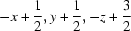 .
. Data collection: SCXmini (Rigaku/MSC, 2006); cell refinement: PROCESS-AUTO (Rigaku, 1998); data reduction: PROCESS-AUTO; program(s) used to solve structure: SHELXS97 (Sheldrick, 2008); program(s) used to refine structure: SHELXL97 (Sheldrick, 2008); molecular graphics: CrystalStructure (Rigaku/MSC, 2006); software used to prepare material for publication: CrystalStructure.
Supporting information
contains datablocks global, I. DOI: 10.1107/S1600536808012580/si2087sup1.cif
Structure factors: contains datablock I. DOI: 10.1107/S1600536808012580/si2087Isup2.hkl
The title compound was prepared by a method previously described (Herbert et al., 1987). Sodium azide (3.10 g, 0.048 mol) was added over a 10 minute period to a stirred suspension of 8-bromo-1-naphthoic acid (2.0 g, 0.008 mol) in concentrated sulfuric acid (7 ml) and chloroform (7 ml) at 45° C. Each successive portion of sodium azide being added after the effervescence resulting from the previous addition had subsided. The mixture was stirred for 90 minutes at 45°C and added to water (140 ml), and it was made alkaline with aqueous ammonia and extracted with chloroform (3 x 140 ml). The combined extracts were dried with magnesium sulfate and evaporated to give the desired product. Yield 1.30 g (73%). The black crude product was recrystallized from 60–80 petroleum ether to give pink crystals.
C7 was refined subject to an ISOR constraint. All H atoms were included in calculated positions (C—H distances are 0.95 Å, N—H distances are 0.98 Å) and were refined as riding atoms with Uiso(H) = 1.2 Ueq(parent carbon atom) The N—H protons were refined subject to a distance constraint but with a riding thermal parameter.
Refinement of F2 against ALL reflections. The weighted R-factor wR and goodness of fit S are based on F2, conventional R-factors R are based on F, with F set to zero for negative F2. The threshold expression of F2 > 2sigma(F2) is used only for calculating R-factors(gt) etc. and is not relevant to the choice of reflections for R-factors based on F2 are statistically about twice as large as those based on F, and R– factors based on ALL data will be even larger.
Data collection: SCXmini (Rigaku/MSC, 2006); cell PROCESS-AUTO (Rigaku, 1998); data reduction: PROCESS-AUTO (Rigaku, 1998); program(s) used to solve structure: SHELXS97 (Sheldrick, 2008); program(s) used to refine structure: SHELXL97 (Sheldrick, 2008); molecular graphics: CrystalStructure (Rigaku/MSC, 2006); software used to prepare material for publication: CrystalStructure (Rigaku/MSC, 2006).
![[Figure 1]](./si2087fig1thm.gif) | Fig. 1. The structure of the title compound with labelled atoms and with displacement ellipsoids for non-H atoms drawn at the 50% probability level. The intramolecular hydrogen bond is indicated by a dashed line. |
![[Figure 2]](./si2087fig2thm.gif) | Fig. 2. Packing diagram illustrating the intermolecular hydrogen bonding. |
| C10H8BrN | F(000) = 440.00 |
| Mr = 222.08 | Dx = 1.744 Mg m−3 |
| Monoclinic, P21/n | Melting point: 359 K |
| Hall symbol: -P 2yn | Mo Kα radiation, λ = 0.71075 Å |
| a = 13.6692 (14) Å | Cell parameters from 7235 reflections |
| b = 4.1579 (4) Å | θ = 3.0–27.6° |
| c = 15.8256 (16) Å | µ = 4.81 mm−1 |
| β = 109.941 (3)° | T = 125 K |
| V = 845.52 (15) Å3 | Prism, pink |
| Z = 4 | 0.35 × 0.13 × 0.09 mm |
| Rigaku SCXmini diffractometer | 1281 reflections with F2 > 2σ(F2) |
| Detector resolution: 6.85 pixels mm-1 | Rint = 0.061 |
| ω scans | θmax = 25.4° |
| Absorption correction: multi-scan (ABSCOR; Higashi, 1995) | h = −16→16 |
| Tmin = 0.381, Tmax = 0.649 | k = −5→5 |
| 6823 measured reflections | l = −19→19 |
| 1527 independent reflections |
| Refinement on F2 | 0 restraints |
| Least-squares matrix: full | H-atom parameters constrained |
| R[F2 > 2σ(F2)] = 0.051 | w = 1/[σ2(Fo2) + (0.0516P)2 + 2.4354P] where P = (Fo2 + 2Fc2)/3 |
| wR(F2) = 0.116 | (Δ/σ)max = 0.002 |
| S = 1.10 | Δρmax = 1.76 e Å−3 |
| 1527 reflections | Δρmin = −0.39 e Å−3 |
| 110 parameters |
| C10H8BrN | V = 845.52 (15) Å3 |
| Mr = 222.08 | Z = 4 |
| Monoclinic, P21/n | Mo Kα radiation |
| a = 13.6692 (14) Å | µ = 4.81 mm−1 |
| b = 4.1579 (4) Å | T = 125 K |
| c = 15.8256 (16) Å | 0.35 × 0.13 × 0.09 mm |
| β = 109.941 (3)° |
| Rigaku SCXmini diffractometer | 1527 independent reflections |
| Absorption correction: multi-scan (ABSCOR; Higashi, 1995) | 1281 reflections with F2 > 2σ(F2) |
| Tmin = 0.381, Tmax = 0.649 | Rint = 0.061 |
| 6823 measured reflections |
| R[F2 > 2σ(F2)] = 0.051 | 0 restraints |
| wR(F2) = 0.116 | H-atom parameters constrained |
| S = 1.10 | Δρmax = 1.76 e Å−3 |
| 1527 reflections | Δρmin = −0.39 e Å−3 |
| 110 parameters |
Geometry. All e.s.d.'s (except the e.s.d. in the dihedral angle between two l.s. planes) are estimated using the full covariance matrix. The cell e.s.d.'s are taken into account individually in the estimation of e.s.d.'s in distances, angles and torsion angles; correlations between e.s.d.'s in cell parameters are only used when they are defined by crystal symmetry. An approximate (isotropic) treatment of cell e.s.d.'s is used for estimating e.s.d.'s involving l.s. planes. |
| x | y | z | Uiso*/Ueq | ||
| Br(1) | 0.31174 (4) | 0.55948 (14) | 0.53932 (4) | 0.0293 (2) | |
| N(1) | 0.3079 (3) | 0.8778 (7) | 0.71320 (17) | 0.0237 (10) | |
| C(1) | 0.4427 (3) | 0.4617 (12) | 0.6330 (3) | 0.0198 (11) | |
| C(2) | 0.5076 (4) | 0.2842 (13) | 0.6015 (3) | 0.0257 (12) | |
| C(3) | 0.6037 (4) | 0.1842 (14) | 0.6610 (4) | 0.0304 (13) | |
| C(4) | 0.6321 (4) | 0.2554 (12) | 0.7494 (4) | 0.0274 (13) | |
| C(5) | 0.5666 (4) | 0.4409 (12) | 0.7842 (3) | 0.0224 (11) | |
| C(6) | 0.5988 (4) | 0.5102 (13) | 0.8776 (4) | 0.0349 (15) | |
| C(7) | 0.5414 (4) | 0.6701 (14) | 0.9140 (3) | 0.0263 (12) | |
| C(8) | 0.4419 (4) | 0.8017 (14) | 0.8560 (3) | 0.0314 (13) | |
| C(9) | 0.4054 (3) | 0.7493 (12) | 0.7623 (3) | 0.0206 (11) | |
| C(10) | 0.4667 (3) | 0.5569 (11) | 0.7240 (3) | 0.0157 (10) | |
| H(1a) | 0.2955 | 0.8886 | 0.6486 | 0.020* | |
| H(2a) | 0.4872 | 0.2298 | 0.5396 | 0.031* | |
| H(3a) | 0.6495 | 0.0651 | 0.6393 | 0.037* | |
| H(4a) | 0.6971 | 0.1804 | 0.7892 | 0.033* | |
| H(1b) | 0.2991 | 1.0681 | 0.7464 | 0.057* | |
| H(6a) | 0.6652 | 0.4367 | 0.9152 | 0.042* | |
| H(7a) | 0.5638 | 0.7006 | 0.9772 | 0.032* | |
| H(8a) | 0.4010 | 0.9253 | 0.8820 | 0.038* |
| U11 | U22 | U33 | U12 | U13 | U23 | |
| Br(1) | 0.0265 (3) | 0.0337 (3) | 0.0210 (3) | 0.0021 (2) | −0.0007 (2) | −0.0014 (2) |
| N(1) | 0.023 (2) | 0.020 (2) | 0.029 (2) | 0.0018 (19) | 0.011 (2) | −0.0008 (18) |
| C(1) | 0.018 (2) | 0.025 (2) | 0.014 (2) | −0.003 (2) | 0.003 (2) | 0.003 (2) |
| C(2) | 0.034 (3) | 0.021 (2) | 0.025 (3) | −0.001 (2) | 0.014 (2) | −0.001 (2) |
| C(3) | 0.027 (3) | 0.025 (3) | 0.046 (3) | 0.000 (2) | 0.021 (2) | −0.001 (2) |
| C(4) | 0.016 (2) | 0.016 (3) | 0.045 (3) | 0.000 (2) | 0.004 (2) | 0.010 (2) |
| C(5) | 0.020 (2) | 0.016 (2) | 0.026 (2) | −0.005 (2) | 0.001 (2) | 0.005 (2) |
| C(6) | 0.021 (2) | 0.022 (3) | 0.043 (3) | −0.009 (2) | −0.013 (2) | 0.016 (2) |
| C(7) | 0.0278 (14) | 0.0273 (15) | 0.0247 (14) | −0.0040 (9) | 0.0100 (9) | −0.0020 (9) |
| C(8) | 0.035 (3) | 0.026 (3) | 0.038 (3) | −0.012 (2) | 0.019 (2) | −0.010 (2) |
| C(9) | 0.024 (2) | 0.014 (3) | 0.026 (2) | −0.009 (2) | 0.011 (2) | −0.003 (2) |
| C(10) | 0.015 (2) | 0.014 (2) | 0.019 (2) | −0.005 (2) | 0.007 (2) | −0.0002 (19) |
| Br(1)—C(1) | 1.939 (4) | C(8)—C(9) | 1.410 (7) |
| N(1)—C(9) | 1.400 (5) | C(9)—C(10) | 1.435 (8) |
| C(1)—C(2) | 1.372 (8) | N(1)—H(1a) | 0.98 |
| C(1)—C(10) | 1.420 (7) | N(1)—H(1b) | 0.98 |
| C(2)—C(3) | 1.393 (7) | C(2)—H(2a) | 0.95 |
| C(3)—C(4) | 1.350 (8) | C(3)—H(3a) | 0.95 |
| C(4)—C(5) | 1.428 (8) | C(4)—H(4a) | 0.95 |
| C(5)—C(6) | 1.420 (8) | C(6)—H(6a) | 0.95 |
| C(5)—C(10) | 1.455 (6) | C(7)—H(7a) | 0.95 |
| C(6)—C(7) | 1.304 (9) | C(8)—H(8a) | 0.95 |
| C(7)—C(8) | 1.462 (7) | ||
| Br(1)—C(1)—C(2) | 112.2 (3) | C(5)—C(10)—C(9) | 117.4 (4) |
| Br(1)—C(1)—C(10) | 123.4 (4) | C(9)—N(1)—H(1a) | 113.0 |
| C(2)—C(1)—C(10) | 124.4 (4) | C(9)—N(1)—H(1b) | 106.2 |
| C(1)—C(2)—C(3) | 119.4 (5) | H(1a)—N(1)—H(1b) | 120.9 |
| C(2)—C(3)—C(4) | 120.5 (6) | C(1)—C(2)—H(2a) | 120.3 |
| C(3)—C(4)—C(5) | 121.4 (4) | C(3)—C(2)—H(2a) | 120.3 |
| C(4)—C(5)—C(6) | 119.9 (4) | C(2)—C(3)—H(3a) | 119.8 |
| C(4)—C(5)—C(10) | 119.9 (4) | C(4)—C(3)—H(3a) | 119.8 |
| C(6)—C(5)—C(10) | 120.2 (5) | C(3)—C(4)—H(4a) | 119.3 |
| C(5)—C(6)—C(7) | 123.0 (4) | C(5)—C(4)—H(4a) | 119.3 |
| C(6)—C(7)—C(8) | 118.9 (5) | C(5)—C(6)—H(6a) | 118.5 |
| C(7)—C(8)—C(9) | 121.5 (5) | C(7)—C(6)—H(6a) | 118.5 |
| N(1)—C(9)—C(8) | 117.0 (5) | C(6)—C(7)—H(7a) | 120.5 |
| N(1)—C(9)—C(10) | 124.1 (4) | C(8)—C(7)—H(7a) | 120.5 |
| C(8)—C(9)—C(10) | 118.8 (4) | C(7)—C(8)—H(8a) | 119.3 |
| C(1)—C(10)—C(5) | 114.4 (4) | C(9)—C(8)—H(8a) | 119.3 |
| C(1)—C(10)—C(9) | 128.2 (4) | ||
| Br(1)—C(1)—C(2)—C(3) | −177.8 (4) | C(4)—C(5)—C(10)—C(9) | −178.4 (5) |
| Br(1)—C(1)—C(10)—C(5) | 176.3 (3) | C(6)—C(5)—C(10)—C(1) | −178.0 (5) |
| Br(1)—C(1)—C(10)—C(9) | −3.7 (8) | C(6)—C(5)—C(10)—C(9) | 2.0 (7) |
| C(2)—C(1)—C(10)—C(5) | −2.0 (8) | C(10)—C(5)—C(6)—C(7) | 1.7 (9) |
| C(2)—C(1)—C(10)—C(9) | 178.0 (5) | C(5)—C(6)—C(7)—C(8) | −3.8 (9) |
| C(10)—C(1)—C(2)—C(3) | 0.6 (9) | C(6)—C(7)—C(8)—C(9) | 2.4 (9) |
| C(1)—C(2)—C(3)—C(4) | 1.3 (9) | C(7)—C(8)—C(9)—N(1) | 178.2 (5) |
| C(2)—C(3)—C(4)—C(5) | −1.6 (9) | C(7)—C(8)—C(9)—C(10) | 1.2 (8) |
| C(3)—C(4)—C(5)—C(6) | 179.7 (5) | N(1)—C(9)—C(10)—C(1) | 0.0 (8) |
| C(3)—C(4)—C(5)—C(10) | 0.1 (6) | N(1)—C(9)—C(10)—C(5) | −180.0 (4) |
| C(4)—C(5)—C(6)—C(7) | −177.9 (5) | C(8)—C(9)—C(10)—C(1) | 176.8 (5) |
| C(4)—C(5)—C(10)—C(1) | 1.6 (7) | C(8)—C(9)—C(10)—C(5) | −3.2 (7) |
| D—H···A | D—H | H···A | D···A | D—H···A |
| N1—H1a···Br1 | 0.98 | 2.27 | 3.070 (3) | 138 |
| N1—H1b···N1i | 0.98 | 2.20 | 3.073 (5) | 148 |
| Symmetry code: (i) −x+1/2, y+1/2, −z+3/2. |
Experimental details
| Crystal data | |
| Chemical formula | C10H8BrN |
| Mr | 222.08 |
| Crystal system, space group | Monoclinic, P21/n |
| Temperature (K) | 125 |
| a, b, c (Å) | 13.6692 (14), 4.1579 (4), 15.8256 (16) |
| β (°) | 109.941 (3) |
| V (Å3) | 845.52 (15) |
| Z | 4 |
| Radiation type | Mo Kα |
| µ (mm−1) | 4.81 |
| Crystal size (mm) | 0.35 × 0.13 × 0.09 |
| Data collection | |
| Diffractometer | Rigaku SCXmini diffractometer |
| Absorption correction | Multi-scan (ABSCOR; Higashi, 1995) |
| Tmin, Tmax | 0.381, 0.649 |
| No. of measured, independent and observed [F2 > 2σ(F2)] reflections | 6823, 1527, 1281 |
| Rint | 0.061 |
| (sin θ/λ)max (Å−1) | 0.602 |
| Refinement | |
| R[F2 > 2σ(F2)], wR(F2), S | 0.051, 0.116, 1.10 |
| No. of reflections | 1527 |
| No. of parameters | 110 |
| H-atom treatment | H-atom parameters constrained |
| Δρmax, Δρmin (e Å−3) | 1.76, −0.39 |
Computer programs: SCXmini (Rigaku/MSC, 2006), PROCESS-AUTO (Rigaku, 1998), SHELXS97 (Sheldrick, 2008), SHELXL97 (Sheldrick, 2008), CrystalStructure (Rigaku/MSC, 2006).
| D—H···A | D—H | H···A | D···A | D—H···A |
| N1—H1a···Br1 | 0.98 | 2.27 | 3.070 (3) | 138 |
| N1—H1b···N1i | 0.98 | 2.20 | 3.073 (5) | 148 |
| Symmetry code: (i) −x+1/2, y+1/2, −z+3/2. |
References
 Aucott, S. M., Milton, H. M., Robertson, S. D., Slawin, A. M. Z. & Woollins, J. D. (2004). Heteroatom. Chem. 15, 531–542. Web of Science CSD CrossRef Google Scholar
Herbert, J. M., Woodgate, P. D. & Denny, W. A. (1987). Heterocycles, 26, 1037–1041. CAS Google Scholar
Higashi, T. (1995). ABSCOR. Rigaku, Tokyo, Japan. Google Scholar
Rigaku (1998). PROCESS-AUTO. Rigaku Corporation, Tokyo, Japan. Google Scholar
Rigaku/MSC (2006). CrystalStructure and SCXmini Benchtop Crystallography System Software. Rigaku/MSC, The Woodlands, Texas, USA. Google Scholar
Sheldrick, G. M. (2008). Acta Cryst. A64, 112–122. Web of Science CrossRef CAS IUCr Journals Google Scholar
This is an open-access article distributed under the terms of the Creative Commons Attribution (CC-BY) Licence, which permits unrestricted use, distribution, and reproduction in any medium, provided the original authors and source are cited.
| CRYSTALLOGRAPHIC COMMUNICATIONS |


Contrary to the formally bonded (and sterically strained) S—S or Te—Te atoms in positions 1 and 8 in previous naphthalene compounds (Aucott et al., 2004), the title compound C10H8BrN exhibits a somewhat unstrained, intramolecular non-bonded Br1···N1 distance of 3.070 (3) Å. The molecular structure of the title compound is shown in Figure 1. An intramolecular hydrogen bonding interaction between the N1—H1a···Br1 enables a close nonbonding Br1···N1 distance and at the same time leaves the molecule relatively unstrained.
The other NH proton is involved in the intermolecular hydrogen bond (Table 1) N1—H1b···N1 and forms an infinite zigzag chain. These chains have normal hydrophobic contact to each other (Figure 2). The naphthalene units are arranged in a herringbone stacking motif.