 | Acta Crystallographica Section E Acta Crystallographica Section E CRYSTALLOGRAPHIC COMMUNICATIONS |


 journal menu


organic compounds
| CRYSTALLOGRAPHIC COMMUNICATIONS |
 access
4-Ammoniobenzamidinium dichloride

aInstitut Européen des Membranes, UMR 5635, CC 047 Université de Montpellier II, Montpellier, France
*Correspondence e-mail: [email protected]
The of the title compound, C7H11N32+·2Cl−, has been determined as part of a project focusing on the ability of the benzamidine system to form strong hydrogen bonds in aqueous media. It is commonly used as a ligand in affinity chromatography for purification and immobilization of enzymes. A twofold rotation axis runs along the axis of the cation. The orientation of the amidinium group with respect to the benzene ring is indicated by the N—C—C—C torsion angle of 40.2 (1)°. In the crystal structure, cations and anions are linked via hydrogen bonds. The chloride anion is surrounded by four ammonium cations in a tetrahedral environment. The aromatic rings of the amidinium cations are π-stacked, with a centroid–centroid distance of 4.178 (1) Å.
Related literature
For related literature, see: Boyd (1991![[Boyd, V. (1991). The Chemistry of Amidines and Imidates, Vol. 2, edited by S. Patai, pp. 339-366. New York: John Wiley.]](../../../../../../logos/arrows/e_arr.gif "Boyd, V. (1991). The Chemistry of Amidines and Imidates, Vol. 2, edited by S. Patai, pp. 339-366. New York: John Wiley.") ); Nguyen & Loung (1990); Jarak et al. (2005); Hranjec et al. (2003); Danan et al. (1997); Del Poeta, Schell, Dykstra, Jones, Tidwell, Czarny et al. (1998); Del Poeta, Schell, Dykstra, Jones, Tidwell, Kumar et al., (1998); Janiak (2000); Fujita et al. (1995); Müller et al. (2006); Kimata et al. (1990). For examples of related tubular superstructures, see: Barboiu et al. (2003); Blondeau et al. (2005).
); Nguyen & Loung (1990); Jarak et al. (2005); Hranjec et al. (2003); Danan et al. (1997); Del Poeta, Schell, Dykstra, Jones, Tidwell, Czarny et al. (1998); Del Poeta, Schell, Dykstra, Jones, Tidwell, Kumar et al., (1998); Janiak (2000); Fujita et al. (1995); Müller et al. (2006); Kimata et al. (1990). For examples of related tubular superstructures, see: Barboiu et al. (2003); Blondeau et al. (2005).
![[Scheme 1]](wn2252scheme1.gif)
Experimental
Crystal data
|
Refinement
|
|
 ; (ii)
  ; (iii)
  ; (iv)
  .
. Data collection: CrysAlis CCD (Oxford Diffraction, 2007); cell refinement: CrysAlis RED (Oxford Diffraction, 2007); data reduction: CrysAlis RED; program(s) used to solve structure: SIR2004 (Burla et al., 2003); program(s) used to refine structure: CRYSTALS (Betteridge et al., 2003); molecular graphics: CAMERON (Watkin et al., 1996) and Mercury (Macrae et al., 2006); software used to prepare material for publication: CRYSTALS.
Supporting information
contains datablocks global, I. DOI: 10.1107/S1600536808010179/wn2252sup1.cif
Structure factors: contains datablock I. DOI: 10.1107/S1600536808010179/wn2252Isup2.hkl
The title compound is commercially available. To purify it, it has been crystallized from a mixture of water and methanol (10:2). The crystals formed over a period of one week.
The H atoms, including those attached to nitrogen atoms, were all located in a difference map, and then repositioned geometrically. The H atoms were initially refined with soft restraints on the bond lengths and angles to regularize their geometry (C—H in the range 0.99-1.00, N—H = 0.85-0.94 Å) and Uiso(H) (in the range 1.3-1.8 times Ueq of the parent atom), after which the positions were refined with riding constraints.
Data collection: CrysAlis CCD (Oxford Diffraction, 2007); cell CrysAlis RED (Oxford Diffraction, 2007); data reduction: CrysAlis RED (Oxford Diffraction, 2007); program(s) used to solve structure: SIR2004 (Burla et al., 2003); program(s) used to refine structure: CRYSTALS (Betteridge et al., 2003); molecular graphics: CAMERON (Watkin et al., 1996) and Mercury (Macrae et al., 2006); software used to prepare material for publication: CRYSTALS (Betteridge et al., 2003).
![[Figure 1]](./wn2252fig1thm.gif) | Fig. 1. Representation of the structure of the title compound, with the numbering scheme adopted. The Cl atoms is light-green, the C atom green, the N atoms blue and the H atoms in grey. Displacement ellipsoids are drawn at the 50% probability level [symmetry code: (i) -x, y, -z + 3/2]. |
![[Figure 2]](./wn2252fig2thm.gif) | Fig. 2. The two-dimensional framework of the title compound, viewed down the a cell direction. |
![[Figure 3]](./wn2252fig3thm.gif) | Fig. 3. Representation of the hydrogen bonding network between the cations and the chloride anions, giving rise to a pyramidal scaffold architecture. Hydrogen bonds are denoted by dotted lines. |
| C7H11N32+·2Cl− | F(000) = 432 |
| Mr = 208.09 | Dx = 1.364 Mg m−3 |
| Monoclinic, C2/c | Mo Kα radiation, λ = 0.71073 Å |
| Hall symbol: -C 2yc | Cell parameters from 4424 reflections |
| a = 4.1779 (2) Å | θ = 4–32° |
| b = 20.9388 (10) Å | µ = 0.59 mm−1 |
| c = 11.6260 (5) Å | T = 175 K |
| β = 94.920 (4)° | Stick, colourless |
| V = 1013.30 (8) Å3 | 0.49 × 0.09 × 0.05 mm |
| Z = 4 |
| Oxford Diffraction XCALIBUR diffractometer | 1750 independent reflections |
| Radiation source: Enhance (Mo) X-ray Source | 1144 reflections with I > 2σ(I) |
| Graphite monochromator | Rint = 0.018 |
| Detector resolution: 16.0143 pixels mm-1 | θmax = 32.7°, θmin = 3.9° |
| ω scans | h = −5→6 |
| Absorption correction: multi-scan (CrysAlis RED; Oxford Diffraction, 2007); empirical (using intensity measurements) absorption correction using spherical harmonics, implemented in SCALE3 ABSPACK scaling algorithm | k = −31→29 |
| Tmin = 0.95, Tmax = 0.97 | l = −17→15 |
| 7752 measured reflections |
| Refinement on F | Primary atom site location: structure-invariant direct methods |
| Least-squares matrix: full | Hydrogen site location: inferred from neighbouring sites |
| R[F2 > 2σ(F2)] = 0.027 | H-atom parameters constrained |
| wR(F2) = 0.034 | Method, part 1, Chebychev polynomial [Watkin, D. J. (1994). Acta Cryst. A50, 411-437. Prince, E. (1982). Mathematical Techniques in Crystallography and Materials Science. New York: Springer-Verlag.] [weight] = 1.0/[A0*T0(x) + A1*T1(x) ··· + An-1]*Tn-1(x)] where Ai are the Chebychev coefficients listed below and x = F /Fmax Method = Robust Weighting (Prince, 1982) W = [weight] * [1-(deltaF/6*sigmaF)2]2 Ai are 20.0 -14.7 15.4 |
| S = 1.01 | (Δ/σ)max = 0.001 |
| 1144 reflections | Δρmax = 0.34 e Å−3 |
| 59 parameters | Δρmin = −0.20 e Å−3 |
| 2 restraints |
| C7H11N32+·2Cl− | V = 1013.30 (8) Å3 |
| Mr = 208.09 | Z = 4 |
| Monoclinic, C2/c | Mo Kα radiation |
| a = 4.1779 (2) Å | µ = 0.59 mm−1 |
| b = 20.9388 (10) Å | T = 175 K |
| c = 11.6260 (5) Å | 0.49 × 0.09 × 0.05 mm |
| β = 94.920 (4)° |
| Oxford Diffraction XCALIBUR diffractometer | 1750 independent reflections |
| Absorption correction: multi-scan (CrysAlis RED; Oxford Diffraction, 2007); empirical (using intensity measurements) absorption correction using spherical harmonics, implemented in SCALE3 ABSPACK scaling algorithm | 1144 reflections with I > 2σ(I) |
| Tmin = 0.95, Tmax = 0.97 | Rint = 0.018 |
| 7752 measured reflections |
| R[F2 > 2σ(F2)] = 0.027 | 2 restraints |
| wR(F2) = 0.034 | H-atom parameters constrained |
| S = 1.01 | Δρmax = 0.34 e Å−3 |
| 1144 reflections | Δρmin = −0.20 e Å−3 |
| 59 parameters |
| x | y | z | Uiso*/Ueq | Occ. (<1) | |
| Cl1 | 0.03602 (8) | 0.146532 (14) | 0.92627 (3) | 0.0297 | |
| N2 | 0.0839 (4) | 0.29292 (6) | 0.84632 (10) | 0.0380 | |
| C3 | 0.0000 | 0.32303 (8) | 0.7500 | 0.0271 | |
| C4 | 0.0000 | 0.39368 (8) | 0.7500 | 0.0236 | |
| C5 | −0.1109 (3) | 0.42664 (6) | 0.84251 (11) | 0.0282 | |
| C6 | −0.1138 (3) | 0.49282 (6) | 0.84200 (11) | 0.0296 | |
| C7 | 0.0000 | 0.52485 (8) | 0.7500 | 0.0264 | |
| N8 | 0.000000 (10) | 0.59418 (7) | 0.750000 (10) | 0.0381 | |
| H9 | 0.1600 | 0.3149 | 0.9089 | 0.0500* | |
| H10 | 0.0659 | 0.2491 | 0.8520 | 0.0500* | |
| H11 | −0.1867 | 0.4022 | 0.9091 | 0.0500* | |
| H12 | −0.1892 | 0.5181 | 0.9058 | 0.0500* | |
| H13 | 0.1342 | 0.6109 | 0.8006 | 0.0500* | 0.7500 |
| H14 | −0.1333 | 0.6116 | 0.8033 | 0.0500* | 0.7500 |
| U11 | U22 | U33 | U12 | U13 | U23 | |
| Cl1 | 0.04130 (17) | 0.02485 (14) | 0.02214 (13) | −0.00435 (13) | −0.00233 (9) | −0.00073 (11) |
| N2 | 0.0652 (9) | 0.0209 (5) | 0.0252 (5) | −0.0030 (5) | −0.0122 (5) | 0.0038 (4) |
| C3 | 0.0386 (9) | 0.0198 (7) | 0.0218 (7) | 0.0000 | −0.0043 (6) | 0.0000 |
| C4 | 0.0324 (9) | 0.0184 (6) | 0.0191 (6) | 0.0000 | −0.0030 (6) | 0.0000 |
| C5 | 0.0403 (7) | 0.0236 (5) | 0.0208 (5) | 0.0006 (5) | 0.0021 (4) | 0.0000 (4) |
| C6 | 0.0379 (7) | 0.0238 (6) | 0.0265 (5) | 0.0036 (5) | −0.0011 (4) | −0.0043 (4) |
| C7 | 0.0275 (8) | 0.0180 (6) | 0.0319 (8) | 0.0000 | −0.0074 (6) | 0.0000 |
| N8 | 0.0296 (8) | 0.0177 (7) | 0.0651 (12) | 0.0000 | −0.0072 (8) | 0.0000 |
| N2—C3 | 1.3064 (13) | C6—C7 | 1.3810 (16) |
| N2—H9 | 0.896 | C6—H12 | 0.985 |
| N2—H10 | 0.923 | C7—N8 | 1.452 (2) |
| C3—C4 | 1.479 (2) | N8—H14i | 0.942 |
| C4—C5 | 1.3904 (15) | N8—H13i | 0.852 |
| C5—C6 | 1.3859 (18) | N8—H13 | 0.852 |
| C5—H11 | 1.002 | N8—H14 | 0.942 |
| C3—N2—H9 | 120.0 | C6—C7—N8 | 119.05 (8) |
| C3—N2—H10 | 121.5 | C6i—C7—N8 | 119.05 (8) |
| H9—N2—H10 | 118.5 | C7—N8—H14i | 112.8 |
| N2—C3—N2i | 122.30 (16) | C7—N8—H13i | 114.3 |
| N2—C3—C4 | 118.85 (8) | H14i—N8—H13i | 77.2 |
| C3—C4—C5 | 119.75 (8) | C7—N8—H13 | 114.3 |
| C5i—C4—C5 | 120.49 (16) | H14i—N8—H13 | 84.5 |
| C4—C5—C6 | 119.76 (13) | H13i—N8—H13 | 131.5 |
| C4—C5—H11 | 119.5 | C7—N8—H14 | 112.8 |
| C6—C5—H11 | 120.7 | H14i—N8—H14 | 134.3 |
| C5—C6—C7 | 119.04 (13) | H13i—N8—H14 | 84.5 |
| C5—C6—H12 | 122.5 | H13—N8—H14 | 77.2 |
| C7—C6—H12 | 118.5 | ||
| C(4)—C(5)—C(6)—C(7) | −1.2 (1) | C(5)—C(6)—C(7)—N(8) | −179.4 (1) |
| C(5)—C(4)—C(3)—N(2) | −40.2 (1) |
| Symmetry code: (i) −x, y, −z+3/2. |
| D—H···A | D—H | H···A | D···A | D—H···A |
| N2—H9···Cl1ii | 0.90 | 2.35 | 3.2247 (13) | 166 |
| N2—H10···Cl1 | 0.92 | 2.32 | 3.2142 (13) | 162 |
| N8—H13···Cl1iii | 0.85 | 2.26 | 3.1031 (6) | 173 |
| N8—H14···Cl1iv | 0.94 | 2.20 | 3.1369 (6) | 176 |
| C5—H11···Cl1v | 1.00 | 2.70 | 3.6806 (13) | 165 |
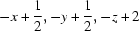
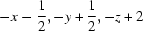
| Symmetry codes: (ii) −x+1/2, −y+1/2, −z+2; (iii) x+1/2, y+1/2, z; (iv) x−1/2, y+1/2, z; (v) −x−1/2, −y+1/2, −z+2. |
Experimental details
| Crystal data | |
| Chemical formula | C7H11N32+·2Cl− |
| Mr | 208.09 |
| Crystal system, space group | Monoclinic, C2/c |
| Temperature (K) | 175 |
| a, b, c (Å) | 4.1779 (2), 20.9388 (10), 11.6260 (5) |
| β (°) | 94.920 (4) |
| V (Å3) | 1013.30 (8) |
| Z | 4 |
| Radiation type | Mo Kα |
| µ (mm−1) | 0.59 |
| Crystal size (mm) | 0.49 × 0.09 × 0.05 |
| Data collection | |
| Diffractometer | Oxford Diffraction XCALIBUR diffractometer |
| Absorption correction | Multi-scan (CrysAlis RED; Oxford Diffraction, 2007); empirical (using intensity measurements) absorption correction using spherical harmonics, implemented in SCALE3 ABSPACK scaling algorithm |
| Tmin, Tmax | 0.95, 0.97 |
| No. of measured, independent and observed [I > 2σ(I)] reflections | 7752, 1750, 1144 |
| Rint | 0.018 |
| (sin θ/λ)max (Å−1) | 0.759 |
| Refinement | |
| R[F2 > 2σ(F2)], wR(F2), S | 0.027, 0.034, 1.01 |
| No. of reflections | 1144 |
| No. of parameters | 59 |
| No. of restraints | 2 |
| H-atom treatment | H-atom parameters constrained |
| Δρmax, Δρmin (e Å−3) | 0.34, −0.20 |
Computer programs: CrysAlis CCD (Oxford Diffraction, 2007), CrysAlis RED (Oxford Diffraction, 2007), SIR2004 (Burla et al., 2003), CRYSTALS (Betteridge et al., 2003), CAMERON (Watkin et al., 1996) and Mercury (Macrae et al., 2006).
| D—H···A | D—H | H···A | D···A | D—H···A |
| N2—H9···Cl1i | 0.90 | 2.35 | 3.2247 (13) | 166 |
| N2—H10···Cl1 | 0.92 | 2.32 | 3.2142 (13) | 162 |
| N8—H13···Cl1ii | 0.85 | 2.26 | 3.1031 (6) | 173 |
| N8—H14···Cl1iii | 0.94 | 2.20 | 3.1369 (6) | 176 |
| C5—H11···Cl1iv | 1.00 | 2.70 | 3.6806 (13) | 165 |
| Symmetry codes: (i) −x+1/2, −y+1/2, −z+2; (ii) x+1/2, y+1/2, z; (iii) x−1/2, y+1/2, z; (iv) −x−1/2, −y+1/2, −z+2. |
Acknowledgements
This work, conducted as part of the award `Dynamic Adaptive Materials for Separation and Sensing Microsystems' (to MB) made under the European Heads of Research Councils and European Science Foundation EURYI (European Young Investigator) Awards Scheme in 2004, was supported by funds from the Participating Organizations of EURYI and the EC Sixth Framework Program (see http://www.esf.org/euryi ). This research was also supported in part by the CNRS and the University of Montpellier II.
References
 Barboiu, M., Vaughan, G. & van der Lee, A. (2003). Org. Lett. 5, 3073–3076. Web of Science CSD CrossRef PubMed CAS Google Scholar
Betteridge, P. W., Carruthers, J. R., Cooper, R. I., Prout, K. & Watkin, D. J. (2003). J. Appl. Cryst. 36, 1487. Web of Science CrossRef IUCr Journals Google Scholar
Blondeau, P., van der Lee, A. & Barboiu, M. (2005). Inorg. Chem. 44, 5649–5653. Web of Science CSD CrossRef PubMed CAS Google Scholar
Boyd, V. (1991). The Chemistry of Amidines and Imidates, Vol. 2, edited by S. Patai, pp. 339–366. New York: John Wiley. Google Scholar
Burla, M. C., Camalli, M., Carrozzini, B., Cascarano, G. L., Giacovazzo, C., Polidori, G. & Spagna, R. (2003). J. Appl. Cryst. 36, 1103. CrossRef IUCr Journals Google Scholar
Danan, A., Charon, D., Kirkiacharian, S., Bories, K. & Loiseau, P. M. (1997). Farmaco, 52, 227–229. CAS PubMed Web of Science Google Scholar
Del Poeta, M., Schell, W. A., Dykstra, C. C., Jones, S. K., Tidwell, R. R., Czarny, A., Bajić, M., Kumar, A., Boykin, D. W. & Perfect, J. R. (1998). Antimicrob. Agents Chemother. 42, 2495–2502. Web of Science CAS PubMed Google Scholar
Del Poeta, M., Schell, W. A., Dykstra, C. C., Jones, S. K., Tidwell, R. R., Kumar, A., Boykin, D. W. & Perfect, J. R. (1998). Antimicrob. Agents Chemother. 42, 2503–2510. Web of Science CAS PubMed Google Scholar
Fujita, M., Oguro, D., Miyazawa, M., Oka, H., Yamaguchi, K. & Ogura, K. (1995). Nature (London), 378, 469–471. CSD CrossRef CAS Web of Science Google Scholar
Hranjec, M., Grdisa, M., Pavelić, K., Boykin, D. W. & Karminski-Zamola, G. (2003). Farmaco, 58, 1319–1324. CrossRef PubMed CAS Google Scholar
Janiak, C. (2000). J. Chem. Soc. Dalton Trans. pp. 3885–3896. Web of Science CrossRef Google Scholar
Jarak, I., Karminski-Zamola, G., Pavlović, G. & Popović, Z. (2005). Acta Cryst. C61, o98–o100. Web of Science CSD CrossRef CAS IUCr Journals Google Scholar
Kimata, K., Tsuboi, R., Hosoya, K., Tanaka, N. & Araki, T. (1990). J. Chromatogr. A, 515, 73–84. CrossRef CAS Web of Science Google Scholar
Macrae, C. F., Edgington, P. R., McCabe, P., Pidcock, E., Shields, G. P., Taylor, R., Towler, M. & van de Streek, J. (2006). J. Appl. Cryst. 39, 453–457. Web of Science CrossRef CAS IUCr Journals Google Scholar
Müller, A., Zhou, Y. S., Bogge, H., Schmidtmann, M., Mitra, T., Haupt, E. T. K. & Berkle, A. (2006). Angew. Chem. Int. Ed. 45, 460–465. Google Scholar
Nguyen, A. L. & Loung, J. H. T. (1990). Enzyme Microb. Technol. 12, 663–668. CrossRef PubMed CAS Web of Science Google Scholar
Oxford Diffraction (2007). CrysAlis CCD and CrysAlis RED. Oxford Diffraction Ltd, Abingdon, Oxfordshire, England. Google Scholar
Watkin, D. J., Prout, C. K. & Pearce, L. J. (1996). CAMERON. Chemical Crystallography Laboratory, Oxford, England. Google Scholar
This is an open-access article distributed under the terms of the Creative Commons Attribution (CC-BY) Licence, which permits unrestricted use, distribution, and reproduction in any medium, provided the original authors and source are cited.
| CRYSTALLOGRAPHIC COMMUNICATIONS |


Several types of heteroditopic receptors, including the title compound, are being used in our group as bricks for supramolecular construction (Barboiu et al., 2003, Blondeau et al., 2005). Among other functions, amidine compounds have shown antiparasitic (Danan et al., 1997) and antifungal activity (Del Poeta, Schell, Dykstra, Jones, Tidwell, Czarny et al., 1998; Del Poeta, Schell, Dykstra, Jones, Tidwell, Kumar et al., 1998). Indeed, this class of compounds has been widely studied for its biological activities. Surprisingly, only one crystal structure of an aminobenzamidine derivative has been published so far (Jarak et al., 2005). Our project deals with the construction of supramolecular architectures based on hydrogen bonding in aqueous media. This is possible due to the strength of the bonds formed between the very electrophilic amidinium unit and the nucleophilic character of acids, for example. Superstructures made of co-crystals have been designed and surprising results have been achieved by Fujita et al. (1995) and Müller et al. (2006). The amidine group also forms a well recognized class of anticancer compounds (Boyd, 1991, Hranjec et al., 2003) and, based on the same properties, can also be used as ligands in affinity chromatography to immobilize enzymes (Nguyen & Loung, 1990 and Kimata et al., 1990).
The molecule of the title compound (Fig. 1) is not planar. The amidinium group has a synclinal disposition with respect to the benzene ring (N2—C3—C4—C5 = -40.2 (1)°). A twofold rotation axis runs along the axis of the cation. The observed deviation from coplanarity might serve to accommodate the formation of intermolecular hydrogen bonds with chloride ions. The three ammonium protons are free to rotate about the C7—N8 bond. These protons were found by Fourier difference maps at four positions (2 + 2 by symmetry) which appears to be in line with the four chloride anions surrounding the ammonium group (N···Cl = 3.103 Å). The site occupation factors of the four ammonium protons was set at 0.75, as there are, in fact, only three protons attached to this ammonium nitrogen. As Fig. 2 shows, rows of head-to-tail benzamidine are stacked alternately. Interestingly, three of four nitrogen atoms form a plane on which the chloride atom sits, almost perfectly. Each chloride anion is bound to four nitrogen cations by weak hydrogen bonds (N···Cl = 3.103 (1)–3.225 (1) Å), while each amidinium unit is bound to eight chloride anions (four times through the ammonium site, twice through each amidinium nitrogen). This produces a singular pyramidal architecture, as depicted in Fig. 3. The packing is determined by these hydrogen bonds, but also by π-stacking. The aromatic rings of the amidinium cations adopt a parallel offset conformation. The distance Cg···Cg between the centroids of two adjacent rings is 4.178 (1) Å, whereas the angle between the ring-centroid vector and the ring normal of one of the amidine rings is 27.7 (1)° (with a perpendicular interplanar distance of 3.7 Å). The angle between the two benzene rings is 0.02°. These values can be considered to be normal for π-π interactions (Janiak, 2000). Fig. 3 also shows both the hydrogen bonding pattern and the interactions between the aromatic groups held together by π-π non-covalent intermolecular interactions.