 | Acta Crystallographica Section E Acta Crystallographica Section E CRYSTALLOGRAPHIC COMMUNICATIONS |


 journal menu


organic compounds
| CRYSTALLOGRAPHIC COMMUNICATIONS |
 access
6-Deoxy-α-L-talopyranose

aDepartment of Organic Chemistry, Chemical Research Laboratory, University of Oxford, Mansfield Road, Oxford, OX1 3TA, England, bRare Sugar Research Centre, Kagawa University, 2393 Miki-cho, Kita-gun, Kagawa 761-0795, Japan, and cDepartment of Chemical Crystallography, Chemical Research Laboratory, University of Oxford, Mansfield Road, Oxford, OX1 3TA, England
*Correspondence e-mail: [email protected]
X-ray crystallography showed that the title compound, C6H12O5, crystallizes in the α-pyranose form with the six-membered ring in a chair conformation. The crystal structure exists as a three-dimensional hydrogen-bonded network of molecules with each molecule acting as a donor and aceptor for four hydrogen bonds. The absolute configuration was determined by the use of L-fucose as starting material.
Related literature
For related literature, see: Beadle et al. (1992![[Beadle, J. R., Saunders, J. P. & Wajda, T. J. (1992). US Patent 5 078 796.]](../../../../../../logos/arrows/e_arr.gif "Beadle, J. R., Saunders, J. P. & Wajda, T. J. (1992). US Patent 5 078 796.") ); Izumori (2002, 2006); Granstrom et al. (2004); Yoshihara et al. (2008).
); Izumori (2002, 2006); Granstrom et al. (2004); Yoshihara et al. (2008).
![[Scheme 1]](lh2652scheme1.gif)
Experimental
Crystal data
|
Refinement
|
| ||||||||||||||||||||||||||||||||
 ; (ii)
  .
. Data collection: COLLECT (Nonius, 1997–2001).; cell refinement: DENZO/SCALEPACK (Otwinowski & Minor, 1997); data reduction: DENZO/SCALEPACK; program(s) used to solve structure: SIR92 (Altomare et al., 1994); program(s) used to refine structure: CRYSTALS (Betteridge et al., 2003); molecular graphics: CAMERON (Watkin et al., 1996); software used to prepare material for publication: CRYSTALS.
Supporting information
contains datablocks global, I. DOI: 10.1107/S1600536808019582/lh2652sup1.cif
Structure factors: contains datablock I. DOI: 10.1107/S1600536808019582/lh2652Isup2.hkl
The title compound was recrystallized from methanol: m.p. 120–123°C; [α]D20 -18.6 (c, 0.94 in H2O).
In the absence of significant Friedel pairs were merged and the was assigned from the starting material.
The H atoms were all located in a difference map, but those attached to carbon atoms were repositioned geometrically. The H atoms were initially refined with soft restraints on the bond lengths and angles to regularize their geometry (C—H in the range 0.93–0.98, O—H = 0.82 Å) and Uiso(H) (in the range 1.2–1.5 times Ueq of the parent atom), after which the positions were refined with riding constraints.
Data collection: COLLECT (Nonius, 1997-2001).; cell DENZO/SCALEPACK (Otwinowski & Minor, 1997); data reduction: DENZO/SCALEPACK (Otwinowski & Minor, 1997); program(s) used to solve structure: SIR92 (Altomare et al., 1994); program(s) used to refine structure: CRYSTALS (Betteridge et al., 2003); molecular graphics: CAMERON (Watkin et al., 1996); software used to prepare material for publication: CRYSTALS (Betteridge et al., 2003).
![[Figure 1]](./lh2652fig1thm.gif) | Fig. 1. Synthetic scheme. |
![[Figure 2]](./lh2652fig2thm.gif) | Fig. 2. The title compound with displacement ellipsoids drawn at the 50% probability level. H atoms are shown as spheres of arbitary radius. |
![[Figure 3]](./lh2652fig3thm.gif) | Fig. 3. Packing diagram of the title compound projected along the a-axis. |
| C6H12O5 | F(000) = 352 |
| Mr = 164.16 | Dx = 1.511 Mg m−3 |
| Orthorhombic, P212121 | Mo Kα radiation, λ = 0.71073 Å |
| Hall symbol: P 2ac 2ab | Cell parameters from 890 reflections |
| a = 6.4939 (3) Å | θ = 5–27° |
| b = 7.4874 (4) Å | µ = 0.13 mm−1 |
| c = 14.8382 (8) Å | T = 150 K |
| V = 721.47 (6) Å3 | Plate, colourless |
| Z = 4 | 0.25 × 0.25 × 0.02 mm |
| Nonius KappaCCD diffractometer | 863 reflections with I > 2.0σ(I) |
| Graphite monochromator | Rint = 0.037 |
| ω scans | θmax = 27.5°, θmin = 5.2° |
| Absorption correction: multi-scan DENZO/SCALEPACK (Otwinowski & Minor, 1997) | h = −8→8 |
| Tmin = 0.97, Tmax = 1.00 | k = −9→9 |
| 4390 measured reflections | l = −19→19 |
| 968 independent reflections |
| Refinement on F2 | Primary atom site location: structure-invariant direct methods |
| Least-squares matrix: full | Hydrogen site location: inferred from neighbouring sites |
| R[F2 > 2σ(F2)] = 0.029 | H-atom parameters constrained |
| wR(F2) = 0.072 | Method = Modified Sheldrick w = 1/[σ2(F2) + ( 0.04P)2 + 0.04P] , where P = (max(Fo2,0) + 2Fc2)/3 |
| S = 1.03 | (Δ/σ)max = 0.000184 |
| 968 reflections | Δρmax = 0.24 e Å−3 |
| 100 parameters | Δρmin = −0.21 e Å−3 |
| 0 restraints |
| C6H12O5 | V = 721.47 (6) Å3 |
| Mr = 164.16 | Z = 4 |
| Orthorhombic, P212121 | Mo Kα radiation |
| a = 6.4939 (3) Å | µ = 0.13 mm−1 |
| b = 7.4874 (4) Å | T = 150 K |
| c = 14.8382 (8) Å | 0.25 × 0.25 × 0.02 mm |
| Nonius KappaCCD diffractometer | 968 independent reflections |
| Absorption correction: multi-scan DENZO/SCALEPACK (Otwinowski & Minor, 1997) | 863 reflections with I > 2.0σ(I) |
| Tmin = 0.97, Tmax = 1.00 | Rint = 0.037 |
| 4390 measured reflections |
| R[F2 > 2σ(F2)] = 0.029 | 0 restraints |
| wR(F2) = 0.072 | H-atom parameters constrained |
| S = 1.03 | Δρmax = 0.24 e Å−3 |
| 968 reflections | Δρmin = −0.21 e Å−3 |
| 100 parameters |
| x | y | z | Uiso*/Ueq | ||
| O1 | 0.95002 (16) | 0.08900 (18) | 0.35376 (7) | 0.0210 | |
| C2 | 0.7416 (2) | 0.1250 (2) | 0.32982 (10) | 0.0175 | |
| C3 | 0.6113 (3) | 0.1509 (3) | 0.41551 (10) | 0.0188 | |
| O4 | 0.65011 (17) | 0.31964 (16) | 0.45740 (7) | 0.0183 | |
| C5 | 0.6150 (2) | 0.4717 (2) | 0.39897 (10) | 0.0194 | |
| C6 | 0.6412 (3) | 0.6382 (3) | 0.45454 (12) | 0.0271 | |
| C7 | 0.7657 (2) | 0.4593 (2) | 0.32003 (10) | 0.0187 | |
| C8 | 0.7208 (2) | 0.2889 (3) | 0.26846 (10) | 0.0186 | |
| O9 | 0.85143 (18) | 0.26675 (18) | 0.19178 (7) | 0.0243 | |
| O10 | 0.97297 (17) | 0.45445 (18) | 0.35319 (8) | 0.0232 | |
| O11 | 0.40458 (18) | 0.1333 (2) | 0.39115 (8) | 0.0254 | |
| H21 | 0.6937 | 0.0193 | 0.2985 | 0.0197* | |
| H31 | 0.6474 | 0.0567 | 0.4621 | 0.0197* | |
| H51 | 0.4756 | 0.4675 | 0.3773 | 0.0236* | |
| H61 | 0.6179 | 0.7441 | 0.4188 | 0.0406* | |
| H62 | 0.5480 | 0.6346 | 0.5057 | 0.0398* | |
| H63 | 0.7791 | 0.6452 | 0.4743 | 0.0401* | |
| H71 | 0.7508 | 0.5628 | 0.2786 | 0.0214* | |
| H81 | 0.5761 | 0.2938 | 0.2475 | 0.0221* | |
| H7 | 0.8826 | 0.3664 | 0.1753 | 0.0374* | |
| H8 | 0.9866 | 0.1914 | 0.3632 | 0.0333* | |
| H10 | 1.0243 | 0.5538 | 0.3399 | 0.0350* | |
| H1 | 0.3258 | 0.1436 | 0.4383 | 0.0408* |
| U11 | U22 | U33 | U12 | U13 | U23 | |
| O1 | 0.0198 (5) | 0.0204 (7) | 0.0229 (6) | 0.0030 (5) | −0.0010 (5) | −0.0005 (5) |
| C2 | 0.0184 (7) | 0.0188 (9) | 0.0153 (7) | −0.0001 (8) | −0.0013 (6) | −0.0015 (6) |
| C3 | 0.0209 (8) | 0.0186 (9) | 0.0169 (7) | −0.0037 (7) | 0.0005 (6) | −0.0021 (7) |
| O4 | 0.0223 (5) | 0.0178 (7) | 0.0150 (5) | −0.0008 (5) | −0.0006 (5) | 0.0007 (5) |
| C5 | 0.0220 (8) | 0.0184 (9) | 0.0179 (7) | 0.0019 (8) | −0.0015 (7) | 0.0002 (7) |
| C6 | 0.0378 (10) | 0.0202 (10) | 0.0232 (8) | 0.0022 (9) | 0.0025 (9) | −0.0040 (7) |
| C7 | 0.0183 (7) | 0.0202 (9) | 0.0176 (7) | 0.0031 (7) | 0.0006 (7) | 0.0029 (7) |
| C8 | 0.0197 (7) | 0.0212 (10) | 0.0149 (7) | 0.0011 (7) | 0.0013 (6) | −0.0005 (7) |
| O9 | 0.0335 (6) | 0.0213 (7) | 0.0180 (5) | 0.0043 (6) | 0.0087 (5) | 0.0025 (5) |
| O10 | 0.0195 (5) | 0.0195 (7) | 0.0306 (6) | −0.0026 (5) | −0.0015 (5) | 0.0023 (6) |
| O11 | 0.0199 (5) | 0.0331 (8) | 0.0233 (5) | −0.0074 (6) | 0.0028 (5) | −0.0047 (6) |
| O1—C2 | 1.4250 (19) | C6—H61 | 0.966 |
| O1—H8 | 0.815 | C6—H62 | 0.971 |
| C2—C3 | 1.540 (2) | C6—H63 | 0.944 |
| C2—C8 | 1.534 (2) | C7—C8 | 1.516 (2) |
| C2—H21 | 0.969 | C7—O10 | 1.4334 (19) |
| C3—O4 | 1.430 (2) | C7—H71 | 0.994 |
| C3—O11 | 1.3965 (19) | C8—O9 | 1.4288 (18) |
| C3—H31 | 1.015 | C8—H81 | 0.990 |
| O4—C5 | 1.449 (2) | O9—H7 | 0.811 |
| C5—C6 | 1.504 (2) | O10—H10 | 0.839 |
| C5—C7 | 1.529 (2) | O11—H1 | 0.870 |
| C5—H51 | 0.962 | ||
| C2—O1—H8 | 98.1 | C5—C6—H62 | 109.6 |
| O1—C2—C3 | 109.88 (12) | H61—C6—H62 | 110.8 |
| O1—C2—C8 | 112.50 (13) | C5—C6—H63 | 108.9 |
| C3—C2—C8 | 109.93 (14) | H61—C6—H63 | 105.9 |
| O1—C2—H21 | 105.7 | H62—C6—H63 | 110.5 |
| C3—C2—H21 | 108.8 | C5—C7—C8 | 108.34 (14) |
| C8—C2—H21 | 109.9 | C5—C7—O10 | 109.84 (12) |
| C2—C3—O4 | 111.93 (14) | C8—C7—O10 | 109.43 (14) |
| C2—C3—O11 | 107.62 (12) | C5—C7—H71 | 111.3 |
| O4—C3—O11 | 111.43 (15) | C8—C7—H71 | 109.0 |
| C2—C3—H31 | 110.4 | O10—C7—H71 | 108.9 |
| O4—C3—H31 | 106.1 | C2—C8—C7 | 110.89 (12) |
| O11—C3—H31 | 109.4 | C2—C8—O9 | 109.12 (13) |
| C3—O4—C5 | 113.97 (11) | C7—C8—O9 | 112.67 (13) |
| O4—C5—C6 | 107.79 (12) | C2—C8—H81 | 107.4 |
| O4—C5—C7 | 108.05 (13) | C7—C8—H81 | 108.0 |
| C6—C5—C7 | 113.45 (14) | O9—C8—H81 | 108.5 |
| O4—C5—H51 | 108.8 | C8—O9—H7 | 106.4 |
| C6—C5—H51 | 108.5 | C7—O10—H10 | 105.7 |
| C7—C5—H51 | 110.1 | C3—O11—H1 | 110.4 |
| C5—C6—H61 | 111.2 |
| D—H···A | D—H | H···A | D···A | D—H···A |
| O9—H7···O1i | 0.81 | 2.04 | 2.818 (2) | 162 |
| O1—H8···C7 | 0.82 | 2.55 | 3.061 (2) | 122 |
| O1—H8···O10 | 0.82 | 1.98 | 2.740 (2) | 156 |
| O10—H10···O9i | 0.84 | 1.85 | 2.686 (2) | 177 |
| O11—H1···O4ii | 0.87 | 1.94 | 2.812 (2) | 177 |
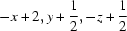
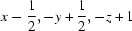
| Symmetry codes: (i) −x+2, y+1/2, −z+1/2; (ii) x−1/2, −y+1/2, −z+1. |
Experimental details
| Crystal data | |
| Chemical formula | C6H12O5 |
| Mr | 164.16 |
| Crystal system, space group | Orthorhombic, P212121 |
| Temperature (K) | 150 |
| a, b, c (Å) | 6.4939 (3), 7.4874 (4), 14.8382 (8) |
| V (Å3) | 721.47 (6) |
| Z | 4 |
| Radiation type | Mo Kα |
| µ (mm−1) | 0.13 |
| Crystal size (mm) | 0.25 × 0.25 × 0.02 |
| Data collection | |
| Diffractometer | Nonius KappaCCD diffractometer |
| Absorption correction | Multi-scan DENZO/SCALEPACK (Otwinowski & Minor, 1997) |
| Tmin, Tmax | 0.97, 1.00 |
| No. of measured, independent and observed [I > 2.0σ(I)] reflections | 4390, 968, 863 |
| Rint | 0.037 |
| (sin θ/λ)max (Å−1) | 0.649 |
| Refinement | |
| R[F2 > 2σ(F2)], wR(F2), S | 0.029, 0.072, 1.03 |
| No. of reflections | 968 |
| No. of parameters | 100 |
| H-atom treatment | H-atom parameters constrained |
| Δρmax, Δρmin (e Å−3) | 0.24, −0.21 |
Computer programs: COLLECT (Nonius, 1997-2001)., DENZO/SCALEPACK (Otwinowski & Minor, 1997), SIR92 (Altomare et al., 1994), CRYSTALS (Betteridge et al., 2003), CAMERON (Watkin et al., 1996).
| D—H···A | D—H | H···A | D···A | D—H···A |
| O9—H7···O1i | 0.81 | 2.04 | 2.818 (2) | 162 |
| O1—H8···O10 | 0.82 | 1.98 | 2.740 (2) | 156 |
| O10—H10···O9i | 0.84 | 1.85 | 2.686 (2) | 177 |
| O11—H1···O4ii | 0.87 | 1.94 | 2.812 (2) | 177 |
| Symmetry codes: (i) −x+2, y+1/2, −z+1/2; (ii) x−1/2, −y+1/2, −z+1. |
Acknowledgements
We gratefully acknowledge the Oxford University Chemical Crystallography service for use of the instruments. This work was supported in part by the Program for Promotion of Basic Research Activities for Innovative Biosciences (PROBRAIN).
References
 Altomare, A., Cascarano, G., Giacovazzo, C., Guagliardi, A., Burla, M. C., Polidori, G. & Camalli, M. (1994). J. Appl. Cryst. 27, 435. CrossRef Web of Science IUCr Journals Google Scholar
Beadle, J. R., Saunders, J. P. & Wajda, T. J. (1992). US Patent 5 078 796. Google Scholar
Betteridge, P. W., Carruthers, J. R., Cooper, R. I., Prout, K. & Watkin, D. J. (2003). J. Appl. Cryst. 36, 1487. Web of Science CrossRef IUCr Journals Google Scholar
Granstrom, T. B., Takata, G., Tokuda, M. & Izumori, K. (2004). J. Biosci. Bioeng. 97, 89–94. Web of Science CrossRef PubMed Google Scholar
Izumori, K. (2002). Naturwissenschaften, 89, 120–124. Web of Science CrossRef PubMed CAS Google Scholar
Izumori, K. (2006). J. Biotech. 124, 717–722. Web of Science CrossRef CAS Google Scholar
Nonius (1997–2001). COLLECT. Nonius BV, Delft, The Netherlands. Google Scholar
Otwinowski, Z. & Minor, W. (1997). Methods in Enzymology, Vol. 276, Macromolecular Crystallography, Part A, edited by C. W. Carter Jr & R. M. Sweet, pp. 307–326. New York: Academic Press. Google Scholar
Watkin, D. J., Prout, C. K. & Pearce, L. J. (1996). CAMERON. Chemical Crystallography Laboratory, Oxford, England. Google Scholar
Yoshihara, A., Haraguchi, S., Gullapalli, P., Rao, D., Morimoto, K., Takata, G., Jones, N., Jenkinson, S. F., Wormald, M. R., Dwek, R. A., Fleet, G. W. J. & Izumori, K. (2008). Tetrahedron Asymmetry, 19, 739–745. Web of Science CrossRef CAS Google Scholar
This is an open-access article distributed under the terms of the Creative Commons Attribution (CC-BY) Licence, which permits unrestricted use, distribution, and reproduction in any medium, provided the original authors and source are cited.
| CRYSTALLOGRAPHIC COMMUNICATIONS |


The range of rare sugars that are now readily available has increased in recent years due to both chemical (Beadle et al., 1992) and biotechnological (Izumori, 2006; Izumori, 2002; Granstrom et al., 2004) advances. The methodology developed by Izumori et al. for the interconversion of tetroses, pentoses and hexoses by enzymatic oxidation, inversion at C3 with a single epimerase, and reduction to the aldose has been seen to be generally applicable for the 1-deoxy ketohexoses (Yoshihara et al., 2008) in large amounts in water.
The Izumoring method is demonstrated here with the synthesis of 6-deoxy-L-talose 3 from L-fucose 1(Fig. 1) by a series of isomerizations. Firstly, using D-arabinose isomerase, L-fucose was isomerized to 6-deoxy-L-tagatose 2 and then using L-rhamnose isomerase this was further isomerized to give 6-deoxy-L-talose 3.
6-Deoxy-L-talose crystallizes solely in the α-pyranose form (Fig. 2). The absolute configuration was determined from the starting material. The crystal exists as an hydrogen bonded network with each molecule acting as a donor and acceptor for 4 hydrogen bonds. Non-conventional hydrogen bonds have been ignored.