 | Acta Crystallographica Section E Acta Crystallographica Section E CRYSTALLOGRAPHIC COMMUNICATIONS |


 journal menu


inorganic compounds
| CRYSTALLOGRAPHIC COMMUNICATIONS |
 access
Lithium manganese(II) diaquaborophosphate monohydrate

aDepartment of Materials Science and Engineering, College of Materials, Xiamen University, Xiamen 361005, Fujian Province, People's Republic of China, and bDepartment of Chemistry and Biochemical Engineering, College of Chemistry and Chemical Engineering, Xiamen University, Xiamen 361005, Fujian Province, People's Republic of China
*Correspondence e-mail: [email protected]
The title compound, LiMn(H2O)2[BP2O8]·H2O, is built up of an open framework of helical borophosphate ribbons interconnected by MnO4(H2O)2 octahedra, forming one-dimensional channels along [001] occupied by Li+ cations and disordered H2O molecules (site occupancy 0.5). The Li cations reside in two partially occupied sites [occupancies = 0.42 (3) and 0.289 (13)] near the helices.
Related literature
For related structures, see: Boy & Kniep (2001a![[Boy, I. & Kniep, R. (2001a). Z. Kristallogr. New Cryst. Struct. 216, 7-8.]](../../../../../../logos/arrows/e_arr.gif "Boy, I. & Kniep, R. (2001a). Z. Kristallogr. New Cryst. Struct. 216, 7-8.") ,b) for LiCu(H2O)2[BP2O8]·(H2O) and LiZn(H2O)2[BP2O8]·H2O; Ge et al. (2003) for LiCd(H2O)2[BP2O8]·H2O; Lin et al. (2008) for LiMg(H2O)2[BP2O8]·H2O. For related literature, see: Ewald et al. (2006); Kniep et al. (1997).
,b) for LiCu(H2O)2[BP2O8]·(H2O) and LiZn(H2O)2[BP2O8]·H2O; Ge et al. (2003) for LiCd(H2O)2[BP2O8]·H2O; Lin et al. (2008) for LiMg(H2O)2[BP2O8]·H2O. For related literature, see: Ewald et al. (2006); Kniep et al. (1997).
Experimental
Crystal data
|
| |||||||||||||||||||||||||||||||||||||||||||||||
 ; (ii)
  ; (iii)
  ; (v)
; (v) 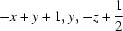 ; (vi)
  ; (vii)
  ; (viii)
| ||||||||||||||||||||||
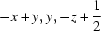 .
. Data collection: CrystalClear (Rigaku, 2005); cell refinement: CrystalClear; data reduction: CrystalClear; program(s) used to solve structure: SHELXS97 (Sheldrick, 2008); program(s) used to refine structure: SHELXL97 (Sheldrick, 2008); molecular graphics: DIAMOND (Brandenburg, 2005) and ATOMS (Dowty, 2004); software used to prepare material for publication: SHELXL97.
Supporting information
contains datablocks I, global. DOI: 10.1107/S1600536808018898/mg2052sup1.cif
Structure factors: contains datablock I. DOI: 10.1107/S1600536808018898/mg2052Isup2.hkl
LiMn(H2O)2[BP2O8].H2O was obtained in the presence of boric acid as a A mixture of 0.1149 g MnCO3, 1.484 g H3BO3, and 0.6235 g LiH2PO4 was ground to a homogeneous powder, which was transferred to a teflon autoclave with 10 ml inline (degree of filling 10%) where it was heated at 443 K for four days.
The hydrogen atoms connected to O5 were located from difference Fourier maps with displacement parameters fixed as 1.2*U(O5), whereas those connected to O6 belonging to the disordered water molecules were not located. The sum of the occupancies of Li sites was restrained to maintain charge neutrality within the entire compound. The occupancy of the O6 site associated with the disordered water molecules was fixed at 0.5.
Data collection: CrystalClear (Rigaku, 2005); cell CrystalClear (Rigaku, 2005); data reduction: CrystalClear (Rigaku, 2005); program(s) used to solve structure: SHELXS97 (Sheldrick, 2008); program(s) used to refine structure: SHELXL97 (Sheldrick, 2008); molecular graphics: DIAMOND (Brandenburg, 2005) and ATOMS (Dowty, 2004); software used to prepare material for publication: SHELXL97 (Sheldrick, 2008).
![[Figure 1]](./mg2052fig1thm.gif) | Fig. 1. Linkage of borophosphate helices in LiMn(H2O)2[BP2O8].H2O through MnO4(H2O)2 octahedra (BO4, green tetrahedra; PO4, orange tetrahedra; MnO6, violet octahedra; Li, black spheres; H2O, red spheres). |
![[Figure 2]](./mg2052fig2thm.gif) | Fig. 2. Section of LiMn(H2O)2[BP2O8].H2O viewed along the c axis (colour scheme as in Fig. 1). |
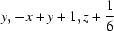
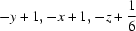
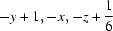
![[Figure 3]](./mg2052fig3thm.gif) | Fig. 3. Coordination environment of Mn, B, and P atoms, with displacement ellipsoids drawn at the 50% probability level (symmetry codes: (i) -x+y, y, 1/2-z; (ii) 1-x, 1-x+y, 1/3-z; (iii) y,1-x+y, 1/6+z; (iv) 1-y,1-x, 1/6-z; (v) x-y, x,-1/6+z; (vi) 1+x-y, 1-y,-z, (vii) x-y, 1-y,-z; (viii) 1+x-y,1+x,-1/6+z). |
| LiMn(H2O)2[BP2O8]·H2O | Dx = 2.505 Mg m−3 |
| Mr = 316.68 | Mo Kα radiation, λ = 0.71073 Å |
| Hexagonal, P6522 | Cell parameters from 6263 reflections |
| Hall symbol: P 65 2 (0 0 1) | θ = 2.5–33.2° |
| a = 9.5765 (4) Å | µ = 2.01 mm−1 |
| c = 15.857 (1) Å | T = 295 K |
| V = 1259.4 (1) Å3 | Hexagonal bipyramid, pale pink |
| Z = 6 | 0.16 × 0.12 × 0.12 mm |
| F(000) = 942 |
| Rigaku AFC-7 CCD diffractometer | 1230 independent reflections |
| Radiation source: fine-focus sealed tube | 1223 reflections with I > 2σ(I) |
| Graphite monochromator | Rint = 0.032 |
| Detector resolution: 14.6306 pixels mm-1 | θmax = 30.0°, θmin = 2.5° |
| thin–slice Δϕ=0.6 & Δω=0.6 scans | h = −13→13 |
| Absorption correction: multi-scan (CrystalClear; Rigaku, 2005) | k = −13→12 |
| Tmin = 0.740, Tmax = 0.795 | l = −19→22 |
| 9731 measured reflections |
| Refinement on F2 | Hydrogen site location: difference Fourier map |
| Least-squares matrix: full | Only H-atom coordinates refined |
| R[F2 > 2σ(F2)] = 0.040 | w = 1/[σ2(Fo2) + (0.008P)2 + 5.1269P] where P = (Fo2 + 2Fc2)/3 |
| wR(F2) = 0.097 | (Δ/σ)max < 0.001 |
| S = 1.19 | Δρmax = 0.62 e Å−3 |
| 1230 reflections | Δρmin = −0.44 e Å−3 |
| 85 parameters | Extinction correction: SHELXL97 (Sheldrick, 2008), Fc*=kFc[1+0.001xFc2λ3/sin(2θ)]-1/4 |
| 1 restraint | Extinction coefficient: 0.0054 (19) |
| Primary atom site location: structure-invariant direct methods | Absolute structure: Flack (1983), 443 Friedel pairs |
| Secondary atom site location: difference Fourier map | Absolute structure parameter: −0.01 (4) |
| LiMn(H2O)2[BP2O8]·H2O | Z = 6 |
| Mr = 316.68 | Mo Kα radiation |
| Hexagonal, P6522 | µ = 2.01 mm−1 |
| a = 9.5765 (4) Å | T = 295 K |
| c = 15.857 (1) Å | 0.16 × 0.12 × 0.12 mm |
| V = 1259.4 (1) Å3 |
| Rigaku AFC-7 CCD diffractometer | 1230 independent reflections |
| Absorption correction: multi-scan (CrystalClear; Rigaku, 2005) | 1223 reflections with I > 2σ(I) |
| Tmin = 0.740, Tmax = 0.795 | Rint = 0.032 |
| 9731 measured reflections |
| R[F2 > 2σ(F2)] = 0.040 | Only H-atom coordinates refined |
| wR(F2) = 0.097 | Δρmax = 0.62 e Å−3 |
| S = 1.19 | Δρmin = −0.44 e Å−3 |
| 1230 reflections | Absolute structure: Flack (1983), 443 Friedel pairs |
| 85 parameters | Absolute structure parameter: −0.01 (4) |
| 1 restraint |
Geometry. All esds (except the esd in the dihedral angle between two l.s. planes) are estimated using the full covariance matrix. The cell esds are taken into account individually in the estimation of esds in distances, angles and torsion angles; correlations between esds in cell parameters are only used when they are defined by crystal symmetry. An approximate (isotropic) treatment of cell esds is used for estimating esds involving l.s. planes. |
Refinement. Refinement of F2 against ALL reflections. The weighted R-factor wR and goodness of fit S are based on F2, conventional R-factors R are based on F, with F set to zero for negative F2. The threshold expression of F2 > σ(F2) is used only for calculating R-factors(gt) etc. and is not relevant to the choice of reflections for refinement. R-factors based on F2 are statistically about twice as large as those based on F, and R- factors based on ALL data will be even larger. |
| x | y | z | Uiso*/Ueq | Occ. (<1) | |
| Mn1 | 0.44888 (4) | 0.89775 (9) | 0.2500 | 0.0163 (2) | |
| P1 | 0.61636 (10) | 0.83327 (10) | 0.08453 (6) | 0.0134 (2) | |
| O1 | 0.0204 (3) | 0.2129 (3) | 0.06593 (16) | 0.0181 (5) | |
| O2 | 0.7681 (3) | 0.1804 (3) | 0.01267 (14) | 0.0158 (5) | |
| O3 | 0.4860 (3) | 0.8589 (4) | 0.12112 (17) | 0.0227 (6) | |
| O4 | 0.6237 (4) | 0.6903 (3) | 0.11938 (17) | 0.0228 (6) | |
| O5 | 0.1884 (4) | 0.7081 (4) | 0.2127 (2) | 0.0340 (8) | |
| O6 | 0.9000 (19) | 0.8166 (12) | 0.2717 (7) | 0.079 (3)* | 0.50 |
| B1 | 0.8493 (3) | 0.1507 (3) | 0.0833 | 0.0140 (9) | |
| Li1 | 0.2428 (18) | 0.7572 (18) | 0.0833 | 0.034 (4) | 0.42 (3) |
| Li2 | 0.899 (4) | 0.763 (3) | 0.3479 (16) | 0.034 (4) | 0.289 (13) |
| H1 | 0.133 (8) | 0.683 (7) | 0.256 (4) | 0.041* | |
| H2 | 0.179 (7) | 0.620 (4) | 0.218 (4) | 0.041* |
| U11 | U22 | U33 | U12 | U13 | U23 | |
| Mn1 | 0.0170 (3) | 0.0165 (4) | 0.0153 (3) | 0.00826 (18) | 0.0028 (2) | 0.000 |
| P1 | 0.0153 (4) | 0.0131 (4) | 0.0113 (3) | 0.0068 (3) | 0.0011 (3) | −0.0005 (3) |
| O1 | 0.0139 (11) | 0.0196 (12) | 0.0200 (12) | 0.0077 (10) | −0.0012 (9) | −0.0060 (9) |
| O2 | 0.0195 (12) | 0.0185 (11) | 0.0106 (9) | 0.0104 (10) | −0.0029 (9) | −0.0024 (8) |
| O3 | 0.0222 (14) | 0.0306 (15) | 0.0177 (12) | 0.0151 (12) | 0.0028 (10) | −0.0046 (11) |
| O4 | 0.0348 (16) | 0.0150 (12) | 0.0177 (11) | 0.0117 (11) | −0.0008 (12) | 0.0022 (10) |
| O5 | 0.0280 (17) | 0.0233 (15) | 0.0393 (17) | 0.0041 (13) | 0.0118 (14) | −0.0065 (14) |
| B1 | 0.0157 (17) | 0.0157 (17) | 0.011 (2) | 0.0083 (19) | 0.0013 (16) | 0.0013 (16) |
| Li1 | 0.036 (7) | 0.036 (7) | 0.023 (8) | 0.012 (8) | 0.003 (6) | 0.003 (6) |
| Li2 | 0.036 (7) | 0.036 (7) | 0.023 (8) | 0.012 (8) | 0.003 (6) | 0.003 (6) |
| Mn1—O4i | 2.133 (3) | O5—H1 | 0.82 (7) |
| Mn1—O4ii | 2.133 (3) | O5—H2 | 0.81 (2) |
| Mn1—O3 | 2.139 (3) | O6—O6ix | 0.71 (2) |
| Mn1—O3iii | 2.139 (3) | O6—Li2 | 1.31 (3) |
| Mn1—O5 | 2.311 (4) | O6—Li2ix | 1.95 (3) |
| Mn1—O5iii | 2.311 (3) | O6—Li2xii | 1.98 (3) |
| P1—O3 | 1.504 (3) | O6—Li2x | 2.45 (3) |
| P1—O4 | 1.510 (3) | O6—Li1xiii | 2.53 (3) |
| P1—O1iv | 1.553 (3) | B1—O1xiv | 1.463 (4) |
| P1—O2v | 1.560 (2) | B1—O1xv | 1.463 (4) |
| O1—B1vi | 1.463 (4) | B1—O2iv | 1.470 (4) |
| O1—P1iv | 1.553 (3) | Li1—O5iv | 2.111 (4) |
| O1—Li2vii | 2.65 (3) | Li1—O3iv | 2.112 (17) |
| O2—B1 | 1.470 (4) | Li2—O6ix | 1.95 (3) |
| O2—P1viii | 1.560 (2) | Li2—O6xii | 1.98 (3) |
| O3—Li1 | 2.112 (17) | Li2—O4ix | 2.11 (3) |
| O4—Li2ix | 2.11 (3) | Li2—O5xiii | 2.18 (3) |
| O4—Mn1x | 2.133 (3) | Li2—Li2xii | 2.30 (6) |
| O5—Li1 | 2.111 (4) | Li2—O6i | 2.45 (3) |
| O5—Li2xi | 2.18 (3) | ||
| O4i—Mn1—O4ii | 97.89 (17) | O2—B1—O2iv | 102.6 (4) |
| O4i—Mn1—O3 | 100.17 (11) | O5iv—Li1—O5 | 177.6 (17) |
| O4ii—Mn1—O3 | 91.22 (11) | O5iv—Li1—O3iv | 85.4 (4) |
| O4i—Mn1—O3iii | 91.22 (11) | O5—Li1—O3iv | 96.0 (5) |
| O4ii—Mn1—O3iii | 100.17 (11) | O5iv—Li1—O3 | 96.0 (5) |
| O3—Mn1—O3iii | 162.68 (17) | O5—Li1—O3 | 85.4 (4) |
| O4i—Mn1—O5 | 178.14 (13) | O3iv—Li1—O3 | 112.6 (14) |
| O4ii—Mn1—O5 | 83.95 (13) | O5iv—Li1—O6ii | 80.8 (8) |
| O3—Mn1—O5 | 80.01 (12) | O5—Li1—O6ii | 96.8 (9) |
| O3iii—Mn1—O5 | 88.19 (12) | O3iv—Li1—O6ii | 122.4 (7) |
| O4i—Mn1—O5iii | 83.95 (13) | O3—Li1—O6ii | 124.3 (8) |
| O4ii—Mn1—O5iii | 178.14 (14) | O5iv—Li1—O6xi | 96.8 (9) |
| O3—Mn1—O5iii | 88.19 (12) | O5—Li1—O6xi | 80.8 (8) |
| O3iii—Mn1—O5iii | 80.01 (12) | O3iv—Li1—O6xi | 124.3 (8) |
| O5—Mn1—O5iii | 94.2 (2) | O3—Li1—O6xi | 122.4 (7) |
| O3—P1—O4 | 115.17 (17) | O6ii—Li1—O6xi | 16.0 (5) |
| O3—P1—O1iv | 111.97 (16) | O6—Li2—O6ix | 10.8 (10) |
| O4—P1—O1iv | 104.62 (16) | O6—Li2—O6xii | 90.8 (17) |
| O3—P1—O2v | 105.62 (15) | O6ix—Li2—O6xii | 101.7 (15) |
| O4—P1—O2v | 111.81 (15) | O6—Li2—O4ix | 119.9 (19) |
| O1iv—P1—O2v | 107.54 (14) | O6ix—Li2—O4ix | 110.3 (14) |
| B1vi—O1—P1iv | 129.4 (2) | O6xii—Li2—O4ix | 138.2 (14) |
| B1—O2—P1viii | 131.1 (2) | O6—Li2—O5xiii | 117.8 (18) |
| P1—O3—Mn1 | 128.38 (17) | O6ix—Li2—O5xiii | 114.8 (14) |
| Li1—O5—H1 | 157 (4) | O6xii—Li2—O5xiii | 102.8 (13) |
| Li2xi—O5—H1 | 93 (4) | O4ix—Li2—O5xiii | 87.8 (11) |
| Mn1—O5—H1 | 107 (4) | O6—Li2—O6i | 104.2 (18) |
| Li1—O5—H2 | 103 (4) | O6ix—Li2—O6i | 115.0 (14) |
| Li2xi—O5—H2 | 162 (4) | O6xii—Li2—O6i | 13.8 (7) |
| Mn1—O5—H2 | 107 (4) | O4ix—Li2—O6i | 125.5 (12) |
| H1—O5—H2 | 84 (5) | O5xiii—Li2—O6i | 99.1 (11) |
| Li2—O6—Li2ix | 146 (2) | O6—Li2—O1xvi | 100.4 (16) |
| O1xiv—B1—O1xv | 103.7 (4) | O6ix—Li2—O1xvi | 100.1 (12) |
| O1xiv—B1—O2 | 113.70 (14) | O6xii—Li2—O1xvi | 89.1 (11) |
| O1xv—B1—O2 | 111.75 (14) | O4ix—Li2—O1xvi | 59.9 (8) |
| O1xiv—B1—O2iv | 111.75 (14) | O5xiii—Li2—O1xvi | 139.4 (13) |
| O1xv—B1—O2iv | 113.70 (14) | O6i—Li2—O1xvi | 83.4 (9) |
| Symmetry codes: (i) y, −x+y+1, z+1/6; (ii) −x+1, −x+y+1, −z+1/3; (iii) −x+y, y, −z+1/2; (iv) −y+1, −x+1, −z+1/6; (v) x−y, −y+1, −z; (vi) x−1, y, z; (vii) −y+1, x−y, z−1/3; (viii) x−y+1, −y+1, −z; (ix) −x+y+1, y, −z+1/2; (x) x−y+1, x, z−1/6; (xi) x−y, x, z−1/6; (xii) y, x, −z+2/3; (xiii) y, −x+y, z+1/6; (xiv) −y+1, −x, −z+1/6; (xv) x+1, y, z; (xvi) −x+y+1, −x+1, z+1/3. |
| D—H···A | D—H | H···A | D···A | D—H···A |
| O5—H1···O4iii | 0.83 (7) | 2.09 (7) | 2.878 (5) | 159.80 |
| O5—H2···O2i | 0.81 (4) | 2.09 (5) | 2.845 (5) | 156 |
| Symmetry codes: (i) y, −x+y+1, z+1/6; (iii) −x+y, y, −z+1/2. |
Experimental details
| Crystal data | |
| Chemical formula | LiMn(H2O)2[BP2O8]·H2O |
| Mr | 316.68 |
| Crystal system, space group | Hexagonal, P6522 |
| Temperature (K) | 295 |
| a, c (Å) | 9.5765 (4), 15.857 (1) |
| V (Å3) | 1259.4 (1) |
| Z | 6 |
| Radiation type | Mo Kα |
| µ (mm−1) | 2.01 |
| Crystal size (mm) | 0.16 × 0.12 × 0.12 |
| Data collection | |
| Diffractometer | Rigaku AFC-7 CCD diffractometer |
| Absorption correction | Multi-scan (CrystalClear; Rigaku, 2005) |
| Tmin, Tmax | 0.740, 0.795 |
| No. of measured, independent and observed [I > 2σ(I)] reflections | 9731, 1230, 1223 |
| Rint | 0.032 |
| (sin θ/λ)max (Å−1) | 0.703 |
| Refinement | |
| R[F2 > 2σ(F2)], wR(F2), S | 0.040, 0.097, 1.19 |
| No. of reflections | 1230 |
| No. of parameters | 85 |
| No. of restraints | 1 |
| H-atom treatment | Only H-atom coordinates refined |
| Δρmax, Δρmin (e Å−3) | 0.62, −0.44 |
| Absolute structure | Flack (1983), 443 Friedel pairs |
| Absolute structure parameter | −0.01 (4) |
Computer programs: CrystalClear (Rigaku, 2005), SHELXS97 (Sheldrick, 2008), SHELXL97 (Sheldrick, 2008), DIAMOND (Brandenburg, 2005) and ATOMS (Dowty, 2004).
| Mn1—O4i | 2.133 (3) | B1—O1iv | 1.463 (4) |
| Mn1—O3 | 2.139 (3) | B1—O2ii | 1.470 (4) |
| Mn1—O5 | 2.311 (4) | Li1—O5ii | 2.111 (4) |
| P1—O3 | 1.504 (3) | Li1—O3ii | 2.112 (17) |
| P1—O4 | 1.510 (3) | Li2—O6v | 1.95 (3) |
| P1—O1ii | 1.553 (3) | Li2—O6vi | 1.98 (3) |
| P1—O2iii | 1.560 (2) | Li2—O4v | 2.11 (3) |
| O5—H1 | 0.82 (7) | Li2—O5vii | 2.18 (3) |
| O5—H2 | 0.81 (2) | ||
| B1viii—O1—P1ii | 129.4 (2) | P1—O3—Mn1 | 128.38 (17) |
| B1—O2—P1ix | 131.1 (2) |
| Symmetry codes: (i) y, −x+y+1, z+1/6; (ii) −y+1, −x+1, −z+1/6; (iii) x−y, −y+1, −z; (iv) −y+1, −x, −z+1/6; (v) −x+y+1, y, −z+1/2; (vi) y, x, −z+2/3; (vii) y, −x+y, z+1/6; (viii) x−1, y, z; (ix) x−y+1, −y+1, −z. |
| D—H···A | D—H | H···A | D···A | D—H···A |
| O5—H1···O4x | 0.83 (7) | 2.09 (7) | 2.878 (5) | 159.80 |
| O5—H2···O2i | 0.81 (4) | 2.09 (5) | 2.845 (5) | 155.74 |
| Symmetry codes: (i) y, −x+y+1, z+1/6; (x) −x+y, y, −z+1/2. |
Acknowledgements
This project was supported by a fund from the National Natural Science Foundation of China (No. 40472027).
References
 Boy, I. & Kniep, R. (2001a). Z. Kristallogr. New Cryst. Struct. 216, 7–8. CAS Google Scholar
Boy, I. & Kniep, R. (2001b). Z. Kristallogr. New Cryst. Struct. 216, 9–10. CAS Google Scholar
Brandenburg, K. (2005). DIAMOND. Crystal Impact GbR, Bonn, Germany. Google Scholar
Dowty, E. (2004). ATOMS. Shape Software, Kingsport, Tennessee, USA. Google Scholar
Ewald, B., Prots, Yu., Kudla, C., Grünner, D., Cardoso-Gil, R. & Kniep, R. (2006). Chem. Mater. 18, 673–679. Web of Science CrossRef CAS Google Scholar
Flack, H. D. (1983). Acta Cryst. A39, 876–881. CrossRef CAS Web of Science IUCr Journals Google Scholar
Ge, M.-H., Mi, J.-X., Huang, Y.-X., Zhao, J.-T. & Kniep, R. (2003). Z. Kristallogr. New Cryst. Struct. 218, 273–274. CAS Google Scholar
Kniep, R., Will, H.-G., Boy, I. & Röhr, C. (1997). Angew. Chem. Int. Ed. Engl. 36, 1013–1014. CrossRef CAS Web of Science Google Scholar
Lin, J.-R., Huang, Y.-X., Wu, Y.-H. & Zhou, Y. (2008). Acta Cryst. E64, i39–i40. Web of Science CrossRef IUCr Journals Google Scholar
Rigaku (2005). CrystalClear. Rigaku Corporation, Tokyo, Japan. Google Scholar
Sheldrick, G. M. (2008). Acta Cryst. A64, 112–122. Web of Science CrossRef CAS IUCr Journals Google Scholar
This is an open-access article distributed under the terms of the Creative Commons Attribution (CC-BY) Licence, which permits unrestricted use, distribution, and reproduction in any medium, provided the original authors and source are cited.
| CRYSTALLOGRAPHIC COMMUNICATIONS |


A large family of compounds contains helical borophosphate anions ∞1[BP2O8]3- with various combinations of metal cations (MIMII, M0.5IMII, MIII) (Kniep et al., 1997; Ewald et al., 2006). To date, the only Li-containing members are LiMII(H2O)2[BP2O8].H2O (MII = Cu, Zn, Cd, Mg) (Boy & Kniep, 2001a, 2001b; Ge et al., 2003; Lin et al., 2008). The structure of LiMn(H2O)2[BP2O8].H2O is reported here.
The borophosphate helices, built up of four-membered rings of alternating BO4 and PO4 tetrahedra, extend along the 65 screw axis (Fig. 1 and 2). These helices are interconnected by Jahn-Teller-distorted Mn2+-centred octahedra, with four oxygen atoms (O3, O4) from PO4 groups and two (O5) from water molecules at the vertices (Fig. 3). Unlike the compounds containing Cu and Zn (Boy & Kniep, 2001a, 2001b) but similar to those containing Cd and Mg (Ge et al., 2003; Lin et al., 2008), there are two distinct Li sites: Li1 is close to the outer wall of the borophosphate helices and Li2 is situated at the free loops (inner wall) of the helices. The sum of occupancies of these Li sites refines to almost unity, as required to maintain charge neutrality in the compound.