Experimental
Crystal data
C7H8N5S+·Cl− Mr = 229.69 Monoclinic, P 21 /c a = 7.6740 (15) Å b = 13.374 (3) Å c = 9.965 (2) Å β = 104.70 (3)° V = 989.3 (4) Å3 Z = 4 Mo Kα radiation μ = 0.56 mm−1 T = 293 (2) K 0.20 × 0.15 × 0.11 mm
|
Data collection
Enraf–Nonius CAD-4 diffractometer Absorption correction: none 2238 measured reflections 2091 independent reflections 1712 reflections with I > 2σ(I) Rint = 0.050 3 standard reflections every 100 reflections intensity decay: none
|
| D—H⋯A | D—H | H⋯A | D⋯A | D—H⋯A | | N1—H1A⋯Cl1i | 0.86 | 2.43 | 3.099 (2) | 135 | | N3—H3A⋯Cl1ii | 0.86 | 2.17 | 3.027 (2) | 176 | | N5—H5B⋯S1iii | 0.84 (3) | 2.72 (3) | 3.466 (3) | 148 (3) | Symmetry codes: (i) 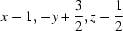 ; (ii) ; (ii)  ; (iii) -x+1, -y+2, -z+1. ; (iii) -x+1, -y+2, -z+1.
| |
Data collection: CAD-4 Software (Enraf–Nonius, 1989![[Enraf-Nonius (1989). CAD-4 Software. Enraf-Nonius, Delft, The Netherlands.]](../../../../../../logos/arrows/e_arr.gif "Enraf-Nonius (1989). CAD-4 Software. Enraf-Nonius, Delft, The Netherlands.") ); cell refinement: CAD-4 Software; data reduction: NRCVAX (Gabe et al., 1989); program(s) used to solve structure: SHELXS97 (Sheldrick, 2008); program(s) used to refine structure: SHELXL97 (Sheldrick, 2008); molecular graphics: SHELXTL/PC (Sheldrick, 2008); software used to prepare material for publication: WinGX (Farrugia, 1999).
); cell refinement: CAD-4 Software; data reduction: NRCVAX (Gabe et al., 1989); program(s) used to solve structure: SHELXS97 (Sheldrick, 2008); program(s) used to refine structure: SHELXL97 (Sheldrick, 2008); molecular graphics: SHELXTL/PC (Sheldrick, 2008); software used to prepare material for publication: WinGX (Farrugia, 1999).
Supporting information
The title compound (I) was prepared by the process as following: ethyl isonicotinate 1.51 g (0.01 mol) and hydrazine hydrate 0.32 g (0.01 mol) with ethanol at 377 K for 3 h, afford ivory-white compound A 1.32 g (yield 96%), then add 0.06 ml carbon disulfide and KOH 0.56 g (0.01 mol) with ethanol, stirred at room temperature for 5 h, afford yellow compound B 2.0 g (yield 85.6%). At last, add 0.32 g hydrazine hydrate to the compound B with water at 377 K for 12 h. Single crystals suitable for X-ray measurements were obtained by recrystallization from DMF-HCl (3:1) at 334 K.
The H atoms of the NH2 group were found from a difference Fourier map and refined freely. The other H atoms were positioned geometrically and allowed to ride on their parent atoms, with N—H and C—H distances of 0.86 and 0.93 Å, respectively, and with Uiso(H) = 1.2Ueq of the parent atoms.
Data collection: CAD-4 Software (Enraf–Nonius, 1989); cell refinement: CAD-4 Software (Enraf–Nonius, 1989); data reduction: NRCVAX (Gabe et al., 1989); program(s) used to solve structure: SHELXS97 (Sheldrick, 2008); program(s) used to refine structure: SHELXL97 (Sheldrick, 2008); molecular graphics: SHELXTL/PC (Sheldrick, 2008); software used to prepare material for publication: WinGX (Farrugia, 1999).
4-(4-Amino-5-thioxo-4,5-dihydro-1
H-1,2,4-triazol-3-yl)pyridinium chloride
top Crystal data top | C7H8N5S+·Cl− | F(000) = 472 |
| Mr = 229.69 | Dx = 1.542 Mg m−3 |
| Monoclinic, P21/c | Mo Kα radiation, λ = 0.71073 Å |
| Hall symbol: -P 2ybc | Cell parameters from 25 reflections |
| a = 7.6740 (15) Å | θ = 4–14° |
| b = 13.374 (3) Å | µ = 0.56 mm−1 |
| c = 9.965 (2) Å | T = 293 K |
| β = 104.70 (3)° | Bar, yellow |
| V = 989.3 (4) Å3 | 0.20 × 0.15 × 0.11 mm |
| Z = 4 | |
Data collection top Enraf–Nonius CAD-4
diffractometer | Rint = 0.050 |
| Radiation source: fine-focus sealed tube | θmax = 27.0°, θmin = 2.6° |
| Graphite monochromator | h = 0→9 |
| ω scans | k = 0→15 |
| 2238 measured reflections | l = −11→11 |
| 2091 independent reflections | 3 standard reflections every 100 reflections |
| 1712 reflections with I > 2σ(I) | intensity decay: none |
Refinement top | Refinement on F2 | Primary atom site location: structure-invariant direct methods |
| Least-squares matrix: full | Secondary atom site location: difference Fourier map |
| R[F2 > 2σ(F2)] = 0.038 | Hydrogen site location: inferred from neighbouring sites |
| wR(F2) = 0.111 | H atoms treated by a mixture of independent and constrained refinement |
| S = 0.96 | w = 1/[σ2(Fo2) + (0.0626P)2 + 0.6426P]
where P = (Fo2 + 2Fc2)/3 |
| 2091 reflections | (Δ/σ)max < 0.001 |
| 135 parameters | Δρmax = 0.35 e Å−3 |
| 0 restraints | Δρmin = −0.29 e Å−3 |
Crystal data top | C7H8N5S+·Cl− | V = 989.3 (4) Å3 |
| Mr = 229.69 | Z = 4 |
| Monoclinic, P21/c | Mo Kα radiation |
| a = 7.6740 (15) Å | µ = 0.56 mm−1 |
| b = 13.374 (3) Å | T = 293 K |
| c = 9.965 (2) Å | 0.20 × 0.15 × 0.11 mm |
| β = 104.70 (3)° | |
Data collection top Enraf–Nonius CAD-4
diffractometer | Rint = 0.050 |
| 2238 measured reflections | 3 standard reflections every 100 reflections |
| 2091 independent reflections | intensity decay: none |
| 1712 reflections with I > 2σ(I) | |
Refinement top | R[F2 > 2σ(F2)] = 0.038 | 0 restraints |
| wR(F2) = 0.111 | H atoms treated by a mixture of independent and constrained refinement |
| S = 0.96 | Δρmax = 0.35 e Å−3 |
| 2091 reflections | Δρmin = −0.29 e Å−3 |
| 135 parameters | |
Special details top Geometry. All e.s.d.'s (except the e.s.d. in the dihedral angle between two l.s. planes) are estimated using the full covariance matrix. The cell e.s.d.'s are taken into account individually in the estimation of e.s.d.'s in distances, angles and torsion angles; correlations between e.s.d.'s in cell parameters are only used when they are defined by crystal symmetry. An approximate (isotropic) treatment of cell e.s.d.'s is used for estimating e.s.d.'s involving l.s. planes. |
Refinement. Refinement of F2 against ALL reflections. The weighted R-factor wR and goodness of fit S are based on F2, conventional R-factors R are based on F, with F set to zero for negative F2. The threshold expression of F2 > σ(F2) is used only for calculating R-factors(gt) etc. and is not relevant to the choice of reflections for refinement. R-factors based on F2 are statistically about twice as large as those based on F, and R- factors based on ALL data will be even larger. |
Fractional atomic coordinates and isotropic or equivalent isotropic displacement parameters (Å2) top| | x | y | z | Uiso*/Ueq | |
| Cl1 | 0.80625 (8) | 0.86963 (4) | 0.12228 (5) | 0.04585 (18) | |
| S1 | 0.75196 (9) | 0.94026 (5) | 0.52007 (7) | 0.0565 (2) | |
| N1 | 0.0222 (2) | 0.78167 (16) | −0.16338 (19) | 0.0469 (5) | |
| H1A | −0.0577 | 0.7735 | −0.2405 | 0.056* | |
| N2 | 0.4905 (2) | 0.89786 (14) | 0.28259 (18) | 0.0376 (4) | |
| N3 | 0.5917 (2) | 0.76955 (15) | 0.40203 (19) | 0.0452 (5) | |
| H3A | 0.6505 | 0.7315 | 0.4676 | 0.054* | |
| N4 | 0.4694 (3) | 0.73433 (15) | 0.28792 (19) | 0.0439 (4) | |
| N5 | 0.4688 (4) | 0.99550 (16) | 0.2289 (3) | 0.0540 (6) | |
| C1 | 0.0851 (3) | 0.7017 (2) | −0.0868 (2) | 0.0494 (6) | |
| H1B | 0.0430 | 0.6383 | −0.1173 | 0.059* | |
| C2 | 0.2114 (3) | 0.71260 (18) | 0.0365 (2) | 0.0459 (5) | |
| H2A | 0.2551 | 0.6568 | 0.0903 | 0.055* | |
| C3 | 0.2744 (3) | 0.80777 (17) | 0.0811 (2) | 0.0362 (5) | |
| C4 | 0.2062 (3) | 0.88900 (18) | −0.0017 (2) | 0.0441 (5) | |
| H4B | 0.2462 | 0.9533 | 0.0254 | 0.053* | |
| C5 | 0.0786 (3) | 0.87364 (19) | −0.1248 (2) | 0.0491 (6) | |
| H5C | 0.0318 | 0.9278 | −0.1810 | 0.059* | |
| C6 | 0.4102 (3) | 0.81438 (16) | 0.2152 (2) | 0.0367 (5) | |
| C7 | 0.6114 (3) | 0.86845 (18) | 0.4025 (2) | 0.0402 (5) | |
| H5A | 0.575 (5) | 1.011 (3) | 0.211 (4) | 0.092 (12)* | |
| H5B | 0.443 (4) | 1.032 (2) | 0.290 (3) | 0.065 (9)* | |
Atomic displacement parameters (Å2) top| | U11 | U22 | U33 | U12 | U13 | U23 |
| Cl1 | 0.0495 (3) | 0.0475 (3) | 0.0356 (3) | 0.0015 (2) | 0.0015 (2) | 0.0021 (2) |
| S1 | 0.0499 (4) | 0.0593 (4) | 0.0497 (4) | −0.0019 (3) | −0.0071 (3) | −0.0162 (3) |
| N1 | 0.0392 (10) | 0.0627 (13) | 0.0340 (10) | −0.0050 (9) | 0.0007 (7) | −0.0061 (9) |
| N2 | 0.0357 (9) | 0.0395 (9) | 0.0353 (9) | −0.0011 (7) | 0.0044 (7) | −0.0037 (7) |
| N3 | 0.0436 (10) | 0.0493 (11) | 0.0356 (9) | −0.0030 (9) | −0.0030 (8) | 0.0022 (8) |
| N4 | 0.0440 (10) | 0.0465 (11) | 0.0354 (9) | −0.0058 (8) | −0.0004 (8) | −0.0004 (8) |
| N5 | 0.0633 (15) | 0.0395 (12) | 0.0503 (13) | 0.0003 (10) | −0.0024 (11) | −0.0020 (10) |
| C1 | 0.0500 (13) | 0.0506 (14) | 0.0445 (12) | −0.0123 (11) | 0.0063 (10) | −0.0096 (11) |
| C2 | 0.0486 (12) | 0.0445 (13) | 0.0402 (12) | −0.0047 (10) | 0.0035 (9) | 0.0002 (10) |
| C3 | 0.0324 (10) | 0.0451 (12) | 0.0317 (10) | −0.0027 (9) | 0.0090 (8) | −0.0032 (9) |
| C4 | 0.0464 (12) | 0.0421 (12) | 0.0397 (11) | −0.0016 (10) | 0.0034 (9) | −0.0017 (9) |
| C5 | 0.0498 (13) | 0.0509 (14) | 0.0403 (12) | 0.0037 (11) | 0.0000 (10) | 0.0018 (10) |
| C6 | 0.0340 (10) | 0.0409 (11) | 0.0350 (10) | −0.0026 (8) | 0.0081 (8) | −0.0009 (8) |
| C7 | 0.0348 (10) | 0.0491 (13) | 0.0347 (11) | −0.0002 (9) | 0.0055 (8) | −0.0043 (9) |
Geometric parameters (Å, º) top | S1—C7 | 1.679 (2) | N5—H5A | 0.90 (4) |
| N1—C5 | 1.328 (3) | N5—H5B | 0.84 (3) |
| N1—C1 | 1.331 (3) | C1—C2 | 1.366 (3) |
| N1—H1A | 0.8600 | C1—H1B | 0.9300 |
| N2—C6 | 1.366 (3) | C2—C3 | 1.394 (3) |
| N2—C7 | 1.371 (3) | C2—H2A | 0.9300 |
| N2—N5 | 1.405 (3) | C3—C4 | 1.385 (3) |
| N3—C7 | 1.331 (3) | C3—C6 | 1.474 (3) |
| N3—N4 | 1.362 (3) | C4—C5 | 1.376 (3) |
| N3—H3A | 0.8600 | C4—H4B | 0.9300 |
| N4—C6 | 1.308 (3) | C5—H5C | 0.9300 |
| | | |
| C5—N1—C1 | 122.28 (19) | C1—C2—H2A | 120.2 |
| C5—N1—H1A | 118.9 | C3—C2—H2A | 120.2 |
| C1—N1—H1A | 118.9 | C4—C3—C2 | 118.6 (2) |
| C6—N2—C7 | 108.35 (18) | C4—C3—C6 | 124.5 (2) |
| C6—N2—N5 | 125.26 (18) | C2—C3—C6 | 116.9 (2) |
| C7—N2—N5 | 125.94 (19) | C5—C4—C3 | 119.3 (2) |
| C7—N3—N4 | 113.60 (18) | C5—C4—H4B | 120.3 |
| C7—N3—H3A | 123.2 | C3—C4—H4B | 120.3 |
| N4—N3—H3A | 123.2 | N1—C5—C4 | 120.1 (2) |
| C6—N4—N3 | 104.37 (18) | N1—C5—H5C | 119.9 |
| N2—N5—H5A | 105 (2) | C4—C5—H5C | 119.9 |
| N2—N5—H5B | 107 (2) | N4—C6—N2 | 110.29 (18) |
| H5A—N5—H5B | 114 (3) | N4—C6—C3 | 121.29 (19) |
| N1—C1—C2 | 120.1 (2) | N2—C6—C3 | 128.43 (19) |
| N1—C1—H1B | 120.0 | N3—C7—N2 | 103.35 (18) |
| C2—C1—H1B | 120.0 | N3—C7—S1 | 128.55 (17) |
| C1—C2—C3 | 119.6 (2) | N2—C7—S1 | 128.10 (18) |
Hydrogen-bond geometry (Å, º) top | D—H···A | D—H | H···A | D···A | D—H···A |
| N1—H1A···Cl1i | 0.86 | 2.43 | 3.099 (2) | 135 |
| N3—H3A···Cl1ii | 0.86 | 2.17 | 3.027 (2) | 176 |
| N5—H5B···S1iii | 0.84 (3) | 2.72 (3) | 3.466 (3) | 148 (3) |
| Symmetry codes: (i) x−1, −y+3/2, z−1/2; (ii) x, −y+3/2, z+1/2; (iii) −x+1, −y+2, −z+1. |
Experimental details
| Crystal data |
| Chemical formula | C7H8N5S+·Cl− |
| Mr | 229.69 |
| Crystal system, space group | Monoclinic, P21/c |
| Temperature (K) | 293 |
| a, b, c (Å) | 7.6740 (15), 13.374 (3), 9.965 (2) |
| β (°) | 104.70 (3) |
| V (Å3) | 989.3 (4) |
| Z | 4 |
| Radiation type | Mo Kα |
| µ (mm−1) | 0.56 |
| Crystal size (mm) | 0.20 × 0.15 × 0.11 |
| |
| Data collection |
| Diffractometer | Enraf–Nonius CAD-4
diffractometer |
| Absorption correction | – |
No. of measured, independent and
observed [I > 2σ(I)] reflections | 2238, 2091, 1712 |
| Rint | 0.050 |
| (sin θ/λ)max (Å−1) | 0.638 |
| |
| Refinement |
| R[F2 > 2σ(F2)], wR(F2), S | 0.038, 0.111, 0.96 |
| No. of reflections | 2091 |
| No. of parameters | 135 |
| H-atom treatment | H atoms treated by a mixture of independent and constrained refinement |
| Δρmax, Δρmin (e Å−3) | 0.35, −0.29 |
Hydrogen-bond geometry (Å, º) top | D—H···A | D—H | H···A | D···A | D—H···A |
| N1—H1A···Cl1i | 0.86 | 2.43 | 3.099 (2) | 135.3 |
| N3—H3A···Cl1ii | 0.86 | 2.17 | 3.027 (2) | 176.1 |
| N5—H5B···S1iii | 0.84 (3) | 2.72 (3) | 3.466 (3) | 148 (3) |
| Symmetry codes: (i) x−1, −y+3/2, z−1/2; (ii) x, −y+3/2, z+1/2; (iii) −x+1, −y+2, −z+1. |
References
 Enraf–Nonius (1989). CAD-4 Software. Enraf–Nonius, Delft, The Netherlands. Google Scholar
Farrugia, L. J. (1999). J. Appl. Cryst. 32, 837–838. CrossRef CAS IUCr Journals Google Scholar
Gabe, E. J., Le Page, Y., Charland, J.-P., Lee, F. L. & White, P. S. (1989). J. Appl. Cryst. 22, 384–387. CrossRef CAS Web of Science IUCr Journals Google Scholar
Jian, F.-F., Yu, H.-Q., Qiao, Y.-B. & Liang, T.-L. (2006). Acta Cryst. E62, o3416–o3417. Web of Science CSD CrossRef IUCr Journals Google Scholar
Sheldrick, G. M. (2008). Acta Cryst. A64, 112–122. Web of Science CrossRef CAS IUCr Journals Google Scholar
Shi, Y. N., Lu, Y. C. & Fang, J. X. (1995). Chem. J. Chin. Univ. 16, 1710–1713. CAS Google Scholar
Xu, L. Z., Zhang, S. S., Li, H. J. & Jiao, K. (2002). Chem. Res. Chin. Univ. 18, 284–286. Google Scholar
This is an open-access article distributed under the terms of the Creative Commons Attribution (CC-BY) Licence, which permits unrestricted use, distribution, and reproduction in any medium, provided the original authors and source are cited.
 | CRYSTALLOGRAPHIC
COMMUNICATIONS |
ISSN: 2056-9890
Open

access


 journal menu



![[Scheme 1]](at2609scheme1.gif)
![[Figure 1]](./at2609fig1thm.gif)


An important type of fungicides, triazole compounds are highly efficient and of low tocicity (Shi et al.,1995; Xu, et al., 2002). The part of our research is to find triazole with higher cooperational activity, we synthesized the title compound (I) and report its crystal structure here.
In the crystal structure of compound (I) (Fig. 1), the dihedral angle formed by the triazole ring (N1/N3/N4/C6/C7) and the pyridine ring (N1/C1-C5) was 0.7 (4)°. The C═S bond length [1.676 (3) Å] is in agreement with that observed before (Jian, et al., 2006). There are intermolecular N–H···Cl and N—H···S hydrogen-bond interactions to stabilize the crystal structure (Table 1).