 | Acta Crystallographica Section E Acta Crystallographica Section E CRYSTALLOGRAPHIC COMMUNICATIONS |


 journal menu


organic compounds
| CRYSTALLOGRAPHIC COMMUNICATIONS |
 access
3,6-Dichlorocatechol

aState Key Laboratory of Applied Organic Chemistry and College of Chemistry and Chemical Engineering, Lanzhou University, Lanzhou, Gansu 730000, People's Republic of China
*Correspondence e-mail: [email protected]
The title compound, C6H4Cl2O2, exhibits a two-dimensional supramolecular hydrogen-bonded network and forms a three-dimensional network supramolecular structure via hydrogen bonds and π–π stacking of benzene rings. The π–π interactions are between the benzene rings of centrosymmetrically related molecules, with centroid–centroid distances of 3.7676 (13) and 3.7107 (13) Å.
Related literature
For related literature, see: Haigler et al. (1988![[Haigler, B. E., Nishino, S. F. & Spain, J. C. (1988). Appl. Environ. Microbiol. 54, 294-301.]](../../../../../../logos/arrows/e_arr.gif "Haigler, B. E., Nishino, S. F. & Spain, J. C. (1988). Appl. Environ. Microbiol. 54, 294-301.") ); Kirsh & Stan (1994); Nishizawa & Satoh (1975a,b); Sander et al. (1991); Schraa et al. (1986); Spiess et al. (1995); Spain et al. (1989).
); Kirsh & Stan (1994); Nishizawa & Satoh (1975a,b); Sander et al. (1991); Schraa et al. (1986); Spiess et al. (1995); Spain et al. (1989).
![[Scheme 1]](bq2078scheme1.gif)
Experimental
Crystal data
|
Refinement
|
| ||||||||||||||||||||||||||||||||
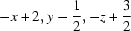 ; (ii)
  .
. Data collection: SMART (Bruker, 1997); cell refinement: SMART; data reduction: SAINT (Bruker, 1997); program(s) used to solve structure: SHELXS97 (Sheldrick, 2008); program(s) used to refine structure: SHELXL97 (Sheldrick, 2008); molecular graphics: SHELXTL (Sheldrick, 2008); software used to prepare material for publication: SHELXTL.
Supporting information
contains datablocks global, I. DOI: 10.1107/S1600536808025014/bq2078sup1.cif
Structure factors: contains datablock I. DOI: 10.1107/S1600536808025014/bq2078Isup2.hkl
3,6,6-Tricholor-2-hydroxycyclohex-2-en-1-one (26 g, 0.12 mol) was treated with Li2CO3 (13.4 g, 0.18 mol) in DMF to give the title compound (I). (18.4 g) in 86% yield (Nishizawa & Satoh, 1975a,b). m. p. 108-109°C; 1H NMR (CDCl3, 300 MHz) δ: 5.79 (s, 2H), 6.86 (d, J = 2.4 Hz, 2H); 13 C NMR (CDCl3, 75 MHz) δ: 118.7, 120.8, 140.6; MS (ESI) m/z (%): 178 (M+, 95), 180 (49), 182 (8).
All H atoms were placed in geometrically idealized positions, with C—H = 0.93 Å and O—H = 0.82 Å, and constrained to ride on their respective parent atoms, with Uiso(H) = 1.2Ueq(C) and Uiso(H) = 1.5Ueq(O).
Data collection: SMART (Bruker, 1997); cell SMART (Bruker, 1997); data reduction: SAINT (Bruker, 1997); program(s) used to solve structure: SHELXS97 (Sheldrick, 2008); program(s) used to refine structure: SHELXL97 (Sheldrick, 2008); molecular graphics: SHELXTL (Sheldrick, 2008); software used to prepare material for publication: SHELXTL (Sheldrick, 2008).
![[Figure 1]](./bq2078fig1thm.gif) | Fig. 1. A view of the title compound, showing the atom-numbering scheme. Displacement ellipsoids are drawn at the 50% probability level. |
![[Figure 2]](./bq2078fig2thm.gif) | Fig. 2. The three-dimensional structure by molecular packing, showing the intermolecular hydrogen bonds as yellow dashed lines [Symmetry codes: (i) -x+2, y-1/2, -z+3/2; (ii) x, -y+3/2, z-1/2], and π-π interactions as black dashed lines. |
| C6H4Cl2O2 | F(000) = 360 |
| Mr = 178.99 | Dx = 1.710 Mg m−3 |
| Monoclinic, P21/c | Mo Kα radiation, λ = 0.71073 Å |
| Hall symbol: -P 2ybc | Cell parameters from 2193 reflections |
| a = 7.4411 (7) Å | θ = 2.9–26.4° |
| b = 10.1283 (10) Å | µ = 0.86 mm−1 |
| c = 10.6448 (8) Å | T = 296 K |
| β = 119.903 (5)° | Block, colorless |
| V = 695.45 (11) Å3 | 0.36 × 0.17 × 0.15 mm |
| Z = 4 |
| Bruker SMART CCD area-detector diffractometer | 1243 independent reflections |
| Radiation source: fine-focus sealed tube | 1117 reflections with I > 2σ(I) |
| Graphite monochromator | Rint = 0.017 |
| ϕ and ω scans | θmax = 25.2°, θmin = 3.0° |
| Absorption correction: multi-scan (SADABS; Bruker, 1997) | h = −8→8 |
| Tmin = 0.748, Tmax = 0.882 | k = −9→12 |
| 3531 measured reflections | l = −12→12 |
| Refinement on F2 | Primary atom site location: structure-invariant direct methods |
| Least-squares matrix: full | Secondary atom site location: difference Fourier map |
| R[F2 > 2σ(F2)] = 0.030 | Hydrogen site location: inferred from neighbouring sites |
| wR(F2) = 0.118 | H-atom parameters constrained |
| S = 1.01 | w = 1/[σ2(Fo2) + (0.01P)2] where P = (Fo2 + 2Fc2)/3 |
| 1243 reflections | (Δ/σ)max = 0.001 |
| 93 parameters | Δρmax = 0.18 e Å−3 |
| 0 restraints | Δρmin = −0.34 e Å−3 |
| C6H4Cl2O2 | V = 695.45 (11) Å3 |
| Mr = 178.99 | Z = 4 |
| Monoclinic, P21/c | Mo Kα radiation |
| a = 7.4411 (7) Å | µ = 0.86 mm−1 |
| b = 10.1283 (10) Å | T = 296 K |
| c = 10.6448 (8) Å | 0.36 × 0.17 × 0.15 mm |
| β = 119.903 (5)° |
| Bruker SMART CCD area-detector diffractometer | 1243 independent reflections |
| Absorption correction: multi-scan (SADABS; Bruker, 1997) | 1117 reflections with I > 2σ(I) |
| Tmin = 0.748, Tmax = 0.882 | Rint = 0.017 |
| 3531 measured reflections |
| R[F2 > 2σ(F2)] = 0.030 | 0 restraints |
| wR(F2) = 0.118 | H-atom parameters constrained |
| S = 1.01 | Δρmax = 0.18 e Å−3 |
| 1243 reflections | Δρmin = −0.34 e Å−3 |
| 93 parameters |
Geometry. All e.s.d.'s (except the e.s.d. in the dihedral angle between two l.s. planes) are estimated using the full covariance matrix. The cell e.s.d.'s are taken into account individually in the estimation of e.s.d.'s in distances, angles and torsion angles; correlations between e.s.d.'s in cell parameters are only used when they are defined by crystal symmetry. An approximate (isotropic) treatment of cell e.s.d.'s is used for estimating e.s.d.'s involving l.s. planes. |
Refinement. Refinement of F2 against ALL reflections. The weighted R-factor wR and goodness of fit S are based on F2, conventional R-factors R are based on F, with F set to zero for negative F2. The threshold expression of F2 > σ(F2) is used only for calculating R-factors(gt) etc. and is not relevant to the choice of reflections for refinement. R-factors based on F2 are statistically about twice as large as those based on F, and R- factors based on ALL data will be even larger. |
| x | y | z | Uiso*/Ueq | ||
| Cl1 | 0.84969 (7) | 1.04043 (6) | 0.81747 (4) | 0.0483 (3) | |
| Cl2 | 0.64593 (7) | 0.99288 (7) | 0.17713 (4) | 0.0529 (3) | |
| O1 | 0.8451 (2) | 0.79625 (12) | 0.66807 (12) | 0.0487 (4) | |
| H1 | 0.8578 | 0.7331 | 0.6249 | 0.073* | |
| O2 | 0.7560 (2) | 0.76889 (12) | 0.39645 (12) | 0.0490 (4) | |
| H2 | 0.7570 | 0.7708 | 0.3198 | 0.074* | |
| C1 | 0.7904 (3) | 1.02895 (16) | 0.63843 (18) | 0.0344 (4) | |
| C2 | 0.7954 (2) | 0.90633 (16) | 0.58289 (15) | 0.0335 (4) | |
| C3 | 0.7515 (2) | 0.89485 (16) | 0.44037 (17) | 0.0330 (4) | |
| C4 | 0.7012 (3) | 1.00694 (18) | 0.35485 (17) | 0.0356 (4) | |
| C5 | 0.6955 (3) | 1.13066 (18) | 0.41095 (17) | 0.0433 (4) | |
| H5 | 0.6619 | 1.2056 | 0.3530 | 0.052* | |
| C6 | 0.7397 (3) | 1.14090 (18) | 0.55181 (19) | 0.0415 (4) | |
| H6 | 0.7359 | 1.2230 | 0.5896 | 0.050* |
| U11 | U22 | U33 | U12 | U13 | U23 | |
| Cl1 | 0.0647 (4) | 0.0507 (4) | 0.0356 (4) | −0.00327 (18) | 0.0296 (3) | −0.00797 (16) |
| Cl2 | 0.0633 (4) | 0.0666 (5) | 0.0307 (4) | 0.0071 (2) | 0.0248 (3) | 0.00907 (18) |
| O1 | 0.0832 (10) | 0.0343 (7) | 0.0401 (7) | 0.0122 (6) | 0.0393 (7) | 0.0089 (5) |
| O2 | 0.0835 (10) | 0.0351 (7) | 0.0414 (7) | −0.0021 (6) | 0.0409 (7) | −0.0039 (5) |
| C1 | 0.0382 (9) | 0.0370 (9) | 0.0307 (8) | −0.0029 (6) | 0.0192 (7) | −0.0042 (6) |
| C2 | 0.0394 (8) | 0.0323 (9) | 0.0317 (8) | 0.0010 (7) | 0.0199 (7) | 0.0053 (6) |
| C3 | 0.0373 (8) | 0.0334 (9) | 0.0298 (7) | −0.0025 (6) | 0.0177 (6) | −0.0020 (6) |
| C4 | 0.0360 (9) | 0.0445 (10) | 0.0276 (8) | −0.0007 (7) | 0.0169 (7) | 0.0042 (7) |
| C5 | 0.0488 (10) | 0.0354 (9) | 0.0450 (9) | 0.0037 (7) | 0.0230 (8) | 0.0100 (7) |
| C6 | 0.0508 (10) | 0.0309 (9) | 0.0429 (8) | 0.0009 (7) | 0.0234 (7) | −0.0003 (7) |
| O1—H1 | 0.8200 | C3—O2 | 1.365 (2) |
| O2—H2 | 0.8200 | C3—C4 | 1.385 (2) |
| C1—C2 | 1.384 (2) | C4—C5 | 1.398 (2) |
| C1—C6 | 1.390 (2) | C4—Cl2 | 1.7299 (16) |
| C1—Cl1 | 1.7326 (17) | C5—C6 | 1.369 (3) |
| C2—O1 | 1.3666 (18) | C5—H5 | 0.9300 |
| C2—C3 | 1.388 (2) | C6—H6 | 0.9300 |
| O1—C2—C1 | 120.31 (13) | C3—C4—C5 | 120.65 (15) |
| O1—C2—C3 | 119.68 (14) | C3—C4—Cl2 | 119.36 (13) |
| O2—C3—C4 | 125.85 (14) | C4—C3—C2 | 119.27 (15) |
| O2—C3—C2 | 114.84 (14) | C4—C5—H5 | 120.2 |
| C1—C2—C3 | 120.02 (14) | C5—C4—Cl2 | 119.98 (13) |
| C1—C6—H6 | 119.9 | C5—C6—C1 | 120.16 (16) |
| C2—O1—H1 | 109.5 | C5—C6—H6 | 119.9 |
| C2—C1—C6 | 120.32 (15) | C6—C5—C4 | 119.59 (15) |
| C2—C1—Cl1 | 118.94 (12) | C6—C1—Cl1 | 120.75 (13) |
| C3—O2—H2 | 109.5 | C6—C5—H5 | 120.2 |
| Cl1—C1—C2—O1 | 0.4 (2) | C1—C2—C3—C4 | −0.5 (2) |
| Cl1—C1—C2—C3 | −179.06 (12) | C2—C1—C6—C5 | −0.3 (3) |
| Cl1—C1—C6—C5 | 179.23 (13) | C2—C3—C4—C5 | 0.3 (2) |
| Cl2—C4—C5—C6 | −179.92 (13) | C2—C3—C4—Cl2 | −179.90 (12) |
| O1—C2—C3—O2 | 2.1 (2) | C3—C4—C5—C6 | −0.1 (3) |
| O1—C2—C3—C4 | 179.98 (15) | C4—C5—C6—C1 | 0.2 (3) |
| O2—C3—C4—C5 | 177.97 (16) | C6—C1—C2—O1 | −179.97 (15) |
| O2—C3—C4—Cl2 | −2.3 (2) | C6—C1—C2—C3 | 0.5 (2) |
| C1—C2—C3—O2 | −178.41 (15) |
| D—H···A | D—H | H···A | D···A | D—H···A |
| O1—H1···O2 | 0.82 | 2.19 | 2.6391 (17) | 115 |
| O1—H1···Cl1i | 0.82 | 2.76 | 3.3980 (16) | 137 |
| O2—H2···Cl2 | 0.82 | 2.61 | 3.0597 (13) | 116 |
| O2—H2···O1ii | 0.82 | 2.13 | 2.8969 (19) | 155 |
| Symmetry codes: (i) −x+2, y−1/2, −z+3/2; (ii) x, −y+3/2, z−1/2. |
Experimental details
| Crystal data | |
| Chemical formula | C6H4Cl2O2 |
| Mr | 178.99 |
| Crystal system, space group | Monoclinic, P21/c |
| Temperature (K) | 296 |
| a, b, c (Å) | 7.4411 (7), 10.1283 (10), 10.6448 (8) |
| β (°) | 119.903 (5) |
| V (Å3) | 695.45 (11) |
| Z | 4 |
| Radiation type | Mo Kα |
| µ (mm−1) | 0.86 |
| Crystal size (mm) | 0.36 × 0.17 × 0.15 |
| Data collection | |
| Diffractometer | Bruker SMART CCD area-detector diffractometer |
| Absorption correction | Multi-scan (SADABS; Bruker, 1997) |
| Tmin, Tmax | 0.748, 0.882 |
| No. of measured, independent and observed [I > 2σ(I)] reflections | 3531, 1243, 1117 |
| Rint | 0.017 |
| (sin θ/λ)max (Å−1) | 0.598 |
| Refinement | |
| R[F2 > 2σ(F2)], wR(F2), S | 0.030, 0.118, 1.01 |
| No. of reflections | 1243 |
| No. of parameters | 93 |
| H-atom treatment | H-atom parameters constrained |
| Δρmax, Δρmin (e Å−3) | 0.18, −0.34 |
Computer programs: SMART (Bruker, 1997), SAINT (Bruker, 1997), SHELXS97 (Sheldrick, 2008), SHELXL97 (Sheldrick, 2008), SHELXTL (Sheldrick, 2008).
| D—H···A | D—H | H···A | D···A | D—H···A |
| O1—H1···O2 | 0.82 | 2.19 | 2.6391 (17) | 115 |
| O1—H1···Cl1i | 0.82 | 2.76 | 3.3980 (16) | 137 |
| O2—H2···Cl2 | 0.82 | 2.61 | 3.0597 (13) | 116 |
| O2—H2···O1ii | 0.82 | 2.13 | 2.8969 (19) | 155 |
| Symmetry codes: (i) −x+2, y−1/2, −z+3/2; (ii) x, −y+3/2, z−1/2. |
Acknowledgements
The authors gratefully acknowledge financial support from the National Natural Science Foundation of China (20621091). The authors are also grateful to Professor Yu Tang, Lanzhou University, for her helpful guidance in the preparation of the manuscript.
References
 Bruker (1997). SMART, SADABS and SAINT. Bruker AXS Inc., Madison, Wisconsin, USA. Google Scholar
Haigler, B. E., Nishino, S. F. & Spain, J. C. (1988). Appl. Environ. Microbiol. 54, 294–301. CAS PubMed Web of Science Google Scholar
Kirsh, N. H. & Stan, H. J. (1994). Chemosphere, 28, 131–137. Google Scholar
Nishizawa, K. & Satoh, J. Y. (1975a). Bull. Chem. Soc. Jpn, 48, 1276–1279. CrossRef CAS Web of Science Google Scholar
Nishizawa, K. & Satoh, J. Y. (1975b). Bull. Chem. Soc. Jpn, 48, 2215–2216. CrossRef CAS Web of Science Google Scholar
Sander, P., Wittich, R. M., Fortnagel, P., Wilkes, H. & Francke, W. (1991). Appl. Environ. Microbiol. 57, 1430–1440. PubMed CAS Web of Science Google Scholar
Schraa, G., Boone, M. L., Jetten, M. S. M., Van Neerven, A. R. W., Colberg, P. J. & Zehnder, A. J. B. (1986). Appl. Environ. Microbiol. 52, 1374–1381. CAS PubMed Web of Science Google Scholar
Sheldrick, G. M. (2008). Acta Cryst. A64, 112–122. Web of Science CrossRef CAS IUCr Journals Google Scholar
Spain, J. C., Zylstra, G. J., Blake, C. K. & Gibson, D. T. (1989). Appl. Environ. Microbiol. 55, 2648–2652. CAS PubMed Web of Science Google Scholar
Spiess, E., Sommer, C. & Gorisch, H. (1995). Appl. Environ. Microbiol. 61, 3884–3888. CAS PubMed Web of Science Google Scholar
This is an open-access article distributed under the terms of the Creative Commons Attribution (CC-BY) Licence, which permits unrestricted use, distribution, and reproduction in any medium, provided the original authors and source are cited.
| CRYSTALLOGRAPHIC COMMUNICATIONS |


The compound 3,6-dichlorocatechol, (I), was a common metabolite in the microbial aerobic degradation of 1,4-dichlorobenzene. Because 1,4-dichlorobenzene was too stable to be degraded by photochemistry, biodegradation of this compound was an only way that it was eliminated from enviroment. 3,6-Dichlorocatechol has been reported to be an important intermediate in this process (Haigler et al., 1988; Schraa et al., 1986; Spain et al., 1989; Sander et al., 1991; Spiess et al., 1995). So the title compound (I) could be used to optimize the biodegradation process of 1,4-dichlorobenzene (Kirsh et al., 1994). It would be of great important significance in the protection of our surrounding and public health. Herein, we report the synthesis and structure of this compound, namely 3,6-dichlorocatechol. As shown in Fig.1, there are two hydroxyl groups in the phenyl ring. In the formation of these hydrogen bonds, one acts as donor, the other as acceptor. A two-dimensional supramolecular network was formed by O—H···Cl and O—H···O intermolecular hydrogen bonds (Table 1) [Symmetry codes (i): -x+2, y-1/2, -z+3/2; (ii): x, -y+3/2, z-1/2], and there are also weak π-π interactions between the centrosymmetrically related phenyl rings at (x, y, z) and (-x, -y, -z+1), (-x+1, -y, -z+1) with a centroid-to-centroid distance of 3.7676 (13)Å and 3.7107 (13)Å, respectively (Fig. 2).