 | Acta Crystallographica Section E Acta Crystallographica Section E CRYSTALLOGRAPHIC COMMUNICATIONS |


 journal menu


organic compounds
| CRYSTALLOGRAPHIC COMMUNICATIONS |
 access
N-(2,6-Diisopropylphenyl)formamide

aDepartment of Chemistry, University of Saskatchewan, 110 Science Place, Saskatoon, Saskatchewan, Canada S7N 5C9, and bSaskatchewan Structural Sciences Centre, University of Saskatchewan, 110 Science Place, Saskatoon, Saskatchewan, Canada S7N 5C9
*Correspondence e-mail: [email protected]
The title compound, C13H19NO, exhibits a non-planar structure in which the 2,6-diisopropylphenyl ring is tilted at a dihedral angle of 77.4 (1)° with respect to the formamide group. This is the largest dihedral angle known among structurally characterized formamides. The molecules are linked via N—H⋯O hydrogen bonds, forming infinite chains which run along the b-axis directions.
Related literature
For related literature, see: Boeyens et al. (1988![[Boeyens, J. C. A., Denner, L. & Evans, D. G. (1988). J. Crystallogr. Spectrosc. Res. 18, 175-176.]](../../../../../../logos/arrows/e_arr.gif "Boeyens, J. C. A., Denner, L. & Evans, D. G. (1988). J. Crystallogr. Spectrosc. Res. 18, 175-176.") ); Ferguson et al. (1998); Gowda et al. (2000); Krishnamurthy (1982); LaPlanche & Rogers (1964); Omondi et al. (2005); Cerecetto et al. (2004); Chitanda et al. (2008).
); Ferguson et al. (1998); Gowda et al. (2000); Krishnamurthy (1982); LaPlanche & Rogers (1964); Omondi et al. (2005); Cerecetto et al. (2004); Chitanda et al. (2008).
![[Scheme 1]](bv2100scheme1.gif)
Experimental
Crystal data
|
Data collection
|
Refinement
|
| |||||||||||||||||
 .
. Data collection: COLLECT (Nonius, 1998); cell refinement: SCALEPACK (Otwinowski & Minor, 1997); data reduction: DENZO (Otwinowski & Minor, 1997) and SCALEPACK; program(s) used to solve structure: SIR97 (Altomare et al., 1999); program(s) used to refine structure: SHELXL97 (Sheldrick, 2008); molecular graphics: ORTEP-3 for Windows (Farrugia, 1997); software used to prepare material for publication: SHELXL97.
Supporting information
contains datablocks I, global. DOI: 10.1107/S1600536808024811/bv2100sup1.cif
Structure factors: contains datablock I. DOI: 10.1107/S1600536808024811/bv2100Isup2.hkl
The refined procedure for the synthesis of (I) is as follows: A solution of 2,6-diisopropyl aniline (4.695 g, 26.5 mmol s) and formic acid (7.314 g, 159.0 mmol, 6eq.) in chloroform (20 ml) was refluxed with continuous stirring for 16 hrs. The colour of the solution changed from yellow to green to colorless over the course of the reaction. The solvent and excess formic acid were removed under vacuum to yield the title compound as a white solid. Needle-like single crystals suitable for X-ray analysis were obtained from slow evaporation of a chloroform solution (5.00 g, 92%). 1H-NMR (CDCl3, p.p.m.): Two rotomers observed in 2:1 ratio. Major Rotomer: δ 1.19 (d, J = 6.9 Hz, 12H, –CH(CH3)2), δ 3.08 (septet, J = 6.9 Hz, 2H, –CH(CH3)2) δ 6.64 (s(br), 1H, –NH–), δ 7.17 (m, 2H, aromatic), δ 7.30 (m, 1H, aromatic), δ 8.47 (s, 1H, –C(H)=O). 13C-NMR (CDCl3, p.p.m.): δ 23.74 (CH(CH3)2), d 28.9 (–CH(CH3)2), d 123.6, δ 128.7, δ 129.9, δ 146.2, δ 161.0 (–C(H)=O). Minor Rotomer: δ 1.20 (d, J = 6.9 Hz, 12H, –CH(CH3)2), δ 3.20 (septet, J = 6.9 Hz, 2H, –CH(CH3)2) δ 7.02 (d, J = 11.2 Hz, 1H, –NH–), δ 7.19 (m, 2H, aromatic), δ 7.30 (m, 1H, aromatic), δ 8.0 (d, J = 11.2 Hz, 1H, –C(H)=O). 13C-NMR (CDCl3, p.p.m.), Major Rotomer: δ 23.77 (–CH(CH3)2), δ 28.6 (–CH(CH3)2), δ 123.9, δ 129.0, δ 130.4, δ 146.9, δ 165.9 (–C(H)=O). ESI-MS (m/z): calcd. for C13H19NO; 205.1467, 206.1545 [M+H]+; found; 206.1546 [M+H]+.
The hydrogen atoms in the ammonium ions in (II) and (IV) were all found in ΔF maps. The hydrogen atoms were placed in calculated tetrahedral positions on the N atoms (N—H = 0.95 Å). The Uiso of each H atom was assigned as equal to 1.5 times the Ueq of the attached N atom.
Data collection: COLLECT (Nonius, 1998); cell SCALEPACK (Otwinowski & Minor, 1997); data reduction: DENZO and SCALEPACK (Otwinowski & Minor, 1997); program(s) used to solve structure: SIR97 (Altomare et al., 1999); program(s) used to refine structure: SHELXL97 (Sheldrick, 2008); molecular graphics: ORTEP-3 for Windows (Farrugia, 1997); software used to prepare material for publication: SHELXL97 (Sheldrick, 2008).
![[Figure 1]](./bv2100fig1thm.gif) | Fig. 1. The molecular structure of (I), showing the atom-labeling scheme. Thermal ellipsoids are drawn at the 50% probability level. |
![[Figure 2]](./bv2100fig2thm.gif) | Fig. 2. The packing of (I), with hydrogen bonds shown as dashed lines. For clarity, H-atoms have been omitted. |
![[Figure 3]](./bv2100fig3thm.gif) | Fig. 3. Dihedral angle of previously characterized aryl-substituted formamides |
| C13H19NO | F(000) = 448 |
| Mr = 205.29 | Dx = 1.137 Mg m−3 |
| Monoclinic, P21/c | Mo Kα radiation, λ = 0.71073 Å |
| Hall symbol: -P 2ybc | Cell parameters from 5165 reflections |
| a = 8.9581 (15) Å | θ = 1.0–27.5° |
| b = 8.7684 (15) Å | µ = 0.07 mm−1 |
| c = 15.840 (6) Å | T = 173 K |
| β = 105.381 (10)° | Rod, colourless |
| V = 1199.6 (5) Å3 | 0.25 × 0.05 × 0.05 mm |
| Z = 4 |
| Nonius KappaCCD diffractometer | 1556 reflections with I > 2σ(I) |
| Radiation source: fine-focus sealed tube | Rint = 0.070 |
| Horizonally mounted graphite crystal monochromator | θmax = 26.0°, θmin = 2.4° |
| Detector resolution: 9 pixels mm-1 | h = −11→11 |
| ϕ scans and ω scans with κ offsets | k = −10→10 |
| 7758 measured reflections | l = −17→19 |
| 2365 independent reflections |
| Refinement on F2 | Primary atom site location: structure-invariant direct methods |
| Least-squares matrix: full | Secondary atom site location: difference Fourier map |
| R[F2 > 2σ(F2)] = 0.054 | Hydrogen site location: inferred from neighbouring sites |
| wR(F2) = 0.128 | H-atom parameters constrained |
| S = 1.05 | w = 1/[σ2(Fo2) + (0.0512P)2 + 0.2338P] where P = (Fo2 + 2Fc2)/3 |
| 2365 reflections | (Δ/σ)max < 0.001 |
| 140 parameters | Δρmax = 0.16 e Å−3 |
| 0 restraints | Δρmin = −0.20 e Å−3 |
| C13H19NO | V = 1199.6 (5) Å3 |
| Mr = 205.29 | Z = 4 |
| Monoclinic, P21/c | Mo Kα radiation |
| a = 8.9581 (15) Å | µ = 0.07 mm−1 |
| b = 8.7684 (15) Å | T = 173 K |
| c = 15.840 (6) Å | 0.25 × 0.05 × 0.05 mm |
| β = 105.381 (10)° |
| Nonius KappaCCD diffractometer | 1556 reflections with I > 2σ(I) |
| 7758 measured reflections | Rint = 0.070 |
| 2365 independent reflections |
| R[F2 > 2σ(F2)] = 0.054 | 0 restraints |
| wR(F2) = 0.128 | H-atom parameters constrained |
| S = 1.05 | Δρmax = 0.16 e Å−3 |
| 2365 reflections | Δρmin = −0.20 e Å−3 |
| 140 parameters |
Geometry. All e.s.d.'s (except the e.s.d. in the dihedral angle between two l.s. planes) are estimated using the full covariance matrix. The cell e.s.d.'s are taken into account individually in the estimation of e.s.d.'s in distances, angles and torsion angles; correlations between e.s.d.'s in cell parameters are only used when they are defined by crystal symmetry. An approximate (isotropic) treatment of cell e.s.d.'s is used for estimating e.s.d.'s involving l.s. planes. |
Refinement. Refinement of F2 against ALL reflections. The weighted R-factor wR and goodness of fit S are based on F2, conventional R-factors R are based on F, with F set to zero for negative F2. The threshold expression of F2 > σ(F2) is used only for calculating R-factors(gt) etc. and is not relevant to the choice of reflections for refinement. R-factors based on F2 are statistically about twice as large as those based on F, and R- factors based on ALL data will be even larger. |
| x | y | z | Uiso*/Ueq | ||
| N1 | 0.51988 (18) | 0.05926 (16) | 0.22728 (10) | 0.0277 (4) | |
| H1 | 0.5445 | −0.0380 | 0.2282 | 0.033* | |
| O1 | 0.40304 (16) | 0.24069 (14) | 0.29095 (9) | 0.0385 (4) | |
| C1 | 0.5662 (2) | 0.15772 (18) | 0.16592 (12) | 0.0253 (4) | |
| C2 | 0.7219 (2) | 0.20161 (19) | 0.18370 (13) | 0.0276 (5) | |
| C3 | 0.7655 (2) | 0.2939 (2) | 0.12239 (14) | 0.0311 (5) | |
| H3 | 0.8701 | 0.3260 | 0.1329 | 0.037* | |
| C4 | 0.6582 (2) | 0.3389 (2) | 0.04654 (14) | 0.0326 (5) | |
| H4 | 0.6898 | 0.4012 | 0.0053 | 0.039* | |
| C5 | 0.5059 (2) | 0.2940 (2) | 0.03028 (13) | 0.0319 (5) | |
| H5 | 0.4337 | 0.3255 | −0.0223 | 0.038* | |
| C6 | 0.4557 (2) | 0.20300 (19) | 0.08966 (12) | 0.0267 (4) | |
| C7 | 0.2869 (2) | 0.1551 (2) | 0.06884 (13) | 0.0327 (5) | |
| H7 | 0.2744 | 0.0866 | 0.1170 | 0.039* | |
| C8 | 0.2398 (3) | 0.0654 (3) | −0.01662 (16) | 0.0514 (7) | |
| H8A | 0.1320 | 0.0322 | −0.0273 | 0.062* | |
| H8B | 0.3069 | −0.0241 | −0.0125 | 0.062* | |
| H8C | 0.2504 | 0.1304 | −0.0650 | 0.062* | |
| C9 | 0.1804 (2) | 0.2920 (2) | 0.06525 (17) | 0.0460 (6) | |
| H9A | 0.0736 | 0.2566 | 0.0564 | 0.055* | |
| H9B | 0.1867 | 0.3587 | 0.0167 | 0.055* | |
| H9C | 0.2125 | 0.3487 | 0.1204 | 0.055* | |
| C10 | 0.8387 (2) | 0.1508 (2) | 0.26749 (14) | 0.0349 (5) | |
| H10 | 0.8116 | 0.0441 | 0.2800 | 0.042* | |
| C11 | 1.0061 (2) | 0.1496 (3) | 0.26122 (17) | 0.0505 (6) | |
| H11A | 1.0727 | 0.1026 | 0.3140 | 0.061* | |
| H11B | 1.0404 | 0.2545 | 0.2560 | 0.061* | |
| H11C | 1.0125 | 0.0909 | 0.2097 | 0.061* | |
| C12 | 0.8260 (3) | 0.2501 (3) | 0.34482 (15) | 0.0468 (6) | |
| H12A | 0.8939 | 0.2092 | 0.3991 | 0.056* | |
| H12B | 0.7187 | 0.2499 | 0.3488 | 0.056* | |
| H12C | 0.8573 | 0.3548 | 0.3360 | 0.056* | |
| C13 | 0.4417 (2) | 0.1082 (2) | 0.28273 (13) | 0.0309 (5) | |
| H13 | 0.4131 | 0.0339 | 0.3192 | 0.037* |
| U11 | U22 | U33 | U12 | U13 | U23 | |
| N1 | 0.0361 (9) | 0.0177 (7) | 0.0303 (10) | −0.0005 (6) | 0.0103 (8) | 0.0028 (6) |
| O1 | 0.0492 (9) | 0.0278 (7) | 0.0443 (9) | −0.0025 (6) | 0.0228 (7) | −0.0035 (6) |
| C1 | 0.0337 (11) | 0.0167 (8) | 0.0276 (11) | −0.0004 (7) | 0.0120 (9) | 0.0001 (7) |
| C2 | 0.0339 (11) | 0.0187 (9) | 0.0328 (12) | 0.0019 (8) | 0.0134 (9) | −0.0012 (7) |
| C3 | 0.0331 (11) | 0.0229 (9) | 0.0415 (13) | −0.0020 (8) | 0.0171 (10) | −0.0035 (8) |
| C4 | 0.0464 (13) | 0.0236 (9) | 0.0354 (12) | 0.0022 (9) | 0.0240 (10) | 0.0038 (8) |
| C5 | 0.0410 (12) | 0.0272 (10) | 0.0284 (11) | 0.0044 (8) | 0.0109 (9) | 0.0027 (8) |
| C6 | 0.0348 (11) | 0.0205 (9) | 0.0270 (11) | 0.0014 (8) | 0.0120 (9) | −0.0018 (7) |
| C7 | 0.0339 (12) | 0.0314 (10) | 0.0312 (12) | −0.0015 (8) | 0.0058 (9) | 0.0026 (8) |
| C8 | 0.0455 (14) | 0.0435 (13) | 0.0606 (17) | −0.0008 (10) | 0.0062 (12) | −0.0204 (11) |
| C9 | 0.0364 (13) | 0.0465 (13) | 0.0544 (16) | 0.0002 (10) | 0.0106 (11) | −0.0147 (11) |
| C10 | 0.0342 (12) | 0.0284 (10) | 0.0394 (13) | 0.0004 (8) | 0.0050 (10) | 0.0049 (9) |
| C11 | 0.0374 (13) | 0.0464 (13) | 0.0636 (17) | 0.0068 (10) | 0.0065 (12) | 0.0032 (11) |
| C12 | 0.0397 (13) | 0.0600 (14) | 0.0379 (14) | −0.0037 (11) | 0.0052 (11) | −0.0007 (11) |
| C13 | 0.0361 (11) | 0.0271 (10) | 0.0305 (11) | −0.0062 (8) | 0.0106 (9) | 0.0022 (8) |
| N1—C13 | 1.331 (2) | C7—H7 | 1.0000 |
| N1—C1 | 1.441 (2) | C8—H8A | 0.9800 |
| N1—H1 | 0.8800 | C8—H8B | 0.9800 |
| O1—C13 | 1.229 (2) | C8—H8C | 0.9800 |
| C1—C6 | 1.401 (3) | C9—H9A | 0.9800 |
| C1—C2 | 1.402 (3) | C9—H9B | 0.9800 |
| C2—C3 | 1.397 (3) | C9—H9C | 0.9800 |
| C2—C10 | 1.522 (3) | C10—C11 | 1.529 (3) |
| C3—C4 | 1.382 (3) | C10—C12 | 1.532 (3) |
| C3—H3 | 0.9500 | C10—H10 | 1.0000 |
| C4—C5 | 1.377 (3) | C11—H11A | 0.9800 |
| C4—H4 | 0.9500 | C11—H11B | 0.9800 |
| C5—C6 | 1.396 (3) | C11—H11C | 0.9800 |
| C5—H5 | 0.9500 | C12—H12A | 0.9800 |
| C6—C7 | 1.520 (3) | C12—H12B | 0.9800 |
| C7—C9 | 1.525 (3) | C12—H12C | 0.9800 |
| C7—C8 | 1.525 (3) | C13—H13 | 0.9500 |
| C13—N1—C1 | 123.23 (15) | C7—C8—H8C | 109.5 |
| C13—N1—H1 | 118.4 | H8A—C8—H8C | 109.5 |
| C1—N1—H1 | 118.4 | H8B—C8—H8C | 109.5 |
| C6—C1—C2 | 122.22 (17) | C7—C9—H9A | 109.5 |
| C6—C1—N1 | 119.19 (16) | C7—C9—H9B | 109.5 |
| C2—C1—N1 | 118.57 (17) | H9A—C9—H9B | 109.5 |
| C3—C2—C1 | 117.78 (18) | C7—C9—H9C | 109.5 |
| C3—C2—C10 | 121.42 (17) | H9A—C9—H9C | 109.5 |
| C1—C2—C10 | 120.80 (16) | H9B—C9—H9C | 109.5 |
| C4—C3—C2 | 120.77 (18) | C2—C10—C11 | 113.87 (18) |
| C4—C3—H3 | 119.6 | C2—C10—C12 | 110.56 (16) |
| C2—C3—H3 | 119.6 | C11—C10—C12 | 109.77 (18) |
| C5—C4—C3 | 120.46 (18) | C2—C10—H10 | 107.5 |
| C5—C4—H4 | 119.8 | C11—C10—H10 | 107.5 |
| C3—C4—H4 | 119.8 | C12—C10—H10 | 107.5 |
| C4—C5—C6 | 121.17 (19) | C10—C11—H11A | 109.5 |
| C4—C5—H5 | 119.4 | C10—C11—H11B | 109.5 |
| C6—C5—H5 | 119.4 | H11A—C11—H11B | 109.5 |
| C5—C6—C1 | 117.59 (18) | C10—C11—H11C | 109.5 |
| C5—C6—C7 | 119.45 (17) | H11A—C11—H11C | 109.5 |
| C1—C6—C7 | 122.95 (16) | H11B—C11—H11C | 109.5 |
| C6—C7—C9 | 111.57 (15) | C10—C12—H12A | 109.5 |
| C6—C7—C8 | 111.09 (17) | C10—C12—H12B | 109.5 |
| C9—C7—C8 | 110.50 (18) | H12A—C12—H12B | 109.5 |
| C6—C7—H7 | 107.8 | C10—C12—H12C | 109.5 |
| C9—C7—H7 | 107.8 | H12A—C12—H12C | 109.5 |
| C8—C7—H7 | 107.8 | H12B—C12—H12C | 109.5 |
| C7—C8—H8A | 109.5 | O1—C13—N1 | 125.92 (17) |
| C7—C8—H8B | 109.5 | O1—C13—H13 | 117.0 |
| H8A—C8—H8B | 109.5 | N1—C13—H13 | 117.0 |
| C13—N1—C1—C6 | −77.0 (2) | N1—C1—C6—C5 | −177.80 (15) |
| C13—N1—C1—C2 | 104.7 (2) | C2—C1—C6—C7 | 179.32 (16) |
| C6—C1—C2—C3 | 0.1 (3) | N1—C1—C6—C7 | 1.1 (3) |
| N1—C1—C2—C3 | 178.38 (15) | C5—C6—C7—C9 | −64.7 (2) |
| C6—C1—C2—C10 | 179.73 (16) | C1—C6—C7—C9 | 116.4 (2) |
| N1—C1—C2—C10 | −2.0 (2) | C5—C6—C7—C8 | 59.1 (2) |
| C1—C2—C3—C4 | −0.5 (3) | C1—C6—C7—C8 | −119.8 (2) |
| C10—C2—C3—C4 | 179.90 (17) | C3—C2—C10—C11 | −24.2 (3) |
| C2—C3—C4—C5 | 0.3 (3) | C1—C2—C10—C11 | 156.20 (17) |
| C3—C4—C5—C6 | 0.3 (3) | C3—C2—C10—C12 | 99.9 (2) |
| C4—C5—C6—C1 | −0.7 (3) | C1—C2—C10—C12 | −79.7 (2) |
| C4—C5—C6—C7 | −179.57 (17) | C1—N1—C13—O1 | −2.2 (3) |
| C2—C1—C6—C5 | 0.4 (3) |
| D—H···A | D—H | H···A | D···A | D—H···A |
| N1—H1···O1i | 0.88 | 2.04 | 2.910 (2) | 171 |
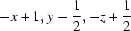
| Symmetry code: (i) −x+1, y−1/2, −z+1/2. |
Experimental details
| Crystal data | |
| Chemical formula | C13H19NO |
| Mr | 205.29 |
| Crystal system, space group | Monoclinic, P21/c |
| Temperature (K) | 173 |
| a, b, c (Å) | 8.9581 (15), 8.7684 (15), 15.840 (6) |
| β (°) | 105.381 (10) |
| V (Å3) | 1199.6 (5) |
| Z | 4 |
| Radiation type | Mo Kα |
| µ (mm−1) | 0.07 |
| Crystal size (mm) | 0.25 × 0.05 × 0.05 |
| Data collection | |
| Diffractometer | Nonius KappaCCD diffractometer |
| Absorption correction | – |
| No. of measured, independent and observed [I > 2σ(I)] reflections | 7758, 2365, 1556 |
| Rint | 0.070 |
| (sin θ/λ)max (Å−1) | 0.617 |
| Refinement | |
| R[F2 > 2σ(F2)], wR(F2), S | 0.054, 0.128, 1.05 |
| No. of reflections | 2365 |
| No. of parameters | 140 |
| H-atom treatment | H-atom parameters constrained |
| Δρmax, Δρmin (e Å−3) | 0.16, −0.20 |
Computer programs: COLLECT (Nonius, 1998), DENZO and SCALEPACK (Otwinowski & Minor, 1997), SIR97 (Altomare et al., 1999), SHELXL97 (Sheldrick, 2008), ORTEP-3 for Windows (Farrugia, 1997).
| D—H···A | D—H | H···A | D···A | D—H···A |
| N1—H1···O1i | 0.88 | 2.04 | 2.910 (2) | 170.8 |
| Symmetry code: (i) −x+1, y−1/2, −z+1/2. |
Acknowledgements
Financial assistance for this project was provided by the Natural Sciences and Engineering Research Council of Canada (NSERC) for an operating grant to SRF, and by the Canadian Government through the Commonwealth Scholarship fund for JMC.
References
 Altomare, A., Burla, M. C., Camalli, M., Cascarano, G. L., Giacovazzo, C., Guagliardi, A., Moliterni, A. G. G., Polidori, G. & Spagna, R. (1999). J. Appl. Cryst. 32, 115–119. Web of Science CrossRef CAS IUCr Journals Google Scholar
Boeyens, J. C. A., Denner, L. & Evans, D. G. (1988). J. Crystallogr. Spectrosc. Res. 18, 175–176. CSD CrossRef CAS Web of Science Google Scholar
Cerecetto, H., Gerpe, A., Gonzalez, M., Fernadez Sainz, Y., Piro, O. E. & Castellano, E. E. (2004). Synthesis, pp. 2678–2684. Web of Science CSD CrossRef Google Scholar
Chitanda, J. M., Prokopchuk, D. E., Quail, J. W. & Foley, S. R. (2008). Organometallics, 27, 2337–2345. Web of Science CSD CrossRef CAS Google Scholar
Farrugia, L. J. (1997). J. Appl. Cryst. 30, 565. CrossRef IUCr Journals Google Scholar
Ferguson, G., Low, J. N., Penner, G. H. & Wardell, J. L. (1998). Acta Cryst. C54, 1974–1977. CSD CrossRef CAS IUCr Journals Google Scholar
Gowda, B. T., Paulus, H. & Fuess, H. (2000). Z. Naturforsch. Teil A, 55, 791–793. CAS Google Scholar
Krishnamurthy, S. (1982). Tetrahedron Lett. 23, 3315–3318. CrossRef CAS Web of Science Google Scholar
LaPlanche, L. A. & Rogers, M. T. (1964). J. Am. Chem. Soc. 86, 337–341. CrossRef CAS Web of Science Google Scholar
Nonius (1998). COLLECT. Nonius BV, Delft, The Netherlands. Google Scholar
Omondi, B., Fernandes, M. A., Layh, M., Levendis, D. C., Look, J. L. & Mkwizu, T. S. P. (2005). CrystEngComm. 7, 690–700. Web of Science CSD CrossRef CAS Google Scholar
Otwinowski, Z. & Minor, W. (1997). Methods in Enzymology, Vol. 276, Macromolecular Crystallography, Part A, edited by C. W. Carter Jr & R. M. Sweet, pp. 307–326. New York: Academic Press. Google Scholar
Sheldrick, G. M. (2008). Acta Cryst. A64, 112–122. Web of Science CrossRef CAS IUCr Journals Google Scholar
This is an open-access article distributed under the terms of the Creative Commons Attribution (CC-BY) Licence, which permits unrestricted use, distribution, and reproduction in any medium, provided the original authors and source are cited.
| CRYSTALLOGRAPHIC COMMUNICATIONS |


As part of the ongoing research in our laboratory directed at the synthesis substituted iminoisoindolines (Chitanda et al., 2008), the title compound was obtained as a by-product and then purposefully synthesized in 92% yield. N-(2,6-diisopropylphenyl)formamide has been previously reported (Krishnamurthy, 1982), however no X-ray structure nor NMR data has been previously published. We have now determined the single-crystal X-ray structure of the title compound, (I).
The 1H NMR (CDCl3) spectra of I is a mixture of two carbon-nitrogen bond rotomers, where the ratio of the major rotomer to the minor rotomer is about 2:1. Upon crystallization however, the solid state structure shows exclusive formation of the cisoidal rotomer. As shown in Figure 1, the carbonyl group on the formamide moiety is positioned almost perpendicular to the plane of the aromatic ring, and is oriented cis to the aromatic group about the carbon-nitrogen bond. The dihedral angle between the plane of the aromatic ring and that formed by the N—C=O moiety is 77.4 (1)°, which is considerably larger than the corresponding angle in previously structurally characterized aryl-substituted formamides (Figure 3). This is attributed to the presence of the bulky isopropyl groups on the ortho positions of the phenyl ring which increases torsional strain between the two planes defining the dihedral angle. For example, in the less bulky analogue, N-(4-methoxyphenyl)formamide, the dihedral angle is only 8.0 (3)° (Figure 3, Cerecetto et al., 2004). The two isomers of the title compound arise due to hindered rotation about the amidic bond (LaPlanche et al., 1964). (I) crystallizes in the monoclinic space group P21/c. The molecules of (I) are linked to form infinite chains which run along the b axis direction via N—H···O hydrogen bonds (details in Table 3).