 | Acta Crystallographica Section E Acta Crystallographica Section E CRYSTALLOGRAPHIC COMMUNICATIONS |


 journal menu


metal-organic compounds
| CRYSTALLOGRAPHIC COMMUNICATIONS |
 access
Di-μ-bromido-bis[bromido(di-2-pyridylmethanediol-κ2N,N′)copper(II)] dihydrate

aDepartment of Chemistry and Biochemistry, Central Connecticut State University, New Britain, CT 06050, USA, bRigaku Americas Corp., 9009 New Trails Dr., The Woodlands, TX 77381, USA, and cDepartment of Chemistry, Youngstown State University, Youngstown, OH 44555, USA
*Correspondence e-mail: [email protected]
The centrosymmetric title complex, [Cu2Br4(C11H10N2O2)2]·2H2O, was one of three complexes isolated by slow evaporation of an acetonitrile reaction mixture of CuBr2 with di-2-pyridyl ketone (1:1 molar ratio). The title complex contains a 1:1 metal-to-ligand ratio of copper(II) with the hydrated form of the ligand di-2-pyridylmethanediol. The copper centers are bridged by bromide donors, leading to a Cu—Cu distance of 4.090 (6) Å. The crystals form as non-merohedral twins with two components related by a 180° rotation around the normal to [100]; the selected sample had a twin ratio of 0.63:0.37.
Related literature
Apart from the title complex, two others were isolated from the reaction mixture and structurally characterized. One complex was reported previously by Parker et al. (2000![[Parker, O. J., Aubol, S. L. & Breneman, G. L. (2000). Polyhedron, 19, 623-626.]](../../../../../../logos/arrows/e_arr.gif "Parker, O. J., Aubol, S. L. & Breneman, G. L. (2000). Polyhedron, 19, 623-626.") ), the other is reported in the preceding paper by Zeller et al. (2008). For other related structures, see: Wang et al. (1986); Mariezcurrena et al. (1999).
), the other is reported in the preceding paper by Zeller et al. (2008). For other related structures, see: Wang et al. (1986); Mariezcurrena et al. (1999).
![[Scheme 1]](fj2132scheme1.gif)
Experimental
Crystal data
|
Refinement
|
|
 ; (ii)
  .
. Data collection: CrystalClear (Rigaku/MSC, 2004); cell refinement: TwinSolve (Rigaku/MSC, 2002); data reduction: TwinSolve; program(s) used to solve structure: SIR92 (Altomare et al., 1994); program(s) used to refine structure: SHELXL97 (Sheldrick, 2008); molecular graphics: CrystalStructure (Rigaku, 2006); software used to prepare material for publication: publCIF (Westrip, 2008).
Supporting information
contains datablocks I, global. DOI: 10.1107/S1600536808024203/fj2132sup1.cif
Structure factors: contains datablock I. DOI: 10.1107/S1600536808024203/fj2132Isup2.hkl
Di-2-pyridyl ketone (dpk) was purchased from Aldrich and used as received. Copper(II) bromide hexahydrate was dried in an oven at 110°C for 48 h before use. DPK (1 mmol) and copper(II) bromide (1 mmol) were combined in 40 ml acetonitrile and stirred for 30 minutes. The resulting olive crystals were isolated after 5 days by slow evaporation of the solution. Prior to harvesting these crystals, crystals of two other distinct complexes were removed by gravity filtration.
The crystals form as non-merohedral twins. All reflections for both domains (44628 total) were integrated with the Rigaku TwinSolve program, to produce 3540 reflections for component 1 only, 3645 for component 2 only, and 815 containing contributions from both components (including systematic absences). The two twin components are related by a 180° rotation around the normal to [1 0 0], given by the matrix (1 0 0.549, 0 - 1 0, 0 0 - 1)
The positions of H atoms bonded to O were allowed to refine with isotropic displacement parameter set equal to the isotropic equivalent value for the attached atom. A mild restraint was applied to the two ligand O—H distances (0.84 Å). Other H atoms were used in calculated positions (C—H 0.95 Å) with isotropic displacement parameter set equal to 1.2 times the the isotropic equivalent value for the attached atom.
Data collection: CrystalClear (Rigaku/MSC, 2004); cell TwinSolve (Rigaku/MSC, 2002); data reduction: TwinSolve (Rigaku/MSC, 2002); program(s) used to solve structure: SIR92 (Altomare et al., 1994); program(s) used to refine structure: SHELXL97 (Sheldrick, 2008); molecular graphics: CrystalStructure (Rigaku, 2006); software used to prepare material for publication: publCIF (Westrip, 2008).
![[Figure 1]](./fj2132fig1thm.gif) | Fig. 1. ORTEP view of the unique part of the Cu complex, drawn with 60% probability displacement ellipsoids for the non-H atoms. The water molecule that loosely bridges Br atoms between adjacent complexes is not shown. |
![[Figure 2]](./fj2132fig2thm.gif) | Fig. 2. A view of the dimeric unit generated by the association of one of the Br ligands with the Cu atom of an adjacent molecule. The longer interactions of the Br and O atoms are shown as dashed lines. Non-H atoms are drawn with 60% probability ellipsoids. |
| [Cu2Br4(C11H10N2O2)2]·2H2O | F(000) = 1720 |
| Mr = 887.18 | Dx = 2.135 Mg m−3 |
| Monoclinic, C2/c | Mo Kα radiation, λ = 0.71073 Å |
| Hall symbol: -C 2yc | Cell parameters from 13358 reflections |
| a = 21.2685 (7) Å | θ = 2.7–29.8° |
| b = 9.1275 (3) Å | µ = 7.38 mm−1 |
| c = 14.4731 (4) Å | T = 100 K |
| β = 100.749 (2)° | Blocks, green |
| V = 2760.34 (15) Å3 | 0.34 × 0.25 × 0.13 mm |
| Z = 4 |
| Rigaku R-AXIS RAPID diffractometer | 7508 independent reflections |
| Radiation source: fine-focus sealed tube | 6192 reflections with I > 2σ(I) |
| Graphite monochromator | Rint = 0.058 |
| Detector resolution: 10 pixels mm-1 | θmax = 30.1°, θmin = 2.7° |
| ω scans | h = −29→29 |
| Absorption correction: multi-scan (TwinSolve; Rigaku/MSC, 2002) | k = −12→12 |
| Tmin = 0.08, Tmax = 0.38 | l = −20→20 |
| 46376 measured reflections |
| Refinement on F2 | Primary atom site location: structure-invariant direct methods |
| Least-squares matrix: full | Secondary atom site location: difference Fourier map |
| R[F2 > 2σ(F2)] = 0.065 | Hydrogen site location: difference Fourier map |
| wR(F2) = 0.198 | H atoms treated by a mixture of independent and constrained refinement |
| S = 1.13 | w = 1/[σ2(Fo2) + (0.0753P)2 + 82.8356P] where P = (Fo2 + 2Fc2)/3 |
| 7508 reflections | (Δ/σ)max = 0.002 |
| 185 parameters | Δρmax = 1.54 e Å−3 |
| 2 restraints | Δρmin = −1.58 e Å−3 |
| [Cu2Br4(C11H10N2O2)2]·2H2O | V = 2760.34 (15) Å3 |
| Mr = 887.18 | Z = 4 |
| Monoclinic, C2/c | Mo Kα radiation |
| a = 21.2685 (7) Å | µ = 7.38 mm−1 |
| b = 9.1275 (3) Å | T = 100 K |
| c = 14.4731 (4) Å | 0.34 × 0.25 × 0.13 mm |
| β = 100.749 (2)° |
| Rigaku R-AXIS RAPID diffractometer | 7508 independent reflections |
| Absorption correction: multi-scan (TwinSolve; Rigaku/MSC, 2002) | 6192 reflections with I > 2σ(I) |
| Tmin = 0.08, Tmax = 0.38 | Rint = 0.058 |
| 46376 measured reflections |
| R[F2 > 2σ(F2)] = 0.065 | 2 restraints |
| wR(F2) = 0.198 | H atoms treated by a mixture of independent and constrained refinement |
| S = 1.13 | w = 1/[σ2(Fo2) + (0.0753P)2 + 82.8356P] where P = (Fo2 + 2Fc2)/3 |
| 7508 reflections | Δρmax = 1.54 e Å−3 |
| 185 parameters | Δρmin = −1.58 e Å−3 |
Geometry. All e.s.d.'s (except the e.s.d. in the dihedral angle between two l.s. planes) are estimated using the full covariance matrix. The cell e.s.d.'s are taken into account individually in the estimation of e.s.d.'s in distances, angles and torsion angles; correlations between e.s.d.'s in cell parameters are only used when they are defined by crystal symmetry. An approximate (isotropic) treatment of cell e.s.d.'s is used for estimating e.s.d.'s involving l.s. planes. |
Refinement. Refinement of F2 against ALL reflections. The weighted R-factor wR and goodness of fit S are based on F2, conventional R-factors R are based on F, with F set to zero for negative F2. The threshold expression of F2 > σ(F2) is used only for calculating R-factors(gt) etc. and is not relevant to the choice of reflections for refinement. R-factors based on F2 are statistically about twice as large as those based on F, and R- factors based on ALL data will be even larger. |
| x | y | z | Uiso*/Ueq | ||
| Br1 | 0.15441 (3) | 0.62635 (7) | 0.55691 (4) | 0.01359 (14) | |
| Br2 | 0.02135 (3) | 0.54295 (7) | 0.38142 (4) | 0.01492 (15) | |
| Cu1 | 0.08934 (3) | 0.41245 (8) | 0.50766 (5) | 0.00990 (16) | |
| O1 | 0.1794 (2) | 0.2937 (5) | 0.4473 (3) | 0.0137 (8) | |
| H12 | 0.165 (4) | 0.306 (9) | 0.394 (3) | 0.014* | |
| O2 | 0.2056 (2) | 0.0447 (5) | 0.4596 (4) | 0.0163 (9) | |
| H9 | 0.241 (2) | 0.052 (10) | 0.484 (6) | 0.016* | |
| O3 | 0.1174 (2) | 0.3109 (6) | 0.2691 (4) | 0.0216 (10) | |
| H10 | 0.091 (5) | 0.391 (10) | 0.270 (6) | 0.022* | |
| H11 | 0.126 (4) | 0.334 (10) | 0.215 (7) | 0.022* | |
| N1 | 0.1400 (2) | 0.2914 (6) | 0.6142 (4) | 0.0121 (9) | |
| N2 | 0.0544 (2) | 0.2175 (6) | 0.4509 (4) | 0.0107 (9) | |
| C1 | 0.1432 (3) | 0.3159 (8) | 0.7059 (5) | 0.0199 (14) | |
| H1 | 0.1210 | 0.3957 | 0.7238 | 0.024* | |
| C2 | 0.1773 (3) | 0.2300 (8) | 0.7748 (5) | 0.0208 (14) | |
| H2 | 0.1792 | 0.2528 | 0.8379 | 0.025* | |
| C3 | 0.2088 (3) | 0.1091 (9) | 0.7493 (5) | 0.0231 (15) | |
| H3 | 0.2320 | 0.0486 | 0.7951 | 0.028* | |
| C4 | 0.2058 (3) | 0.0783 (8) | 0.6545 (5) | 0.0168 (12) | |
| H4 | 0.2256 | −0.0045 | 0.6356 | 0.020* | |
| C5 | 0.1724 (3) | 0.1751 (7) | 0.5888 (4) | 0.0134 (11) | |
| C6 | 0.1666 (3) | 0.1538 (7) | 0.4830 (4) | 0.0103 (10) | |
| C7 | 0.0974 (3) | 0.1111 (6) | 0.4443 (4) | 0.0106 (10) | |
| C8 | 0.0795 (3) | −0.0259 (7) | 0.4077 (4) | 0.0139 (11) | |
| H5 | 0.1098 | −0.0990 | 0.4065 | 0.017* | |
| C9 | 0.0145 (3) | −0.0511 (7) | 0.3725 (4) | 0.0146 (11) | |
| H6 | 0.0010 | −0.1415 | 0.3465 | 0.017* | |
| C10 | −0.0295 (3) | 0.0584 (7) | 0.3766 (4) | 0.0149 (12) | |
| H7 | −0.0727 | 0.0438 | 0.3522 | 0.018* | |
| C11 | −0.0078 (3) | 0.1923 (7) | 0.4184 (5) | 0.0137 (11) | |
| H8 | −0.0374 | 0.2654 | 0.4237 | 0.016* |
| U11 | U22 | U33 | U12 | U13 | U23 | |
| Br1 | 0.0089 (2) | 0.0146 (3) | 0.0168 (3) | 0.0002 (2) | 0.0011 (2) | −0.0018 (2) |
| Br2 | 0.0159 (3) | 0.0139 (3) | 0.0133 (3) | 0.0015 (2) | −0.0015 (2) | 0.0027 (2) |
| Cu1 | 0.0087 (3) | 0.0108 (3) | 0.0095 (3) | 0.0007 (2) | −0.0003 (2) | −0.0002 (3) |
| O1 | 0.012 (2) | 0.020 (2) | 0.0103 (19) | −0.0023 (17) | 0.0046 (16) | 0.0041 (17) |
| O2 | 0.0081 (19) | 0.018 (2) | 0.023 (2) | 0.0049 (17) | 0.0022 (17) | −0.0022 (18) |
| O3 | 0.019 (2) | 0.033 (3) | 0.013 (2) | −0.002 (2) | 0.0031 (18) | 0.008 (2) |
| N1 | 0.007 (2) | 0.017 (2) | 0.011 (2) | −0.0003 (18) | −0.0015 (17) | 0.0040 (19) |
| N2 | 0.010 (2) | 0.011 (2) | 0.011 (2) | 0.0045 (18) | 0.0031 (17) | 0.0051 (18) |
| C1 | 0.020 (3) | 0.028 (4) | 0.013 (3) | −0.007 (3) | 0.007 (2) | −0.009 (3) |
| C2 | 0.020 (3) | 0.032 (4) | 0.010 (3) | −0.009 (3) | 0.001 (2) | 0.001 (3) |
| C3 | 0.012 (3) | 0.039 (4) | 0.018 (3) | 0.003 (3) | 0.001 (2) | 0.018 (3) |
| C4 | 0.007 (2) | 0.024 (3) | 0.019 (3) | 0.001 (2) | 0.001 (2) | 0.009 (3) |
| C5 | 0.009 (2) | 0.018 (3) | 0.012 (3) | −0.001 (2) | 0.001 (2) | 0.000 (2) |
| C6 | 0.003 (2) | 0.013 (3) | 0.014 (3) | 0.0023 (19) | 0.0003 (19) | 0.001 (2) |
| C7 | 0.012 (3) | 0.010 (3) | 0.010 (2) | 0.003 (2) | 0.004 (2) | 0.003 (2) |
| C8 | 0.014 (3) | 0.013 (3) | 0.016 (3) | 0.004 (2) | 0.006 (2) | 0.002 (2) |
| C9 | 0.014 (3) | 0.015 (3) | 0.014 (3) | −0.001 (2) | 0.000 (2) | 0.000 (2) |
| C10 | 0.010 (3) | 0.019 (3) | 0.015 (3) | −0.005 (2) | 0.000 (2) | 0.004 (2) |
| C11 | 0.011 (3) | 0.012 (3) | 0.017 (3) | 0.003 (2) | 0.000 (2) | 0.005 (2) |
| Br1—Cu1 | 2.4222 (10) | C2—C3 | 1.377 (11) |
| Br2—Cu1 | 2.4212 (9) | C2—H2 | 0.9300 |
| Cu1—N1 | 2.034 (5) | C3—C4 | 1.390 (10) |
| Cu1—N2 | 2.041 (5) | C3—H3 | 0.9300 |
| Cu1—Br2i | 3.1138 (10) | C4—C5 | 1.392 (9) |
| O1—C6 | 1.423 (7) | C4—H4 | 0.9300 |
| O1—H12 | 0.78 (4) | C5—C6 | 1.527 (8) |
| O2—C6 | 1.378 (7) | C6—C7 | 1.525 (8) |
| O2—H9 | 0.77 (4) | C7—C8 | 1.382 (9) |
| O3—H10 | 0.92 (10) | C8—C9 | 1.402 (9) |
| O3—H11 | 0.86 (10) | C8—H5 | 0.9300 |
| N1—C1 | 1.335 (8) | C9—C10 | 1.377 (9) |
| N1—C5 | 1.353 (8) | C9—H6 | 0.9300 |
| N2—C11 | 1.339 (8) | C10—C11 | 1.403 (9) |
| N2—C7 | 1.349 (7) | C10—H7 | 0.9300 |
| C1—C2 | 1.367 (10) | C11—H8 | 0.9300 |
| C1—H1 | 0.9300 | ||
| N1—Cu1—N2 | 86.2 (2) | C3—C4—C5 | 118.0 (7) |
| N1—Cu1—Br2 | 175.12 (15) | C3—C4—H4 | 121.0 |
| N2—Cu1—Br2 | 90.21 (14) | C5—C4—H4 | 121.0 |
| N1—Cu1—Br1 | 91.25 (15) | N1—C5—C4 | 122.3 (6) |
| N2—Cu1—Br1 | 165.08 (15) | N1—C5—C6 | 115.0 (5) |
| Br2—Cu1—Br1 | 93.07 (3) | C4—C5—C6 | 122.7 (6) |
| N1—Cu1—Br2i | 91.44 (15) | O2—C6—O1 | 113.3 (5) |
| N2—Cu1—Br2i | 93.91 (15) | O2—C6—C7 | 108.0 (5) |
| Br2—Cu1—Br2i | 85.54 (3) | O1—C6—C7 | 109.5 (4) |
| Br1—Cu1—Br2i | 100.85 (3) | O2—C6—C5 | 113.5 (5) |
| C6—O1—H12 | 114 (6) | O1—C6—C5 | 105.3 (5) |
| C6—O2—H9 | 114 (7) | C7—C6—C5 | 107.1 (5) |
| H10—O3—H11 | 93 (8) | N2—C7—C8 | 122.5 (6) |
| C1—N1—C5 | 117.9 (6) | N2—C7—C6 | 114.2 (5) |
| C1—N1—Cu1 | 125.7 (5) | C8—C7—C6 | 123.3 (5) |
| C5—N1—Cu1 | 116.5 (4) | C7—C8—C9 | 118.0 (6) |
| C11—N2—C7 | 119.3 (5) | C7—C8—H5 | 121.0 |
| C11—N2—Cu1 | 123.6 (4) | C9—C8—H5 | 121.0 |
| C7—N2—Cu1 | 117.1 (4) | C10—C9—C8 | 119.9 (6) |
| N1—C1—C2 | 123.4 (7) | C10—C9—H6 | 120.1 |
| N1—C1—H1 | 118.3 | C8—C9—H6 | 120.1 |
| C2—C1—H1 | 118.3 | C9—C10—C11 | 118.6 (6) |
| C1—C2—C3 | 119.0 (6) | C9—C10—H7 | 120.7 |
| C1—C2—H2 | 120.5 | C11—C10—H7 | 120.7 |
| C3—C2—H2 | 120.5 | N2—C11—C10 | 121.7 (6) |
| C2—C3—C4 | 119.4 (6) | N2—C11—H8 | 119.2 |
| C2—C3—H3 | 120.3 | C10—C11—H8 | 119.2 |
| C4—C3—H3 | 120.3 | ||
| N2—Cu1—N1—C1 | −131.0 (6) | C4—C5—C6—O2 | −10.3 (9) |
| Br1—Cu1—N1—C1 | 63.9 (5) | N1—C5—C6—O1 | 49.0 (7) |
| N2—Cu1—N1—C5 | 47.9 (5) | C4—C5—C6—O1 | −134.4 (6) |
| Br1—Cu1—N1—C5 | −117.3 (4) | N1—C5—C6—C7 | −67.6 (7) |
| N1—Cu1—N2—C11 | 131.8 (6) | C4—C5—C6—C7 | 109.0 (7) |
| Br1—Cu1—N2—C11 | −147.0 (5) | C11—N2—C7—C8 | −1.5 (9) |
| Br2—Cu1—N2—C11 | −44.9 (5) | Cu1—N2—C7—C8 | 179.3 (5) |
| N1—Cu1—N2—C7 | −49.1 (5) | C11—N2—C7—C6 | 179.7 (6) |
| Br2—Cu1—N2—C7 | 134.2 (4) | Cu1—N2—C7—C6 | 0.6 (7) |
| C5—N1—C1—C2 | 0.3 (10) | O2—C6—C7—N2 | −171.3 (5) |
| Cu1—N1—C1—C2 | 179.1 (5) | O1—C6—C7—N2 | −47.5 (7) |
| N1—C1—C2—C3 | −2.1 (11) | C5—C6—C7—N2 | 66.6 (7) |
| C1—C2—C3—C4 | 0.8 (11) | O2—C6—C7—C8 | 10.0 (8) |
| C2—C3—C4—C5 | 2.2 (10) | O1—C6—C7—C8 | 133.8 (6) |
| C1—N1—C5—C4 | 2.9 (9) | C5—C6—C7—C8 | −112.1 (7) |
| Cu1—N1—C5—C4 | −176.0 (5) | N2—C7—C8—C9 | 3.0 (9) |
| C1—N1—C5—C6 | 179.6 (6) | C6—C7—C8—C9 | −178.4 (6) |
| Cu1—N1—C5—C6 | 0.6 (7) | C7—C8—C9—C10 | −2.0 (10) |
| C3—C4—C5—N1 | −4.2 (10) | C7—N2—C11—C10 | −1.0 (10) |
| C3—C4—C5—C6 | 179.4 (6) | C9—C10—C11—N2 | 1.9 (10) |
| N1—C5—C6—O2 | 173.1 (5) |
| Symmetry code: (i) −x, −y+1, −z+1. |
| D—H···A | D—H | H···A | D···A | D—H···A |
| O3—H11···Br1ii | 0.85 (6) | 2.53 (6) | 3.361 (5) | 166 (9) |
| O2—H9···O1iii | 0.77 (6) | 2.21 (7) | 2.961 (7) | 147 (9) |
| O2—H9···Br1iii | 0.77 (6) | 2.87 (9) | 3.411 (5) | 123 (8) |
| O3—H10···Br2 | 0.85 (6) | 2.80 (8) | 3.542 (6) | 147 (9) |
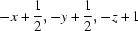
| Symmetry codes: (ii) x, −y+1, z−1/2; (iii) −x+1/2, −y+1/2, −z+1. |
Experimental details
| Crystal data | |
| Chemical formula | [Cu2Br4(C11H10N2O2)2]·2H2O |
| Mr | 887.18 |
| Crystal system, space group | Monoclinic, C2/c |
| Temperature (K) | 100 |
| a, b, c (Å) | 21.2685 (7), 9.1275 (3), 14.4731 (4) |
| β (°) | 100.749 (2) |
| V (Å3) | 2760.34 (15) |
| Z | 4 |
| Radiation type | Mo Kα |
| µ (mm−1) | 7.38 |
| Crystal size (mm) | 0.34 × 0.25 × 0.13 |
| Data collection | |
| Diffractometer | Rigaku R-AXIS RAPID diffractometer |
| Absorption correction | Multi-scan (TwinSolve; Rigaku/MSC, 2002) |
| Tmin, Tmax | 0.08, 0.38 |
| No. of measured, independent and observed [I > 2σ(I)] reflections | 46376, 7508, 6192 |
| Rint | 0.058 |
| (sin θ/λ)max (Å−1) | 0.705 |
| Refinement | |
| R[F2 > 2σ(F2)], wR(F2), S | 0.065, 0.198, 1.13 |
| No. of reflections | 7508 |
| No. of parameters | 185 |
| No. of restraints | 2 |
| H-atom treatment | H atoms treated by a mixture of independent and constrained refinement |
| w = 1/[σ2(Fo2) + (0.0753P)2 + 82.8356P] where P = (Fo2 + 2Fc2)/3 | |
| Δρmax, Δρmin (e Å−3) | 1.54, −1.58 |
Computer programs: CrystalClear (Rigaku/MSC, 2004), TwinSolve (Rigaku/MSC, 2002), SIR92 (Altomare et al., 1994), SHELXL97 (Sheldrick, 2008), CrystalStructure (Rigaku, 2006), publCIF (Westrip, 2008).
| D—H···A | D—H | H···A | D···A | D—H···A |
| O3—H11···Br1i | 0.85 (6) | 2.53 (6) | 3.361 (5) | 166 (9) |
| O2—H9···O1ii | 0.77 (6) | 2.21 (7) | 2.961 (7) | 147 (9) |
| O2—H9···Br1ii | 0.77 (6) | 2.87 (9) | 3.411 (5) | 123 (8) |
| O3—H10···Br2 | 0.85 (6) | 2.80 (8) | 3.542 (6) | 147 (9) |
| Symmetry codes: (i) x, −y+1, z−1/2; (ii) −x+1/2, −y+1/2, −z+1. |
Acknowledgements
The authors thank Dr Guy Crundwell (CCSU) for helpful discussions. BLW acknowledges funding from the National Science Foundation (NSF #0420322). MZ acknowledge funding from the National Science Foundation (NSF #0087210) and the Ohio Board of Regents (CAP-491).
References
 Altomare, A., Cascarano, G., Giacovazzo, C., Guagliardi, A., Burla, M. C., Polidori, G. & Camalli, M. (1994). J. Appl. Cryst. 27, 435. CrossRef Web of Science IUCr Journals Google Scholar
Mariezcurrena, R. A., Mombrú, A. W., Suescun, L., Kremer, E. & González, R. (1999). Acta Cryst. C55, 1989–1991. Web of Science CSD CrossRef CAS IUCr Journals Google Scholar
Parker, O. J., Aubol, S. L. & Breneman, G. L. (2000). Polyhedron, 19, 623–626. Web of Science CSD CrossRef CAS Google Scholar
Rigaku (2006). CrystalStructure. Rigaku Corporation, Tokyo, Japan. Google Scholar
Rigaku/MSC (2002). TwinSolve. Rigaku/MSC, The Woodlands, Texas, USA. Google Scholar
Rigaku/MSC (2004). CrystalClear. Rigaku/MSC, The Woodlands, Texas, USA. Google Scholar
Sheldrick, G. M. (2008). Acta Cryst. A64, 112–122. Web of Science CrossRef CAS IUCr Journals Google Scholar
Wang, S.-L., Richardson, J. W. Jr, Briggs, S. J., Jacobson, R. A. & Jensen, W. P. (1986). Inorg. Chim. Acta, 111, 67–72. CAS Google Scholar
Westrip, S. P. (2008). publCIF. In preparation. Google Scholar
Zeller, M., Westcott, B. L., Kopp-Vaughn, K. M. & Hunter, A. D. (2008). Acta Cryst. E64, m1121. Web of Science CSD CrossRef IUCr Journals Google Scholar
This is an open-access article distributed under the terms of the Creative Commons Attribution (CC-BY) Licence, which permits unrestricted use, distribution, and reproduction in any medium, provided the original authors and source are cited.
| CRYSTALLOGRAPHIC COMMUNICATIONS |


The title compound was one of three Cu–dpkoh complexes isolated from the 1:1 molar mixture of copper(II)bromide and di-2-pyridyl ketone, and was the third isolated from solution. The remaining two strutcures are described in Parker et al. (2000) and Zeller et al. (2008).