 | Acta Crystallographica Section E Acta Crystallographica Section E CRYSTALLOGRAPHIC COMMUNICATIONS |


 journal menu


organic compounds
| CRYSTALLOGRAPHIC COMMUNICATIONS |
 access
4-Nitrophenyl methacrylate

aSchool of Science, Beijing Jiaotong University, Beijing 100044, People's Republic of China, and bCollege of Chemistry and Molecular Sciences, Wuhan University, Wuhan, Hubei 430072, People's Republic of China
*Correspondence e-mail: [email protected]
The title compound, C10H9NO4, was obtained serendipitously during the preparation of benzyl cyclohexylcarbamate. The molecule consists of two approximately planar parts, the nitrophenyl ring and the rest of the non-H atoms, with a dihedral angle of 55.05 (6)° between the two segments. The crystal structure is stabilized by weak C—H⋯O interactions and π stacking [3.753 (1) Å] along the b axis.
Related literature
For related literature, see: Banks et al. (1977![[Banks, A. R., Fibiger, R. F. & Jones, T. (1977). J. Org. Chem. 42, 3965-3966.]](../../../../../../logos/arrows/e_arr.gif "Banks, A. R., Fibiger, R. F. & Jones, T. (1977). J. Org. Chem. 42, 3965-3966.") ); Hwang et al. (2007); Li et al. (2007); Otsu et al. (1968); Tang et al. (2007).
); Hwang et al. (2007); Li et al. (2007); Otsu et al. (1968); Tang et al. (2007).
![[Scheme 1]](fl2212scheme1.gif)
Experimental
Crystal data
|
Refinement
|
|
 ; (ii)
  ; (iii)
 Data collection: COLLECT (Nonius, 2002); cell refinement: DENZO-SMN (Otwinowski & Minor, 1997); data reduction: DENZO-SMN; program(s) used to solve structure: SHELXS97 (Sheldrick, 2008); program(s) used to refine structure: SHELXL97 (Sheldrick, 2008); molecular graphics: XP in SHELXTL (Sheldrick, 2008); software used to prepare material for publication: SHELXL97 and local procedures.
Supporting information
contains datablocks global, I. DOI: 10.1107/S1600536808025130/fl2212sup1.cif
Structure factors: contains datablock I. DOI: 10.1107/S1600536808025130/fl2212Isup2.hkl
4-nitrophenyl cyclohexylcarbamate (0.95 g, 3.5 mmol), phenylmethanol (0.40 g, 3.7 mmol) and triethylamine (0.36 g, 3.6 mmol) were reflxued overnight in 20 ml methylene chloride. The solution was washed with 1 N NaOH, water and brine, and then dried with anhydrous Na2SO4. After removal of the solvent, the product was recovered as a colorless solid (0.5 g). Crystals of (I) were obtained by recrystallization from ethyl acetate as colorless rods.
H atoms were found in difference Fourier maps and subsequently placed in idealized positions with constrained C—H distances of 0.95 Å (CArH) and 0.98 Å (Csp3H). Uiso(H) values were set to 1.2Ueq for all H atoms.
Data collection: COLLECT (Nonius, 2002); cell DENZO-SMN (Otwinowski & Minor, 1997); data reduction: DENZO-SMN (Otwinowski & Minor, 1997); program(s) used to solve structure: SHELXS97 (Sheldrick, 2008); program(s) used to refine structure: SHELXL97 (Sheldrick, 2008); molecular graphics: XP in SHELXTL (Sheldrick, 2008); software used to prepare material for publication: SHELXL97 (Sheldrick, 2008) and local procedures.
![[Figure 1]](./fl2212fig1thm.gif) | Fig. 1. The molecular structure of (I), with displacement ellipsoids drawn at the 50% probability level (arbitrary spheres for the H atoms). |
![[Figure 2]](./fl2212fig2thm.gif) | Fig. 2. A packing diagram of (I) shown looking down the b axis. |
| C10H9NO4 | F(000) = 864 |
| Mr = 207.18 | Dx = 1.434 Mg m−3 |
| Monoclinic, C2/c | Mo Kα radiation, λ = 0.71073 Å |
| a = 24.491 (6) Å | Cell parameters from 2523 reflections |
| b = 3.753 (1) Å | θ = 1.0–27.5° |
| c = 23.428 (6) Å | µ = 0.11 mm−1 |
| β = 116.98 (1)° | T = 90 K |
| V = 1919.0 (9) Å3 | Thin rod, colorless |
| Z = 8 | 0.30 × 0.10 × 0.04 mm |
| Nonius KappaCCD diffractometer | 2193 independent reflections |
| Radiation source: fine-focus sealed tube | 1380 reflections with I > 2σ(I) |
| Graphite monochromator | Rint = 0.049 |
| Detector resolution: 18 pixels mm-1 | θmax = 27.5°, θmin = 1.9° |
| ω scans at fixed χ = 55° | h = −31→31 |
| Absorption correction: multi-scan (SCALEPACK; Otwinowski & Minor, 1997) | k = −4→4 |
| Tmin = 0.967, Tmax = 0.996 | l = −30→29 |
| 3936 measured reflections |
| Refinement on F2 | Primary atom site location: structure-invariant direct methods |
| Least-squares matrix: full | Secondary atom site location: difference Fourier map |
| R[F2 > 2σ(F2)] = 0.053 | Hydrogen site location: inferred from neighbouring sites |
| wR(F2) = 0.145 | H-atom parameters constrained |
| S = 1.04 | w = 1/[σ2(Fo2) + (0.0788P)2 + 0.0268P] where P = (Fo2 + 2Fc2)/3 |
| 2193 reflections | (Δ/σ)max < 0.001 |
| 137 parameters | Δρmax = 0.32 e Å−3 |
| 0 restraints | Δρmin = −0.29 e Å−3 |
| C10H9NO4 | V = 1919.0 (9) Å3 |
| Mr = 207.18 | Z = 8 |
| Monoclinic, C2/c | Mo Kα radiation |
| a = 24.491 (6) Å | µ = 0.11 mm−1 |
| b = 3.753 (1) Å | T = 90 K |
| c = 23.428 (6) Å | 0.30 × 0.10 × 0.04 mm |
| β = 116.98 (1)° |
| Nonius KappaCCD diffractometer | 2193 independent reflections |
| Absorption correction: multi-scan (SCALEPACK; Otwinowski & Minor, 1997) | 1380 reflections with I > 2σ(I) |
| Tmin = 0.967, Tmax = 0.996 | Rint = 0.049 |
| 3936 measured reflections |
| R[F2 > 2σ(F2)] = 0.053 | 0 restraints |
| wR(F2) = 0.145 | H-atom parameters constrained |
| S = 1.04 | Δρmax = 0.32 e Å−3 |
| 2193 reflections | Δρmin = −0.29 e Å−3 |
| 137 parameters |
Geometry. All e.s.d.'s (except the e.s.d. in the dihedral angle between two l.s. planes) are estimated using the full covariance matrix. The cell e.s.d.'s are taken into account individually in the estimation of e.s.d.'s in distances, angles and torsion angles; correlations between e.s.d.'s in cell parameters are only used when they are defined by crystal symmetry. An approximate (isotropic) treatment of cell e.s.d.'s is used for estimating e.s.d.'s involving l.s. planes. |
Refinement. Refinement of F2 against ALL reflections. The weighted R-factor wR and goodness of fit S are based on F2, conventional R-factors R are based on F, with F set to zero for negative F2. The threshold expression of F2 > σ(F2) is used only for calculating R-factors(gt) etc. and is not relevant to the choice of reflections for refinement. R-factors based on F2 are statistically about twice as large as those based on F, and R- factors based on ALL data will be even larger. |
| x | y | z | Uiso*/Ueq | ||
| C1 | 0.34238 (9) | 0.3043 (6) | 0.08125 (9) | 0.0350 (5) | |
| H1A | 0.3022 | 0.2636 | 0.0481 | 0.042* | |
| H1B | 0.3769 | 0.2388 | 0.0753 | 0.042* | |
| C2 | 0.41131 (8) | 0.5324 (6) | 0.19114 (9) | 0.0327 (5) | |
| H2A | 0.4437 | 0.4551 | 0.1803 | 0.049* | |
| H2B | 0.4153 | 0.4042 | 0.2293 | 0.049* | |
| H2C | 0.4150 | 0.7891 | 0.1998 | 0.049* | |
| C3 | 0.35044 (8) | 0.4545 (6) | 0.13665 (9) | 0.0258 (5) | |
| C4 | 0.29729 (8) | 0.5595 (5) | 0.14726 (9) | 0.0247 (5) | |
| C5 | 0.18934 (8) | 0.4978 (5) | 0.10638 (9) | 0.0232 (5) | |
| C6 | 0.18535 (8) | 0.3892 (5) | 0.16081 (8) | 0.0248 (5) | |
| H6 | 0.2196 | 0.2858 | 0.1958 | 0.030* | |
| C7 | 0.13046 (8) | 0.4341 (5) | 0.16321 (9) | 0.0249 (5) | |
| H7 | 0.1262 | 0.3607 | 0.1998 | 0.030* | |
| C8 | 0.08165 (8) | 0.5879 (5) | 0.11143 (8) | 0.0225 (5) | |
| C9 | 0.08549 (8) | 0.6948 (5) | 0.05692 (8) | 0.0239 (5) | |
| H9 | 0.0511 | 0.7963 | 0.0218 | 0.029* | |
| C10 | 0.14063 (8) | 0.6505 (5) | 0.05472 (8) | 0.0243 (5) | |
| H10 | 0.1449 | 0.7242 | 0.0182 | 0.029* | |
| N1 | 0.02377 (7) | 0.6382 (5) | 0.11468 (7) | 0.0273 (4) | |
| O1 | 0.30028 (5) | 0.7338 (4) | 0.19146 (6) | 0.0309 (4) | |
| O2 | 0.24257 (5) | 0.4394 (4) | 0.09952 (6) | 0.0265 (4) | |
| O3 | 0.01867 (6) | 0.5094 (4) | 0.16001 (7) | 0.0379 (4) | |
| O4 | −0.01732 (6) | 0.8076 (4) | 0.07152 (6) | 0.0356 (4) |
| U11 | U22 | U33 | U12 | U13 | U23 | |
| C1 | 0.0292 (11) | 0.0418 (15) | 0.0387 (11) | −0.0006 (11) | 0.0195 (9) | −0.0047 (11) |
| C2 | 0.0274 (11) | 0.0333 (14) | 0.0390 (12) | 0.0015 (10) | 0.0165 (10) | −0.0001 (10) |
| C3 | 0.0258 (10) | 0.0259 (12) | 0.0286 (11) | −0.0004 (9) | 0.0148 (9) | 0.0030 (9) |
| C4 | 0.0239 (10) | 0.0250 (12) | 0.0228 (10) | 0.0004 (9) | 0.0084 (8) | 0.0007 (9) |
| C5 | 0.0217 (10) | 0.0231 (12) | 0.0272 (10) | −0.0010 (9) | 0.0133 (8) | −0.0051 (9) |
| C6 | 0.0215 (10) | 0.0237 (12) | 0.0246 (10) | −0.0001 (9) | 0.0066 (8) | −0.0014 (9) |
| C7 | 0.0258 (10) | 0.0254 (12) | 0.0238 (10) | −0.0008 (9) | 0.0116 (8) | −0.0005 (8) |
| C8 | 0.0199 (9) | 0.0233 (12) | 0.0251 (10) | −0.0017 (9) | 0.0107 (8) | −0.0032 (9) |
| C9 | 0.0230 (10) | 0.0233 (12) | 0.0219 (9) | 0.0006 (9) | 0.0070 (8) | −0.0013 (9) |
| C10 | 0.0269 (10) | 0.0248 (12) | 0.0204 (9) | 0.0004 (9) | 0.0102 (8) | −0.0007 (9) |
| N1 | 0.0238 (9) | 0.0312 (11) | 0.0268 (9) | 0.0008 (8) | 0.0113 (7) | −0.0005 (8) |
| O1 | 0.0260 (7) | 0.0375 (10) | 0.0295 (7) | −0.0029 (7) | 0.0129 (6) | −0.0088 (7) |
| O2 | 0.0201 (7) | 0.0343 (8) | 0.0258 (7) | −0.0005 (6) | 0.0111 (6) | −0.0043 (6) |
| O3 | 0.0317 (8) | 0.0518 (11) | 0.0365 (8) | 0.0040 (7) | 0.0210 (7) | 0.0094 (7) |
| O4 | 0.0251 (7) | 0.0489 (11) | 0.0319 (7) | 0.0098 (7) | 0.0121 (6) | 0.0059 (7) |
| C1—C3 | 1.345 (3) | C5—O2 | 1.402 (2) |
| C1—H1A | 0.9500 | C6—C7 | 1.381 (3) |
| C1—H1B | 0.9500 | C6—H6 | 0.9500 |
| C2—C3 | 1.487 (2) | C7—C8 | 1.385 (3) |
| C2—H2A | 0.9800 | C7—H7 | 0.9500 |
| C2—H2B | 0.9800 | C8—C9 | 1.382 (2) |
| C2—H2C | 0.9800 | C8—N1 | 1.466 (2) |
| C3—C4 | 1.485 (3) | C9—C10 | 1.385 (3) |
| C4—O1 | 1.199 (2) | C9—H9 | 0.9500 |
| C4—O2 | 1.375 (2) | C10—H10 | 0.9500 |
| C5—C10 | 1.381 (3) | N1—O3 | 1.224 (2) |
| C5—C6 | 1.384 (3) | N1—O4 | 1.231 (2) |
| C3—C1—H1A | 120.0 | C7—C6—H6 | 120.7 |
| C3—C1—H1B | 120.0 | C5—C6—H6 | 120.7 |
| H1A—C1—H1B | 120.0 | C6—C7—C8 | 119.00 (17) |
| C3—C2—H2A | 109.5 | C6—C7—H7 | 120.5 |
| C3—C2—H2B | 109.5 | C8—C7—H7 | 120.5 |
| H2A—C2—H2B | 109.5 | C9—C8—C7 | 122.47 (17) |
| C3—C2—H2C | 109.5 | C9—C8—N1 | 118.91 (16) |
| H2A—C2—H2C | 109.5 | C7—C8—N1 | 118.62 (16) |
| H2B—C2—H2C | 109.5 | C8—C9—C10 | 118.42 (17) |
| C1—C3—C4 | 121.11 (17) | C8—C9—H9 | 120.8 |
| C1—C3—C2 | 124.19 (18) | C10—C9—H9 | 120.8 |
| C4—C3—C2 | 114.70 (17) | C5—C10—C9 | 119.11 (17) |
| O1—C4—O2 | 122.47 (17) | C5—C10—H10 | 120.4 |
| O1—C4—C3 | 125.08 (17) | C9—C10—H10 | 120.4 |
| O2—C4—C3 | 112.45 (16) | O3—N1—O4 | 123.34 (16) |
| C10—C5—C6 | 122.41 (17) | O3—N1—C8 | 118.44 (15) |
| C10—C5—O2 | 116.30 (16) | O4—N1—C8 | 118.22 (15) |
| C6—C5—O2 | 121.19 (16) | C4—O2—C5 | 118.00 (14) |
| C7—C6—C5 | 118.58 (17) | ||
| C1—C3—C4—O1 | −170.1 (2) | C6—C5—C10—C9 | −0.5 (3) |
| C2—C3—C4—O1 | 9.4 (3) | O2—C5—C10—C9 | 176.01 (16) |
| C1—C3—C4—O2 | 8.8 (3) | C8—C9—C10—C5 | 0.8 (3) |
| C2—C3—C4—O2 | −171.74 (17) | C9—C8—N1—O3 | 172.43 (18) |
| C10—C5—C6—C7 | 0.3 (3) | C7—C8—N1—O3 | −7.5 (3) |
| O2—C5—C6—C7 | −176.06 (18) | C9—C8—N1—O4 | −7.5 (3) |
| C5—C6—C7—C8 | −0.4 (3) | C7—C8—N1—O4 | 172.65 (18) |
| C6—C7—C8—C9 | 0.8 (3) | O1—C4—O2—C5 | −5.8 (3) |
| C6—C7—C8—N1 | −179.34 (17) | C3—C4—O2—C5 | 175.30 (15) |
| C7—C8—C9—C10 | −1.0 (3) | C10—C5—O2—C4 | 129.61 (19) |
| N1—C8—C9—C10 | 179.14 (16) | C6—C5—O2—C4 | −53.8 (2) |
| D—H···A | D—H | H···A | D···A | D—H···A |
| C7—H7···O1i | 0.95 | 2.41 | 3.130 (2) | 133 |
| C1—H1B···O4ii | 0.95 | 2.64 | 3.546 (3) | 159 |
| C2—H2A···O3ii | 0.98 | 2.68 | 3.611 (2) | 159 |
| C9—H9···O4iii | 0.95 | 2.46 | 3.282 (2) | 145 |
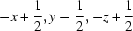
| Symmetry codes: (i) −x+1/2, y−1/2, −z+1/2; (ii) x+1/2, y−1/2, z; (iii) −x, −y+2, −z. |
Experimental details
| Crystal data | |
| Chemical formula | C10H9NO4 |
| Mr | 207.18 |
| Crystal system, space group | Monoclinic, C2/c |
| Temperature (K) | 90 |
| a, b, c (Å) | 24.491 (6), 3.753 (1), 23.428 (6) |
| β (°) | 116.98 (1) |
| V (Å3) | 1919.0 (9) |
| Z | 8 |
| Radiation type | Mo Kα |
| µ (mm−1) | 0.11 |
| Crystal size (mm) | 0.30 × 0.10 × 0.04 |
| Data collection | |
| Diffractometer | Nonius KappaCCD diffractometer |
| Absorption correction | Multi-scan (SCALEPACK; Otwinowski & Minor, 1997) |
| Tmin, Tmax | 0.967, 0.996 |
| No. of measured, independent and observed [I > 2σ(I)] reflections | 3936, 2193, 1380 |
| Rint | 0.049 |
| (sin θ/λ)max (Å−1) | 0.650 |
| Refinement | |
| R[F2 > 2σ(F2)], wR(F2), S | 0.053, 0.145, 1.04 |
| No. of reflections | 2193 |
| No. of parameters | 137 |
| H-atom treatment | H-atom parameters constrained |
| Δρmax, Δρmin (e Å−3) | 0.32, −0.29 |
Computer programs: COLLECT (Nonius, 2002), DENZO-SMN (Otwinowski & Minor, 1997), SHELXS97 (Sheldrick, 2008), XP in SHELXTL (Sheldrick, 2008), SHELXL97 (Sheldrick, 2008) and local procedures.
| D—H···A | D—H | H···A | D···A | D—H···A |
| C7—H7···O1i | 0.95 | 2.41 | 3.130 (2) | 132.7 |
| C1—H1B···O4ii | 0.95 | 2.64 | 3.546 (3) | 158.5 |
| C2—H2A···O3ii | 0.98 | 2.68 | 3.611 (2) | 158.5 |
| C9—H9···O4iii | 0.95 | 2.46 | 3.282 (2) | 145.3 |
| Symmetry codes: (i) −x+1/2, y−1/2, −z+1/2; (ii) x+1/2, y−1/2, z; (iii) −x, −y+2, −z. |
Acknowledgements
YX and FQ thank Dr Sihui Long for helpful discussions and invaluable suggestions.
References
 Banks, A. R., Fibiger, R. F. & Jones, T. (1977). J. Org. Chem. 42, 3965–3966. CrossRef CAS Web of Science Google Scholar
Hwang, J., Li, R. C. & Maynard, H. D. (2007). J. Controlled Release, 122, 279–286. Web of Science CrossRef CAS Google Scholar
Li, R. C., Hwang, J. & Maynard, H. D. (2007). Chem. Commun. 35, 3631–3633. Web of Science CrossRef Google Scholar
Nonius (2002). COLLECT. Nonius BV, Delft, The Netherlands. Google Scholar
Otsu, T., Ito, T., Fujii, Y. & Imoto, M. (1968). Bull. Chem. Soc. Jpn, 4, 204–207. CrossRef CAS Web of Science Google Scholar
Otwinowski, Z. & Minor, W. (1997). Methods in Enzymology, Vol. 276, Macromolecular Crystallography, Part A, edited by C. W. Carter Jr & R. M. Sweet, pp. 307–326. New York: Academic Press. Google Scholar
Sheldrick, G. M. (2008). Acta Cryst. A64, 112–122. Web of Science CrossRef CAS IUCr Journals Google Scholar
Tang, X., Hu, Y. & Pan, C. (2007). Polymer, 48, 6354–6365. Web of Science CrossRef CAS Google Scholar
This is an open-access article distributed under the terms of the Creative Commons Attribution (CC-BY) Licence, which permits unrestricted use, distribution, and reproduction in any medium, provided the original authors and source are cited.
| CRYSTALLOGRAPHIC COMMUNICATIONS |


The title compound (I) is an important building block in the preparation of functional block polymers (Tang, et al. 2007; Hwang, et al. 2007; Li, et al. 2007). Although it has been widely used as a monomer in polymerization reactions for a long time (Otsu, et al. 1968), the crystal structure, as far as we know, has never been reported before.
Traditonally, (I) has been synthesized by refluxing methacryloyl chloride and para-nitrophenol (Banks, et al. 1977). Here it was obtained unexpectedly during an attempt to make benzyl cyclohexylcarbamate as described in the experimental section.
The asymmetric unit of (I) (Fig. 1) contains one molecule and bond lengths and angles are within normal ranges. The molecule consists of two approximately planar parts: the nitrophenyl ring and the rest of the non-hydrogen atoms (dihedral angle between the two segments is 55.05 (6)°). The nitro group is nearly coplanar with the phenyl ring as indicated by the torsion angle O3-N1-C8-C7 of -7.48 °. The remaining non-hydrogen atoms are almost coplanar as suggested by the torsion angle C2-C3-C4-O1 at 9.35 °. Since (I) has no classic hydrogen bonding donors, the crystal packng is stabilized by C—H···O interactions (Table 1)in two directions with aromatic C-H atoms as the donors and both oxygen atoms of the nitro group and the carbonyl oxygen as the acceptors. There is also π-stacking along the third direction, the shortest (b), where the aromatic rings are separated by a unit cell translation of 3.753 (1) Å (Fig. 2).