Related literature
For the isostructural Zn and Co compounds, see: Shakeri & Haussuhl (1992![[Shakeri, V. & Haussuhl, S. (1992). Z. Kristallogr. 299, 198-199.]](../../../../../../logos/arrows/e_arr.gif "Shakeri, V. & Haussuhl, S. (1992). Z. Kristallogr. 299, 198-199.") ). For a similar layered structure, see: Cai et al. (2003).
). For a similar layered structure, see: Cai et al. (2003).
Experimental
Data collection
Bruker SMART CCD diffractometer Absorption correction: multi-scan (SADABS; Bruker, 2002) Tmin = 0.547, Tmax = 0.625 6604 measured reflections 1637 independent reflections 1585 reflections with I > 2σ(I) Rint = 0.015
|
| Mn1—O4 | 1.993 (3) | | Mn1—N1i | 2.058 (3) | | Mn1—O1 | 2.425 (3) | | | O4—Mn1—O4ii | 180 | | O4—Mn1—N1i | 92.95 (13) | | O4—Mn1—N1iii | 87.05 (13) | | N1i—Mn1—N1iii | 180 | | O4—Mn1—O1ii | 84.94 (12) | | O4—Mn1—O1 | 95.06 (12) | | N1i—Mn1—O1 | 86.66 (11) | | N1iii—Mn1—O1 | 93.34 (11) | | O1ii—Mn1—O1 | 180 | Symmetry codes: (i) 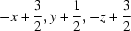 ; (ii) -x+1, -y+2, -z+1; (iii) ; (ii) -x+1, -y+2, -z+1; (iii) 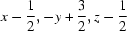 . .
| |
| D—H⋯A | D—H | H⋯A | D⋯A | D—H⋯A | | N1—H1B⋯O2iv | 0.90 | 2.46 | 2.980 (4) | 117 | | O5—H3W⋯O1 | 0.82 | 2.06 | 2.855 (5) | 164 | | C2—H2⋯O2 | 0.93 | 2.54 | 2.920 (5) | 105 | | N1—H1B⋯O2iii | 0.90 | 2.41 | 3.217 (4) | 149 | | O4—H2W⋯O5v | 0.83 | 1.83 | 2.651 (5) | 175 | | C2—H2⋯O5v | 0.93 | 2.53 | 3.431 (6) | 164 | | O4—H1W⋯O3vi | 0.82 | 2.02 | 2.795 (4) | 157 | | N1—H1A⋯O3vii | 0.90 | 2.24 | 3.070 (5) | 153 | | C3—H3⋯O3vii | 0.93 | 2.55 | 3.300 (5) | 138 | | O5—H4W⋯O2viii | 0.82 | 2.00 | 2.815 (5) | 175 | Symmetry codes: (iii) ; (iv) 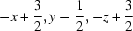 ; (v) x+1, y, z; (vi) x, y, z-1; (vii) ; (v) x+1, y, z; (vi) x, y, z-1; (vii) 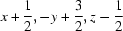 ; (viii) -x+1, -y+2, -z+2. ; (viii) -x+1, -y+2, -z+2.
| |
Data collection: SMART (Bruker, 2002); cell refinement: SAINT (Bruker, 2002); data reduction: SAINT; program(s) used to solve structure: SHELXS97 (Sheldrick, 2008); program(s) used to refine structure: SHELXL97 (Sheldrick, 2008); molecular graphics: SHELXTL (Sheldrick, 2008); software used to prepare material for publication: SHELXTL.
Supporting information
All the reagents were of AR grade and used without further purification. p-anilinesulfonic acid (0.8690 g, 5 mmol) were dissolved in 50 ml H2O solution, the mixed solution was basified with 1 mol.L-1 KOH to pH =7.5. Then the resultant solution was added in 10 ml double-distilled water containing MnCl2.4H2O (0.3950 g, 2 mmol), the resulting solution was heated at 423 K for 96 h. After cooling to room temperature, block crystals were obtained in a yield up to 37.6%.
H atoms bonded to O atoms were included in 'as found' positions and refined with Uiso(H)=1.5Ueq(O). Other H atoms were positioned geometrically and refined using a riding model, with C-H = 0.97 Å ; N-H = 0.90 Å and with Uiso(H)=1.2 times Ueq(C,N).
Data collection: SMART (Bruker, 2002); cell refinement: SAINT (Bruker, 2002); data reduction: SAINT (Bruker, 2002); program(s) used to solve structure: SHELXS97 (Sheldrick, 2008); program(s) used to refine structure: SHELXL97 (Sheldrick, 2008); molecular graphics: SHELXTL (Sheldrick, 2008); software used to prepare material for publication: SHELXTL (Sheldrick, 2008).
Poly[[bis(µ
2-4-aminobenzenesulfonato-
κ2N:O)diaquamanganese(II)] dihydrate]
top Crystal data top | [Mn(C6H6NO3S)2(H2O)2]·2H2O | F(000) = 486 |
| Mr = 471.36 | Dx = 1.766 Mg m−3 |
| Monoclinic, P21/n | Mo Kα radiation, λ = 0.71073 Å |
| Hall symbol: -P 2yn | Cell parameters from 2041 reflections |
| a = 7.4485 (8) Å | θ = 2.5–26.2° |
| b = 17.4102 (19) Å | µ = 1.04 mm−1 |
| c = 7.6509 (9) Å | T = 295 K |
| β = 116.688 (1)° | Block, yellow |
| V = 886.47 (17) Å3 | 0.49 × 0.45 × 0.45 mm |
| Z = 2 | |
Data collection top Bruker SMART CCD
diffractometer | 1637 independent reflections |
| Radiation source: fine-focus sealed tube | 1585 reflections with I > 2σ(I) |
| Graphite monochromator | Rint = 0.015 |
| Detector resolution: 0 pixels mm-1 | θmax = 25.5°, θmin = 2.3° |
| ϕ and ω scans | h = −9→9 |
Absorption correction: multi-scan
(SADABS; Bruker, 2002) | k = −19→20 |
| Tmin = 0.547, Tmax = 0.625 | l = −9→9 |
| 6604 measured reflections | |
Refinement top | Refinement on F2 | Primary atom site location: structure-invariant direct methods |
| Least-squares matrix: full | Secondary atom site location: difference Fourier map |
| R[F2 > 2σ(F2)] = 0.048 | Hydrogen site location: inferred from neighbouring sites |
| wR(F2) = 0.149 | H-atom parameters constrained |
| S = 1.11 | w = 1/[σ2(Fo2) + (0.0902P)2 + 2.4519P]
where P = (Fo2 + 2Fc2)/3 |
| 1637 reflections | (Δ/σ)max < 0.001 |
| 124 parameters | Δρmax = 1.19 e Å−3 |
| 0 restraints | Δρmin = −1.03 e Å−3 |
Crystal data top | [Mn(C6H6NO3S)2(H2O)2]·2H2O | V = 886.47 (17) Å3 |
| Mr = 471.36 | Z = 2 |
| Monoclinic, P21/n | Mo Kα radiation |
| a = 7.4485 (8) Å | µ = 1.04 mm−1 |
| b = 17.4102 (19) Å | T = 295 K |
| c = 7.6509 (9) Å | 0.49 × 0.45 × 0.45 mm |
| β = 116.688 (1)° | |
Data collection top Bruker SMART CCD
diffractometer | 1637 independent reflections |
Absorption correction: multi-scan
(SADABS; Bruker, 2002) | 1585 reflections with I > 2σ(I) |
| Tmin = 0.547, Tmax = 0.625 | Rint = 0.015 |
| 6604 measured reflections | |
Refinement top | R[F2 > 2σ(F2)] = 0.048 | 0 restraints |
| wR(F2) = 0.149 | H-atom parameters constrained |
| S = 1.11 | Δρmax = 1.19 e Å−3 |
| 1637 reflections | Δρmin = −1.03 e Å−3 |
| 124 parameters | |
Special details top Geometry. All e.s.d.'s (except the e.s.d. in the dihedral angle between two l.s. planes) are estimated using the full covariance matrix. The cell e.s.d.'s are taken into account individually in the estimation of e.s.d.'s in distances, angles and torsion angles; correlations between e.s.d.'s in cell parameters are only used when they are defined by crystal symmetry. An approximate (isotropic) treatment of cell e.s.d.'s is used for estimating e.s.d.'s involving l.s. planes. |
Refinement. Refinement of F2 against ALL reflections. The weighted R-factor wR and goodness of fit S are based on F2, conventional R-factors R are based on F, with F set to zero for negative F2. The threshold expression of F2 > σ(F2) is used only for calculating R-factors(gt) etc. and is not relevant to the choice of reflections for refinement. R-factors based on F2 are statistically about twice as large as those based on F, and R- factors based on ALL data will be even larger. |
Fractional atomic coordinates and isotropic or equivalent isotropic displacement parameters (Å2) top| | x | y | z | Uiso*/Ueq | |
| Mn1 | 0.5000 | 1.0000 | 0.5000 | 0.0103 (3) | |
| S1 | 0.65941 (14) | 0.89771 (5) | 0.94564 (13) | 0.0222 (3) | |
| O1 | 0.4931 (4) | 0.92302 (17) | 0.7611 (4) | 0.0299 (7) | |
| O2 | 0.8422 (4) | 0.94184 (16) | 0.9916 (4) | 0.0315 (7) | |
| O3 | 0.6018 (5) | 0.89731 (17) | 1.1046 (4) | 0.0333 (7) | |
| O4 | 0.7291 (5) | 0.9436 (2) | 0.4921 (4) | 0.0376 (8) | |
| H1W | 0.7114 | 0.9406 | 0.3785 | 0.056* | |
| H2W | 0.8495 | 0.9411 | 0.5706 | 0.056* | |
| N1 | 0.8133 (5) | 0.57368 (19) | 0.7847 (5) | 0.0265 (7) | |
| H1A | 0.8601 | 0.5771 | 0.6950 | 0.032* | |
| H1B | 0.6918 | 0.5512 | 0.7253 | 0.032* | |
| C1 | 0.7134 (6) | 0.8009 (2) | 0.9110 (5) | 0.0238 (8) | |
| C2 | 0.8724 (6) | 0.7854 (2) | 0.8697 (6) | 0.0307 (9) | |
| H2 | 0.9547 | 0.8250 | 0.8669 | 0.037* | |
| C3 | 0.9088 (6) | 0.7106 (2) | 0.8325 (6) | 0.0309 (9) | |
| H3 | 1.0167 | 0.6997 | 0.8065 | 0.037* | |
| C4 | 0.7828 (6) | 0.6515 (2) | 0.8344 (5) | 0.0236 (8) | |
| C5 | 0.6261 (6) | 0.6673 (2) | 0.8804 (6) | 0.0289 (9) | |
| H5 | 0.5452 | 0.6276 | 0.8857 | 0.035* | |
| C6 | 0.5900 (6) | 0.7421 (2) | 0.9184 (6) | 0.0288 (9) | |
| H6 | 0.4847 | 0.7529 | 0.9485 | 0.035* | |
| O5 | 0.1093 (5) | 0.9329 (2) | 0.7587 (5) | 0.0484 (9) | |
| H3W | 0.2066 | 0.9285 | 0.7362 | 0.073* | |
| H4W | 0.1188 | 0.9679 | 0.8342 | 0.073* | |
Atomic displacement parameters (Å2) top| | U11 | U22 | U33 | U12 | U13 | U23 |
| Mn1 | 0.0192 (4) | 0.0266 (4) | 0.0139 (4) | −0.0005 (2) | 0.0062 (3) | −0.0015 (2) |
| S1 | 0.0264 (5) | 0.0180 (5) | 0.0240 (5) | 0.0012 (3) | 0.0129 (4) | −0.0003 (3) |
| O1 | 0.0309 (15) | 0.0283 (15) | 0.0302 (15) | 0.0046 (12) | 0.0134 (12) | 0.0053 (12) |
| O2 | 0.0311 (15) | 0.0227 (15) | 0.0398 (16) | −0.0025 (12) | 0.0153 (13) | −0.0021 (12) |
| O3 | 0.0452 (18) | 0.0300 (16) | 0.0328 (15) | 0.0003 (13) | 0.0246 (14) | −0.0025 (12) |
| O4 | 0.0328 (16) | 0.050 (2) | 0.0276 (15) | 0.0088 (14) | 0.0110 (13) | −0.0041 (14) |
| N1 | 0.0320 (18) | 0.0209 (17) | 0.0281 (17) | −0.0011 (13) | 0.0147 (15) | −0.0042 (13) |
| C1 | 0.0269 (19) | 0.0205 (18) | 0.0237 (18) | 0.0017 (15) | 0.0110 (15) | −0.0006 (14) |
| C2 | 0.036 (2) | 0.021 (2) | 0.042 (2) | −0.0019 (16) | 0.023 (2) | −0.0006 (17) |
| C3 | 0.031 (2) | 0.027 (2) | 0.042 (2) | 0.0011 (17) | 0.0226 (19) | −0.0010 (17) |
| C4 | 0.028 (2) | 0.0185 (18) | 0.0210 (18) | 0.0038 (14) | 0.0081 (15) | 0.0015 (14) |
| C5 | 0.031 (2) | 0.025 (2) | 0.032 (2) | −0.0039 (16) | 0.0153 (17) | 0.0010 (16) |
| C6 | 0.032 (2) | 0.025 (2) | 0.035 (2) | 0.0006 (16) | 0.0199 (18) | −0.0024 (16) |
| O5 | 0.0323 (17) | 0.064 (2) | 0.051 (2) | −0.0065 (16) | 0.0208 (16) | −0.0216 (18) |
Geometric parameters (Å, º) top | Mn1—O4 | 1.993 (3) | N1—H1A | 0.9000 |
| Mn1—O4i | 1.993 (3) | N1—H1B | 0.9000 |
| Mn1—N1ii | 2.058 (3) | C1—C2 | 1.383 (6) |
| Mn1—N1iii | 2.058 (3) | C1—C6 | 1.393 (6) |
| Mn1—O1i | 2.425 (3) | C2—C3 | 1.385 (6) |
| Mn1—O1 | 2.425 (3) | C2—H2 | 0.9300 |
| S1—O3 | 1.460 (3) | C3—C4 | 1.396 (6) |
| S1—O2 | 1.462 (3) | C3—H3 | 0.9300 |
| S1—O1 | 1.467 (3) | C4—C5 | 1.390 (6) |
| S1—C1 | 1.780 (4) | C5—C6 | 1.387 (6) |
| O4—H1W | 0.8200 | C5—H5 | 0.9300 |
| O4—H2W | 0.8267 | C6—H6 | 0.9300 |
| N1—C4 | 1.453 (5) | O5—H3W | 0.8197 |
| N1—Mn1iv | 2.058 (3) | O5—H4W | 0.8216 |
| | | |
| O4—Mn1—O4i | 180 | C4—N1—Mn1iv | 120.1 (2) |
| O4—Mn1—N1ii | 92.95 (13) | C4—N1—H1A | 107.3 |
| O4i—Mn1—N1ii | 87.05 (13) | Mn1iv—N1—H1A | 107.3 |
| O4—Mn1—N1iii | 87.05 (13) | C4—N1—H1B | 107.3 |
| O4i—Mn1—N1iii | 92.95 (13) | Mn1iv—N1—H1B | 107.3 |
| N1ii—Mn1—N1iii | 180 | H1A—N1—H1B | 106.9 |
| O4—Mn1—O1i | 84.94 (12) | C2—C1—C6 | 121.0 (4) |
| O4i—Mn1—O1i | 95.06 (12) | C2—C1—S1 | 119.5 (3) |
| N1ii—Mn1—O1i | 93.34 (11) | C6—C1—S1 | 119.5 (3) |
| N1iii—Mn1—O1i | 86.66 (11) | C1—C2—C3 | 119.8 (4) |
| O4—Mn1—O1 | 95.06 (12) | C1—C2—H2 | 120.1 |
| O4i—Mn1—O1 | 84.94 (12) | C3—C2—H2 | 120.1 |
| N1ii—Mn1—O1 | 86.66 (11) | C2—C3—C4 | 119.7 (4) |
| N1iii—Mn1—O1 | 93.34 (11) | C2—C3—H3 | 120.1 |
| O1i—Mn1—O1 | 180 | C4—C3—H3 | 120.1 |
| O3—S1—O2 | 113.12 (18) | C5—C4—C3 | 120.1 (4) |
| O3—S1—O1 | 111.46 (18) | C5—C4—N1 | 119.9 (4) |
| O2—S1—O1 | 111.50 (18) | C3—C4—N1 | 119.9 (4) |
| O3—S1—C1 | 106.85 (18) | C6—C5—C4 | 120.2 (4) |
| O2—S1—C1 | 106.57 (18) | C6—C5—H5 | 119.9 |
| O1—S1—C1 | 106.90 (18) | C4—C5—H5 | 119.9 |
| S1—O1—Mn1 | 129.61 (17) | C5—C6—C1 | 119.2 (4) |
| Mn1—O4—H1W | 109.4 | C5—C6—H6 | 120.4 |
| Mn1—O4—H2W | 132.0 | C1—C6—H6 | 120.4 |
| H1W—O4—H2W | 111.8 | H3W—O5—H4W | 114.3 |
| | | |
| O3—S1—O1—Mn1 | 143.8 (2) | C6—C1—C2—C3 | 0.8 (6) |
| O2—S1—O1—Mn1 | 16.3 (3) | S1—C1—C2—C3 | −176.6 (3) |
| C1—S1—O1—Mn1 | −99.8 (2) | C1—C2—C3—C4 | 0.9 (6) |
| O4—Mn1—O1—S1 | 45.3 (2) | C2—C3—C4—C5 | −2.4 (6) |
| O4i—Mn1—O1—S1 | −134.7 (2) | C2—C3—C4—N1 | 176.5 (4) |
| N1ii—Mn1—O1—S1 | −47.3 (2) | Mn1iv—N1—C4—C5 | −91.0 (4) |
| N1iii—Mn1—O1—S1 | 132.7 (2) | Mn1iv—N1—C4—C3 | 90.1 (4) |
| O3—S1—C1—C2 | −141.2 (3) | C3—C4—C5—C6 | 2.1 (6) |
| O2—S1—C1—C2 | −20.0 (4) | N1—C4—C5—C6 | −176.8 (4) |
| O1—S1—C1—C2 | 99.4 (3) | C4—C5—C6—C1 | −0.4 (6) |
| O3—S1—C1—C6 | 41.3 (4) | C2—C1—C6—C5 | −1.1 (6) |
| O2—S1—C1—C6 | 162.5 (3) | S1—C1—C6—C5 | 176.4 (3) |
| O1—S1—C1—C6 | −78.2 (4) | | |
| Symmetry codes: (i) −x+1, −y+2, −z+1; (ii) −x+3/2, y+1/2, −z+3/2; (iii) x−1/2, −y+3/2, z−1/2; (iv) −x+3/2, y−1/2, −z+3/2. |
Hydrogen-bond geometry (Å, º) top | D—H···A | D—H | H···A | D···A | D—H···A |
| N1—H1B···O2iv | 0.90 | 2.46 | 2.980 (4) | 117 |
| O5—H3W···O1 | 0.82 | 2.06 | 2.855 (5) | 164 |
| C2—H2···O2 | 0.93 | 2.54 | 2.920 (5) | 105 |
| N1—H1B···O2iii | 0.90 | 2.41 | 3.217 (4) | 149 |
| O4—H2W···O5v | 0.83 | 1.83 | 2.651 (5) | 175 |
| C2—H2···O5v | 0.93 | 2.53 | 3.431 (6) | 164 |
| O4—H1W···O3vi | 0.82 | 2.02 | 2.795 (4) | 157 |
| N1—H1A···O3vii | 0.90 | 2.24 | 3.070 (5) | 153 |
| C3—H3···O3vii | 0.93 | 2.55 | 3.300 (5) | 138 |
| O5—H4W···O2viii | 0.82 | 2.00 | 2.815 (5) | 175 |
| Symmetry codes: (iii) x−1/2, −y+3/2, z−1/2; (iv) −x+3/2, y−1/2, −z+3/2; (v) x+1, y, z; (vi) x, y, z−1; (vii) x+1/2, −y+3/2, z−1/2; (viii) −x+1, −y+2, −z+2. |
Experimental details
| Crystal data |
| Chemical formula | [Mn(C6H6NO3S)2(H2O)2]·2H2O |
| Mr | 471.36 |
| Crystal system, space group | Monoclinic, P21/n |
| Temperature (K) | 295 |
| a, b, c (Å) | 7.4485 (8), 17.4102 (19), 7.6509 (9) |
| β (°) | 116.688 (1) |
| V (Å3) | 886.47 (17) |
| Z | 2 |
| Radiation type | Mo Kα |
| µ (mm−1) | 1.04 |
| Crystal size (mm) | 0.49 × 0.45 × 0.45 |
| |
| Data collection |
| Diffractometer | Bruker SMART CCD
diffractometer |
| Absorption correction | Multi-scan
(SADABS; Bruker, 2002) |
| Tmin, Tmax | 0.547, 0.625 |
No. of measured, independent and
observed [I > 2σ(I)] reflections | 6604, 1637, 1585 |
| Rint | 0.015 |
| (sin θ/λ)max (Å−1) | 0.606 |
| |
| Refinement |
| R[F2 > 2σ(F2)], wR(F2), S | 0.048, 0.149, 1.11 |
| No. of reflections | 1637 |
| No. of parameters | 124 |
| H-atom treatment | H-atom parameters constrained |
| Δρmax, Δρmin (e Å−3) | 1.19, −1.03 |
Selected geometric parameters (Å, º) top| Mn1—O4 | 1.993 (3) | Mn1—O1 | 2.425 (3) |
| Mn1—N1i | 2.058 (3) | | |
| | | |
| O4—Mn1—O4ii | 180 | O4—Mn1—O1 | 95.06 (12) |
| O4—Mn1—N1i | 92.95 (13) | O4ii—Mn1—O1 | 84.94 (12) |
| O4—Mn1—N1iii | 87.05 (13) | N1i—Mn1—O1 | 86.66 (11) |
| N1i—Mn1—N1iii | 180 | N1iii—Mn1—O1 | 93.34 (11) |
| O4—Mn1—O1ii | 84.94 (12) | O1ii—Mn1—O1 | 180 |
| Symmetry codes: (i) −x+3/2, y+1/2, −z+3/2; (ii) −x+1, −y+2, −z+1; (iii) x−1/2, −y+3/2, z−1/2. |
Hydrogen-bond geometry (Å, º) top | D—H···A | D—H | H···A | D···A | D—H···A |
| N1—H1B···O2iv | 0.90 | 2.46 | 2.980 (4) | 116.9 |
| O5—H3W···O1 | 0.82 | 2.06 | 2.855 (5) | 164.2 |
| C2—H2···O2 | 0.93 | 2.54 | 2.920 (5) | 104.7 |
| N1—H1B···O2iii | 0.90 | 2.41 | 3.217 (4) | 149.2 |
| O4—H2W···O5v | 0.83 | 1.83 | 2.651 (5) | 175.4 |
| C2—H2···O5v | 0.93 | 2.53 | 3.431 (6) | 163.9 |
| O4—H1W···O3vi | 0.82 | 2.02 | 2.795 (4) | 156.9 |
| N1—H1A···O3vii | 0.90 | 2.24 | 3.070 (5) | 152.5 |
| C3—H3···O3vii | 0.93 | 2.55 | 3.300 (5) | 137.5 |
| O5—H4W···O2viii | 0.82 | 2.00 | 2.815 (5) | 174.7 |
| Symmetry codes: (iii) x−1/2, −y+3/2, z−1/2; (iv) −x+3/2, y−1/2, −z+3/2; (v) x+1, y, z; (vi) x, y, z−1; (vii) x+1/2, −y+3/2, z−1/2; (viii) −x+1, −y+2, −z+2. |
Acknowledgements
We thank the Natural Science Foundation of Henan Province and the Key Discipline Foundation of Zhoukou Normal University for financial support of this research.
References
 Bruker (2002). SMART, SAINT and SADABS. Bruker AXS Inc., Madison, Wisconsin, USA. Google Scholar
Cai, J., Zhou, J.-S. & Lin, M.-L. (2003). J. Mater. Chem. 13, 1806–1808. Web of Science CrossRef CAS Google Scholar
Shakeri, V. & Haussuhl, S. (1992). Z. Kristallogr. 299, 198–199. Google Scholar
Sheldrick, G. M. (2008). Acta Cryst. A64, 112–122. Web of Science CrossRef CAS IUCr Journals Google Scholar
This is an open-access article distributed under the terms of the Creative Commons Attribution (CC-BY) Licence, which permits unrestricted use, distribution, and reproduction in any medium, provided the original authors and source are cited.
 | CRYSTALLOGRAPHIC
COMMUNICATIONS |
ISSN: 2056-9890
Open

access


 journal menu



![[Scheme 1]](lh2671scheme1.gif)
![[Figure 1]](./lh2671fig1thm.gif)
![[Figure 2]](./lh2671fig2thm.gif)


The asymmetric unit of the title compound (I) is illustrated in Fig.1. This consists of one half of MnII ion, one 4-aminobenzenesulfonate ligand, one coordinated water molecule and one solvent water molecule. The title compound is isostructural with the Cobalt and Zinc analogs (Shakeri & Haussuhl, 1992). It is interesting to note that the title compound has very similar layered structure as that observed in [Cd(1,5 nds)-(H2O)2]n (Cai et al., 2003) (1,5-nds = 1,5-naphthalenedisulfonate) in which the CdII ion is also coordinated octahedrally by two water molecules occupying the axial positions and the layers are connected by hydrogen bonds formed between the coordinated water molecules and the sulfonate O atoms. In the crystal structure of (I) inter-layered hydrogen bonds formed between the coordinated water molecules and the –NH2 groups with the free –SO3- oxygen atoms generate an extended 3-D structure (Fig.2)