 | Acta Crystallographica Section E Acta Crystallographica Section E CRYSTALLOGRAPHIC COMMUNICATIONS |


 journal menu


organic compounds
| CRYSTALLOGRAPHIC COMMUNICATIONS |
 access
A second monoclinic polymorph of 2-amino-4,6-dichloropyrimidine

aX-ray Crystallography Unit, School of Physics, Universiti Sains Malaysia, 11800 USM, Penang, Malaysia, bCrystal Materials Research Unit, Department of Chemistry, Faculty of Science, Prince of Songkla University, Hat-Yai, Songkhla 90112, Thailand, and cDepartment of Chemistry, Bengal Engineering and Science University', Shibpur, Howrah, India 711 103
*Correspondence e-mail: [email protected]
The title chloro-substituted 2-aminopyrimidine, C4H3Cl2N3, is a second monoclinic polymorph of this compound which crystallizes in the space group C2/c. The structure was previously reported [Clews & Cochran (1948![[Clews, C. J. B. & Cochran, W. (1948). Acta Cryst. 1, 4-11.]](../../../../../../logos/arrows/e_arr.gif "Clews, C. J. B. & Cochran, W. (1948). Acta Cryst. 1, 4-11.") ). Acta Cryst. 1, 4–11] in the space group P21/a. There are two crystallographically independent molecules in the asymmetric unit and each molecule is planar. The dihedral angle between the two pyrimidine rings is 30.71 (12)°. In the crystal structure, molecules are linked via N—H⋯N intermolecular hydrogen bonds, forming infinite one-dimensional chains along the a axis. These hydrogen bonds generate R22(8) ring motifs. The chains are stacked along the b axis.
). Acta Cryst. 1, 4–11] in the space group P21/a. There are two crystallographically independent molecules in the asymmetric unit and each molecule is planar. The dihedral angle between the two pyrimidine rings is 30.71 (12)°. In the crystal structure, molecules are linked via N—H⋯N intermolecular hydrogen bonds, forming infinite one-dimensional chains along the a axis. These hydrogen bonds generate R22(8) ring motifs. The chains are stacked along the b axis.
Related literature
For bond-length data, see: Allen et al. (1987). For details of hydrogen-bond motifs, see: Bernstein et al. (1995). For related structures, see: the polymorph reported by Clews & Cochran (1948); Low et al. (2002). For applications of pyrimidine compounds and their supramolecular chemistry, see, for example: Blackburn & Gait (1996); Brown (1988); Hurst (1980); Goswami et al. (2008a,b); Ligthart et al. (2005); Sherrington & Taskinen (2001).
![[Scheme 1]](sj2524scheme1.gif)
Experimental
Crystal data
|
Refinement
|
|
 .
. Data collection: APEX2 (Bruker, 2005); cell refinement: APEX2; data reduction: SAINT (Bruker, 2005); program(s) used to solve structure: SHELXTL (Sheldrick, 2008); program(s) used to refine structure: SHELXTL; molecular graphics: SHELXTL; software used to prepare material for publication: SHELXTL and PLATON (Spek, 2003).
Supporting information
contains datablocks global, I. DOI: 10.1107/S1600536808023714/sj2524sup1.cif
Structure factors: contains datablock I. DOI: 10.1107/S1600536808023714/sj2524Isup2.hkl
Phosphorus oxy-chloride (POCl3) (25 ml) was added to anhydrous 2-amino-4,6-dioxopyrimidine (6 g) and the mixture refluxed at 383 K for 12 h. Excess POCl3 was distilled off. The solid residue was neutralized using KOH solution in an ice bath and saturated NaHCO3 solution was added. The solid residue was filtered off, extracted with CHCl3 and the solution was dried over Na2SO4 and then concentrated under vacuum. The crude product was purified by using 20% ethyl acetate in petroleum ether as and the title compound (I) (4.29 g, 61%) was isolated. Single crystals were grown by slow evaporation of a CH2Cl2/ethanol (v/v 3:1) solution, Mp. 492–494 K.
All H atoms were located in a difference map and freely refined isotropically. The highest residual electron density peak is located at 1.00 Å from N2A and the deepest hole is located at 0.81 Å from H2NA.
Data collection: APEX2 (Bruker, 2005); cell APEX2 (Bruker, 2005); data reduction: SAINT (Bruker, 2005); program(s) used to solve structure: SHELXTL (Sheldrick, 2008); program(s) used to refine structure: SHELXTL (Sheldrick, 2008); molecular graphics: SHELXTL (Sheldrick, 2008); software used to prepare material for publication: SHELXTL and PLATON (Spek, 2003).
![[Figure 1]](./sj2524fig1thm.gif) | Fig. 1. The molecular structure of the title compound, showing 50% probability displacement ellipsoids and the atomic numbering. |
![[Figure 2]](./sj2524fig2thm.gif) | Fig. 2. The crystal packing of (I), viewed approximately along the b axis showing one-dimensional chains along the a axis. Hydrogen bonds were shown as dashed lines. |
| C4H3Cl2N3 | F(000) = 1312 |
| Mr = 163.99 | Dx = 1.716 Mg m−3 |
| Monoclinic, C2/c | Melting point = 492–494 K |
| Hall symbol: -C 2yc | Mo Kα radiation, λ = 0.71073 Å |
| a = 32.060 (4) Å | Cell parameters from 2886 reflections |
| b = 3.8045 (6) Å | θ = 1.3–27.5° |
| c = 21.302 (3) Å | µ = 0.92 mm−1 |
| β = 102.193 (7)° | T = 296 K |
| V = 2539.6 (6) Å3 | Block, colorless |
| Z = 16 | 0.57 × 0.14 × 0.02 mm |
| Bruker SMART APEX2 CCD area-detector diffractometer | 2886 independent reflections |
| Radiation source: fine-focus sealed tube | 1875 reflections with I > 2σ(I) |
| Graphite monochromator | Rint = 0.051 |
| Detector resolution: 8.33 pixels mm-1 | θmax = 27.5°, θmin = 1.3° |
| ω scans | h = −40→40 |
| Absorption correction: multi-scan (SADABS; Bruker, 2005) | k = −4→4 |
| Tmin = 0.620, Tmax = 0.985 | l = −27→27 |
| 12772 measured reflections |
| Refinement on F2 | Primary atom site location: structure-invariant direct methods |
| Least-squares matrix: full | Secondary atom site location: difference Fourier map |
| R[F2 > 2σ(F2)] = 0.040 | Hydrogen site location: inferred from neighbouring sites |
| wR(F2) = 0.098 | All H-atom parameters refined |
| S = 1.02 | w = 1/[σ2(Fo2) + (0.0403P)2] where P = (Fo2 + 2Fc2)/3 |
| 2886 reflections | (Δ/σ)max = 0.001 |
| 187 parameters | Δρmax = 0.22 e Å−3 |
| 0 restraints | Δρmin = −0.24 e Å−3 |
| C4H3Cl2N3 | V = 2539.6 (6) Å3 |
| Mr = 163.99 | Z = 16 |
| Monoclinic, C2/c | Mo Kα radiation |
| a = 32.060 (4) Å | µ = 0.92 mm−1 |
| b = 3.8045 (6) Å | T = 296 K |
| c = 21.302 (3) Å | 0.57 × 0.14 × 0.02 mm |
| β = 102.193 (7)° |
| Bruker SMART APEX2 CCD area-detector diffractometer | 2886 independent reflections |
| Absorption correction: multi-scan (SADABS; Bruker, 2005) | 1875 reflections with I > 2σ(I) |
| Tmin = 0.620, Tmax = 0.985 | Rint = 0.051 |
| 12772 measured reflections |
| R[F2 > 2σ(F2)] = 0.040 | 0 restraints |
| wR(F2) = 0.098 | All H-atom parameters refined |
| S = 1.02 | Δρmax = 0.22 e Å−3 |
| 2886 reflections | Δρmin = −0.24 e Å−3 |
| 187 parameters |
Geometry. All e.s.d.'s (except the e.s.d. in the dihedral angle between two l.s. planes) are estimated using the full covariance matrix. The cell e.s.d.'s are taken into account individually in the estimation of e.s.d.'s in distances, angles and torsion angles; correlations between e.s.d.'s in cell parameters are only used when they are defined by crystal symmetry. An approximate (isotropic) treatment of cell e.s.d.'s is used for estimating e.s.d.'s involving l.s. planes. |
Refinement. Refinement of F2 against ALL reflections. The weighted R-factor wR and goodness of fit S are based on F2, conventional R-factors R are based on F, with F set to zero for negative F2. The threshold expression of F2 > σ(F2) is used only for calculating R-factors(gt) etc. and is not relevant to the choice of reflections for refinement. R-factors based on F2 are statistically about twice as large as those based on F, and R- factors based on ALL data will be even larger. |
| x | y | z | Uiso*/Ueq | ||
| Cl1A | 0.330814 (19) | 0.45738 (18) | 0.35093 (3) | 0.0475 (2) | |
| Cl2A | 0.49584 (2) | 0.5271 (2) | 0.33992 (4) | 0.0572 (2) | |
| N1A | 0.46421 (6) | 0.7708 (5) | 0.43348 (9) | 0.0371 (5) | |
| N2A | 0.38986 (6) | 0.7401 (5) | 0.43849 (9) | 0.0349 (5) | |
| N3A | 0.43941 (8) | 0.9927 (7) | 0.51907 (11) | 0.0490 (6) | |
| H2NA | 0.4619 (8) | 1.056 (7) | 0.5293 (12) | 0.033 (8)* | |
| H1NA | 0.4174 (9) | 1.026 (7) | 0.5366 (14) | 0.057 (9)* | |
| C1A | 0.38306 (7) | 0.5786 (6) | 0.38271 (11) | 0.0338 (6) | |
| C2A | 0.41389 (8) | 0.5008 (7) | 0.34867 (12) | 0.0377 (6) | |
| H2A | 0.4102 (7) | 0.386 (6) | 0.3120 (11) | 0.034 (7)* | |
| C3A | 0.45423 (7) | 0.6088 (7) | 0.37766 (11) | 0.0353 (6) | |
| C4A | 0.43110 (7) | 0.8296 (7) | 0.46279 (11) | 0.0350 (6) | |
| Cl1B | 0.58263 (2) | 1.02542 (19) | 0.31034 (3) | 0.0510 (2) | |
| Cl2B | 0.73894 (2) | 0.50031 (18) | 0.32094 (3) | 0.0474 (2) | |
| N1B | 0.71199 (6) | 0.7404 (6) | 0.41918 (9) | 0.0389 (5) | |
| N2B | 0.64127 (6) | 0.9690 (6) | 0.41463 (9) | 0.0406 (5) | |
| N3B | 0.69119 (9) | 0.9534 (8) | 0.50908 (11) | 0.0589 (7) | |
| H1NB | 0.6706 (10) | 1.049 (8) | 0.5237 (16) | 0.080 (12)* | |
| H2NB | 0.7156 (10) | 0.881 (9) | 0.5264 (16) | 0.075 (11)* | |
| C1B | 0.63348 (7) | 0.9103 (6) | 0.35235 (12) | 0.0364 (6) | |
| C2B | 0.66172 (7) | 0.7709 (7) | 0.31888 (11) | 0.0374 (6) | |
| H2B | 0.6550 (7) | 0.753 (7) | 0.2743 (12) | 0.047 (7)* | |
| C3B | 0.70066 (7) | 0.6887 (7) | 0.35702 (11) | 0.0361 (6) | |
| C4B | 0.68134 (8) | 0.8851 (7) | 0.44634 (11) | 0.0403 (6) |
| U11 | U22 | U33 | U12 | U13 | U23 | |
| Cl1A | 0.0320 (3) | 0.0586 (5) | 0.0491 (4) | −0.0065 (3) | 0.0027 (3) | −0.0029 (3) |
| Cl2A | 0.0442 (4) | 0.0698 (5) | 0.0658 (5) | −0.0003 (4) | 0.0298 (3) | −0.0132 (4) |
| N1A | 0.0293 (10) | 0.0422 (13) | 0.0402 (11) | 0.0003 (10) | 0.0086 (9) | −0.0014 (11) |
| N2A | 0.0295 (10) | 0.0416 (13) | 0.0339 (10) | 0.0028 (10) | 0.0073 (8) | −0.0013 (10) |
| N3A | 0.0351 (14) | 0.0707 (19) | 0.0418 (13) | −0.0073 (14) | 0.0093 (11) | −0.0161 (13) |
| C1A | 0.0293 (12) | 0.0320 (14) | 0.0385 (13) | −0.0009 (11) | 0.0040 (10) | 0.0039 (11) |
| C2A | 0.0378 (14) | 0.0402 (16) | 0.0355 (13) | −0.0012 (13) | 0.0087 (11) | −0.0057 (13) |
| C3A | 0.0338 (13) | 0.0354 (14) | 0.0396 (13) | 0.0033 (12) | 0.0141 (10) | 0.0001 (12) |
| C4A | 0.0327 (13) | 0.0404 (15) | 0.0315 (12) | −0.0020 (12) | 0.0060 (10) | 0.0013 (12) |
| Cl1B | 0.0344 (4) | 0.0669 (5) | 0.0514 (4) | 0.0072 (4) | 0.0083 (3) | 0.0056 (4) |
| Cl2B | 0.0358 (3) | 0.0566 (4) | 0.0546 (4) | −0.0001 (3) | 0.0204 (3) | −0.0103 (3) |
| N1B | 0.0355 (11) | 0.0438 (13) | 0.0386 (11) | 0.0036 (11) | 0.0109 (9) | 0.0016 (10) |
| N2B | 0.0388 (12) | 0.0481 (14) | 0.0377 (11) | 0.0044 (11) | 0.0143 (9) | 0.0001 (11) |
| N3B | 0.0534 (17) | 0.087 (2) | 0.0368 (13) | 0.0187 (16) | 0.0102 (12) | −0.0034 (13) |
| C1B | 0.0315 (13) | 0.0386 (15) | 0.0407 (13) | 0.0001 (12) | 0.0112 (10) | 0.0014 (12) |
| C2B | 0.0352 (14) | 0.0465 (17) | 0.0328 (13) | −0.0025 (13) | 0.0123 (11) | −0.0036 (13) |
| C3B | 0.0329 (13) | 0.0369 (15) | 0.0416 (14) | −0.0031 (12) | 0.0151 (11) | −0.0009 (12) |
| C4B | 0.0398 (15) | 0.0477 (16) | 0.0352 (13) | 0.0043 (13) | 0.0122 (11) | 0.0023 (12) |
| Cl1A—C1A | 1.731 (2) | Cl1B—C1B | 1.742 (2) |
| Cl2A—C3A | 1.725 (2) | Cl2B—C3B | 1.735 (2) |
| N1A—C3A | 1.317 (3) | N1B—C3B | 1.312 (3) |
| N1A—C4A | 1.359 (3) | N1B—C4B | 1.358 (3) |
| N2A—C1A | 1.314 (3) | N2B—C1B | 1.316 (3) |
| N2A—C4A | 1.357 (3) | N2B—C4B | 1.357 (3) |
| N3A—C4A | 1.326 (3) | N3B—C4B | 1.332 (3) |
| N3A—H2NA | 0.75 (2) | N3B—H1NB | 0.87 (3) |
| N3A—H1NA | 0.87 (3) | N3B—H2NB | 0.84 (3) |
| C1A—C2A | 1.376 (3) | C1B—C2B | 1.372 (3) |
| C2A—C3A | 1.373 (3) | C2B—C3B | 1.374 (3) |
| C2A—H2A | 0.88 (2) | C2B—H2B | 0.93 (2) |
| C3A—N1A—C4A | 115.3 (2) | C3B—N1B—C4B | 114.8 (2) |
| C1A—N2A—C4A | 115.11 (19) | C1B—N2B—C4B | 114.9 (2) |
| C4A—N3A—H2NA | 114 (2) | C4B—N3B—H1NB | 114 (2) |
| C4A—N3A—H1NA | 115.4 (19) | C4B—N3B—H2NB | 112 (2) |
| H2NA—N3A—H1NA | 130 (3) | H1NB—N3B—H2NB | 134 (3) |
| N2A—C1A—C2A | 125.2 (2) | N2B—C1B—C2B | 125.7 (2) |
| N2A—C1A—Cl1A | 116.12 (18) | N2B—C1B—Cl1B | 115.67 (18) |
| C2A—C1A—Cl1A | 118.68 (19) | C2B—C1B—Cl1B | 118.62 (19) |
| C3A—C2A—C1A | 114.3 (2) | C1B—C2B—C3B | 113.4 (2) |
| C3A—C2A—H2A | 118.9 (14) | C1B—C2B—H2B | 121.6 (15) |
| C1A—C2A—H2A | 126.7 (15) | C3B—C2B—H2B | 124.8 (14) |
| N1A—C3A—C2A | 124.9 (2) | N1B—C3B—C2B | 125.9 (2) |
| N1A—C3A—Cl2A | 116.14 (18) | N1B—C3B—Cl2B | 115.99 (17) |
| C2A—C3A—Cl2A | 118.95 (19) | C2B—C3B—Cl2B | 118.12 (18) |
| N3A—C4A—N2A | 117.1 (2) | N3B—C4B—N2B | 116.9 (2) |
| N3A—C4A—N1A | 117.7 (2) | N3B—C4B—N1B | 117.8 (2) |
| N2A—C4A—N1A | 125.2 (2) | N2B—C4B—N1B | 125.3 (2) |
| D—H···A | D—H | H···A | D···A | D—H···A |
| N3A—H2NA···N1Ai | 0.75 (3) | 2.43 (3) | 3.172 (3) | 176 (2) |
| N3A—H1NA···N2Bi | 0.87 (3) | 2.33 (3) | 3.201 (3) | 172 (2) |
| N3B—H1NB···N2Ai | 0.87 (3) | 2.39 (3) | 3.253 (4) | 174 (3) |
| N3B—H2NB···N1Bii | 0.84 (3) | 2.41 (3) | 3.242 (3) | 172 (3) |
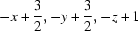
| Symmetry codes: (i) −x+1, −y+2, −z+1; (ii) −x+3/2, −y+3/2, −z+1. |
Experimental details
| Crystal data | |
| Chemical formula | C4H3Cl2N3 |
| Mr | 163.99 |
| Crystal system, space group | Monoclinic, C2/c |
| Temperature (K) | 296 |
| a, b, c (Å) | 32.060 (4), 3.8045 (6), 21.302 (3) |
| β (°) | 102.193 (7) |
| V (Å3) | 2539.6 (6) |
| Z | 16 |
| Radiation type | Mo Kα |
| µ (mm−1) | 0.92 |
| Crystal size (mm) | 0.57 × 0.14 × 0.02 |
| Data collection | |
| Diffractometer | Bruker SMART APEX2 CCD area-detector diffractometer |
| Absorption correction | Multi-scan (SADABS; Bruker, 2005) |
| Tmin, Tmax | 0.620, 0.985 |
| No. of measured, independent and observed [I > 2σ(I)] reflections | 12772, 2886, 1875 |
| Rint | 0.051 |
| (sin θ/λ)max (Å−1) | 0.650 |
| Refinement | |
| R[F2 > 2σ(F2)], wR(F2), S | 0.040, 0.098, 1.02 |
| No. of reflections | 2886 |
| No. of parameters | 187 |
| H-atom treatment | All H-atom parameters refined |
| Δρmax, Δρmin (e Å−3) | 0.22, −0.24 |
Computer programs: APEX2 (Bruker, 2005), SAINT (Bruker, 2005), SHELXTL (Sheldrick, 2008), SHELXTL and PLATON (Spek, 2003).
| D—H···A | D—H | H···A | D···A | D—H···A |
| N3A—H2NA···N1Ai | 0.75 (3) | 2.43 (3) | 3.172 (3) | 176 (2) |
| N3A—H1NA···N2Bi | 0.87 (3) | 2.33 (3) | 3.201 (3) | 172 (2) |
| N3B—H1NB···N2Ai | 0.87 (3) | 2.39 (3) | 3.253 (4) | 174 (3) |
| N3B—H2NB···N1Bii | 0.84 (3) | 2.41 (3) | 3.242 (3) | 172 (3) |
| Symmetry codes: (i) −x+1, −y+2, −z+1; (ii) −x+3/2, −y+3/2, −z+1. |
Footnotes
‡Additional correspondence author, email: [email protected].
Acknowledgements
SJ, RC and SG acknowledge the DST [SR/S1/OC-13/2005] and CSIR [01(1913)/04/EMR-II], Government of India for financial support. SJ and RC thank the CSIR, Government of India, for research fellowships. The authors also thank Universiti Sains Malaysia for the Research University Golden Goose Grant No. 1001/PFIZIK/811012.
References
 Allen, F. H., Kennard, O., Watson, D. G., Brammer, L., Orpen, A. G. & Taylor, R. (1987). J. Chem. Soc. Perkin Trans. 2, pp. S1–S19. CrossRef Web of Science Google Scholar
Bernstein, J., Davis, R. E., Shimoni, L. & Chang, N.-L. (1995). Angew. Chem. Int. Ed. Engl. 34, 1555–1573. CrossRef CAS Web of Science Google Scholar
Blackburn, G. M. & Gait, M. J. (1996). Nucleic Acids in Chemistry and Biology. Editors. Oxford University Press. Google Scholar
Brown, D. J. (1988). Fused Pyrimidines The Chemistry of Heterocyclic Compounds, Vol. 24, pt. 3. New York: John Wiley & Sons. Google Scholar
Bruker (2005). APEX2, SAINT and SADABS. Bruker AXS Inc., Madison, Wisconsin, USA. Google Scholar
Clews, C. J. B. & Cochran, W. (1948). Acta Cryst. 1, 4–11. CSD CrossRef CAS IUCr Journals Web of Science Google Scholar
Goswami, S., Jana, S., Das, N. K., Fun, H.-K. & Chantrapromma, S. (2008a). J. Mol. Struct. 876, 313–321. Web of Science CSD CrossRef CAS Google Scholar
Goswami, S., Jana, S., Hazra, A., Fun, H.-K. & Chantrapromma, S. (2008b). Supramol. Chem. 20, 495–500. Web of Science CSD CrossRef CAS Google Scholar
Hurst, D. T. (1980). Chemistry and Biochemistry of Pyrimidines, Purines, Pteridines. Chichester: Wiley. Google Scholar
Ligthart, G. B. W. L., Ohkawa, H., Sijbesma, R. P. & Meijer, E. W. (2005). J. Am. Chem. Soc. 127, 810–811. Web of Science CrossRef PubMed CAS Google Scholar
Low, J. N., Quesada, A., Marchal, A., Melguizo, M., Nogueras, M. & Glidewell, C. (2002). Acta Cryst. C58, o289–o294. Web of Science CSD CrossRef CAS IUCr Journals Google Scholar
Sheldrick, G. M. (2008). Acta Cryst. A64, 112–122. Web of Science CrossRef CAS IUCr Journals Google Scholar
Sherrington, D. C. & Taskinen, K. A. (2001). Chem. Soc. Rev. 30, 83–93. Web of Science CrossRef CAS Google Scholar
Spek, A. L. (2003). J. Appl. Cryst. 36, 7–13. Web of Science CrossRef CAS IUCr Journals Google Scholar
This is an open-access article distributed under the terms of the Creative Commons Attribution (CC-BY) Licence, which permits unrestricted use, distribution, and reproduction in any medium, provided the original authors and source are cited.
| CRYSTALLOGRAPHIC COMMUNICATIONS |


Functionalized pyrimidines play a major role in the synthesis of different drug molecules and of naturally occurring pyrimidine bases (Blackburn & Gait, 1996; Brown, 1988; Hurst, 1980). Substituted pyrimidines are also very important for studies on multiple hydrogen bonding interactions in molecular recognition and supramolecular chemistry (Sherrington & Taskinen, 2001; Goswami et al., 2008a,b; Ligthart et al., 20050). In this work we report the crystal structure of the title compound, Fig 1, which is a second monoclinic polymorph of 2-amino-4,6-dichloropyrimidine.
The crystal structure of the title compound (I) was previously reported by Clews & Cochran (1948) in the monoclinic space group P21/a, with a = 16.447, b = 3.845, c = 10.283 Å, β = 107.58° and Z = 4. In the present work, the compound crystallized out in the monoclinic space group C2/c with Z = 16. There are two crystallographically independent molecules in the asymmetric unit, A and B, (see Fig. 1) with slightly different bond lengths and bond angles. Both molecules A and B are planar with maximum deviations of 0.005 (2) Å for atom N2A in A and 0.009 (2) Å for atom C2B in B. The dihedral angle between the two pyrimidine rings is 30.71 (12)°. The amino group acts as a double donor in N—H···N hydrogen bonds, while the two ring N atoms (N1 and N2) act as the acceptors. The molecules are linked via N—H···N intermolecular hydrogen bonds to form infinite one-dimensional chains along the a axis, Table 1. These hydrogen bonds generate R22(8) ring motifs (Bernstein at al., 1995) (Fig. 2). Interestingly, the Cl atoms do not form N—H···Cl hydrogen bonds. The closest Cl···Cl distance is 3.3635 (11) Å [3.37 Å in Clews & Cochran (1948)]. The bond lengths and angles in (I) are within normal ranges (Allen et al., 1987) and comparable to those found in related structures (Clews & Cochran, 1948; Low et al., 2002).
In the crystal packing shown in Fig. 2, the [1 0 0] molecular chains are stacked along the b axis.