 | Acta Crystallographica Section E Acta Crystallographica Section E CRYSTALLOGRAPHIC COMMUNICATIONS |


 journal menu


metal-organic compounds
| CRYSTALLOGRAPHIC COMMUNICATIONS |
 access
Poly[[diaqua-μ2-hydroxido-(μ7-2-phosphonatoethanesulfonato)dicopper(II)] trihydrate]

aInstitute of Inorganic Chemistry, Christian-Albrechts-University, Max-Eyth-Strasse 2, D 24118 Kiel, Germany, and bSchool of Chemistry, University of Southampton, Highfield, Southampton SO17 1BJ, England
*Correspondence e-mail: [email protected]
The of the title compound, [Cu2(C2H4O6PS)(OH)(H2O)2]·3H2O, consists of two Cu2+ ions, one (O3PC2H4SO3)3− ion and one OH− ion, as well as five water molecules, two of which are coordinated to Cu2+. The Cu2+ ions are coordinated by six O atoms. The CuO6 polyhedra are connected by μ- and μ3-O atoms into zigzag chains along the b axis. These chains are further connected by –CH2CH2– groups to form layers, in turn building a three-dimensional framework via hydrogen bonding.
Related literature
For related structures, see: Sonnauer et al. (2007![[Sonnauer, A., Näther, C., Höppe, H. A., Senker, J. & Stock, N. (2007). Inorg. Chem. 46, 9968-9974.]](../../../../../../logos/arrows/e_arr.gif "Sonnauer, A., Näther, C., Höppe, H. A., Senker, J. & Stock, N. (2007). Inorg. Chem. 46, 9968-9974.") ); Sonnauer & Stock (2008a,b); Benedetto et al. (1997); Adani et al. (1998); Du et al. (2006a,b); Du, Li et al. (2007); Du, Prosvirin & Mao (2007); Du, Xu et al. (2007).
); Sonnauer & Stock (2008a,b); Benedetto et al. (1997); Adani et al. (1998); Du et al. (2006a,b); Du, Li et al. (2007); Du, Prosvirin & Mao (2007); Du, Xu et al. (2007).
![[Scheme 1]](bt2803scheme1.gif)
Experimental
Crystal data
|
Refinement
|
|
 ; (iv)
 Data collection: COLLECT (Nonius, 1998); cell refinement: DENZO (Otwinowski & Minor, 1997) and COLLECT; data reduction: DENZO and COLLECT; program(s) used to solve structure: SHELXS97 (Sheldrick, 2008); program(s) used to refine structure: SHELXL97 (Sheldrick, 2008); molecular graphics: DIAMOND (Brandenburg & Putz, 1999); software used to prepare material for publication: publCIF (Westrip, 2008).
Supporting information
contains datablocks I, global. DOI: 10.1107/S1600536808033229/bt2803sup1.cif
Structure factors: contains datablock I. DOI: 10.1107/S1600536808033229/bt2803Isup2.hkl
H2O3PC2H4SO3H was synthesized as previously reported (Sonnauer & Stock, 2008b). All other reagents were of analytical grade (Aldrich and Fluka) and were used without further purification. The synthesis was performed in a glass reactor (DURAN culture tubes 12 × 100 mm D50 GL 14 M.KAP, SCHOTT 261351155). 263 µl of 2.0 M H3L (0.53 mmol), 536 µl of 2.0 M Cu(NO3)2 (1.06 mmol), and 789 µl of 2.0 M NaOH (1.59 mmol) were mixed and H2O was added to give the final volume of 2900 µl. The mixture was heated at 90 °C for 24 h. After filtration single-crystals were isolated from the filtrate.
The hydrogen atoms of the C—H groups were positioned with idealized geometry and were refined using a riding model. The hydrogen atoms of the O—H groups were located in the Fourier difference map, their bond lengths were set to ideal values and afterwards the atom positions were refined using a riding model with U(H) = 1.2Ueq(C) or U(H) = 1.5Ueq(O).
Data collection: COLLECT (Nonius, 1998); cell DENZO (Otwinowski & Minor, 1997) and COLLECT (Nonius, 1998); data reduction: DENZO (Otwinowski & Minor, 1997) and COLLECT (Nonius, 1998); program(s) used to solve structure: SHELXS97 (Sheldrick, 2008); program(s) used to refine structure: SHELXL97 (Sheldrick, 2008); molecular graphics: DIAMOND (Brandenburg & Putz, 1999); software used to prepare material for publication: publCIF (Westrip, 2008).
![[Figure 1]](./bt2803fig1thm.gif) | Fig. 1. Asymmetric unit of the title compound. Displacement ellipsoids are drawn at the 50% probability level. |
![[Figure 2]](./bt2803fig2thm.gif) | Fig. 2. Chains of edge-sharing CuO6 polyhedra along the b-axis. Polyhedra are shaded in grey. |
![[Figure 3]](./bt2803fig3thm.gif) | Fig. 3. The framework consists of layers, which are connected via hydrogen bonds (dotted line). |
| [Cu2(C2H4O6PS)(OH)(H2O)2]·3H2O | F(000) = 848 |
| Mr = 421.25 | Dx = 2.438 Mg m−3 |
| Monoclinic, P21/n | Mo Kα radiation, λ = 0.71073 Å |
| Hall symbol: -P 2yn | Cell parameters from 30417 reflections |
| a = 10.553 (2) Å | θ = 2.9–33.1° |
| b = 7.1312 (14) Å | µ = 4.09 mm−1 |
| c = 15.791 (3) Å | T = 120 K |
| β = 105.07 (3)° | Plate, colourless |
| V = 1147.5 (4) Å3 | 0.16 × 0.05 × 0.02 mm |
| Z = 4 |
| Bruker Nonius APEXII CCD diffractometer | 4352 independent reflections |
| Radiation source: Bruker Nonius FR591 rotating-anode | 3542 reflections with I > 2σ(I) |
| 10cm confocal mirrors monochromator | Rint = 0.061 |
| Detector resolution: 4096 pixels mm-1 | θmax = 33.1°, θmin = 3.2° |
| ϕ and ω scans | h = −15→16 |
| Absorption correction: multi-scan (SADABS; Sheldrick, 2007) | k = −10→10 |
| Tmin = 0.783, Tmax = 0.922 | l = −24→24 |
| 20855 measured reflections |
| Refinement on F2 | Primary atom site location: structure-invariant direct methods |
| Least-squares matrix: full | Secondary atom site location: difference Fourier map |
| R[F2 > 2σ(F2)] = 0.047 | Hydrogen site location: inferred from neighbouring sites |
| wR(F2) = 0.089 | H-atom parameters constrained |
| S = 1.11 | w = 1/[σ2(Fo2) + 7.2829P] where P = (Fo2 + 2Fc2)/3 |
| 4352 reflections | (Δ/σ)max < 0.001 |
| 163 parameters | Δρmax = 0.75 e Å−3 |
| 0 restraints | Δρmin = −0.78 e Å−3 |
| 0 constraints |
| [Cu2(C2H4O6PS)(OH)(H2O)2]·3H2O | V = 1147.5 (4) Å3 |
| Mr = 421.25 | Z = 4 |
| Monoclinic, P21/n | Mo Kα radiation |
| a = 10.553 (2) Å | µ = 4.09 mm−1 |
| b = 7.1312 (14) Å | T = 120 K |
| c = 15.791 (3) Å | 0.16 × 0.05 × 0.02 mm |
| β = 105.07 (3)° |
| Bruker Nonius APEXII CCD diffractometer | 4352 independent reflections |
| Absorption correction: multi-scan (SADABS; Sheldrick, 2007) | 3542 reflections with I > 2σ(I) |
| Tmin = 0.783, Tmax = 0.922 | Rint = 0.061 |
| 20855 measured reflections |
| R[F2 > 2σ(F2)] = 0.047 | 0 restraints |
| wR(F2) = 0.089 | H-atom parameters constrained |
| S = 1.11 | Δρmax = 0.75 e Å−3 |
| 4352 reflections | Δρmin = −0.78 e Å−3 |
| 163 parameters |
Geometry. All e.s.d.'s (except the e.s.d. in the dihedral angle between two l.s. planes) are estimated using the full covariance matrix. The cell e.s.d.'s are taken into account individually in the estimation of e.s.d.'s in distances, angles and torsion angles; correlations between e.s.d.'s in cell parameters are only used when they are defined by crystal symmetry. An approximate (isotropic) treatment of cell e.s.d.'s is used for estimating e.s.d.'s involving l.s. planes. |
Refinement. Refinement of F2 against ALL reflections. The weighted R-factor wR and goodness of fit S are based on F2, conventional R-factors R are based on F, with F set to zero for negative F2. The threshold expression of F2 > σ(F2) is used only for calculating R-factors(gt) etc. and is not relevant to the choice of reflections for refinement. R-factors based on F2 are statistically about twice as large as those based on F, and R- factors based on ALL data will be even larger. |
| x | y | z | Uiso*/Ueq | ||
| Cu1 | 0.82890 (4) | 0.68693 (6) | 0.59499 (2) | 0.00711 (8) | |
| Cu2 | 0.75171 (4) | 0.93431 (6) | 0.75238 (3) | 0.00646 (8) | |
| P1 | 0.55820 (7) | 0.69233 (12) | 0.62006 (5) | 0.00591 (13) | |
| O1 | 0.5805 (2) | 0.5079 (3) | 0.67215 (15) | 0.0087 (4) | |
| O2 | 0.5796 (2) | 0.8648 (3) | 0.68088 (14) | 0.0082 (4) | |
| O3 | 0.6414 (2) | 0.7048 (3) | 0.55453 (14) | 0.0080 (4) | |
| S1 | 0.18276 (7) | 0.82114 (11) | 0.43204 (5) | 0.00632 (12) | |
| O4 | 0.1526 (2) | 0.9848 (3) | 0.37393 (15) | 0.0099 (4) | |
| O5 | 0.1833 (2) | 0.6481 (3) | 0.38242 (15) | 0.0097 (4) | |
| O6 | 0.0958 (2) | 0.8096 (4) | 0.49057 (15) | 0.0123 (4) | |
| C1 | 0.3885 (3) | 0.6862 (5) | 0.56008 (19) | 0.0083 (5) | |
| H1A | 0.3725 | 0.5717 | 0.5258 | 0.010* | |
| H1B | 0.3350 | 0.6820 | 0.6015 | 0.010* | |
| C2 | 0.3448 (3) | 0.8532 (4) | 0.4986 (2) | 0.0096 (5) | |
| H2A | 0.4044 | 0.8679 | 0.4615 | 0.012* | |
| H2B | 0.3486 | 0.9667 | 0.5330 | 0.012* | |
| O7 | 0.8254 (2) | 0.6840 (3) | 0.72394 (13) | 0.0067 (4) | |
| H7 | 0.9031 | 0.6654 | 0.7482 | 0.010* | |
| OW1 | 0.8352 (2) | 0.6968 (4) | 0.47036 (15) | 0.0138 (5) | |
| H1O1 | 0.8932 | 0.7573 | 0.4569 | 0.021* | |
| H1O2 | 1.0598 | 0.7033 | 0.5919 | 0.021* | |
| OW2 | 1.0209 (2) | 0.6627 (3) | 0.62678 (14) | 0.0106 (4) | |
| H2O1 | 0.7633 | 0.7017 | 0.4347 | 0.016* | |
| H2O2 | 1.0403 | 0.5590 | 0.6487 | 0.016* | |
| OW3 | 0.3840 (2) | 0.2617 (4) | 0.66291 (16) | 0.0153 (5) | |
| H1O3 | 0.4395 | 0.3368 | 0.6564 | 0.023* | |
| H2O3 | 0.3752 | 0.3195 | 0.7059 | 0.023* | |
| OW4 | 0.1112 (2) | 0.3811 (4) | 0.73327 (16) | 0.0147 (5) | |
| H1O4 | 0.1639 | 0.4569 | 0.7617 | 0.022* | |
| H2O4 | 0.0512 | 0.3840 | 0.7574 | 0.022* | |
| OW5 | 0.1476 (3) | 1.0144 (4) | 0.6947 (2) | 0.0227 (6) | |
| H1O5 | 0.0800 | 0.9714 | 0.6626 | 0.034* | |
| H2O5 | 0.1251 | 1.1196 | 0.7059 | 0.034* |
| U11 | U22 | U33 | U12 | U13 | U23 | |
| Cu1 | 0.00682 (16) | 0.00862 (17) | 0.00601 (15) | −0.00029 (14) | 0.00186 (12) | 0.00002 (13) |
| Cu2 | 0.00614 (15) | 0.00526 (15) | 0.00695 (15) | −0.00005 (12) | −0.00012 (11) | −0.00153 (12) |
| P1 | 0.0060 (3) | 0.0054 (3) | 0.0054 (3) | −0.0002 (3) | −0.0003 (2) | −0.0005 (3) |
| O1 | 0.0066 (10) | 0.0079 (10) | 0.0096 (10) | −0.0010 (8) | −0.0014 (8) | 0.0024 (8) |
| O2 | 0.0094 (10) | 0.0059 (9) | 0.0083 (9) | −0.0011 (8) | 0.0001 (8) | −0.0021 (7) |
| O3 | 0.0061 (9) | 0.0104 (10) | 0.0069 (9) | 0.0002 (8) | 0.0008 (7) | −0.0003 (8) |
| S1 | 0.0069 (3) | 0.0057 (3) | 0.0059 (3) | 0.0002 (2) | 0.0007 (2) | 0.0003 (2) |
| O4 | 0.0107 (10) | 0.0070 (10) | 0.0106 (10) | 0.0008 (8) | 0.0003 (8) | 0.0016 (8) |
| O5 | 0.0124 (10) | 0.0064 (10) | 0.0093 (9) | 0.0006 (8) | 0.0008 (8) | −0.0013 (8) |
| O6 | 0.0105 (10) | 0.0144 (11) | 0.0122 (10) | 0.0006 (9) | 0.0036 (8) | 0.0017 (9) |
| C1 | 0.0067 (12) | 0.0080 (12) | 0.0090 (11) | −0.0011 (11) | −0.0002 (9) | 0.0005 (11) |
| C2 | 0.0095 (13) | 0.0085 (13) | 0.0099 (12) | −0.0014 (10) | 0.0007 (10) | 0.0008 (10) |
| O7 | 0.0069 (9) | 0.0050 (9) | 0.0077 (8) | 0.0004 (8) | 0.0010 (7) | 0.0000 (8) |
| OW1 | 0.0091 (10) | 0.0230 (13) | 0.0085 (9) | −0.0046 (10) | 0.0010 (8) | 0.0012 (9) |
| OW2 | 0.0121 (10) | 0.0114 (11) | 0.0102 (9) | 0.0001 (8) | 0.0061 (8) | 0.0016 (8) |
| OW3 | 0.0141 (11) | 0.0161 (12) | 0.0146 (11) | −0.0034 (9) | 0.0019 (9) | 0.0018 (9) |
| OW4 | 0.0126 (11) | 0.0165 (12) | 0.0164 (11) | 0.0000 (9) | 0.0063 (9) | 0.0016 (9) |
| OW5 | 0.0161 (13) | 0.0183 (13) | 0.0310 (15) | −0.0033 (11) | 0.0010 (11) | −0.0078 (12) |
| Cu1—O3 | 1.919 (2) | O4—Cu1i | 2.389 (2) |
| Cu1—OW2 | 1.965 (2) | O5—Cu2vi | 2.420 (2) |
| Cu1—OW1 | 1.988 (2) | O5—Cu1ii | 2.424 (2) |
| Cu1—O7 | 2.046 (2) | C1—C2 | 1.530 (4) |
| Cu1—O4i | 2.389 (2) | C1—H1A | 0.9700 |
| Cu1—O5ii | 2.424 (2) | C1—H1B | 0.9700 |
| Cu2—O1iii | 1.932 (2) | C2—H2A | 0.9700 |
| Cu2—O2 | 1.937 (2) | C2—H2B | 0.9700 |
| Cu2—O7iii | 2.033 (2) | O7—Cu2v | 2.033 (2) |
| Cu2—O7 | 2.043 (2) | O7—H7 | 0.8200 |
| Cu2—O5iv | 2.420 (2) | OW1—H1O1 | 0.8199 |
| P1—O3 | 1.524 (2) | OW1—H2O1 | 0.8200 |
| P1—O1 | 1.537 (2) | OW2—H1O2 | 0.8199 |
| P1—O1 | 1.537 (2) | OW2—H2O2 | 0.8200 |
| P1—O2 | 1.541 (2) | OW3—H1O3 | 0.8200 |
| P1—C1 | 1.795 (3) | OW3—H2O3 | 0.8200 |
| O1—Cu2v | 1.932 (2) | OW4—H1O4 | 0.8200 |
| S1—O5 | 1.463 (2) | OW4—H2O4 | 0.8200 |
| S1—O6 | 1.465 (2) | OW5—H1O5 | 0.8199 |
| S1—O4 | 1.468 (2) | OW5—H2O5 | 0.8200 |
| S1—C2 | 1.774 (3) | ||
| O3—Cu1—OW2 | 175.39 (9) | O5—S1—O6 | 112.38 (15) |
| O3—Cu1—OW1 | 88.01 (10) | O5—S1—O4 | 111.51 (13) |
| OW2—Cu1—OW1 | 87.60 (10) | O6—S1—O4 | 111.70 (14) |
| O3—Cu1—O7 | 92.77 (9) | O5—S1—C2 | 106.77 (15) |
| OW2—Cu1—O7 | 91.66 (9) | O6—S1—C2 | 107.42 (14) |
| OW1—Cu1—O7 | 178.32 (10) | O4—S1—C2 | 106.68 (14) |
| O3—Cu1—O4i | 91.45 (9) | S1—O4—Cu1i | 131.14 (14) |
| OW2—Cu1—O4i | 90.56 (9) | S1—O5—Cu2vi | 134.67 (14) |
| OW1—Cu1—O4i | 98.45 (10) | S1—O5—Cu1ii | 138.17 (14) |
| O7—Cu1—O4i | 80.05 (9) | Cu2vi—O5—Cu1ii | 85.68 (7) |
| O3—Cu1—O5ii | 91.43 (9) | C2—C1—P1 | 114.3 (2) |
| OW2—Cu1—O5ii | 88.08 (9) | C2—C1—H1A | 108.7 |
| OW1—Cu1—O5ii | 101.37 (10) | P1—C1—H1A | 108.7 |
| O7—Cu1—O5ii | 80.11 (8) | C2—C1—H1B | 108.7 |
| O4i—Cu1—O5ii | 160.06 (8) | P1—C1—H1B | 108.7 |
| O1iii—Cu2—O2 | 177.30 (10) | H1A—C1—H1B | 107.6 |
| O1iii—Cu2—O7iii | 89.73 (9) | C1—C2—S1 | 111.2 (2) |
| O2—Cu2—O7iii | 88.38 (9) | C1—C2—H2A | 109.4 |
| O1iii—Cu2—O7 | 91.86 (9) | S1—C2—H2A | 109.4 |
| O2—Cu2—O7 | 90.07 (9) | C1—C2—H2B | 109.4 |
| O7iii—Cu2—O7 | 177.92 (2) | S1—C2—H2B | 109.4 |
| O1iii—Cu2—O5iv | 88.29 (9) | H2A—C2—H2B | 108.0 |
| O2—Cu2—O5iv | 89.48 (9) | Cu2v—O7—Cu2 | 122.09 (10) |
| O7iii—Cu2—O5iv | 80.47 (8) | Cu2v—O7—Cu1 | 107.67 (10) |
| O7—Cu2—O5iv | 100.90 (8) | Cu2—O7—Cu1 | 108.43 (10) |
| O3—P1—O1 | 112.24 (13) | Cu2v—O7—H7 | 99.9 |
| O3—P1—O1 | 112.24 (13) | Cu2—O7—H7 | 115.5 |
| O3—P1—O2 | 111.09 (13) | Cu1—O7—H7 | 101.1 |
| O1—P1—O2 | 111.86 (12) | Cu1—OW1—H1O1 | 119.6 |
| O1—P1—O2 | 111.86 (12) | Cu1—OW1—H2O1 | 114.7 |
| O3—P1—C1 | 108.35 (13) | H1O1—OW1—H2O1 | 114.8 |
| O1—P1—C1 | 104.75 (14) | Cu1—OW2—H1O2 | 117.4 |
| O1—P1—C1 | 104.75 (14) | Cu1—OW2—H2O2 | 108.3 |
| O2—P1—C1 | 108.21 (14) | H1O2—OW2—H2O2 | 119.3 |
| P1—O1—Cu2v | 123.42 (14) | H1O3—OW3—H2O3 | 90.8 |
| P1—O2—Cu2 | 122.06 (14) | H1O4—OW4—H2O4 | 103.0 |
| P1—O3—Cu1 | 119.75 (13) | H1O5—OW5—H2O5 | 102.8 |
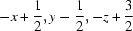
| Symmetry codes: (i) −x+1, −y+2, −z+1; (ii) −x+1, −y+1, −z+1; (iii) −x+3/2, y+1/2, −z+3/2; (iv) x+1/2, −y+3/2, z+1/2; (v) −x+3/2, y−1/2, −z+3/2; (vi) x−1/2, −y+3/2, z−1/2. |
| D—H···A | D—H | H···A | D···A | D—H···A |
| OW1—H2O1···OW3ii | 0.82 | 1.90 | 2.709 (3) | 168 |
| OW1—H1O1···O6vii | 0.82 | 2.10 | 2.802 (3) | 144 |
| OW2—H1O2···O6vii | 0.82 | 1.90 | 2.689 (3) | 162 |
| OW2—H2O2···OW4vii | 0.82 | 1.85 | 2.634 (3) | 159 |
| OW3—H1O3···O1 | 0.82 | 1.89 | 2.692 (3) | 166 |
| OW3—H2O3···OW5viii | 0.82 | 2.16 | 2.967 (4) | 170 |
| OW4—H2O4···O2viii | 0.82 | 1.89 | 2.707 (3) | 174 |
| OW4—H1O4···OW5viii | 0.82 | 1.97 | 2.677 (4) | 144 |
| OW5—H1O5···OW2ix | 0.82 | 2.32 | 2.912 (4) | 130 |
| OW5—H2O5···OW4x | 0.82 | 1.93 | 2.735 (4) | 168 |
| Symmetry codes: (ii) −x+1, −y+1, −z+1; (vii) x+1, y, z; (viii) −x+1/2, y−1/2, −z+3/2; (ix) x−1, y, z; (x) x, y+1, z. |
Experimental details
| Crystal data | |
| Chemical formula | [Cu2(C2H4O6PS)(OH)(H2O)2]·3H2O |
| Mr | 421.25 |
| Crystal system, space group | Monoclinic, P21/n |
| Temperature (K) | 120 |
| a, b, c (Å) | 10.553 (2), 7.1312 (14), 15.791 (3) |
| β (°) | 105.07 (3) |
| V (Å3) | 1147.5 (4) |
| Z | 4 |
| Radiation type | Mo Kα |
| µ (mm−1) | 4.09 |
| Crystal size (mm) | 0.16 × 0.05 × 0.02 |
| Data collection | |
| Diffractometer | Bruker Nonius APEXII CCD diffractometer |
| Absorption correction | Multi-scan (SADABS; Sheldrick, 2007) |
| Tmin, Tmax | 0.783, 0.922 |
| No. of measured, independent and observed [I > 2σ(I)] reflections | 20855, 4352, 3542 |
| Rint | 0.061 |
| (sin θ/λ)max (Å−1) | 0.769 |
| Refinement | |
| R[F2 > 2σ(F2)], wR(F2), S | 0.047, 0.089, 1.11 |
| No. of reflections | 4352 |
| No. of parameters | 163 |
| H-atom treatment | H-atom parameters constrained |
| Δρmax, Δρmin (e Å−3) | 0.75, −0.78 |
Computer programs: , DENZO (Otwinowski & Minor, 1997) and COLLECT (Nonius, 1998), SHELXS97 (Sheldrick, 2008), SHELXL97 (Sheldrick, 2008), DIAMOND (Brandenburg & Putz, 1999), publCIF (Westrip, 2008).
| D—H···A | D—H | H···A | D···A | D—H···A |
| OW1—H2O1···OW3i | 0.82 | 1.90 | 2.709 (3) | 168.1 |
| OW1—H1O1···O6ii | 0.82 | 2.10 | 2.802 (3) | 143.8 |
| OW2—H1O2···O6ii | 0.82 | 1.90 | 2.689 (3) | 162.3 |
| OW2—H2O2···OW4ii | 0.82 | 1.85 | 2.634 (3) | 158.8 |
| OW3—H1O3···O1 | 0.82 | 1.89 | 2.692 (3) | 165.7 |
| OW3—H2O3···OW5iii | 0.82 | 2.16 | 2.967 (4) | 170.0 |
| OW4—H2O4···O2iii | 0.82 | 1.89 | 2.707 (3) | 173.5 |
| OW4—H1O4···OW5iii | 0.82 | 1.97 | 2.677 (4) | 143.8 |
| OW5—H1O5···OW2iv | 0.82 | 2.32 | 2.912 (4) | 129.9 |
| OW5—H2O5···OW4v | 0.82 | 1.93 | 2.735 (4) | 167.5 |
| Symmetry codes: (i) −x+1, −y+1, −z+1; (ii) x+1, y, z; (iii) −x+1/2, y−1/2, −z+3/2; (iv) x−1, y, z; (v) x, y+1, z. |
Acknowledgements
This work was supported by the Deutsche Forschungsgemeinschaft (DFG) (Project No. STO 643/2-2).
References
 Adani, F., Casciola, M., Jones, D. J., Massinelli, L., Montoneri, E., Rozière, J. & Vivani, R. (1998). J. Mater. Chem. 8, 961–964. Web of Science CrossRef CAS Google Scholar
Benedetto, A. F., Squattrito, P. J., Adani, F. & Montoneri, E. (1997). Inorg. Chim. Acta, 260, 207–216. CSD CrossRef CAS Web of Science Google Scholar
Brandenburg, K. & Putz, H. (1999). DIAMOND. Crystal Impact GbR, Bonn, Germany. Google Scholar
Du, Z.-Y., Li, X.-L., Liu, Q.-Y. & Mao, J.-G. (2007). Cryst. Growth Des. 7, 1501–1507. Web of Science CSD CrossRef CAS Google Scholar
Du, Z.-Y., Prosvirin, V. A. & Mao, J.-G. (2007). Inorg. Chem. 46, 9884–9894. Web of Science CSD CrossRef PubMed CAS Google Scholar
Du, Z.-Y., Xu, H.-B., Li, X.-L. & Mao, J.-G. (2007). Eur. J. Inorg. Chem. pp. 4520–4529. Web of Science CSD CrossRef Google Scholar
Du, Z.-Y., Xu, H.-B. & Mao, J.-G. (2006a). Inorg. Chem. 45, 6424–6430. Web of Science CSD CrossRef PubMed CAS Google Scholar
Du, Z.-Y., Xu, H.-B. & Mao, J.-G. (2006b). Inorg. Chem. 45, 9780–9788. Web of Science CSD CrossRef PubMed CAS Google Scholar
Nonius (1998). COLLECT. Nonius BV, Delft, The Netherlands. Google Scholar
Otwinowski, Z. & Minor, W. (1997). Methods in Enzymology, Vol. 276, Macromolecular Crystallography, Part A, edited by C. W. Carter Jr & R. M. Sweet, pp. 307–326. New York: Academic Press. Google Scholar
Sheldrick, G. M. (2007). SADABS. Bruker AXS Inc., Madison, Wisconsin, USA. Google Scholar
Sheldrick, G. M. (2008). Acta Cryst. A64, 112–122. Web of Science CrossRef CAS IUCr Journals Google Scholar
Sonnauer, A., Näther, C., Höppe, H. A., Senker, J. & Stock, N. (2007). Inorg. Chem. 46, 9968–9974. Web of Science CSD CrossRef PubMed CAS Google Scholar
Sonnauer, A. & Stock, N. (2008a). Eur. J. Inorg. Chem., doi:10.1002/ejic.200800315. Google Scholar
Sonnauer, A. & Stock, N. (2008b). J. Solid State Chem. 181, 473–479. Web of Science CrossRef CAS Google Scholar
Westrip, S. P. (2008). publCIF. In preparation. Google Scholar
This is an open-access article distributed under the terms of the Creative Commons Attribution (CC-BY) Licence, which permits unrestricted use, distribution, and reproduction in any medium, provided the original authors and source are cited.
| CRYSTALLOGRAPHIC COMMUNICATIONS |


Inorganic–organic hybrid materials based on metal carboxylates, sulfonates and phosphonates are intensively investigated due to their potential application in the field of gas separation, storage, as well as catalysis, or as sensor materials. We are interested in the use of organic ligands containing two or more different functional groups for the synthesis of functionalized hybrid compounds. Although a large number of metal phosphonates and metal sulfonates have been reported in the literature, compounds based on ligands containing simultaneously a phosphonic as well as a sulfonic acid group have only recently been investigated. These few studies are limited to the use of linker molecules based on rigid phosphonoarylsulfonic acids. Our group has started a systematic investigation using the flexible linker 2-phosphonoethansulfonic acid, which has been reported in the literature (Sonnauer et al., 2007; Sonnauer & Stock, 2008a,b). Here we report the crystal structure of the new copper phosphonatosulfonate Cu2[(O3PC2H4SO3)(OH)(H2O)2](H2O)3, which was obtained from a hydrothermal reaction in a glass tube.
The title compound consists of two crystallographic independent copper(II) ions, one fully deprotonated (O3PC2H4SO3)3- anion, one hydroxide ion, as well as five water molecules (two coordinated to the copper ions)(Fig. 1). The copper ions are coordinated by six oxygen atoms and form CuO6 polyhedra. These polyhedra are connected by µ-O and µ3-O atoms. Thus, Cu—O—Cu zigzag chains of edge-sharing polyhedra are observed (Fig. 2), which are connected by the organic group –C2H4– to form layers. These layers are connected via hydrogen bonds into a three-dimensional framework (Fig. 3).