 | Acta Crystallographica Section E Acta Crystallographica Section E CRYSTALLOGRAPHIC COMMUNICATIONS |


 journal menu


inorganic compounds
| CRYSTALLOGRAPHIC COMMUNICATIONS |
 access
K2Ho(PO4)(WO4)

aDepartment of Inorganic Chemistry, Taras Shevchenko National University, 64 Volodymyrska Street, 01033 Kyiv, Ukraine, and bSTC `Institute for Single Crystals', NAS of Ukraine, 60 Lenin Avenue, 61001 Kharkiv, Ukraine
*Correspondence e-mail: [email protected]
A new compound, dipotassium holmium(III) phosphate(V) tungstate(VI), K2Ho(PO4)(WO4), has been obtained during investigation of the K2O–P2O5–WO3–HoF3 phase system using the technique. The compound is isotypic with K2Bi(PO4)(WO4). Its framework structure consists of flat ∞2[HoPO4] layers parallel to (100) that are made up of ∞1[HoO8] zigzag chains interlinked via slightly distorted PO4 tetrahedra. WO4 tetrahedra are attached above and below these layers, leaving space for the K+ counter-cations. The HoO8, PO4 and WO4 units exhibit 2 symmetry.
Related literature
For related structures, see: Ben Amara & Dabbabi (1987![[Ben Amara, M. & Dabbabi, M. (1987). Acta Cryst. C43, 616-618.]](../../../../../../logos/arrows/e_arr.gif "Ben Amara, M. & Dabbabi, M. (1987). Acta Cryst. C43, 616-618.") ); Marsh (1987); Zatovsky, Terebilenko, Slobodyanik & Baumer (2006); Zatovsky, Terebilenko, Slobodyanik, Baumer & Shishkin (2006).
); Marsh (1987); Zatovsky, Terebilenko, Slobodyanik & Baumer (2006); Zatovsky, Terebilenko, Slobodyanik, Baumer & Shishkin (2006).
Experimental
Crystal data
|
Refinement
|
| ||||||||||||||||||||
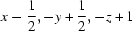 ; (ii)
  .
. Data collection: CrysAlis CCD (Oxford Diffraction, 2005); cell refinement: CrysAlis RED (Oxford Diffraction, 2005); data reduction: CrysAlis RED; program(s) used to solve structure: SHELXS97 (Sheldrick, 2008); program(s) used to refine structure: SHELXL97 (Sheldrick, 2008); molecular graphics: DIAMOND (Brandenburg, 2006); software used to prepare material for publication: WinGX (Farrugia, 1999).
Supporting information
contains datablocks global, I. DOI: 10.1107/S160053680803287X/wm2196sup1.cif
Structure factors: contains datablock I. DOI: 10.1107/S160053680803287X/wm2196Isup2.hkl
Single crystals of the title compound were grown from a multicomponent high-temperature solution. A mixture of 4.645 g K2W2O7, 0.865 g KPO3, and 1.150 g K4P2O7 was heated in a platinum crucible up to 1173 K which is above the melting temperature. Then 0.200 g of HoF3 were added to this melt under stirring. The final mixture was held at this temperature for 1 h and cooled down to room temperature with a rate of 30 Kh-1. The solidified melt was leached out with warm water to dissolve the superfluous The final product consisted of beige needle-like crystals with a maximum length of up to 5 mm.
The highest peak and the deepest hole of the final Fourier map are located 0.58 Å from atom W1 and 1.11 Å from the same atom, respectively.
Data collection: CrysAlis CCD (Oxford Diffraction, 2005); cell CrysAlis RED (Oxford Diffraction, 2005); data reduction: CrysAlis RED (Oxford Diffraction, 2005); program(s) used to solve structure: SHELXS97 (Sheldrick, 2008); program(s) used to refine structure: SHELXL97 (Sheldrick, 2008); molecular graphics: DIAMOND (Brandenburg, 2006); software used to prepare material for publication: WinGX (Farrugia, 1999).
![[Figure 1]](./wm2196fig1thm.gif) | Fig. 1. The layered structure of K2Ho(PO4)(WO4), leaving space where the K+ ions are located. |
![[Figure 2]](./wm2196fig2thm.gif) | Fig. 2. View of K2Ho(PO4)(WO4) with displacement ellipsoids drawn at the 50% probability level. [Symmetry codes: (i) 1,5-x; y; 1-z; (ii) 1-x; 0.5-y; z]. |
| K2Ho(PO4)(WO4) | F(000) = 2064 |
| Mr = 585.95 | Dx = 4.727 Mg m−3 |
| Orthorhombic, Ibca | Mo Kα radiation, λ = 0.71073 Å |
| Hall symbol: -I 2b 2c | Cell parameters from 8608 reflections |
| a = 6.882 (1) Å | θ = 3.4–33.0° |
| b = 12.1485 (18) Å | µ = 24.72 mm−1 |
| c = 19.695 (3) Å | T = 293 K |
| V = 1646.6 (4) Å3 | Prism, pale beige |
| Z = 8 | 0.10 × 0.09 × 0.07 mm |
| Oxford Diffraction XCalibur-3 CCD diffractometer | 1561 independent reflections |
| Radiation source: fine-focus sealed tube | 1257 reflections with I > 2σ(I) |
| Graphite monochromator | Rint = 0.055 |
| ϕ and ω scans | θmax = 33.0°, θmin = 3.4° |
| Absorption correction: multi-scan based on the method by Blessing (1995) | h = −10→10 |
| Tmin = 0.102, Tmax = 0.177 | k = −18→18 |
| 8608 measured reflections | l = −30→29 |
| Refinement on F2 | 0 restraints |
| Least-squares matrix: full | w = 1/[σ2(Fo2) + (0.0397P)2 + 3.2575P] where P = (Fo2 + 2Fc2)/3 |
| R[F2 > 2σ(F2)] = 0.029 | (Δ/σ)max < 0.001 |
| wR(F2) = 0.071 | Δρmax = 1.90 e Å−3 |
| S = 1.15 | Δρmin = −1.73 e Å−3 |
| 1561 reflections | Extinction correction: SHELXL97 (Sheldrick, 2008), Fc*=kFc[1+0.001xFc2λ3/sin(2θ)]-1/4 |
| 62 parameters | Extinction coefficient: 0.00010 (2) |
| K2Ho(PO4)(WO4) | V = 1646.6 (4) Å3 |
| Mr = 585.95 | Z = 8 |
| Orthorhombic, Ibca | Mo Kα radiation |
| a = 6.882 (1) Å | µ = 24.72 mm−1 |
| b = 12.1485 (18) Å | T = 293 K |
| c = 19.695 (3) Å | 0.10 × 0.09 × 0.07 mm |
| Oxford Diffraction XCalibur-3 CCD diffractometer | 1561 independent reflections |
| Absorption correction: multi-scan based on the method by Blessing (1995) | 1257 reflections with I > 2σ(I) |
| Tmin = 0.102, Tmax = 0.177 | Rint = 0.055 |
| 8608 measured reflections |
| R[F2 > 2σ(F2)] = 0.029 | 62 parameters |
| wR(F2) = 0.071 | 0 restraints |
| S = 1.15 | Δρmax = 1.90 e Å−3 |
| 1561 reflections | Δρmin = −1.73 e Å−3 |
Geometry. All e.s.d.'s (except the e.s.d. in the dihedral angle between two l.s. planes) are estimated using the full covariance matrix. The cell e.s.d.'s are taken into account individually in the estimation of e.s.d.'s in distances, angles and torsion angles; correlations between e.s.d.'s in cell parameters are only used when they are defined by crystal symmetry. An approximate (isotropic) treatment of cell e.s.d.'s is used for estimating e.s.d.'s involving l.s. planes. |
| x | y | z | Uiso*/Ueq | ||
| W1 | 0.5 | 0.25 | 0.334530 (12) | 0.01088 (5) | |
| Ho1 | 0.75 | 0.325113 (17) | 0.5 | 0.00662 (5) | |
| K1 | 0.96872 (15) | 0.07992 (10) | 0.34389 (5) | 0.0196 (2) | |
| P1 | 0.75 | 0.07042 (10) | 0.5 | 0.0065 (2) | |
| O1 | 0.7088 (4) | 0.2796 (3) | 0.38536 (17) | 0.0146 (7) | |
| O2 | 0.4420 (6) | 0.3643 (4) | 0.2845 (2) | 0.0269 (8) | |
| O3 | 0.7308 (4) | −0.0047 (2) | 0.43834 (16) | 0.0102 (6) | |
| O4 | 0.9229 (4) | 0.1514 (2) | 0.49215 (17) | 0.0105 (6) |
| U11 | U22 | U33 | U12 | U13 | U23 | |
| W1 | 0.01432 (9) | 0.01167 (9) | 0.00666 (9) | −0.00095 (8) | 0 | 0 |
| Ho1 | 0.00652 (9) | 0.00523 (9) | 0.00811 (10) | 0 | −0.00005 (9) | 0 |
| K1 | 0.0204 (4) | 0.0248 (5) | 0.0137 (4) | −0.0002 (4) | 0.0021 (3) | 0.0039 (4) |
| P1 | 0.0064 (5) | 0.0034 (5) | 0.0098 (6) | 0 | 0.0000 (5) | 0 |
| O1 | 0.0154 (14) | 0.0171 (14) | 0.0113 (14) | −0.0035 (11) | −0.0012 (11) | −0.0031 (11) |
| O2 | 0.0308 (17) | 0.0296 (19) | 0.0203 (17) | −0.0008 (17) | 0.0013 (15) | 0.0126 (16) |
| O3 | 0.0126 (13) | 0.0079 (11) | 0.0101 (13) | −0.0018 (10) | −0.0002 (11) | −0.0010 (9) |
| O4 | 0.0052 (10) | 0.0066 (11) | 0.0198 (16) | −0.0017 (9) | 0.0011 (10) | −0.0016 (11) |
| W1—O2i | 1.749 (4) | Ho1—K1vii | 3.8119 (11) |
| W1—O2 | 1.749 (4) | Ho1—K1vi | 3.8119 (12) |
| W1—O1 | 1.788 (3) | K1—O3 | 2.683 (3) |
| W1—O1i | 1.788 (3) | K1—O2v | 2.689 (4) |
| W1—K1 | 3.8352 (12) | K1—O3x | 2.747 (3) |
| W1—K1i | 3.8352 (12) | K1—O1vi | 2.916 (3) |
| W1—K1ii | 4.0181 (13) | K1—O2xi | 2.934 (5) |
| W1—K1iii | 4.0181 (13) | K1—O4 | 3.063 (3) |
| W1—K1iv | 4.0821 (12) | K1—O1 | 3.122 (4) |
| W1—K1v | 4.0821 (12) | K1—O2i | 3.133 (4) |
| Ho1—O4vi | 2.274 (3) | K1—P1 | 3.4251 (11) |
| Ho1—O4vii | 2.274 (3) | K1—Ho1vi | 3.8119 (11) |
| Ho1—O1 | 2.342 (3) | K1—K1iii | 3.9511 (13) |
| Ho1—O1viii | 2.342 (3) | P1—O3 | 1.525 (3) |
| Ho1—O3ix | 2.401 (3) | P1—O3viii | 1.525 (3) |
| Ho1—O3ii | 2.401 (3) | P1—O4 | 1.552 (3) |
| Ho1—O4viii | 2.428 (3) | P1—O4viii | 1.552 (3) |
| Ho1—O4 | 2.428 (3) | P1—Ho1xii | 2.9802 (13) |
| Ho1—P1ix | 2.9802 (13) | P1—K1viii | 3.4251 (11) |
| Ho1—P1 | 3.0941 (13) | ||
| O2i—W1—O2 | 111.4 (3) | O3x—K1—O4 | 61.07 (8) |
| O2i—W1—O1 | 106.94 (17) | O1vi—K1—O4 | 69.23 (9) |
| O2—W1—O1 | 109.83 (19) | O2xi—K1—O4 | 130.90 (10) |
| O2i—W1—O1i | 109.83 (19) | O3—K1—O1 | 76.52 (9) |
| O2—W1—O1i | 106.94 (17) | O2v—K1—O1 | 100.44 (12) |
| O1—W1—O1i | 111.9 (2) | O3x—K1—O1 | 117.21 (9) |
| O4vi—Ho1—O4vii | 165.59 (15) | O1vi—K1—O1 | 84.72 (10) |
| O4vi—Ho1—O1 | 94.81 (11) | O2xi—K1—O1 | 156.62 (10) |
| O4vii—Ho1—O1 | 88.59 (11) | O4—K1—O1 | 58.09 (8) |
| O4vi—Ho1—O1viii | 88.59 (11) | O3—K1—O2i | 77.94 (10) |
| O4vii—Ho1—O1viii | 94.81 (11) | O2v—K1—O2i | 78.50 (9) |
| O1—Ho1—O1viii | 152.68 (18) | O3x—K1—O2i | 156.48 (11) |
| O4vi—Ho1—O3ix | 88.91 (10) | O1vi—K1—O2i | 131.64 (12) |
| O4vii—Ho1—O3ix | 78.65 (10) | O2xi—K1—O2i | 103.49 (13) |
| O1—Ho1—O3ix | 133.18 (11) | O4—K1—O2i | 101.64 (9) |
| O1viii—Ho1—O3ix | 73.88 (12) | O1—K1—O2i | 54.04 (10) |
| O4vi—Ho1—O3ii | 78.65 (10) | O3—P1—O3viii | 106.4 (2) |
| O4vii—Ho1—O3ii | 88.91 (10) | O3—P1—O4 | 111.52 (16) |
| O1—Ho1—O3ii | 73.88 (12) | O3viii—P1—O4 | 113.10 (16) |
| O1viii—Ho1—O3ii | 133.18 (12) | O3—P1—O4viii | 113.10 (16) |
| O3ix—Ho1—O3ii | 61.17 (15) | O3viii—P1—O4viii | 111.52 (16) |
| O4vi—Ho1—O4viii | 126.77 (7) | O4—P1—O4viii | 101.3 (2) |
| O4vii—Ho1—O4viii | 67.63 (12) | W1—O1—Ho1 | 133.20 (16) |
| O1—Ho1—O4viii | 78.27 (12) | W1—O1—K1vi | 124.93 (16) |
| O1viii—Ho1—O4viii | 78.03 (12) | Ho1—O1—K1vi | 92.27 (11) |
| O3ix—Ho1—O4viii | 133.56 (10) | W1—O1—K1 | 99.08 (14) |
| O3ii—Ho1—O4viii | 143.86 (10) | Ho1—O1—K1 | 111.49 (12) |
| O4vi—Ho1—O4 | 67.63 (12) | K1vi—O1—K1 | 86.88 (9) |
| O4vii—Ho1—O4 | 126.77 (8) | W1—O2—K1v | 132.6 (2) |
| O1—Ho1—O4 | 78.03 (12) | W1—O2—K1ii | 115.89 (19) |
| O1viii—Ho1—O4 | 78.27 (12) | K1v—O2—K1ii | 95.86 (13) |
| O3ix—Ho1—O4 | 143.86 (10) | W1—O2—K1i | 99.64 (16) |
| O3ii—Ho1—O4 | 133.56 (10) | K1v—O2—K1i | 120.18 (15) |
| O4viii—Ho1—O4 | 59.26 (13) | K1ii—O2—K1i | 81.21 (11) |
| O3—K1—O2v | 152.62 (12) | P1—O3—Ho1xii | 96.20 (15) |
| O3—K1—O3x | 78.69 (8) | P1—O3—K1 | 105.64 (14) |
| O2v—K1—O3x | 124.78 (11) | Ho1xii—O3—K1 | 130.32 (12) |
| O3—K1—O1vi | 119.65 (10) | P1—O3—K1iii | 142.66 (16) |
| O2v—K1—O1vi | 86.67 (12) | Ho1xii—O3—K1iii | 95.30 (9) |
| O3x—K1—O1vi | 60.35 (9) | K1—O3—K1iii | 93.37 (11) |
| O3—K1—O2xi | 93.55 (11) | P1—O4—Ho1vi | 146.28 (18) |
| O2v—K1—O2xi | 78.59 (14) | P1—O4—Ho1 | 99.72 (13) |
| O3x—K1—O2xi | 80.53 (10) | Ho1vi—O4—Ho1 | 111.83 (11) |
| O1vi—K1—O2xi | 118.34 (11) | P1—O4—K1 | 89.66 (13) |
| O3—K1—O4 | 52.05 (8) | Ho1vi—O4—K1 | 89.92 (10) |
| O2v—K1—O4 | 148.06 (12) | Ho1—O4—K1 | 110.96 (11) |
| Symmetry codes: (i) −x+1, −y+1/2, z; (ii) −x+3/2, y+1/2, z; (iii) x−1/2, −y, z; (iv) x−1/2, y, −z+1/2; (v) −x+3/2, −y+1/2, −z+1/2; (vi) −x+2, −y+1/2, z; (vii) x−1/2, −y+1/2, −z+1; (viii) −x+3/2, y, −z+1; (ix) x, y+1/2, −z+1; (x) x+1/2, −y, z; (xi) −x+3/2, y−1/2, z; (xii) x, y−1/2, −z+1. |
Experimental details
| Crystal data | |
| Chemical formula | K2Ho(PO4)(WO4) |
| Mr | 585.95 |
| Crystal system, space group | Orthorhombic, Ibca |
| Temperature (K) | 293 |
| a, b, c (Å) | 6.882 (1), 12.1485 (18), 19.695 (3) |
| V (Å3) | 1646.6 (4) |
| Z | 8 |
| Radiation type | Mo Kα |
| µ (mm−1) | 24.72 |
| Crystal size (mm) | 0.10 × 0.09 × 0.07 |
| Data collection | |
| Diffractometer | Oxford Diffraction XCalibur-3 CCD diffractometer |
| Absorption correction | Multi-scan based on the method by Blessing (1995) |
| Tmin, Tmax | 0.102, 0.177 |
| No. of measured, independent and observed [I > 2σ(I)] reflections | 8608, 1561, 1257 |
| Rint | 0.055 |
| (sin θ/λ)max (Å−1) | 0.766 |
| Refinement | |
| R[F2 > 2σ(F2)], wR(F2), S | 0.029, 0.071, 1.15 |
| No. of reflections | 1561 |
| No. of parameters | 62 |
| Δρmax, Δρmin (e Å−3) | 1.90, −1.73 |
Computer programs: CrysAlis CCD (Oxford Diffraction, 2005), CrysAlis RED (Oxford Diffraction, 2005), SHELXS97 (Sheldrick, 2008), SHELXL97 (Sheldrick, 2008), DIAMOND (Brandenburg, 2006), WinGX (Farrugia, 1999).
| W1—O2 | 1.749 (4) | Ho1—O3ii | 2.401 (3) |
| W1—O1 | 1.788 (3) | Ho1—O4 | 2.428 (3) |
| Ho1—O4i | 2.274 (3) | P1—O3 | 1.525 (3) |
| Ho1—O1 | 2.342 (3) | P1—O4 | 1.552 (3) |
| Symmetry codes: (i) x−1/2, −y+1/2, −z+1; (ii) x, y+1/2, −z+1. |
Acknowledgements
The authors acknowledge the ICDD for financial support (grant No. 03-02).
References
 Ben Amara, M. & Dabbabi, M. (1987). Acta Cryst. C43, 616–618. CrossRef CAS IUCr Journals Google Scholar
Blessing, R. H. (1995). Acta Cryst. A51, 33–38. CrossRef CAS Web of Science IUCr Journals Google Scholar
Brandenburg, K. (2006). DIAMOND. Crystal Impact GbR, Bonn, Germany. Google Scholar
Farrugia, L. J. (1999). J. Appl. Cryst. 32, 837–838. CrossRef CAS IUCr Journals Google Scholar
Marsh, R. E. (1987). Acta Cryst. C43, 2470. CrossRef IUCr Journals Google Scholar
Oxford Diffraction (2005). CrysAlis CCD and CrysAlis RED. Oxford Diffraction Ltd, Abington, Oxfordshire, England. Google Scholar
Sheldrick, G. M. (2008). Acta Cryst. A64, 112–122. Web of Science CrossRef CAS IUCr Journals Google Scholar
Zatovsky, I. V., Terebilenko, K. V., Slobodyanik, N. S. & Baumer, V. N. (2006). J. Solid State Chem. 179, 3550–3555. Web of Science CrossRef CAS Google Scholar
Zatovsky, I. V., Terebilenko, K. V., Slobodyanik, N. S., Baumer, V. N. & Shishkin, O. V. (2006). Acta Cryst. E62, i193–i195. Web of Science CrossRef IUCr Journals Google Scholar
This is an open-access article distributed under the terms of the Creative Commons Attribution (CC-BY) Licence, which permits unrestricted use, distribution, and reproduction in any medium, provided the original authors and source are cited.
| CRYSTALLOGRAPHIC COMMUNICATIONS |


The co-existence of different anionic units in crystal structures represents an interesting field of investigation. One of the first structural examples of a combination of PO4 with MoO4/WO4 tetrahedra, viz. Na2Y(MoO4)(PO4), was reported to be monoclinic with space group C2/c (Ben Amara & Dabbabi, 1987). Later this structure was reinvestigated and described as orthorhombic, space group Ibca (Marsh, 1987). Recently, the compounds K2Bi(PO4)(MO4) (M=Mo, W) with isotypic structures were obtained by application of the flux method (Zatovsky, Terebilenko, Slobodyanik & Baumer, 2006; Zatovsky, Terebilenko, Slobodyanik, Baumer & Shishkin, 2006). Herein, we report the flux synthesis and crystal structure of a new member of the A2B(PO4)(AO4) (A = Na, K; B = lanthanide, Y, Bi; M = Mo, W) family.
One of the characteristic features of this structure type is the "segregation" of slightly distorted PO4 and WO4 tetrahedra into adjacent layers (Fig. 1). The first layer with composition 2∞[HoPO4] contains 1∞[HoO8] zigzag chains (Fig. 2). The connection between neighboring chains is achieved via PO4 tetrahedra. On the top and on the bottom of the 2∞[HoPO4] layer, WO4 tetrahedra are attached. All [HoO8], PO4 and WO4 units exhibit 2 symmetry with bond lengths in the typical ranges (Table 1). The K+ cations are situated in the resulting interlayer space and are surrounded by 8 oxygen atoms with K—O bond lengths ranging from 2.683 (4) Å to 3.133 (4) Å.