 | Acta Crystallographica Section E Acta Crystallographica Section E CRYSTALLOGRAPHIC COMMUNICATIONS |


 journal menu


inorganic compounds
| CRYSTALLOGRAPHIC COMMUNICATIONS |
 access
Disodium tricopper(II) tetrakis[selenate(IV)] tetrahydrate

aInstitute of Materials Science and Engineering, The Ocean University of China, Qingdao 266100, People's Republic of China, bDepartment of Computer Science, Dezhou University, Shandong 253023, People's Republic of China, and cState Key Laboratory of High Performance Ceramics and Superfine Microstructure, Shanghai Institute of Ceramics, Chinese Academy of Science, Shanghai 200050, People's Republic of China
*Correspondence e-mail: [email protected]
The title compound, Na2Cu3(SeO3)4(H2O)4, has been prepared under hydrothermal conditions. The crystal structure contains a three-dimensional anionic framework made up from distorted [CuO4(H2O)2] octahedra ( symmetry), [CuO4(H2O)] square pyramids and trigonal-pyramidal SeO3 units sharing common corners. The connectivity among these units leads to four- and eight-membered polyhedral rings, which by edge-sharing interconnect into walls. A rhombus-like 16-membered polyhedral ring channel system with a longest length of approximately 14.0 Å and a shortest length of 5.3 Å is enclosed by such walls along the a axis. The water molecules attached to the Cu atoms, as well as the electron lone pairs of the SeIV atoms, protrude into these channels. The seven-coordinated Na+ counter-cations occupy the remaining free space of the 16-membered polyhedral ring channels. An intricate network of O—H⋯O hydrogen bonds further consolidates the three-dimensional structure.
Related literature
For the structures of other hydrous copper(II) selenates(IV) or selenates(VI), see: Asai & Kiriyama (1973![[Asai, T. & Kiriyama, R. (1973). Bull. Chem. Soc. Jpn, 46, 2395-2401.]](../../../../../../logos/arrows/e_arr.gif "Asai, T. & Kiriyama, R. (1973). Bull. Chem. Soc. Jpn, 46, 2395-2401.") ), Giester (1991); Iskhakova & Kozlova (1995).
), Giester (1991); Iskhakova & Kozlova (1995).
Experimental
Crystal data
|
Refinement
|
|
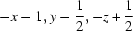 ; (ii)
|
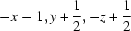 ; (vi)
 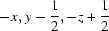 .
. Data collection: SMART (Bruker, 2001); cell refinement: SAINT (Bruker, 2001); data reduction: SAINT; program(s) used to solve structure: SHELXS97 (Sheldrick, 2008); program(s) used to refine structure: SHELXL97 (Sheldrick, 2008); molecular graphics: ORTEP-3 (Farrugia, 1997) and DIAMOND (Crystal Impact, 2004); software used to prepare material for publication: WinGX (Farrugia, 1999).
Supporting information
contains datablocks I, global. DOI: 10.1107/S160053680803434X/wm2197sup1.cif
Structure factors: contains datablock I. DOI: 10.1107/S160053680803434X/wm2197Isup2.hkl
The title compound was synthesized under hydrothermal conditions. A mixture of Na2SeO3 and CuSO4.5H2O in a molar ratio of 1:1 was placed in a Teflon-lined stainless steel autoclave and heated to 443 K for 5 d, cooled at 2 K/h to 373 K, and finally cooled to room temperature. Light blue crystals with a rod-like habit were obtained. Cu, Se and Na contents were analyzed using ICP-AES (Varian Vista, radial observation): Obs./calc. mass%: Cu, 23.33/23.91; Se, 38.70/39.23; Na, 5.63/5.42.
Charge balance considerations and bond valence sum (BVS) calculations indicate that atoms O5 and O6 belong to water molecules. For the metal atoms, the oxidation states of +2 for Cu ions (BVS Cu1: +2.05 and Cu2: +2.01), +4 for the Se ions (BVS Se1: +4.01 and Se2: +4.06) and +1 for the Na ions (BVS Na1: +1.02) were confirmed. The hydrogen atoms of the water molecules were located from difference Fourier maps and were refined with distance restraints of d(O—H) = 0.80 (8)–0.89 (8) Å and a common Uiso parameter of 0.05 Å2.
Data collection: SMART (Bruker, 2001); cell SAINT (Bruker, 2001); data reduction: SAINT (Bruker, 2001); program(s) used to solve structure: SHELXS97 (Sheldrick, 2008); program(s) used to refine structure: SHELXL97 (Sheldrick, 2008); molecular graphics: ORTEP-3 (Farrugia, 1997) and DIAMOND (Crystal Impact, 2004); software used to prepare material for publication: WinGX (Farrugia, 1999).
![[Figure 1]](./wm2197fig1thm.gif) | Fig. 1. The coordination environment of copper and selenium atoms with anisotropic thermal ellipsoids drawn at the 60% probability level. H atoms are draw as small spheres of arbitrary radius. [Symmetry codes: (i) -x, -y, -z; (ii) -x - 1, y - 1/2, -z + 1/2; (iii) x + 1, y, z; (iv) x - 1, y, z).] |
![[Figure 2]](./wm2197fig2thm.gif) | Fig. 2. The 16-membered polyhedral ring channels of (I), filled with Na+ counter cations. |
![[Figure 3]](./wm2197fig3thm.gif) | Fig. 3. Schematic representation of the formation of the anionic framework structure of (I). (a): The wavy layer built from an edge-sharing linear chain by corner-sharing 4-membered rings and ladders by edge-sharing 8-membered rings; (b): The wavy layers intersecting each other with an approximate angle of 110° to the entire three-dimensional open-framework. (Black spheres: Cu atoms; white spheres: Se atoms). |
| Na2Cu3(SeO3)4(H2O)4 | F(000) = 762 |
| Mr = 816.50 | Dx = 3.661 Mg m−3 |
| Monoclinic, P21/c | Mo Kα radiation, λ = 0.71073 Å |
| Hall symbol: -P 2ybc | Cell parameters from 986 reflections |
| a = 5.2218 (5) Å | θ = 2.6–22.8° |
| b = 8.9863 (6) Å | µ = 14.24 mm−1 |
| c = 15.7960 (11) Å | T = 296 K |
| β = 92.071 (4)° | Rod, light blue |
| V = 740.74 (10) Å3 | 0.15 × 0.10 × 0.10 mm |
| Z = 2 |
| Bruker SMART CCD diffractometer | 2142 independent reflections |
| Radiation source: fine-focus sealed tube | 2065 reflections with I > 2σ(I) |
| Graphite monochromator | Rint = 0.027 |
| ω scans | θmax = 30.0°, θmin = 2.6° |
| Absorption correction: multi-scan (SADABS; Sheldrick, 2004) | h = −7→7 |
| Tmin = 0.204, Tmax = 0.250 | k = −12→12 |
| 6010 measured reflections | l = −21→22 |
| Refinement on F2 | Primary atom site location: structure-invariant direct methods |
| Least-squares matrix: full | Secondary atom site location: difference Fourier map |
| R[F2 > 2σ(F2)] = 0.033 | Hydrogen site location: inferred from neighbouring sites |
| wR(F2) = 0.068 | H atoms treated by a mixture of independent and constrained refinement |
| S = 1.12 | w = 1/[σ2(Fo2) + (0.0202P)2 + 3.7977P] where P = (Fo2 + 2Fc2)/3 |
| 2142 reflections | (Δ/σ)max = 0.001 |
| 115 parameters | Δρmax = 0.77 e Å−3 |
| 0 restraints | Δρmin = −1.02 e Å−3 |
| Na2Cu3(SeO3)4(H2O)4 | V = 740.74 (10) Å3 |
| Mr = 816.50 | Z = 2 |
| Monoclinic, P21/c | Mo Kα radiation |
| a = 5.2218 (5) Å | µ = 14.24 mm−1 |
| b = 8.9863 (6) Å | T = 296 K |
| c = 15.7960 (11) Å | 0.15 × 0.10 × 0.10 mm |
| β = 92.071 (4)° |
| Bruker SMART CCD diffractometer | 2142 independent reflections |
| Absorption correction: multi-scan (SADABS; Sheldrick, 2004) | 2065 reflections with I > 2σ(I) |
| Tmin = 0.204, Tmax = 0.250 | Rint = 0.027 |
| 6010 measured reflections |
| R[F2 > 2σ(F2)] = 0.033 | 0 restraints |
| wR(F2) = 0.068 | H atoms treated by a mixture of independent and constrained refinement |
| S = 1.12 | Δρmax = 0.77 e Å−3 |
| 2142 reflections | Δρmin = −1.02 e Å−3 |
| 115 parameters |
Geometry. All e.s.d.'s (except the e.s.d. in the dihedral angle between two l.s. planes) are estimated using the full covariance matrix. The cell e.s.d.'s are taken into account individually in the estimation of e.s.d.'s in distances, angles and torsion angles; correlations between e.s.d.'s in cell parameters are only used when they are defined by crystal symmetry. An approximate (isotropic) treatment of cell e.s.d.'s is used for estimating e.s.d.'s involving l.s. planes. |
Refinement. Refinement of F^2^ against ALL reflections. The weighted R-factor wR and goodness of fit S are based on F^2^, conventional R-factors R are based on F, with F set to zero for negative F^2^. The threshold expression of F^2^ > σ(F^2^) is used only for calculating R-factors(gt) etc. and is not relevant to the choice of reflections for refinement. R-factors based on F^2^ are statistically about twice as large as those based on F, and R- factors based on ALL data will be even larger. |
| x | y | z | Uiso*/Ueq | ||
| Se1 | 0.20254 (7) | 0.28287 (4) | 0.09687 (2) | 0.01090 (10) | |
| Se2 | −0.79415 (7) | 0.53958 (5) | 0.27304 (2) | 0.01476 (11) | |
| Cu1 | 0.0000 | 0.0000 | 0.0000 | 0.01381 (14) | |
| Cu2 | −0.29891 (8) | 0.42910 (6) | 0.17116 (3) | 0.01266 (11) | |
| O1 | −1.0733 (5) | 0.4403 (4) | 0.27181 (18) | 0.0207 (6) | |
| O2 | −0.0088 (5) | 0.4276 (3) | 0.09497 (18) | 0.0153 (5) | |
| O3 | −0.5831 (5) | 0.4016 (3) | 0.24757 (18) | 0.0165 (5) | |
| O4 | 0.1289 (6) | 0.2058 (3) | 0.00011 (18) | 0.0166 (5) | |
| O5 | −0.3653 (7) | 0.6725 (4) | 0.1392 (2) | 0.0209 (6) | |
| O6 | 0.2781 (6) | −0.0756 (4) | 0.07804 (19) | 0.0199 (6) | |
| O7 | 0.4702 (5) | 0.3793 (3) | 0.07309 (17) | 0.0149 (5) | |
| O8 | −0.7371 (6) | 0.5600 (4) | 0.3773 (2) | 0.0272 (7) | |
| Na1 | 0.7415 (3) | 0.3619 (2) | −0.04070 (11) | 0.0226 (4) | |
| H1 | −0.277 (15) | 0.707 (9) | 0.104 (5) | 0.050* | |
| H2 | −0.372 (14) | 0.748 (9) | 0.174 (5) | 0.050* | |
| H4 | 0.226 (15) | −0.063 (9) | 0.131 (5) | 0.050* | |
| H3 | 0.437 (15) | −0.049 (9) | 0.088 (5) | 0.050* |
| U11 | U22 | U33 | U12 | U13 | U23 | |
| Se1 | 0.01040 (17) | 0.01286 (18) | 0.00949 (17) | −0.00189 (12) | 0.00133 (12) | −0.00064 (12) |
| Se2 | 0.01172 (18) | 0.0176 (2) | 0.01500 (18) | 0.00083 (13) | 0.00180 (13) | −0.00071 (14) |
| Cu1 | 0.0139 (3) | 0.0124 (3) | 0.0149 (3) | −0.0023 (2) | −0.0030 (2) | −0.0004 (2) |
| Cu2 | 0.0085 (2) | 0.0195 (2) | 0.0101 (2) | 0.00022 (17) | 0.00143 (15) | −0.00087 (17) |
| O1 | 0.0097 (12) | 0.0415 (19) | 0.0110 (12) | −0.0042 (12) | 0.0007 (10) | −0.0034 (12) |
| O2 | 0.0107 (12) | 0.0208 (14) | 0.0146 (12) | 0.0036 (10) | 0.0042 (10) | 0.0019 (11) |
| O3 | 0.0137 (12) | 0.0207 (14) | 0.0152 (12) | 0.0002 (11) | 0.0044 (10) | 0.0009 (11) |
| O4 | 0.0211 (14) | 0.0166 (13) | 0.0121 (12) | −0.0080 (11) | 0.0015 (10) | −0.0022 (10) |
| O5 | 0.0298 (16) | 0.0117 (14) | 0.0215 (15) | −0.0011 (12) | 0.0048 (13) | −0.0013 (11) |
| O6 | 0.0177 (14) | 0.0280 (17) | 0.0138 (13) | 0.0011 (12) | −0.0030 (11) | −0.0043 (12) |
| O7 | 0.0099 (11) | 0.0215 (14) | 0.0135 (12) | −0.0054 (10) | 0.0010 (9) | −0.0021 (11) |
| O8 | 0.0190 (14) | 0.045 (2) | 0.0176 (14) | −0.0028 (14) | 0.0012 (12) | −0.0149 (14) |
| Na1 | 0.0193 (8) | 0.0307 (10) | 0.0177 (8) | 0.0015 (7) | 0.0015 (6) | 0.0005 (7) |
| Se1—O7 | 1.698 (3) | Cu2—O1iii | 1.947 (3) |
| Se1—O2 | 1.705 (3) | Cu2—O3 | 1.962 (3) |
| Se1—O4 | 1.709 (3) | Cu2—O2 | 1.968 (3) |
| Se2—O8 | 1.673 (3) | Cu2—O7iv | 1.980 (3) |
| Se2—O1 | 1.708 (3) | Cu2—O5 | 2.268 (3) |
| Se2—O3 | 1.717 (3) | Na1—O7 | 2.333 (4) |
| Cu1—O4 | 1.968 (3) | Na1—O5v | 2.482 (4) |
| Cu1—O4i | 1.968 (3) | Na1—O2vi | 2.519 (4) |
| Cu1—O6 | 1.990 (3) | Na1—O4iii | 2.526 (4) |
| Cu1—O6i | 1.990 (3) | Na1—O2iii | 2.537 (3) |
| Cu1—O8ii | 2.475 (3) | Na1—O7vi | 2.618 (4) |
| Cu1—O8ii | 2.475 (3) | Na1—O6vii | 2.641 (4) |
| O7—Se1—O2 | 98.30 (14) | Cu2—O5—H2 | 129 (5) |
| O7—Se1—O4 | 99.75 (13) | Na1v—O5—H2 | 116 (5) |
| O2—Se1—O4 | 99.71 (14) | H1—O5—H2 | 100 (7) |
| O8—Se2—O1 | 100.95 (16) | Cu1—O6—Na1vii | 99.94 (13) |
| O8—Se2—O3 | 102.54 (16) | Cu1—O6—H4 | 107 (5) |
| O1—Se2—O3 | 100.08 (15) | Na1vii—O6—H4 | 109 (5) |
| O4—Cu1—O4i | 180.00 (6) | Cu1—O6—H3 | 133 (5) |
| O4—Cu1—O6 | 94.50 (13) | Na1vii—O6—H3 | 110 (5) |
| O4i—Cu1—O6 | 85.50 (13) | H4—O6—H3 | 97 (7) |
| O4—Cu1—O6i | 85.50 (13) | Se1—O7—Cu2iii | 115.16 (15) |
| O4i—Cu1—O6i | 94.50 (13) | Se1—O7—Na1 | 131.60 (16) |
| O6—Cu1—O6i | 180.00 (14) | Cu2iii—O7—Na1 | 104.37 (12) |
| O1iii—Cu2—O3 | 87.30 (12) | Se1—O7—Na1vi | 98.71 (13) |
| O1iii—Cu2—O2 | 92.48 (12) | Cu2iii—O7—Na1vi | 101.13 (12) |
| O3—Cu2—O2 | 172.34 (13) | Na1—O7—Na1vi | 99.95 (12) |
| O1iii—Cu2—O7iv | 169.80 (14) | O7—Na1—O5v | 90.14 (12) |
| O3—Cu2—O7iv | 90.00 (12) | O7—Na1—O2vi | 124.83 (13) |
| O2—Cu2—O7iv | 88.88 (11) | O5v—Na1—O2vi | 108.41 (12) |
| O1iii—Cu2—O5 | 102.39 (14) | O7—Na1—O4iii | 110.09 (12) |
| O3—Cu2—O5 | 98.36 (13) | O5v—Na1—O4iii | 134.38 (13) |
| O2—Cu2—O5 | 89.17 (12) | O2vi—Na1—O4iii | 93.18 (11) |
| O7iv—Cu2—O5 | 87.73 (12) | O7—Na1—O2iii | 69.01 (10) |
| Se2—O1—Cu2iv | 121.82 (17) | O5v—Na1—O2iii | 158.39 (13) |
| Se1—O2—Cu2 | 120.42 (16) | O2vi—Na1—O2iii | 80.72 (11) |
| Se1—O2—Na1vi | 102.26 (13) | O4iii—Na1—O2iii | 62.06 (10) |
| Cu2—O2—Na1vi | 130.61 (15) | O7—Na1—O7vi | 80.06 (12) |
| Se1—O2—Na1iv | 98.62 (14) | O5v—Na1—O7vi | 70.66 (11) |
| Cu2—O2—Na1iv | 97.75 (12) | O2vi—Na1—O7vi | 60.11 (10) |
| Na1vi—O2—Na1iv | 99.28 (11) | O4iii—Na1—O7vi | 150.69 (12) |
| Se2—O3—Cu2 | 124.02 (17) | O2iii—Na1—O7vi | 99.14 (11) |
| Se1—O4—Cu1 | 116.58 (15) | O7—Na1—O6vii | 102.55 (12) |
| Se1—O4—Na1iv | 98.94 (14) | O5v—Na1—O6vii | 73.44 (11) |
| Cu1—O4—Na1iv | 104.54 (13) | O2vi—Na1—O6vii | 132.30 (12) |
| Cu2—O5—Na1v | 97.49 (13) | O4iii—Na1—O6vii | 62.63 (11) |
| Cu2—O5—H1 | 116 (6) | O2iii—Na1—O6vii | 115.47 (12) |
| Na1v—O5—H1 | 94 (5) | O7vi—Na1—O6vii | 144.02 (11) |
| Symmetry codes: (i) −x, −y, −z; (ii) −x−1, y−1/2, −z+1/2; (iii) x+1, y, z; (iv) x−1, y, z; (v) −x, −y+1, −z; (vi) −x+1, −y+1, −z; (vii) −x+1, −y, −z. |
| D—H···A | D—H | H···A | D···A | D—H···A |
| O5—H1···O4v | 0.80 (8) | 2.00 (8) | 2.786 (4) | 168 (7) |
| O5—H2···O3viii | 0.87 (8) | 1.88 (8) | 2.746 (4) | 174 (7) |
| O6—H3···O8ix | 0.87 (8) | 1.91 (8) | 2.758 (5) | 163 (7) |
| O6—H4···O1ii | 0.89 (8) | 1.76 (8) | 2.641 (4) | 169 (8) |
| Symmetry codes: (ii) −x−1, y−1/2, −z+1/2; (v) −x, −y+1, −z; (viii) −x−1, y+1/2, −z+1/2; (ix) −x, y−1/2, −z+1/2. |
Experimental details
| Crystal data | |
| Chemical formula | Na2Cu3(SeO3)4(H2O)4 |
| Mr | 816.50 |
| Crystal system, space group | Monoclinic, P21/c |
| Temperature (K) | 296 |
| a, b, c (Å) | 5.2218 (5), 8.9863 (6), 15.7960 (11) |
| β (°) | 92.071 (4) |
| V (Å3) | 740.74 (10) |
| Z | 2 |
| Radiation type | Mo Kα |
| µ (mm−1) | 14.24 |
| Crystal size (mm) | 0.15 × 0.10 × 0.10 |
| Data collection | |
| Diffractometer | Bruker SMART CCD diffractometer |
| Absorption correction | Multi-scan (SADABS; Sheldrick, 2004) |
| Tmin, Tmax | 0.204, 0.250 |
| No. of measured, independent and observed [I > 2σ(I)] reflections | 6010, 2142, 2065 |
| Rint | 0.027 |
| (sin θ/λ)max (Å−1) | 0.703 |
| Refinement | |
| R[F2 > 2σ(F2)], wR(F2), S | 0.033, 0.068, 1.12 |
| No. of reflections | 2142 |
| No. of parameters | 115 |
| H-atom treatment | H atoms treated by a mixture of independent and constrained refinement |
| Δρmax, Δρmin (e Å−3) | 0.77, −1.02 |
Computer programs: SMART (Bruker, 2001), SAINT (Bruker, 2001), SHELXS97 (Sheldrick, 2008), SHELXL97 (Sheldrick, 2008), ORTEP-3 (Farrugia, 1997) and DIAMOND (Crystal Impact, 2004), WinGX (Farrugia, 1999).
| Se1—O7 | 1.698 (3) | Cu1—O6 | 1.990 (3) |
| Se1—O2 | 1.705 (3) | Cu1—O8i | 2.475 (3) |
| Se1—O4 | 1.709 (3) | Cu2—O1ii | 1.947 (3) |
| Se2—O8 | 1.673 (3) | Cu2—O3 | 1.962 (3) |
| Se2—O1 | 1.708 (3) | Cu2—O2 | 1.968 (3) |
| Se2—O3 | 1.717 (3) | Cu2—O7iii | 1.980 (3) |
| Cu1—O4 | 1.968 (3) | Cu2—O5 | 2.268 (3) |
| Symmetry codes: (i) −x−1, y−1/2, −z+1/2; (ii) x+1, y, z; (iii) x−1, y, z. |
| D—H···A | D—H | H···A | D···A | D—H···A |
| O5—H1···O4iv | 0.80 (8) | 2.00 (8) | 2.786 (4) | 168 (7) |
| O5—H2···O3v | 0.87 (8) | 1.88 (8) | 2.746 (4) | 174 (7) |
| O6—H3···O8vi | 0.87 (8) | 1.91 (8) | 2.758 (5) | 163 (7) |
| O6—H4···O1i | 0.89 (8) | 1.76 (8) | 2.641 (4) | 169 (8) |
| Symmetry codes: (i) −x−1, y−1/2, −z+1/2; (iv) −x, −y+1, −z; (v) −x−1, y+1/2, −z+1/2; (vi) −x, y−1/2, −z+1/2. |
Acknowledgements
This work was supported by the opening project of the State Key Laboratory of High Performance Ceramics and Superfine Microstructure (grant No. SKL200706SIC).
References
 Asai, T. & Kiriyama, R. (1973). Bull. Chem. Soc. Jpn, 46, 2395–2401. CrossRef CAS Web of Science Google Scholar
Bruker (2001). SMART and SAINT. Bruker AXS Inc., Madison, Wisconsin, USA. Google Scholar
Crystal Impact (2004). DIAMOND. Crystal Impact GbR, Bonn, Germany. Google Scholar
Farrugia, L. J. (1997). J. Appl. Cryst. 30, 565. CrossRef IUCr Journals Google Scholar
Farrugia, L. J. (1999). J. Appl. Cryst. 32, 837–838. CrossRef CAS IUCr Journals Google Scholar
Giester, G. (1991). Monatsh. Chem. 122, 229–234. CrossRef CAS Web of Science Google Scholar
Iskhakova, L. D. & Kozlova, N. P. (1995). Kristallografiya, 40, 635–638. CAS Google Scholar
Sheldrick, G. M. (2008). Acta Cryst. A64, 112–122. Web of Science CrossRef CAS IUCr Journals Google Scholar
Sheldrick, G. M. (2004). SADABS. University of Göttingen, Germany. Google Scholar
This is an open-access article distributed under the terms of the Creative Commons Attribution (CC-BY) Licence, which permits unrestricted use, distribution, and reproduction in any medium, provided the original authors and source are cited.
| CRYSTALLOGRAPHIC COMMUNICATIONS |


Studies of hydrous copper selenites and selenates with three-dimensional frameworks have been reported previously, e.g. by Asai & Kiriyama (1973), Giester (1991) and Iskhakova & Kozlova (1995). Among the corresponding structures various polyhedral ring channel systems are established. The current article presents the result of the single-crystal X-ray analysis of a new sodium copper selenite, Na2Cu3(SeO3)4(H2O)4, (I), with a 16-membered polydedral ring channel system.
In the asymmetric unit of (I) there are two crystallographically distinct copper atoms. The six-coordinated Cu1 site is a typical Jahn-Teller ion with a distorted, tetragonally elongated octahedral [Cu1O4(H2O)2] coordination, whereas Cu2 is surrounded by five O-atoms, leading to a distorted square-pyramidal [Cu2O4(H2O)] environment. The two independent selenium atoms are coordinated by three oxygen atoms, forming the characteristic trigonal-pyramidal SeO32- anion (Fig. 1).
The square-pyramidal [Cu2O4(H2O)] units share its basal O atoms with four neighboring SeO3 units leading to chains of corner-shared four-membered polyhedral rings running along [100]. The [Cu1O4(H2O)2] units are located between such parallel chains and bridge them via Cu—O—Se bonds into an open framework. The water molecules attached to Cu1 and Cu2 as well as the electron lone-pairs of the selenium(IV) atoms protrude into the free space of this network (Fig. 2).
The basic features of the structure could also be described as the assemblage of linear chains of Cu and Se centres leading to 4-membered and 8-membered rings that interconnect by edge-sharing into two similar wavy layer packings extending along [011] and [011], respectively. Such layers intersect at the Cu(1) sites, eventually forming a rhombus-like 16-membered ring channel system extending along the a axis with the biggest length of approximately 14.0 Å and the smallest length of 5.3 Å (Fig.3).
The Na+ counter cations are coordinated by seven oxygen atoms and occupy the central space of the 16-membered ring polyhedral channels to keep the structural stability and satisfy the charge balance. An intricate network of O—H···O hydrogen bonds further consolidates the three-dimensional structure (Table 2).