 | Acta Crystallographica Section E Acta Crystallographica Section E CRYSTALLOGRAPHIC COMMUNICATIONS |


 journal menu


organic compounds
| CRYSTALLOGRAPHIC COMMUNICATIONS |
 access
3-(1H-Tetrazol-5-yl)benzoic acid

aDepartment of Chemistry and Chemical Engineering, Southeast University, Nanjing, 211189, People's Republic of China, and bDepartment of Chemistry and Chemical Engineering, State Key Laboratory of Coordination Chemistry, Nanjing University, Nanjing, 211189, People's Republic of China
*Correspondence e-mail: [email protected]
The title compound, C8H6N4O2, is a difunctional compound with a carboxylate and a tetrazole residue. In the crystal structure, molecules are linked into two-dimensional sheets by intermolecular N—H⋯O and O—H⋯N hydrogen bonds.
Related literature
For the applications of tetrazoles, see: Chen & Tong (2007![[Chen, X.-M. & Tong, M.-L. (2007). Acc. Chem. Res. 40, 162-170.]](../../../../../../logos/arrows/e_arr.gif "Chen, X.-M. & Tong, M.-L. (2007). Acc. Chem. Res. 40, 162-170.") ); Demko & Sharpless (2001). For related structures, see: Rizk et al. (2005).
); Demko & Sharpless (2001). For related structures, see: Rizk et al. (2005).
![[Scheme 1]](bt2829scheme1.gif)
Experimental
Crystal data
|
Refinement
|
| ||||||||||||||||||||||
 .
. Data collection: SMART (Bruker, 2000); cell refinement: SAINT (Bruker, 2000); data reduction: SAINT; program(s) used to solve structure: SHELXS97 (Sheldrick, 2008); program(s) used to refine structure: SHELXL97 (Sheldrick, 2008); molecular graphics: SHELXTL (Sheldrick, 2008); software used to prepare material for publication: SHELXL97.
Supporting information
contains datablocks I, global. DOI: 10.1107/S1600536808041482/bt2829sup1.cif
Structure factors: contains datablock I. DOI: 10.1107/S1600536808041482/bt2829Isup2.hkl
A mixture of 3-cyanobenzoic acid (0.147 g, 1.0 mmol), Cd(NO3)2.6H2O (0.345 g, 1 mmol) and water (8 ml) was was heated in a 15-ml Teflon-lined autoclave at 160 ° for 3 days, followed by slow cooling (5 ° h-1) to room temperature. The resulting mixture was washed with water and collected. Then, the obtained solids were put into 20 ml water, and 10% Na2S aqueous solution was droped to the suspension liquid until that no precipitation appeared. The solution was filtered and the filtrate was acidified with 50% HCl solution until the pH value was 1.0. White products were filtered, washed with water, then dried and collected in 76.2% yield (0.145 g) based on 3-cyanobenzoic acid. Colorless block shaped crystals were collected from the filtrate after the second filtration.
H atoms bonded to N and O atoms were located in a difference map and were freely refined. Other H atoms were positioned geometrically and refined using a riding model with C—H = 0.93 Å and with Uiso(H) = 1.2.
Data collection: SMART (Bruker, 2000); cell SMART (Bruker, 2000); data reduction: SAINT (Bruker, 2000); program(s) used to solve structure: SHELXS (Sheldrick, 2008); program(s) used to refine structure: SHELXL (Sheldrick, 2008); molecular graphics: SHELXTL Sheldrick, 2008); software used to prepare material for publication: SHELXL97 (Sheldrick, 2008).
![[Figure 1]](./bt2829fig1thm.gif) | Fig. 1. Structure of the title compound with 30% displacement ellipsoids. |
![[Figure 2]](./bt2829fig2thm.gif) | Fig. 2. The two-dimensional hydrogen bonding network of the title compound. |
![[Figure 3]](./bt2829fig3thm.gif) | Fig. 3. Packing of the title compound with view onto the ac plane. |
| C8H6N4O2 | F(000) = 392 |
| Mr = 190.17 | Dx = 1.555 Mg m−3 |
| Monoclinic, P21/c | Mo Kα radiation, λ = 0.71073 Å |
| Hall symbol: -P 2ybc | Cell parameters from 785 reflections |
| a = 5.2501 (10) Å | θ = 2.4–28.0° |
| b = 16.805 (3) Å | µ = 0.12 mm−1 |
| c = 9.3290 (18) Å | T = 293 K |
| β = 99.188 (3)° | Block, colorless |
| V = 812.5 (3) Å3 | 0.45 × 0.14 × 0.13 mm |
| Z = 4 |
| Bruker APX CCD diffractometer | 1583 independent reflections |
| Radiation source: fine-focus sealed tube | 1425 reflections with I > 2σ(I) |
| Graphite monochromator | Rint = 0.018 |
| phi and ω scan | θmax = 26.0°, θmin = 2.4° |
| Absorption correction: multi-scan SADABS (Sheldrick, 2000) | h = −6→6 |
| Tmin = 0.949, Tmax = 0.985 | k = −20→20 |
| 5991 measured reflections | l = −11→11 |
| Refinement on F2 | Secondary atom site location: difference Fourier map |
| Least-squares matrix: full | Hydrogen site location: inferred from neighbouring sites |
| R[F2 > 2σ(F2)] = 0.040 | H atoms treated by a mixture of independent and constrained refinement |
| wR(F2) = 0.106 | w = 1/[σ2(Fo2) + (0.0592P)2 + 0.1634P] where P = (Fo2 + 2Fc2)/3 |
| S = 1.07 | (Δ/σ)max < 0.001 |
| 1583 reflections | Δρmax = 0.19 e Å−3 |
| 136 parameters | Δρmin = −0.24 e Å−3 |
| 0 restraints | Extinction correction: SHELXL, Fc*=kFc[1+0.001xFc2λ3/sin(2θ)]-1/4 |
| Primary atom site location: structure-invariant direct methods | Extinction coefficient: 0.018 (3) |
| C8H6N4O2 | V = 812.5 (3) Å3 |
| Mr = 190.17 | Z = 4 |
| Monoclinic, P21/c | Mo Kα radiation |
| a = 5.2501 (10) Å | µ = 0.12 mm−1 |
| b = 16.805 (3) Å | T = 293 K |
| c = 9.3290 (18) Å | 0.45 × 0.14 × 0.13 mm |
| β = 99.188 (3)° |
| Bruker APX CCD diffractometer | 1583 independent reflections |
| Absorption correction: multi-scan SADABS (Sheldrick, 2000) | 1425 reflections with I > 2σ(I) |
| Tmin = 0.949, Tmax = 0.985 | Rint = 0.018 |
| 5991 measured reflections |
| R[F2 > 2σ(F2)] = 0.040 | 0 restraints |
| wR(F2) = 0.106 | H atoms treated by a mixture of independent and constrained refinement |
| S = 1.07 | Δρmax = 0.19 e Å−3 |
| 1583 reflections | Δρmin = −0.24 e Å−3 |
| 136 parameters |
Geometry. All e.s.d.'s (except the e.s.d. in the dihedral angle between two l.s. planes) are estimated using the full covariance matrix. The cell e.s.d.'s are taken into account individually in the estimation of e.s.d.'s in distances, angles and torsion angles; correlations between e.s.d.'s in cell parameters are only used when they are defined by crystal symmetry. An approximate (isotropic) treatment of cell e.s.d.'s is used for estimating e.s.d.'s involving l.s. planes. |
Refinement. Refinement of F2 against ALL reflections. The weighted R-factor wR and goodness of fit S are based on F2, conventional R-factors R are based on F, with F set to zero for negative F2. The threshold expression of F2 > σ(F2) is used only for calculating R-factors(gt) etc. and is not relevant to the choice of reflections for refinement. R-factors based on F2 are statistically about twice as large as those based on F, and R- factors based on ALL data will be even larger. |
| x | y | z | Uiso*/Ueq | ||
| O1 | 0.0644 (2) | 0.36005 (6) | 0.68049 (12) | 0.0471 (3) | |
| O2 | 0.3759 (2) | 0.42002 (6) | 0.58687 (13) | 0.0496 (3) | |
| H2B | 0.410 (4) | 0.3707 (14) | 0.550 (2) | 0.082 (7)* | |
| C1 | 0.1794 (3) | 0.42040 (8) | 0.65768 (15) | 0.0358 (3) | |
| C2 | 0.1127 (3) | 0.50146 (7) | 0.70380 (15) | 0.0349 (3) | |
| C3 | −0.0705 (3) | 0.51184 (8) | 0.79498 (16) | 0.0403 (4) | |
| H3A | −0.1499 | 0.4680 | 0.8296 | 0.048* | |
| C4 | −0.1332 (3) | 0.58797 (9) | 0.83368 (16) | 0.0439 (4) | |
| H4A | −0.2539 | 0.5950 | 0.8955 | 0.053* | |
| C5 | −0.0189 (3) | 0.65372 (8) | 0.78180 (16) | 0.0392 (3) | |
| H5A | −0.0640 | 0.7046 | 0.8081 | 0.047* | |
| C6 | 0.1642 (3) | 0.64386 (7) | 0.68994 (14) | 0.0338 (3) | |
| C7 | 0.2301 (2) | 0.56732 (8) | 0.65297 (14) | 0.0356 (3) | |
| H7A | 0.3544 | 0.5602 | 0.5934 | 0.043* | |
| C8 | 0.2910 (3) | 0.71171 (7) | 0.63149 (14) | 0.0338 (3) | |
| N1 | 0.2597 (2) | 0.78846 (7) | 0.66034 (13) | 0.0402 (3) | |
| N2 | 0.4101 (3) | 0.83282 (7) | 0.58804 (14) | 0.0453 (3) | |
| N3 | 0.5310 (3) | 0.78398 (7) | 0.51637 (14) | 0.0445 (3) | |
| N4 | 0.4608 (2) | 0.70804 (7) | 0.54077 (13) | 0.0394 (3) | |
| H1A | 0.147 (4) | 0.8129 (12) | 0.716 (2) | 0.067 (5)* |
| U11 | U22 | U33 | U12 | U13 | U23 | |
| O1 | 0.0573 (7) | 0.0296 (5) | 0.0618 (7) | −0.0056 (4) | 0.0317 (5) | 0.0017 (4) |
| O2 | 0.0616 (7) | 0.0266 (5) | 0.0718 (7) | −0.0021 (4) | 0.0446 (6) | −0.0037 (5) |
| C1 | 0.0416 (7) | 0.0290 (7) | 0.0408 (7) | −0.0007 (5) | 0.0188 (6) | 0.0037 (5) |
| C2 | 0.0379 (7) | 0.0299 (7) | 0.0400 (7) | 0.0007 (5) | 0.0158 (6) | 0.0010 (5) |
| C3 | 0.0448 (8) | 0.0328 (7) | 0.0485 (8) | −0.0023 (6) | 0.0231 (6) | 0.0013 (6) |
| C4 | 0.0468 (8) | 0.0408 (8) | 0.0510 (8) | 0.0015 (6) | 0.0285 (7) | −0.0021 (6) |
| C5 | 0.0434 (8) | 0.0305 (7) | 0.0474 (8) | 0.0036 (5) | 0.0188 (6) | −0.0048 (6) |
| C6 | 0.0374 (7) | 0.0285 (7) | 0.0380 (7) | −0.0004 (5) | 0.0133 (5) | −0.0002 (5) |
| C7 | 0.0394 (7) | 0.0311 (7) | 0.0406 (7) | 0.0002 (5) | 0.0195 (6) | 0.0003 (5) |
| C8 | 0.0383 (7) | 0.0266 (6) | 0.0388 (7) | 0.0026 (5) | 0.0131 (5) | −0.0021 (5) |
| N1 | 0.0498 (7) | 0.0263 (6) | 0.0496 (7) | 0.0012 (5) | 0.0238 (6) | −0.0017 (5) |
| N2 | 0.0564 (8) | 0.0290 (6) | 0.0559 (8) | −0.0022 (5) | 0.0257 (6) | 0.0001 (5) |
| N3 | 0.0537 (7) | 0.0293 (6) | 0.0562 (8) | −0.0026 (5) | 0.0260 (6) | 0.0005 (5) |
| N4 | 0.0470 (7) | 0.0263 (6) | 0.0504 (7) | −0.0010 (5) | 0.0247 (5) | −0.0010 (5) |
| O1—C1 | 1.2163 (16) | C5—H5A | 0.9300 |
| O2—C1 | 1.3112 (16) | C6—C7 | 1.3898 (18) |
| O2—H2B | 0.93 (2) | C6—C8 | 1.4684 (18) |
| C1—C2 | 1.4871 (18) | C7—H7A | 0.9300 |
| C2—C7 | 1.3868 (18) | C8—N4 | 1.3254 (17) |
| C2—C3 | 1.3927 (19) | C8—N1 | 1.3331 (17) |
| C3—C4 | 1.3833 (19) | N1—N2 | 1.3430 (16) |
| C3—H3A | 0.9300 | N1—H1A | 0.94 (2) |
| C4—C5 | 1.381 (2) | N2—N3 | 1.2882 (17) |
| C4—H4A | 0.9300 | N3—N4 | 1.3576 (16) |
| C5—C6 | 1.3961 (18) | ||
| C1—O2—H2B | 114.1 (14) | C7—C6—C5 | 119.03 (12) |
| O1—C1—O2 | 122.47 (12) | C7—C6—C8 | 118.74 (11) |
| O1—C1—C2 | 124.52 (12) | C5—C6—C8 | 122.22 (12) |
| O2—C1—C2 | 113.01 (11) | C2—C7—C6 | 120.79 (12) |
| C7—C2—C3 | 119.79 (12) | C2—C7—H7A | 119.6 |
| C7—C2—C1 | 119.61 (11) | C6—C7—H7A | 119.6 |
| C3—C2—C1 | 120.59 (11) | N4—C8—N1 | 106.91 (11) |
| C4—C3—C2 | 119.44 (12) | N4—C8—C6 | 126.31 (11) |
| C4—C3—H3A | 120.3 | N1—C8—C6 | 126.77 (12) |
| C2—C3—H3A | 120.3 | C8—N1—N2 | 109.54 (11) |
| C5—C4—C3 | 120.91 (12) | C8—N1—H1A | 129.9 (12) |
| C5—C4—H4A | 119.5 | N2—N1—H1A | 120.5 (12) |
| C3—C4—H4A | 119.5 | N3—N2—N1 | 106.56 (11) |
| C4—C5—C6 | 120.02 (12) | N2—N3—N4 | 110.02 (11) |
| C4—C5—H5A | 120.0 | C8—N4—N3 | 106.96 (10) |
| C6—C5—H5A | 120.0 |
| D—H···A | D—H | H···A | D···A | D—H···A |
| O2—H2B···N4i | 0.93 (2) | 1.76 (2) | 2.6664 (15) | 164 (2) |
| N1—H1A···O1ii | 0.94 (2) | 1.77 (2) | 2.7118 (16) | 179.1 (19) |
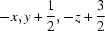
| Symmetry codes: (i) −x+1, −y+1, −z+1; (ii) −x, y+1/2, −z+3/2. |
Experimental details
| Crystal data | |
| Chemical formula | C8H6N4O2 |
| Mr | 190.17 |
| Crystal system, space group | Monoclinic, P21/c |
| Temperature (K) | 293 |
| a, b, c (Å) | 5.2501 (10), 16.805 (3), 9.3290 (18) |
| β (°) | 99.188 (3) |
| V (Å3) | 812.5 (3) |
| Z | 4 |
| Radiation type | Mo Kα |
| µ (mm−1) | 0.12 |
| Crystal size (mm) | 0.45 × 0.14 × 0.13 |
| Data collection | |
| Diffractometer | Bruker APX CCD diffractometer |
| Absorption correction | Multi-scan SADABS (Sheldrick, 2000) |
| Tmin, Tmax | 0.949, 0.985 |
| No. of measured, independent and observed [I > 2σ(I)] reflections | 5991, 1583, 1425 |
| Rint | 0.018 |
| (sin θ/λ)max (Å−1) | 0.617 |
| Refinement | |
| R[F2 > 2σ(F2)], wR(F2), S | 0.040, 0.106, 1.07 |
| No. of reflections | 1583 |
| No. of parameters | 136 |
| H-atom treatment | H atoms treated by a mixture of independent and constrained refinement |
| Δρmax, Δρmin (e Å−3) | 0.19, −0.24 |
Computer programs: SMART (Bruker, 2000), SAINT (Bruker, 2000), SHELXS (Sheldrick, 2008), SHELXL (Sheldrick, 2008), SHELXTL Sheldrick, 2008), SHELXL97 (Sheldrick, 2008).
| D—H···A | D—H | H···A | D···A | D—H···A |
| O2—H2B···N4i | 0.93 (2) | 1.76 (2) | 2.6664 (15) | 164 (2) |
| N1—H1A···O1ii | 0.94 (2) | 1.77 (2) | 2.7118 (16) | 179.1 (19) |
| Symmetry codes: (i) −x+1, −y+1, −z+1; (ii) −x, y+1/2, −z+3/2. |
Acknowledgements
The authors thank the Program for Young Excellent Talents in Southeast University for financial support.
References
 Bruker (2000). SMART and SAINT. Bruker AXS Inc., Madison, Wisconsin, USA. Google Scholar
Chen, X.-M. & Tong, M.-L. (2007). Acc. Chem. Res. 40, 162–170. Web of Science CrossRef PubMed CAS Google Scholar
Demko, Z. P. & Sharpless, K. B. (2001). J. Org. Chem. 66, 7945–7950. Web of Science CrossRef PubMed CAS Google Scholar
Rizk, A. T., Kilner, C. A. & Halcrow, M. A. (2005). CrystEngComm, 7, 359–362. Web of Science CrossRef CAS Google Scholar
Sheldrick, G. M. (2000). SADABS, University of Göttingen. Google Scholar
Sheldrick, G. M. (2008). Acta Cryst. A64, 112–122. Web of Science CrossRef CAS IUCr Journals Google Scholar
This is an open-access article distributed under the terms of the Creative Commons Attribution (CC-BY) Licence, which permits unrestricted use, distribution, and reproduction in any medium, provided the original authors and source are cited.
| CRYSTALLOGRAPHIC COMMUNICATIONS |


Tetrazoles have been extensively investigated in organic synthetic chemistry for several decades due to the fact that they have wide ranging applications in pharmaceuticals, especially explosives, photography, information recording systems, agriculture, and as precursors to a variety of heterocycles (Chen et al. 2007; Demko et al. 2001). They have also been used as a type of important multidentate ligands in coordination chemistry. Here, we report the crystal structure of a new tetrazole, 3-(1H-tetrazol-5-yl)benzoic acid.
The title compound, C8H6N4O2, is a difunctional compound with carboxylate and tetrazole groups. The C=O distance of the carboxylate is 1.216 (2) Å, which is much shorter than the C—O distance of 1.311 (2) Å. In the tetrazole group, the N=N distance is 1.288 (2) Å, and the N—N distances are 1.343 (2) and 1.358 (2) Å, respectively. The C—N distance is 1.333 (2) Å, being close to the C=N distance of 1.325 (2) Å, which is considered to have part double-bond character. In the crystalline state, the molecules are linked to two-dimensional hydrogen-bonding networks by intermolecular N—H···O and O—H···N hydrogen bonds. The N···O distance is 2.712 (2) Å, and the O···N distance is 2.666 (2) Å.