 | Acta Crystallographica Section E Acta Crystallographica Section E CRYSTALLOGRAPHIC COMMUNICATIONS |


 journal menu


metal-organic compounds
| CRYSTALLOGRAPHIC COMMUNICATIONS |
 access
Triaquachlorido(1,10-phenanthroline-κ2N,N′)cobalt(II) chloride monohydrate

aSchool of Science, North University of China, Taiyuan 030051, People's Republic of China, bSchool of Mechatronic Engineering, North University of China, Taiyuan 030051, People's Republic of China, and cDepartment of Materials Science and Chemical Engineering, Taishan University, 271021 Taian, Shandong, People's Republic of China
*Correspondence e-mail: [email protected]
In the title compound, [CoCl(C12H8N2)(H2O)3]Cl·H2O, the CoII ion is coordinated by two N atoms from the 1,10-phenanthroline ligand [Co—N = 2.125 (6) and 2.146 (6) Å], one chloride ligand [Co—Cl = 2.459 (2)Å] and three water molecules [Co—O = 2.070 (5)–2.105 (5)Å] in a distorted octahedral geometry. Intermolecular O—H⋯Cl and O—H⋯O hydrogen bonds form an extensive three-dimensional hydrogen-bonding network, which consolidates the crystal packing.
![[Scheme 1]](cv2481scheme1.gif)
Experimental
Crystal data
|
Refinement
|
|
 .
. Data collection: SMART (Siemens, 1996![[Siemens (1996). SMART and SAINT. Siemens Analytical X-ray Instruments Inc., Madison, Wisconsin, USA.]](../../../../../../logos/arrows/e_arr.gif "Siemens (1996). SMART and SAINT. Siemens Analytical X-ray Instruments Inc., Madison, Wisconsin, USA.") ); cell refinement: SAINT (Siemens, 1996); data reduction: SAINT; program(s) used to solve structure: SHELXS97 (Sheldrick, 2008); program(s) used to refine structure: SHELXL97 (Sheldrick, 2008); molecular graphics: SHELXTL (Sheldrick, 2008); software used to prepare material for publication: SHELXTL.
); cell refinement: SAINT (Siemens, 1996); data reduction: SAINT; program(s) used to solve structure: SHELXS97 (Sheldrick, 2008); program(s) used to refine structure: SHELXL97 (Sheldrick, 2008); molecular graphics: SHELXTL (Sheldrick, 2008); software used to prepare material for publication: SHELXTL.
Supporting information
contains datablocks I, global. DOI: 10.1107/S1600536808042591/cv2481sup1.cif
Structure factors: contains datablock I. DOI: 10.1107/S1600536808042591/cv2481Isup2.hkl
A mixture of Cu(Cl)2*3H2O(168 mg, 1 mmol) and 1,10-phenanthroline(185 mg, 1 mmol) in methanol(30 ml) was placed in a Teflon-lined stainless steel Parr bomb that was heated at 423 K for 72 h. The bomb was then cooled down to the room temperature, the solution was filtered. The solvent was removed from the filtrate under vacuum, and the solid residue was recrystallized from diethyl ether; blue crystals suitable for X-Ray diffraction study were obtained. Yield, 0.724 g, 81%. m.p. 566 K. Analysis, calculated for C12H16Cl2CoN2O4: C 37.72, H 4.22, N 7.33; found: C 37.53, H 4.68, N 7.17%. The elemental analyses were performed with a Perkine Elemer PE2400II instrument.
Water H atoms were located in a differece map and were isotropically refined with an O—H strict distance restraint of 0.85/%A. H atoms bound to C atoms were placed in calculated positions(C—H = 0.93/%A) and refined in the riding-model approximation, Uiso(H)=1.2Ueq(C).
Data collection: SMART (Siemens, 1996); cell SMART (Siemens, 1996); data reduction: SAINT (Siemens, 1996); program(s) used to solve structure: SHELXS97 (Sheldrick, 2008); program(s) used to refine structure: SHELXL97 (Sheldrick, 2008); molecular graphics: SHELXTL (Sheldrick, 2008); software used to prepare material for publication: SHELXTL (Sheldrick, 2008).
![[Figure 1]](./cv2481fig1thm.gif) | Fig. 1. The structure of the title complex, showing 30% probability displacement ellipsoids and the atom-numbering scheme. Dashed lines denote hydrogen bonds. |
| [CoCl(C12H8N2)(H2O)3]Cl·H2O | F(000) = 780 |
| Mr = 382.10 | Dx = 1.617 Mg m−3 |
| Monoclinic, P21/c | Mo Kα radiation, λ = 0.71073 Å |
| a = 7.646 (4) Å | Cell parameters from 580 reflections |
| b = 12.426 (6) Å | θ = 3.0–20.1° |
| c = 16.987 (8) Å | µ = 1.45 mm−1 |
| β = 103.54 (2)° | T = 273 K |
| V = 1569.1 (13) Å3 | Block, blue |
| Z = 4 | 0.37 × 0.25 × 0.19 mm |
| Bruker SMART CCD area-detector diffractometer | 2733 independent reflections |
| Radiation source: fine-focus sealed tube | 1564 reflections with I > 2σ(I) |
| Graphite monochromator | Rint = 0.080 |
| ϕ and ω scans | θmax = 25.0°, θmin = 2.1° |
| Absorption correction: multi-scan (SADABS; Sheldrick, 1996) | h = −9→5 |
| Tmin = 0.616, Tmax = 0.770 | k = −10→14 |
| 6533 measured reflections | l = −17→20 |
| Refinement on F2 | Primary atom site location: structure-invariant direct methods |
| Least-squares matrix: full | Secondary atom site location: difference Fourier map |
| R[F2 > 2σ(F2)] = 0.071 | Hydrogen site location: inferred from neighbouring sites |
| wR(F2) = 0.177 | H-atom parameters constrained |
| S = 1.04 | w = 1/[σ2(Fo2) + (0.0517P)2 + 4.0479P] where P = (Fo2 + 2Fc2)/3 |
| 2733 reflections | (Δ/σ)max < 0.001 |
| 198 parameters | Δρmax = 0.67 e Å−3 |
| 13 restraints | Δρmin = −0.56 e Å−3 |
| [CoCl(C12H8N2)(H2O)3]Cl·H2O | V = 1569.1 (13) Å3 |
| Mr = 382.10 | Z = 4 |
| Monoclinic, P21/c | Mo Kα radiation |
| a = 7.646 (4) Å | µ = 1.45 mm−1 |
| b = 12.426 (6) Å | T = 273 K |
| c = 16.987 (8) Å | 0.37 × 0.25 × 0.19 mm |
| β = 103.54 (2)° |
| Bruker SMART CCD area-detector diffractometer | 2733 independent reflections |
| Absorption correction: multi-scan (SADABS; Sheldrick, 1996) | 1564 reflections with I > 2σ(I) |
| Tmin = 0.616, Tmax = 0.770 | Rint = 0.080 |
| 6533 measured reflections |
| R[F2 > 2σ(F2)] = 0.071 | 13 restraints |
| wR(F2) = 0.177 | H-atom parameters constrained |
| S = 1.04 | Δρmax = 0.67 e Å−3 |
| 2733 reflections | Δρmin = −0.56 e Å−3 |
| 198 parameters |
Geometry. All e.s.d.'s (except the e.s.d. in the dihedral angle between two l.s. planes) are estimated using the full covariance matrix. The cell e.s.d.'s are taken into account individually in the estimation of e.s.d.'s in distances, angles and torsion angles; correlations between e.s.d.'s in cell parameters are only used when they are defined by crystal symmetry. An approximate (isotropic) treatment of cell e.s.d.'s is used for estimating e.s.d.'s involving l.s. planes. |
Refinement. Refinement of F2 against ALL reflections. The weighted R-factor wR and goodness of fit S are based on F2, conventional R-factors R are based on F, with F set to zero for negative F2. The threshold expression of F2 > σ(F2) is used only for calculating R-factors(gt) etc. and is not relevant to the choice of reflections for refinement. R-factors based on F2 are statistically about twice as large as those based on F, and R- factors based on ALL data will be even larger. |
| x | y | z | Uiso*/Ueq | ||
| Co1 | 0.75359 (13) | 0.66886 (9) | 0.99070 (6) | 0.0342 (3) | |
| Cl1 | 0.6997 (3) | 0.49910 (16) | 0.91423 (11) | 0.0431 (5) | |
| Cl2 | 0.8145 (3) | 0.34056 (18) | 1.16347 (12) | 0.0536 (6) | |
| N1 | 0.6918 (8) | 0.7697 (5) | 0.8867 (4) | 0.0360 (15) | |
| N2 | 0.7887 (8) | 0.8255 (5) | 1.0452 (4) | 0.0405 (16) | |
| O1 | 0.8190 (8) | 0.5892 (4) | 1.1032 (3) | 0.0478 (15) | |
| H1A | 0.9003 | 0.5920 | 1.1469 | 0.15 (6)* | |
| H1B | 0.7797 | 0.5251 | 1.0958 | 0.10 (4)* | |
| O2 | 0.4845 (7) | 0.6729 (4) | 0.9965 (3) | 0.0459 (13) | |
| H2A | 0.4527 | 0.6214 | 1.0231 | 0.06 (3)* | |
| H2B | 0.4185 | 0.6755 | 0.9488 | 0.05 (3)* | |
| O3 | 1.0230 (7) | 0.6657 (4) | 0.9883 (3) | 0.0456 (14) | |
| H3A | 1.0372 | 0.6788 | 0.9411 | 0.05 (3)* | |
| H3B | 1.1121 | 0.6289 | 1.0137 | 0.09 (4)* | |
| O4 | 1.1261 (10) | 0.6517 (6) | 1.2062 (4) | 0.075 (2) | |
| H4A | 1.1566 | 0.7013 | 1.2412 | 0.06 (3)* | |
| H4B | 1.2171 | 0.6296 | 1.1901 | 0.16 (7)* | |
| C1 | 0.6476 (11) | 0.7393 (8) | 0.8103 (5) | 0.049 (2) | |
| H1 | 0.6394 | 0.6664 | 0.7979 | 0.059* | |
| C2 | 0.6123 (11) | 0.8160 (7) | 0.7468 (5) | 0.050 (2) | |
| H2 | 0.5810 | 0.7933 | 0.6931 | 0.060* | |
| C3 | 0.6243 (11) | 0.9222 (7) | 0.7645 (5) | 0.052 (2) | |
| H3 | 0.6017 | 0.9726 | 0.7228 | 0.062* | |
| C4 | 0.6706 (11) | 0.9573 (7) | 0.8456 (5) | 0.046 (2) | |
| C5 | 0.7032 (10) | 0.8787 (6) | 0.9056 (5) | 0.037 (2) | |
| C6 | 0.7525 (9) | 0.9047 (6) | 0.9885 (5) | 0.0338 (17) | |
| C7 | 0.7636 (10) | 1.0150 (7) | 1.0107 (5) | 0.044 (2) | |
| C8 | 0.8142 (12) | 1.0398 (8) | 1.0931 (6) | 0.062 (3) | |
| H8 | 0.8232 | 1.1111 | 1.1102 | 0.075* | |
| C9 | 0.8501 (13) | 0.9583 (8) | 1.1481 (6) | 0.062 (3) | |
| H9 | 0.8841 | 0.9740 | 1.2031 | 0.074* | |
| C10 | 0.8363 (10) | 0.8527 (7) | 1.1225 (5) | 0.049 (2) | |
| H10 | 0.8616 | 0.7985 | 1.1612 | 0.058* | |
| C11 | 0.6849 (12) | 1.0667 (7) | 0.8682 (6) | 0.058 (3) | |
| H11 | 0.6645 | 1.1199 | 0.8285 | 0.070* | |
| C12 | 0.7284 (13) | 1.0944 (7) | 0.9475 (6) | 0.063 (3) | |
| H12 | 0.7357 | 1.1669 | 0.9614 | 0.075* |
| U11 | U22 | U33 | U12 | U13 | U23 | |
| Co1 | 0.0399 (6) | 0.0288 (6) | 0.0335 (6) | −0.0003 (5) | 0.0080 (4) | 0.0012 (5) |
| Cl1 | 0.0576 (13) | 0.0299 (11) | 0.0394 (12) | −0.0009 (9) | 0.0068 (9) | −0.0034 (10) |
| Cl2 | 0.0673 (14) | 0.0495 (14) | 0.0443 (12) | 0.0020 (11) | 0.0133 (10) | 0.0060 (12) |
| N1 | 0.040 (4) | 0.033 (4) | 0.036 (4) | 0.000 (3) | 0.011 (3) | 0.002 (3) |
| N2 | 0.043 (4) | 0.034 (4) | 0.045 (4) | −0.001 (3) | 0.009 (3) | −0.003 (4) |
| O1 | 0.068 (4) | 0.040 (4) | 0.034 (3) | −0.006 (3) | 0.009 (3) | 0.002 (3) |
| O2 | 0.050 (3) | 0.042 (4) | 0.048 (3) | 0.000 (3) | 0.016 (3) | 0.004 (3) |
| O3 | 0.043 (3) | 0.055 (4) | 0.042 (3) | 0.006 (3) | 0.015 (2) | 0.007 (3) |
| O4 | 0.080 (5) | 0.080 (5) | 0.058 (4) | 0.008 (4) | 0.001 (4) | −0.028 (4) |
| C1 | 0.058 (6) | 0.059 (6) | 0.030 (5) | 0.005 (4) | 0.010 (4) | 0.004 (4) |
| C2 | 0.061 (6) | 0.055 (6) | 0.032 (4) | 0.003 (4) | 0.008 (4) | 0.004 (4) |
| C3 | 0.062 (6) | 0.040 (6) | 0.052 (6) | 0.003 (4) | 0.012 (4) | 0.005 (5) |
| C4 | 0.046 (5) | 0.044 (6) | 0.047 (5) | 0.005 (4) | 0.009 (4) | 0.006 (4) |
| C5 | 0.036 (4) | 0.025 (4) | 0.055 (6) | 0.000 (3) | 0.018 (4) | −0.009 (4) |
| C6 | 0.038 (4) | 0.022 (4) | 0.042 (5) | −0.001 (3) | 0.010 (3) | −0.001 (4) |
| C7 | 0.043 (5) | 0.032 (5) | 0.057 (6) | 0.001 (4) | 0.013 (4) | −0.005 (4) |
| C8 | 0.078 (7) | 0.034 (6) | 0.074 (7) | −0.002 (5) | 0.014 (5) | −0.023 (5) |
| C9 | 0.080 (7) | 0.045 (6) | 0.059 (6) | −0.001 (5) | 0.016 (5) | −0.021 (5) |
| C10 | 0.053 (5) | 0.054 (6) | 0.038 (5) | 0.004 (4) | 0.009 (4) | −0.004 (5) |
| C11 | 0.072 (7) | 0.038 (6) | 0.062 (7) | 0.009 (5) | 0.012 (5) | 0.020 (5) |
| C12 | 0.075 (7) | 0.030 (5) | 0.082 (7) | 0.002 (5) | 0.013 (5) | 0.004 (6) |
| Co1—O3 | 2.071 (5) | C1—H1 | 0.9300 |
| Co1—O2 | 2.084 (5) | C2—C3 | 1.35 (1) |
| Co1—O1 | 2.106 (5) | C2—H2 | 0.9301 |
| Co1—N1 | 2.127 (6) | C3—C4 | 1.41 (1) |
| Co1—N2 | 2.145 (7) | C3—H3 | 0.9300 |
| Co1—Cl1 | 2.461 (2) | C4—C5 | 1.39 (1) |
| N1—C1 | 1.317 (9) | C4—C11 | 1.41 (1) |
| N1—C5 | 1.390 (9) | C5—C6 | 1.41 (1) |
| N2—C10 | 1.321 (9) | C6—C7 | 1.42 (1) |
| N2—C6 | 1.361 (9) | C7—C8 | 1.40 (1) |
| O1—H1A | 0.8500 | C7—C12 | 1.44 (1) |
| O1—H1B | 0.8501 | C8—C9 | 1.36 (1) |
| O2—H2A | 0.8500 | C8—H8 | 0.9301 |
| O2—H2B | 0.8498 | C9—C10 | 1.38 (1) |
| O3—H3A | 0.8500 | C9—H9 | 0.9301 |
| O3—H3B | 0.8500 | C10—H10 | 0.9300 |
| O4—H4A | 0.8500 | C11—C12 | 1.36 (1) |
| O4—H4B | 0.8500 | C11—H11 | 0.9300 |
| C1—C2 | 1.42 (1) | C12—H12 | 0.9300 |
| O3—Co1—O2 | 178.4 (2) | C1—C2—H2 | 120.2 |
| O3—Co1—O1 | 89.0 (2) | C2—C3—C4 | 120.5 (8) |
| O2—Co1—O1 | 89.7 (2) | C2—C3—H3 | 119.7 |
| O3—Co1—N1 | 91.3 (2) | C4—C3—H3 | 119.7 |
| O2—Co1—N1 | 89.8 (2) | C5—C4—C3 | 117.4 (8) |
| O1—Co1—N1 | 171.9 (2) | C5—C4—C11 | 119.3 (8) |
| O3—Co1—N2 | 90.1 (2) | C3—C4—C11 | 123.3 (8) |
| O2—Co1—N2 | 89.0 (2) | N1—C5—C4 | 121.6 (8) |
| O1—Co1—N2 | 93.2 (2) | N1—C5—C6 | 116.3 (7) |
| N1—Co1—N2 | 78.8 (2) | C4—C5—C6 | 122.0 (7) |
| C1—N1—C5 | 119.6 (7) | N2—C6—C5 | 120.3 (7) |
| C1—N1—Co1 | 127.3 (6) | N2—C6—C7 | 121.4 (7) |
| C5—N1—Co1 | 113.1 (5) | C5—C6—C7 | 118.3 (7) |
| C10—N2—C6 | 118.8 (7) | C8—C7—C6 | 117.7 (8) |
| C10—N2—Co1 | 129.7 (6) | C8—C7—C12 | 123.8 (8) |
| C6—N2—Co1 | 111.5 (5) | C6—C7—C12 | 118.4 (8) |
| Co1—O1—H1A | 138.0 | C9—C8—C7 | 119.2 (8) |
| Co1—O1—H1B | 107.8 | C9—C8—H8 | 120.4 |
| H1A—O1—H1B | 109.2 | C7—C8—H8 | 120.4 |
| Co1—O2—H2A | 114.5 | C8—C9—C10 | 120.2 (9) |
| Co1—O2—H2B | 109.1 | C8—C9—H9 | 119.9 |
| H2A—O2—H2B | 110.8 | C10—C9—H9 | 119.9 |
| Co1—O3—H3A | 111.3 | N2—C10—C9 | 122.7 (9) |
| Co1—O3—H3B | 133.1 | N2—C10—H10 | 118.7 |
| H3A—O3—H3B | 108.6 | C9—C10—H10 | 118.7 |
| H4A—O4—H4B | 110.4 | C12—C11—C4 | 120.0 (8) |
| N1—C1—C2 | 121.2 (8) | C12—C11—H11 | 120.0 |
| N1—C1—H1 | 119.4 | C4—C11—H11 | 120.0 |
| C2—C1—H1 | 119.4 | C11—C12—C7 | 121.9 (9) |
| C3—C2—C1 | 119.7 (8) | C11—C12—H12 | 119.1 |
| C3—C2—H2 | 120.2 | C7—C12—H12 | 119.1 |
| D—H···A | D—H | H···A | D···A | D—H···A |
| O1—H1A···O4 | 0.85 | 1.93 | 2.693 (9) | 149 |
| O1—H1B···Cl2 | 0.85 | 2.55 | 3.258 (6) | 141 |
| O2—H2A···Cl1i | 0.85 | 2.31 | 3.139 (6) | 166 |
| O2—H2B···Cl2i | 0.85 | 2.29 | 3.119 (6) | 164 |
| O3—H3A···Cl2ii | 0.85 | 2.33 | 3.114 (6) | 153 |
| O3—H3B···Cl1ii | 0.85 | 2.30 | 3.128 (6) | 166 |
| O4—H4A···Cl2iii | 0.85 | 2.34 | 3.185 (8) | 170 |
| O4—H4B···Cl1ii | 0.85 | 2.58 | 3.278 (8) | 141 |
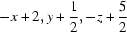
| Symmetry codes: (i) −x+1, −y+1, −z+2; (ii) −x+2, −y+1, −z+2; (iii) −x+2, y+1/2, −z+5/2. |
Experimental details
| Crystal data | |
| Chemical formula | [CoCl(C12H8N2)(H2O)3]Cl·H2O |
| Mr | 382.10 |
| Crystal system, space group | Monoclinic, P21/c |
| Temperature (K) | 273 |
| a, b, c (Å) | 7.646 (4), 12.426 (6), 16.987 (8) |
| β (°) | 103.54 (2) |
| V (Å3) | 1569.1 (13) |
| Z | 4 |
| Radiation type | Mo Kα |
| µ (mm−1) | 1.45 |
| Crystal size (mm) | 0.37 × 0.25 × 0.19 |
| Data collection | |
| Diffractometer | Bruker SMART CCD area-detector diffractometer |
| Absorption correction | Multi-scan (SADABS; Sheldrick, 1996) |
| Tmin, Tmax | 0.616, 0.770 |
| No. of measured, independent and observed [I > 2σ(I)] reflections | 6533, 2733, 1564 |
| Rint | 0.080 |
| (sin θ/λ)max (Å−1) | 0.596 |
| Refinement | |
| R[F2 > 2σ(F2)], wR(F2), S | 0.071, 0.177, 1.04 |
| No. of reflections | 2733 |
| No. of parameters | 198 |
| No. of restraints | 13 |
| H-atom treatment | H-atom parameters constrained |
| Δρmax, Δρmin (e Å−3) | 0.67, −0.56 |
Computer programs: SMART (Siemens, 1996), SAINT (Siemens, 1996), SHELXS97 (Sheldrick, 2008), SHELXL97 (Sheldrick, 2008), SHELXTL (Sheldrick, 2008).
| D—H···A | D—H | H···A | D···A | D—H···A |
| O1—H1A···O4 | 0.85 | 1.93 | 2.693 (9) | 148.50 |
| O1—H1B···Cl2 | 0.85 | 2.55 | 3.258 (6) | 141.22 |
| O2—H2A···Cl1i | 0.85 | 2.31 | 3.139 (6) | 166.35 |
| O2—H2B···Cl2i | 0.85 | 2.29 | 3.119 (6) | 164.31 |
| O3—H3A···Cl2ii | 0.85 | 2.33 | 3.114 (6) | 153.01 |
| O3—H3B···Cl1ii | 0.85 | 2.30 | 3.128 (6) | 166.26 |
| O4—H4A···Cl2iii | 0.85 | 2.34 | 3.185 (8) | 169.75 |
| O4—H4B···Cl1ii | 0.85 | 2.58 | 3.278 (8) | 140.74 |
| Symmetry codes: (i) −x+1, −y+1, −z+2; (ii) −x+2, −y+1, −z+2; (iii) −x+2, y+1/2, −z+5/2. |
Acknowledgements
The authors thank the National Natural Science Foundation of China for financial support.
References
 Liu, J.-T., Fan, S.-D. & Li, D.-Q. (2006). Acta Cryst. E62, m2165–m2166. Web of Science CrossRef IUCr Journals Google Scholar
Sheldrick, G. M. (1996). SADABS. University of Göttingen, Germany. Google Scholar
Sheldrick, G. M. (2008). Acta Cryst. A64, 112–122. Web of Science CrossRef CAS IUCr Journals Google Scholar
Siemens (1996). SMART and SAINT. Siemens Analytical X-ray Instruments Inc., Madison, Wisconsin, USA. Google Scholar
Zhang, C., Yu, K., Wu, D. & Zhao, C. (1999). Acta Cryst. C55, 1815–1817. Web of Science CSD CrossRef CAS IUCr Journals Google Scholar
This is an open-access article distributed under the terms of the Creative Commons Attribution (CC-BY) Licence, which permits unrestricted use, distribution, and reproduction in any medium, provided the original authors and source are cited.
| CRYSTALLOGRAPHIC COMMUNICATIONS |


The structures of some tetraaqua(1,10-phenanthroline) metal ionic complexes with different anions have been reported (Liu et al., 2006; Zhang et al., 1999). In our study in this field, we select 1,10-phenanthroline as the co-ligand to continue our exploration of the Co complexes. Herein we report the structure of the title compound (I), which was characterized by elemental analyses and X-ray crystallography diffraction.
In (I) (Fig. 1), each CoII ion is coordinated by two N atoms from 1,10-phenanthroline ligand [Co—N 2.125 (6), 2.146 (6) Å], one chlorine anion [Co—Cl 2.459 (2) Å] and three water molecules [Co—O 2.070 (5)–2.105 (5) Å] in a distorted octahedral geometry. Two aqua O atoms and two N atoms from 1,10-phenanthroline ligand define the special position on a mirror plane. One aqua group and chlorine anion fill the axial apical positions. The intermolecular O—H···Cl and O—H···O hydrogen bonds (Table 1) form an extensive three-dimensional hydrogen-bonding network, which consolidate the crystal packing.