 | Acta Crystallographica Section E Acta Crystallographica Section E CRYSTALLOGRAPHIC COMMUNICATIONS |


 journal menu


organic compounds
| CRYSTALLOGRAPHIC COMMUNICATIONS |
 access
2,5-Dimethylanilinium chloride monohydrate

aLaboratoire de Chimie des Matériaux, Faculté des Sciences de Bizerte, 7021 Zarzouna, Bizerte, Tunisia
*Correspondence e-mail: [email protected]
In the title compound, C8H12N+·Cl−·H2O, the crystal packing is influenced by O—H⋯Cl, N—H⋯Cl and N—H⋯O hydrogen bonds, resulting in a two-dimensional network propagating parallel to (001).
Related literature
For related literature, see: Aloui et al. (2006![[Aloui, Z., Abid, S. & Rzaigui, M. (2006). Anal. Sci. (Japan), 22, x201-x202.]](../../../../../../logos/arrows/e_arr.gif "Aloui, Z., Abid, S. & Rzaigui, M. (2006). Anal. Sci. (Japan), 22, x201-x202.") ); Masse et al. (1993); Blessing (1986).
); Masse et al. (1993); Blessing (1986).
![[Scheme 1]](hb2876scheme1.gif)
Experimental
Crystal data
|
Data collection
|
|
 ; (ii)
  ; (iii)
  ; (iv)
 Data collection: CAD-4 EXPRESS (Enraf–Nonius, 1994); cell refinement: CAD-4 EXPRESS; data reduction: XCAD4 (Harms & Wocadlo, 1995); program(s) used to solve structure: SHELXS97 (Sheldrick, 2008); program(s) used to refine structure: SHELXL97 (Sheldrick, 2008); molecular graphics: ORTEP-3 (Farrugia, 1997); software used to prepare material for publication: WinGX publication routines (Farrugia, 1999).
Supporting information
contains datablocks I, global. DOI: 10.1107/S1600536808041287/hb2876sup1.cif
Structure factors: contains datablock I. DOI: 10.1107/S1600536808041287/hb2876Isup2.hkl
The title compound was prepared by slow addition, at room temperature, of an aqueous hydrochloric acid solution to an alcoholic solution of 2,5-xylidine in a 1:1 molar ratio. A crystalline precipitate was formed. After dissolution by adding H2O, the solution was slowly evaporated at room temperature over several days resulting in the formation of transparent plates of (I).
The water H atoms were located in a difference map and freely refined. The other H atoms were positioned geometrically (N—H = 0.89, C—H = 0.93–0.96 Å) and refined as riding with Uiso(H) = 1.2Ueq(C,N) or 1.5Ueq(methyl C).
Data collection: CAD-4 EXPRESS (Enraf–Nonius, 1994); cell CAD-4 EXPRESS (Enraf–Nonius, 1994); data reduction: XCAD4 (Harms & Wocadlo, 1995); program(s) used to solve structure: SHELXS97 (Sheldrick, 2008); program(s) used to refine structure: SHELXL97 (Sheldrick, 2008); molecular graphics: ORTEP-3 (Farrugia, 1997); software used to prepare material for publication: WinGX publication routines (Farrugia, 1999).
![[Figure 1]](./hb2876fig1thm.gif) | Fig. 1. View of (I) with displacement ellipsoids for non-H atoms drawn at the 30% probability level. |
![[Figure 2]](./hb2876fig2thm.gif) | Fig. 2. A view of the atomic arrangement of the title compound along the b axis with H bonds shown as dashed lines. |
| C8H12N+·Cl−·H2O | F(000) = 188 |
| Mr = 175.65 | Dx = 1.187 Mg m−3 |
| Monoclinic, P21 | Mo Kα radiation, λ = 0.71073 Å |
| Hall symbol: P 2yb | Cell parameters from 25 reflections |
| a = 7.515 (4) Å | θ = 9.0–10.8° |
| b = 7.441 (3) Å | µ = 0.34 mm−1 |
| c = 9.019 (2) Å | T = 293 K |
| β = 102.87 (3)° | Plate, colourless |
| V = 491.7 (4) Å3 | 0.50 × 0.30 × 0.20 mm |
| Z = 2 |
| Enraf–Nonius TurboCAD-4 diffractometer | Rint = 0.025 |
| Radiation source: Enraf Nonius FR590 | θmax = 28.0°, θmin = 2.3° |
| Graphite monochromator | h = −9→9 |
| non–profiled ω scans | k = 0→9 |
| 2058 measured reflections | l = −5→11 |
| 1260 independent reflections | 2 standard reflections every 120 min |
| 1166 reflections with I > 2σ(I) | intensity decay: 5% |
| Refinement on F2 | Secondary atom site location: difference Fourier map |
| Least-squares matrix: full | Hydrogen site location: difmap and geom |
| R[F2 > 2σ(F2)] = 0.028 | H atoms treated by a mixture of independent and constrained refinement |
| wR(F2) = 0.081 | w = 1/[σ2(Fo2) + (0.0515P)2 + 0.0061P] where P = (Fo2 + 2Fc2)/3 |
| S = 1.10 | (Δ/σ)max < 0.001 |
| 1260 reflections | Δρmax = 0.20 e Å−3 |
| 111 parameters | Δρmin = −0.14 e Å−3 |
| 1 restraint | Absolute structure: Flack (1983), unique data only |
| Primary atom site location: structure-invariant direct methods | Absolute structure parameter: 0.17 (9) |
| C8H12N+·Cl−·H2O | V = 491.7 (4) Å3 |
| Mr = 175.65 | Z = 2 |
| Monoclinic, P21 | Mo Kα radiation |
| a = 7.515 (4) Å | µ = 0.34 mm−1 |
| b = 7.441 (3) Å | T = 293 K |
| c = 9.019 (2) Å | 0.50 × 0.30 × 0.20 mm |
| β = 102.87 (3)° |
| Enraf–Nonius TurboCAD-4 diffractometer | Rint = 0.025 |
| 2058 measured reflections | 2 standard reflections every 120 min |
| 1260 independent reflections | intensity decay: 5% |
| 1166 reflections with I > 2σ(I) |
| R[F2 > 2σ(F2)] = 0.028 | H atoms treated by a mixture of independent and constrained refinement |
| wR(F2) = 0.081 | Δρmax = 0.20 e Å−3 |
| S = 1.10 | Δρmin = −0.14 e Å−3 |
| 1260 reflections | Absolute structure: Flack (1983), unique data only |
| 111 parameters | Absolute structure parameter: 0.17 (9) |
| 1 restraint |
Geometry. All e.s.d.'s (except the e.s.d. in the dihedral angle between two l.s. planes) are estimated using the full covariance matrix. The cell e.s.d.'s are taken into account individually in the estimation of e.s.d.'s in distances, angles and torsion angles; correlations between e.s.d.'s in cell parameters are only used when they are defined by crystal symmetry. An approximate (isotropic) treatment of cell e.s.d.'s is used for estimating e.s.d.'s involving l.s. planes. |
Refinement. Refinement of F2 against ALL reflections. The weighted R-factor wR and goodness of fit S are based on F2, conventional R-factors R are based on F, with F set to zero for negative F2. The threshold expression of F2 > σ(F2) is used only for calculating R-factors(gt) etc. and is not relevant to the choice of reflections for refinement. R-factors based on F2 are statistically about twice as large as those based on F, and R- factors based on ALL data will be even larger. |
| x | y | z | Uiso*/Ueq | ||
| H30 | 0.343 (5) | 0.410 (6) | 0.541 (3) | 0.068 (9)* | |
| H31 | 0.467 (5) | 0.287 (7) | 0.548 (4) | 0.101 (13)* | |
| Cl1 | 0.77059 (6) | 0.20498 (11) | 0.51544 (5) | 0.05039 (16) | |
| C1 | 0.7901 (2) | 0.5395 (3) | 1.1684 (2) | 0.0384 (4) | |
| N1 | 0.8345 (2) | 0.5589 (3) | 1.33479 (17) | 0.0417 (4) | |
| H1A | 0.7624 | 0.6418 | 1.3617 | 0.062* | |
| H1B | 0.9505 | 0.5923 | 1.3660 | 0.062* | |
| H1C | 0.8174 | 0.4543 | 1.3774 | 0.062* | |
| C6 | 0.9259 (3) | 0.5724 (3) | 1.0904 (2) | 0.0431 (4) | |
| H6 | 1.0405 | 0.6101 | 1.1431 | 0.052* | |
| C2 | 0.6147 (2) | 0.4859 (3) | 1.0962 (2) | 0.0427 (4) | |
| C5 | 0.8914 (3) | 0.5491 (3) | 0.9335 (3) | 0.0487 (5) | |
| C3 | 0.5844 (3) | 0.4628 (4) | 0.9399 (2) | 0.0541 (5) | |
| H3 | 0.4698 | 0.4248 | 0.8873 | 0.065* | |
| C7 | 0.4674 (3) | 0.4531 (4) | 1.1817 (3) | 0.0560 (6) | |
| H7A | 0.5086 | 0.3654 | 1.2599 | 0.084* | |
| H7B | 0.3597 | 0.4097 | 1.1128 | 0.084* | |
| H7C | 0.4399 | 0.5634 | 1.2271 | 0.084* | |
| C4 | 0.7171 (3) | 0.4937 (4) | 0.8597 (3) | 0.0551 (6) | |
| H4 | 0.6902 | 0.4773 | 0.7548 | 0.066* | |
| O1 | 0.3659 (3) | 0.3043 (4) | 0.5526 (3) | 0.0783 (6) | |
| C8 | 1.0363 (4) | 0.5817 (4) | 0.8458 (3) | 0.0682 (7) | |
| H8A | 1.1339 | 0.6502 | 0.9071 | 0.102* | |
| H8B | 0.9850 | 0.6472 | 0.7546 | 0.102* | |
| H8C | 1.0828 | 0.4687 | 0.8197 | 0.102* |
| U11 | U22 | U33 | U12 | U13 | U23 | |
| Cl1 | 0.0441 (2) | 0.0462 (2) | 0.0622 (3) | 0.0054 (3) | 0.01468 (18) | 0.0086 (3) |
| C1 | 0.0394 (9) | 0.0301 (8) | 0.0461 (9) | −0.0005 (7) | 0.0105 (7) | −0.0040 (7) |
| N1 | 0.0388 (7) | 0.0414 (8) | 0.0458 (8) | −0.0036 (7) | 0.0115 (6) | −0.0009 (7) |
| C6 | 0.0421 (9) | 0.0341 (9) | 0.0555 (11) | −0.0039 (8) | 0.0157 (8) | −0.0023 (9) |
| C2 | 0.0378 (8) | 0.0371 (9) | 0.0541 (11) | −0.0006 (8) | 0.0120 (8) | −0.0042 (9) |
| C5 | 0.0574 (11) | 0.0372 (9) | 0.0567 (11) | −0.0024 (9) | 0.0237 (9) | −0.0033 (10) |
| C3 | 0.0486 (11) | 0.0568 (14) | 0.0545 (12) | −0.0063 (11) | 0.0064 (9) | −0.0123 (11) |
| C7 | 0.0400 (10) | 0.0655 (16) | 0.0649 (14) | −0.0104 (11) | 0.0169 (9) | −0.0068 (12) |
| C4 | 0.0658 (13) | 0.0554 (13) | 0.0450 (11) | −0.0011 (12) | 0.0143 (9) | −0.0082 (10) |
| O1 | 0.0586 (11) | 0.0618 (13) | 0.1229 (18) | 0.0097 (10) | 0.0381 (11) | 0.0362 (12) |
| C8 | 0.0852 (18) | 0.0626 (17) | 0.0694 (15) | −0.0123 (15) | 0.0439 (14) | −0.0039 (14) |
| C1—C6 | 1.383 (3) | C3—C4 | 1.376 (3) |
| C1—C2 | 1.393 (3) | C3—H3 | 0.9300 |
| C1—N1 | 1.470 (2) | C7—H7A | 0.9600 |
| N1—H1A | 0.8900 | C7—H7B | 0.9600 |
| N1—H1B | 0.8900 | C7—H7C | 0.9600 |
| N1—H1C | 0.8900 | C4—H4 | 0.9300 |
| C6—C5 | 1.391 (3) | O1—H30 | 0.80 (4) |
| C6—H6 | 0.9300 | O1—H31 | 0.78 (4) |
| C2—C3 | 1.388 (3) | C8—H8A | 0.9600 |
| C2—C7 | 1.503 (3) | C8—H8B | 0.9600 |
| C5—C4 | 1.393 (3) | C8—H8C | 0.9600 |
| C5—C8 | 1.501 (3) | ||
| C6—C1—C2 | 122.80 (19) | C4—C3—H3 | 118.7 |
| C6—C1—N1 | 118.46 (17) | C2—C3—H3 | 118.7 |
| C2—C1—N1 | 118.73 (18) | C2—C7—H7A | 109.5 |
| C1—N1—H1A | 109.5 | C2—C7—H7B | 109.5 |
| C1—N1—H1B | 109.5 | H7A—C7—H7B | 109.5 |
| H1A—N1—H1B | 109.5 | C2—C7—H7C | 109.5 |
| C1—N1—H1C | 109.5 | H7A—C7—H7C | 109.5 |
| H1A—N1—H1C | 109.5 | H7B—C7—H7C | 109.5 |
| H1B—N1—H1C | 109.5 | C3—C4—C5 | 120.8 (2) |
| C1—C6—C5 | 120.3 (2) | C3—C4—H4 | 119.6 |
| C1—C6—H6 | 119.9 | C5—C4—H4 | 119.6 |
| C5—C6—H6 | 119.9 | H30—O1—H31 | 110 (4) |
| C3—C2—C1 | 115.72 (19) | C5—C8—H8A | 109.5 |
| C3—C2—C7 | 121.90 (19) | C5—C8—H8B | 109.5 |
| C1—C2—C7 | 122.38 (19) | H8A—C8—H8B | 109.5 |
| C6—C5—C4 | 117.7 (2) | C5—C8—H8C | 109.5 |
| C6—C5—C8 | 121.6 (2) | H8A—C8—H8C | 109.5 |
| C4—C5—C8 | 120.7 (2) | H8B—C8—H8C | 109.5 |
| C4—C3—C2 | 122.7 (2) | ||
| C2—C1—C6—C5 | −1.2 (3) | C1—C6—C5—C8 | −179.4 (2) |
| N1—C1—C6—C5 | 177.61 (19) | C1—C2—C3—C4 | −1.2 (4) |
| C6—C1—C2—C3 | 1.5 (3) | C7—C2—C3—C4 | 179.4 (3) |
| N1—C1—C2—C3 | −177.3 (2) | C2—C3—C4—C5 | 0.6 (4) |
| C6—C1—C2—C7 | −179.1 (2) | C6—C5—C4—C3 | −0.2 (4) |
| N1—C1—C2—C7 | 2.1 (3) | C8—C5—C4—C3 | 179.7 (3) |
| C1—C6—C5—C4 | 0.5 (3) |
| D—H···A | D—H | H···A | D···A | D—H···A |
| O1—H30···Cl1i | 0.81 (4) | 2.37 (4) | 3.168 (3) | 171 (4) |
| O1—H31···Cl1 | 0.78 (4) | 2.44 (4) | 3.219 (3) | 174 (5) |
| N1—H1A···O1ii | 0.89 | 1.82 | 2.705 (4) | 171 |
| N1—H1B···Cl1iii | 0.89 | 2.29 | 3.167 (2) | 169 |
| N1—H1C···Cl1iv | 0.89 | 2.30 | 3.189 (3) | 173 |
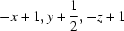
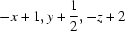
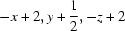
| Symmetry codes: (i) −x+1, y+1/2, −z+1; (ii) −x+1, y+1/2, −z+2; (iii) −x+2, y+1/2, −z+2; (iv) x, y, z+1. |
Experimental details
| Crystal data | |
| Chemical formula | C8H12N+·Cl−·H2O |
| Mr | 175.65 |
| Crystal system, space group | Monoclinic, P21 |
| Temperature (K) | 293 |
| a, b, c (Å) | 7.515 (4), 7.441 (3), 9.019 (2) |
| β (°) | 102.87 (3) |
| V (Å3) | 491.7 (4) |
| Z | 2 |
| Radiation type | Mo Kα |
| µ (mm−1) | 0.34 |
| Crystal size (mm) | 0.50 × 0.30 × 0.20 |
| Data collection | |
| Diffractometer | Enraf–Nonius TurboCAD-4 diffractometer |
| Absorption correction | – |
| No. of measured, independent and observed [I > 2σ(I)] reflections | 2058, 1260, 1166 |
| Rint | 0.025 |
| (sin θ/λ)max (Å−1) | 0.660 |
| Refinement | |
| R[F2 > 2σ(F2)], wR(F2), S | 0.028, 0.081, 1.10 |
| No. of reflections | 1260 |
| No. of parameters | 111 |
| No. of restraints | 1 |
| H-atom treatment | H atoms treated by a mixture of independent and constrained refinement |
| Δρmax, Δρmin (e Å−3) | 0.20, −0.14 |
| Absolute structure | Flack (1983), unique data only |
| Absolute structure parameter | 0.17 (9) |
Computer programs: CAD-4 EXPRESS (Enraf–Nonius, 1994), XCAD4 (Harms & Wocadlo, 1995), SHELXS97 (Sheldrick, 2008), SHELXL97 (Sheldrick, 2008), ORTEP-3 (Farrugia, 1997), WinGX publication routines (Farrugia, 1999).
| D—H···A | D—H | H···A | D···A | D—H···A |
| O1—H30···Cl1i | 0.81 (4) | 2.37 (4) | 3.168 (3) | 171 (4) |
| O1—H31···Cl1 | 0.78 (4) | 2.44 (4) | 3.219 (3) | 174 (5) |
| N1—H1A···O1ii | 0.89 | 1.82 | 2.705 (4) | 171 |
| N1—H1B···Cl1iii | 0.89 | 2.29 | 3.167 (2) | 169 |
| N1—H1C···Cl1iv | 0.89 | 2.30 | 3.189 (3) | 173 |
| Symmetry codes: (i) −x+1, y+1/2, −z+1; (ii) −x+1, y+1/2, −z+2; (iii) −x+2, y+1/2, −z+2; (iv) x, y, z+1. |
References
 Aloui, Z., Abid, S. & Rzaigui, M. (2006). Anal. Sci. (Japan), 22, x201–x202. CSD CrossRef CAS Google Scholar
Blessing, R. H. (1986). Acta Cryst. B42, 613–621. CSD CrossRef CAS Web of Science IUCr Journals Google Scholar
Enraf–Nonius (1994). CAD-4 EXPRESS. Enraf–Nonius, Delft, The Netherlands. Google Scholar
Farrugia, L. J. (1997). J. Appl. Cryst. 30, 565. CrossRef IUCr Journals Google Scholar
Farrugia, L. J. (1999). J. Appl. Cryst. 32, 837–838. CrossRef CAS IUCr Journals Google Scholar
Flack, H. D. (1983). Acta Cryst. A39, 876–881. CrossRef CAS Web of Science IUCr Journals Google Scholar
Harms, K. & Wocadlo, S. (1995). XCAD4. University of Marburg, Germany. Google Scholar
Masse, R., Bagieu-Beucher, M., Pecault, J., Levy, J. P. & Zyss, J. (1993). Nonlin. Opt. 5, 413–423. CAS Google Scholar
Sheldrick, G. M. (2008). Acta Cryst. A64, 112–122. Web of Science CrossRef CAS IUCr Journals Google Scholar
This is an open-access article distributed under the terms of the Creative Commons Attribution (CC-BY) Licence, which permits unrestricted use, distribution, and reproduction in any medium, provided the original authors and source are cited.
| CRYSTALLOGRAPHIC COMMUNICATIONS |


The preparation of inorganic anion and organic cation salts continues to be a focus area in chemistry and material science because of their abilities to combine the properties of organic and inorganic compounds within one single molecular scale, so as to exhibit some interesting crystal structure and some special properties, such as second-order nonlinear optical response, magnetism, luminescence, and even multifunctional properties (Masse et al., 1993). It is therefore vital to design and synthesize novel salts with inorganic anions and organic cations so as to explore their various properties. In this context, we report the synthesis and the crystal structure of a the title compound, (I), (Fig. 1). The crystal packing can be described as a typical layered organization. A projection of such a layer shows that the Cl- anions are linked to the water molecules by O—H···Cl hydrogen bonds to form infinite corrugated chains along the b direction (Fig. 2). These chains are themselves connected via N—H···O and N—H···Cl hydrogen bonds originating from NH3+ groups, so as to built inorganic layers spreading around the (a,b) plane. The 2,5-xylidinium cations are anchored onto the successive inorganic layers via hydrogen bonds and electrostatic interactions, to compensate their negative charges.
The examination of the organic cation shows that the values of the N—C, C—C distances and N—C—C, C—C—C angles range from 1.376 (3) to 1.503 (3) Å and 115.72 (19) to 122.80 (19)°, respectively. These values show no significant difference from those obtained in other organic materials associated with the same organic groups (Aloui et al., 2006).
In this structure, the water molecule play a very important role in the cohesion of the various groups. It participates with the organic cation and chloride anion in an H-bonding scheme of N—H···O and O—H···Cl interactions in the asymmetrical unit. Among these five H-bonds, only one could be considered to be strong according to the well known criterion of Blessing and Brown: N···O = 2.705 (4)Å (Blessing, 1986). The four remaining hydrogen bonds are relatively weak, and their donor···acceptor distances vary from 3.167 (2) to 3.219 (3) Å. Thus, these different interactions (hydrogen bonds, Van der Waals, and electrostatic) form a stable three-dimensional network.