 | Acta Crystallographica Section E Acta Crystallographica Section E CRYSTALLOGRAPHIC COMMUNICATIONS |


 journal menu


organic compounds
| CRYSTALLOGRAPHIC COMMUNICATIONS |
 access
3-Phenyltetrahydrofuran-2,5-dione

aCollege of Chemistry and Chemical Engineering, Liaocheng University, Shandong 252059, People's Republic of China
*Correspondence e-mail: [email protected]
In the title compound, C10H8O3, the dihedral angle between the approximately planar tetrahydrofuran-2,5-dione ring [maximum deviation 0.014 (3) Å] and the phenyl ring is 85.68 (8)°. Weak C—H⋯O=C intermolecular hydrogen-bonding contacts are observed in the structure.
Related literature
For the of the related compound, 3,3-dimethyl-4-phenyltetrahydrofuran-2,5-dione, see: Rudler et al. (2005![[Rudler, H., Parlier, A., Alvarez, C. & Vaissermann, J. (2005). J. Organomet. Chem. 690, 4087-4089. ]](../../../../../../logos/arrows/e_arr.gif "Rudler, H., Parlier, A., Alvarez, C. & Vaissermann, J. (2005). J. Organomet. Chem. 690, 4087-4089.") ). For hydrogen bonds, see: Desiraju & Steiner (2001); Jeffrey & Saenger (1994).
). For hydrogen bonds, see: Desiraju & Steiner (2001); Jeffrey & Saenger (1994).
![[Scheme 1]](si2139scheme1.gif)
Experimental
Crystal data
|
Refinement
|
|
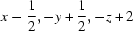 ; (ii)
 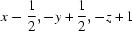 ; (iii)
 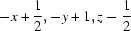 .
. Data collection: SMART (Siemens, 1996); cell refinement: SAINT (Siemens, 1996); data reduction: SAINT; program(s) used to solve structure: SHELXS97 (Sheldrick, 2008); program(s) used to refine structure: SHELXL97 (Sheldrick, 2008); molecular graphics: ORTEP-3 (Farrugia, 1997) and PLATON (Spek, 2003); software used to prepare material for publication: SHELXTL (Sheldrick, 2008) and PLATON.
Supporting information
contains datablocks I, global. DOI: 10.1107/S1600536808042670/si2139sup1.cif
Structure factors: contains datablock I. DOI: 10.1107/S1600536808042670/si2139Isup2.hkl
Pyrazine-2,3-dicarboxylic acid ( 0.336 g, 2 mmol) was added to stirring toluene solution (25 ml) containing triphenylantimonyoxide (0.738 g, 2 mmol). After refluxing for 8 h, the solution was filtered. The solvent was gradually removed by evaporation under vacuum until the white solid is obtained. The solid was recrystallized from petroleum ether/dichoromethane (1:1) to give colorless crystals.
The H atom bound to the (phenyl) ring was constraint to values of 0.93Å, the CH and CH2 groups were 0.98Å and 0.97Å with Uiso(H) = 1.2 Ueq. The phenyl H atom, H8, and one of the CH2 H atoms, H3B, were refined using distance restraints (DFIX 1.02 (0.02) Å, see Table 1) for comparison with similar C—H···O hydrogen bonds (C—H = 1.00 - 1.03 Å) in the related structure (II) (but in centrosymmetric P21/n).
In the absence of significant effects, Friedel pairs were averaged, with the result of a poor data/parameter ratio of 7.67.
Data collection: SMART (Siemens, 1996); cell SAINT (Siemens, 1996); data reduction: SAINT (Siemens, 1996); program(s) used to solve structure: SHELXS97 (Sheldrick, 2008); program(s) used to refine structure: SHELXL97 (Sheldrick, 2008); molecular graphics: ORTEP-3 (Farrugia, 1997) and PLATON (Spek, 2003); software used to prepare material for publication: SHELXTL (Sheldrick, 2008) and PLATON (Spek (2003).
![[Figure 1]](./si2139fig1thm.gif) | Fig. 1. The molecular structure of the title compound, showing displacement ellipsoids drawn at the 30% probability level. |
![[Figure 2]](./si2139fig2thm.gif) | Fig. 2. A projection of the title compound (I) viewed down the a axis. Weak C—H···O contacts are indicated as dashed lines. |
![[Figure 3]](./si2139fig3thm.gif) | Fig. 3. A section of the structure of (II) viewed down the a axis (II = 3,3-dimethyl-4-phenyltetrahydrofuran-2,5-dione). The C—H···O bonds extending along the b axis are shown as dashed lines. |
| C10H8O3 | Dx = 1.370 Mg m−3 |
| Mr = 176.16 | Mo Kα radiation, λ = 0.71073 Å |
| Orthorhombic, P212121 | Cell parameters from 826 reflections |
| a = 5.6172 (9) Å | θ = 2.7–29.9° |
| b = 10.1460 (12) Å | µ = 0.10 mm−1 |
| c = 14.9899 (19) Å | T = 298 K |
| V = 854.3 (2) Å3 | Block, colorless |
| Z = 4 | 0.43 × 0.18 × 0.15 mm |
| F(000) = 368 |
| Siemens SMART diffractometer | 905 independent reflections |
| Radiation source: fine-focus sealed tube | 583 reflections with I > 2σ(I) |
| Graphite monochromator | Rint = 0.048 |
| ϕ and ω scans | θmax = 25.0°, θmin = 2.4° |
| Absorption correction: multi-scan (SADABS; Sheldrick, 1996) | h = −6→6 |
| Tmin = 0.958, Tmax = 0.985 | k = −12→9 |
| 4082 measured reflections | l = −15→17 |
| Refinement on F2 | Primary atom site location: structure-invariant direct methods |
| Least-squares matrix: full | Secondary atom site location: difference Fourier map |
| R[F2 > 2σ(F2)] = 0.035 | Hydrogen site location: inferred from neighbouring sites |
| wR(F2) = 0.069 | H atoms treated by a mixture of independent and constrained refinement |
| S = 1.14 | w = 1/[σ2(Fo2) + (0.0218P)2] where P = (Fo2 + 2Fc2)/3 |
| 905 reflections | (Δ/σ)max < 0.001 |
| 124 parameters | Δρmax = 0.11 e Å−3 |
| 4 restraints | Δρmin = −0.12 e Å−3 |
| C10H8O3 | V = 854.3 (2) Å3 |
| Mr = 176.16 | Z = 4 |
| Orthorhombic, P212121 | Mo Kα radiation |
| a = 5.6172 (9) Å | µ = 0.10 mm−1 |
| b = 10.1460 (12) Å | T = 298 K |
| c = 14.9899 (19) Å | 0.43 × 0.18 × 0.15 mm |
| Siemens SMART diffractometer | 905 independent reflections |
| Absorption correction: multi-scan (SADABS; Sheldrick, 1996) | 583 reflections with I > 2σ(I) |
| Tmin = 0.958, Tmax = 0.985 | Rint = 0.048 |
| 4082 measured reflections |
| R[F2 > 2σ(F2)] = 0.035 | 4 restraints |
| wR(F2) = 0.069 | H atoms treated by a mixture of independent and constrained refinement |
| S = 1.14 | Δρmax = 0.11 e Å−3 |
| 905 reflections | Δρmin = −0.12 e Å−3 |
| 124 parameters |
Geometry. All esds (except the esd in the dihedral angle between two l.s. planes) are estimated using the full covariance matrix. The cell esds are taken into account individually in the estimation of esds in distances, angles and torsion angles; correlations between esds in cell parameters are only used when they are defined by crystal symmetry. An approximate (isotropic) treatment of cell esds is used for estimating esds involving l.s. planes. |
Refinement. Refinement of F2 against ALL reflections. The weighted R-factor wR and goodness of fit S are based on F2, conventional R-factors R are based on F, with F set to zero for negative F2. The threshold expression of F2 > 2sigma(F2) is used only for calculating R-factors(gt) etc. and is not relevant to the choice of reflections for R-factors based on F2 are statistically about twice as large as those based on F, and R- factors based on ALL data will be even larger. |
| x | y | z | Uiso*/Ueq | ||
| O1 | 0.4229 (4) | 0.1359 (2) | 0.81130 (15) | 0.0641 (6) | |
| O2 | 0.2752 (5) | 0.0346 (2) | 0.69260 (15) | 0.0814 (8) | |
| O3 | 0.4849 (4) | 0.2600 (3) | 0.93134 (16) | 0.0959 (10) | |
| C1 | 0.2504 (7) | 0.1168 (3) | 0.7480 (2) | 0.0538 (8) | |
| C2 | 0.0469 (6) | 0.2115 (3) | 0.76195 (17) | 0.0539 (8) | |
| H2 | −0.0975 | 0.1607 | 0.7747 | 0.065* | |
| C3 | 0.1200 (7) | 0.2861 (3) | 0.84658 (19) | 0.0657 (10) | |
| H3A | 0.1304 | 0.3800 | 0.8349 | 0.079* | |
| H3B | 0.001 (4) | 0.267 (3) | 0.8964 (14) | 0.079* | |
| C4 | 0.3563 (7) | 0.2335 (3) | 0.8716 (2) | 0.0608 (9) | |
| C5 | 0.0043 (5) | 0.2936 (3) | 0.67943 (17) | 0.0450 (7) | |
| C6 | 0.1636 (5) | 0.3888 (3) | 0.65339 (19) | 0.0525 (8) | |
| H6 | 0.3001 | 0.4032 | 0.6871 | 0.063* | |
| C7 | 0.1241 (7) | 0.4634 (3) | 0.5779 (2) | 0.0623 (9) | |
| H7 | 0.2342 | 0.5271 | 0.5611 | 0.075* | |
| C8 | −0.0773 (7) | 0.4438 (3) | 0.5275 (2) | 0.0614 (9) | |
| H8 | −0.115 (5) | 0.505 (2) | 0.4773 (14) | 0.074* | |
| C9 | −0.2372 (6) | 0.3485 (3) | 0.55219 (19) | 0.0626 (10) | |
| H9 | −0.3733 | 0.3343 | 0.5182 | 0.075* | |
| C10 | −0.1959 (5) | 0.2734 (3) | 0.62758 (19) | 0.0550 (8) | |
| H10 | −0.3043 | 0.2083 | 0.6436 | 0.066* |
| U11 | U22 | U33 | U12 | U13 | U23 | |
| O1 | 0.0586 (15) | 0.0705 (14) | 0.0630 (14) | 0.0132 (13) | 0.0002 (13) | 0.0001 (13) |
| O2 | 0.115 (2) | 0.0673 (15) | 0.0614 (14) | 0.0060 (15) | 0.0136 (17) | −0.0120 (12) |
| O3 | 0.099 (2) | 0.104 (2) | 0.0843 (17) | −0.0020 (17) | −0.0379 (17) | −0.0119 (15) |
| C1 | 0.068 (2) | 0.052 (2) | 0.0422 (18) | 0.001 (2) | 0.009 (2) | 0.0096 (17) |
| C2 | 0.048 (2) | 0.0672 (18) | 0.0463 (19) | 0.0028 (19) | 0.0053 (16) | 0.0059 (17) |
| C3 | 0.081 (3) | 0.079 (2) | 0.0376 (18) | 0.022 (2) | 0.0030 (18) | 0.0019 (17) |
| C4 | 0.073 (3) | 0.059 (2) | 0.050 (2) | 0.001 (2) | −0.007 (2) | 0.0065 (19) |
| C5 | 0.0393 (19) | 0.0519 (18) | 0.0438 (17) | 0.0014 (17) | 0.0004 (16) | 0.0007 (15) |
| C6 | 0.045 (2) | 0.063 (2) | 0.0499 (19) | −0.0080 (18) | −0.0062 (16) | −0.0024 (16) |
| C7 | 0.072 (3) | 0.055 (2) | 0.060 (2) | −0.0102 (19) | 0.003 (2) | 0.0008 (18) |
| C8 | 0.078 (3) | 0.057 (2) | 0.049 (2) | 0.010 (2) | −0.006 (2) | −0.0008 (16) |
| C9 | 0.054 (2) | 0.081 (3) | 0.053 (2) | 0.004 (2) | −0.014 (2) | −0.0067 (17) |
| C10 | 0.043 (2) | 0.068 (2) | 0.0545 (19) | −0.0044 (19) | 0.0001 (17) | −0.0010 (17) |
| O1—C1 | 1.371 (3) | C5—C6 | 1.374 (3) |
| O1—C4 | 1.392 (3) | C5—C10 | 1.382 (4) |
| O2—C1 | 1.185 (3) | C6—C7 | 1.378 (4) |
| O3—C4 | 1.182 (3) | C6—H6 | 0.9300 |
| C1—C2 | 1.508 (4) | C7—C8 | 1.375 (4) |
| C2—C5 | 1.510 (3) | C7—H7 | 0.9300 |
| C2—C3 | 1.533 (4) | C8—C9 | 1.371 (4) |
| C2—H2 | 0.9800 | C8—H8 | 1.00 (2) |
| C3—C4 | 1.479 (4) | C9—C10 | 1.383 (4) |
| C3—H3A | 0.9700 | C9—H9 | 0.9300 |
| C3—H3B | 1.02 (2) | C10—H10 | 0.9300 |
| C1—O1—C4 | 111.1 (2) | C6—C5—C10 | 118.3 (3) |
| O2—C1—O1 | 120.1 (3) | C6—C5—C2 | 121.2 (3) |
| O2—C1—C2 | 129.4 (3) | C10—C5—C2 | 120.5 (3) |
| O1—C1—C2 | 110.5 (2) | C7—C6—C5 | 120.9 (3) |
| C1—C2—C5 | 110.9 (2) | C7—C6—H6 | 119.5 |
| C1—C2—C3 | 103.1 (3) | C5—C6—H6 | 119.5 |
| C5—C2—C3 | 116.6 (3) | C8—C7—C6 | 120.3 (3) |
| C1—C2—H2 | 108.6 | C8—C7—H7 | 119.9 |
| C5—C2—H2 | 108.6 | C6—C7—H7 | 119.9 |
| C3—C2—H2 | 108.6 | C9—C8—C7 | 119.5 (3) |
| C4—C3—C2 | 105.8 (3) | C9—C8—H8 | 120.4 (16) |
| C4—C3—H3A | 110.3 | C7—C8—H8 | 119.7 (15) |
| C2—C3—H3A | 110.6 | C8—C9—C10 | 120.0 (3) |
| C4—C3—H3B | 109.4 (14) | C8—C9—H9 | 120.0 |
| C2—C3—H3B | 109.6 (14) | C10—C9—H9 | 120.0 |
| H3A—C3—H3B | 111.1 | C5—C10—C9 | 120.9 (3) |
| O3—C4—O1 | 119.3 (3) | C5—C10—H10 | 119.5 |
| O3—C4—C3 | 131.2 (4) | C9—C10—H10 | 119.5 |
| O1—C4—C3 | 109.5 (3) |
| D—H···A | D—H | H···A | D···A | D—H···A |
| C3—H3B···O3i | 1.02 (2) | 2.60 (2) | 3.446 (4) | 140 (2) |
| C8—H8···O2ii | 1.00 (2) | 2.65 (2) | 3.409 (4) | 133 (2) |
| C8—H8···O3iii | 1.00 (2) | 2.58 (2) | 3.373 (4) | 136 (2) |
| Symmetry codes: (i) x−1/2, −y+1/2, −z+2; (ii) x−1/2, −y+1/2, −z+1; (iii) −x+1/2, −y+1, z−1/2. |
Experimental details
| Crystal data | |
| Chemical formula | C10H8O3 |
| Mr | 176.16 |
| Crystal system, space group | Orthorhombic, P212121 |
| Temperature (K) | 298 |
| a, b, c (Å) | 5.6172 (9), 10.1460 (12), 14.9899 (19) |
| V (Å3) | 854.3 (2) |
| Z | 4 |
| Radiation type | Mo Kα |
| µ (mm−1) | 0.10 |
| Crystal size (mm) | 0.43 × 0.18 × 0.15 |
| Data collection | |
| Diffractometer | Siemens SMART diffractometer |
| Absorption correction | Multi-scan (SADABS; Sheldrick, 1996) |
| Tmin, Tmax | 0.958, 0.985 |
| No. of measured, independent and observed [I > 2σ(I)] reflections | 4082, 905, 583 |
| Rint | 0.048 |
| (sin θ/λ)max (Å−1) | 0.595 |
| Refinement | |
| R[F2 > 2σ(F2)], wR(F2), S | 0.035, 0.069, 1.14 |
| No. of reflections | 905 |
| No. of parameters | 124 |
| No. of restraints | 4 |
| H-atom treatment | H atoms treated by a mixture of independent and constrained refinement |
| Δρmax, Δρmin (e Å−3) | 0.11, −0.12 |
Computer programs: SMART (Siemens, 1996), SAINT (Siemens, 1996), SHELXS97 (Sheldrick, 2008), SHELXL97 (Sheldrick, 2008), ORTEP-3 (Farrugia, 1997) and PLATON (Spek, 2003), SHELXTL (Sheldrick, 2008) and PLATON (Spek (2003).
| D—H···A | D—H | H···A | D···A | D—H···A |
| C3—H3B···O3i | 1.02 (2) | 2.60 (2) | 3.446 (4) | 140 (2) |
| C8—H8···O2ii | 1.00 (2) | 2.65 (2) | 3.409 (4) | 133 (2) |
| C8—H8···O3iii | 1.00 (2) | 2.58 (2) | 3.373 (4) | 136 (2) |
| Symmetry codes: (i) x−1/2, −y+1/2, −z+2; (ii) x−1/2, −y+1/2, −z+1; (iii) −x+1/2, −y+1, z−1/2. |
Acknowledgements
We acknowledge the National Natural Science Foundation of China (grant No. 20771053).
References
 Desiraju, G. R. & Steiner, T. (2001). The Weak Hydrogen Bond In Structural Chemistry and Biology. IUCr Monographs on Crystallography, No. 9, pp. 97–121. Oxford University Press. Google Scholar
Farrugia, L. J. (1997). J. Appl. Cryst. 30, 565. CrossRef IUCr Journals Google Scholar
Flack, H. D. (1983). Acta Cryst. A39, 876–881. CrossRef CAS Web of Science IUCr Journals Google Scholar
Jeffrey, G. A. & Saenger, W. (1994). Hydrogen Bonding in Biological Structures, p. 157, Study Edition. Berlin, Heidelberg: Springer Verlag. Google Scholar
Rudler, H., Parlier, A., Alvarez, C. & Vaissermann, J. (2005). J. Organomet. Chem. 690, 4087–4089. Web of Science CSD CrossRef CAS Google Scholar
Sheldrick, G. M. (1996). SADABS. University of Göttingen, Germany. Google Scholar
Sheldrick, G. M. (2008). Acta Ctyst. A64, 112-122. CrossRef CAS Google Scholar
Siemens (1996). SMART and SAINT. Siemens Analytical X-ray Instruments Inc., Madison, Wisconsin, USA. Google Scholar
Spek, A. L. (2003). J. Appl. Cryst. 36, 7–13. Web of Science CrossRef CAS IUCr Journals Google Scholar
This is an open-access article distributed under the terms of the Creative Commons Attribution (CC-BY) Licence, which permits unrestricted use, distribution, and reproduction in any medium, provided the original authors and source are cited.
| CRYSTALLOGRAPHIC COMMUNICATIONS |


Initially, the structure of the title compound (I) was refined with an absolute structure parameter x (Flack, 1983) of 0.0(1.9), which is a meaningless result. As a consequence, the Friedel pairs were averaged. Thus, the absolute structure of the title compound (Fig.1) is unknown and the chiral atom C2 indicates the S* form (Fig. 1). A similar compound, 3,3-dimethyl-4-phenyltetrahydrofuran-2,5-dione, (Rudler et al. 2005) crystallized in the centrosymmetric space group P21/n, with racemic forms R* and S* in the structure.
Normally, a twist or envelope form for the THF-2,5-dione ring was expected. In the title structure, the 2,5-dione ring is essentially planar, with the chiral atom C2 within the plane, whereas in the 3,3-dimethyl-2,5-dione ring (Rudler et al. 2005), a flattened envelope form was observed, with the chiral atom C1 being slightly out-of-plane. Interestingly, the title molecule has a dihedral angle of 85.68 (8)° between the phenyl ring and the planar tetrahydrofurane-2,5-dione ring.
The dione C==O groups are normally good acceptors for intermolecular weak C—H···O contacts in the absence of classic donors (O–H, N–H). In the title structure, the C—H···O==C contacts should be considered as very weak interactions. Two H···O distances are below the accepted maximum values of 2.65 - 2.66 Å which are reported in the literature (Jeffrey & Saenger, 1994, p. 157). Weak intra- and intermolecular hydrogen bonds are also extensively discussed, with many structural examples, by Desiraju & Steiner (2001).
For the following comparison of the title structure (I) and the related structure reported by Rudler et al. (2005) (II), the CIF of (II) has been requested from the Cambridge Crystallographic Data Centre (CCDC) by using the assigned CCDC No. 266338. Calculation of geometric details for both structures and for preparing Figures 2 and 3, the programme PLATON (Spek, 2003) was used, including the check.CIF procedures. Inspection of the hydrogen bond geometry in the 3,3-dimethyl analogue structure (II) (Rudler et al. 2005) however, with C–H distances 1.00 - 1.03 Å, showed acceptable C—H···O==C bonds. For a fair comparison of both structures, hard distance restraints (DFIX 1.02 (0.02) Å) for C8–H8 and C3–H3B were applied in the re-refinement of the title structure. As a result, two of the three intermolecular contacts C—H···O==C (Table 1) with O3 as a bifurcated acceptor, showed up to form a three-dimensional hydrogen bonding network, due to the screw axes (21) distribution in the cell (Fig. 2). Interestingly, in the dimethyl-structure (II), the molecules are linked by weak intermolecular C—H···O==C hydrogen bonding contacts to form layers along the b axis (Fig. 3). The intermolecular C—H···O hydrogen bonding contacs in (II) have shorter H···O distances and larger angles around the H atoms, and one of the methyl groups is a donor. The calculated H···O distances are 2.36, 2.44 and 2.53 Å, the corresponding angles are 170, 162 and 159 °. These contacts are much stronger than those observed in the title compound (I).