 | Acta Crystallographica Section E Acta Crystallographica Section E CRYSTALLOGRAPHIC COMMUNICATIONS |


 journal menu


organic compounds
| CRYSTALLOGRAPHIC COMMUNICATIONS |
 access
Dimethyl 2,2′-(p-phenylenedioxy)diacetate

aDepartment of Applied Chemistry, College of Science, Nanjing University of Technology, Nanjing 210009, People's Republic of China, and bDepartment of Light Chemical Engineering, College of Science, Nanjing University of Technology, Nanjing 210009, People's Republic of China
*Correspondence e-mail: [email protected]
The title compound, C12H14O6, was prepared by the Williamson reaction of 1,4-dihydroxybenzene and methyl chloroacetate with phase-transfer catalysis. The compound lies on an inversion center. The structure is stabilized by weak C—H⋯π interactions.
Related literature
For details of the synthesis procedure and the applications of benzothiazoles, see: Chakraborti et al. (2004![[Chakraborti, A. K., Selvam, C., Kaur, G. & Bhagat, S. (2004). Synlett, pp. 851-855.]](../../../../../../logos/arrows/e_arr.gif "Chakraborti, A. K., Selvam, C., Kaur, G. & Bhagat, S. (2004). Synlett, pp. 851-855.") ); Seijas et al. (2007); Wang et al. (2009). For details of the synthesis procedure and the applications of aryloxyacetic acids, see: Nagy et al. (1997); Wei et al. (2005). For the use of phase-transfer catalysis in organic synthesis, see: Perreux et al. (2001). For bond-length data, see: Allen et al. (1987).
); Seijas et al. (2007); Wang et al. (2009). For details of the synthesis procedure and the applications of aryloxyacetic acids, see: Nagy et al. (1997); Wei et al. (2005). For the use of phase-transfer catalysis in organic synthesis, see: Perreux et al. (2001). For bond-length data, see: Allen et al. (1987).
![[Scheme 1]](dn2426scheme1.gif)
Experimental
Crystal data
|
Refinement
|
| |||||||||||||||||
 .
. Data collection: CAD-4 Software (Enraf–Nonius, 1989); cell refinement: CAD-4 Software; data reduction: XCAD4 (Harms & Wocadlo, 1995); program(s) used to solve structure: SHELXS97 (Sheldrick, 2008); program(s) used to refine structure: SHELXL97 (Sheldrick, 2008); molecular graphics: SHELXTL (Sheldrick, 2008); software used to prepare material for publication: SHELXTL.
Supporting information
contains datablocks global, I. DOI: 10.1107/S1600536809002980/dn2426sup1.cif
Structure factors: contains datablock I. DOI: 10.1107/S1600536809002980/dn2426Isup2.hkl
5.5 g (0.05 mole) hydroquinone was dissolved in 50 ml acetone, 6.9 g (0.05 mole) potassium carbonate, potassium iodide 0.8 g and tetrabutyl ammonium bromide 1.0 g were added. Then 8.8 ml L (0.10 mole) of methyl chloroacetate was dropped into the mixture. The mixture was boiled for 5 h with intensive stirring, cooled to room temperature, and filtered. The organic solution was evaporated under vacuum to dryness and the dry residue was recrystallized from methanol to obtain title compound. Crystals of (I) suitable for X-ray diffraction were obtained by slow evaporation of ethyl acetate. 1H NMR (CDCl3, δ, p.p.m.) 6.85 (m, 4H), 4.58 (s, 4H), 3.79 (s,6H).
All H atoms were positioned geometrically and treated as riding on their parent C atoms with C—H = 0.93 Å (aromatic), 0.97Å (methylene) and 0.96Å (methyl) with Uiso(H) = xUeq(C), where x= 1.5 for methyl H and 1.2 for aromatic and methylene H atoms.
Data collection: CAD-4 Software (Enraf–Nonius, 1989); cell CAD-4 Software (Enraf–Nonius, 1989); data reduction: XCAD4 (Harms & Wocadlo, 1995); program(s) used to solve structure: SHELXS97 (Sheldrick, 2008); program(s) used to refine structure: SHELXL97 (Sheldrick, 2008); molecular graphics: SHELXTL (Sheldrick, 2008); software used to prepare material for publication: SHELXTL (Sheldrick, 2008).
![[Figure 1]](./dn2426fig1thm.gif) | Fig. 1. A view of the molecular structure of (I) showing the atom-numbering scheme. Ellipsoids are drawn at the 30% probability level. H atoms are represented as small spheres of arbitrary radii. [symmetry code: (A) 1/2-x, 1/2+y, 1/2-z]. |
| C12H14O6 | F(000) = 268 |
| Mr = 254.23 | Dx = 1.367 Mg m−3 |
| Monoclinic, P21/n | Mo Kα radiation, λ = 0.71073 Å |
| Hall symbol: -P 2yn | Cell parameters from 27 reflections |
| a = 7.4190 (15) Å | θ = 1–25° |
| b = 7.0990 (14) Å | µ = 0.11 mm−1 |
| c = 11.785 (2) Å | T = 293 K |
| β = 95.49 (3)° | Block, yellow |
| V = 617.8 (2) Å3 | 0.30 × 0.20 × 0.10 mm |
| Z = 2 |
| Enraf–Nonius CAD-4 diffractometer | 769 reflections with I > 2σ(I) |
| Radiation source: fine-focus sealed tube | Rint = 0.000 |
| Graphite monochromator | θmax = 25.3°, θmin = 3.1° |
| ω/2θ scans | h = −8→8 |
| Absorption correction: ψ scan (North et al., 1968) | k = 0→8 |
| Tmin = 0.954, Tmax = 0.977 | l = 0→14 |
| 1123 measured reflections | 3 standard reflections every 200 reflections |
| 1123 independent reflections | intensity decay: 9% |
| Refinement on F2 | Primary atom site location: structure-invariant direct methods |
| Least-squares matrix: full | Secondary atom site location: difference Fourier map |
| R[F2 > 2σ(F2)] = 0.058 | Hydrogen site location: inferred from neighbouring sites |
| wR(F2) = 0.173 | H-atom parameters constrained |
| S = 1.00 | w = 1/[σ2(Fo2) + (0.1P)2 + 0.23P] where P = (Fo2 + 2Fc2)/3 |
| 1123 reflections | (Δ/σ)max = 0.001 |
| 82 parameters | Δρmax = 0.26 e Å−3 |
| 0 restraints | Δρmin = −0.24 e Å−3 |
| C12H14O6 | V = 617.8 (2) Å3 |
| Mr = 254.23 | Z = 2 |
| Monoclinic, P21/n | Mo Kα radiation |
| a = 7.4190 (15) Å | µ = 0.11 mm−1 |
| b = 7.0990 (14) Å | T = 293 K |
| c = 11.785 (2) Å | 0.30 × 0.20 × 0.10 mm |
| β = 95.49 (3)° |
| Enraf–Nonius CAD-4 diffractometer | 769 reflections with I > 2σ(I) |
| Absorption correction: ψ scan (North et al., 1968) | Rint = 0.000 |
| Tmin = 0.954, Tmax = 0.977 | 3 standard reflections every 200 reflections |
| 1123 measured reflections | intensity decay: 9% |
| 1123 independent reflections |
| R[F2 > 2σ(F2)] = 0.058 | 0 restraints |
| wR(F2) = 0.173 | H-atom parameters constrained |
| S = 1.00 | Δρmax = 0.26 e Å−3 |
| 1123 reflections | Δρmin = −0.24 e Å−3 |
| 82 parameters |
Geometry. All e.s.d.'s (except the e.s.d. in the dihedral angle between two l.s. planes) are estimated using the full covariance matrix. The cell e.s.d.'s are taken into account individually in the estimation of e.s.d.'s in distances, angles and torsion angles; correlations between e.s.d.'s in cell parameters are only used when they are defined by crystal symmetry. An approximate (isotropic) treatment of cell e.s.d.'s is used for estimating e.s.d.'s involving l.s. planes. |
Refinement. Refinement of F2 against ALL reflections. The weighted R-factor wR and goodness of fit S are based on F2, conventional R-factors R are based on F, with F set to zero for negative F2. The threshold expression of F2 > σ(F2) is used only for calculating R-factors(gt) etc. and is not relevant to the choice of reflections for refinement. R-factors based on F2 are statistically about twice as large as those based on F, and R- factors based on ALL data will be even larger. |
| x | y | z | Uiso*/Ueq | ||
| O1 | 1.1983 (3) | 0.2968 (2) | −0.07350 (16) | 0.0520 (6) | |
| O2 | 1.3969 (3) | 0.5931 (3) | −0.13385 (19) | 0.0636 (7) | |
| O3 | 1.6159 (2) | 0.3997 (3) | −0.17937 (17) | 0.0531 (6) | |
| C1 | 0.8429 (3) | 0.0447 (3) | 0.0519 (2) | 0.0431 (7) | |
| H1A | 0.7382 | 0.0734 | 0.0859 | 0.052* | |
| C2 | 0.9507 (3) | 0.1863 (4) | 0.0139 (2) | 0.0444 (7) | |
| H2A | 0.9186 | 0.3114 | 0.0235 | 0.053* | |
| C3 | 1.1039 (3) | 0.1452 (4) | −0.0376 (2) | 0.0425 (7) | |
| C4 | 1.3668 (3) | 0.2569 (4) | −0.1199 (2) | 0.0460 (7) | |
| H4A | 1.3449 | 0.1844 | −0.1896 | 0.055* | |
| H4B | 1.4456 | 0.1845 | −0.0658 | 0.055* | |
| C5 | 1.4535 (3) | 0.4417 (4) | −0.1439 (2) | 0.0441 (7) | |
| C6 | 1.7243 (4) | 0.5536 (4) | −0.2101 (3) | 0.0617 (8) | |
| H6A | 1.8350 | 0.5067 | −0.2354 | 0.093* | |
| H6B | 1.7513 | 0.6340 | −0.1452 | 0.093* | |
| H6C | 1.6595 | 0.6240 | −0.2705 | 0.093* |
| U11 | U22 | U33 | U12 | U13 | U23 | |
| O1 | 0.0553 (11) | 0.0450 (11) | 0.0577 (12) | 0.0023 (9) | 0.0163 (9) | 0.0020 (9) |
| O2 | 0.0667 (14) | 0.0491 (12) | 0.0760 (16) | 0.0059 (10) | 0.0130 (11) | −0.0036 (11) |
| O3 | 0.0517 (11) | 0.0536 (12) | 0.0555 (12) | −0.0040 (9) | 0.0125 (9) | −0.0034 (9) |
| C1 | 0.0441 (14) | 0.0464 (14) | 0.0381 (14) | 0.0046 (11) | −0.0002 (10) | −0.0050 (11) |
| C2 | 0.0433 (14) | 0.0448 (14) | 0.0444 (16) | 0.0021 (11) | 0.0006 (11) | −0.0049 (12) |
| C3 | 0.0451 (14) | 0.0459 (14) | 0.0356 (14) | 0.0001 (11) | −0.0011 (11) | 0.0007 (11) |
| C4 | 0.0395 (13) | 0.0500 (15) | 0.0473 (15) | −0.0007 (11) | −0.0018 (11) | 0.0007 (12) |
| C5 | 0.0519 (15) | 0.0476 (15) | 0.0314 (13) | 0.0028 (12) | −0.0031 (11) | −0.0023 (11) |
| C6 | 0.0703 (19) | 0.0603 (18) | 0.0553 (18) | −0.0192 (15) | 0.0100 (14) | 0.0034 (15) |
| O1—C3 | 1.372 (3) | C2—C3 | 1.370 (4) |
| O1—C4 | 1.440 (3) | C2—H2A | 0.9300 |
| O2—C5 | 1.164 (3) | C4—C5 | 1.499 (4) |
| O3—C5 | 1.347 (3) | C4—H4A | 0.9700 |
| O3—C6 | 1.424 (3) | C4—H4B | 0.9700 |
| C1—C2 | 1.385 (4) | C6—H6A | 0.9600 |
| C1—C3i | 1.419 (3) | C6—H6B | 0.9600 |
| C1—H1A | 0.9300 | C6—H6C | 0.9600 |
| C3—O1—C4 | 116.7 (2) | C5—C4—H4A | 110.2 |
| C5—O3—C6 | 116.9 (2) | O1—C4—H4B | 110.2 |
| C2—C1—C3i | 118.4 (2) | C5—C4—H4B | 110.2 |
| C2—C1—H1A | 120.8 | H4A—C4—H4B | 108.5 |
| C3i—C1—H1A | 120.8 | O2—C5—O3 | 125.3 (3) |
| C3—C2—C1 | 121.2 (2) | O2—C5—C4 | 128.6 (3) |
| C3—C2—H2A | 119.4 | O3—C5—C4 | 106.1 (2) |
| C1—C2—H2A | 119.4 | O3—C6—H6A | 109.5 |
| C2—C3—O1 | 116.0 (2) | O3—C6—H6B | 109.5 |
| C2—C3—C1i | 120.4 (2) | H6A—C6—H6B | 109.5 |
| O1—C3—C1i | 123.5 (2) | O3—C6—H6C | 109.5 |
| O1—C4—C5 | 107.6 (2) | H6A—C6—H6C | 109.5 |
| O1—C4—H4A | 110.2 | H6B—C6—H6C | 109.5 |
| C3i—C1—C2—C3 | 0.9 (4) | C3—O1—C4—C5 | −175.2 (2) |
| C1—C2—C3—O1 | 178.9 (2) | C6—O3—C5—O2 | −1.9 (4) |
| C1—C2—C3—C1i | −0.9 (4) | C6—O3—C5—C4 | 178.7 (2) |
| C4—O1—C3—C2 | 175.4 (2) | O1—C4—C5—O2 | −3.6 (4) |
| C4—O1—C3—C1i | −4.8 (4) | O1—C4—C5—O3 | 175.74 (19) |
| Symmetry code: (i) −x+2, −y, −z. |
| D—H···A | D—H | H···A | D···A | D—H···A |
| C6—H6C···Cg1ii | 0.97 | 2.98 | 3.674 (2) | 130 |
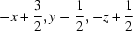
| Symmetry code: (ii) −x+3/2, y−1/2, −z+1/2. |
Experimental details
| Crystal data | |
| Chemical formula | C12H14O6 |
| Mr | 254.23 |
| Crystal system, space group | Monoclinic, P21/n |
| Temperature (K) | 293 |
| a, b, c (Å) | 7.4190 (15), 7.0990 (14), 11.785 (2) |
| β (°) | 95.49 (3) |
| V (Å3) | 617.8 (2) |
| Z | 2 |
| Radiation type | Mo Kα |
| µ (mm−1) | 0.11 |
| Crystal size (mm) | 0.30 × 0.20 × 0.10 |
| Data collection | |
| Diffractometer | Enraf–Nonius CAD-4 diffractometer |
| Absorption correction | ψ scan (North et al., 1968) |
| Tmin, Tmax | 0.954, 0.977 |
| No. of measured, independent and observed [I > 2σ(I)] reflections | 1123, 1123, 769 |
| Rint | 0.000 |
| (sin θ/λ)max (Å−1) | 0.601 |
| Refinement | |
| R[F2 > 2σ(F2)], wR(F2), S | 0.058, 0.173, 1.00 |
| No. of reflections | 1123 |
| No. of parameters | 82 |
| H-atom treatment | H-atom parameters constrained |
| Δρmax, Δρmin (e Å−3) | 0.26, −0.24 |
Computer programs: CAD-4 Software (Enraf–Nonius, 1989), XCAD4 (Harms & Wocadlo, 1995), SHELXS97 (Sheldrick, 2008), SHELXL97 (Sheldrick, 2008), SHELXTL (Sheldrick, 2008).
| D—H···A | D—H | H···A | D···A | D—H···A |
| C6—H6C···Cg1i | 0.97 | 2.98 | 3.674 (2) | 130 |
| Symmetry code: (i) −x+3/2, y−1/2, −z+1/2. |
Acknowledgements
The authors thank the Center of Testing and Analysis, Nanjing University, for support.
References
 Allen, F. H., Kennard, O., Watson, D. G., Brammer, L., Orpen, A. G. & Taylor, R. (1987). J. Chem. Soc. Perkin Trans. 2, pp. S1–19. CrossRef Web of Science Google Scholar
Chakraborti, A. K., Selvam, C., Kaur, G. & Bhagat, S. (2004). Synlett, pp. 851–855. Web of Science CrossRef Google Scholar
Enraf–Nonius (1989). CAD-4 Software. Enraf–Nonius, Delft, The Netherlands. Google Scholar
Harms, K. & Wocadlo, S. (1995). XCAD4. University of Marburg, Germany. Google Scholar
Nagy, C., Filip, S. V., Surducan, E. & Surducan, V. (1997). Synth. Commun. 27, 3729–3736. CrossRef CAS Web of Science Google Scholar
North, A. C. T., Phillips, D. C. & Mathews, F. S. (1968). Acta Cryst. A24, 351–359. CrossRef IUCr Journals Web of Science Google Scholar
Perreux, L. & Loupy, A. (2001). Tetrahedron, 57, 7957–7966. Web of Science CrossRef Google Scholar
Seijas, J. A., Vazquez, T. M. P., Carballido, R. M. R., Crecente, C. J. & Romar, L. L. (2007). Synlett, pp. 313–317. Web of Science CrossRef Google Scholar
Sheldrick, G. M. (2008). Acta Cryst. A64, 112–122. Web of Science CrossRef CAS IUCr Journals Google Scholar
Wang, G., Wu, L., Zhuang, L. & Wang, J. (2009). Acta Cryst. E65, o158. Web of Science CSD CrossRef IUCr Journals Google Scholar
Wei, T. B., Liu, H., Li, M. L. & Zhang, Y. M. (2005). Synth. Commun. 35, 1759–1764. Web of Science CrossRef CAS Google Scholar
This is an open-access article distributed under the terms of the Creative Commons Attribution (CC-BY) Licence, which permits unrestricted use, distribution, and reproduction in any medium, provided the original authors and source are cited.
| CRYSTALLOGRAPHIC COMMUNICATIONS |


The derivatives of aryloxyacetic acids and their derivatives constitute a class of compounds for both biological activity and plant growth regulators (Nagy et al., 1997; Wei et al.,2005). The phase-transfer catalysis, with the advantages of simple experimental operations, mild reaction conditions, and inexpensive and environmentally benign reagents, has established its significance in organic synthesis as one of the most useful methods for the acceleration of heterogeneous reactions (Perreux & Loupy, 2001).
Benzothiazole are remarkable heterocyclic ring systems. They have been found to exhibit a wide spectrum of biological activities. Many kinds of 2-substituted benzothiazoles are utilized as vulcanization accelators in the manufacture of rubber,as fluorescent brightening agents in textile dyeing,and in the leather industry (Chakraborti et al.,2004; Seijas et al.,2007; Wang et al.,2009). There are numerous synthetic methods to produce 2-arylbenzothiazoles. The most important ones include the reaction of o-aminothiophenols with benzoic acids or their derivatives (Chakraborti et al.,2004; Seijas et al.,2007; Wang et al.,2009). We are focusing on the synthesis of new products of bisbenzothiazole. We here report the crystal structure of the title compound (I).
The compound (I) lies on an inversion center(Fig.1). All bond lengths are within normal ranges (Allen et al., 1987). There are no typical hydrogen bonds, while weak intermolecular C—H···π interactions involving benzene ring (C1/C3/C2/C1a/C3a/C2a) (Table 1) may help in stabilizing the structure.