 | Acta Crystallographica Section E Acta Crystallographica Section E CRYSTALLOGRAPHIC COMMUNICATIONS |


 journal menu


metal-organic compounds
| CRYSTALLOGRAPHIC COMMUNICATIONS |
 access
A chiral three-dimensional network in poly[μ-4,4′-bipyridine-di-μ-formato-cadmium(II)]

aState Key Laboratory Base of Novel Functional Materials and Preparation Science, Faculty of Materials Science and Chemical Engineering, Institute of Solid Materials Chemistry, Ningbo University, Zhejiang 315211, People's Republic of China
*Correspondence e-mail: [email protected]
In the title compound, [Cd(HCOO)2(C10H8N2)]n, the CdII ion, located on a position with 2.22 is surrounded by two 4,4′-bipyridine ligands and four formate ligands in a distorted octahedral CdN2O4 coordination. The 4,4′-bipyridine ligands bridge the metal ions, forming one-dimensional chains along different directions, which are further connected by formate ligands into a topologically (1010.124.14)(10)3 three-dimensional network.
Related literature
For the design and synthesis of coordination polymer complexes and their potential applications, see: Barbour (2006![[Barbour, L. J. (2006). Chem. Commun. pp. 1163-1168.]](../../../../../../logos/arrows/e_arr.gif "Barbour, L. J. (2006). Chem. Commun. pp. 1163-1168.") ); Biradha (2003); Brammer (2004); Hosseini (2005); O'Keeffe & Yaghi (2001); Papaefstathiou & MacGillivray (2003); Venkataraman et al. (1995). For the 4,4′-bipyridine (4BPY) bridging ligand, see: Hagrman et al. (1999); Moulton & Zaworotko (2001); Sharma (2001); Zaworotko (2001). For one-dimensional zigzag networks using 2,2′-bpy as the ancillary ligand, see: Park et al. (2001). For the doubly interpenetrated square grid network {[Zn(bipy)2(H2O)2][SiF6]}n, see: Subramanian & Zaworotko (1995). For a three-dimensional network with large channels constructed through square grid networks of 4BPY and Zn(II) linked by SiF6 anions, see: Gable et al. (1990).
); Biradha (2003); Brammer (2004); Hosseini (2005); O'Keeffe & Yaghi (2001); Papaefstathiou & MacGillivray (2003); Venkataraman et al. (1995). For the 4,4′-bipyridine (4BPY) bridging ligand, see: Hagrman et al. (1999); Moulton & Zaworotko (2001); Sharma (2001); Zaworotko (2001). For one-dimensional zigzag networks using 2,2′-bpy as the ancillary ligand, see: Park et al. (2001). For the doubly interpenetrated square grid network {[Zn(bipy)2(H2O)2][SiF6]}n, see: Subramanian & Zaworotko (1995). For a three-dimensional network with large channels constructed through square grid networks of 4BPY and Zn(II) linked by SiF6 anions, see: Gable et al. (1990).
![[Scheme 1]](jh2074scheme1.gif)
Experimental
Crystal data
|
| ||||||||||||||||
 ; (iii)
  .
. Data collection: RAPID-AUTO (Rigaku, 1998); cell refinement: RAPID-AUTO; data reduction: CrystalStructure (Rigaku/MSC, 2002); program(s) used to solve structure: SHELXS97 (Sheldrick, 2008); program(s) used to refine structure: SHELXL97 (Sheldrick, 2008); molecular graphics: SHELXL97; software used to prepare material for publication: SHELXL97.
Supporting information
contains datablocks global, I. DOI: 10.1107/S1600536809009969/jh2074sup1.cif
Structure factors: contains datablock I. DOI: 10.1107/S1600536809009969/jh2074Isup2.hkl
4,4'-bpy (0.153 g, 1.0 mmol) and CdCO3 (0.177 g, 1.0 mmol) were orderly added in 10 ml H2O. Under continous stirring, 5.5 ml HCOOH (2 M) solution was subsequently added in the resulting mixture yielding clear solution. After filtration, the filtrate was maintained for slow evaporation at 40°C constant temperature for 3 days. Light yellow granule-liked crystals were obtained in a yield of ca 23.7% based on CdCO3.
H atoms bonded to C atoms were palced in geometrically calculated position and were refined using a riding model, with Uiso(H) = 1.2 Ueq(C). H atoms attached to O atoms were found in a difference Fourier synthesis and were refined using a riding model, with the O—H distances fixed as initially found and with Uiso(H) values set at 1.2 Ueq(O).
Data collection: RAPID-AUTO (Rigaku, 1998); cell RAPID-AUTO (Rigaku, 1998); data reduction: CrystalStructure (Rigaku/MSC, 2002); program(s) used to solve structure: SHELXS97 (Sheldrick, 2008); program(s) used to refine structure: SHELXL97 (Sheldrick, 2008); molecular graphics: SHELXL97 (Sheldrick, 2008); software used to prepare material for publication: SHELXL97 (Sheldrick, 2008).
![[Figure 1]](./jh2074fig1thm.gif) | Fig. 1. A view of the complex molecule of the title compound, showing the atom-numbering scheme. Displacement ellipsoids are drawn at the 60% probability level [Symmetry codes: #1 = -x + 1/2, -y + 1/2, -z + 3/2; #2 = -x + 1, -y, z; #3 = x + 1/2, -y + 1, z + 1/4; #4 = -x + 1/2, y - 1, z + 1/4; #5 = -x, -y + 1, z; #6 = x, -y + 2/3, -z + 5/4; #7 = x - 1, y + 1, z; #8 = x + 1/2, -y, z + 1/4; #9 = x, -y + 1/2, z - 1/4; #10 = x + 1, y - 1, z; #11 = x + 1, -y + 1/2, z - 1/4; #12 = 1 - x, -y, z]. |
![[Figure 2]](./jh2074fig2thm.gif) | Fig. 2. Right-handed one-dimensional helical chains along a axis. |
![[Figure 3]](./jh2074fig3thm.gif) | Fig. 3. Topological representation of the three-dimensional structure. |
| [Cd(CHO2)2(C10H8N2)] | Dx = 1.944 Mg m−3 |
| Mr = 358.62 | Mo Kα radiation, λ = 0.71073 Å |
| Tetragonal, I4122 | Cell parameters from 1106 reflections |
| Hall symbol: I 4bw 2bw | θ = 3.2–27.5° |
| a = 8.2269 (12) Å | µ = 1.79 mm−1 |
| c = 18.103 (4) Å | T = 293 K |
| V = 1225.2 (4) Å3 | Granule, yellow |
| Z = 4 | 0.33 × 0.33 × 0.20 mm |
| F(000) = 704 |
| Rigaku R-AXIS RAPID diffractometer | 711 independent reflections |
| Radiation source: fine-focus sealed tube | 681 reflections with I > 2σ(I) |
| Graphite monochromator | Rint = 0.025 |
| Detector resolution: 0 pixels mm-1 | θmax = 27.5°, θmin = 2.7° |
| ω scans | h = −10→1 |
| Absorption correction: multi-scan (ABSCOR; Higashi, 1995) | k = −10→1 |
| Tmin = 0.554, Tmax = 0.698 | l = −23→1 |
| 1106 measured reflections |
| Refinement on F2 | Secondary atom site location: difference Fourier map |
| Least-squares matrix: full | Hydrogen site location: inferred from neighbouring sites |
| R[F2 > 2σ(F2)] = 0.018 | H-atom parameters constrained |
| wR(F2) = 0.046 | w = 1/[σ2(Fo2) + (0.018P)2 + 0.9631P] where P = (Fo2 + 2Fc2)/3 |
| S = 1.13 | (Δ/σ)max < 0.001 |
| 711 reflections | Δρmax = 0.21 e Å−3 |
| 46 parameters | Δρmin = −0.43 e Å−3 |
| 0 restraints | Absolute structure: Flack (1983), 263 Friedel pairs |
| Primary atom site location: structure-invariant direct methods | Absolute structure parameter: 0.02 (7) |
| [Cd(CHO2)2(C10H8N2)] | Z = 4 |
| Mr = 358.62 | Mo Kα radiation |
| Tetragonal, I4122 | µ = 1.79 mm−1 |
| a = 8.2269 (12) Å | T = 293 K |
| c = 18.103 (4) Å | 0.33 × 0.33 × 0.20 mm |
| V = 1225.2 (4) Å3 |
| Rigaku R-AXIS RAPID diffractometer | 711 independent reflections |
| Absorption correction: multi-scan (ABSCOR; Higashi, 1995) | 681 reflections with I > 2σ(I) |
| Tmin = 0.554, Tmax = 0.698 | Rint = 0.025 |
| 1106 measured reflections |
| R[F2 > 2σ(F2)] = 0.018 | H-atom parameters constrained |
| wR(F2) = 0.046 | Δρmax = 0.21 e Å−3 |
| S = 1.13 | Δρmin = −0.43 e Å−3 |
| 711 reflections | Absolute structure: Flack (1983), 263 Friedel pairs |
| 46 parameters | Absolute structure parameter: 0.02 (7) |
| 0 restraints |
Geometry. All e.s.d.'s (except the e.s.d. in the dihedral angle between two l.s. planes) are estimated using the full covariance matrix. The cell e.s.d.'s are taken into account individually in the estimation of e.s.d.'s in distances, angles and torsion angles; correlations between e.s.d.'s in cell parameters are only used when they are defined by crystal symmetry. An approximate (isotropic) treatment of cell e.s.d.'s is used for estimating e.s.d.'s involving l.s. planes. |
Refinement. Refinement of F2 against ALL reflections. The weighted R-factor wR and goodness of fit S are based on F2, conventional R-factors R are based on F, with F set to zero for negative F2. The threshold expression of F2 > σ(F2) is used only for calculating R-factors(gt) etc. and is not relevant to the choice of reflections for refinement. R-factors based on F2 are statistically about twice as large as those based on F, and R- factors based on ALL data will be even larger. |
| x | y | z | Uiso*/Ueq | ||
| Cd1 | 0.0000 | 0.5000 | 0.7500 | 0.02047 (10) | |
| O1 | 0.1521 (3) | 0.6479 (3) | 0.66505 (10) | 0.0380 (4) | |
| N1 | 0.1982 (2) | 0.3018 (2) | 0.7500 | 0.0284 (6) | |
| C1 | 0.0885 (5) | 0.7500 | 0.6250 | 0.0354 (9) | |
| H1A | −0.0282 | 0.7500 | 0.6250 | 0.042* | |
| C2 | 0.3461 (3) | 0.3320 (3) | 0.72483 (18) | 0.0431 (7) | |
| H2 | 0.3680 | 0.4350 | 0.7062 | 0.052* | |
| C3 | 0.4696 (3) | 0.2183 (3) | 0.7249 (2) | 0.0432 (8) | |
| H3 | 0.5731 | 0.2454 | 0.7083 | 0.052* | |
| C4 | 0.4359 (3) | 0.0641 (3) | 0.7500 | 0.0269 (7) |
| U11 | U22 | U33 | U12 | U13 | U23 | |
| Cd1 | 0.01803 (12) | 0.01803 (12) | 0.02535 (16) | 0.00289 (14) | 0.000 | 0.000 |
| O1 | 0.0320 (11) | 0.0393 (12) | 0.0428 (10) | 0.0038 (8) | 0.0064 (10) | 0.0191 (10) |
| N1 | 0.0214 (8) | 0.0214 (8) | 0.0425 (15) | 0.0042 (10) | 0.0017 (10) | 0.0017 (10) |
| C1 | 0.0238 (19) | 0.047 (2) | 0.0354 (19) | 0.000 | 0.000 | 0.0116 (18) |
| C2 | 0.0256 (13) | 0.0257 (13) | 0.078 (2) | 0.0063 (9) | 0.0064 (14) | 0.0173 (14) |
| C3 | 0.0197 (14) | 0.0333 (14) | 0.077 (2) | 0.0050 (11) | 0.0072 (12) | 0.0180 (14) |
| C4 | 0.0228 (9) | 0.0228 (9) | 0.0352 (16) | 0.0083 (13) | −0.0012 (12) | −0.0012 (12) |
| Cd1—N1 | 2.306 (3) | C1—O1iv | 1.227 (3) |
| Cd1—N1i | 2.306 (3) | C1—H1A | 0.9600 |
| Cd1—O1ii | 2.3264 (18) | C2—C3 | 1.381 (4) |
| Cd1—O1i | 2.3264 (18) | C2—H2 | 0.9300 |
| Cd1—O1iii | 2.3264 (18) | C3—C4 | 1.376 (3) |
| Cd1—O1 | 2.3264 (18) | C3—H3 | 0.9300 |
| O1—C1 | 1.227 (3) | C4—C3iii | 1.376 (3) |
| N1—C2 | 1.323 (3) | C4—C4v | 1.492 (7) |
| N1—C2iii | 1.323 (3) | ||
| N1—Cd1—N1i | 180.0 | C2—N1—C2iii | 117.6 (3) |
| N1—Cd1—O1ii | 90.61 (6) | C2—N1—Cd1 | 121.20 (16) |
| N1i—Cd1—O1ii | 89.39 (6) | C2iii—N1—Cd1 | 121.20 (16) |
| N1—Cd1—O1i | 90.61 (6) | O1—C1—O1iv | 129.5 (4) |
| N1i—Cd1—O1i | 89.39 (6) | O1—C1—H1A | 115.3 |
| O1ii—Cd1—O1i | 178.78 (12) | O1iv—C1—H1A | 115.3 |
| N1—Cd1—O1iii | 89.39 (6) | N1—C2—C3 | 123.4 (3) |
| N1i—Cd1—O1iii | 90.61 (6) | N1—C2—H2 | 118.3 |
| O1ii—Cd1—O1iii | 97.24 (10) | C3—C2—H2 | 118.3 |
| O1i—Cd1—O1iii | 82.77 (10) | C4—C3—C2 | 118.4 (3) |
| N1—Cd1—O1 | 89.39 (6) | C4—C3—H3 | 120.8 |
| N1i—Cd1—O1 | 90.61 (6) | C2—C3—H3 | 120.8 |
| O1ii—Cd1—O1 | 82.77 (10) | C3iii—C4—C3 | 118.7 (3) |
| O1i—Cd1—O1 | 97.24 (10) | C3iii—C4—C4v | 120.63 (16) |
| O1iii—Cd1—O1 | 178.78 (12) | C3—C4—C4v | 120.63 (16) |
| C1—O1—Cd1 | 121.3 (2) |
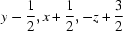
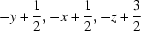
| Symmetry codes: (i) −x, −y+1, z; (ii) y−1/2, x+1/2, −z+3/2; (iii) −y+1/2, −x+1/2, −z+3/2; (iv) x, −y+3/2, −z+5/4; (v) −x+1, −y, z. |
Experimental details
| Crystal data | |
| Chemical formula | [Cd(CHO2)2(C10H8N2)] |
| Mr | 358.62 |
| Crystal system, space group | Tetragonal, I4122 |
| Temperature (K) | 293 |
| a, c (Å) | 8.2269 (12), 18.103 (4) |
| V (Å3) | 1225.2 (4) |
| Z | 4 |
| Radiation type | Mo Kα |
| µ (mm−1) | 1.79 |
| Crystal size (mm) | 0.33 × 0.33 × 0.20 |
| Data collection | |
| Diffractometer | Rigaku R-AXIS RAPID diffractometer |
| Absorption correction | Multi-scan (ABSCOR; Higashi, 1995) |
| Tmin, Tmax | 0.554, 0.698 |
| No. of measured, independent and observed [I > 2σ(I)] reflections | 1106, 711, 681 |
| Rint | 0.025 |
| (sin θ/λ)max (Å−1) | 0.650 |
| Refinement | |
| R[F2 > 2σ(F2)], wR(F2), S | 0.018, 0.046, 1.13 |
| No. of reflections | 711 |
| No. of parameters | 46 |
| H-atom treatment | H-atom parameters constrained |
| Δρmax, Δρmin (e Å−3) | 0.21, −0.43 |
| Absolute structure | Flack (1983), 263 Friedel pairs |
| Absolute structure parameter | 0.02 (7) |
Computer programs: RAPID-AUTO (Rigaku, 1998), CrystalStructure (Rigaku/MSC, 2002), SHELXS97 (Sheldrick, 2008), SHELXL97 (Sheldrick, 2008).
| Cd1—N1 | 2.306 (3) | Cd1—O1i | 2.3264 (18) |
| Cd1—N1i | 2.306 (3) | Cd1—O1iii | 2.3264 (18) |
| Cd1—O1ii | 2.3264 (18) | Cd1—O1 | 2.3264 (18) |
| N1—Cd1—N1i | 180.0 | O1ii—Cd1—O1iii | 97.24 (10) |
| N1—Cd1—O1ii | 90.61 (6) | O1i—Cd1—O1iii | 82.77 (10) |
| N1i—Cd1—O1ii | 89.39 (6) | N1—Cd1—O1 | 89.39 (6) |
| N1—Cd1—O1i | 90.61 (6) | N1i—Cd1—O1 | 90.61 (6) |
| N1i—Cd1—O1i | 89.39 (6) | O1ii—Cd1—O1 | 82.77 (10) |
| O1ii—Cd1—O1i | 178.78 (12) | O1i—Cd1—O1 | 97.24 (10) |
| N1—Cd1—O1iii | 89.39 (6) | O1iii—Cd1—O1 | 178.78 (12) |
| N1i—Cd1—O1iii | 90.61 (6) |
| Symmetry codes: (i) −x, −y+1, z; (ii) y−1/2, x+1/2, −z+3/2; (iii) −y+1/2, −x+1/2, −z+3/2. |
Acknowledgements
This project was sponsored by the K. C. Wong Magna Fund of Ningbo University and supported by the Expert Project for Key Basic Research of the Ministry of Science and Technology of China (grant No. 2003CCA00800), the Zhejiang Provincial Natural Science Foundation (grant No. Z203067) and the Ningbo Municipal Natural Science Foundation (grant No. 2006 A610061).
References
 Barbour, L. J. (2006). Chem. Commun. pp. 1163–1168. Web of Science CrossRef Google Scholar
Biradha, K. (2003). CrystEngComm, 5, 374–384. Web of Science CrossRef CAS Google Scholar
Brammer, L. (2004). Chem. Soc. Rev. 33, 476–489. Web of Science CrossRef PubMed CAS Google Scholar
Flack, H. D. (1983). Acta Cryst. A39, 876–881. CrossRef CAS Web of Science IUCr Journals Google Scholar
Gable, R. W., Hoskins, B. F. & Robson, R. (1990). J. Chem. Soc. Chem. Commun. pp. 1677–1678. CrossRef Web of Science Google Scholar
Hagrman, P. J., Hagrman, D. & Zubieta, J. (1999). Angew. Chem. Int. Ed. 38, 2638–2684. CrossRef Google Scholar
Higashi, T. (1995). ABSCOR. Rigaku Corporation, Tokyo, Japan. Google Scholar
Hosseini, M. W. (2005). Acc. Chem. Res. 38, 313–323. Web of Science CrossRef PubMed CAS Google Scholar
Moulton, B. & Zaworotko, M. J. (2001). Chem. Rev. 101, 1629–1658. Web of Science CrossRef PubMed CAS Google Scholar
O'Keeffe, M. & Yaghi, O. M. (2001). Acc. Chem. Res. 34, 319–330. Web of Science PubMed Google Scholar
Papaefstathiou, G. S. & MacGillivray, L. R. (2003). Coord. Chem. Rev. 246, 169–184. Web of Science CrossRef CAS Google Scholar
Park, H. W., Sung, S. M., Min, K. S., Bang, H. & Suh, M. P. (2001). Eur. J. Inorg. Chem. pp. 2857–2863. CrossRef Google Scholar
Rigaku (1998). RAPID-AUTO. Rigaku Corporation, Tokyo, Japan. Google Scholar
Rigaku/MSC (2002). CrystalStructure. Rigaku/MSC Inc., The Woodlands, Texas, USA. Google Scholar
Sharma, C. V. K. (2001). J. Chem. Educ. 78, 617–618. CrossRef CAS Google Scholar
Sheldrick, G. M. (2008). Acta Cryst. A64, 112–122. Web of Science CrossRef CAS IUCr Journals Google Scholar
Subramanian, S. & Zaworotko, M. J. (1995). Angew. Chem. Int. Ed. Engl. 34, 2127–2129. CSD CrossRef CAS Web of Science Google Scholar
Venkataraman, D., Gardner, G. B., Lee, S. & Moore, J. S. (1995). J. Am. Chem. Soc. 117, 11600–11601. CrossRef CAS Web of Science Google Scholar
Zaworotko, M. J. (2001). Chem. Commun. pp. 1–9. Web of Science CrossRef Google Scholar
This is an open-access article distributed under the terms of the Creative Commons Attribution (CC-BY) Licence, which permits unrestricted use, distribution, and reproduction in any medium, provided the original authors and source are cited.
| CRYSTALLOGRAPHIC COMMUNICATIONS |


The design and synthesis of coordination polymer complexes, which is an emerging area of research with several potential applications in areas such as catalysis, conductivity, porosity, chirality, luminescence, magnetism, spin-transition and non-linear optics, are of considerable interest from the viewpoint of crystal engineering (Barbour, 2006; Biradha, 2003; Brammer, 2004; Hosseini, 2005; O'Keeffe, 2001; Papaefstathiou, 2003; Venkataraman, 1995). The structures and properties of coordination polymers can be controlled by choosing appropriate bridging ligands and metal ions. Many types of bridging ligand have been reported, of which the most extensively studied bidentate ligands are probably 4,4'-bipyridine (4BPY) (Hagrman, 1999; Moulton, 2001; Sharma, 2001; Zaworotko, 2001). The ligand 4,4'-bipyridine is an ideal connector between the transition metal atoms for the propagation of coordination networks and shown to form a variety of networks ranging from one-dimensional to three-dimensional with several transition metal salts, such as the one-dimensional zigzag networks by using of 2,2'-bpy as the ancillary ligand (Park, 2001), the doubly interpenetrated square grid networks {[Zn(bipy)2(H2O)2][SiF6]}n (Gable, 1990) and a three-dimensional network with large channels which is constructed through square grid networks of 4BPY and Zn(II) linked by SiF6 anions (Subramanian, 1995). In this contribution, we here report a novel chiral three-dimensional crystal structure built from CdII ions and mixed-ligand including 4BPY ligands and formic acid ligands.
Compound 1 consists of CdII ions, 4,4'-bipyridine (4BPY) ligands and formato anions. As illustrated in Figure 1, the CdII ions are all disposed in a N2O4 octahedron coordination environment with the equatorial coordination from four formate ligands (O1, O1#2, O1#5, O1#12) [symmetry codes: #2 = 1 - x, -y, z; #5 = -x, 1 - y, z; #12 = 1 - x, -y, z] and the apical sites occupied by two N atoms from two 4BPY ligands (N1, N1#5) [symmetry code: #5 = -x, 1 - y, z]. The average bond lengths of Cd—O and Cd—N are 2.326 (3) Å and 2.306 (4) Å, respectively. There are two kinds of formate ligands in this sturcture, one kind of them connect metal ions into right-handed helical chains along a axis (Figure 2) and the others connecte the helical chains along two different orientations [011] and [011], which generate a three-dimensional network. In the resulting structure, 4BPY ligands further link the CdII ions along [110] and [110] directions,respectively, to generate a (1010.124.14)(10)3 topological three-dimensional network (Figure 3). Moreover, the 4BPY ligand displays obvious distortion and the dihedral angel between the two pyridine rings is approximately 46.2°.