 | Acta Crystallographica Section E Acta Crystallographica Section E CRYSTALLOGRAPHIC COMMUNICATIONS |


 journal menu


metal-organic compounds
| CRYSTALLOGRAPHIC COMMUNICATIONS |
 access
Poly[hemi(ethylenediammonium) [di-μ-oxalato-indium(III)] dihydrate]

aDepartment of Materials Chemistry, School of Materials Science and Engineering, Key Laboratory of Non-ferrous Metals of the Ministry of Education, Central South University, Changsha 410083, People's Republic of China
*Correspondence e-mail: [email protected]
In title compound, {(C2H10N2)0.5[In(C2O4)2]·2H2O}n, the unique InIII ion is coordinated by eight O atoms from four oxalate ligands in a distorted square-antiprismatic environment. The doubly bis-chelating oxalate ligands act as bridging ligands connecting symmetry-related InIII ions and forming a three-dimensional open framework structure. Ethylenediammonium cations and water molecules occupy the voids within the structure. The unique ethylenediammonium cation and one water molecule both lie on a twofold rotation axis. One of the other two water molecules residing on general crystallographic sites was refined as disordered with half occupancy. In the cations and water molecules are linked to the anionic framework via intermolecular O—H⋯O and N—H⋯O hydrogen bonds.
Related literature
For background information on open-framework materials, see: Fang et al. (2004![[Fang, Q. R., Zhu, G. S., Shi, X., Wu, G., Tian, G., Wang, R. W. & Qiu, S. L. (2004). J. Solid State Chem. 177, 1060-1066.]](../../../../../../logos/arrows/e_arr.gif "Fang, Q. R., Zhu, G. S., Shi, X., Wu, G., Tian, G., Wang, R. W. & Qiu, S. L. (2004). J. Solid State Chem. 177, 1060-1066.") ); Li et al. (2008); Serre et al. (2006); Sun et al. (2006). For related materials containing the oxalate ligand, see: Audebrand et al. (2001, 2004); Kokunov et al. (2004); Stock et al. (2000); Chakrabarti & Natarajan (2002); Evans & Lin (2001); Vaidhyanathan et al. (2001); Gavilan et al. (2007); Bataille et al. (2000); Trombe et al. (2001); Yuan et al. (2004). For indium oxaltes, see: Audebrand et al. (2003); Bulc et al. (1983); Bulc & Golič (1983); Chen et al. (2003); Huang & Lii (1998); Jeanneau et al. (2003); Yang et al. (2005); For the bond-valence method, see: Brown (1996). For bond distances and angles for bridging bidentate oxalate groups, see: Hann (1957).
); Li et al. (2008); Serre et al. (2006); Sun et al. (2006). For related materials containing the oxalate ligand, see: Audebrand et al. (2001, 2004); Kokunov et al. (2004); Stock et al. (2000); Chakrabarti & Natarajan (2002); Evans & Lin (2001); Vaidhyanathan et al. (2001); Gavilan et al. (2007); Bataille et al. (2000); Trombe et al. (2001); Yuan et al. (2004). For indium oxaltes, see: Audebrand et al. (2003); Bulc et al. (1983); Bulc & Golič (1983); Chen et al. (2003); Huang & Lii (1998); Jeanneau et al. (2003); Yang et al. (2005); For the bond-valence method, see: Brown (1996). For bond distances and angles for bridging bidentate oxalate groups, see: Hann (1957).
![[Scheme 1]](lh2779scheme1.gif)
Experimental
Crystal data
|
|
 ; (iii)
  ; (iv)
  ; (v)
; (v) 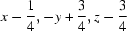 .
. Data collection: SMART (Bruker, 2001); cell refinement: SAINT (Bruker, 2001); data reduction: SAINT; program(s) used to solve structure: SHELXTL (Sheldrick, 2008); program(s) used to refine structure: SHELXTL; molecular graphics: SHELXTL; software used to prepare material for publication: SHELXTL.
Supporting information
contains datablocks global, I. DOI: 10.1107/S1600536809008381/lh2779sup1.cif
Structure factors: contains datablock I. DOI: 10.1107/S1600536809008381/lh2779Isup2.hkl
A mixture of Ti(SO4)2 (0.2 g, 0.84 mmol), H2C2O4.2H2O (1.0 g, 7.93 mmol), InCl3.4H2O (2 ml, 0.5 mol/L) and H2N(CH2)2NH2 (0.2 ml, CR) in H2O (5.0 ml) was sealed in a 20 ml stainless-steal reactor with Teflon liner and heated at 393 K for 2 days under autogenously pressure. Colorless crystals were isolated after the reaction solution was cooled gradually and washed with water.
H atoms bonded to C and N atoms were inlcuded in calcluated positions with C-H = 0.97 and N-H = 0.89Å and Uiso(H) = 1.2Ueq(C) or 1.5Ueq(N). The H atoms bonded to O atoms were either included in calculated positions [O-H = 0.85Å] based on 'as found' locations or based on the most efficient H-bonding location and with Uiso(H)= 1.0-1.2Ueq(C).
Data collection: SMART (Bruker, 2001); cell SAINT (Bruker, 2001); data reduction: SAINT (Bruker, 2001); program(s) used to solve structure: SHELXTL (Sheldrick, 2008); program(s) used to refine structure: SHELXTL (Sheldrick, 2008); molecular graphics: SHELXTL (Sheldrick, 2008); software used to prepare material for publication: SHELXTL (Sheldrick, 2008).
![[Figure 1]](./lh2779fig1thm.gif) | Fig. 1. The asymmetric unit showing the atom-numbering scheme. Displacement ellipsoids are drawn at the 50% probability level. |
![[Figure 2]](./lh2779fig2thm.gif) | Fig. 2. The distorted square antiprismatic environment of Indium. Symmetry codes A: -x, 0.5 - y, 1/2 + z; B: x - 1/4, 0.75 - y, 1/4 + z. |
![[Figure 3]](./lh2779fig3thm.gif) | Fig. 3. Part of the crystal structure viewed crystal along the c axis, the ethylenediammonium and water molecules reside in the voids. |
| (C2H10N2)0.5[In(C2O4)2]·2H2O | F(000) = 2800 |
| Mr = 357.95 | Dx = 2.223 Mg m−3 |
| Orthorhombic, Fdd2 | Mo Kα radiation, λ = 0.71073 Å |
| Hall symbol: F 2 -2d | Cell parameters from 7228 reflections |
| a = 15.8498 (4) Å | θ = 2.6–27.9° |
| b = 31.1643 (8) Å | µ = 2.26 mm−1 |
| c = 8.6618 (2) Å | T = 293 K |
| V = 4278.48 (18) Å3 | Block, colourless |
| Z = 16 | 0.4 × 0.38 × 0.38 mm |
| Bruker SMART CCD diffractometer | 1679 independent reflections |
| Radiation source: fine-focus sealed tube | 1673 reflections with I > 2σ(I) |
| Graphite monochromator | Rint = 0.025 |
| ϕ and ω scans | θmax = 25.0°, θmin = 2.6° |
| Absorption correction: multi-scan (SADABS; Bruker, 2001) | h = −18→18 |
| Tmin = 0.426, Tmax = 0.467 | k = −36→36 |
| 7189 measured reflections | l = −10→10 |
| Refinement on F2 | Hydrogen site location: inferred from neighbouring sites |
| Least-squares matrix: full | H-atom parameters constrained |
| R[F2 > 2σ(F2)] = 0.018 | w = 1/[σ2(Fo2) + (0.0322P)2 + 7.4478P] where P = (Fo2 + 2Fc2)/3 |
| wR(F2) = 0.046 | (Δ/σ)max = 0.001 |
| S = 1.06 | Δρmax = 0.45 e Å−3 |
| 1679 reflections | Δρmin = −0.71 e Å−3 |
| 160 parameters | Extinction correction: SHELXTL (Sheldrick, 2008), Fc*=kFc[1+0.001xFc2λ3/sin(2θ)]-1/4 |
| 13 restraints | Extinction coefficient: 0.00087 (5) |
| Primary atom site location: structure-invariant direct methods | Absolute structure: Flack (1983), 668 Friedel pairs |
| Secondary atom site location: difference Fourier map | Absolute structure parameter: 0.00 (3) |
| (C2H10N2)0.5[In(C2O4)2]·2H2O | V = 4278.48 (18) Å3 |
| Mr = 357.95 | Z = 16 |
| Orthorhombic, Fdd2 | Mo Kα radiation |
| a = 15.8498 (4) Å | µ = 2.26 mm−1 |
| b = 31.1643 (8) Å | T = 293 K |
| c = 8.6618 (2) Å | 0.4 × 0.38 × 0.38 mm |
| Bruker SMART CCD diffractometer | 1679 independent reflections |
| Absorption correction: multi-scan (SADABS; Bruker, 2001) | 1673 reflections with I > 2σ(I) |
| Tmin = 0.426, Tmax = 0.467 | Rint = 0.025 |
| 7189 measured reflections |
| R[F2 > 2σ(F2)] = 0.018 | H-atom parameters constrained |
| wR(F2) = 0.046 | Δρmax = 0.45 e Å−3 |
| S = 1.06 | Δρmin = −0.71 e Å−3 |
| 1679 reflections | Absolute structure: Flack (1983), 668 Friedel pairs |
| 160 parameters | Absolute structure parameter: 0.00 (3) |
| 13 restraints |
Geometry. All e.s.d.'s (except the e.s.d. in the dihedral angle between two l.s. planes) are estimated using the full covariance matrix. The cell e.s.d.'s are taken into account individually in the estimation of e.s.d.'s in distances, angles and torsion angles; correlations between e.s.d.'s in cell parameters are only used when they are defined by crystal symmetry. An approximate (isotropic) treatment of cell e.s.d.'s is used for estimating e.s.d.'s involving l.s. planes. |
Refinement. Refinement of F2 against ALL reflections. The weighted R-factor wR and goodness of fit S are based on F2, conventional R-factors R are based on F, with F set to zero for negative F2. The threshold expression of F2 > σ(F2) is used only for calculating R-factors(gt) etc. and is not relevant to the choice of reflections for refinement. R-factors based on F2 are statistically about twice as large as those based on F, and R- factors based on ALL data will be even larger. |
| x | y | z | Uiso*/Ueq | Occ. (<1) | |
| In1 | 0.013694 (15) | 0.314689 (7) | 0.33266 (6) | 0.01510 (11) | |
| O1 | −0.06449 (17) | 0.27864 (9) | 0.1683 (4) | 0.0277 (6) | |
| O2 | 0.10165 (19) | 0.26861 (9) | 0.1750 (4) | 0.0290 (7) | |
| O3 | 0.04152 (19) | 0.35822 (9) | 0.1416 (3) | 0.0241 (6) | |
| O4 | 0.14920 (17) | 0.34173 (8) | 0.3713 (3) | 0.0220 (6) | |
| C1 | −0.0334 (2) | 0.25113 (11) | 0.0817 (7) | 0.0194 (7) | |
| C2 | 0.0620 (2) | 0.24552 (11) | 0.0823 (7) | 0.0204 (7) | |
| C3 | 0.1128 (2) | 0.37559 (10) | 0.1357 (4) | 0.0165 (7) | |
| C4 | 0.1740 (2) | 0.36645 (11) | 0.2696 (5) | 0.0180 (8) | |
| O5 | −0.07692 (18) | 0.22769 (9) | −0.0061 (3) | 0.0259 (7) | |
| O6 | 0.09025 (18) | 0.21856 (9) | −0.0112 (4) | 0.0302 (7) | |
| O7 | 0.13838 (16) | 0.39927 (8) | 0.0302 (3) | 0.0223 (6) | |
| O8 | 0.24530 (18) | 0.38498 (9) | 0.2625 (4) | 0.0231 (6) | |
| C5 | 0.2294 (3) | 0.2715 (2) | −0.2277 (8) | 0.0535 (16) | |
| H5C | 0.1687 | 0.2676 | −0.2275 | 0.064* | |
| H5A | 0.2444 | 0.2864 | −0.1332 | 0.064* | |
| N1 | 0.2527 (3) | 0.29883 (17) | −0.3608 (6) | 0.0502 (12) | |
| H1A | 0.3035 | 0.2913 | −0.3949 | 0.075* | |
| H1B | 0.2534 | 0.3262 | −0.3316 | 0.075* | |
| H1C | 0.2150 | 0.2954 | −0.4360 | 0.075* | |
| OW1 | 0.2500 | 0.2500 | 0.3570 (7) | 0.0504 (16) | |
| HW1A | 0.2938 | 0.2445 | 0.3040 | 0.050* | |
| OW2 | 0.0119 (6) | 0.3117 (3) | −0.173 (3) | 0.069 (2) | 0.50 |
| HW2B | 0.0188 | 0.2848 | −0.1847 | 0.083* | 0.50 |
| HW2A | 0.0010 | 0.3173 | −0.0793 | 0.083* | 0.50 |
| OW3 | 0.1418 (3) | 0.36723 (19) | −0.2928 (7) | 0.1000 (17) | |
| HW3B | 0.1123 | 0.3788 | −0.3632 | 0.120* | |
| HW3A | 0.1542 | 0.3857 | −0.2244 | 0.120* |
| U11 | U22 | U33 | U12 | U13 | U23 | |
| In1 | 0.01446 (16) | 0.01545 (14) | 0.01540 (15) | −0.00012 (8) | −0.00093 (14) | 0.00069 (11) |
| O1 | 0.0185 (13) | 0.0268 (13) | 0.0378 (17) | −0.0013 (11) | 0.0018 (14) | −0.0157 (13) |
| O2 | 0.0224 (15) | 0.0289 (15) | 0.0358 (17) | 0.0008 (12) | −0.0078 (14) | −0.0104 (13) |
| O3 | 0.0187 (14) | 0.0299 (14) | 0.0237 (15) | −0.0058 (12) | −0.0031 (12) | 0.0086 (11) |
| O4 | 0.0264 (15) | 0.0220 (12) | 0.0176 (15) | −0.0037 (10) | −0.0021 (11) | 0.0065 (10) |
| C1 | 0.0209 (18) | 0.0154 (15) | 0.0218 (17) | −0.0017 (14) | 0.001 (2) | 0.0002 (16) |
| C2 | 0.0220 (19) | 0.0194 (16) | 0.0199 (17) | 0.0002 (14) | 0.000 (2) | −0.0018 (17) |
| C3 | 0.0177 (19) | 0.0139 (15) | 0.0179 (17) | 0.0038 (13) | 0.0005 (15) | 0.0001 (14) |
| C4 | 0.019 (2) | 0.0132 (15) | 0.0214 (17) | 0.0010 (14) | −0.0015 (16) | −0.0011 (14) |
| O5 | 0.0193 (15) | 0.0251 (13) | 0.0333 (17) | −0.0004 (11) | −0.0037 (13) | −0.0135 (13) |
| O6 | 0.0213 (15) | 0.0324 (15) | 0.0369 (19) | 0.0024 (12) | 0.0032 (14) | −0.0131 (14) |
| O7 | 0.0224 (13) | 0.0229 (12) | 0.0217 (14) | −0.0042 (10) | −0.0032 (11) | 0.0066 (10) |
| O8 | 0.0180 (13) | 0.0273 (15) | 0.0239 (15) | −0.0057 (11) | −0.0039 (13) | 0.0084 (12) |
| C5 | 0.031 (3) | 0.080 (4) | 0.049 (4) | −0.020 (2) | 0.006 (3) | −0.016 (3) |
| N1 | 0.028 (2) | 0.074 (3) | 0.049 (3) | −0.006 (2) | −0.011 (2) | −0.001 (2) |
| OW1 | 0.026 (2) | 0.086 (4) | 0.039 (4) | 0.024 (2) | 0.000 | 0.000 |
| OW2 | 0.084 (4) | 0.067 (4) | 0.055 (4) | 0.013 (4) | −0.002 (5) | −0.006 (4) |
| OW3 | 0.083 (3) | 0.146 (4) | 0.072 (3) | 0.016 (3) | −0.030 (3) | −0.045 (3) |
| In1—O5i | 2.168 (3) | C4—O8 | 1.270 (5) |
| In1—O3 | 2.185 (3) | O5—In1iii | 2.168 (3) |
| In1—O1 | 2.196 (3) | O6—In1iii | 2.370 (3) |
| In1—O8ii | 2.230 (3) | O7—In1iv | 2.327 (3) |
| In1—O7ii | 2.327 (3) | O8—In1iv | 2.230 (3) |
| In1—O4 | 2.331 (3) | C5—N1 | 1.480 (8) |
| In1—O6i | 2.370 (3) | C5—C5v | 1.492 (12) |
| In1—O2 | 2.423 (3) | C5—H5C | 0.9700 |
| O1—C1 | 1.242 (5) | C5—H5A | 0.9700 |
| O2—C2 | 1.248 (6) | N1—H1A | 0.8900 |
| O3—C3 | 1.253 (5) | N1—H1B | 0.8900 |
| O4—C4 | 1.235 (5) | N1—H1C | 0.8900 |
| C1—O5 | 1.260 (6) | OW1—HW1A | 0.8500 |
| C1—C2 | 1.522 (6) | OW2—HW2B | 0.8502 |
| C2—O6 | 1.250 (6) | OW2—HW2A | 0.8500 |
| C3—O7 | 1.243 (4) | OW3—HW3B | 0.8498 |
| C3—C4 | 1.539 (5) | OW3—HW3A | 0.8500 |
| O5i—In1—O3 | 140.63 (11) | C4—O4—In1 | 114.7 (2) |
| O5i—In1—O1 | 111.52 (10) | O1—C1—O5 | 123.2 (4) |
| O3—In1—O1 | 86.60 (12) | O1—C1—C2 | 118.2 (4) |
| O5i—In1—O8ii | 92.22 (11) | O5—C1—C2 | 118.7 (4) |
| O3—In1—O8ii | 96.82 (11) | O2—C2—O6 | 128.6 (4) |
| O1—In1—O8ii | 137.63 (10) | O2—C2—C1 | 115.8 (4) |
| O5i—In1—O7ii | 144.54 (11) | O6—C2—C1 | 115.5 (4) |
| O3—In1—O7ii | 74.02 (11) | O7—C3—O3 | 125.5 (4) |
| O1—In1—O7ii | 68.82 (10) | O7—C3—C4 | 117.2 (3) |
| O8ii—In1—O7ii | 71.65 (10) | O3—C3—C4 | 117.3 (3) |
| O5i—In1—O4 | 72.66 (9) | O4—C4—O8 | 127.0 (4) |
| O3—In1—O4 | 72.43 (9) | O4—C4—C3 | 116.8 (3) |
| O1—In1—O4 | 142.91 (10) | O8—C4—C3 | 116.1 (3) |
| O8ii—In1—O4 | 76.46 (10) | C1—O5—In1iii | 119.2 (3) |
| O7ii—In1—O4 | 129.79 (9) | C2—O6—In1iii | 114.5 (3) |
| O5i—In1—O6i | 71.78 (10) | C3—O7—In1iv | 115.0 (2) |
| O3—In1—O6i | 147.56 (11) | C4—O8—In1iv | 118.0 (3) |
| O1—In1—O6i | 75.75 (11) | N1—C5—C5v | 114.0 (4) |
| O8ii—In1—O6i | 79.52 (11) | N1—C5—H5C | 108.7 |
| O7ii—In1—O6i | 74.28 (10) | C5v—C5—H5C | 108.7 |
| O4—In1—O6i | 135.78 (10) | N1—C5—H5A | 108.7 |
| O5i—In1—O2 | 74.70 (10) | C5v—C5—H5A | 108.7 |
| O3—In1—O2 | 79.93 (11) | H5C—C5—H5A | 107.6 |
| O1—In1—O2 | 69.90 (11) | C5—N1—H1A | 109.5 |
| O8ii—In1—O2 | 152.36 (10) | C5—N1—H1B | 109.5 |
| O7ii—In1—O2 | 131.86 (10) | H1A—N1—H1B | 109.5 |
| O4—In1—O2 | 76.41 (9) | C5—N1—H1C | 109.5 |
| O6i—In1—O2 | 117.54 (10) | H1A—N1—H1C | 109.5 |
| C1—O1—In1 | 121.4 (3) | H1B—N1—H1C | 109.5 |
| C2—O2—In1 | 114.5 (3) | HW2B—OW2—HW2A | 109.8 |
| C3—O3—In1 | 118.7 (2) | HW3B—OW3—HW3A | 109.8 |
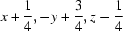
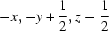
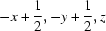
| Symmetry codes: (i) −x, −y+1/2, z+1/2; (ii) x−1/4, −y+3/4, z+1/4; (iii) −x, −y+1/2, z−1/2; (iv) x+1/4, −y+3/4, z−1/4; (v) −x+1/2, −y+1/2, z. |
| D—H···A | D—H | H···A | D···A | D—H···A |
| N1—H1C···OW1vi | 0.89 | 2.35 | 2.880 (8) | 118 |
| N1—H1B···O7iv | 0.89 | 2.47 | 2.956 (5) | 115 |
| N1—H1B···OW3 | 0.89 | 2.21 | 2.825 (8) | 126 |
| N1—H1C···O4vi | 0.89 | 2.44 | 3.140 (6) | 136 |
| N1—H1C···O5iii | 0.89 | 2.38 | 3.166 (5) | 147 |
| OW1—HW1A···O2v | 0.85 | 2.04 | 2.889 (5) | 180 |
| OW2—HW2B···O1iii | 0.85 | 2.46 | 3.241 (15) | 153 |
| OW2—HW2A···O3 | 0.85 | 2.39 | 3.12 (3) | 145 |
| OW3—HW3B···O8vii | 0.85 | 2.19 | 2.870 (6) | 137 |
| OW3—HW3A···O7 | 0.85 | 2.26 | 2.971 (7) | 141 |
| OW3—HW3A···O3iv | 0.85 | 2.40 | 2.962 (6) | 124 |
| Symmetry codes: (iii) −x, −y+1/2, z−1/2; (iv) x+1/4, −y+3/4, z−1/4; (v) −x+1/2, −y+1/2, z; (vi) x, y, z−1; (vii) x−1/4, −y+3/4, z−3/4. |
Experimental details
| Crystal data | |
| Chemical formula | (C2H10N2)0.5[In(C2O4)2]·2H2O |
| Mr | 357.95 |
| Crystal system, space group | Orthorhombic, Fdd2 |
| Temperature (K) | 293 |
| a, b, c (Å) | 15.8498 (4), 31.1643 (8), 8.6618 (2) |
| V (Å3) | 4278.48 (18) |
| Z | 16 |
| Radiation type | Mo Kα |
| µ (mm−1) | 2.26 |
| Crystal size (mm) | 0.4 × 0.38 × 0.38 |
| Data collection | |
| Diffractometer | Bruker SMART CCD diffractometer |
| Absorption correction | Multi-scan (SADABS; Bruker, 2001) |
| Tmin, Tmax | 0.426, 0.467 |
| No. of measured, independent and observed [I > 2σ(I)] reflections | 7189, 1679, 1673 |
| Rint | 0.025 |
| (sin θ/λ)max (Å−1) | 0.594 |
| Refinement | |
| R[F2 > 2σ(F2)], wR(F2), S | 0.018, 0.046, 1.06 |
| No. of reflections | 1679 |
| No. of parameters | 160 |
| No. of restraints | 13 |
| H-atom treatment | H-atom parameters constrained |
| Δρmax, Δρmin (e Å−3) | 0.45, −0.71 |
| Absolute structure | Flack (1983), 668 Friedel pairs |
| Absolute structure parameter | 0.00 (3) |
Computer programs: SMART (Bruker, 2001), SAINT (Bruker, 2001), SHELXTL (Sheldrick, 2008).
| D—H···A | D—H | H···A | D···A | D—H···A |
| N1—H1C···OW1i | 0.89 | 2.35 | 2.880 (8) | 118.2 |
| N1—H1B···O7ii | 0.89 | 2.47 | 2.956 (5) | 114.9 |
| N1—H1B···OW3 | 0.89 | 2.21 | 2.825 (8) | 125.9 |
| N1—H1C···O4i | 0.89 | 2.44 | 3.140 (6) | 135.7 |
| N1—H1C···O5iii | 0.89 | 2.38 | 3.166 (5) | 147.1 |
| OW1—HW1A···O2iv | 0.85 | 2.04 | 2.889 (5) | 179.5 |
| OW2—HW2B···O1iii | 0.85 | 2.46 | 3.241 (15) | 152.8 |
| OW2—HW2A···O3 | 0.85 | 2.39 | 3.12 (3) | 145.2 |
| OW3—HW3B···O8v | 0.85 | 2.19 | 2.870 (6) | 137.4 |
| OW3—HW3A···O7 | 0.85 | 2.26 | 2.971 (7) | 141.3 |
| OW3—HW3A···O3ii | 0.85 | 2.40 | 2.962 (6) | 123.7 |
| Symmetry codes: (i) x, y, z−1; (ii) x+1/4, −y+3/4, z−1/4; (iii) −x, −y+1/2, z−1/2; (iv) −x+1/2, −y+1/2, z; (v) x−1/4, −y+3/4, z−3/4. |
Acknowledgements
The authors acknowledge financial support from the Innovation Program for College Students of Central South University (grant No. 081053308).
References
 Audebrand, N., Jeanneau, E., Bataille, T., Raite, S. & Louër, D. (2004). Solid State Sci. 6, 579–591. Web of Science CSD CrossRef CAS Google Scholar
Audebrand, N., Raite, S. & Louër, D. (2003). Solid State Sci. 5, 783–794. Web of Science CSD CrossRef CAS Google Scholar
Audebrand, N., Vaillant, M. L., Auffréidc, J. P. & Louër, D. (2001). Solid State Sci. 3, 483–494. Web of Science CSD CrossRef CAS Google Scholar
Bataille, T., Louër, M., Auffrédic, J. P. & Louër, D. (2000). J. Solid State Chem. 150, 81–95. Web of Science CSD CrossRef CAS Google Scholar
Brown, I. D. (1996). J. Appl. Cryst. 29, 479–480. CrossRef CAS Web of Science IUCr Journals Google Scholar
Bruker (2001). SMART, SAINT and SADABS. Bruker AXS Inc., Madison, Wisconsin, USA. Google Scholar
Bulc, N. & Golič, L. (1983). Acta Cryst. C39, 174–176. CSD CrossRef CAS Web of Science IUCr Journals Google Scholar
Bulc, N., Golič, L. & Šiftar, J. (1983). Acta Cryst. C39, 176–178. CSD CrossRef CAS Web of Science IUCr Journals Google Scholar
Chakrabarti, S. & Natarajan, S. (2002). J. Chem. Soc. Dalton Trans. pp. 4156–4161. Web of Science CSD CrossRef Google Scholar
Chen, Zh. X., Zhou, Y. M., Weng, L. H., Zhang, H. Y. & Zhao, D. Y. (2003). J. Solid State Chem. 173, 435–441. Web of Science CSD CrossRef CAS Google Scholar
Evans, O. R. & Lin, W. (2001). Cryst. Growth Des. 1, 9–11. Web of Science CSD CrossRef CAS Google Scholar
Fang, Q. R., Zhu, G. S., Shi, X., Wu, G., Tian, G., Wang, R. W. & Qiu, S. L. (2004). J. Solid State Chem. 177, 1060–1066. Web of Science CSD CrossRef CAS Google Scholar
Flack, H. D. (1983). Acta Cryst. A39, 876–881. CrossRef CAS Web of Science IUCr Journals Google Scholar
Gavilan, E., Audebrand, N. & Jeanneau, E. (2007). Solid State Sci. 9, 985–999. Web of Science CSD CrossRef CAS Google Scholar
Hann, T. (1957). Z. Kristallogr. 109, 438–466. Google Scholar
Huang, Y.-F. & Lii, K.-W. (1998). J. Chem. Soc. Dalton Trans. pp. 4085–4086. Web of Science CSD CrossRef Google Scholar
Jeanneau, E., Audebrand, N., Le Floch, M., Bureau, B. & Louër, D. (2003). J. Solid State Chem. 170, 330–338. Web of Science CSD CrossRef CAS Google Scholar
Kokunov, Y. V., Gorbunova, Y. E. & Detkov, D. G. (2004). Russ. J. Inorg. Chem. 49, 1000–1006. Google Scholar
Li, Y. W., Wang, Y. H., Li, Y. G. & Wang, E. B. (2008). J. Solid State Chem. 181, 1485–1491. Web of Science CSD CrossRef CAS Google Scholar
Serre, C., Millange, F., Devic, T., Audebrand, N. & Van Beek, W. (2006). Mater. Res. Bull. 41, 1550–1557. Web of Science CrossRef CAS Google Scholar
Sheldrick, G. M. (2008). Acta Cryst. A64, 112–122. Web of Science CrossRef CAS IUCr Journals Google Scholar
Stock, N., Stucky, G. D. & Cheetham, A. K. (2000). Chem. Commun. pp. 2277–2278. Web of Science CSD CrossRef Google Scholar
Sun, D. F., Collins, D. J., Ke, Y., Zuo, J. L. & Zhou, H. C. (2006). Chem. Eur. J. 12, 3768–3776. Web of Science CrossRef PubMed CAS Google Scholar
Trombe, J. C., Thomas, P. & Cabarrecq, C. B. (2001). Solid State Sci. 3, 309–319. Web of Science CSD CrossRef CAS Google Scholar
Vaidhyanathan, R., Natatajan, S. & Rao, C. N. R. (2001). J. Chem. Soc. Dalton Trans. pp. 699–706. Web of Science CSD CrossRef Google Scholar
Yang, S., Li, G., Tian, S., Liao, F. & Lin, J. (2005). J. Solid State Chem. 178, 3703–3707. Web of Science CSD CrossRef CAS Google Scholar
Yuan, Y. P., Song, J. L. & Mao, J. G. (2004). Inorg. Chem. Commun. 7, 24–26. Web of Science CSD CrossRef CAS Google Scholar
This is an open-access article distributed under the terms of the Creative Commons Attribution (CC-BY) Licence, which permits unrestricted use, distribution, and reproduction in any medium, provided the original authors and source are cited.
| CRYSTALLOGRAPHIC COMMUNICATIONS |


The synthesis of open-framework materials has emerged as an important area of research because of their potential applications in separation processes, ion exchange and catalysis. In the past few years, there has been considerable effort in designing open-framework structures formed by metal organic carboxylates because of its interesting structural features and the quality for apt design (Fang et al., 2004; Li et al., 2008; Serre et al., 2006; Sun et al., 2006) of which the oxalate ligand plays a major role in the assembly of metal-organic porous frameworks. Many metal oxalate structures are reported such as tin (Audebrand et al., 2001; Kokunov et al., 2004; Stock et al., 2000), zinc (Chakrabarti & Natarajan, 2002; Rvans & Lin, 2001; Vaidhyanathan et al., 2001), zirconium (Audebrand et al., 2004; Gavilan et al., 2007), rare earth (Bataille et al., 2000; Trombe et al., 2001; Yuan et al., 2004). The structures of these compounds vary from monomers, dimmers, chains, layered honeycomb networks to three dimensional frameworks. In this paper, we selected indium and synthesized the three-dimensional indium oxalate compound [(C2N2H10)0.5In(C2O4)2.2H2O]n (Fig. 1). Although many indium oxalates have been reported (Audebrand et al., 2003; Bulc et al., 1983; Chen et al., 2003; Huang & Lii, 1998; Jeanneau et al., 2003; Yang et al., 2005), relatively a few of them are three dimensional open frameworks (Chen et al., 2003; Huang & Lii, 1998; Yang et al., 2005).
In the title structure, the In ion is coordinated by eight O atoms from four tetradentate oxalate groups, forming a distorted square antiprismatic arrangement (Fig. 2) in which atoms O1, O2, O5A and O6A (Symmetry code A: -x, 0.5 - y, 1/2 + z) are approximately in the same plane with a deviation of ca. 0.01 Å, while the other plane (formed by atoms O3, O4, O7B and O8B; Symmetry code B: x - 1/4, 0.75 - y, 1/4 + z) is significantly distorted, with a deviation of ca. 0.24 Å. The eight In—O bond distances vary between 2.168 (3) and 2.423 (3) Å (average 2.279 Å), which agrees well with the value 2.265 Å calculated for an eightfold coordinated indium atom with the bond valence method using the program VALENCE (Brown, 1996).
The indium ions are linked by the oxygen atoms of oxalate, giving rise to a three-dimensional interdependent porous framework (Fig. 3). The protonated ethylenediammonium and water molecules occupy the voids, interacting with oxalate anions through N—H···O and O—H···O hydrogen bonds. Without water molecules and cations, the framework exhibits voids possessing approximate dimensions of 6.9×14.5 Å along the crystallographic c axis and an analysis of the void shows that ca 44% of the space is empty. Thus, the ethylenediammonium and water molecules assigned to these cavities act as not only charge-compensating cations but also organic templates. The bond distances and angles for the bridging bidentate oxalate groups are in good agreement with the mean values reported by Hann (1957) for oxalate compounds, i.e., 1.24 and 1.52 Å, 118 and 123° for the C1—O1 and C1—C2 bond lengths and O1—C1—C2 and O1—C1—O5 angles, respectively.