 | Acta Crystallographica Section E Acta Crystallographica Section E CRYSTALLOGRAPHIC COMMUNICATIONS |


 journal menu


metal-organic compounds
| CRYSTALLOGRAPHIC COMMUNICATIONS |
 access
Poly[(μ2-2-hydroxy-2-methylpropionato-κ3O1,O2:O1′)(μ2-2-hydroxy-2-methylpropionato-κ2O1:κO1′)dioxidouranium(VI)]

aDepartment of Chemistry, Graduate School of Science, Osaka University, Toyonaka, Osaka 560-0043, Japan
*Correspondence e-mail: [email protected]
In the title compound, [UO2(C4H7O3)2]n, the dioxouranium(VI) units are linked by 2-hydroxy-2-methylpropionate ligands into a honeycomb structure. The U atom is seven-coordinate in a pentagonal-bipyramidal geometry. The uncoordinated hydroxy groups of the 2-hydroxy-2-methylpropionate ions interact with the O atom of the uranyl and with the coordinated hydroxy group of an adjacent 2-hydroxy-2-methylpropionate ion through O—H⋯O hydrogen bonds.
Related literature
For related structures, see: Back et al. (2007![[Back, D. F., Manzoni de Oliveira, G. & Schulz Lang, E. (2007). Z. Anorg. Allg. Chem. 633, 729-733.]](../../../../../../logos/arrows/e_arr.gif "Back, D. F., Manzoni de Oliveira, G. & Schulz Lang, E. (2007). Z. Anorg. Allg. Chem. 633, 729-733.") ); Bombieri et al. (1973, 1974); Jiang et al. (2002); Thuéry (2006, 2007a,b,c, 2008); Xie et al. (2003); Yokoyama et al. (1990).
); Bombieri et al. (1973, 1974); Jiang et al. (2002); Thuéry (2006, 2007a,b,c, 2008); Xie et al. (2003); Yokoyama et al. (1990).
![[Scheme 1]](ng2546scheme1.gif)
Experimental
Crystal data
|
Refinement
|
| ||||||||||||||||||
 .
.
| ||||||||||||||||||||||
Data collection: PROCESS-AUTO (Rigaku, 1998); cell refinement: PROCESS-AUTO; data reduction: TEXSAN (Rigaku/MSC, 2004); program(s) used to solve structure: SIR92 (Altomare et al., 1994); program(s) used to refine structure: SHELXL97 (Sheldrick, 2008); molecular graphics: ORTEP-3 (Farrugia, 1997) and Mercury (Macrae et al., 2006); software used to prepare material for publication: TEXSAN.
Supporting information
contains datablocks global, I. DOI: 10.1107/S1600536809006059/ng2546sup1.cif
Structure factors: contains datablock I. DOI: 10.1107/S1600536809006059/ng2546Isup2.hkl
2-Hydroxy-2-methylpropionic acid (150 mg, 1.45 mmol) was added to a solution of bis(acetato)dioxouranium dihydrate (50 mg, 0.12 mmol) in 3 ml of water. The resulting yellow solution was left for several days at room temperature to give yellow crystals, which were filtered off, washed with a small amount of water, and then dried in air.
H atoms bonded to C and O atoms were placed at calculated positions [C—H = 0.96 and O—H = 0.82] and refined as riding with Uiso(H) = 1.0 Ueq(C,O). The deepest hole is 0.68 Å from atom U(1).
Data collection: PROCESS-AUTO (Rigaku, 1998); cell PROCESS-AUTO (Rigaku, 1998); data reduction: TEXSAN (Rigaku/MSC, 2004); program(s) used to solve structure: SIR92 (Altomare et al., 1994); program(s) used to refine structure: SHELXL97 (Sheldrick, 2008); molecular graphics: ORTEP-3 (Farrugia, 1997) and Mercury (Macrae et al., 2006); software used to prepare material for publication: TEXSAN (Rigaku/MSC, 2004).
![[Figure 1]](./ng2546fig1thm.gif) | Fig. 1. The assymmetric unit of I, with the atom-numbering scheme and displacement ellipsoids drawn at 50% probability level. Hydrogen atoms are omitted for clarity. |
![[Figure 2]](./ng2546fig2thm.gif) | Fig. 2. Fragment of the polymeric structure. Hydrogen atoms are omitted for clarity. |
![[Figure 3]](./ng2546fig3thm.gif) | Fig. 3. View of the polymeric structure. Hydrogen atoms are omitted for clarity. |
| [U(C4H7O3)2O2] | F(000) = 872.00 |
| Mr = 476.22 | Dx = 2.454 Mg m−3 |
| Monoclinic, P21/n | Mo Kα radiation, λ = 0.7107 Å |
| Hall symbol: -P 2yn | Cell parameters from 8716 reflections |
| a = 9.009 (2) Å | θ = 3.0–27.5° |
| b = 8.237 (2) Å | µ = 12.62 mm−1 |
| c = 17.552 (6) Å | T = 200 K |
| β = 98.246 (9)° | Platelet, yellow |
| V = 1289.0 (6) Å3 | 0.20 × 0.11 × 0.03 mm |
| Z = 4 |
| Rigaku R-AXIS RAPID Imaging Plate diffractometer | 2949 independent reflections |
| Radiation source: fine-focus sealed tube | 2547 reflections with I > 2σ(I) |
| Graphite monochromator | Rint = 0.050 |
| Detector resolution: 10.00 pixels mm-1 | θmax = 27.5°, θmin = 3.0° |
| ω scans | h = 12→11 |
| Absorption correction: multi-scan (ABSCOR; Higashi, 1995) | k = −9→10 |
| Tmin = 0.233, Tmax = 0.685 | l = −22→22 |
| 11887 measured reflections |
| Refinement on F2 | Secondary atom site location: difference Fourier map |
| Least-squares matrix: full | Hydrogen site location: inferred from neighbouring sites |
| R[F2 > 2σ(F2)] = 0.029 | H-atom parameters constrained |
| wR(F2) = 0.100 | w = 1/[σ2(Fo2) + (0.079P)2 + 5.354P] where P = (Fo2 + 2Fc2)/3 |
| S = 0.86 | (Δ/σ)max = 0.001 |
| 2949 reflections | Δρmax = 0.99 e Å−3 |
| 160 parameters | Δρmin = −2.15 e Å−3 |
| Primary atom site location: structure-invariant direct methods |
| [U(C4H7O3)2O2] | V = 1289.0 (6) Å3 |
| Mr = 476.22 | Z = 4 |
| Monoclinic, P21/n | Mo Kα radiation |
| a = 9.009 (2) Å | µ = 12.62 mm−1 |
| b = 8.237 (2) Å | T = 200 K |
| c = 17.552 (6) Å | 0.20 × 0.11 × 0.03 mm |
| β = 98.246 (9)° |
| Rigaku R-AXIS RAPID Imaging Plate diffractometer | 2949 independent reflections |
| Absorption correction: multi-scan (ABSCOR; Higashi, 1995) | 2547 reflections with I > 2σ(I) |
| Tmin = 0.233, Tmax = 0.685 | Rint = 0.050 |
| 11887 measured reflections |
| R[F2 > 2σ(F2)] = 0.029 | 160 parameters |
| wR(F2) = 0.100 | H-atom parameters constrained |
| S = 0.86 | Δρmax = 0.99 e Å−3 |
| 2949 reflections | Δρmin = −2.15 e Å−3 |
Geometry. All e.s.d's (except the e.s.d. in the dihedral angle between two l.s. planes) are estimated using the full covariance matrix. The cell e.s.d.'s are taken into account individually in the estimation of e.s.d.'s in distances, angles and torsion angles; correlations between e.s.d.'s in cell parameters are only used when they are defined by crystal symmetry. An approximate (isotropic) treatment of cell e.s.d.'s is used for estimating e.s.d.'s involving l.s. planes. |
Refinement. Refinement of F2 against ALL reflections. The weighted R-factor wR and goodness of fit S are based on F2, conventional R-factors R are based on F, with F set to zero for negative F2. The threshold expression of F2 > σ(F2) is used only for calculating R-factors(gt) etc. and is not relevant to the choice of reflections for refinement. R-factors based on F2 are statistically about twice as large as those based on F, and R- factors based on ALL data will be even larger. |
| x | y | z | Uiso*/Ueq | ||
| U(1) | 0.63772 (2) | 0.19668 (3) | 0.62425 (1) | 0.0180 (1) | |
| O(1) | 0.7538 (6) | 0.3101 (5) | 0.5695 (3) | 0.028 (1) | |
| O(2) | 0.5188 (6) | 0.0891 (6) | 0.6778 (3) | 0.032 (1) | |
| O(3) | 0.4753 (5) | 0.4342 (5) | 0.6250 (3) | 0.026 (1) | |
| O(4) | 0.6920 (5) | 0.3869 (6) | 0.7286 (3) | 0.029 (1) | |
| O(5) | 0.6435 (5) | 0.6018 (6) | 0.7991 (3) | 0.0252 (10) | |
| O(6) | 0.2338 (5) | 0.4208 (5) | 0.5248 (3) | 0.0241 (10) | |
| O(7) | 0.7009 (6) | −0.0415 (6) | 0.5630 (3) | 0.034 (1) | |
| O(8) | 0.4514 (6) | 0.1975 (5) | 0.5169 (3) | 0.030 (1) | |
| C(1) | 0.6115 (7) | 0.5015 (8) | 0.7435 (3) | 0.022 (1) | |
| C(2) | 0.4611 (7) | 0.5295 (8) | 0.6929 (4) | 0.021 (1) | |
| C(3) | 0.3351 (8) | 0.463 (1) | 0.7324 (4) | 0.036 (2) | |
| C(4) | 0.4392 (10) | 0.7064 (7) | 0.6704 (5) | 0.030 (2) | |
| C(5) | 0.3241 (7) | 0.1601 (8) | 0.4820 (4) | 0.020 (1) | |
| C(6) | 0.1889 (7) | 0.2626 (8) | 0.4949 (4) | 0.021 (1) | |
| C(7) | 0.1191 (10) | 0.1790 (9) | 0.5588 (5) | 0.039 (2) | |
| C(8) | 0.0781 (10) | 0.280 (1) | 0.4211 (5) | 0.038 (2) | |
| H(1) | 0.3277 | 0.5253 | 0.7779 | 0.0356* | |
| H(2) | 0.2423 | 0.4698 | 0.6980 | 0.0356* | |
| H(3) | 0.3555 | 0.3516 | 0.7462 | 0.0356* | |
| H(4) | 0.4388 | 0.7711 | 0.7159 | 0.0297* | |
| H(5) | 0.3454 | 0.7192 | 0.6374 | 0.0297* | |
| H(6) | 0.5196 | 0.7409 | 0.6438 | 0.0297* | |
| H(7) | 0.0321 | 0.2384 | 0.5684 | 0.0386* | |
| H(8) | 0.1908 | 0.1757 | 0.6048 | 0.0386* | |
| H(9) | 0.0907 | 0.0703 | 0.5432 | 0.0386* | |
| H(10) | −0.0100 | 0.3359 | 0.4322 | 0.0383* | |
| H(11) | 0.0507 | 0.1746 | 0.4007 | 0.0383* | |
| H(12) | 0.1237 | 0.3413 | 0.3841 | 0.0383* | |
| H(13) | 0.4210 | 0.4724 | 0.5878 | 0.0255* | |
| H(14) | 0.2178 | 0.4883 | 0.4902 | 0.0241* |
| U11 | U22 | U33 | U12 | U13 | U23 | |
| U(1) | 0.0192 (2) | 0.0158 (2) | 0.0185 (2) | 0.00083 (8) | 0.0005 (1) | −0.00114 (8) |
| O(1) | 0.022 (3) | 0.030 (3) | 0.032 (3) | 0.007 (2) | 0.004 (2) | 0.007 (2) |
| O(2) | 0.029 (3) | 0.025 (2) | 0.044 (3) | 0.005 (2) | 0.009 (2) | 0.007 (2) |
| O(3) | 0.034 (3) | 0.022 (2) | 0.017 (2) | 0.008 (2) | −0.008 (2) | −0.005 (2) |
| O(4) | 0.029 (3) | 0.025 (2) | 0.030 (2) | 0.007 (2) | −0.004 (2) | −0.006 (2) |
| O(5) | 0.028 (2) | 0.027 (2) | 0.020 (2) | −0.008 (2) | 0.001 (2) | −0.010 (2) |
| O(6) | 0.030 (2) | 0.016 (2) | 0.023 (2) | 0.002 (2) | −0.005 (2) | −0.001 (2) |
| O(7) | 0.032 (3) | 0.027 (3) | 0.038 (3) | 0.009 (2) | −0.008 (2) | −0.018 (2) |
| O(8) | 0.023 (3) | 0.033 (3) | 0.033 (3) | 0.005 (2) | −0.002 (2) | −0.008 (2) |
| C(1) | 0.023 (3) | 0.024 (3) | 0.017 (3) | −0.007 (3) | 0.000 (2) | −0.001 (3) |
| C(2) | 0.027 (3) | 0.016 (3) | 0.020 (3) | 0.000 (3) | 0.000 (2) | −0.008 (2) |
| C(3) | 0.032 (4) | 0.042 (4) | 0.035 (4) | −0.012 (3) | 0.009 (3) | −0.013 (3) |
| C(4) | 0.040 (4) | 0.015 (3) | 0.032 (4) | 0.004 (3) | −0.001 (3) | −0.004 (3) |
| C(5) | 0.022 (3) | 0.019 (3) | 0.020 (3) | 0.009 (3) | 0.001 (2) | 0.002 (3) |
| C(6) | 0.021 (3) | 0.018 (3) | 0.022 (3) | 0.013 (3) | −0.003 (2) | 0.003 (3) |
| C(7) | 0.035 (4) | 0.036 (4) | 0.048 (5) | −0.015 (3) | 0.017 (4) | −0.005 (3) |
| C(8) | 0.035 (4) | 0.035 (4) | 0.040 (4) | 0.014 (3) | −0.012 (4) | −0.004 (4) |
| U(1)—O(1) | 1.783 (5) | C(2)—C(4) | 1.514 (9) |
| U(1)—O(2) | 1.762 (6) | C(3)—H(1) | 0.960 |
| U(1)—O(3) | 2.444 (5) | C(3)—H(2) | 0.960 |
| U(1)—O(4) | 2.407 (5) | C(3)—H(3) | 0.960 |
| U(1)—O(5)i | 2.355 (4) | C(4)—H(4) | 0.960 |
| U(1)—O(7) | 2.346 (5) | C(4)—H(5) | 0.960 |
| U(1)—O(8) | 2.336 (5) | C(4)—H(6) | 0.960 |
| O(3)—C(2) | 1.449 (8) | C(5)—C(6) | 1.525 (10) |
| O(3)—H(13) | 0.820 | C(6)—C(7) | 1.53 (1) |
| O(4)—C(1) | 1.241 (8) | C(6)—C(8) | 1.523 (10) |
| O(5)—C(1) | 1.280 (8) | C(7)—H(7) | 0.960 |
| O(6)—C(6) | 1.441 (8) | C(7)—H(8) | 0.960 |
| O(6)—H(14) | 0.820 | C(7)—H(9) | 0.960 |
| O(7)—C(5)ii | 1.257 (8) | C(8)—H(10) | 0.960 |
| O(8)—C(5) | 1.259 (8) | C(8)—H(11) | 0.960 |
| C(1)—C(2) | 1.528 (8) | C(8)—H(12) | 0.960 |
| C(2)—C(3) | 1.51 (1) | ||
| O(1)—U(1)—O(2) | 178.3 (2) | C(1)—C(2)—C(4) | 111.6 (6) |
| O(1)—U(1)—O(3) | 88.9 (2) | C(3)—C(2)—C(4) | 112.9 (6) |
| O(1)—U(1)—O(4) | 89.9 (2) | C(2)—C(3)—H(1) | 109.5 |
| O(1)—U(1)—O(5)i | 88.5 (2) | C(2)—C(3)—H(2) | 109.5 |
| O(1)—U(1)—O(7) | 89.5 (2) | C(2)—C(3)—H(3) | 109.5 |
| O(1)—U(1)—O(8) | 88.5 (2) | H(1)—C(3)—H(2) | 109.5 |
| O(2)—U(1)—O(3) | 89.4 (2) | H(1)—C(3)—H(3) | 109.5 |
| O(2)—U(1)—O(4) | 89.7 (2) | H(2)—C(3)—H(3) | 109.5 |
| O(2)—U(1)—O(5)i | 93.0 (2) | C(2)—C(4)—H(4) | 109.5 |
| O(2)—U(1)—O(7) | 91.7 (2) | C(2)—C(4)—H(5) | 109.5 |
| O(2)—U(1)—O(8) | 90.6 (2) | C(2)—C(4)—H(6) | 109.5 |
| O(3)—U(1)—O(4) | 62.1 (1) | H(4)—C(4)—H(5) | 109.5 |
| O(3)—U(1)—O(5)i | 135.7 (2) | H(4)—C(4)—H(6) | 109.5 |
| O(3)—U(1)—O(7) | 148.9 (2) | H(5)—C(4)—H(6) | 109.5 |
| O(3)—U(1)—O(8) | 68.9 (2) | O(7)ii—C(5)—O(8) | 124.4 (6) |
| O(4)—U(1)—O(5)i | 73.7 (2) | O(7)ii—C(5)—C(6) | 116.7 (6) |
| O(4)—U(1)—O(7) | 149.0 (2) | O(8)—C(5)—C(6) | 119.0 (6) |
| O(4)—U(1)—O(8) | 131.0 (2) | O(6)—C(6)—C(5) | 111.4 (5) |
| O(5)i—U(1)—O(7) | 75.3 (2) | O(6)—C(6)—C(7) | 105.3 (5) |
| O(5)i—U(1)—O(8) | 155.1 (2) | O(6)—C(6)—C(8) | 109.8 (6) |
| O(7)—U(1)—O(8) | 80.0 (2) | C(5)—C(6)—C(7) | 106.3 (6) |
| U(1)—O(3)—C(2) | 124.2 (3) | C(5)—C(6)—C(8) | 111.5 (6) |
| U(1)—O(3)—H(13) | 126.3 | C(7)—C(6)—C(8) | 112.2 (6) |
| C(2)—O(3)—H(13) | 109.5 | C(6)—C(7)—H(7) | 109.5 |
| U(1)—O(4)—C(1) | 126.5 (4) | C(6)—C(7)—H(8) | 109.5 |
| U(1)iii—O(5)—C(1) | 136.7 (4) | C(6)—C(7)—H(9) | 109.5 |
| C(6)—O(6)—H(14) | 109.5 | H(7)—C(7)—H(8) | 109.5 |
| U(1)—O(7)—C(5)ii | 154.9 (4) | H(7)—C(7)—H(9) | 109.5 |
| U(1)—O(8)—C(5) | 153.0 (5) | H(8)—C(7)—H(9) | 109.5 |
| O(4)—C(1)—O(5) | 125.3 (6) | C(6)—C(8)—H(10) | 109.5 |
| O(4)—C(1)—C(2) | 119.3 (5) | C(6)—C(8)—H(11) | 109.5 |
| O(5)—C(1)—C(2) | 115.4 (6) | C(6)—C(8)—H(12) | 109.5 |
| O(3)—C(2)—C(1) | 102.7 (5) | H(10)—C(8)—H(11) | 109.5 |
| O(3)—C(2)—C(3) | 109.9 (5) | H(10)—C(8)—H(12) | 109.5 |
| O(3)—C(2)—C(4) | 109.3 (5) | H(11)—C(8)—H(12) | 109.5 |
| C(1)—C(2)—C(3) | 109.9 (5) |
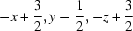
| Symmetry codes: (i) −x+3/2, y−1/2, −z+3/2; (ii) −x+1, −y, −z+1; (iii) −x+3/2, y+1/2, −z+3/2. |
| D—H···A | D—H | H···A | D···A | D—H···A |
| O(3)—H(13)···O(6) | 0.820 | 1.927 | 2.597 (6) | 138.188 |
| O(6)—H(14)···O(1)iv | 0.820 | 1.999 | 2.777 (6) | 158.201 |
| Symmetry code: (iv) −x+1, −y+1, −z+1. |
Experimental details
| Crystal data | |
| Chemical formula | [U(C4H7O3)2O2] |
| Mr | 476.22 |
| Crystal system, space group | Monoclinic, P21/n |
| Temperature (K) | 200 |
| a, b, c (Å) | 9.009 (2), 8.237 (2), 17.552 (6) |
| β (°) | 98.246 (9) |
| V (Å3) | 1289.0 (6) |
| Z | 4 |
| Radiation type | Mo Kα |
| µ (mm−1) | 12.62 |
| Crystal size (mm) | 0.20 × 0.11 × 0.03 |
| Data collection | |
| Diffractometer | Rigaku R-AXIS RAPID Imaging Plate diffractometer |
| Absorption correction | Multi-scan (ABSCOR; Higashi, 1995) |
| Tmin, Tmax | 0.233, 0.685 |
| No. of measured, independent and observed [I > 2σ(I)] reflections | 11887, 2949, 2547 |
| Rint | 0.050 |
| (sin θ/λ)max (Å−1) | 0.649 |
| Refinement | |
| R[F2 > 2σ(F2)], wR(F2), S | 0.029, 0.100, 0.86 |
| No. of reflections | 2949 |
| No. of parameters | 160 |
| No. of restraints | ? |
| H-atom treatment | H-atom parameters constrained |
| Δρmax, Δρmin (e Å−3) | 0.99, −2.15 |
Computer programs: PROCESS-AUTO (Rigaku, 1998), TEXSAN (Rigaku/MSC, 2004), SIR92 (Altomare et al., 1994), SHELXL97 (Sheldrick, 2008), ORTEP-3 (Farrugia, 1997) and Mercury (Macrae et al., 2006).
| U(1)—O(1) | 1.783 (5) | U(1)—O(5)i | 2.355 (4) |
| U(1)—O(2) | 1.762 (6) | U(1)—O(7) | 2.346 (5) |
| U(1)—O(3) | 2.444 (5) | U(1)—O(8) | 2.336 (5) |
| U(1)—O(4) | 2.407 (5) |
| Symmetry code: (i) −x+3/2, y−1/2, −z+3/2. |
| D—H···A | D—H | H···A | D···A | D—H···A |
| O(3)—H(13)···O(6) | 0.820 | 1.927 | 2.597 (6) | 138.188 |
| O(6)—H(14)···O(1)ii | 0.820 | 1.999 | 2.777 (6) | 158.201 |
| Symmetry code: (ii) −x+1, −y+1, −z+1. |
Acknowledgements
The present study is the result of the efficient separation and analysis of products for reprocessing systems entrusted to Osaka University by the Ministry of Education, Culture, Sports, Science and Technology of Japan (MEXT).
References
 Altomare, A., Cascarano, G., Giacovazzo, C., Guagliardi, A., Burla, M. C., Polidori, G. & Camalli, M. (1994). J. Appl. Cryst. 27, 435. CrossRef Web of Science IUCr Journals Google Scholar
Back, D. F., Manzoni de Oliveira, G. & Schulz Lang, E. (2007). Z. Anorg. Allg. Chem. 633, 729–733. Web of Science CSD CrossRef CAS Google Scholar
Bombieri, G., Croatto, U., Graziani, R., Forsellini, E. & Magon, L. (1974). Acta Cryst. B30, 407–411. CSD CrossRef CAS IUCr Journals Web of Science Google Scholar
Bombieri, G., Graziani, R. & Forsellini, E. (1973). Inorg. Nucl. Chem. Lett. 9, 551–557. CSD CrossRef CAS Web of Science Google Scholar
Farrugia, L. J. (1997). J. Appl. Cryst. 30, 565. CrossRef IUCr Journals Google Scholar
Higashi, T. (1995). ABSCOR. Rigaku Corporation, Tokyo, Japan. Google Scholar
Jiang, J., Sarsfield, M. J., Renshaw, J. C., Livens, F. R., Collison, D., Charnock, J. M., Helliwell, M. & Eccles, H. (2002). Inorg. Chem. 41, 2799–2806. Web of Science CSD CrossRef PubMed CAS Google Scholar
Macrae, C. F., Edgington, P. R., McCabe, P., Pidcock, E., Shields, G. P., Taylor, R., Towler, M. & van de Streek, J. (2006). J. Appl. Cryst. 39, 453–457. Web of Science CrossRef CAS IUCr Journals Google Scholar
Rigaku (1998). PROCESS-AUTO. Rigaku Corporation, Tokyo, Japan. Google Scholar
Rigaku/MSC (2004). TEXSAN. Rigaku/MSC, The Woodlands, Texas, USA. Google Scholar
Sheldrick, G. M. (2008). Acta Cryst. A64, 112–122. Web of Science CrossRef CAS IUCr Journals Google Scholar
Thuéry, P. (2006). Chem. Commun. pp. 853–855. Google Scholar
Thuéry, P. (2007a). CrystEngComm, 9, 358–360. Google Scholar
Thuéry, P. (2007b). Inorg. Chem. 46, 2307–2315. Web of Science PubMed Google Scholar
Thuéry, P. (2007c). Polyhedron, 26, 101–106. Google Scholar
Thuéry, P. (2008). CrystEngComm, 10, 79–85. Google Scholar
Xie, Y.-R., Zhao, H., Wang, X.-S., Qu, Z.-R., Xiong, R.-G., Xue, X., Xue, Z. & You, X.-Z. (2003). Eur. J. Inorg. Chem. pp. 3712–3715. Web of Science CSD CrossRef Google Scholar
Yokoyama, Y., Inaba, A., Hara, H., Yamazaki, T., Tamura, H. & Kushi, Y. (1990). Chem. Lett. pp. 671–674. CrossRef Web of Science Google Scholar
This is an open-access article distributed under the terms of the Creative Commons Attribution (CC-BY) Licence, which permits unrestricted use, distribution, and reproduction in any medium, provided the original authors and source are cited.
| CRYSTALLOGRAPHIC COMMUNICATIONS |


Structural chemistry of uranyl(VI) complexes with hydroxycarboxylate or alkoxycarboxylate has been extensively studied (Back et al. (2007); Bombieri et al.(1973, 1974); Jiang et al. (2002); Thuéry (2006, 2007a,b,c, 2008); Xie et al. (2003); Yokoyama et al.(1990)). The crystals of the title compound (I) suitable for single-crystal X-ray analysis were obtained by the reaction of bis(acetato)dioxouranium dihydrate with an excess amount of 2-hydroxy-2-methylpropionic acid in water. Herein, we report on the crystal structure of I. Uranium(VI) atom is seven-coordinate in a pentagonal-bipyramidal structure. The two oxygen atoms are located at the axial positions with nearly linear O(1)—U(1)—O(2) angle (178.3 (2)°). The equatorial positions are coordinated by five oxygen atoms of 2-hydroxy-2-methylpropionate (HIB) ligands. Two kinds of HIB ligands exist in the asymmetric unit. One of the HIB ligands links two uranium atoms by the carboxyl group. The other chelates one uranium atom through the hydroxy and carboxyl groups, moreover the carboxyl group bridges the neighboring uranium atom. As a result, a two-dimensional honeycomb structure is formed. The IR spectrum of I shows stretching bands of the carboxyl group of HIB at 1614 and 1561 cm-1.