Experimental
Crystal data
[Cu(HPO3)(H2O)2] Mr = 179.55 Monoclinic, P 21 /c a = 7.12940 (10) Å b = 7.33460 (10) Å c = 8.8313 (2) Å β = 110.4280 (10)° V = 432.76 (1) Å3 Z = 4 Mo Kα radiation μ = 5.32 mm−1 T = 296 K 0.25 × 0.25 × 0.20 mm
|
Data collection
Bruker APEXII CCD diffractometer Absorption correction: multi-scan (SHELXTL; Sheldrick, 2008![[Sheldrick, G. M. (2008). Acta Cryst. A64, 112-122.]](../../../../../../logos/arrows/e_arr.gif "Sheldrick, G. M. (2008). Acta Cryst. A64, 112-122.") ) Tmin = 0.288, Tmax = 0.345 ) Tmin = 0.288, Tmax = 0.345 3641 measured reflections 994 independent reflections 980 reflections with I > 2σ(I) Rint = 0.023
|
| Cu1—O3 | 1.9293 (14) | | Cu1—O1 | 1.9607 (14) | | Cu1—O2 | 1.9774 (14) | | Cu1—O4 | 1.9960 (14) | | Cu1—O5 | 2.2396 (17) | | Cu1—O3i | 2.8716 (15) | | | O1—Cu1—O2 | 160.25 (6) | | O3—Cu1—O4 | 177.82 (6) | | O3—Cu1—O5 | 97.18 (6) | | O2—Cu1—O5 | 104.95 (6) | Symmetry code: (i) -x, -y, -z+1.
| |
| D—H⋯A | D—H | H⋯A | D⋯A | D—H⋯A | | O4—H4A⋯O1ii | 0.878 (17) | 1.81 (2) | 2.658 (2) | 162 (4) | | O4—H4B⋯O2iii | 0.890 (16) | 1.864 (16) | 2.728 (2) | 163 (2) | | O5—H5A⋯O2iii | 0.867 (18) | 2.18 (3) | 2.925 (2) | 143 (3) | | O5—H5A⋯O3iv | 0.867 (18) | 2.60 (3) | 3.380 (2) | 151 (3) | | O5—H5B⋯O4v | 0.851 (18) | 1.985 (18) | 2.818 (2) | 166 (3) | Symmetry codes: (ii)  ; (iii) -x+1, -y, -z+1; (iv) ; (iii) -x+1, -y, -z+1; (iv) 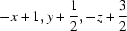 ; (v) ; (v) 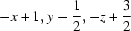 . .
| |
Data collection: APEX2 (Bruker, 2001); cell refinement: SAINT (Bruker, 2001); data reduction: SAINT; program(s) used to solve structure: SHELXS97 (Sheldrick, 2008); program(s) used to refine structure: SHELXL97 (Sheldrick, 2008); molecular graphics: SHELXTL (Sheldrick, 2008); software used to prepare material for publication: SHELXL97 and PLATON (Spek, 2009).
Supporting information
All reagents were of analytical grade. The title sample was prepared by Cu(NO3)2, H2O, H3(PO3) and (C2H5)3N triethylamine in the molar ratio 1:144:5:11 and heated at 393 K for 8 d. The blue single crystals were filtered, washed with distilled water and dried in air.
The H atoms of the water molecules were located from a difference density map and were refined with distance restraints of d(H–H) = 1.40 (2) Å, d(O–H) = 0.90 (2) Å, and with isotropic displacement parameters. The H atom of the hydrogenphosphite group was freely refined.
Data collection: APEX2 (Bruker, 2001); cell refinement: SAINT (Bruker, 2001); data reduction: SAINT (Bruker, 2001); program(s) used to solve structure: SHELXS97 (Sheldrick, 2008); program(s) used to refine structure: SHELXL97 (Sheldrick, 2008); molecular graphics: SHELXTL (Sheldrick, 2008); software used to prepare material for publication: SHELXL97 (Sheldrick, 2008) and PLATON (Spek, 2009).
poly[[diaquacopper(II)]-µ
3-hydrogenphosphito]
top Crystal data top | [Cu(HPO3)(H2O)2] | F(000) = 356 |
| Mr = 179.55 | Dx = 2.756 Mg m−3 |
| Monoclinic, P21/c | Mo Kα radiation, λ = 0.71073 Å |
| a = 7.1294 (1) Å | Cell parameters from 3157 reflections |
| b = 7.3346 (1) Å | θ = 3.1–27.5° |
| c = 8.8313 (2) Å | µ = 5.32 mm−1 |
| β = 110.428 (1)° | T = 296 K |
| V = 432.76 (1) Å3 | Block, blue |
| Z = 4 | 0.25 × 0.25 × 0.20 mm |
Data collection top Bruker APEXII CCD
diffractometer | 994 independent reflections |
| Radiation source: fine-focus sealed tube | 980 reflections with I > 2σ(I) |
| Graphite monochromator | Rint = 0.023 |
| ϕ and ω scans | θmax = 27.5°, θmin = 3.1° |
Absorption correction: multi-scan
(SHELXTL; Sheldrick, 2008) | h = −9→9 |
| Tmin = 0.288, Tmax = 0.345 | k = −9→9 |
| 3641 measured reflections | l = −10→11 |
Refinement top | Refinement on F2 | Secondary atom site location: difference Fourier map |
| Least-squares matrix: full | Hydrogen site location: inferred from neighbouring sites |
| R[F2 > 2σ(F2)] = 0.018 | H atoms treated by a mixture of independent and constrained refinement |
| wR(F2) = 0.049 | w = 1/[σ2(Fo2) + (0.0209P)2 + 0.4287P]
where P = (Fo2 + 2Fc2)/3 |
| S = 1.18 | (Δ/σ)max < 0.001 |
| 994 reflections | Δρmax = 0.44 e Å−3 |
| 85 parameters | Δρmin = −0.42 e Å−3 |
| 6 restraints | Extinction correction: SHELXL97 (Sheldrick, 2008), Fc*=kFc[1+0.001xFc2λ3/sin(2θ)]-1/4 |
| Primary atom site location: structure-invariant direct methods | Extinction coefficient: 0.134 (4) |
Crystal data top | [Cu(HPO3)(H2O)2] | V = 432.76 (1) Å3 |
| Mr = 179.55 | Z = 4 |
| Monoclinic, P21/c | Mo Kα radiation |
| a = 7.1294 (1) Å | µ = 5.32 mm−1 |
| b = 7.3346 (1) Å | T = 296 K |
| c = 8.8313 (2) Å | 0.25 × 0.25 × 0.20 mm |
| β = 110.428 (1)° | |
Data collection top Bruker APEXII CCD
diffractometer | 994 independent reflections |
Absorption correction: multi-scan
(SHELXTL; Sheldrick, 2008) | 980 reflections with I > 2σ(I) |
| Tmin = 0.288, Tmax = 0.345 | Rint = 0.023 |
| 3641 measured reflections | |
Refinement top | R[F2 > 2σ(F2)] = 0.018 | 6 restraints |
| wR(F2) = 0.049 | H atoms treated by a mixture of independent and constrained refinement |
| S = 1.18 | Δρmax = 0.44 e Å−3 |
| 994 reflections | Δρmin = −0.42 e Å−3 |
| 85 parameters | |
Special details top Geometry. All esds (except the esd in the dihedral angle between two l.s. planes) are estimated using the full covariance matrix. The cell esds are taken into account individually in the estimation of esds in distances, angles and torsion angles; correlations between esds in cell parameters are only used when they are defined by crystal symmetry. An approximate (isotropic) treatment of cell esds is used for estimating esds involving l.s. planes. |
Refinement. Refinement of F2 against ALL reflections. The weighted R-factor wR and goodness of fit S are based on F2, conventional R-factors R are based on F, with F set to zero for negative F2. The threshold expression of F2 > σ(F2) is used only for calculating R-factors(gt) etc. and is not relevant to the choice of reflections for refinement. R-factors based on F2 are statistically about twice as large as those based on F, and R- factors based on ALL data will be even larger. |
Fractional atomic coordinates and isotropic or equivalent isotropic displacement parameters (Å2) top| | x | y | z | Uiso*/Ueq | |
| Cu1 | 0.22809 (3) | 0.02792 (3) | 0.58956 (3) | 0.01035 (13) | |
| P1 | −0.08713 (7) | 0.28227 (6) | 0.66809 (6) | 0.00990 (15) | |
| O1 | 0.1259 (2) | 0.21752 (19) | 0.69683 (17) | 0.0145 (3) | |
| O2 | 0.2458 (2) | −0.1406 (2) | 0.42031 (17) | 0.0144 (3) | |
| O3 | 0.1081 (2) | −0.1660 (2) | 0.67218 (17) | 0.0173 (3) | |
| O4 | 0.3581 (2) | 0.22142 (19) | 0.50133 (17) | 0.0129 (3) | |
| O5 | 0.5311 (3) | 0.0183 (2) | 0.7831 (2) | 0.0234 (4) | |
| H1 | −0.116 (4) | 0.420 (4) | 0.582 (3) | 0.019 (6)* | |
| H4A | 0.298 (4) | 0.262 (5) | 0.403 (3) | 0.056 (12)* | |
| H4B | 0.482 (3) | 0.197 (4) | 0.506 (3) | 0.022 (7)* | |
| H5A | 0.630 (4) | 0.073 (4) | 0.766 (4) | 0.051 (10)* | |
| H5B | 0.580 (5) | −0.075 (3) | 0.841 (4) | 0.043 (9)* | |
Atomic displacement parameters (Å2) top| | U11 | U22 | U33 | U12 | U13 | U23 |
| Cu1 | 0.01143 (18) | 0.01023 (17) | 0.01156 (17) | −0.00141 (8) | 0.00675 (12) | −0.00082 (7) |
| P1 | 0.0107 (3) | 0.0093 (2) | 0.0109 (2) | 0.00038 (17) | 0.00539 (19) | −0.00079 (16) |
| O1 | 0.0100 (7) | 0.0186 (7) | 0.0154 (7) | −0.0006 (5) | 0.0049 (6) | −0.0061 (5) |
| O2 | 0.0115 (7) | 0.0159 (7) | 0.0179 (7) | −0.0029 (5) | 0.0076 (6) | −0.0055 (5) |
| O3 | 0.0229 (8) | 0.0169 (7) | 0.0156 (7) | −0.0058 (6) | 0.0109 (6) | 0.0018 (6) |
| O4 | 0.0118 (7) | 0.0148 (6) | 0.0124 (6) | −0.0009 (5) | 0.0046 (5) | 0.0008 (5) |
| O5 | 0.0128 (8) | 0.0286 (9) | 0.0256 (9) | 0.0001 (6) | 0.0027 (7) | 0.0126 (7) |
Geometric parameters (Å, º) top | Cu1—O3 | 1.9293 (14) | P1—O2i | 1.5337 (14) |
| Cu1—O1 | 1.9607 (14) | P1—H1 | 1.24 (3) |
| Cu1—O2 | 1.9774 (14) | O2—P1i | 1.5337 (14) |
| Cu1—O4 | 1.9960 (14) | O3—P1iii | 1.5178 (14) |
| Cu1—O5 | 2.2396 (17) | O4—H4A | 0.878 (17) |
| Cu1—O3i | 2.8716 (15) | O4—H4B | 0.890 (16) |
| P1—O3ii | 1.5178 (14) | O5—H5A | 0.867 (18) |
| P1—O1 | 1.5254 (15) | O5—H5B | 0.851 (18) |
| | | |
| O3—Cu1—O1 | 92.95 (6) | O3ii—P1—H1 | 108.6 (12) |
| O3—Cu1—O2 | 88.78 (6) | O1—P1—H1 | 107.4 (13) |
| O1—Cu1—O2 | 160.25 (6) | O2i—P1—H1 | 107.6 (13) |
| O3—Cu1—O4 | 177.82 (6) | P1—O1—Cu1 | 131.06 (9) |
| O1—Cu1—O4 | 89.19 (6) | P1i—O2—Cu1 | 125.31 (8) |
| O2—Cu1—O4 | 89.35 (6) | P1iii—O3—Cu1 | 137.43 (9) |
| O3—Cu1—O5 | 97.18 (6) | Cu1—O4—H4A | 120 (2) |
| O1—Cu1—O5 | 94.36 (6) | Cu1—O4—H4B | 115.5 (18) |
| O2—Cu1—O5 | 104.95 (6) | H4A—O4—H4B | 104 (2) |
| O4—Cu1—O5 | 82.23 (6) | Cu1—O5—H5A | 119 (2) |
| O3ii—P1—O1 | 109.79 (8) | Cu1—O5—H5B | 124 (2) |
| O3ii—P1—O2i | 110.37 (8) | H5A—O5—H5B | 107 (2) |
| O1—P1—O2i | 112.85 (8) | | |
| Symmetry codes: (i) −x, −y, −z+1; (ii) −x, y+1/2, −z+3/2; (iii) −x, y−1/2, −z+3/2. |
Hydrogen-bond geometry (Å, º) top | D—H···A | D—H | H···A | D···A | D—H···A |
| O4—H4A···O1iv | 0.88 (2) | 1.81 (2) | 2.658 (2) | 162 (4) |
| O4—H4B···O2v | 0.89 (2) | 1.86 (2) | 2.728 (2) | 163 (2) |
| O5—H5A···O2v | 0.87 (2) | 2.18 (3) | 2.925 (2) | 143 (3) |
| O5—H5A···O3vi | 0.87 (2) | 2.60 (3) | 3.380 (2) | 151 (3) |
| O5—H5B···O4vii | 0.85 (2) | 1.99 (2) | 2.818 (2) | 166 (3) |
| Symmetry codes: (iv) x, −y+1/2, z−1/2; (v) −x+1, −y, −z+1; (vi) −x+1, y+1/2, −z+3/2; (vii) −x+1, y−1/2, −z+3/2. |
Experimental details
| Crystal data |
| Chemical formula | [Cu(HPO3)(H2O)2] |
| Mr | 179.55 |
| Crystal system, space group | Monoclinic, P21/c |
| Temperature (K) | 296 |
| a, b, c (Å) | 7.1294 (1), 7.3346 (1), 8.8313 (2) |
| β (°) | 110.428 (1) |
| V (Å3) | 432.76 (1) |
| Z | 4 |
| Radiation type | Mo Kα |
| µ (mm−1) | 5.32 |
| Crystal size (mm) | 0.25 × 0.25 × 0.20 |
| |
| Data collection |
| Diffractometer | Bruker APEXII CCD
diffractometer |
| Absorption correction | Multi-scan
(SHELXTL; Sheldrick, 2008) |
| Tmin, Tmax | 0.288, 0.345 |
No. of measured, independent and
observed [I > 2σ(I)] reflections | 3641, 994, 980 |
| Rint | 0.023 |
| (sin θ/λ)max (Å−1) | 0.650 |
| |
| Refinement |
| R[F2 > 2σ(F2)], wR(F2), S | 0.018, 0.049, 1.18 |
| No. of reflections | 994 |
| No. of parameters | 85 |
| No. of restraints | 6 |
| H-atom treatment | H atoms treated by a mixture of independent and constrained refinement |
| Δρmax, Δρmin (e Å−3) | 0.44, −0.42 |
Selected geometric parameters (Å, º) top| Cu1—O3 | 1.9293 (14) | Cu1—O4 | 1.9960 (14) |
| Cu1—O1 | 1.9607 (14) | Cu1—O5 | 2.2396 (17) |
| Cu1—O2 | 1.9774 (14) | Cu1—O3i | 2.8716 (15) |
| | | |
| O1—Cu1—O2 | 160.25 (6) | O3—Cu1—O5 | 97.18 (6) |
| O3—Cu1—O4 | 177.82 (6) | O2—Cu1—O5 | 104.95 (6) |
| Symmetry code: (i) −x, −y, −z+1. |
Hydrogen-bond geometry (Å, º) top | D—H···A | D—H | H···A | D···A | D—H···A |
| O4—H4A···O1ii | 0.878 (17) | 1.81 (2) | 2.658 (2) | 162 (4) |
| O4—H4B···O2iii | 0.890 (16) | 1.864 (16) | 2.728 (2) | 163 (2) |
| O5—H5A···O2iii | 0.867 (18) | 2.18 (3) | 2.925 (2) | 143 (3) |
| O5—H5A···O3iv | 0.867 (18) | 2.60 (3) | 3.380 (2) | 151 (3) |
| O5—H5B···O4v | 0.851 (18) | 1.985 (18) | 2.818 (2) | 166 (3) |
| Symmetry codes: (ii) x, −y+1/2, z−1/2; (iii) −x+1, −y, −z+1; (iv) −x+1, y+1/2, −z+3/2; (v) −x+1, y−1/2, −z+3/2. |
Acknowledgements
The authors thank the Co-editor for help with the paper.
References
 Biradha, K. (2007). Curr. Sci. 92, 584–585. CAS Google Scholar
Bruker (2001). APEX2 and SAINT. Bruker AXS Inc., Madison, Wisconsin, USA. Google Scholar
El Bali, B. & Massa, W. (2002). Acta Cryst. E58, i29–i31. Web of Science CrossRef IUCr Journals Google Scholar
Handlovič, M. (1969). Acta Cryst. B25, 227–231. CrossRef IUCr Journals Web of Science Google Scholar
Harrison, W. T. A., Phillips, M. L. F. & Nenoff, T. M. (2001). J. Chem. Soc. Dalton Trans. pp. 2459–2461. Web of Science CSD CrossRef Google Scholar
Sheldrick, G. M. (2008). Acta Cryst. A64, 112–122. Web of Science CrossRef CAS IUCr Journals Google Scholar
Spek, A. L. (2009). Acta Cryst. D65, 148–155. Web of Science CrossRef CAS IUCr Journals Google Scholar
This is an open-access article distributed under the terms of the Creative Commons Attribution (CC-BY) Licence, which permits unrestricted use, distribution, and reproduction in any medium, provided the original authors and source are cited.
 | CRYSTALLOGRAPHIC
COMMUNICATIONS |
ISSN: 2056-9890
Open

access


 journal menu



![[Figure 1]](./si2150fig1thm.gif)
![[Figure 2]](./si2150fig2thm.gif)


Cu atoms in the asymmetric unit are pentahedrally coordinated and link three P atoms via phosphite O atoms (O1, O2, O3) with shorter distances and two water molecules (O4, O5) with longer distances (Fig. 1 and Table 1). A distorted octahedral geometry around the Cu atoms are considered when the strongly elongated apical Cu—O distances of 3.036 (14) Å (Handlovič, 1969), 3.000 (1) Å in II (El Bali & Massa, 2002), and 2.8716 (15) in I are included. The P atoms form the centers of a pseudo pyramid with the hydrogen phosphite groups, and each P links to three Cu via P—O—Cu bonds. The P—O bonds are in the range of 1.5178 (14) - 1.5337 (14) Å. The two-dimensional structure (Fig. 2) is built up from SBU (Biradha, 2007) (secondary building units, Fig.1), the corner sharing of tetra-meric units. One Cu atom links two P atom via O1 and O2. Two pentahedra Cu(H2O)2O3, and two pseudopyramids HPO3 form a dinucleus unit, noted as SBU. The Cu···Cu distance in the dimeric unit of I is 3.1074 (3) Å. The SBU and hydrogenphosphite polyhedra are connected into a one-dimensional chain by sharing the corner O3, and each chain links two other chains by sharing other atoms O3, forming a sheet along the bc-plane, containing 8-membered rings when the long Cu—O3c distance is neglected. In the structure of (CN3H6)2.Zn(HPO3)2, ZnO4 and HPO3building units form a 12-ring framework (Harrison et al., 2001). In both polymorph structures strong O—H···O hydrogen bonds are observed (Table 2).