 | Acta Crystallographica Section E Acta Crystallographica Section E CRYSTALLOGRAPHIC COMMUNICATIONS |


 journal menu


organic compounds
| CRYSTALLOGRAPHIC COMMUNICATIONS |
 access
(R)-4-[2-(Methylsulfanyl)pyrimidin-4-yl]-1-(tetrahydrofuran-3-yl)-1H-pyrazol-5-amine

aPfizer Global Research and Development, La Jolla Labs, 10614 Science Center Drive, San Diego, CA 92121, USA, and bDepartment of Chemistry and Biochemistry, University of California, San Diego, 9500 Gilman Drive, La Jolla, CA 92093, USA
*Correspondence e-mail: [email protected]
The title compound, C12H15N5OS, was obtained by reaction of 2-(2-(methylthio)pyrimidin-4-yl)-3-oxopropanenitrile with (tetrahydrofuran-3-yl)hydrazine dihydrochloride, and the racemic product was subsequently separated by chiral chromatography (first peak; [α]D20 = +51.3°). The chiral center at the substituted atom of the tetrahydrofuranyl group has an R-configuration. The pyrimidine and pyrazolyl rings are almost coplanar, their mean planes forming a dihedral angle of 6.4 (1)°. One of the H atoms of the amino group participates in an intramolecular hydrogen bond with the pyrimidine N atom in position 3. The second H atom is involved in an intermolecular hydrogen bond, which links the molecules into an infinite chain.
Related literature
For the structure of a related compound with a methyl-substituted amino group, see: Liu et al. (2009![[Liu, Z., Liu, K. K.-C., Elleraas, J., Rheingold, A. L., DiPasquale, A. & Yanovsky, A. (2009). Acta Cryst. E65, o616.]](../../../../../../logos/arrows/e_arr.gif "Liu, Z., Liu, K. K.-C., Elleraas, J., Rheingold, A. L., DiPasquale, A. & Yanovsky, A. (2009). Acta Cryst. E65, o616.") ).
).
![[Scheme 1]](tk2382scheme1.gif)
Experimental
Crystal data
|
| ||||||||||||||||||||||
 .
. Data collection: APEX2 (Bruker, 2004); cell refinement: SAINT (Bruker, 2004); data reduction: SAINT; program(s) used to solve structure: SIR2004 (Burla et al., 2005); program(s) used to refine structure: SHELXL97 (Sheldrick, 2008); molecular graphics: ORTEP-32 (Farrugia, 1997); software used to prepare material for publication: WinGX (Farrugia, 1999).
Supporting information
contains datablocks global, I. DOI: 10.1107/S160053680900734X/tk2382sup1.cif
Structure factors: contains datablock I. DOI: 10.1107/S160053680900734X/tk2382Isup2.hkl
To a suspension of 2-(2-(methylthio)pyrimidin-4-yl)-3-oxopropanenitrile (13.5 g, 70.0 mmol) in AcOH (100 ml) was added (tetrahydrofuran-3-yl)hydrazine dihydrochloride (12.3 g,70.0 mmol), and the resulting orange mixture was heated at 80°C under nitrogen for 3 h. Acetic acid was removed and the orange solid residue was partitioned between aqueous Na2CO3 (200 ml) and EtOAc (400 ml). The mixture was refluxed for 30 min. The separated organic layer was washed with brine, dried over sodium sulfate and concentrated to give the crude product as a brown gum (16.82 g, 87%). The brown gum (8.32 g) was purified by flash using 30–70% EtOAc in hexane to afford a yellow solid (5.96 g).
The part of the product thus obtained (4.85 g) was subjected to chiral on Chiralpak AS—H 21.2 x 250 mm column with 35% MeOH in CO2 at 140 bar as (flow = 55 ml/min; UV detection at 260 nm). Two fractions corresponding to each of the enantiomers (Peak1 and Peak2) were collected and evaporated to dryness; the specific rotation [α]D20 was measured in CH2Cl2 solution and yielded the values of +51.3° and -52.1°, respectively. The collected as Peak 1 was recrystallized from EtOAc/hexane to yield colorless single crystals.
All H atoms were placed in geometrically calculated positions (C—H 0.94 Å, 0.97 Å, 0.98 Å, and 0.99 Å for aromatic-, methyl-, methylene- and methine-H atoms, respectively; N—H 0.87 Å) and included in the in the riding model approximation. The Uiso(H) values were set to 1.2Ueq of the carrying atom except for 1.5Ueq for methyl-H atoms.
Data collection: APEX2 (Bruker, 2004); cell SAINT (Bruker, 2004); data reduction: SAINT (Bruker, 2004); program(s) used to solve structure: SIR2004 (Burla et al., 2005); program(s) used to refine structure: SHELXL97 (Sheldrick, 2008); molecular graphics: ORTEP-32 (Farrugia, 1997); software used to prepare material for publication: WinGX (Farrugia, 1999).
![[Figure 1]](./tk2382fig1thm.gif) | Fig. 1. Molecular structure of (I), showing 50% probability displacement ellipsoids and atom numbering scheme. H atoms are drawn as circles with arbitrary small radius. |
![[Figure 2]](./tk2382fig2thm.gif) | Fig. 2. Crystal packing for (I) viewed down the b axis; H-bonds are shown as dashed lines. |
| C12H15N5OS | F(000) = 584 |
| Mr = 277.35 | Dx = 1.419 Mg m−3 |
| Orthorhombic, P21212 | Mo Kα radiation, λ = 0.71073 Å |
| Hall symbol: P 2 2ab | Cell parameters from 5004 reflections |
| a = 15.479 (2) Å | θ = 2.6–28.1° |
| b = 7.1217 (10) Å | µ = 0.25 mm−1 |
| c = 11.7802 (17) Å | T = 208 K |
| V = 1298.6 (3) Å3 | Block, yellow |
| Z = 4 | 0.20 × 0.20 × 0.20 mm |
| Bruker D8 APEXII CCD area-detector diffractometer | 3025 independent reflections |
| Radiation source: fine-focus sealed tube | 2844 reflections with I > 2σ(I) |
| Graphite monochromator | Rint = 0.043 |
| phi and ω scans | θmax = 28.1°, θmin = 1.7° |
| Absorption correction: multi-scan (SADABS; Bruker, 2001) | h = −20→19 |
| Tmin = 0.844, Tmax = 0.952 | k = −4→9 |
| 6570 measured reflections | l = −15→13 |
| Refinement on F2 | Hydrogen site location: inferred from neighbouring sites |
| Least-squares matrix: full | H-atom parameters constrained |
| R[F2 > 2σ(F2)] = 0.041 | w = 1/[σ2(Fo2) + (0.0703P)2 + 0.0815P] where P = (Fo2 + 2Fc2)/3 |
| wR(F2) = 0.115 | (Δ/σ)max = 0.001 |
| S = 1.07 | Δρmax = 0.24 e Å−3 |
| 3025 reflections | Δρmin = −0.35 e Å−3 |
| 174 parameters | Extinction correction: SHELXL (Sheldrick, 2008), Fc*=kFc[1+0.001xFc2λ3/sin(2θ)]-1/4 |
| 0 restraints | Extinction coefficient: 0.058 (5) |
| Primary atom site location: structure-invariant direct methods | Absolute structure: Flack (1983), 1180 Friedel pairs |
| Secondary atom site location: difference Fourier map | Absolute structure parameter: −0.05 (8) |
| C12H15N5OS | V = 1298.6 (3) Å3 |
| Mr = 277.35 | Z = 4 |
| Orthorhombic, P21212 | Mo Kα radiation |
| a = 15.479 (2) Å | µ = 0.25 mm−1 |
| b = 7.1217 (10) Å | T = 208 K |
| c = 11.7802 (17) Å | 0.20 × 0.20 × 0.20 mm |
| Bruker D8 APEXII CCD area-detector diffractometer | 3025 independent reflections |
| Absorption correction: multi-scan (SADABS; Bruker, 2001) | 2844 reflections with I > 2σ(I) |
| Tmin = 0.844, Tmax = 0.952 | Rint = 0.043 |
| 6570 measured reflections |
| R[F2 > 2σ(F2)] = 0.041 | H-atom parameters constrained |
| wR(F2) = 0.115 | Δρmax = 0.24 e Å−3 |
| S = 1.07 | Δρmin = −0.35 e Å−3 |
| 3025 reflections | Absolute structure: Flack (1983), 1180 Friedel pairs |
| 174 parameters | Absolute structure parameter: −0.05 (8) |
| 0 restraints |
Geometry. All e.s.d.'s (except the e.s.d. in the dihedral angle between two l.s. planes) are estimated using the full covariance matrix. The cell e.s.d.'s are taken into account individually in the estimation of e.s.d.'s in distances, angles and torsion angles; correlations between e.s.d.'s in cell parameters are only used when they are defined by crystal symmetry. An approximate (isotropic) treatment of cell e.s.d.'s is used for estimating e.s.d.'s involving l.s. planes. |
Refinement. Refinement of F2 against ALL reflections. The weighted R-factor wR and goodness of fit S are based on F2, conventional R-factors R are based on F, with F set to zero for negative F2. The threshold expression of F2 > σ(F2) is used only for calculating R-factors(gt) etc. and is not relevant to the choice of reflections for refinement. R-factors based on F2 are statistically about twice as large as those based on F, and R- factors based on ALL data will be even larger. |
| x | y | z | Uiso*/Ueq | ||
| C1 | 0.61092 (15) | 0.3862 (4) | 1.04598 (18) | 0.0592 (6) | |
| H1A | 0.6660 | 0.3550 | 1.0825 | 0.071* | |
| H1B | 0.5758 | 0.4600 | 1.0989 | 0.071* | |
| C2 | 0.62567 (13) | 0.4931 (3) | 0.93597 (14) | 0.0471 (4) | |
| H2A | 0.6760 | 0.5761 | 0.9418 | 0.057* | |
| H2B | 0.5748 | 0.5677 | 0.9154 | 0.057* | |
| C3 | 0.64143 (10) | 0.3354 (3) | 0.85008 (15) | 0.0414 (4) | |
| H3 | 0.6054 | 0.3562 | 0.7818 | 0.050* | |
| C4 | 0.61086 (12) | 0.1571 (3) | 0.91240 (18) | 0.0514 (5) | |
| H4A | 0.5721 | 0.0835 | 0.8639 | 0.062* | |
| H4B | 0.6603 | 0.0785 | 0.9334 | 0.062* | |
| C5 | 0.86860 (11) | 0.3275 (3) | 0.84766 (15) | 0.0456 (4) | |
| H5 | 0.9228 | 0.3341 | 0.8835 | 0.055* | |
| C6 | 0.85782 (9) | 0.3006 (3) | 0.72974 (14) | 0.0355 (4) | |
| C7 | 0.76781 (9) | 0.3006 (2) | 0.71461 (13) | 0.0341 (3) | |
| C8 | 0.92276 (9) | 0.2767 (2) | 0.64376 (13) | 0.0341 (3) | |
| C9 | 1.01122 (10) | 0.2623 (3) | 0.66996 (14) | 0.0427 (4) | |
| H9 | 1.0308 | 0.2671 | 0.7454 | 0.051* | |
| C10 | 1.06733 (10) | 0.2412 (3) | 0.58192 (16) | 0.0466 (4) | |
| H10 | 1.1264 | 0.2289 | 0.5987 | 0.056* | |
| C11 | 0.95801 (10) | 0.2531 (3) | 0.45560 (14) | 0.0371 (3) | |
| C12 | 0.81445 (13) | 0.2818 (3) | 0.31648 (16) | 0.0526 (5) | |
| H12A | 0.7888 | 0.1785 | 0.3583 | 0.079* | |
| H12B | 0.7917 | 0.2833 | 0.2398 | 0.079* | |
| H12C | 0.8006 | 0.3993 | 0.3539 | 0.079* | |
| N1 | 0.73257 (8) | 0.3241 (2) | 0.81741 (12) | 0.0393 (3) | |
| N2 | 0.79452 (9) | 0.3423 (3) | 0.90197 (12) | 0.0488 (4) | |
| N3 | 0.72268 (9) | 0.2815 (3) | 0.61696 (12) | 0.0493 (4) | |
| H3A | 0.6665 | 0.2841 | 0.6182 | 0.059* | |
| H3B | 0.7498 | 0.2667 | 0.5529 | 0.059* | |
| N4 | 1.04322 (9) | 0.2367 (3) | 0.47231 (13) | 0.0453 (4) | |
| N5 | 0.89635 (8) | 0.2704 (2) | 0.53396 (11) | 0.0341 (3) | |
| O1 | 0.56646 (9) | 0.2206 (3) | 1.01145 (14) | 0.0630 (5) | |
| S1 | 0.92940 (3) | 0.25258 (9) | 0.31179 (4) | 0.05191 (18) |
| U11 | U22 | U33 | U12 | U13 | U23 | |
| C1 | 0.0580 (12) | 0.0835 (15) | 0.0362 (10) | 0.0152 (11) | 0.0142 (8) | 0.0072 (10) |
| C2 | 0.0412 (9) | 0.0661 (12) | 0.0340 (8) | 0.0096 (8) | 0.0063 (7) | 0.0034 (8) |
| C3 | 0.0248 (7) | 0.0669 (11) | 0.0325 (8) | 0.0036 (7) | 0.0002 (6) | 0.0017 (8) |
| C4 | 0.0343 (8) | 0.0675 (12) | 0.0523 (11) | −0.0037 (8) | 0.0026 (7) | 0.0040 (10) |
| C5 | 0.0288 (7) | 0.0790 (13) | 0.0290 (7) | −0.0006 (8) | −0.0025 (6) | −0.0024 (8) |
| C6 | 0.0258 (7) | 0.0512 (9) | 0.0293 (7) | −0.0007 (6) | −0.0009 (5) | 0.0000 (7) |
| C7 | 0.0269 (7) | 0.0473 (8) | 0.0282 (7) | 0.0005 (6) | −0.0020 (5) | −0.0004 (6) |
| C8 | 0.0262 (6) | 0.0443 (8) | 0.0320 (7) | −0.0002 (6) | 0.0010 (5) | 0.0008 (6) |
| C9 | 0.0277 (7) | 0.0655 (11) | 0.0350 (7) | 0.0007 (7) | −0.0029 (6) | 0.0006 (9) |
| C10 | 0.0259 (7) | 0.0684 (11) | 0.0456 (9) | 0.0031 (9) | 0.0023 (6) | −0.0035 (9) |
| C11 | 0.0315 (7) | 0.0471 (8) | 0.0327 (7) | −0.0020 (7) | 0.0027 (5) | −0.0045 (8) |
| C12 | 0.0438 (9) | 0.0754 (13) | 0.0385 (9) | 0.0067 (9) | −0.0061 (7) | −0.0041 (10) |
| N1 | 0.0254 (6) | 0.0642 (9) | 0.0282 (6) | 0.0003 (6) | −0.0011 (5) | −0.0007 (6) |
| N2 | 0.0290 (6) | 0.0884 (12) | 0.0290 (7) | −0.0003 (7) | −0.0043 (5) | −0.0034 (8) |
| N3 | 0.0284 (6) | 0.0917 (13) | 0.0278 (6) | 0.0010 (7) | −0.0043 (5) | −0.0065 (8) |
| N4 | 0.0293 (6) | 0.0657 (9) | 0.0408 (7) | −0.0002 (7) | 0.0045 (5) | −0.0076 (9) |
| N5 | 0.0287 (6) | 0.0435 (7) | 0.0300 (6) | −0.0016 (5) | 0.0020 (4) | −0.0026 (6) |
| O1 | 0.0460 (8) | 0.0826 (11) | 0.0604 (9) | 0.0041 (8) | 0.0233 (6) | 0.0185 (8) |
| S1 | 0.0394 (2) | 0.0852 (4) | 0.0311 (2) | −0.0016 (2) | 0.00439 (15) | −0.0075 (2) |
| C1—O1 | 1.425 (3) | C7—N1 | 1.339 (2) |
| C1—C2 | 1.520 (3) | C7—N3 | 1.353 (2) |
| C1—H1A | 0.9800 | C8—N5 | 1.357 (2) |
| C1—H1B | 0.9800 | C8—C9 | 1.407 (2) |
| C2—C3 | 1.531 (3) | C9—C10 | 1.361 (2) |
| C2—H2A | 0.9800 | C9—H9 | 0.9400 |
| C2—H2B | 0.9800 | C10—N4 | 1.344 (2) |
| C3—N1 | 1.4644 (18) | C10—H10 | 0.9400 |
| C3—C4 | 1.541 (3) | C11—N5 | 1.3334 (19) |
| C3—H3 | 0.9900 | C11—N4 | 1.339 (2) |
| C4—O1 | 1.428 (3) | C11—S1 | 1.7510 (17) |
| C4—H4A | 0.9800 | C12—S1 | 1.792 (2) |
| C4—H4B | 0.9800 | C12—H12A | 0.9700 |
| C5—N2 | 1.317 (2) | C12—H12B | 0.9700 |
| C5—C6 | 1.412 (2) | C12—H12C | 0.9700 |
| C5—H5 | 0.9400 | N1—N2 | 1.3888 (18) |
| C6—C7 | 1.4046 (19) | N3—H3A | 0.8700 |
| C6—C8 | 1.437 (2) | N3—H3B | 0.8700 |
| O1—C1—C2 | 104.11 (19) | N1—C7—C6 | 106.83 (13) |
| O1—C1—H1A | 110.9 | N3—C7—C6 | 128.32 (15) |
| C2—C1—H1A | 110.9 | N5—C8—C9 | 119.98 (14) |
| O1—C1—H1B | 110.9 | N5—C8—C6 | 117.70 (13) |
| C2—C1—H1B | 110.9 | C9—C8—C6 | 122.32 (14) |
| H1A—C1—H1B | 109.0 | C10—C9—C8 | 117.50 (15) |
| C1—C2—C3 | 102.70 (18) | C10—C9—H9 | 121.2 |
| C1—C2—H2A | 111.2 | C8—C9—H9 | 121.2 |
| C3—C2—H2A | 111.2 | N4—C10—C9 | 123.87 (14) |
| C1—C2—H2B | 111.2 | N4—C10—H10 | 118.1 |
| C3—C2—H2B | 111.2 | C9—C10—H10 | 118.1 |
| H2A—C2—H2B | 109.1 | N5—C11—N4 | 127.69 (15) |
| N1—C3—C2 | 111.55 (15) | N5—C11—S1 | 119.28 (12) |
| N1—C3—C4 | 112.07 (16) | N4—C11—S1 | 113.03 (12) |
| C2—C3—C4 | 103.93 (14) | S1—C12—H12A | 109.5 |
| N1—C3—H3 | 109.7 | S1—C12—H12B | 109.5 |
| C2—C3—H3 | 109.7 | H12A—C12—H12B | 109.5 |
| C4—C3—H3 | 109.7 | S1—C12—H12C | 109.5 |
| O1—C4—C3 | 106.03 (18) | H12A—C12—H12C | 109.5 |
| O1—C4—H4A | 110.5 | H12B—C12—H12C | 109.5 |
| C3—C4—H4A | 110.5 | C7—N1—N2 | 112.28 (13) |
| O1—C4—H4B | 110.5 | C7—N1—C3 | 129.58 (14) |
| C3—C4—H4B | 110.5 | N2—N1—C3 | 118.13 (13) |
| H4A—C4—H4B | 108.7 | C5—N2—N1 | 104.20 (14) |
| N2—C5—C6 | 112.69 (15) | C7—N3—H3A | 120.0 |
| N2—C5—H5 | 123.7 | C7—N3—H3B | 120.0 |
| C6—C5—H5 | 123.7 | H3A—N3—H3B | 120.0 |
| C7—C6—C5 | 104.00 (14) | C11—N4—C10 | 114.37 (14) |
| C7—C6—C8 | 127.19 (14) | C11—N5—C8 | 116.57 (13) |
| C5—C6—C8 | 128.81 (14) | C1—O1—C4 | 105.25 (15) |
| N1—C7—N3 | 124.85 (14) | C11—S1—C12 | 102.76 (8) |
| D—H···A | D—H | H···A | D···A | D—H···A |
| N3—H3A···N4i | 0.87 | 2.19 | 2.9731 (19) | 150 |
| N3—H3B···N5 | 0.87 | 2.28 | 2.8616 (19) | 124 |
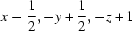
| Symmetry code: (i) x−1/2, −y+1/2, −z+1. |
Experimental details
| Crystal data | |
| Chemical formula | C12H15N5OS |
| Mr | 277.35 |
| Crystal system, space group | Orthorhombic, P21212 |
| Temperature (K) | 208 |
| a, b, c (Å) | 15.479 (2), 7.1217 (10), 11.7802 (17) |
| V (Å3) | 1298.6 (3) |
| Z | 4 |
| Radiation type | Mo Kα |
| µ (mm−1) | 0.25 |
| Crystal size (mm) | 0.20 × 0.20 × 0.20 |
| Data collection | |
| Diffractometer | Bruker D8 APEXII CCD area-detector diffractometer |
| Absorption correction | Multi-scan (SADABS; Bruker, 2001) |
| Tmin, Tmax | 0.844, 0.952 |
| No. of measured, independent and observed [I > 2σ(I)] reflections | 6570, 3025, 2844 |
| Rint | 0.043 |
| (sin θ/λ)max (Å−1) | 0.663 |
| Refinement | |
| R[F2 > 2σ(F2)], wR(F2), S | 0.041, 0.115, 1.07 |
| No. of reflections | 3025 |
| No. of parameters | 174 |
| H-atom treatment | H-atom parameters constrained |
| Δρmax, Δρmin (e Å−3) | 0.24, −0.35 |
| Absolute structure | Flack (1983), 1180 Friedel pairs |
| Absolute structure parameter | −0.05 (8) |
Computer programs: APEX2 (Bruker, 2004), SAINT (Bruker, 2004), SIR2004 (Burla et al., 2005), SHELXL97 (Sheldrick, 2008), ORTEP-32 (Farrugia, 1997), WinGX (Farrugia, 1999).
| D—H···A | D—H | H···A | D···A | D—H···A |
| N3—H3A···N4i | 0.87 | 2.19 | 2.9731 (19) | 149.5 |
| N3—H3B···N5 | 0.87 | 2.28 | 2.8616 (19) | 124.4 |
| Symmetry code: (i) x−1/2, −y+1/2, −z+1. |
References
 Bruker (2001). SADABS. Bruker AXS Inc., Madison, Wisconsin, USA. Google Scholar
Bruker (2004). APEX2 and SAINT. Bruker AXS Inc., Madison, Wisconsin, USA. Google Scholar
Burla, M. C., Caliandro, R., Camalli, M., Carrozzini, B., Cascarano, G. L., De Caro, L., Giacovazzo, C., Polidori, G. & Spagna, R. (2005). J. Appl. Cryst. 38, 381–388. Web of Science CrossRef CAS IUCr Journals Google Scholar
Farrugia, L. J. (1997). J. Appl. Cryst. 30, 565. CrossRef IUCr Journals Google Scholar
Farrugia, L. J. (1999). J. Appl. Cryst. 32, 837–838. CrossRef CAS IUCr Journals Google Scholar
Flack, H. D. (1983). Acta Cryst. A39, 876–881. CrossRef CAS Web of Science IUCr Journals Google Scholar
Liu, Z., Liu, K. K.-C., Elleraas, J., Rheingold, A. L., DiPasquale, A. & Yanovsky, A. (2009). Acta Cryst. E65, o616. Web of Science CSD CrossRef IUCr Journals Google Scholar
Sheldrick, G. M. (2008). Acta Cryst. A64, 112–122. Web of Science CrossRef CAS IUCr Journals Google Scholar
This is an open-access article distributed under the terms of the Creative Commons Attribution (CC-BY) Licence, which permits unrestricted use, distribution, and reproduction in any medium, provided the original authors and source are cited.
| CRYSTALLOGRAPHIC COMMUNICATIONS |


The title compound was obtained by reaction of 2-(2-(methylthio)pyrimidin-4-yl)-3-oxopropanenitrile with (tetrahydrofuran-3-yl)hydrazine dihydrochloride. The racemic product was then separated with the help of chiral chromatography; the title compound, (I), was collected as the earlier fraction, when eluted with methanol using the Chiralpak column (99% ee; [α]D20 = +51.3°).
The present X-ray study unambiguously established the R configuration of the chiral center at the C3 atom (Fig. 1).
The pyrimidine and pyrazolyl rings lie approximately in one plane; the dihedral angle formed by their mean planes is equal to 6.4 (1)°. The orientation of the tetrahydrofurane ring can be characterized by the dihedral angle 99.6 (1)° formed by the pyrazolyl plane with the C2—C3—C4 plane.
The molecular geometry of (I) is similar to that of related compound with a methyl substituent at the amino group (Liu et al., 2009). However, the crystal packing is substantially different as (I) has one additional H atom capable of H-bond formation. Indeed, while the H3A atom forms an intramolecular H-bond with the N5 atom of the pyrimidine ring similar to that observed in methyl-substituted structure, the H3B atom is involved in intermolecular H-bonding, which links molecules into infinite chains running along the a axis (Fig. 2; Table 2).