 | Acta Crystallographica Section E Acta Crystallographica Section E CRYSTALLOGRAPHIC COMMUNICATIONS |


 journal menu


organic compounds
| CRYSTALLOGRAPHIC COMMUNICATIONS |
 access
2-(4,5-Dihydro-1H-imidazol-2-yl)pyridine

aX-ray Crystallography Unit, School of Physics, Universiti Sains Malaysia, 11800 USM, Penang, Malaysia, and bDepartment of Chemistry, School of Science, Payame Noor University (PNU), Ardakan, Yazd, Iran
*Correspondence e-mail: [email protected]
In the molecule of the title compound, C8H9N3, a new imidazoline derivative, the six- and five-membered rings are slightly twisted away from each other, forming a dihedral angle of 7.96 (15)°. In the crystal structure, neighbouring molecules are linked together by intermolecular N—H⋯N hydrogen bonds into extended one-dimensional chains along the a axis. The pyridine N atom is in close proximity to a carbon-bound H atom of the imidazoline ring, with an H⋯N distance of 2.70 Å, which is slightly shorter than the sum of the van der Waals radii of these atoms (2.75 Å). The is further stabilized by intermolecular C—H⋯π and π–π interactions (centroid-to-centroid distance 3.853 Å).
Related literature
For related structures and synthesis, see: Stibrany et al. (2004![[Stibrany, R. T., Schugar, H. J. & Potenza, J. A. (2004). Acta Cryst. E60, o527-o529.]](../../../../../../logos/arrows/e_arr.gif "Stibrany, R. T., Schugar, H. J. & Potenza, J. A. (2004). Acta Cryst. E60, o527-o529.") ); Kia et al. (2008, 2009a,b). For biological and pharmaceutical applications, see, for example: Blancafort (1978); Chan (1993); Vizi (1986); Li et al. (1996); Ueno et al. (1995); Corey & Grogan (1999). For the stability of the temperature controller used for data collection, see: Cosier & Glazer (1986). For standard bond-length data, see: Allen et al. (1987).
); Kia et al. (2008, 2009a,b). For biological and pharmaceutical applications, see, for example: Blancafort (1978); Chan (1993); Vizi (1986); Li et al. (1996); Ueno et al. (1995); Corey & Grogan (1999). For the stability of the temperature controller used for data collection, see: Cosier & Glazer (1986). For standard bond-length data, see: Allen et al. (1987).
![[Scheme 1]](wn2314scheme1.gif)
Experimental
Crystal data
|
Refinement
|
| |||||||||||||||||||||||||||
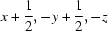 ; (ii)
 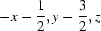 .
. Data collection: APEX2 (Bruker, 2005); cell refinement: SAINT (Bruker, 2005); data reduction: SAINT; program(s) used to solve structure: SHELXTL (Sheldrick, 2008); program(s) used to refine structure: SHELXTL; molecular graphics: SHELXTL; software used to prepare material for publication: SHELXTL and PLATON (Spek, 2009).
Supporting information
contains datablocks global, I. DOI: 10.1107/S1600536809009131/wn2314sup1.cif
Structure factors: contains datablock I. DOI: 10.1107/S1600536809009131/wn2314Isup2.hkl
The synthetic method was based on previous work (Stibrany et al., 2004), except that 10 mmol of 2-cyanopyridine and 40 mmol of ethylenediamine were used. Single crystals suitable for X-ray diffraction were obtained by evaporation of a methanol solution at room temperature.
The N-bound H atom was located in a Fourier difference map and refined freely (Table 1). The other H atoms were positioned geometrically and refined with a riding approximation model; C—H = 0.95–0.99 Å and Uiso(H) = 1.2Ueq(C).
Data collection: APEX2 (Bruker, 2005); cell APEX2 (Bruker, 2005); data reduction: SAINT (Bruker, 2005); program(s) used to solve structure: SHELXTL (Sheldrick, 2008); program(s) used to refine structure: SHELXTL (Sheldrick, 2008); molecular graphics: SHELXTL (Sheldrick, 2008); software used to prepare material for publication: SHELXTL (Sheldrick, 2008) and PLATON (Spek, 2009).
![[Figure 1]](./wn2314fig1thm.gif) | Fig. 1. The molecular structure of the title compound, with atom labels. Displacement ellipsoids are drawn at the 50% probability level. H atoms are shown as spheres of arbitrary radius. |
![[Figure 2]](./wn2314fig2thm.gif) | Fig. 2. The crystal packing of the title compound, viewed down the b axis, showing a one-dimensional extended chain along the a axis, formed by intermolecular N—H···N interactions. The intermolecular interactions are shown as dashed lines. |
| C8H9N3 | F(000) = 624 |
| Mr = 147.18 | Dx = 1.389 Mg m−3 |
| Orthorhombic, Pbca | Mo Kα radiation, λ = 0.71073 Å |
| Hall symbol: -P 2ac 2ab | Cell parameters from 3233 reflections |
| a = 10.0057 (8) Å | θ = 3.1–30.9° |
| b = 7.9828 (7) Å | µ = 0.09 mm−1 |
| c = 17.6199 (14) Å | T = 100 K |
| V = 1407.4 (2) Å3 | Plate, colourless |
| Z = 8 | 0.48 × 0.46 × 0.09 mm |
| Bruker SMART APEXII CCD area-detector diffractometer | 1238 independent reflections |
| Radiation source: fine-focus sealed tube | 869 reflections with I > 2σ(I) |
| Graphite monochromator | Rint = 0.094 |
| ϕ and ω scans | θmax = 25.0°, θmin = 2.3° |
| Absorption correction: multi-scan (SADABS; Bruker, 2005) | h = −11→11 |
| Tmin = 0.959, Tmax = 0.992 | k = −9→9 |
| 10642 measured reflections | l = −20→20 |
| Refinement on F2 | Primary atom site location: structure-invariant direct methods |
| Least-squares matrix: full | Secondary atom site location: difference Fourier map |
| R[F2 > 2σ(F2)] = 0.051 | Hydrogen site location: inferred from neighbouring sites |
| wR(F2) = 0.146 | H atoms treated by a mixture of independent and constrained refinement |
| S = 1.08 | w = 1/[σ2(Fo2) + (0.0658P)2 + 1.1427P] where P = (Fo2 + 2Fc2)/3 |
| 1238 reflections | (Δ/σ)max < 0.001 |
| 104 parameters | Δρmax = 0.26 e Å−3 |
| 0 restraints | Δρmin = −0.31 e Å−3 |
| C8H9N3 | V = 1407.4 (2) Å3 |
| Mr = 147.18 | Z = 8 |
| Orthorhombic, Pbca | Mo Kα radiation |
| a = 10.0057 (8) Å | µ = 0.09 mm−1 |
| b = 7.9828 (7) Å | T = 100 K |
| c = 17.6199 (14) Å | 0.48 × 0.46 × 0.09 mm |
| Bruker SMART APEXII CCD area-detector diffractometer | 1238 independent reflections |
| Absorption correction: multi-scan (SADABS; Bruker, 2005) | 869 reflections with I > 2σ(I) |
| Tmin = 0.959, Tmax = 0.992 | Rint = 0.094 |
| 10642 measured reflections |
| R[F2 > 2σ(F2)] = 0.051 | 0 restraints |
| wR(F2) = 0.146 | H atoms treated by a mixture of independent and constrained refinement |
| S = 1.08 | Δρmax = 0.26 e Å−3 |
| 1238 reflections | Δρmin = −0.31 e Å−3 |
| 104 parameters |
Experimental. The crystal was placed in the cold stream of an Oxford Cyrosystems Cobra open-flow nitrogen cryostat (Cosier & Glazer, 1986) operating at 100.0 (1) K. |
Geometry. All e.s.d.'s (except the e.s.d. in the dihedral angle between two l.s. planes) are estimated using the full covariance matrix. The cell e.s.d.'s are taken into account individually in the estimation of e.s.d.'s in distances, angles and torsion angles; correlations between e.s.d.'s in cell parameters are only used when they are defined by crystal symmetry. An approximate (isotropic) treatment of cell e.s.d.'s is used for estimating e.s.d.'s involving l.s. planes. |
Refinement. Refinement of F2 against ALL reflections. The weighted R-factor wR and goodness of fit S are based on F2, conventional R-factors R are based on F, with F set to zero for negative F2. The threshold expression of F2 > σ(F2) is used only for calculating R-factors(gt) etc. and is not relevant to the choice of reflections for refinement. R-factors based on F2 are statistically about twice as large as those based on F, and R- factors based on ALL data will be even larger. |
| x | y | z | Uiso*/Ueq | ||
| N1 | 0.4819 (2) | 0.2650 (3) | −0.01294 (14) | 0.0329 (7) | |
| N2 | 0.2746 (2) | 0.1657 (3) | −0.03211 (12) | 0.0232 (6) | |
| N3 | 0.4811 (2) | 0.1456 (3) | 0.13473 (12) | 0.0225 (6) | |
| C1 | 0.3126 (3) | 0.2543 (4) | −0.10232 (14) | 0.0251 (7) | |
| H1 | 0.2478 | 0.3446 | −0.1137 | 0.030* | |
| H2 | 0.3149 | 0.1757 | −0.1457 | 0.030* | |
| C2 | 0.4531 (3) | 0.3285 (4) | −0.08783 (14) | 0.0232 (7) | |
| H3 | 0.5188 | 0.2877 | −0.1256 | 0.028* | |
| H4 | 0.4516 | 0.4525 | −0.0886 | 0.028* | |
| C3 | 0.3763 (2) | 0.1770 (3) | 0.01289 (14) | 0.0195 (6) | |
| C4 | 0.3779 (3) | 0.1036 (3) | 0.08982 (14) | 0.0202 (6) | |
| C5 | 0.2758 (2) | −0.0035 (3) | 0.11365 (15) | 0.0213 (6) | |
| H5 | 0.2050 | −0.0326 | 0.0803 | 0.026* | |
| C6 | 0.2797 (3) | −0.0662 (4) | 0.18629 (14) | 0.0231 (7) | |
| H6 | 0.2106 | −0.1378 | 0.2040 | 0.028* | |
| C7 | 0.3852 (3) | −0.0238 (3) | 0.23325 (15) | 0.0231 (7) | |
| H7 | 0.3904 | −0.0658 | 0.2836 | 0.028* | |
| C8 | 0.4829 (3) | 0.0814 (4) | 0.20475 (15) | 0.0229 (7) | |
| H8 | 0.5556 | 0.1097 | 0.2369 | 0.027* | |
| H1N1 | 0.555 (3) | 0.278 (4) | 0.0109 (16) | 0.036 (9)* |
| U11 | U22 | U33 | U12 | U13 | U23 | |
| N1 | 0.0146 (14) | 0.0501 (17) | 0.0340 (15) | −0.0094 (12) | −0.0053 (12) | 0.0105 (12) |
| N2 | 0.0147 (13) | 0.0261 (13) | 0.0289 (12) | 0.0008 (10) | −0.0021 (10) | −0.0009 (9) |
| N3 | 0.0105 (11) | 0.0244 (13) | 0.0326 (13) | 0.0018 (10) | −0.0013 (10) | −0.0013 (10) |
| C1 | 0.0138 (14) | 0.0320 (16) | 0.0296 (15) | 0.0004 (12) | −0.0023 (12) | 0.0006 (12) |
| C2 | 0.0146 (14) | 0.0260 (15) | 0.0290 (15) | 0.0005 (12) | 0.0007 (11) | −0.0008 (11) |
| C3 | 0.0118 (14) | 0.0173 (14) | 0.0292 (15) | 0.0027 (11) | 0.0018 (11) | −0.0038 (11) |
| C4 | 0.0108 (13) | 0.0180 (14) | 0.0317 (15) | 0.0048 (11) | 0.0008 (11) | −0.0028 (11) |
| C5 | 0.0102 (15) | 0.0204 (15) | 0.0334 (15) | 0.0005 (11) | −0.0010 (11) | −0.0056 (11) |
| C6 | 0.0161 (15) | 0.0205 (15) | 0.0327 (16) | −0.0009 (12) | 0.0048 (12) | −0.0017 (11) |
| C7 | 0.0204 (15) | 0.0203 (14) | 0.0287 (15) | 0.0029 (12) | 0.0023 (12) | 0.0001 (11) |
| C8 | 0.0148 (15) | 0.0259 (15) | 0.0278 (15) | 0.0007 (12) | −0.0042 (11) | −0.0040 (12) |
| N1—C3 | 1.349 (3) | C2—H4 | 0.9900 |
| N1—C2 | 1.442 (4) | C3—C4 | 1.477 (4) |
| N1—H1N1 | 0.85 (3) | C4—C5 | 1.397 (4) |
| N2—C3 | 1.293 (3) | C5—C6 | 1.374 (4) |
| N2—C1 | 1.475 (3) | C5—H5 | 0.9500 |
| N3—C8 | 1.336 (3) | C6—C7 | 1.383 (4) |
| N3—C4 | 1.343 (3) | C6—H6 | 0.9500 |
| C1—C2 | 1.547 (4) | C7—C8 | 1.383 (4) |
| C1—H1 | 0.9900 | C7—H7 | 0.9500 |
| C1—H2 | 0.9900 | C8—H8 | 0.9500 |
| C2—H3 | 0.9900 | ||
| C3—N1—C2 | 109.6 (2) | N2—C3—C4 | 122.9 (2) |
| C3—N1—H1N1 | 125 (2) | N1—C3—C4 | 120.5 (2) |
| C2—N1—H1N1 | 126 (2) | N3—C4—C5 | 122.5 (2) |
| C3—N2—C1 | 106.1 (2) | N3—C4—C3 | 116.7 (2) |
| C8—N3—C4 | 117.3 (2) | C5—C4—C3 | 120.7 (2) |
| N2—C1—C2 | 106.2 (2) | C6—C5—C4 | 118.8 (2) |
| N2—C1—H1 | 110.5 | C6—C5—H5 | 120.6 |
| C2—C1—H1 | 110.5 | C4—C5—H5 | 120.6 |
| N2—C1—H2 | 110.5 | C5—C6—C7 | 119.3 (3) |
| C2—C1—H2 | 110.5 | C5—C6—H6 | 120.4 |
| H1—C1—H2 | 108.7 | C7—C6—H6 | 120.4 |
| N1—C2—C1 | 101.4 (2) | C8—C7—C6 | 118.1 (2) |
| N1—C2—H3 | 111.5 | C8—C7—H7 | 121.0 |
| C1—C2—H3 | 111.5 | C6—C7—H7 | 121.0 |
| N1—C2—H4 | 111.5 | N3—C8—C7 | 124.0 (2) |
| C1—C2—H4 | 111.5 | N3—C8—H8 | 118.0 |
| H3—C2—H4 | 109.3 | C7—C8—H8 | 118.0 |
| N2—C3—N1 | 116.5 (2) | ||
| C3—N2—C1—C2 | −3.2 (3) | N1—C3—C4—N3 | 7.7 (4) |
| C3—N1—C2—C1 | −2.3 (3) | N2—C3—C4—C5 | 9.5 (4) |
| N2—C1—C2—N1 | 3.3 (3) | N1—C3—C4—C5 | −172.6 (2) |
| C1—N2—C3—N1 | 1.9 (3) | N3—C4—C5—C6 | 1.2 (4) |
| C1—N2—C3—C4 | 179.9 (2) | C3—C4—C5—C6 | −178.6 (2) |
| C2—N1—C3—N2 | 0.4 (3) | C4—C5—C6—C7 | −1.0 (4) |
| C2—N1—C3—C4 | −177.7 (2) | C5—C6—C7—C8 | 0.3 (4) |
| C8—N3—C4—C5 | −0.5 (4) | C4—N3—C8—C7 | −0.4 (4) |
| C8—N3—C4—C3 | 179.3 (2) | C6—C7—C8—N3 | 0.5 (4) |
| N2—C3—C4—N3 | −170.2 (2) |
| D—H···A | D—H | H···A | D···A | D—H···A |
| N1—H1N1···N2i | 0.85 (3) | 2.27 (3) | 3.084 (3) | 160 (3) |
| C2—H3···Cg1ii | 0.99 | 2.87 | 3.611 (3) | 133 |
| C6—H6···Cg1iii | 0.95 | 2.84 | 3.561 (3) | 134 |
| Symmetry codes: (i) x+1/2, −y+1/2, −z; (ii) −x+1, −y, −z; (iii) −x−1/2, y−3/2, z. |
Experimental details
| Crystal data | |
| Chemical formula | C8H9N3 |
| Mr | 147.18 |
| Crystal system, space group | Orthorhombic, Pbca |
| Temperature (K) | 100 |
| a, b, c (Å) | 10.0057 (8), 7.9828 (7), 17.6199 (14) |
| V (Å3) | 1407.4 (2) |
| Z | 8 |
| Radiation type | Mo Kα |
| µ (mm−1) | 0.09 |
| Crystal size (mm) | 0.48 × 0.46 × 0.09 |
| Data collection | |
| Diffractometer | Bruker SMART APEXII CCD area-detector diffractometer |
| Absorption correction | Multi-scan (SADABS; Bruker, 2005) |
| Tmin, Tmax | 0.959, 0.992 |
| No. of measured, independent and observed [I > 2σ(I)] reflections | 10642, 1238, 869 |
| Rint | 0.094 |
| (sin θ/λ)max (Å−1) | 0.595 |
| Refinement | |
| R[F2 > 2σ(F2)], wR(F2), S | 0.051, 0.146, 1.08 |
| No. of reflections | 1238 |
| No. of parameters | 104 |
| H-atom treatment | H atoms treated by a mixture of independent and constrained refinement |
| Δρmax, Δρmin (e Å−3) | 0.26, −0.31 |
Computer programs: APEX2 (Bruker, 2005), SAINT (Bruker, 2005), SHELXTL (Sheldrick, 2008) and PLATON (Spek, 2009).
| D—H···A | D—H | H···A | D···A | D—H···A |
| N1—H1N1···N2i | 0.85 (3) | 2.27 (3) | 3.084 (3) | 160 (3) |
| C2—H3···Cg1ii | 0.99 | 2.87 | 3.611 (3) | 133 |
| C6—H6···Cg1iii | 0.95 | 2.84 | 3.561 (3) | 134 |
| Symmetry codes: (i) x+1/2, −y+1/2, −z; (ii) −x+1, −y, −z; (iii) −x−1/2, y−3/2, z. |
Acknowledgements
HKF and RK thank the Malaysian Government and Universiti Sains Malaysia for a Science Fund Grant (No. 305/PFIZIK/613312). RK thanks Universiti Sains Malaysia for a postdoctoral research fellowship. HK thanks PNU for financial support. HKF also thanks Universiti Sains Malaysia for a Research University Golden Goose Grant (No. 1001/PFIZIK/811012).
References
 Allen, F. H., Kennard, O., Watson, D. G., Brammer, L., Orpen, A. G. & Taylor, R. (1987). J. Chem. Soc. Perkin Trans. 2, pp. S1–19. CrossRef Web of Science Google Scholar
Blancafort, P. (1978). Drugs Fut. 3, 592–592. CrossRef Google Scholar
Bruker (2005). SADABS, APEX2 and SAINT. Bruker AXS Inc., Madison, Wisconsin, USA. Google Scholar
Chan, S. (1993). Clin. Sci. 85, 671–677. CAS PubMed Web of Science Google Scholar
Corey, E. J. & Grogan, M. J. (1999). Org. Lett. 1, 157–160. Web of Science CSD CrossRef PubMed CAS Google Scholar
Cosier, J. & Glazer, A. M. (1986). J. Appl. Cryst. 19, 105–107. CrossRef CAS Web of Science IUCr Journals Google Scholar
Kia, R., Fun, H.-K. & Kargar, H. (2008). Acta Cryst. E64, o2406. Web of Science CSD CrossRef IUCr Journals Google Scholar
Kia, R., Fun, H.-K. & Kargar, H. (2009a). Acta Cryst. E65, o338–o339. Web of Science CSD CrossRef IUCr Journals Google Scholar
Kia, R., Fun, H.-K. & Kargar, H. (2009b). Acta Cryst. E65, o724. Web of Science CSD CrossRef IUCr Journals Google Scholar
Li, H. Y., Drummond, S., De Lucca, I. & Boswell, G. A. (1996). Tetrahedron, 52, 11153–11162. CSD CrossRef CAS Web of Science Google Scholar
Sheldrick, G. M. (2008). Acta Cryst. A64, 112–122. Web of Science CrossRef CAS IUCr Journals Google Scholar
Spek, A. L. (2009). Acta Cryst. D65, 148–155. Web of Science CrossRef CAS IUCr Journals Google Scholar
Stibrany, R. T., Schugar, H. J. & Potenza, J. A. (2004). Acta Cryst. E60, o527–o529. Web of Science CSD CrossRef IUCr Journals Google Scholar
Ueno, M., Imaizumi, K., Sugita, T., Takata, I. & Takeshita, M. (1995). Int. J. Immunopharmacol. 17, 597–603. CrossRef CAS PubMed Web of Science Google Scholar
Vizi, E. S. (1986). Med. Res. Rev. 6, 431–449. CrossRef CAS PubMed Web of Science Google Scholar
This is an open-access article distributed under the terms of the Creative Commons Attribution (CC-BY) Licence, which permits unrestricted use, distribution, and reproduction in any medium, provided the original authors and source are cited.
| CRYSTALLOGRAPHIC COMMUNICATIONS |


Imidazoline derivatives are of great importance because they exhibit significant biological and pharmacological activities, such as antihypertensive (Blancafort, 1978), antihyperglycemic (Chan, 1993), antidepressant (Vizi, 1986), antihypercholesterolemic (Li et al., 1996) and anti-inflammatory (Ueno et al., 1995) properties. These compounds are also used as catalysts and synthetic intermediates in some organic reactions (Corey & Grogan, 1999). With regard to these important applications of imidazolines, we report here the crystal structure of the title compound.
In the title compound (Fig. 1), bond lengths (Allen et al., 1987) and angles are within the normal ranges and are comparable with those in related structures (Stibrany et al., 2004; Kia et al., 2008, 2009a,b). The molecule is almost planar, with a maximum deviation from the mean plane of the molecule for atom N1: 0.106 (2) Å. The six- and five-membered rings are twisted from each other, forming a dihedral angle of 7.96 (15)°. Atom H1 of the imidazoline ring is in close proximity to atom N3 of the pyridine ring, with a distance of 2.70 Å [N3···H1], which is shorter than the sum of the van der Waals radii of these atoms (2.75 Å). In the crystal structure, neighbouring molecules are linked together by intermolecular N—H···N hydrogen bonds into one-dimensional extended chains along the a axis (Table 1, Fig. 2). The crystal structure is further stabilized by intermolecular C—H···π [Cg1 is the centroid of the N3/C4–C8 pyridine ring] and π–π interactions [Cg1···Cg2 = 3.853 Å and Cg2 is the centroid of the N1/C1/C2/N2/C3 ring].