 | Acta Crystallographica Section E Acta Crystallographica Section E CRYSTALLOGRAPHIC COMMUNICATIONS |


 journal menu


metal-organic compounds
| CRYSTALLOGRAPHIC COMMUNICATIONS |
 access
{6,6′-Diethoxy-2,2′-[4,5-dimethyl-o-phenylenebis(nitrilomethylidyne)]diphenolato}nickel(II) dihydrate

aDepartment of Chemistry, School of Science, Payame Noor University (PNU), Ardakan, Yazd, Iran, and bX-ray Crystallography Unit, School of Physics, Universiti Sains Malaysia, 11800 USM, Penang, Malaysia
*Correspondence e-mail: [email protected]
In the title complex, [Ni(C26H26N2O4)]·2H2O, the NiII ion, lying on a twofold crystallographic rotation axis, has a square-planar geometry, being coordinated by the N2O2 unit of the tetradentate Schiff base ligand. The of the title compound comprises one-half of the complex molecule and one of the water molecules of crystallization. The water H atoms form bifurcated O—H⋯(O,O) hydrogen bonds with the O atoms of the phenolato and ethoxy groups with R12(5) and R12(6) ring motifs. The dihedral angle between the central benzene ring and the two outer benzene rings are 4.07 (11) and 3.99 (12)°. The dihedral angle between the two O–Ni–N coordination planes is only 0.77 (11)°. In the crystal structure, the molecules are linked together into extended chains along the c axis by intermolecular O—H⋯O and C—H⋯O interactions. An interesting feature of the is a short intermolecular C ⋯ C [3.355 (3) Å] contact, which is shorter than the sum of the van der Waals radii. The may be further stabilized by intermolecular π–π interactions [centroid–centroid distances in the range 3.5758 (13)–3.6337 (13) Å].
Related literature
For bond-length data, see Allen et al. (1987![[Allen, F. H., Kennard, O., Watson, D. G., Brammer, L., Orpen, A. G. & Taylor, R. (1987). J. Chem. Soc. Perkin Trans. 2, pp. S1-S19.]](../../../../../../logos/arrows/e_arr.gif "Allen, F. H., Kennard, O., Watson, D. G., Brammer, L., Orpen, A. G. & Taylor, R. (1987). J. Chem. Soc. Perkin Trans. 2, pp. S1-S19.") ). For related structures see, for example: Clark et al. (1968, 1969, 1970). For the applications and bioactivity of Schiff base complexes see, for example: Elmali et al. (2000); Blower (1998); Granovski et al. (1993); Li & Chang, (1991); Shahrokhian et al. (2000). For hydrogen-bond motifs, see: Bernstein et al. (1995).
). For related structures see, for example: Clark et al. (1968, 1969, 1970). For the applications and bioactivity of Schiff base complexes see, for example: Elmali et al. (2000); Blower (1998); Granovski et al. (1993); Li & Chang, (1991); Shahrokhian et al. (2000). For hydrogen-bond motifs, see: Bernstein et al. (1995).
![[Scheme 1]](cs2114scheme1.gif)
Experimental
Crystal data
|
Refinement
|
| ||||||||
|
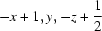 ; (ii)
  .
. Data collection: APEX2 (Bruker, 2005); cell refinement: SAINT (Bruker, 2005); data reduction: SAINT; program(s) used to solve structure: SHELXTL (Sheldrick, 2008); program(s) used to refine structure: SHELXTL; molecular graphics: SHELXTL; software used to prepare material for publication: SHELXTL and PLATON (Spek, 2009).
Supporting information
contains datablocks global, I. DOI: 10.1107/S1600536809012641/cs2114sup1.cif
Structure factors: contains datablock I. DOI: 10.1107/S1600536809012641/cs2114Isup2.hkl
A chloroform solution (40 ml) of [N,N'-Bis(3-ethoxy-salicylidene)- 4,5-dimethyl-phenylenediamine (1 mmol) was added to a ethanol solution (20 mL) of NiCl2.6H2O (1.05 mmol, 237 mg). The mixture was refluxed for 30 min and then filtered. After keeping the filtrate in air, deep-red block-shaped crystals were formed at the bottom of the vessel on slow evaporation of the solvent.
The water H-atoms were located from the difference Fourier map and constrained to refine with the after O—H distance restraint of 0.82 (1) Å. The rest of the hydrogen atoms were positioned geometrically [C—H = 0.95–97 Å] and refined using a riding approximation model. A rotating-group model was used for the methyl groups.
Data collection: APEX2 (Bruker, 2005); cell SAINT (Bruker, 2005); data reduction: SAINT (Bruker, 2005); program(s) used to solve structure: SHELXTL (Sheldrick, 2008); program(s) used to refine structure: SHELXTL (Sheldrick, 2008); molecular graphics: SHELXTL (Sheldrick, 2008); software used to prepare material for publication: SHELXTL (Sheldrick, 2008) and PLATON (Spek, 2009).
![[Figure 1]](./cs2114fig1thm.gif) | Fig. 1. The title molecular compound, showing 50° probability displacement ellipsoids and the atomic numbering, hydrogen bonds are shown as dashed lines. Symmetry code for suffix A: -x + 1, y, -z + 1/2. |
![[Figure 2]](./cs2114fig2thm.gif) | Fig. 2. A crystal packing excerpt of the title compound viewed down the b-axis, showing 1-D extended chains along the c-axis. Intermolecular interactions are drawn as dashed lines. |
| [Ni(C26H26N2O4)]·2H2O | F(000) = 1104 |
| Mr = 525.23 | Dx = 1.419 Mg m−3 |
| Orthorhombic, Pbcn | Mo Kα radiation, λ = 0.71073 Å |
| Hall symbol: -P 2n 2ab | Cell parameters from 2497 reflections |
| a = 12.8706 (4) Å | θ = 2.7–22.3° |
| b = 16.1130 (4) Å | µ = 0.83 mm−1 |
| c = 11.8546 (3) Å | T = 294 K |
| V = 2458.45 (12) Å3 | Block, red |
| Z = 4 | 0.30 × 0.16 × 0.08 mm |
| Bruker APEXII CCD area-detector diffractometer | 3517 independent reflections |
| Radiation source: fine-focus sealed tube | 2007 reflections with I > 2σ(I) |
| Graphite monochromator | Rint = 0.065 |
| ϕ and ω scans | θmax = 29.8°, θmin = 2.5° |
| Absorption correction: multi-scan (SADABS; Bruker, 2005) | h = −17→17 |
| Tmin = 0.790, Tmax = 0.935 | k = −22→22 |
| 16330 measured reflections | l = −16→11 |
| Refinement on F2 | Primary atom site location: structure-invariant direct methods |
| Least-squares matrix: full | Secondary atom site location: difference Fourier map |
| R[F2 > 2σ(F2)] = 0.046 | Hydrogen site location: inferred from neighbouring sites |
| wR(F2) = 0.122 | H-atom parameters constrained |
| S = 1.01 | w = 1/[σ2(Fo2) + (0.0543P)2 + 0.1108P] where P = (Fo2 + 2Fc2)/3 |
| 3517 reflections | (Δ/σ)max < 0.001 |
| 161 parameters | Δρmax = 0.29 e Å−3 |
| 0 restraints | Δρmin = −0.51 e Å−3 |
| [Ni(C26H26N2O4)]·2H2O | V = 2458.45 (12) Å3 |
| Mr = 525.23 | Z = 4 |
| Orthorhombic, Pbcn | Mo Kα radiation |
| a = 12.8706 (4) Å | µ = 0.83 mm−1 |
| b = 16.1130 (4) Å | T = 294 K |
| c = 11.8546 (3) Å | 0.30 × 0.16 × 0.08 mm |
| Bruker APEXII CCD area-detector diffractometer | 3517 independent reflections |
| Absorption correction: multi-scan (SADABS; Bruker, 2005) | 2007 reflections with I > 2σ(I) |
| Tmin = 0.790, Tmax = 0.935 | Rint = 0.065 |
| 16330 measured reflections |
| R[F2 > 2σ(F2)] = 0.046 | 0 restraints |
| wR(F2) = 0.122 | H-atom parameters constrained |
| S = 1.01 | Δρmax = 0.29 e Å−3 |
| 3517 reflections | Δρmin = −0.51 e Å−3 |
| 161 parameters |
| x | y | z | Uiso*/Ueq | ||
| Ni1 | 0.5000 | −0.00935 (2) | 0.2500 | 0.04044 (15) | |
| O1 | 0.44372 (13) | 0.07589 (9) | 0.33400 (13) | 0.0501 (4) | |
| O2 | 0.38481 (16) | 0.21443 (10) | 0.42373 (15) | 0.0716 (6) | |
| N1 | 0.44336 (14) | −0.09376 (10) | 0.33719 (15) | 0.0398 (4) | |
| C1 | 0.38667 (17) | 0.06930 (14) | 0.4246 (2) | 0.0441 (5) | |
| C2 | 0.3505 (2) | 0.14350 (15) | 0.4772 (2) | 0.0524 (6) | |
| C3 | 0.2894 (2) | 0.14174 (16) | 0.5706 (2) | 0.0605 (7) | |
| H3A | 0.2659 | 0.1912 | 0.6020 | 0.073* | |
| C4 | 0.2614 (2) | 0.06548 (19) | 0.6203 (2) | 0.0660 (8) | |
| H4A | 0.2193 | 0.0646 | 0.6841 | 0.079* | |
| C5 | 0.2961 (2) | −0.00668 (16) | 0.5746 (2) | 0.0566 (7) | |
| H5A | 0.2790 | −0.0568 | 0.6088 | 0.068* | |
| C6 | 0.35820 (19) | −0.00679 (13) | 0.4755 (2) | 0.0451 (6) | |
| C7 | 0.39054 (17) | −0.08387 (14) | 0.42982 (19) | 0.0441 (5) | |
| H7A | 0.3725 | −0.1315 | 0.4695 | 0.053* | |
| C8 | 0.46786 (17) | −0.17483 (13) | 0.29740 (18) | 0.0412 (5) | |
| C9 | 0.43332 (19) | −0.24982 (14) | 0.3410 (2) | 0.0498 (6) | |
| H9A | 0.3879 | −0.2497 | 0.4020 | 0.060* | |
| C10 | 0.4649 (2) | −0.32468 (14) | 0.2957 (2) | 0.0519 (6) | |
| C11 | 0.3545 (2) | 0.29234 (15) | 0.4698 (3) | 0.0759 (9) | |
| H11A | 0.3783 | 0.2974 | 0.5471 | 0.091* | |
| H11B | 0.2794 | 0.2979 | 0.4687 | 0.091* | |
| C12 | 0.4041 (3) | 0.35795 (18) | 0.3968 (3) | 0.1078 (13) | |
| H12A | 0.3824 | 0.4119 | 0.4219 | 0.162* | |
| H12B | 0.3832 | 0.3500 | 0.3198 | 0.162* | |
| H12C | 0.4783 | 0.3537 | 0.4022 | 0.162* | |
| C13 | 0.4247 (3) | −0.40558 (15) | 0.3438 (2) | 0.0791 (10) | |
| H13A | 0.3822 | −0.3943 | 0.4086 | 0.119* | |
| H13B | 0.4823 | −0.4399 | 0.3656 | 0.119* | |
| H13C | 0.3841 | −0.4338 | 0.2877 | 0.119* | |
| O1W | 0.38489 (17) | 0.20940 (12) | 0.15851 (16) | 0.0853 (6) | |
| H1W1 | 0.3725 | 0.1955 | 0.2239 | 0.128* | |
| H2W1 | 0.4475 | 0.2018 | 0.1648 | 0.128* |
| U11 | U22 | U33 | U12 | U13 | U23 | |
| Ni1 | 0.0477 (2) | 0.0286 (2) | 0.0450 (3) | 0.000 | 0.00116 (19) | 0.000 |
| O1 | 0.0667 (11) | 0.0307 (8) | 0.0530 (10) | 0.0029 (8) | 0.0057 (9) | −0.0006 (7) |
| O2 | 0.1017 (15) | 0.0353 (9) | 0.0778 (13) | 0.0146 (9) | 0.0068 (11) | −0.0068 (9) |
| N1 | 0.0447 (11) | 0.0313 (9) | 0.0434 (11) | 0.0007 (8) | 0.0005 (9) | −0.0028 (8) |
| C1 | 0.0453 (13) | 0.0388 (12) | 0.0481 (14) | 0.0059 (10) | −0.0064 (11) | −0.0071 (11) |
| C2 | 0.0561 (15) | 0.0429 (14) | 0.0582 (16) | 0.0118 (12) | −0.0078 (12) | −0.0123 (12) |
| C3 | 0.0610 (17) | 0.0553 (16) | 0.0651 (18) | 0.0144 (13) | −0.0023 (14) | −0.0211 (14) |
| C4 | 0.0646 (17) | 0.0690 (19) | 0.0643 (18) | 0.0047 (14) | 0.0141 (14) | −0.0177 (15) |
| C5 | 0.0582 (16) | 0.0584 (16) | 0.0533 (17) | −0.0020 (12) | 0.0091 (13) | −0.0069 (12) |
| C6 | 0.0447 (13) | 0.0418 (13) | 0.0487 (15) | 0.0012 (10) | −0.0008 (10) | −0.0074 (11) |
| C7 | 0.0470 (13) | 0.0392 (12) | 0.0461 (14) | −0.0042 (10) | 0.0000 (11) | −0.0020 (10) |
| C8 | 0.0496 (13) | 0.0312 (11) | 0.0429 (13) | 0.0000 (9) | −0.0010 (10) | −0.0010 (9) |
| C9 | 0.0603 (15) | 0.0384 (12) | 0.0507 (14) | 0.0005 (11) | 0.0115 (12) | 0.0003 (11) |
| C10 | 0.0660 (16) | 0.0321 (12) | 0.0576 (15) | −0.0057 (10) | 0.0056 (12) | 0.0027 (10) |
| C11 | 0.079 (2) | 0.0387 (15) | 0.111 (2) | 0.0179 (14) | −0.0129 (18) | −0.0251 (16) |
| C12 | 0.161 (4) | 0.0409 (17) | 0.122 (3) | 0.016 (2) | −0.011 (3) | −0.0029 (18) |
| C13 | 0.111 (3) | 0.0372 (15) | 0.089 (2) | −0.0093 (15) | 0.0313 (19) | 0.0036 (14) |
| O1W | 0.1029 (16) | 0.0723 (14) | 0.0809 (14) | 0.0234 (12) | −0.0218 (12) | 0.0009 (11) |
| Ni1—O1i | 1.8447 (15) | C7—H7A | 0.9300 |
| Ni1—O1 | 1.8447 (15) | C8—C9 | 1.387 (3) |
| Ni1—N1 | 1.8573 (17) | C8—C8i | 1.396 (4) |
| Ni1—N1i | 1.8573 (17) | C9—C10 | 1.381 (3) |
| O1—C1 | 1.306 (3) | C9—H9A | 0.9300 |
| O2—C2 | 1.380 (3) | C10—C10i | 1.410 (5) |
| O2—C11 | 1.423 (3) | C10—C13 | 1.514 (3) |
| N1—C7 | 1.301 (3) | C11—C12 | 1.508 (4) |
| N1—C8 | 1.424 (2) | C11—H11A | 0.9700 |
| C1—C6 | 1.415 (3) | C11—H11B | 0.9700 |
| C1—C2 | 1.427 (3) | C12—H12A | 0.9600 |
| C2—C3 | 1.358 (3) | C12—H12B | 0.9600 |
| C3—C4 | 1.410 (4) | C12—H12C | 0.9600 |
| C3—H3A | 0.9300 | C13—H13A | 0.9600 |
| C4—C5 | 1.358 (3) | C13—H13B | 0.9600 |
| C4—H4A | 0.9300 | C13—H13C | 0.9600 |
| C5—C6 | 1.421 (3) | O1W—H1W1 | 0.8226 |
| C5—H5A | 0.9300 | O1W—H2W1 | 0.8179 |
| C6—C7 | 1.417 (3) | ||
| O1i—Ni1—O1 | 83.75 (10) | N1—C7—H7A | 117.2 |
| O1i—Ni1—N1 | 178.81 (7) | C6—C7—H7A | 117.2 |
| O1—Ni1—N1 | 95.21 (7) | C9—C8—C8i | 119.32 (13) |
| O1i—Ni1—N1i | 95.21 (7) | C9—C8—N1 | 127.2 (2) |
| O1—Ni1—N1i | 178.81 (7) | C8i—C8—N1 | 113.45 (11) |
| N1—Ni1—N1i | 85.84 (11) | C10—C9—C8 | 121.4 (2) |
| C1—O1—Ni1 | 127.19 (14) | C10—C9—H9A | 119.3 |
| C2—O2—C11 | 117.8 (2) | C8—C9—H9A | 119.3 |
| C7—N1—C8 | 120.49 (18) | C9—C10—C10i | 119.14 (14) |
| C7—N1—Ni1 | 125.80 (15) | C9—C10—C13 | 120.3 (2) |
| C8—N1—Ni1 | 113.61 (14) | C10i—C10—C13 | 120.54 (14) |
| O1—C1—C6 | 124.54 (19) | O2—C11—C12 | 106.4 (2) |
| O1—C1—C2 | 118.4 (2) | O2—C11—H11A | 110.5 |
| C6—C1—C2 | 117.1 (2) | C12—C11—H11A | 110.5 |
| C3—C2—O2 | 125.3 (2) | O2—C11—H11B | 110.5 |
| C3—C2—C1 | 121.8 (2) | C12—C11—H11B | 110.5 |
| O2—C2—C1 | 112.9 (2) | H11A—C11—H11B | 108.6 |
| C2—C3—C4 | 120.5 (2) | C11—C12—H12A | 109.5 |
| C2—C3—H3A | 119.8 | C11—C12—H12B | 109.5 |
| C4—C3—H3A | 119.8 | H12A—C12—H12B | 109.5 |
| C5—C4—C3 | 119.7 (3) | C11—C12—H12C | 109.5 |
| C5—C4—H4A | 120.2 | H12A—C12—H12C | 109.5 |
| C3—C4—H4A | 120.2 | H12B—C12—H12C | 109.5 |
| C4—C5—C6 | 121.1 (2) | C10—C13—H13A | 109.5 |
| C4—C5—H5A | 119.5 | C10—C13—H13B | 109.5 |
| C6—C5—H5A | 119.5 | H13A—C13—H13B | 109.5 |
| C1—C6—C7 | 121.4 (2) | C10—C13—H13C | 109.5 |
| C1—C6—C5 | 119.8 (2) | H13A—C13—H13C | 109.5 |
| C7—C6—C5 | 118.8 (2) | H13B—C13—H13C | 109.5 |
| N1—C7—C6 | 125.7 (2) | H1W1—O1W—H2W1 | 93.7 |
| O1i—Ni1—O1—C1 | −177.9 (2) | C2—C1—C6—C7 | −179.8 (2) |
| O1—Ni1—N1—C7 | −4.77 (19) | O1—C1—C6—C5 | 179.7 (2) |
| N1i—Ni1—N1—C7 | 175.8 (2) | C2—C1—C6—C5 | 0.0 (3) |
| O1—Ni1—N1—C8 | 178.82 (14) | C4—C5—C6—C1 | 1.5 (4) |
| N1i—Ni1—N1—C8 | −0.62 (11) | C4—C5—C6—C7 | −178.6 (2) |
| Ni1—O1—C1—C6 | 0.5 (3) | C8—N1—C7—C6 | −177.5 (2) |
| Ni1—O1—C1—C2 | −179.89 (15) | Ni1—N1—C7—C6 | 6.3 (3) |
| C11—O2—C2—C3 | 0.2 (4) | C1—C6—C7—N1 | −3.4 (4) |
| C11—O2—C2—C1 | −179.2 (2) | C5—C6—C7—N1 | 176.7 (2) |
| O1—C1—C2—C3 | 178.9 (2) | C7—N1—C8—C9 | 6.6 (4) |
| C6—C1—C2—C3 | −1.4 (3) | Ni1—N1—C8—C9 | −176.77 (19) |
| O1—C1—C2—O2 | −1.6 (3) | C7—N1—C8—C8i | −174.9 (2) |
| C6—C1—C2—O2 | 178.1 (2) | Ni1—N1—C8—C8i | 1.8 (3) |
| O2—C2—C3—C4 | −178.1 (2) | C8i—C8—C9—C10 | 3.0 (4) |
| C1—C2—C3—C4 | 1.3 (4) | N1—C8—C9—C10 | −178.6 (2) |
| C2—C3—C4—C5 | 0.3 (4) | C8—C9—C10—C10i | 1.0 (5) |
| C3—C4—C5—C6 | −1.7 (4) | C8—C9—C10—C13 | −179.1 (2) |
| O1—C1—C6—C7 | −0.2 (4) | C2—O2—C11—C12 | 178.9 (2) |
| Symmetry code: (i) −x+1, y, −z+1/2. |
| D—H···A | D—H | H···A | D···A | D—H···A |
| O1W—H1W1···O1 | 0.82 | 2.50 | 3.087 (2) | 129 |
| O1W—H1W1···O2 | 0.82 | 2.39 | 3.145 (3) | 152 |
| O1W—H2W1···O1i | 0.82 | 2.47 | 3.083 (3) | 133 |
| O1W—H2W1···O2i | 0.82 | 2.41 | 3.121 (3) | 146 |
| C7—H7A···O1Wii | 0.93 | 2.57 | 3.383 (3) | 146 |
| Symmetry codes: (i) −x+1, y, −z+1/2; (ii) x, −y, z+1/2. |
Experimental details
| Crystal data | |
| Chemical formula | [Ni(C26H26N2O4)]·2H2O |
| Mr | 525.23 |
| Crystal system, space group | Orthorhombic, Pbcn |
| Temperature (K) | 294 |
| a, b, c (Å) | 12.8706 (4), 16.1130 (4), 11.8546 (3) |
| V (Å3) | 2458.45 (12) |
| Z | 4 |
| Radiation type | Mo Kα |
| µ (mm−1) | 0.83 |
| Crystal size (mm) | 0.30 × 0.16 × 0.08 |
| Data collection | |
| Diffractometer | Bruker APEXII CCD area-detector diffractometer |
| Absorption correction | Multi-scan (SADABS; Bruker, 2005) |
| Tmin, Tmax | 0.790, 0.935 |
| No. of measured, independent and observed [I > 2σ(I)] reflections | 16330, 3517, 2007 |
| Rint | 0.065 |
| (sin θ/λ)max (Å−1) | 0.700 |
| Refinement | |
| R[F2 > 2σ(F2)], wR(F2), S | 0.046, 0.122, 1.01 |
| No. of reflections | 3517 |
| No. of parameters | 161 |
| H-atom treatment | H-atom parameters constrained |
| Δρmax, Δρmin (e Å−3) | 0.29, −0.51 |
Computer programs: APEX2 (Bruker, 2005), SAINT (Bruker, 2005), SHELXTL (Sheldrick, 2008) and PLATON (Spek, 2009).
| D—H···A | D—H | H···A | D···A | D—H···A |
| O1W—H1W1···O1 | 0.8200 | 2.5000 | 3.087 (2) | 129.00 |
| O1W—H1W1···O2 | 0.8200 | 2.3900 | 3.145 (3) | 152.00 |
| O1W—H2W1···O1i | 0.8200 | 2.4700 | 3.083 (3) | 133.00 |
| O1W—H2W1···O2i | 0.8200 | 2.4100 | 3.121 (3) | 146.00 |
| C7—H7A···O1Wii | 0.9300 | 2.5700 | 3.383 (3) | 146.00 |
| Symmetry codes: (i) −x+1, y, −z+1/2; (ii) x, −y, z+1/2. |
Footnotes
‡Additional correspondence author: [email protected].
Acknowledgements
HKF and RK thank the Malaysian Government and Universiti Sains Malaysia for the Science Fund grant No. 305/PFIZIK/613312. RK thanks Universiti Sains Malaysia for a post-doctoral research fellowship. HK and AJ thank PNU for financial support. HKF also thanks Universiti Sains Malaysia for the Research University Golden Goose grant No. 1001/PFIZIK/811012.
References
 Allen, F. H., Kennard, O., Watson, D. G., Brammer, L., Orpen, A. G. & Taylor, R. (1987). J. Chem. Soc. Perkin Trans. 2, pp. S1–S19. CrossRef Web of Science Google Scholar
Bernstein, J., Davis, R. E., Shimoni, L. & Chang, N.-L. (1995). Angew. Chem. Int. Ed. Engl. 34, 1555–1573. CrossRef CAS Web of Science Google Scholar
Blower, P. J. (1998). Transition Met. Chem. 23, 109–112. CrossRef CAS Google Scholar
Bruker (2005). APEX2 , SAINT and SADABS. Bruker AXS Inc., Madison, Wisconsin, USA. Google Scholar
Clark, G. R., Hall, D. & Waters, T. N. (1968). J. Chem. Soc. A, pp. 223–226. CSD CrossRef Google Scholar
Clark, G. R., Hall, D. & Waters, T. N. (1969). J. Chem. Soc. A, pp. 823–829. CSD CrossRef Google Scholar
Clark, G. R., Hall, D. & Waters, T. N. (1970). J. Chem. Soc. A, pp. 396–399. Google Scholar
Elmali, A., Elerman, Y. & Svoboda, I. (2000). Acta Cryst. C56, 423–424. CSD CrossRef CAS IUCr Journals Google Scholar
Granovski, A. D., Nivorozhkin, A. L. & Minkin, V. I. (1993). Coord. Chem. Rev. 126, 1–69. Google Scholar
Li, C. H. & Chang, T. C. (1991). Eur. Polym. J. 27, 35–39. CrossRef CAS Web of Science Google Scholar
Shahrokhian, S., Amini, M. K., Kia, R. & Tangestaninejad, S. (2000). Anal. Chem. 72, 956–962. Web of Science CrossRef PubMed CAS Google Scholar
Sheldrick, G. M. (2008). Acta Cryst. A64, 112–122. Web of Science CrossRef CAS IUCr Journals Google Scholar
Spek, A. L. (2009). Acta Cryst. D65, 148–155. Web of Science CrossRef CAS IUCr Journals Google Scholar
This is an open-access article distributed under the terms of the Creative Commons Attribution (CC-BY) Licence, which permits unrestricted use, distribution, and reproduction in any medium, provided the original authors and source are cited.
| CRYSTALLOGRAPHIC COMMUNICATIONS |


Schiff base complexes are some of the most important stereochemical models in transition metal coordination chemistry, with their ease of preparation and structural variations (Granovski et al., 1993). Metal derivatives of Schiff bases have been studied extensively, and copper(II) and Ni(II) complexes play a major role in both synthetic and structural research (Elmali et al., 2000; Blower, 1998; Granovski et al., 1993; Li & Chang, 1991; Shahrokhian et al., 2000). Tetradentate Schiff base metal complexes may form trans or cis planar or tetrahedral structures (Elmali et al., 2000).
The NiII ion of the title compound (Fig. 1), shows a square planar geometry which is coordinated by two imine N atoms and two phenol O atoms of the tetradentate Schiff base ligand and lies across a crystallographic twofold rotation axis. The bond lengths (Allen et al.,, 1987) and angles are within normal ranges and are comparable with the related structures (Clark et al., 1968, 1969, 1970). The water H atoms form bifurcated O—H(O,O) intermolecular hydrogen bonds with the oxygen atoms of the phenolato- and ethoxy groups with R21(5) and R21(6) ring motifs (Bernstein et al., 1995), which may, in part, influence the molecular configuration (Fig. 1). The dihedral angle between the central benzene ring and the two outer benzene rings are 4.07 (11) and 3.99 (12)°. The dihedral angle between the two coordination planes O1—Ni1—N1 and O1A—Ni1—N1A is 0.77 (11)°. In the crystal structure the complex and two water molecules, association of which form the title compound, are linked together into 1-D extended chains by intermolecular O—H···O and C—H···O interactions along the c axis (Fig. 2). The interesting feature of the crystal structure is a short intermolecular C1···C7iii [3.355 (3) Å; (iii) 1 - x, -y, 1 - z ] contact, shorter than the sum of the van der Waals radius of carbon atoms. The crystal structure is further stabilized by intermolecular π-π [Cg1···Cg3iii = 3.5758 (13) Å; Cg2···Cg2iii = 3.6085 (11) Å; Cg2···Cg3iii = 3.6337 (13) Å, Cg1, Cg2 and Cg3 are the centroid of the Ni1/N1/C8/C8A/N1A, C1–C6, and Ni1/O1/C1/C6/C7/N1 rings, respectively].