 | Acta Crystallographica Section E Acta Crystallographica Section E CRYSTALLOGRAPHIC COMMUNICATIONS |


 journal menu


metal-organic compounds
| CRYSTALLOGRAPHIC COMMUNICATIONS |
 access
Poly[[diaqua{N-[1-(3-pyridyl)ethylidene]-4H-1,2,4-triazol-4-amine}zinc(II)] bis(perchlorate)]

aDepartment of Materials Chemistry, School of Materials Science and Engineering, Key Laboratory of Non-ferrous Metals of the Ministry of Education, Central South University, Changsha 410083, People's Republic of China
*Correspondence e-mail: [email protected]
In the title compound, {[Zn(C9H9N5)2(H2O)2](ClO4)2}n, the ZnII ion lies on an inversion center and is coordinated by two triazolyl N atoms and two pyridyl N atoms from four symmetry-related N-1-(3-pyridyl)ethylidene-4H-1,2,4-triazol-4-amine (L) ligands and two O atoms from coordinated water molecules in a slightly distorted octahedral environment. Each L ligand bridges symmetry-related ZnII ions, forming a two-dimensional layer with a (4,4) grid. In the intermolecular O—H⋯O hydrogen bonds connect perchlorate counter-anions to the layers.
Related literature
For the structures of triazole complexes, see: Wang et al. (2006![[Wang, Y., Yi, L., Yang, X., Ding, B., Cheng, P., Liao, D.-Z. & Yan, S.-P. (2006). Inorg. Chem. 45, 5822-5829.]](../../../../../../logos/arrows/e_arr.gif "Wang, Y., Yi, L., Yang, X., Ding, B., Cheng, P., Liao, D.-Z. & Yan, S.-P. (2006). Inorg. Chem. 45, 5822-5829.") , 2007); Drabent et al. (2003, 2004, 2008); Sun et al. (2009a,b); Yi et al. (2004). For general background information, see: Beckmann & Brooker (2003); Ding et al. (2007); Haasnoot (2000); Klingele & Brooker (2003); Zhai et al. (2006). For the (4,4) topology, see: Batten & Robson (1998).
, 2007); Drabent et al. (2003, 2004, 2008); Sun et al. (2009a,b); Yi et al. (2004). For general background information, see: Beckmann & Brooker (2003); Ding et al. (2007); Haasnoot (2000); Klingele & Brooker (2003); Zhai et al. (2006). For the (4,4) topology, see: Batten & Robson (1998).
![[Scheme 1]](lh2801scheme1.gif)
Experimental
Crystal data
|
Refinement
|
| |||||||||||||||||||||||||||
 .
. Data collection: SMART (Bruker, 2000); cell refinement: SAINT (Bruker, 2000); data reduction: SAINT; program(s) used to solve structure: SHELXTL (Sheldrick, 2008); program(s) used to refine structure: SHELXTL; molecular graphics: SHELXTL, DIAMOND (Brandenburg & Putz, 1999) and OLEX (Dolomanov et al., 2003); software used to prepare material for publication: SHELXTL.
Supporting information
contains datablocks global, I. DOI: 10.1107/S1600536809013130/lh2801sup1.cif
Structure factors: contains datablock I. DOI: 10.1107/S1600536809013130/lh2801Isup2.hkl
Preparation of ligand L: An ethanolic solution (20 ml) of 3-acetylpyridine (1.21 g, 10 mmol) was added to a warm ethanolic solution (10 ml) of 4-amino- 1,2,4-triazole (0.84 g, 10 mmol) and the resulting solution was refluxed for four hours. The reaction mixture was then cooled to room temperature. Upon standing overnight the resultant pale yellow solid was filtered off, washed with diethyl ether and dried under vacuum. Yield: 80%. Elemental analyses calcd (%): C, 57.7; H, 4.8; N, 37.4. Found: C, 57.6; H, 4.8; N, 37.4. 1H NMR (500 MHz, DMSO, 298 K): 9.14 (d, 1H), 8.80 (s, 2H), 8.77 (d, 1H), 8.35–8.36 (d, 1H), 7.57–7.59 (m, 1H), 2.44 (s, 3H).
Preparation of the title compound: The ligand L (0.1 mmol, 0.019 g) and Zn(ClO4)2.6H2O (0.1 mmol, 0.037 g) were mixed in acetonitrile and methanol. After stirring at room temperature for one hour, the colourless solution was filtered and evaporated at room temperature. A few days later the block crystals were obtained. Elemental analyses calcd (%) for Zn0.5C9H11ClN5O5: C, 30.8; H, 4.6; N, 20.0. Found: C, 30.7; H, 4.5; N, 20.0. IR (KBr pellets, λ, cm-1): 3384m, 3124m, 1627m, 1588w, 1523m, 1477w, 1420w, 1369w, 1291m, 1184m, 1088vs, 1010m, 888w, 826w, 698m, 626 s, 489w, 435w.
H atoms were placed calculated positions C-H = 0.93-0.96Å; O-H = 0.85Å and included in a riding-model approximation with Uiso(H) = 1.2Ueq(C,O).
Data collection: SMART (Bruker, 2000); cell SAINT (Bruker, 2000); data reduction: SAINT (Bruker, 2000); program(s) used to solve structure: SHELXTL (Sheldrick, 2008); program(s) used to refine structure: SHELXTL (Sheldrick, 2008); molecular graphics: SHELXTL (Sheldrick, 2008), DIAMOND (Brandenburg & Putz, 1999) and OLEX (Dolomanov et al., 2003); software used to prepare material for publication: SHELXTL (Sheldrick, 2008).
![[Figure 1]](./lh2801fig1thm.gif) | Fig. 1. The asymmetric unit of the title compound showing the atom-numbering scheme. Displacement ellipsoids are drawn at the 30% probability level. |
![[Figure 2]](./lh2801fig2thm.gif) | Fig. 2. Part of the crystal structure showing the (4, 4) topology and the slightly distorted octahedal configuration for ZnII ions. |
![[Figure 3]](./lh2801fig3thm.gif) | Fig. 3. Part of the crystal structure viewed perpendicular to the (010) plane to show how ClO4- anions and coordinated water ligands occupy the layers. H atoms have been omitted for clarity. |
| [Zn(C9H9N5)2(H2O)2](ClO4)2 | F(000) = 688 |
| Mr = 674.75 | Dx = 1.734 Mg m−3 |
| Monoclinic, P21/n | Mo Kα radiation, λ = 0.71073 Å |
| Hall symbol: -P 2yn | Cell parameters from 2652 reflections |
| a = 7.4929 (9) Å | θ = 2.4–27.8° |
| b = 10.0963 (12) Å | µ = 1.23 mm−1 |
| c = 17.149 (2) Å | T = 293 K |
| β = 94.887 (2)° | Block, colourless |
| V = 1292.6 (3) Å3 | 0.38 × 0.30 × 0.30 mm |
| Z = 2 |
| Bruker SMART CCD diffractometer | 2266 independent reflections |
| Radiation source: fine-focus sealed tube | 1856 reflections with I > 2σ(I) |
| Graphite monochromator | Rint = 0.053 |
| ϕ and ω scans | θmax = 25.0°, θmin = 2.3° |
| Absorption correction: multi-scan (SADABS; Bruker, 2000) | h = −8→8 |
| Tmin = 0.647, Tmax = 0.697 | k = −11→11 |
| 6344 measured reflections | l = −20→18 |
| Refinement on F2 | Primary atom site location: structure-invariant direct methods |
| Least-squares matrix: full | Secondary atom site location: difference Fourier map |
| R[F2 > 2σ(F2)] = 0.044 | Hydrogen site location: inferred from neighbouring sites |
| wR(F2) = 0.130 | H-atom parameters constrained |
| S = 1.05 | w = 1/[σ2(Fo2) + (0.0859P)2 + 0.0827P] where P = (Fo2 + 2Fc2)/3 |
| 2266 reflections | (Δ/σ)max < 0.001 |
| 187 parameters | Δρmax = 0.34 e Å−3 |
| 0 restraints | Δρmin = −0.35 e Å−3 |
| [Zn(C9H9N5)2(H2O)2](ClO4)2 | V = 1292.6 (3) Å3 |
| Mr = 674.75 | Z = 2 |
| Monoclinic, P21/n | Mo Kα radiation |
| a = 7.4929 (9) Å | µ = 1.23 mm−1 |
| b = 10.0963 (12) Å | T = 293 K |
| c = 17.149 (2) Å | 0.38 × 0.30 × 0.30 mm |
| β = 94.887 (2)° |
| Bruker SMART CCD diffractometer | 2266 independent reflections |
| Absorption correction: multi-scan (SADABS; Bruker, 2000) | 1856 reflections with I > 2σ(I) |
| Tmin = 0.647, Tmax = 0.697 | Rint = 0.053 |
| 6344 measured reflections |
| R[F2 > 2σ(F2)] = 0.044 | 0 restraints |
| wR(F2) = 0.130 | H-atom parameters constrained |
| S = 1.05 | Δρmax = 0.34 e Å−3 |
| 2266 reflections | Δρmin = −0.35 e Å−3 |
| 187 parameters |
Geometry. All e.s.d.'s (except the e.s.d. in the dihedral angle between two l.s. planes) are estimated using the full covariance matrix. The cell e.s.d.'s are taken into account individually in the estimation of e.s.d.'s in distances, angles and torsion angles; correlations between e.s.d.'s in cell parameters are only used when they are defined by crystal symmetry. An approximate (isotropic) treatment of cell e.s.d.'s is used for estimating e.s.d.'s involving l.s. planes. |
Refinement. Refinement of F2 against ALL reflections. The weighted R-factor wR and goodness of fit S are based on F2, conventional R-factors R are based on F, with F set to zero for negative F2. The threshold expression of F2 > σ(F2) is used only for calculating R-factors(gt) etc. and is not relevant to the choice of reflections for refinement. R-factors based on F2 are statistically about twice as large as those based on F, and R- factors based on ALL data will be even larger. |
| x | y | z | Uiso*/Ueq | ||
| Zn1 | 0.5000 | 0.0000 | 0.0000 | 0.0318 (2) | |
| N1 | 0.6739 (4) | 0.0235 (3) | 0.10252 (15) | 0.0313 (6) | |
| N2 | 0.8545 (4) | 0.0414 (3) | 0.09414 (16) | 0.0388 (7) | |
| N3 | 0.8080 (3) | 0.0549 (3) | 0.21762 (14) | 0.0295 (6) | |
| N4 | 0.8448 (4) | 0.0976 (3) | 0.29546 (14) | 0.0339 (6) | |
| N5 | 0.9165 (4) | 0.2865 (3) | 0.50082 (15) | 0.0346 (6) | |
| C1 | 0.6489 (4) | 0.0320 (3) | 0.17647 (18) | 0.0311 (7) | |
| H1B | 0.5392 | 0.0237 | 0.1976 | 0.037* | |
| C2 | 0.9296 (4) | 0.0616 (4) | 0.16374 (18) | 0.0375 (8) | |
| H2B | 1.0511 | 0.0784 | 0.1753 | 0.045* | |
| C3 | 0.7815 (4) | 0.0301 (3) | 0.34965 (19) | 0.0305 (7) | |
| C4 | 0.6845 (5) | −0.0988 (3) | 0.3412 (2) | 0.0433 (9) | |
| H4B | 0.6757 | −0.1257 | 0.2873 | 0.065* | |
| H4C | 0.5665 | −0.0889 | 0.3582 | 0.065* | |
| H4D | 0.7489 | −0.1648 | 0.3726 | 0.065* | |
| C5 | 0.8132 (4) | 0.0933 (3) | 0.42821 (17) | 0.0289 (7) | |
| C6 | 0.7662 (5) | 0.0350 (4) | 0.4965 (2) | 0.0383 (8) | |
| H6A | 0.7139 | −0.0486 | 0.4953 | 0.046* | |
| C7 | 0.7979 (5) | 0.1027 (4) | 0.56667 (19) | 0.0419 (9) | |
| H7A | 0.7705 | 0.0639 | 0.6134 | 0.050* | |
| C8 | 0.8695 (5) | 0.2266 (4) | 0.56639 (19) | 0.0388 (8) | |
| H8A | 0.8870 | 0.2721 | 0.6136 | 0.047* | |
| C9 | 0.8878 (4) | 0.2192 (3) | 0.43411 (18) | 0.0336 (8) | |
| H9A | 0.9199 | 0.2592 | 0.3885 | 0.040* | |
| Cl1 | 0.65614 (11) | 0.77575 (8) | 0.69869 (5) | 0.0395 (3) | |
| O2 | 0.6939 (3) | 0.9043 (3) | 0.73148 (17) | 0.0567 (7) | |
| O1 | 0.5062 (4) | 0.7213 (3) | 0.7307 (2) | 0.0798 (11) | |
| O3 | 0.6227 (7) | 0.7890 (4) | 0.6170 (2) | 0.1085 (14) | |
| O4 | 0.8049 (5) | 0.6906 (3) | 0.7127 (3) | 0.0937 (12) | |
| O1W | 0.7229 (3) | 0.0328 (3) | −0.06446 (14) | 0.0425 (6) | |
| H1WA | 0.8172 | 0.0228 | −0.0338 | 0.051* | |
| H1WB | 0.7353 | 0.0972 | −0.0954 | 0.051* |
| U11 | U22 | U33 | U12 | U13 | U23 | |
| Zn1 | 0.0407 (4) | 0.0362 (4) | 0.0182 (3) | 0.0009 (2) | 0.0001 (2) | 0.00160 (19) |
| N1 | 0.0336 (15) | 0.0363 (16) | 0.0236 (14) | 0.0012 (12) | −0.0006 (11) | −0.0013 (11) |
| N2 | 0.0366 (16) | 0.0505 (18) | 0.0295 (16) | −0.0022 (14) | 0.0039 (12) | −0.0054 (13) |
| N3 | 0.0340 (14) | 0.0331 (15) | 0.0205 (13) | −0.0001 (12) | −0.0014 (11) | −0.0046 (11) |
| N4 | 0.0432 (16) | 0.0377 (16) | 0.0202 (14) | −0.0052 (13) | −0.0014 (11) | −0.0075 (11) |
| N5 | 0.0452 (17) | 0.0345 (16) | 0.0235 (14) | −0.0029 (13) | −0.0003 (11) | −0.0017 (11) |
| C1 | 0.0358 (18) | 0.0342 (18) | 0.0231 (17) | 0.0003 (14) | 0.0018 (14) | −0.0037 (13) |
| C2 | 0.0329 (18) | 0.049 (2) | 0.0310 (19) | −0.0013 (16) | 0.0051 (14) | −0.0044 (16) |
| C3 | 0.0302 (17) | 0.0324 (18) | 0.0281 (17) | 0.0047 (14) | −0.0034 (14) | −0.0024 (14) |
| C4 | 0.060 (2) | 0.035 (2) | 0.0332 (19) | −0.0104 (17) | −0.0008 (16) | −0.0012 (15) |
| C5 | 0.0290 (16) | 0.0318 (18) | 0.0255 (16) | 0.0025 (13) | 0.0006 (12) | 0.0020 (13) |
| C6 | 0.042 (2) | 0.0398 (19) | 0.0335 (19) | −0.0050 (16) | 0.0045 (15) | 0.0020 (15) |
| C7 | 0.051 (2) | 0.048 (2) | 0.0270 (18) | −0.0056 (17) | 0.0055 (15) | 0.0059 (15) |
| C8 | 0.050 (2) | 0.044 (2) | 0.0222 (17) | −0.0012 (16) | 0.0023 (15) | −0.0005 (14) |
| C9 | 0.0439 (19) | 0.0359 (19) | 0.0212 (16) | −0.0003 (15) | 0.0035 (13) | 0.0014 (13) |
| Cl1 | 0.0451 (5) | 0.0349 (5) | 0.0397 (5) | 0.0018 (4) | 0.0111 (4) | −0.0036 (3) |
| O2 | 0.0545 (16) | 0.0439 (16) | 0.073 (2) | −0.0038 (13) | 0.0105 (14) | −0.0182 (13) |
| O1 | 0.068 (2) | 0.067 (2) | 0.110 (3) | −0.0251 (17) | 0.043 (2) | −0.0256 (18) |
| O3 | 0.196 (4) | 0.089 (3) | 0.041 (2) | 0.001 (3) | 0.010 (2) | −0.0046 (18) |
| O4 | 0.067 (2) | 0.054 (2) | 0.161 (4) | 0.0276 (17) | 0.012 (2) | 0.011 (2) |
| O1W | 0.0432 (14) | 0.0514 (16) | 0.0339 (14) | −0.0006 (12) | 0.0092 (11) | 0.0095 (11) |
| Zn1—O1W | 2.106 (2) | C3—C5 | 1.491 (4) |
| Zn1—O1Wi | 2.106 (2) | C4—H4B | 0.9600 |
| Zn1—N1i | 2.111 (3) | C4—H4C | 0.9600 |
| Zn1—N1 | 2.111 (3) | C4—H4D | 0.9600 |
| Zn1—N5ii | 2.245 (3) | C5—C6 | 1.382 (4) |
| Zn1—N5iii | 2.245 (3) | C5—C9 | 1.389 (5) |
| N1—C1 | 1.301 (4) | C6—C7 | 1.387 (5) |
| N1—N2 | 1.385 (4) | C6—H6A | 0.9300 |
| N2—C2 | 1.292 (4) | C7—C8 | 1.362 (5) |
| N3—C1 | 1.352 (4) | C7—H7A | 0.9300 |
| N3—C2 | 1.354 (4) | C8—H8A | 0.9300 |
| N3—N4 | 1.408 (3) | C9—H9A | 0.9300 |
| N4—C3 | 1.276 (4) | Cl1—O1 | 1.404 (3) |
| N5—C9 | 1.332 (4) | Cl1—O3 | 1.409 (4) |
| N5—C8 | 1.349 (4) | Cl1—O4 | 1.412 (3) |
| N5—Zn1iv | 2.245 (3) | Cl1—O2 | 1.433 (3) |
| C1—H1B | 0.9300 | O1W—H1WA | 0.8500 |
| C2—H2B | 0.9300 | O1W—H1WB | 0.8500 |
| C3—C4 | 1.491 (5) | ||
| O1W—Zn1—O1Wi | 180 | N4—C3—C5 | 112.9 (3) |
| O1W—Zn1—N1i | 92.38 (10) | C4—C3—C5 | 120.0 (3) |
| O1Wi—Zn1—N1i | 87.62 (10) | C3—C4—H4B | 109.5 |
| O1W—Zn1—N1 | 87.62 (10) | C3—C4—H4C | 109.5 |
| O1Wi—Zn1—N1 | 92.38 (10) | H4B—C4—H4C | 109.5 |
| N1i—Zn1—N1 | 180 | C3—C4—H4D | 109.5 |
| O1W—Zn1—N5ii | 94.97 (10) | H4B—C4—H4D | 109.5 |
| O1Wi—Zn1—N5ii | 85.03 (10) | H4C—C4—H4D | 109.5 |
| N1i—Zn1—N5ii | 87.73 (10) | C6—C5—C9 | 117.2 (3) |
| N1—Zn1—N5ii | 92.27 (10) | C6—C5—C3 | 123.4 (3) |
| O1W—Zn1—N5iii | 85.03 (10) | C9—C5—C3 | 119.3 (3) |
| O1Wi—Zn1—N5iii | 94.97 (10) | C5—C6—C7 | 119.2 (3) |
| N1i—Zn1—N5iii | 92.27 (10) | C5—C6—H6A | 120.4 |
| N1—Zn1—N5iii | 87.73 (10) | C7—C6—H6A | 120.4 |
| N5ii—Zn1—N5iii | 180 | C8—C7—C6 | 119.2 (3) |
| C1—N1—N2 | 108.4 (3) | C8—C7—H7A | 120.4 |
| C1—N1—Zn1 | 133.6 (2) | C6—C7—H7A | 120.4 |
| N2—N1—Zn1 | 117.9 (2) | N5—C8—C7 | 123.0 (3) |
| C2—N2—N1 | 106.1 (3) | N5—C8—H8A | 118.5 |
| C1—N3—C2 | 105.5 (3) | C7—C8—H8A | 118.5 |
| C1—N3—N4 | 129.8 (3) | N5—C9—C5 | 124.3 (3) |
| C2—N3—N4 | 122.9 (3) | N5—C9—H9A | 117.8 |
| C3—N4—N3 | 118.2 (3) | C5—C9—H9A | 117.8 |
| C9—N5—C8 | 116.9 (3) | O1—Cl1—O3 | 110.2 (3) |
| C9—N5—Zn1iv | 120.6 (2) | O1—Cl1—O4 | 110.0 (2) |
| C8—N5—Zn1iv | 121.9 (2) | O3—Cl1—O4 | 107.3 (3) |
| N1—C1—N3 | 109.0 (3) | O1—Cl1—O2 | 109.83 (17) |
| N1—C1—H1B | 125.5 | O3—Cl1—O2 | 108.5 (2) |
| N3—C1—H1B | 125.5 | O4—Cl1—O2 | 111.0 (2) |
| N2—C2—N3 | 110.9 (3) | Zn1—O1W—H1WA | 108.1 |
| N2—C2—H2B | 124.5 | Zn1—O1W—H1WB | 125.6 |
| N3—C2—H2B | 124.5 | H1WA—O1W—H1WB | 110.4 |
| N4—C3—C4 | 127.1 (3) |
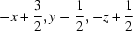
| Symmetry codes: (i) −x+1, −y, −z; (ii) x−1/2, −y+1/2, z−1/2; (iii) −x+3/2, y−1/2, −z+1/2; (iv) −x+3/2, y+1/2, −z+1/2. |
| D—H···A | D—H | H···A | D···A | D—H···A |
| O1W—H1WA···N2 | 0.85 | 2.20 | 2.814 (4) | 130 |
| O1W—H1WB···O4iii | 0.85 | 2.22 | 2.993 (5) | 151 |
| O1W—H1WB···O3iii | 0.85 | 2.26 | 3.003 (5) | 147 |
| Symmetry code: (iii) −x+3/2, y−1/2, −z+1/2. |
Experimental details
| Crystal data | |
| Chemical formula | [Zn(C9H9N5)2(H2O)2](ClO4)2 |
| Mr | 674.75 |
| Crystal system, space group | Monoclinic, P21/n |
| Temperature (K) | 293 |
| a, b, c (Å) | 7.4929 (9), 10.0963 (12), 17.149 (2) |
| β (°) | 94.887 (2) |
| V (Å3) | 1292.6 (3) |
| Z | 2 |
| Radiation type | Mo Kα |
| µ (mm−1) | 1.23 |
| Crystal size (mm) | 0.38 × 0.30 × 0.30 |
| Data collection | |
| Diffractometer | Bruker SMART CCD diffractometer |
| Absorption correction | Multi-scan (SADABS; Bruker, 2000) |
| Tmin, Tmax | 0.647, 0.697 |
| No. of measured, independent and observed [I > 2σ(I)] reflections | 6344, 2266, 1856 |
| Rint | 0.053 |
| (sin θ/λ)max (Å−1) | 0.595 |
| Refinement | |
| R[F2 > 2σ(F2)], wR(F2), S | 0.044, 0.130, 1.05 |
| No. of reflections | 2266 |
| No. of parameters | 187 |
| H-atom treatment | H-atom parameters constrained |
| Δρmax, Δρmin (e Å−3) | 0.34, −0.35 |
Computer programs: SMART (Bruker, 2000), SAINT (Bruker, 2000), SHELXTL (Sheldrick, 2008), DIAMOND (Brandenburg & Putz, 1999) and OLEX (Dolomanov et al., 2003).
| D—H···A | D—H | H···A | D···A | D—H···A |
| O1W—H1WA···N2 | 0.85 | 2.20 | 2.814 (4) | 130 |
| O1W—H1WB···O4i | 0.85 | 2.22 | 2.993 (5) | 151 |
| O1W—H1WB···O3i | 0.85 | 2.26 | 3.003 (5) | 147 |
| Symmetry code: (i) −x+3/2, y−1/2, −z+1/2. |
Acknowledgements
The authors acknowledge financial support from the Innovation Program for College Students of Central South University (grant No. 081053308).
References
 Batten, S. R. & Robson, R. (1998). Angew. Chem. Int. Ed. 37, 1460–1494. Web of Science CrossRef Google Scholar
Beckmann, U. & Brooker, S. (2003). Coord. Chem. Rev. 245, 17–29. Web of Science CrossRef CAS Google Scholar
Brandenburg, K. & Putz, H. (1999). DIAMOND. Crystal Impact GbR, Bonn, Germany. Google Scholar
Bruker (2000). SMART, SAINT and SADABS. Bruker AXS Inc., Madison, Wisconsin, USA. Google Scholar
Ding, B., Huang, Y. Q., Liu, Y. Y., Shi, W. & Cheng, P. (2007). Inorg. Chem. Commun. 10, 7–10. Web of Science CSD CrossRef CAS Google Scholar
Dolomanov, O. V., Blake, A. J., Champness, N. R. & Schröder, M. (2003). J. Appl. Cryst. 36, 1283–1284. Web of Science CrossRef CAS IUCr Journals Google Scholar
Drabent, K., Białońska, A. & Ciunik, Z. (2004). Inorg. Chem. Commun. 7, 224–227. Web of Science CSD CrossRef CAS Google Scholar
Drabent, K., Ciunick, Z. & Ozarowshi, A. (2008). Inorg. Chem. 47, 3358–3365. Web of Science CSD CrossRef PubMed CAS Google Scholar
Drabent, K., Ciunik, Z. & Chmielewski, P. J. (2003). Eur. J. Inorg. Chem. pp. 1548–1554. CSD CrossRef Google Scholar
Haasnoot, J. G. (2000). Coord. Chem. Rev. 200, 131–185. Web of Science CrossRef Google Scholar
Klingele, M. H. & Brooker, S. (2003). Coord. Chem. Rev. 241, 119–132. Web of Science CrossRef CAS Google Scholar
Sheldrick, G. M. (2008). Acta Cryst. A64, 112–122. Web of Science CrossRef CAS IUCr Journals Google Scholar
Sun, Q., Zheng, F., Sun, X. & Wang, W. (2009a). Acta Cryst. E65, m124. Web of Science CSD CrossRef IUCr Journals Google Scholar
Sun, Q., Zheng, F., Sun, X. & Wang, W. (2009b). Acta Cryst. E65, m283–m284. Web of Science CSD CrossRef IUCr Journals Google Scholar
Wang, Y., Ding, B., Cheng, P., Liao, D.-Z. & Yan, S.-P. (2007). Inorg. Chem. 43, 2002–2010. Web of Science CSD CrossRef Google Scholar
Wang, Y., Yi, L., Yang, X., Ding, B., Cheng, P., Liao, D.-Z. & Yan, S.-P. (2006). Inorg. Chem. 45, 5822–5829. Web of Science CSD CrossRef PubMed CAS Google Scholar
Yi, L., Ding, B., Zhao, B., Cheng, P., Liao, D.-Z., Yan, S.-P. & Jiang, Z.-H. (2004). Inorg. Chem. 43, 33–43. Web of Science CSD CrossRef PubMed CAS Google Scholar
Zhai, Q. G., Wu, X. Y., Chen, S. M., Lu, C. Z. & Yang, W. B. (2006). Cryst. Growth Des. 6, 2126–2135. Web of Science CSD CrossRef CAS Google Scholar
This is an open-access article distributed under the terms of the Creative Commons Attribution (CC-BY) Licence, which permits unrestricted use, distribution, and reproduction in any medium, provided the original authors and source are cited.
| CRYSTALLOGRAPHIC COMMUNICATIONS |


1,2,4-Triazoles and their derivatives can coordinate with metal ions using two bridging adjacent nitrogen atoms via the 1, 2 or 4-positioned N atoms, exhibiting unique magnetic properties. Recently, a variety of such coordination compounds with various structures and different chemical properties have been reported (Beckmann & Brooker, 2003; Ding et al., 2007; Haasnoot, 2000; Klingele & Brooker, 2003; Zhai et al., 2006). Relatively speaking, the crystal structures of only a few compounds based on 4-amido-1,2,4-triazoles Schiff base ligands have been studied e.g. [Ag4(µ2-L)6(CH3CN)2] (AsF6)4.2H2O [where L=4-salicylideneamino- 1,2,4-triazole] (Wang et al., 2006) and a series of one-dimensional linear chain polymers {[Cu(µ-OH)(µ-RPhtrz)] [(H2O)X]}n (where R=Cl, Br; HPhtrz= N-[(E)-phenylmethylidene-4H-1,2,4-triazol-4- amine]; X=BF4-, NO3-) (Drabent et al., 2008). However, the most common structure type is dimeric with M2L4 [where M=Cu(I), Ag(I)] in which two ligands coordinate with metal ion in monodentate fashion and two in bidentate mode (Drabent et al., 2003;2004; Wang et al., 2007).
As part of our on-going work (Sun et al., 2009a,b), we have synthesized N-[1-(3-pyridyl)ethylidene]-4H-1,2,4-triazol- 4-amine. Unlike above Schiff base ligands containing 1,2,4-triazole, it is a rigid angular multifunctional ligand containing one pyridine and one triazole group, which are both strong coordination donors to metal centers. Therefore, it was expected that the pyridyl N atom would coordinate with metal ions creating a structure with a novel topology. Herein we present the crystal structure of the title two-dimensional layer compound with a (4,4) grid (Batten & Robson, 1998).
The asymmetric unit of the title compound is shown in Fig. 1. Each ZnII ion is in a slightly distorted octahedral coordination environment with the equatorial sites occupied by two triazolyl N atoms of symmetry related ligands (L) and two symmetry related water molecules. The axial sites are occupied by two pyridyl N atoms from two symmetry related ligands (L). Unlike the N1, N2 coordination mode reported previously (Drabent et al., 2003,2004,2008; Sun et al., 2009a,b; Wang et al., 2006 and 2007; Yi et al., 2004), each ligand in the title compound bridges two ZnII ions, forming a two-dimensional sheet with a (4, 4) topology (Fig. 2). Fig. 3 shows how ClO4- anions and coordinated water molecules occupy the spaces between neighbouring layers.