 | Acta Crystallographica Section E Acta Crystallographica Section E CRYSTALLOGRAPHIC COMMUNICATIONS |


 journal menu


metal-organic compounds
| CRYSTALLOGRAPHIC COMMUNICATIONS |
 access
Tetraaqua(1,10-phenanthroline-5,6-dione-κ2N,N′)cobalt(II) dinitrate

aJiangxi Key Laboratory of Surface Engineering, Jiangxi Science and Technology Normal University, Jiangxi 330013, People's Republic of China.
*Correspondence e-mail: [email protected]
The of the title compound, [Co(C12H6N2O2)(H2O)4](NO3)2, consists of a CoII complex cation with twofold rotational symmetry and two nitrate anions. The CoII atom has a distorted octahedral geometry with the basal plane occupied by two 1,10-phenanthroline-5,6-dione N atoms and two aqua O atoms, with the other two aqua ligands in axial positions. The aqua ligands are involved in extensive hydrogen bonding to nitrate and 1,10-phenanthroline-5,6-dione O atoms.
Related literature
For related complexes of 1,10-phenanthroline-5,6-dione, see: Calderazzo et al. (1999![[Calderazzo, F., Marchetti, F., Pampaloni, G. & Passarelli, V. (1999). J. Chem. Soc. Dalton Trans. pp. 4389-4396.]](../../../../../../logos/arrows/e_arr.gif "Calderazzo, F., Marchetti, F., Pampaloni, G. & Passarelli, V. (1999). J. Chem. Soc. Dalton Trans. pp. 4389-4396.") ); Fox et al. (1991); Onuegbu et al. (2007); Paw & Eisenberg (1997); Ruiz et al. (1999); Shavaleev et al. (2003). For the structures of the related phenanthroline and phendione derivatives of cobalt(II), see: Liu et al. (2008); Rubin-Preminger et al. (2008). For bond-length data, see: Allen et al. (1987).
); Fox et al. (1991); Onuegbu et al. (2007); Paw & Eisenberg (1997); Ruiz et al. (1999); Shavaleev et al. (2003). For the structures of the related phenanthroline and phendione derivatives of cobalt(II), see: Liu et al. (2008); Rubin-Preminger et al. (2008). For bond-length data, see: Allen et al. (1987).
![[Scheme 1]](at2784scheme1.gif)
Experimental
Crystal data
|
Refinement
|
|
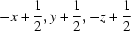 ; (ii)
 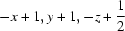 ; (iii)
 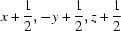 .
. Data collection: SMART (Bruker, 2002); cell refinement: SAINT (Bruker, 2002); data reduction: SAINT; program(s) used to solve structure: SHELXS97 (Sheldrick, 2008); program(s) used to refine structure: SHELXL97 (Sheldrick, 2008); molecular graphics: SHELXTL (Sheldrick, 2008); software used to prepare material for publication: SHELXTL.
Supporting information
contains datablocks I, global. DOI: 10.1107/S1600536809017826/at2784sup1.cif
Structure factors: contains datablock I. DOI: 10.1107/S1600536809017826/at2784Isup2.hkl
A solution of cobalt(II) nitrate hexahydrate (29.1 mg, 0.10 mmol) and phendione (21.0 mg, 0.10 mmol) in methanol (8 ml) was stirred for 2 h. After filtering, the filtrate was left at room temperature for about one week and purple, block-like crystals of the title compound appeared [yield: 18 mg (39%)].
The water H atoms were located in a difference Fourier map and refined with Uiso(H) = 1.5Ueq(O). The O—H distances of water were refined with idealized values of 0.85 Å. The aromatic H-atoms were positioned geometrically and refined using a riding model with d(C-H) = 0.93 Å, Uiso=1.2Ueqeq (C).
Data collection: SMART (Bruker, 2002); cell SAINT (Bruker, 2002); data reduction: SAINT (Bruker, 2002); program(s) used to solve structure: SHELXS97 (Sheldrick, 2008); program(s) used to refine structure: SHELXL97 (Sheldrick, 2008); molecular graphics: SHELXTL (Sheldrick, 2008); software used to prepare material for publication: SHELXTL (Sheldrick, 2008).
![[Figure 1]](./at2784fig1thm.gif) | Fig. 1. The molecular structure of the title compound, with displacement ellipsoids drawn at the 30% probability level. Hand H atoms are drawn as spheres of arbitrary radius. [Symmetry code, A: 1-x, y, 1/2-z]. |
![[Figure 2]](./at2784fig2thm.gif) | Fig. 2. Packing diagram of the title structure, showing the intermolecular O—H···O hydrogen bonds as dashed lines. |
| [Co(C12H6N2O2)(H2O)4](NO3)2 | F(000) = 948 |
| Mr = 465.20 | Dx = 1.796 Mg m−3 |
| Monoclinic, C2/c | Mo Kα radiation, λ = 0.71073 Å |
| Hall symbol: -C 2yc | Cell parameters from 2754 reflections |
| a = 12.7978 (12) Å | θ = 2.5–26.8° |
| b = 10.6388 (10) Å | µ = 1.08 mm−1 |
| c = 13.0989 (12) Å | T = 295 K |
| β = 105.248 (2)° | Block, purple |
| V = 1720.7 (3) Å3 | 0.18 × 0.14 × 0.13 mm |
| Z = 4 |
| Bruker SMART APEX area-detector diffractometer | 1695 independent reflections |
| Radiation source: fine-focus sealed tube | 1549 reflections with I > 2σ(I) |
| Graphite monochromator | Rint = 0.020 |
| ϕ and ω scans | θmax = 26.0°, θmin = 2.5° |
| Absorption correction: multi-scan (SADABS; Sheldrick, 1996) | h = −15→15 |
| Tmin = 0.830, Tmax = 0.873 | k = −5→13 |
| 4509 measured reflections | l = −16→15 |
| Refinement on F2 | Primary atom site location: structure-invariant direct methods |
| Least-squares matrix: full | Secondary atom site location: difference Fourier map |
| R[F2 > 2σ(F2)] = 0.051 | Hydrogen site location: inferred from neighbouring sites |
| wR(F2) = 0.138 | H-atom parameters constrained |
| S = 1.04 | w = 1/[σ2(Fo2) + (0.071P)2 + 5.1444P] where P = (Fo2 + 2Fc2)/3 |
| 1695 reflections | (Δ/σ)max < 0.001 |
| 132 parameters | Δρmax = 0.68 e Å−3 |
| 12 restraints | Δρmin = −0.61 e Å−3 |
| [Co(C12H6N2O2)(H2O)4](NO3)2 | V = 1720.7 (3) Å3 |
| Mr = 465.20 | Z = 4 |
| Monoclinic, C2/c | Mo Kα radiation |
| a = 12.7978 (12) Å | µ = 1.08 mm−1 |
| b = 10.6388 (10) Å | T = 295 K |
| c = 13.0989 (12) Å | 0.18 × 0.14 × 0.13 mm |
| β = 105.248 (2)° |
| Bruker SMART APEX area-detector diffractometer | 1695 independent reflections |
| Absorption correction: multi-scan (SADABS; Sheldrick, 1996) | 1549 reflections with I > 2σ(I) |
| Tmin = 0.830, Tmax = 0.873 | Rint = 0.020 |
| 4509 measured reflections |
| R[F2 > 2σ(F2)] = 0.051 | 12 restraints |
| wR(F2) = 0.138 | H-atom parameters constrained |
| S = 1.04 | Δρmax = 0.68 e Å−3 |
| 1695 reflections | Δρmin = −0.61 e Å−3 |
| 132 parameters |
Geometry. All esds (except the esd in the dihedral angle between two l.s. planes) are estimated using the full covariance matrix. The cell esds are taken into account individually in the estimation of esds in distances, angles and torsion angles; correlations between esds in cell parameters are only used when they are defined by crystal symmetry. An approximate (isotropic) treatment of cell esds is used for estimating esds involving l.s. planes. |
Refinement. Refinement of F2 against ALL reflections. The weighted R-factor wR and goodness of fit S are based on F2, conventional R-factors R are based on F, with F set to zero for negative F2. The threshold expression of F2 > 2sigma(F2) is used only for calculating R-factors(gt) etc. and is not relevant to the choice of reflections for R-factors based on F2 are statistically about twice as large as those based on F, and R- factors based on ALL data will be even larger. |
| x | y | z | Uiso*/Ueq | ||
| Co1 | 0.5000 | 0.25979 (6) | 0.2500 | 0.0379 (3) | |
| O1W | 0.5719 (3) | 0.3981 (3) | 0.3584 (3) | 0.0621 (10) | |
| H1W1 | 0.5858 | 0.4726 | 0.3425 | 0.075* | |
| H1W2 | 0.6036 | 0.3829 | 0.4228 | 0.075* | |
| O1 | 0.4265 (4) | −0.3399 (4) | 0.1544 (5) | 0.1088 (17) | |
| O2W | 0.3649 (3) | 0.2686 (3) | 0.3112 (3) | 0.0554 (9) | |
| H2W1 | 0.3018 | 0.2370 | 0.2998 | 0.066* | |
| H2W2 | 0.3376 | 0.3407 | 0.3149 | 0.066* | |
| O2 | 0.2233 (3) | 0.0263 (4) | 0.2267 (3) | 0.0784 (12) | |
| O3 | 0.1111 (4) | 0.0285 (6) | 0.0756 (4) | 0.107 (2) | |
| O4 | 0.1792 (4) | 0.2017 (5) | 0.1484 (4) | 0.0996 (18) | |
| N1 | 0.4417 (3) | 0.1042 (3) | 0.1501 (3) | 0.0394 (8) | |
| N2 | 0.1708 (3) | 0.0851 (5) | 0.1490 (3) | 0.0649 (13) | |
| C1 | 0.3828 (4) | 0.1087 (6) | 0.0491 (4) | 0.0585 (12) | |
| H1 | 0.3646 | 0.1869 | 0.0176 | 0.070* | |
| C2 | 0.3481 (5) | 0.0028 (7) | −0.0099 (4) | 0.0761 (15) | |
| H2 | 0.3086 | 0.0097 | −0.0802 | 0.091* | |
| C3 | 0.3716 (5) | −0.1113 (6) | 0.0347 (5) | 0.0735 (14) | |
| H3 | 0.3470 | −0.1836 | −0.0040 | 0.088* | |
| C4 | 0.4336 (4) | −0.1200 (4) | 0.1406 (4) | 0.0515 (11) | |
| C5 | 0.4673 (3) | −0.0087 (4) | 0.1946 (3) | 0.0353 (8) | |
| C6 | 0.4594 (3) | −0.2412 (4) | 0.1964 (4) | 0.0679 (14) |
| U11 | U22 | U33 | U12 | U13 | U23 | |
| Co1 | 0.0443 (5) | 0.0219 (4) | 0.0489 (5) | 0.000 | 0.0149 (4) | 0.000 |
| O1W | 0.094 (3) | 0.0341 (16) | 0.065 (2) | −0.0210 (17) | 0.0333 (19) | −0.0165 (15) |
| O1 | 0.133 (4) | 0.047 (2) | 0.169 (4) | −0.030 (2) | 0.080 (3) | −0.043 (2) |
| O2W | 0.0501 (18) | 0.0530 (19) | 0.069 (2) | 0.0035 (14) | 0.0271 (17) | 0.0139 (16) |
| O2 | 0.075 (3) | 0.090 (3) | 0.065 (2) | 0.006 (2) | 0.010 (2) | 0.033 (2) |
| O3 | 0.092 (3) | 0.166 (6) | 0.058 (3) | −0.050 (3) | 0.011 (2) | 0.001 (3) |
| O4 | 0.079 (3) | 0.089 (3) | 0.125 (4) | −0.014 (3) | 0.016 (3) | 0.063 (3) |
| N1 | 0.0454 (18) | 0.0375 (18) | 0.0322 (16) | −0.0019 (15) | 0.0046 (14) | 0.0049 (14) |
| N2 | 0.048 (2) | 0.092 (4) | 0.054 (2) | −0.014 (2) | 0.0108 (19) | 0.027 (2) |
| C1 | 0.052 (2) | 0.079 (3) | 0.039 (2) | −0.004 (2) | 0.0033 (18) | 0.010 (2) |
| C2 | 0.066 (3) | 0.117 (4) | 0.042 (2) | −0.025 (3) | 0.007 (2) | −0.015 (2) |
| C3 | 0.074 (3) | 0.090 (3) | 0.062 (3) | −0.036 (3) | 0.028 (2) | −0.041 (2) |
| C4 | 0.060 (3) | 0.047 (2) | 0.057 (2) | −0.0194 (19) | 0.0323 (19) | −0.0230 (18) |
| C5 | 0.0425 (19) | 0.0318 (18) | 0.0342 (19) | −0.0051 (15) | 0.0143 (16) | −0.0032 (14) |
| C6 | 0.083 (3) | 0.036 (2) | 0.104 (4) | −0.012 (2) | 0.059 (3) | −0.0202 (19) |
| Co1—O1W | 2.084 (3) | O4—N2 | 1.245 (7) |
| Co1—O1Wi | 2.084 (3) | N1—C5 | 1.338 (5) |
| Co1—O2W | 2.091 (3) | N1—C1 | 1.340 (5) |
| Co1—O2Wi | 2.091 (3) | C1—C2 | 1.372 (9) |
| Co1—N1 | 2.121 (3) | C1—H1 | 0.9300 |
| Co1—N1i | 2.121 (3) | C2—C3 | 1.346 (10) |
| O1W—H1W1 | 0.8500 | C2—H2 | 0.9300 |
| O1W—H1W2 | 0.8502 | C3—C4 | 1.408 (8) |
| O1—C6 | 1.208 (6) | C3—H3 | 0.9300 |
| O2W—H2W1 | 0.8501 | C4—C5 | 1.388 (6) |
| O2W—H2W2 | 0.8500 | C4—C6 | 1.476 (7) |
| O2—N2 | 1.232 (6) | C5—C5i | 1.473 (8) |
| O3—N2 | 1.218 (6) | C6—C6i | 1.511 (10) |
| O1W—Co1—O1Wi | 90.1 (2) | C1—N1—Co1 | 126.6 (3) |
| O1W—Co1—O2W | 88.21 (14) | O3—N2—O2 | 119.6 (6) |
| O1Wi—Co1—O2W | 88.18 (14) | O3—N2—O4 | 121.7 (5) |
| O1W—Co1—O2Wi | 88.18 (14) | O2—N2—O4 | 118.7 (5) |
| O1Wi—Co1—O2Wi | 88.21 (14) | N1—C1—C2 | 122.7 (5) |
| O2W—Co1—O2Wi | 174.89 (19) | N1—C1—H1 | 118.7 |
| O1W—Co1—N1 | 173.05 (14) | C2—C1—H1 | 118.7 |
| O1Wi—Co1—N1 | 96.32 (15) | C3—C2—C1 | 119.6 (5) |
| O2W—Co1—N1 | 94.55 (14) | C3—C2—H2 | 120.2 |
| O2Wi—Co1—N1 | 89.44 (13) | C1—C2—H2 | 120.2 |
| O1W—Co1—N1i | 96.32 (15) | C2—C3—C4 | 119.4 (5) |
| O1Wi—Co1—N1i | 173.05 (14) | C2—C3—H3 | 120.3 |
| O2W—Co1—N1i | 89.44 (13) | C4—C3—H3 | 120.3 |
| O2Wi—Co1—N1i | 94.55 (14) | C5—C4—C3 | 117.7 (5) |
| N1—Co1—N1i | 77.36 (18) | C5—C4—C6 | 119.6 (4) |
| Co1—O1W—H1W1 | 125.1 | C3—C4—C6 | 122.7 (4) |
| Co1—O1W—H1W2 | 123.5 | N1—C5—C4 | 122.4 (4) |
| H1W1—O1W—H1W2 | 110.1 | N1—C5—C5i | 116.1 (2) |
| Co1—O2W—H2W1 | 139.2 | C4—C5—C5i | 121.5 (3) |
| Co1—O2W—H2W2 | 117.1 | O1—C6—C4 | 121.8 (5) |
| H2W1—O2W—H2W2 | 89.0 | O1—C6—C6i | 119.7 (4) |
| C5—N1—C1 | 118.2 (4) | C4—C6—C6i | 118.0 (3) |
| C5—N1—Co1 | 115.2 (2) | ||
| O1Wi—Co1—N1—C5 | −176.8 (3) | C2—C3—C4—C6 | 177.7 (5) |
| O2W—Co1—N1—C5 | −88.2 (3) | C1—N1—C5—C4 | −1.0 (6) |
| O2Wi—Co1—N1—C5 | 95.0 (3) | Co1—N1—C5—C4 | 178.8 (3) |
| N1i—Co1—N1—C5 | 0.2 (2) | C1—N1—C5—C5i | 179.6 (4) |
| O1Wi—Co1—N1—C1 | 2.9 (4) | Co1—N1—C5—C5i | −0.6 (5) |
| O2W—Co1—N1—C1 | 91.6 (4) | C3—C4—C5—N1 | 0.8 (6) |
| O2Wi—Co1—N1—C1 | −85.2 (4) | C6—C4—C5—N1 | −176.5 (4) |
| N1i—Co1—N1—C1 | 180.0 (5) | C3—C4—C5—C5i | −179.8 (5) |
| C5—N1—C1—C2 | −0.1 (7) | C6—C4—C5—C5i | 2.9 (7) |
| Co1—N1—C1—C2 | −179.8 (4) | C5—C4—C6—O1 | 175.7 (3) |
| N1—C1—C2—C3 | 1.3 (9) | C3—C4—C6—O1 | −1.4 (6) |
| C1—C2—C3—C4 | −1.5 (9) | C5—C4—C6—C6i | −12.2 (6) |
| C2—C3—C4—C5 | 0.5 (8) | C3—C4—C6—C6i | 170.7 (4) |
| Symmetry code: (i) −x+1, y, −z+1/2. |
| D—H···A | D—H | H···A | D···A | D—H···A |
| O2W—H2W1···O4 | 0.85 | 2.21 | 2.834 (6) | 130 |
| O2W—H2W2···O2ii | 0.85 | 2.14 | 2.957 (6) | 161 |
| O1W—H1W1···O1iii | 0.85 | 2.00 | 2.793 (5) | 154 |
| O1W—H1W2···O3iv | 0.85 | 2.19 | 2.864 (6) | 136 |
| Symmetry codes: (ii) −x+1/2, y+1/2, −z+1/2; (iii) −x+1, y+1, −z+1/2; (iv) x+1/2, −y+1/2, z+1/2. |
Experimental details
| Crystal data | |
| Chemical formula | [Co(C12H6N2O2)(H2O)4](NO3)2 |
| Mr | 465.20 |
| Crystal system, space group | Monoclinic, C2/c |
| Temperature (K) | 295 |
| a, b, c (Å) | 12.7978 (12), 10.6388 (10), 13.0989 (12) |
| β (°) | 105.248 (2) |
| V (Å3) | 1720.7 (3) |
| Z | 4 |
| Radiation type | Mo Kα |
| µ (mm−1) | 1.08 |
| Crystal size (mm) | 0.18 × 0.14 × 0.13 |
| Data collection | |
| Diffractometer | Bruker SMART APEX area-detector diffractometer |
| Absorption correction | Multi-scan (SADABS; Sheldrick, 1996) |
| Tmin, Tmax | 0.830, 0.873 |
| No. of measured, independent and observed [I > 2σ(I)] reflections | 4509, 1695, 1549 |
| Rint | 0.020 |
| (sin θ/λ)max (Å−1) | 0.617 |
| Refinement | |
| R[F2 > 2σ(F2)], wR(F2), S | 0.051, 0.138, 1.04 |
| No. of reflections | 1695 |
| No. of parameters | 132 |
| No. of restraints | 12 |
| H-atom treatment | H-atom parameters constrained |
| Δρmax, Δρmin (e Å−3) | 0.68, −0.61 |
Computer programs: SMART (Bruker, 2002), SAINT (Bruker, 2002), SHELXS97 (Sheldrick, 2008), SHELXL97 (Sheldrick, 2008), SHELXTL (Sheldrick, 2008).
| D—H···A | D—H | H···A | D···A | D—H···A |
| O2W—H2W1···O4 | 0.85 | 2.21 | 2.834 (6) | 129.9 |
| O2W—H2W2···O2i | 0.85 | 2.14 | 2.957 (6) | 161.2 |
| O1W—H1W1···O1ii | 0.85 | 2.00 | 2.793 (5) | 154.2 |
| O1W—H1W2···O3iii | 0.85 | 2.19 | 2.864 (6) | 136.0 |
| Symmetry codes: (i) −x+1/2, y+1/2, −z+1/2; (ii) −x+1, y+1, −z+1/2; (iii) x+1/2, −y+1/2, z+1/2. |
Acknowledgements
We thank Jiangxi Science and Technology Normal University for supporting this study.
References
 Allen, F. H., Kennard, O., Watson, D. G., Brammer, L., Orpen, A. G. & Taylor, R. (1987). J. Chem. Soc. Perkin Trans. 2, pp. S1–19. CrossRef Web of Science Google Scholar
Bruker (2002). SMART and SAINT. Bruker AXS Inc., Madison, Wisconsin, USA. Google Scholar
Calderazzo, F., Marchetti, F., Pampaloni, G. & Passarelli, V. (1999). J. Chem. Soc. Dalton Trans. pp. 4389–4396. Web of Science CSD CrossRef Google Scholar
Fox, G. A., Bhattacharya, S. & Pierpont, C. G. (1991). Inorg. Chem. 30, 2895–2899. CSD CrossRef CAS Web of Science Google Scholar
Liu, G.-X., Xu, H. & Ren, X.-M. (2008). Z. Anorg. Allg. Chem. 634, 927–930. Web of Science CSD CrossRef CAS Google Scholar
Onuegbu, J., Butcher, R. J., Hosten, C., Udeochu, U. C. & Bakare, O. (2007). Acta Cryst. E63, m2309–m2310. Web of Science CSD CrossRef IUCr Journals Google Scholar
Paw, W. & Eisenberg, R. (1997). Inorg. Chem. 36, 2287–2293. CSD CrossRef PubMed CAS Web of Science Google Scholar
Rubin-Preminger, J. M., Kozlov, L. & Goldberg, I. (2008). Acta Cryst. C64, m83–m86. Web of Science CSD CrossRef IUCr Journals Google Scholar
Ruiz, R., Caneschi, A., Gatteschi, D., Gaspar, A. B., Real, J. A., Fernandez, I. & Munoz, M. C. (1999). Inorg. Chem. Commun. 2, 521–523. Web of Science CSD CrossRef CAS Google Scholar
Shavaleev, N. M., Moorcraft, L. P., Pope, S. J. A., Bell, Z. R., Faulkner, S. & Ward, M. D. (2003). Chem. Commun. pp. 1134–1135. Web of Science CSD CrossRef Google Scholar
Sheldrick, G. M. (1996). SADABS. University of Göttingen, Germany. Google Scholar
Sheldrick, G. M. (2008). Acta Cryst. A64, 112–122. Web of Science CrossRef CAS IUCr Journals Google Scholar
This is an open-access article distributed under the terms of the Creative Commons Attribution (CC-BY) Licence, which permits unrestricted use, distribution, and reproduction in any medium, provided the original authors and source are cited.
| CRYSTALLOGRAPHIC COMMUNICATIONS |


Phendione (1,10-phenanthroline-5,6-dione) is an excellent ligand that incorporates two functional groups with different coordination properties. Though phendione usually binds to metals through the imine N atoms (Onuegbu et al., 2007), in some cases both the N and O donors are used simultaneously (Calderazzo et al., 1999; Fox et al., 1991; Paw & Eisenberg, 1997; Ruiz et al., 1999; Shavaleev et al., 2003). In this paper we report the synthesis and characterization of the title compound, [CoL(H2O)4].(NO3)2 (L = 1,10-phenanthroline-5,6-dione).
The molecular structure of the title compound, shown in Fig. 1, is made up of a [CoL(H2O)4]2+ cation and two nitrate anions, which the cations have twofold rotational symmetry. The cobalt atom is coordinated to the two N atoms of a phendione ligand and four aqua ligands to form distorted octahedral geometry. The C=O bond length in the phendione ligand [1.208 (6) Å] is comparable to those observed in other complexes of phendione (Allen et al., 1987). The Co—N bond lengths [2.121 (3) Å] are similar to those values in related phenanthroline and phendione derivatives of cobalt(II) (Liu et al., 2008; Rubin-Preminger et al., 2008).
In addition to the strong O—H···O hydrogen bonds formed by the water ligands to both the nitrate and phendione O atoms, there are π-π stacking interactions between adjacent phendione ligands [perpendicular interplanar distance 3.582 (1) Å and centroid-to-centroid distance 3.823 (1) Å] (Fig. 2).