 | Acta Crystallographica Section E Acta Crystallographica Section E CRYSTALLOGRAPHIC COMMUNICATIONS |


 journal menu


metal-organic compounds
| CRYSTALLOGRAPHIC COMMUNICATIONS |
 access
Bis(di-2-pyridylmethanediol-κ3N,O,N′)nickel(II) dinitrate

aDepartment of Fine Chemistry and Eco-Product and Materials Education Center, Seoul National University of Technology, Seoul 139-743, Republic of Korea, bDepartment of Computer Engineering, Yeosu Campus, Chonnam National University, Yeosu 550-749, Republic of Korea, and cDepartment of Chemistry and Nano Science, Ewha Women's University, Seoul 120-750, Republic of Korea
*Correspondence e-mail: [email protected], [email protected]
The title compound, [Ni(C11H10N2O2)2](NO3)2, consists of an NiII atom coordinated by two tridentate chelating di-2-pyridylmethanediol [(2-py)2C(OH)2] ligands. The NiII atom is located on an inversion center. The geometry around the NiII atom is distorted octahedral. The gem-diol (2-py)2C(OH)2 ligand adopts the coordination mode η1:η1:η1. The Ni—N and Ni—O bond lengths are typical for high-spin NiII in an octahedral environment [Ni—N = 2.094 (2) and 2.124 (3) Å, and Ni—O = 2.108 (3) Å]. One of the hydroxy H atoms is split over two positions which both interact with the nitrate anion. The occurence of different O—H⋯O hydrogen bonds leads to the formation of a layer parallel to the (101) plane.
Related literature
For background information, see: Efthymiou et al. (2006![[Efthymiou, C. G., Raptopoulou, C. P., Terzis, A., Boča, R., Korabic, M., Mrozinski, J., Perlepes, S. P. & Bakalbassis, E. G. (2006). Eur. J. Inorg. Chem. pp. 2236-2252.]](../../../../../../logos/arrows/e_arr.gif "Efthymiou, C. G., Raptopoulou, C. P., Terzis, A., Boča, R., Korabic, M., Mrozinski, J., Perlepes, S. P. & Bakalbassis, E. G. (2006). Eur. J. Inorg. Chem. pp. 2236-2252.") ); Moragues-Cánovas et al. (2004); Papaefstathiou & Perlepes (2002); Papatriantafyllopoulou et al. (2007); Stoumpos et al. (2008, 2009). For related structures, see: Li et al. (2005); Wang et al. (1986).
); Moragues-Cánovas et al. (2004); Papaefstathiou & Perlepes (2002); Papatriantafyllopoulou et al. (2007); Stoumpos et al. (2008, 2009). For related structures, see: Li et al. (2005); Wang et al. (1986).
![[Scheme 1]](dn2454scheme1.gif)
Experimental
Crystal data
|
Data collection
|
Refinement
|
| |||||||||||||||||||||||||||
 .
. Data collection: SMART (Bruker, 1997); cell refinement: SAINT (Bruker, 1997); data reduction: SAINT; program(s) used to solve structure: SHELXS97 (Sheldrick, 2008); program(s) used to refine structure: SHELXL97 (Sheldrick, 2008); molecular graphics: SHELXTL (Sheldrick, 2008); software used to prepare material for publication: SHELXTL.
Supporting information
contains datablocks I, global. DOI: 10.1107/S1600536809018728/dn2454sup1.cif
Structure factors: contains datablock I. DOI: 10.1107/S1600536809018728/dn2454Isup2.hkl
36.7 mg (0.125 mmol) of Ni(NO3)2.6H2O and 35.5 mg (0.25 mmol) of C6H5COONH4 were dissolved in 4 ml water and carefully layered by 4 ml solution of amixture of acetone, methanol and ethanol (2/2/2) of di-2-pyridyl ketone ligand (46.1 mg, 0.25 mmol). Suitable crystals of the title compound for X-ray analysis were obtained in a few weeks.
All H atoms attached to C atoms were fixed geometrically and treated as riding with C—H = 0.93 Å with Uiso(H) = 1.2Ueq(C). Hydroxyl H atom for O2 were treated as riding on the parent atom with O—H = 0.82 Å and Uiso(H) = 1.5Ueq(O). The hydroxyl H attached to O1 appears to be splitted on two positions. The coordinates of these two positions were initially refined with O—H restraints (0.85 Å) and Uiso(H) = 1.5Ueq(O). Then in the last stage of these disordered H atoms were treated as riding on the O atom.
Data collection: SMART (Bruker, 1997); cell SAINT (Bruker, 1997); data reduction: SAINT (Bruker, 1997); program(s) used to solve structure: SHELXS97 (Sheldrick, 2008); program(s) used to refine structure: SHELXL97 (Sheldrick, 2008); molecular graphics: SHELXTL (Sheldrick, 2008); software used to prepare material for publication: SHELXTL (Sheldrick, 2008).
![[Figure 1]](./dn2454fig1thm.gif) | Fig. 1. View of the title complex with the atom labeling scheme. Displacement ellipsoids are drawn at the 30% probability level. H atoms are represented as small spheres of arbitrary radii and hydrogen bonds are shown as dashed lines. [Symmetry code: (i) 1 - x, 1 - y, 1 - z]. |
![[Figure 2]](./dn2454fig2thm.gif) | Fig. 2. Packing view down the b axis. Hydrogen bonds are shown as dashed lines. H atoms not involved in hydrogen bondings have been omitted for clarity. |
| [Ni(C11H10N2O2)2](NO3)2 | F(000) = 604 |
| Mr = 587.15 | Dx = 1.570 Mg m−3 |
| Monoclinic, P21/n | Mo Kα radiation, λ = 0.71073 Å |
| Hall symbol: -P 2yn | Cell parameters from 2352 reflections |
| a = 8.4077 (9) Å | θ = 2.5–25.6° |
| b = 15.5098 (16) Å | µ = 0.85 mm−1 |
| c = 9.5556 (10) Å | T = 293 K |
| β = 94.644 (2)° | Plate, pale brown |
| V = 1242.0 (2) Å3 | 0.20 × 0.10 × 0.03 mm |
| Z = 2 |
| Bruker SMART CCD diffractometer | 1826 reflections with I > 2σ(I) |
| Radiation source: fine-focus sealed tube | Rint = 0.057 |
| Graphite monochromator | θmax = 26.0°, θmin = 2.5° |
| ϕ and ω scans | h = −11→11 |
| 7646 measured reflections | k = −20→12 |
| 2442 independent reflections | l = −12→12 |
| Refinement on F2 | Primary atom site location: structure-invariant direct methods |
| Least-squares matrix: full | Secondary atom site location: difference Fourier map |
| R[F2 > 2σ(F2)] = 0.046 | Hydrogen site location: inferred from neighbouring sites |
| wR(F2) = 0.135 | H-atom parameters constrained |
| S = 1.06 | w = 1/[σ2(Fo2) + (0.0755P)2 + 0.0426P] where P = (Fo2 + 2Fc2)/3 |
| 2442 reflections | (Δ/σ)max < 0.001 |
| 179 parameters | Δρmax = 0.49 e Å−3 |
| 0 restraints | Δρmin = −0.59 e Å−3 |
| [Ni(C11H10N2O2)2](NO3)2 | V = 1242.0 (2) Å3 |
| Mr = 587.15 | Z = 2 |
| Monoclinic, P21/n | Mo Kα radiation |
| a = 8.4077 (9) Å | µ = 0.85 mm−1 |
| b = 15.5098 (16) Å | T = 293 K |
| c = 9.5556 (10) Å | 0.20 × 0.10 × 0.03 mm |
| β = 94.644 (2)° |
| Bruker SMART CCD diffractometer | 1826 reflections with I > 2σ(I) |
| 7646 measured reflections | Rint = 0.057 |
| 2442 independent reflections |
| R[F2 > 2σ(F2)] = 0.046 | 0 restraints |
| wR(F2) = 0.135 | H-atom parameters constrained |
| S = 1.06 | Δρmax = 0.49 e Å−3 |
| 2442 reflections | Δρmin = −0.59 e Å−3 |
| 179 parameters |
Geometry. All esds (except the esd in the dihedral angle between two l.s. planes) are estimated using the full covariance matrix. The cell esds are taken into account individually in the estimation of esds in distances, angles and torsion angles; correlations between esds in cell parameters are only used when they are defined by crystal symmetry. An approximate (isotropic) treatment of cell esds is used for estimating esds involving l.s. planes. |
Refinement. Refinement of F2 against ALL reflections. The weighted R-factor wR and goodness of fit S are based on F2, conventional R-factors R are based on F, with F set to zero for negative F2. The threshold expression of F2 > σ(F2) is used only for calculating R-factors(gt) etc. and is not relevant to the choice of reflections for refinement. R-factors based on F2 are statistically about twice as large as those based on F, and R- factors based on ALL data will be even larger. |
| x | y | z | Uiso*/Ueq | Occ. (<1) | |
| Ni1 | 0.5000 | 0.5000 | 0.5000 | 0.0334 (2) | |
| N1 | 0.3937 (3) | 0.52480 (18) | 0.2948 (3) | 0.0389 (6) | |
| N2 | 0.2830 (3) | 0.54084 (17) | 0.5703 (3) | 0.0347 (6) | |
| O1 | 0.5183 (3) | 0.63487 (17) | 0.4873 (2) | 0.0574 (7) | |
| H1A | 0.5905 | 0.6553 | 0.4370 | 0.086* | 0.50 |
| H1B | 0.5305 | 0.6590 | 0.5688 | 0.086* | 0.50 |
| O2 | 0.3337 (3) | 0.74355 (14) | 0.3938 (3) | 0.0539 (6) | |
| H2 | 0.3866 | 0.7720 | 0.4530 | 0.081* | |
| C1 | 0.3774 (4) | 0.4731 (2) | 0.1816 (4) | 0.0478 (9) | |
| H1 | 0.4155 | 0.4169 | 0.1884 | 0.057* | |
| C2 | 0.3053 (5) | 0.5019 (3) | 0.0558 (4) | 0.0639 (11) | |
| H2A | 0.2927 | 0.4653 | −0.0214 | 0.077* | |
| C3 | 0.2515 (5) | 0.5865 (3) | 0.0458 (4) | 0.0685 (12) | |
| H3 | 0.2048 | 0.6076 | −0.0389 | 0.082* | |
| C4 | 0.2677 (4) | 0.6386 (3) | 0.1615 (4) | 0.0562 (10) | |
| H4 | 0.2310 | 0.6951 | 0.1573 | 0.067* | |
| C5 | 0.3394 (4) | 0.6055 (2) | 0.2841 (3) | 0.0394 (7) | |
| C6 | 0.3583 (4) | 0.6549 (2) | 0.4213 (3) | 0.0386 (7) | |
| C7 | 0.2392 (3) | 0.61766 (19) | 0.5177 (3) | 0.0353 (7) | |
| C8 | 0.0989 (4) | 0.6581 (2) | 0.5451 (4) | 0.0459 (8) | |
| H8 | 0.0700 | 0.7112 | 0.5054 | 0.055* | |
| C9 | 0.0030 (4) | 0.6160 (3) | 0.6345 (4) | 0.0594 (10) | |
| H9 | −0.0919 | 0.6414 | 0.6569 | 0.071* | |
| C10 | 0.0462 (4) | 0.5378 (3) | 0.6898 (4) | 0.0521 (9) | |
| H10 | −0.0182 | 0.5097 | 0.7500 | 0.063* | |
| C11 | 0.1873 (4) | 0.5008 (2) | 0.6552 (3) | 0.0434 (8) | |
| H11 | 0.2164 | 0.4470 | 0.6916 | 0.052* | |
| N3 | 0.3476 (4) | 0.7718 (2) | 0.7595 (4) | 0.0585 (8) | |
| O3 | 0.4512 (4) | 0.71600 (19) | 0.7535 (3) | 0.0755 (9) | |
| O4 | 0.3188 (5) | 0.8218 (2) | 0.6577 (3) | 0.1014 (12) | |
| O5 | 0.2759 (4) | 0.7785 (2) | 0.8634 (4) | 0.0834 (9) |
| U11 | U22 | U33 | U12 | U13 | U23 | |
| Ni1 | 0.0362 (3) | 0.0326 (3) | 0.0319 (3) | 0.0023 (2) | 0.0050 (2) | −0.0004 (2) |
| N1 | 0.0396 (15) | 0.0451 (16) | 0.0326 (15) | 0.0016 (11) | 0.0079 (11) | −0.0016 (11) |
| N2 | 0.0340 (13) | 0.0360 (15) | 0.0343 (14) | 0.0020 (11) | 0.0047 (11) | −0.0012 (11) |
| O1 | 0.0609 (16) | 0.0526 (16) | 0.0587 (16) | −0.0010 (12) | 0.0049 (13) | −0.0001 (12) |
| O2 | 0.0675 (17) | 0.0363 (13) | 0.0578 (16) | 0.0069 (12) | 0.0054 (12) | 0.0050 (11) |
| C1 | 0.054 (2) | 0.050 (2) | 0.040 (2) | 0.0031 (16) | 0.0081 (16) | −0.0051 (16) |
| C2 | 0.084 (3) | 0.072 (3) | 0.036 (2) | −0.001 (2) | 0.0032 (19) | −0.0137 (19) |
| C3 | 0.087 (3) | 0.079 (3) | 0.038 (2) | 0.011 (2) | −0.004 (2) | 0.006 (2) |
| C4 | 0.072 (3) | 0.054 (2) | 0.043 (2) | 0.0102 (19) | 0.0005 (18) | 0.0078 (17) |
| C5 | 0.0418 (18) | 0.0411 (19) | 0.0363 (17) | 0.0017 (14) | 0.0095 (14) | 0.0007 (14) |
| C6 | 0.0390 (18) | 0.0349 (18) | 0.0422 (18) | 0.0031 (14) | 0.0059 (14) | 0.0046 (14) |
| C7 | 0.0365 (16) | 0.0357 (17) | 0.0336 (16) | 0.0002 (13) | 0.0026 (13) | −0.0053 (13) |
| C8 | 0.0391 (18) | 0.048 (2) | 0.050 (2) | 0.0069 (15) | −0.0001 (15) | −0.0015 (15) |
| C9 | 0.040 (2) | 0.075 (3) | 0.065 (2) | 0.0062 (19) | 0.0128 (18) | −0.010 (2) |
| C10 | 0.047 (2) | 0.064 (2) | 0.047 (2) | −0.0077 (18) | 0.0155 (16) | −0.0005 (18) |
| C11 | 0.0485 (18) | 0.0451 (19) | 0.0370 (17) | −0.0049 (16) | 0.0053 (14) | 0.0002 (15) |
| N3 | 0.067 (2) | 0.047 (2) | 0.061 (2) | −0.0010 (16) | 0.0000 (17) | −0.0192 (17) |
| O3 | 0.077 (2) | 0.077 (2) | 0.0714 (19) | 0.0337 (16) | 0.0032 (15) | −0.0251 (15) |
| O4 | 0.173 (4) | 0.056 (2) | 0.071 (2) | 0.016 (2) | −0.014 (2) | −0.0052 (16) |
| O5 | 0.071 (2) | 0.092 (2) | 0.092 (2) | 0.0066 (16) | 0.0358 (18) | −0.0195 (18) |
| Ni1—N2 | 2.093 (2) | C2—H2A | 0.9300 |
| Ni1—N2i | 2.093 (2) | C3—C4 | 1.367 (5) |
| Ni1—O1 | 2.102 (3) | C3—H3 | 0.9300 |
| Ni1—O1i | 2.102 (3) | C4—C5 | 1.372 (4) |
| Ni1—N1 | 2.123 (3) | C4—H4 | 0.9300 |
| Ni1—N1i | 2.123 (3) | C5—C6 | 1.515 (4) |
| N1—C5 | 1.334 (4) | C6—C7 | 1.528 (4) |
| N1—C1 | 1.345 (4) | C7—C8 | 1.380 (4) |
| N2—C7 | 1.333 (4) | C8—C9 | 1.385 (5) |
| N2—C11 | 1.340 (4) | C8—H8 | 0.9300 |
| O1—C6 | 1.472 (4) | C9—C10 | 1.360 (5) |
| O1—H1A | 0.8650 | C9—H9 | 0.9300 |
| O1—H1B | 0.8625 | C10—C11 | 1.382 (5) |
| O2—C6 | 1.412 (4) | C10—H10 | 0.9300 |
| O2—H2 | 0.8200 | C11—H11 | 0.9300 |
| C1—C2 | 1.377 (5) | N3—O5 | 1.206 (4) |
| C1—H1 | 0.9300 | N3—O3 | 1.233 (4) |
| C2—C3 | 1.388 (5) | N3—O4 | 1.253 (4) |
| N2—Ni1—N2i | 180.0 | C4—C3—C2 | 119.5 (4) |
| N2—Ni1—O1 | 77.70 (10) | C4—C3—H3 | 120.3 |
| N2i—Ni1—O1 | 102.30 (10) | C2—C3—H3 | 120.3 |
| N2—Ni1—O1i | 102.30 (10) | C3—C4—C5 | 118.5 (4) |
| N2i—Ni1—O1i | 77.70 (10) | C3—C4—H4 | 120.7 |
| O1—Ni1—O1i | 180.0 | C5—C4—H4 | 120.7 |
| N2—Ni1—N1 | 85.93 (9) | N1—C5—C4 | 122.7 (3) |
| N2i—Ni1—N1 | 94.07 (9) | N1—C5—C6 | 113.4 (3) |
| O1—Ni1—N1 | 78.10 (10) | C4—C5—C6 | 123.9 (3) |
| O1i—Ni1—N1 | 101.90 (10) | O2—C6—O1 | 113.6 (2) |
| N2—Ni1—N1i | 94.07 (9) | O2—C6—C5 | 109.1 (3) |
| N2i—Ni1—N1i | 85.93 (9) | O1—C6—C5 | 107.0 (2) |
| O1—Ni1—N1i | 101.90 (10) | O2—C6—C7 | 112.8 (2) |
| O1i—Ni1—N1i | 78.10 (10) | O1—C6—C7 | 106.4 (2) |
| N1—Ni1—N1i | 180.000 (1) | C5—C6—C7 | 107.6 (2) |
| C5—N1—C1 | 119.1 (3) | N2—C7—C8 | 123.3 (3) |
| C5—N1—Ni1 | 110.9 (2) | N2—C7—C6 | 113.0 (2) |
| C1—N1—Ni1 | 130.0 (2) | C8—C7—C6 | 123.7 (3) |
| C7—N2—C11 | 118.7 (3) | C7—C8—C9 | 116.8 (3) |
| C7—N2—Ni1 | 111.76 (19) | C7—C8—H8 | 121.6 |
| C11—N2—Ni1 | 129.5 (2) | C9—C8—H8 | 121.6 |
| C6—O1—Ni1 | 99.56 (17) | C10—C9—C8 | 120.7 (3) |
| C6—O1—H1A | 110.0 | C10—C9—H9 | 119.7 |
| Ni1—O1—H1A | 117.0 | C8—C9—H9 | 119.7 |
| C6—O1—H1B | 109.5 | C9—C10—C11 | 119.0 (3) |
| Ni1—O1—H1B | 112.6 | C9—C10—H10 | 120.5 |
| H1A—O1—H1B | 107.8 | C11—C10—H10 | 120.5 |
| C6—O2—H2 | 109.5 | N2—C11—C10 | 121.5 (3) |
| N1—C1—C2 | 121.2 (4) | N2—C11—H11 | 119.3 |
| N1—C1—H1 | 119.4 | C10—C11—H11 | 119.3 |
| C2—C1—H1 | 119.4 | O5—N3—O3 | 120.1 (4) |
| C1—C2—C3 | 119.0 (4) | O5—N3—O4 | 120.5 (4) |
| C1—C2—H2A | 120.5 | O3—N3—O4 | 119.4 (4) |
| C3—C2—H2A | 120.5 |
| Symmetry code: (i) −x+1, −y+1, −z+1. |
| D—H···A | D—H | H···A | D···A | D—H···A |
| O2—H2···O4 | 0.82 | 2.22 | 2.810 (4) | 129 |
| O1—H1B···O3 | 0.86 | 2.13 | 2.933 (4) | 155 |
| O1—H1A···O5ii | 0.87 | 2.04 | 2.884 (4) | 165 |
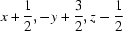
| Symmetry code: (ii) x+1/2, −y+3/2, z−1/2. |
Experimental details
| Crystal data | |
| Chemical formula | [Ni(C11H10N2O2)2](NO3)2 |
| Mr | 587.15 |
| Crystal system, space group | Monoclinic, P21/n |
| Temperature (K) | 293 |
| a, b, c (Å) | 8.4077 (9), 15.5098 (16), 9.5556 (10) |
| β (°) | 94.644 (2) |
| V (Å3) | 1242.0 (2) |
| Z | 2 |
| Radiation type | Mo Kα |
| µ (mm−1) | 0.85 |
| Crystal size (mm) | 0.20 × 0.10 × 0.03 |
| Data collection | |
| Diffractometer | Bruker SMART CCD diffractometer |
| Absorption correction | – |
| No. of measured, independent and observed [I > 2σ(I)] reflections | 7646, 2442, 1826 |
| Rint | 0.057 |
| (sin θ/λ)max (Å−1) | 0.617 |
| Refinement | |
| R[F2 > 2σ(F2)], wR(F2), S | 0.046, 0.135, 1.06 |
| No. of reflections | 2442 |
| No. of parameters | 179 |
| H-atom treatment | H-atom parameters constrained |
| Δρmax, Δρmin (e Å−3) | 0.49, −0.59 |
Computer programs: SMART (Bruker, 1997), SAINT (Bruker, 1997), SHELXS97 (Sheldrick, 2008), SHELXL97 (Sheldrick, 2008), SHELXTL (Sheldrick, 2008).
| D—H···A | D—H | H···A | D···A | D—H···A |
| O2—H2···O4 | 0.82 | 2.22 | 2.810 (4) | 129.1 |
| O1—H1B···O3 | 0.86 | 2.13 | 2.933 (4) | 155.0 |
| O1—H1A···O5i | 0.87 | 2.04 | 2.884 (4) | 165.3 |
| Symmetry code: (i) x+1/2, −y+3/2, z−1/2. |
Acknowledgements
Financial support from the Korean Environment Ministry `ET–Human Resource Development Project' and the Korean Science and Engineering Foundation (grant No. R01-2008-000-20704-0) is gratefully acknowledged.
References
 Bruker (1997). SMART and SAINT. Bruker AXS Inc., Madison, Wisconsin, USA. Google Scholar
Efthymiou, C. G., Raptopoulou, C. P., Terzis, A., Boča, R., Korabic, M., Mrozinski, J., Perlepes, S. P. & Bakalbassis, E. G. (2006). Eur. J. Inorg. Chem. pp. 2236–2252. Web of Science CSD CrossRef Google Scholar
Li, C.-J., Li, W., Tong, M.-L. & Ng, S. W. (2005). Acta Cryst. E61, m229–m231. Web of Science CSD CrossRef IUCr Journals Google Scholar
Moragues-Cánovas, M., Helliwell, M., Ricard, L., Rivière, E., Wernsdorfer, W., Brechin, E. & Mallah, T. (2004). Eur. J. Inorg. Chem. pp. 2219–2222. Google Scholar
Papaefstathiou, G. S. & Perlepes, S. P. (2002). Comments Inorg. Chem. 23, 249–274. Web of Science CrossRef CAS Google Scholar
Papatriantafyllopoulou, C., Efthymiou, C. G., Raptopoulou, C. P., Vicente, R., Manessi-Zoupa, E., Psycharis, V., Escuer, A. & Perlepes, S. P. (2007). J. Mol. Struct. 829, 176–188. Web of Science CSD CrossRef CAS Google Scholar
Sheldrick, G. M. (2008). Acta Cryst. A64, 112–122. Web of Science CrossRef CAS IUCr Journals Google Scholar
Stoumpos, C. C., Gass, I. A., Milios, C. J., Kefalloniti, E., Raptopoulou, C. P., Terzis, A., Lalioti, N., Brechin, E. K. & Perlepes, S. P. (2008). Inorg. Chem. Commun. 11, 196–202. Web of Science CSD CrossRef CAS Google Scholar
Stoumpos, C. C., Lalioti, N., Gass, I. A., Gkotsis, K., Kitos, A. A., Sartzi, H., Milios, C. J., Raptopoulou, C. P., Terzis, A., Brechin, E. K. & Perlepes, S. P. (2009). Polyhedron. doi:10.1016/j.poly.2008.12.001. Google Scholar
Wang, S.-L., Richardson, J. W. Jr, Briggs, S. J., Jacobson, R. A. & Jensen, W. P. (1986). Inorg. Chim. Acta, 111, 67–72. CAS Google Scholar
This is an open-access article distributed under the terms of the Creative Commons Attribution (CC-BY) Licence, which permits unrestricted use, distribution, and reproduction in any medium, provided the original authors and source are cited.
| CRYSTALLOGRAPHIC COMMUNICATIONS |


Di-2-pyridyl ketone ((py)2CO) has been employed to form structurally interesting new complexes with 3 d-metal ions (Stoumpos et al., 2009). Water and alcohols (ROH) have been shown to add to the carbonyl group forming the ligands (2-py)2C(OH)2 [the gem-diol form of (2-py)2CO] and (2-py)2C(OR)(OH) [the hemiacetal form of (2- py)2CO], respectively (Efthymiou et al., 2006). The neutral ligands (py)2C(OH)2 and (py)2C(OR)(OH) coordinate to the metal centres as N,N',O chelates (Papaefstathiou & Perlepes, 2002). The different interesting coordination modes have been seen when the ligands (py)2C(OH)2 and (py)2C(OR)(OH) are deprotonated to form mono- or dianion. The deprotonation of hydroxyl groups leads to a coordinative flexibility (Papatriantafyllopoulou et al., 2007; Stoumpos et al., 2008). Some NiII complexes of the neutral ligand, (py)2C(OH)2 have been structuraly characterized (Wang et al., 1986; Li et al., 2005), but no structure with a nitrate ion as the counter-ion has been reported to date.
The NiII atom is located on an inversion center and is coordinated by two tridentate chelating (2-py)2C(OH)2 ligand to form a distorted octahedral geometry. The gem-diol ligand (2-py)2C(OH)2 adopts the coordination mode η1:η1:η1 (Fig. 1). The Ni—N and Ni—O bond lengths are typical for high-spin Ni(II) in octahedral environments [Ni—N = 2.094 (2) and 2.124 (3) Å, Ni—O = 2.108 (3) Å] (Moragues-Cánovas et al., 2004). The hydrogen attached to O1 is splitting on two positions which are both in interaction with the NO3- anion. The O—H···O hydrogen bonds build up a layer parallel to the (101) plane (Table 1, Fig. 2).