 | Acta Crystallographica Section E Acta Crystallographica Section E CRYSTALLOGRAPHIC COMMUNICATIONS |


 journal menu


organic compounds
| CRYSTALLOGRAPHIC COMMUNICATIONS |
 access
DL-Asparaginium nitrate

aLaboratoire de Chimie Moléculaire, du Contrôle, de l'Environnement et des Mesures Physico-Chimiques, Faculté des Sciences, Département de Chimie, Université Mentouri de Constantine, 25000 Constantine, Algeria, and bCristallographie, Résonance Magnétique et Modélisation (CRM2), Université Henri Poincaré, Nancy 1, Faculté des Sciences, BP 70239, 54506 Vandoeuvre lès Nancy CEDEX, France
*Correspondence e-mail: [email protected]
In the title compound, C4H9N2O3+·NO3−, alternatively called (1RS)-2-carbamoyl-1-carboxyethanaminium nitrate, the asymmetric unit comprises one asparaginium cation and one nitrate anion. The strongest cation–cation O—H⋯O hydrogen bond in the structure, together with other strong cation–cation N—H⋯O hydrogen bonds, generates a succession of infinite chains of R22(8) rings along the b axis. Additional cation–cation C—H⋯O hydrogen bonds link these chains into two-dimensional layers formed by alternating R44(24) and R42(12) rings. Connections between these layers are provided by the strong cation–anion N—H⋯O hydrogen bonds, as well as by one weak C—H⋯O interaction, thus forming a three-dimensional network. Some of the cation–anion N—H⋯O hydrogen bonds are bifurcated of the type D—H⋯(A1,A2).
Related literature
DL-Asparagine has been used in growth media for bacteria, see: Gerhardt & Wilson (1948![[Gerhardt, P. & Wilson, J. B. (1948). J. Bacteriol. 56, 17-24.]](../../../../../../logos/arrows/e_arr.gif "Gerhardt, P. & Wilson, J. B. (1948). J. Bacteriol. 56, 17-24.") ); Palleroni et al. (1973); Wagtendonk et al. (1963). For related structures, see Aarthy et al. (2005); Anitha et al. (2005); Arnold et al. (2000); Flaig et al. (2002); Kartha & de Vries (1961); Ramanadham et al. (1972); Smirnova et al. (1990); Verbist et al. (1972); Wang et al. (1985); Weisinger-Lewin et al. (1989); Yamada et al. (2007). For hydrogen bonding, see: Desiraju & Steiner (1999). For hydrogen-bond morifs, see: Bernstein et al. (1995); Etter et al. (1990).
); Palleroni et al. (1973); Wagtendonk et al. (1963). For related structures, see Aarthy et al. (2005); Anitha et al. (2005); Arnold et al. (2000); Flaig et al. (2002); Kartha & de Vries (1961); Ramanadham et al. (1972); Smirnova et al. (1990); Verbist et al. (1972); Wang et al. (1985); Weisinger-Lewin et al. (1989); Yamada et al. (2007). For hydrogen bonding, see: Desiraju & Steiner (1999). For hydrogen-bond morifs, see: Bernstein et al. (1995); Etter et al. (1990).
![[Scheme 1]](fb2157scheme1.gif)
Experimental
Crystal data
|
Refinement
|
|
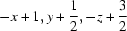 ; (ii)
 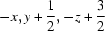 ; (iii)
 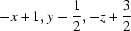 ; (v)
; (v)  .
. Data collection: CrysAlis CCD (Oxford Diffraction, 2008); cell refinement: CrysAlis RED (Oxford Diffraction, 2008); data reduction: CrysAlis RED; program(s) used to solve structure: SIR92 (Altomare et al., 1993); program(s) used to refine structure: SHELXL97 (Sheldrick, 2008); molecular graphics: ORTEPIII (Farrugia, 1997) and Mercury (Macrae et al., 2006); software used to prepare material for publication: PLATON (Spek, 2009).
Supporting information
contains datablocks global, I. DOI: 10.1107/S1600536809031730/fb2157sup1.cif
Structure factors: contains datablock I. DOI: 10.1107/S1600536809031730/fb2157Isup2.hkl
The title compound was prepared by heating of a mixture of DL-asparagine monohydrate of purity 98 % (Alfa Aesar) and nitric acid. This mixture was obtained by dissolution and agitation for 20 minutes of 0.75 g of the DL-asparagine monohydrate in 15 ml of water at 25°C followed by addition of 15 ml of 1 M nitric acid. Colourless needle crystals with approximate dimensions 0.30 x 0.20 x 0.10 mm were obtained by evaporation of the solution at room temperature in the course of a few weeks.
All the H atoms were located in the difference electron density maps. All the H atoms attached to C were treated as riding with C-H = 1.00 Å (methine) or 0.99 Å (methylene) with UisoH = 1.2UeqC. The coordinate parameters of the H atoms attached to N or O were freely refined with UisoH = 1.2UeqN and UisoH = 1.5UeqO.
Data collection: CrysAlis CCD (Oxford Diffraction, 2008); cell CrysAlis RED (Oxford Diffraction, 2008); data reduction: CrysAlis RED (Oxford Diffraction, 2008); program(s) used to solve structure: SIR92 (Altomare et al., 1993); program(s) used to refine structure: SHELXL97 (Sheldrick, 2008); molecular graphics: ORTEPIII (Farrugia, 1997) and Mercury (Macrae et al., 2006); software used to prepare material for publication: PLATON (Spek, 2009).
![[Figure 1]](./fb2157fig1thm.gif) | Fig. 1. The title molecule with the atom-numbering scheme. The displacement ellipsoids are drawn at the 50% probability level |
![[Figure 2]](./fb2157fig2thm.gif) | Fig. 2. The cation-cation hydrogen bonds. Symmetry codes: (i) -x+1, y+1/2, -z+3/2; (iv) -x+1, y-1/2, -z+3/2; (v) x, -y+3/2, z-1/2 |
![[Figure 3]](./fb2157fig3thm.gif) | Fig. 3. The cation-anion hydrogen bonds. Symmetry codes: (ii) -x, y+1/2, -z+3/2; (iii) -x, -y+1, -z+1; (v) x, -y+3/2, z-1/2 |
![[Figure 4]](./fb2157fig4thm.gif) | Fig. 4. Hydrogen bonding cation-cation infinit chains within the DL-asparaginium layer. The axis a is directed downwards from the projection plane. |
![[Figure 5]](./fb2157fig5thm.gif) | Fig. 5. Connection between the cationic layers via cation-anion H-bonds |
| C4H9N2O3+·NO3− | F(000) = 408 |
| Mr = 195.14 | Dx = 1.679 Mg m−3 |
| Monoclinic, P21/c | Mo Kα radiation, λ = 0.71073 Å |
| Hall symbol: -P 2ybc | Cell parameters from 19446 reflections |
| a = 7.923 (2) Å | θ = 2.9–30.0° |
| b = 9.608 (2) Å | µ = 0.16 mm−1 |
| c = 10.613 (3) Å | T = 100 K |
| β = 107.105 (2)° | Prism, colorless |
| V = 772.2 (3) Å3 | 0.3 × 0.2 × 0.09 mm |
| Z = 4 |
| Oxford Diffraction Xcalibur–Sapphire2 CCD diffractometer | 2236 independent reflections |
| Radiation source: fine-focus sealed tube | 1804 reflections with I > 2σ(I) |
| Graphite monochromator | Rint = 0.036 |
| ϕ and ω scans | θmax = 30.0°, θmin = 2.9° |
| Absorption correction: gaussian (CrysAlis RED; Oxford Diffraction, 2008) | h = −11→11 |
| Tmin = 0.966, Tmax = 0.991 | k = −13→13 |
| 19446 measured reflections | l = −11→14 |
| Refinement on F2 | Primary atom site location: structure-invariant direct methods |
| Least-squares matrix: full | Secondary atom site location: difference Fourier map |
| R[F2 > 2σ(F2)] = 0.035 | Hydrogen site location: difference Fourier map |
| wR(F2) = 0.087 | H atoms treated by a mixture of independent and constrained refinement |
| S = 1.07 | w = 1/[σ2(Fo2) + (0.0466P)2 + 0.1163P] where P = (Fo2 + 2Fc2)/3 |
| 2236 reflections | (Δ/σ)max < 0.001 |
| 136 parameters | Δρmax = 0.45 e Å−3 |
| 0 restraints | Δρmin = −0.19 e Å−3 |
| C4H9N2O3+·NO3− | V = 772.2 (3) Å3 |
| Mr = 195.14 | Z = 4 |
| Monoclinic, P21/c | Mo Kα radiation |
| a = 7.923 (2) Å | µ = 0.16 mm−1 |
| b = 9.608 (2) Å | T = 100 K |
| c = 10.613 (3) Å | 0.3 × 0.2 × 0.09 mm |
| β = 107.105 (2)° |
| Oxford Diffraction Xcalibur–Sapphire2 CCD diffractometer | 2236 independent reflections |
| Absorption correction: gaussian (CrysAlis RED; Oxford Diffraction, 2008) | 1804 reflections with I > 2σ(I) |
| Tmin = 0.966, Tmax = 0.991 | Rint = 0.036 |
| 19446 measured reflections |
| R[F2 > 2σ(F2)] = 0.035 | 0 restraints |
| wR(F2) = 0.087 | H atoms treated by a mixture of independent and constrained refinement |
| S = 1.07 | Δρmax = 0.45 e Å−3 |
| 2236 reflections | Δρmin = −0.19 e Å−3 |
| 136 parameters |
Geometry. Bond distances, angles etc. have been calculated using the rounded fractional coordinates. All su's are estimated from the variances of the (full) variance-covariance matrix. The cell esds are taken into account in the estimation of distances, angles and torsion angles |
Refinement. Refinement of F^2^ against ALL reflections. The weighted R-factor wR and goodness of fit S are based on F^2^, conventional R-factors R are based on F, with F set to zero for negative F^2^. The threshold expression of F^2^ > σ(F^2^) is used only for calculating R-factors(gt) etc. and is not relevant to the choice of reflections for refinement. R-factors based on F^2^ are statistically about twice as large as those based on F, and R- factors based on ALL data will be even larger. |
| x | y | z | Uiso*/Ueq | ||
| O1 | 0.35366 (11) | 1.04131 (8) | 0.62255 (8) | 0.0171 (2) | |
| H1 | 0.403 (2) | 1.0991 (17) | 0.6820 (16) | 0.0256* | |
| O2 | 0.21545 (11) | 0.96178 (8) | 0.76602 (8) | 0.0150 (2) | |
| O3 | 0.46509 (10) | 0.71971 (8) | 0.71175 (8) | 0.0144 (2) | |
| N2 | 0.07508 (13) | 0.74096 (10) | 0.61109 (10) | 0.0133 (3) | |
| H1N | 0.0164 (19) | 0.7751 (15) | 0.6650 (14) | 0.0158* | |
| H2N | 0.1526 (19) | 0.6789 (15) | 0.6612 (14) | 0.0158* | |
| H3N | 0.0026 (19) | 0.6923 (15) | 0.5440 (14) | 0.0158* | |
| N3 | 0.57418 (14) | 0.66187 (11) | 0.54436 (11) | 0.0172 (3) | |
| H4N | 0.5623 (19) | 0.6635 (16) | 0.4621 (16) | 0.0207* | |
| H5N | 0.659 (2) | 0.6100 (16) | 0.5979 (15) | 0.0207* | |
| C1 | 0.24959 (14) | 0.95636 (10) | 0.66154 (11) | 0.0118 (3) | |
| C2 | 0.16701 (14) | 0.84965 (10) | 0.55565 (10) | 0.0111 (3) | |
| H2 | 0.07526 | 0.89888 | 0.48445 | 0.0134* | |
| C3 | 0.29888 (14) | 0.78621 (11) | 0.49291 (10) | 0.0129 (3) | |
| H3 | 0.34226 | 0.85986 | 0.44499 | 0.0154* | |
| H4 | 0.23798 | 0.71521 | 0.42775 | 0.0154* | |
| C4 | 0.45449 (14) | 0.71962 (10) | 0.59194 (11) | 0.0117 (3) | |
| O4 | 0.10171 (10) | 0.28059 (8) | 0.69646 (8) | 0.0164 (2) | |
| O5 | 0.18243 (12) | 0.48467 (9) | 0.78126 (9) | 0.0228 (3) | |
| O6 | 0.17667 (12) | 0.44085 (9) | 0.57939 (9) | 0.0204 (3) | |
| N1 | 0.15474 (12) | 0.40279 (9) | 0.68709 (9) | 0.0132 (3) |
| U11 | U22 | U33 | U12 | U13 | U23 | |
| O1 | 0.0219 (4) | 0.0149 (4) | 0.0156 (4) | −0.0083 (3) | 0.0074 (3) | −0.0035 (3) |
| O2 | 0.0182 (4) | 0.0129 (3) | 0.0149 (4) | −0.0026 (3) | 0.0064 (3) | −0.0031 (3) |
| O3 | 0.0147 (4) | 0.0153 (4) | 0.0131 (4) | 0.0045 (3) | 0.0040 (3) | 0.0021 (3) |
| N2 | 0.0129 (4) | 0.0116 (4) | 0.0153 (5) | −0.0020 (3) | 0.0042 (4) | −0.0034 (3) |
| N3 | 0.0171 (5) | 0.0193 (5) | 0.0168 (5) | 0.0066 (4) | 0.0074 (4) | 0.0029 (4) |
| C1 | 0.0105 (5) | 0.0090 (4) | 0.0144 (5) | 0.0017 (3) | 0.0012 (4) | 0.0007 (4) |
| C2 | 0.0113 (5) | 0.0096 (4) | 0.0117 (5) | 0.0008 (3) | 0.0021 (4) | −0.0004 (3) |
| C3 | 0.0139 (5) | 0.0125 (4) | 0.0117 (5) | 0.0029 (4) | 0.0030 (4) | 0.0000 (4) |
| C4 | 0.0119 (5) | 0.0083 (4) | 0.0151 (5) | −0.0003 (3) | 0.0043 (4) | 0.0010 (4) |
| O4 | 0.0158 (4) | 0.0115 (4) | 0.0222 (4) | −0.0018 (3) | 0.0061 (3) | −0.0004 (3) |
| O5 | 0.0249 (5) | 0.0228 (4) | 0.0197 (4) | −0.0048 (3) | 0.0049 (4) | −0.0115 (3) |
| O6 | 0.0266 (5) | 0.0189 (4) | 0.0205 (4) | 0.0002 (3) | 0.0142 (4) | 0.0018 (3) |
| N1 | 0.0104 (4) | 0.0127 (4) | 0.0164 (5) | −0.0004 (3) | 0.0037 (3) | −0.0027 (3) |
| O1—C1 | 1.3107 (16) | N2—H3N | 0.903 (14) |
| O2—C1 | 1.2173 (16) | N2—H2N | 0.907 (15) |
| O3—C4 | 1.2494 (16) | N3—H5N | 0.893 (16) |
| O1—H1 | 0.845 (16) | N3—H4N | 0.850 (16) |
| O4—N1 | 1.2608 (14) | C1—C2 | 1.5198 (17) |
| O5—N1 | 1.2397 (15) | C2—C3 | 1.5218 (18) |
| O6—N1 | 1.2599 (15) | C3—C4 | 1.5072 (18) |
| N2—C2 | 1.4898 (17) | C2—H2 | 1.0000 |
| N3—C4 | 1.3205 (18) | C3—H3 | 0.9900 |
| N2—H1N | 0.899 (15) | C3—H4 | 0.9900 |
| C1—O1—H1 | 111.7 (11) | C1—C2—C3 | 113.09 (9) |
| H2N—N2—H3N | 106.6 (13) | N2—C2—C3 | 111.74 (8) |
| C2—N2—H2N | 111.5 (10) | N2—C2—C1 | 109.57 (9) |
| H1N—N2—H3N | 111.3 (14) | C2—C3—C4 | 113.02 (9) |
| C2—N2—H1N | 113.6 (9) | N3—C4—C3 | 116.35 (10) |
| C2—N2—H3N | 108.9 (9) | O3—C4—N3 | 123.27 (11) |
| H1N—N2—H2N | 104.7 (13) | O3—C4—C3 | 120.38 (10) |
| C4—N3—H4N | 120.7 (11) | N2—C2—H2 | 107.00 |
| H4N—N3—H5N | 119.9 (15) | C1—C2—H2 | 107.00 |
| C4—N3—H5N | 118.8 (10) | C3—C2—H2 | 107.00 |
| O4—N1—O6 | 118.68 (9) | C2—C3—H4 | 109.00 |
| O5—N1—O6 | 120.55 (9) | H3—C3—H4 | 108.00 |
| O4—N1—O5 | 120.76 (9) | C4—C3—H3 | 109.00 |
| O1—C1—C2 | 111.14 (9) | C4—C3—H4 | 109.00 |
| O1—C1—O2 | 126.15 (10) | C2—C3—H3 | 109.00 |
| O2—C1—C2 | 122.67 (10) | ||
| O1—C1—C2—N2 | 170.37 (9) | N2—C2—C3—C4 | −67.79 (11) |
| O1—C1—C2—C3 | 45.00 (12) | C1—C2—C3—C4 | 56.40 (11) |
| O2—C1—C2—N2 | −11.93 (15) | C2—C3—C4—O3 | 0.35 (14) |
| O2—C1—C2—C3 | −137.30 (11) | C2—C3—C4—N3 | 179.75 (10) |
| D—H···A | D—H | H···A | D···A | D—H···A |
| O1—H1···O3i | 0.845 (16) | 1.736 (16) | 2.571 (2) | 169.0 (17) |
| N2—H1N···O4ii | 0.899 (15) | 1.962 (15) | 2.822 (2) | 159.6 (13) |
| N2—H2N···O3 | 0.907 (15) | 2.406 (16) | 2.965 (2) | 119.9 (12) |
| N2—H2N···O5 | 0.907 (15) | 2.233 (14) | 3.024 (2) | 145.4 (13) |
| N2—H2N···O6 | 0.907 (15) | 2.474 (15) | 3.039 (2) | 120.7 (11) |
| N2—H3N···O4iii | 0.903 (14) | 2.454 (14) | 3.157 (2) | 135.0 (12) |
| N2—H3N···O6iii | 0.903 (14) | 2.068 (15) | 2.957 (2) | 168.3 (14) |
| N3—H5N···O2iv | 0.893 (16) | 2.064 (15) | 2.924 (2) | 161.4 (15) |
| C3—H3···O5v | 0.9900 | 2.3600 | 3.086 (2) | 130.00 |
| C3—H4···O2v | 0.9900 | 2.3900 | 3.313 (2) | 156.00 |
| Symmetry codes: (i) −x+1, y+1/2, −z+3/2; (ii) −x, y+1/2, −z+3/2; (iii) −x, −y+1, −z+1; (iv) −x+1, y−1/2, −z+3/2; (v) x, −y+3/2, z−1/2. |
Experimental details
| Crystal data | |
| Chemical formula | C4H9N2O3+·NO3− |
| Mr | 195.14 |
| Crystal system, space group | Monoclinic, P21/c |
| Temperature (K) | 100 |
| a, b, c (Å) | 7.923 (2), 9.608 (2), 10.613 (3) |
| β (°) | 107.105 (2) |
| V (Å3) | 772.2 (3) |
| Z | 4 |
| Radiation type | Mo Kα |
| µ (mm−1) | 0.16 |
| Crystal size (mm) | 0.3 × 0.2 × 0.09 |
| Data collection | |
| Diffractometer | Oxford Diffraction Xcalibur–Sapphire2 CCD diffractometer |
| Absorption correction | Gaussian (CrysAlis RED; Oxford Diffraction, 2008) |
| Tmin, Tmax | 0.966, 0.991 |
| No. of measured, independent and observed [I > 2σ(I)] reflections | 19446, 2236, 1804 |
| Rint | 0.036 |
| (sin θ/λ)max (Å−1) | 0.704 |
| Refinement | |
| R[F2 > 2σ(F2)], wR(F2), S | 0.035, 0.087, 1.07 |
| No. of reflections | 2236 |
| No. of parameters | 136 |
| H-atom treatment | H atoms treated by a mixture of independent and constrained refinement |
| Δρmax, Δρmin (e Å−3) | 0.45, −0.19 |
Computer programs: CrysAlis CCD (Oxford Diffraction, 2008), CrysAlis RED (Oxford Diffraction, 2008), SIR92 (Altomare et al., 1993), SHELXL97 (Sheldrick, 2008), ORTEPIII (Farrugia, 1997) and Mercury (Macrae et al., 2006), PLATON (Spek, 2009).
| D—H···A | D—H | H···A | D···A | D—H···A |
| O1—H1···O3i | 0.845 (16) | 1.736 (16) | 2.571 (2) | 169.0 (17) |
| N2—H1N···O4ii | 0.899 (15) | 1.962 (15) | 2.822 (2) | 159.6 (13) |
| N2—H2N···O3 | 0.907 (15) | 2.406 (16) | 2.965 (2) | 119.9 (12) |
| N2—H2N···O5 | 0.907 (15) | 2.233 (14) | 3.024 (2) | 145.4 (13) |
| N2—H2N···O6 | 0.907 (15) | 2.474 (15) | 3.039 (2) | 120.7 (11) |
| N2—H3N···O4iii | 0.903 (14) | 2.454 (14) | 3.157 (2) | 135.0 (12) |
| N2—H3N···O6iii | 0.903 (14) | 2.068 (15) | 2.957 (2) | 168.3 (14) |
| N3—H5N···O2iv | 0.893 (16) | 2.064 (15) | 2.924 (2) | 161.4 (15) |
| C3—H3···O5v | 0.9900 | 2.3600 | 3.086 (2) | 130.00 |
| C3—H4···O2v | 0.9900 | 2.3900 | 3.313 (2) | 156.00 |
| Symmetry codes: (i) −x+1, y+1/2, −z+3/2; (ii) −x, y+1/2, −z+3/2; (iii) −x, −y+1, −z+1; (iv) −x+1, y−1/2, −z+3/2; (v) x, −y+3/2, z−1/2. |
Acknowledgements
Technical support (X-ray measurements at SCDRX) from Université Henry Poincaré, Nancy 1, is gratefully acknowledged.
References
 Aarthy, A., Anitha, K., Athimoolam, S., Bahadur, S. A. & Rajaram, R. K. (2005). Acta Cryst. E61, o2042–o2044. Web of Science CSD CrossRef IUCr Journals Google Scholar
Altomare, A., Cascarano, G., Giacovazzo, C. & Guagliardi, A. (1993). J. Appl. Cryst. 26, 343–350. CrossRef Web of Science IUCr Journals Google Scholar
Anitha, K., Athimoolam, S. & Rajaram, R. K. (2005). Acta Cryst. E61, o1463–o1465. Web of Science CSD CrossRef IUCr Journals Google Scholar
Arnold, W. D., Sanders, L. K., McMahon, M. T., Volkov, A. V., Wu, G., Coppens, P., Wilson, S. R., Godbout, N. & Oldfield, E. (2000). J. Am. Chem. Soc. 122, 4708-4717. Web of Science CSD CrossRef CAS Google Scholar
Bernstein, J., Davis, R. E., Shimoni, L. & Chang, N. (1995). Angew. Chem. Int. Ed. Engl. 34, 1555–1573. CrossRef CAS Web of Science Google Scholar
Desiraju, G. R. & Steiner, T. (1999). The Weak Hydrogen Bond in Structural Chemistry and Biology, p. 66. International Union of Crystallography Monographs on Crystallography. New York: Oxford University Press Inc. Google Scholar
Etter, M. C., MacDonald, J. C. & Bernstein, J. (1990). Acta Cryst. B46, 256–262. CrossRef CAS Web of Science IUCr Journals Google Scholar
Farrugia, L. J. (1997). J. Appl. Cryst. 30, 565. CrossRef IUCr Journals Google Scholar
Flaig, R., Koritsanszky, T., Dittrich, B., Wagner, A. & Luger, P. (2002). J. Am. Chem. Soc. 124, 3407–3417. Web of Science CSD CrossRef PubMed CAS Google Scholar
Gerhardt, P. & Wilson, J. B. (1948). J. Bacteriol. 56, 17-24. PubMed CAS Google Scholar
Kartha, G. & de Vries, A. (1961). Nature (London), 192, 862–863. CSD CrossRef PubMed CAS Web of Science Google Scholar
Macrae, C. F., Edgington, P. R., McCabe, P., Pidcock, E., Shields, G. P., Taylor, R., Towler, M. & van de Streek, J. (2006). J. Appl. Cryst. 39, 453–457. Web of Science CrossRef CAS IUCr Journals Google Scholar
Oxford Diffraction (2008). CrysAlis CCD and CrysAlis RED. Oxford Diffraction, Wrocław, Poland. Google Scholar
Palleroni, N. J., Kunisawa, R., Contopoulou, R. & Doudoroff, M. (1973). Int. J. Syst. Bacteriol. 23, 333–339. CrossRef CAS Google Scholar
Ramanadham, M., Sikka, S. K. & Chidambaram, R. (1972). Acta Cryst. B28, 3000–3005. CSD CrossRef IUCr Journals Web of Science Google Scholar
Sheldrick, G. M. (2008). Acta Cryst. A64, 112–122. Web of Science CrossRef CAS IUCr Journals Google Scholar
Smirnova, V. I., Sorokina, N. I., Safonov, A. A., Verin, I. A. & Tischenko, G. N. (1990). Kristallografiya, 35, 50–53. CAS Google Scholar
Spek, A. L. (2009). Acta Cryst. D65, 148–155. Web of Science CrossRef CAS IUCr Journals Google Scholar
Verbist, J. J., Lehmann, M. S., Koetzle, T. F. & Hamilton, W. C. (1972). Acta Cryst. B28, 3006–3013. CSD CrossRef IUCr Journals Google Scholar
Wagtendonk, W. J. van, Clark, J. A. D. & Godoy, G. A. (1963). Proc. Natl Acad. Sci. USA, 50, 835–838. CrossRef PubMed Google Scholar
Wang, J. L., Berkovitch-Yellin, Z. & Leiserowitz, L. (1985). Acta Cryst. B41, 341–348. CSD CrossRef CAS Web of Science IUCr Journals Google Scholar
Weisinger-Lewin, Y., Frolow, F., McMullan, R. K., Koetzle, T. F., Lahav, M. & Leiserowitz, L. (1989). J. Am. Chem. Soc. 111, 1035–1040. CSD CrossRef CAS Web of Science Google Scholar
Yamada, K., Hashizume, D., Shimizu, T. & Yokoyama, S. (2007). Acta Cryst. E63, o3802–o3803. Web of Science CSD CrossRef IUCr Journals Google Scholar
This is an open-access article distributed under the terms of the Creative Commons Attribution (CC-BY) Licence, which permits unrestricted use, distribution, and reproduction in any medium, provided the original authors and source are cited.
| CRYSTALLOGRAPHIC COMMUNICATIONS |


DL-asparagine, the racemic melange of the aparagine L and D-enantiomers, has been used in growth-media for bacteria-growth such as Brucellae (Gerhardt & Wilson, 1948), Pseudomonas fluorescens (Palleroni et al., 1973) and lambda particles (van Wagtendonk et al., 1963).
The crystal structures of the L-enantiomer compounds are reported most often, indeed, L-asparagine monohydrate, determined by X-ray or neutron diffraction, has been reported for the first time by Kartha & de Vries (1961) and then reported, i.a., by Verbist et al. (1972); Ramanadham et al. (1972); Wang et al. (1985); Weisinger-Lewin et al. (1989); Smirnova et al. (1990); Arnold et al. (2000); Flaig et al. (2002).
Recently, Yamada et al. (2007) reported the crystal structure of the anhydrous L-asparagine and Aarthy et al. (2005) reported the crystal structure of L-asparaginium nitrate.
In the present study, the single-crystal structure determination of anhydrous DL-asparaginium nitrate as a part of the work of our team is reported. The asymmetric unit is formed by the monoprotonated asparaginium cation (C4H9O3N2)+ and the nitrate anion (NO3)- (Fig. 1). Observation of the build-up of the electron density in the vicinity of O1, the different C-O bond distances [1.3116 (16) and 1.2143 (15) Å ] and the pertinent O-C-O bond angle [126.2 (1)°] clearly confirm the protonation of the carboxyl group.
The crystal structure is stabilized by O-H···O, N-H···O and C-H···O, cation-cation (Fig. 2) and cation-anion (Fig. 3) hydrogen bonds. The O1-H1···O3 cation-cation hydrogen bond is the strongest one observed in the title structure at all (Tab. 1).
The O1-H1···O3 and N3-H5N···O2 cation-cation hydrogen bonds generate a succession of infinite chains composed of R22(8) rings that propagate in a zig-zagged way along the axis b (Fig. 4). These chains are interconnected by C3-H4···O2 hydrogen bonds (Tab. 1), giving rise to two-dimensional cationic layers which are formed by a succession of alternating R42(12) and R44(24) rings (Fig. 4). The former ring includes also N3-H5N···O2 while the latter O1-H1···O3 intermolecular hydrogen bonds (see Tab. 1). The cation-anion hydrogen bonds interlink the cationic layers into a three-dimensional network (Fig. 5). Some of the cation-anion N—H···O hydrogen bonds are bifurcated of the type D-H···(A1,A2) (Desiraju & Steiner, 1999).
The backbone conformation of the cation asparaginium is stabilized by the intramolecular N2-H2N···O3 interaction, with the S(6) motif (Bernstein et al., 1995), between the O atom of the amide group as an acceptor and one of the H atoms of the -NH3 group. The pertinent angle N2-H2N···O3 is quite acute (Tab. 1). A similiar intramolecular interaction is observed in L-asparaginium picrate (Anitha et al., 2005) and L-asparaginium nitrate (Aarthy et al., 2005).
In this study the graph-set suggested by Etter et al. (1990) and the quantitative graph set descriptor Gad(n) (Bernstein et al., 1995) are used in order to describe the hydrogen bonds in the title structure (Tab. 1). The unitary graph set is composed of ten motifs: N1 = C(7)C(7)S(6)C(5)DDDDDD where C(7) applies for O1—H···O3 and N3—H5N···O2; S(6) for N2—H2N···O3 and C(5) for C3—H4···O2 while the rest of the motifs D refer to the cation-anion interactions.