 | Acta Crystallographica Section E Acta Crystallographica Section E CRYSTALLOGRAPHIC COMMUNICATIONS |


 journal menu


metal-organic compounds
| CRYSTALLOGRAPHIC COMMUNICATIONS |
 access
catena-Poly[[iodidocopper(I)]-μ-4,4′,6,6′-tetramethyl-2,2′-(ethylenedithio)dipyrimidine-κ2N:N′]

aKey Laboratory of Special Display Technology, Hefei University of Technology, Ministry of Education, Hefei 230009, People's Republic of China, bAcademy of Opto-Electronic Technology, Hefei University of Technology, Ministry of Education, Hefei 230009, People's Republic of China, and cDepartment of Chemistry, Anhui University, Hefei 230039, People's Republic of China
*Correspondence e-mail: [email protected]
In the title coordination polymer, [CuI(C14H18N4S2)]n, the CuI center is trigonally coordinated by two pyrimidine N-atom donors from two distinct dithioether ligands and one iodide anion. The Cu and I atoms are located on a twofold axis, whereas the midpoint of the central C—C bond of the dithioether ligand is located on an inversion center. Each organic ligand, acting in a bidentate mode, bridges two CuI ions, resulting in the formation of polymeric zigzag chains. The dihedral angle between the two pyrimidine units bonded to the metal center is 88.01 (2)°. The crystal packing is mainly stabilized by van der Waals forces and π–π stacking interactions, with an interplanar distance between the pyrimidine rings of adjacent chains of 3.638 (3) Å.
Related literature
For applications of closed-shell metal atoms or ions, see: Catalano et al. (2000![[Catalano, V. J., Benett, B. L., Yson, R. L. & Noll, B. C. (2000). J. Am. Chem. Soc. 122, 10056-10057.]](../../../../../../logos/arrows/e_arr.gif "Catalano, V. J., Benett, B. L., Yson, R. L. & Noll, B. C. (2000). J. Am. Chem. Soc. 122, 10056-10057.") ). For applications of conjugated multi-branched molecules in optical materials, see: Nishihara et al. (1989); Roberto et al. (2000). For the structures of CuI complexes with similar ligands, see: Shi et al. (2008).
). For applications of conjugated multi-branched molecules in optical materials, see: Nishihara et al. (1989); Roberto et al. (2000). For the structures of CuI complexes with similar ligands, see: Shi et al. (2008).
![[Scheme 1]](gk2225scheme1.gif)
Experimental
Crystal data
|
Refinement
|
| |||||||||||||||
 .
. Data collection: APEX2 (Bruker, 2005); cell refinement: SAINT (Bruker, 2005); data reduction: SAINT; program(s) used to solve structure: SIR97 (Altomare et al., 1999); program(s) used to refine structure: SHELXL97 (Sheldrick, 2008); molecular graphics: SHELXTL (Sheldrick, 2008); software used to prepare material for publication: WinGX (Farrugia, 1999).
Supporting information
contains datablocks I, global. DOI: 10.1107/S1600536809032437/gk2225sup1.cif
Structure factors: contains datablock I. DOI: 10.1107/S1600536809032437/gk2225Isup2.hkl
A mixture of 4,4',6,6'-tetramethyl-2,2'-(ethylenedithio)dipyrimidine (0.30 mmol) and CuI (0.30 mmol) was heated at 363 K with CHCl3 (20 ml) as a solvent for 10 h. The red powder of the title compound was filtered and washed thoroughly with water and then air dried (yield 55%). Single crystals suitable for X-ray analysis were obtained by slow evaporation from a dichloromethane/2-propanol (3:1) solution.
All H atoms were positioned geometrically with C—H =0.97 and 0.96 Å for methylene and methyl H atoms, respectively, and constrained to ride on their parent atoms, with Uiso(H) = xUeq(C), where x = 1.5 for methyl H and x = 1.2 for methylene H atoms.
Data collection: APEX2 (Bruker, 2005); cell SAINT (Bruker, 2005); data reduction: SAINT (Bruker, 2005); program(s) used to solve structure: SIR97 (Altomare et al., 1999); program(s) used to refine structure: SHELXL97 (Sheldrick, 2008); molecular graphics: SHELXTL (Sheldrick, 2008); software used to prepare material for publication: WinGX (Farrugia, 1999).
![[Figure 1]](./gk2225fig1thm.gif) | Fig. 1. : The molecular structure of the title compound showing 30% probability displacement ellipsoids. Atoms labelled with the suffixes A, B and C are at the symmetry positions (1 - x, y, 0.5 - z), (1 - x, 1 - y, -z) and (x, 1 - y, -1/2 + z), respectively. |
| [CuI(C14H18N4S2)] | F(000) = 976 |
| Mr = 496.88 | Dx = 1.830 Mg m−3 |
| Monoclinic, C2/c | Mo Kα radiation, λ = 0.71069 Å |
| Hall symbol: -C 2yc | Cell parameters from 4275 reflections |
| a = 14.201 (5) Å | θ = 3.0–27.5° |
| b = 8.064 (5) Å | µ = 3.16 mm−1 |
| c = 16.940 (5) Å | T = 293 K |
| β = 111.655 (5)° | Prism, yellow |
| V = 1803.0 (14) Å3 | 0.33 × 0.24 × 0.21 mm |
| Z = 4 |
| Bruker APEXII CCD area-detector diffractometer | 2070 independent reflections |
| Radiation source: sealed tube | 1942 reflections with I > 2σ(I) |
| Graphite monochromator | Rint = 0.012 |
| Detector resolution: 0 pixels mm-1 | θmax = 27.5°, θmin = 3.0° |
| ϕ and ω scans | h = −18→14 |
| Absorption correction: multi-scan (SADABS; Sheldrick, 1996) | k = −10→9 |
| Tmin = 0.419, Tmax = 0.515 | l = −21→21 |
| 5585 measured reflections |
| Refinement on F2 | Primary atom site location: structure-invariant direct methods |
| Least-squares matrix: full | Secondary atom site location: difference Fourier map |
| R[F2 > 2σ(F2)] = 0.019 | Hydrogen site location: inferred from neighbouring sites |
| wR(F2) = 0.053 | H-atom parameters constrained |
| S = 1.09 | w = 1/[σ2(Fo2) + (0.0273P)2 + 1.5073P] where P = (Fo2 + 2Fc2)/3 |
| 2070 reflections | (Δ/σ)max = 0.001 |
| 103 parameters | Δρmax = 0.51 e Å−3 |
| 0 restraints | Δρmin = −0.37 e Å−3 |
| [CuI(C14H18N4S2)] | V = 1803.0 (14) Å3 |
| Mr = 496.88 | Z = 4 |
| Monoclinic, C2/c | Mo Kα radiation |
| a = 14.201 (5) Å | µ = 3.16 mm−1 |
| b = 8.064 (5) Å | T = 293 K |
| c = 16.940 (5) Å | 0.33 × 0.24 × 0.21 mm |
| β = 111.655 (5)° |
| Bruker APEXII CCD area-detector diffractometer | 2070 independent reflections |
| Absorption correction: multi-scan (SADABS; Sheldrick, 1996) | 1942 reflections with I > 2σ(I) |
| Tmin = 0.419, Tmax = 0.515 | Rint = 0.012 |
| 5585 measured reflections |
| R[F2 > 2σ(F2)] = 0.019 | 0 restraints |
| wR(F2) = 0.053 | H-atom parameters constrained |
| S = 1.09 | Δρmax = 0.51 e Å−3 |
| 2070 reflections | Δρmin = −0.37 e Å−3 |
| 103 parameters |
Geometry. All e.s.d.'s (except the e.s.d. in the dihedral angle between two l.s. planes) are estimated using the full covariance matrix. The cell e.s.d.'s are taken into account individually in the estimation of e.s.d.'s in distances, angles and torsion angles; correlations between e.s.d.'s in cell parameters are only used when they are defined by crystal symmetry. An approximate (isotropic) treatment of cell e.s.d.'s is used for estimating e.s.d.'s involving l.s. planes. |
Refinement. Refinement of F2 against ALL reflections. The weighted R-factor wR and goodness of fit S are based on F2, conventional R-factors R are based on F, with F set to zero for negative F2. The threshold expression of F2 > σ(F2) is used only for calculating R-factors(gt) etc. and is not relevant to the choice of reflections for refinement. R-factors based on F2 are statistically about twice as large as those based on F, and R- factors based on ALL data will be even larger. |
| x | y | z | Uiso*/Ueq | ||
| I1 | 0.5000 | −0.19054 (3) | 0.2500 | 0.04737 (8) | |
| Cu1 | 0.5000 | 0.12185 (4) | 0.2500 | 0.03416 (9) | |
| S1 | 0.52076 (4) | 0.34963 (8) | 0.11434 (3) | 0.04371 (14) | |
| N1 | 0.32885 (12) | 0.4555 (2) | 0.05807 (11) | 0.0342 (3) | |
| N2 | 0.38109 (11) | 0.2506 (2) | 0.16787 (9) | 0.0290 (3) | |
| C5 | 0.21161 (14) | 0.3484 (3) | 0.11508 (12) | 0.0344 (4) | |
| H5 | 0.1466 | 0.3468 | 0.1161 | 0.041* | |
| C3 | 0.23460 (14) | 0.4530 (2) | 0.06006 (12) | 0.0340 (4) | |
| C6 | 0.28616 (14) | 0.2463 (3) | 0.16853 (11) | 0.0317 (4) | |
| C1 | 0.52381 (15) | 0.5214 (3) | 0.04659 (12) | 0.0366 (4) | |
| H1A | 0.4881 | 0.6149 | 0.0584 | 0.044* | |
| H1B | 0.5936 | 0.5545 | 0.0597 | 0.044* | |
| C2 | 0.39619 (13) | 0.3559 (2) | 0.11190 (11) | 0.0298 (3) | |
| C4 | 0.15807 (18) | 0.5669 (3) | 0.00052 (16) | 0.0505 (5) | |
| H4A | 0.1729 | 0.6791 | 0.0202 | 0.076* | |
| H4B | 0.0916 | 0.5374 | −0.0017 | 0.076* | |
| H4C | 0.1605 | 0.5575 | −0.0552 | 0.076* | |
| C7 | 0.26594 (15) | 0.1282 (3) | 0.22824 (14) | 0.0437 (5) | |
| H7A | 0.2754 | 0.0165 | 0.2128 | 0.066* | |
| H7B | 0.1975 | 0.1419 | 0.2252 | 0.066* | |
| H7C | 0.3119 | 0.1500 | 0.2851 | 0.066* |
| U11 | U22 | U33 | U12 | U13 | U23 | |
| I1 | 0.04987 (13) | 0.03860 (12) | 0.05587 (13) | 0.000 | 0.02211 (9) | 0.000 |
| Cu1 | 0.03150 (16) | 0.0412 (2) | 0.03022 (16) | 0.000 | 0.01191 (12) | 0.000 |
| S1 | 0.0306 (2) | 0.0610 (3) | 0.0444 (3) | 0.0086 (2) | 0.0194 (2) | 0.0221 (2) |
| N1 | 0.0331 (8) | 0.0374 (9) | 0.0338 (8) | 0.0040 (6) | 0.0144 (6) | 0.0047 (6) |
| N2 | 0.0270 (7) | 0.0335 (7) | 0.0272 (7) | −0.0021 (6) | 0.0107 (5) | 0.0004 (6) |
| C5 | 0.0261 (8) | 0.0388 (10) | 0.0398 (10) | −0.0015 (7) | 0.0138 (7) | −0.0044 (8) |
| C3 | 0.0315 (9) | 0.0344 (10) | 0.0346 (9) | 0.0022 (7) | 0.0106 (7) | −0.0033 (7) |
| C6 | 0.0305 (8) | 0.0352 (9) | 0.0308 (8) | −0.0052 (7) | 0.0130 (7) | −0.0036 (7) |
| C1 | 0.0331 (9) | 0.0444 (11) | 0.0337 (10) | −0.0086 (8) | 0.0141 (8) | 0.0027 (8) |
| C2 | 0.0292 (8) | 0.0343 (9) | 0.0283 (8) | −0.0006 (7) | 0.0133 (7) | −0.0001 (7) |
| C4 | 0.0399 (11) | 0.0518 (13) | 0.0563 (13) | 0.0140 (10) | 0.0136 (10) | 0.0122 (11) |
| C7 | 0.0338 (10) | 0.0531 (13) | 0.0470 (11) | −0.0064 (9) | 0.0183 (8) | 0.0099 (10) |
| I1—Cu1 | 2.5191 (16) | C3—C4 | 1.495 (3) |
| Cu1—N2i | 2.0327 (16) | C6—C7 | 1.492 (3) |
| Cu1—N2 | 2.0327 (16) | C1—C1ii | 1.510 (4) |
| S1—C2 | 1.7550 (19) | C1—H1A | 0.9700 |
| S1—C1 | 1.809 (2) | C1—H1B | 0.9700 |
| N1—C2 | 1.322 (2) | C4—H4A | 0.9600 |
| N1—C3 | 1.351 (2) | C4—H4B | 0.9600 |
| N2—C2 | 1.348 (2) | C4—H4C | 0.9600 |
| N2—C6 | 1.353 (2) | C7—H7A | 0.9600 |
| C5—C3 | 1.382 (3) | C7—H7B | 0.9600 |
| C5—C6 | 1.383 (3) | C7—H7C | 0.9600 |
| C5—H5 | 0.9300 | ||
| N2i—Cu1—N2 | 118.55 (10) | S1—C1—H1A | 109.1 |
| N2i—Cu1—I1 | 120.72 (5) | C1ii—C1—H1B | 109.1 |
| N2—Cu1—I1 | 120.72 (5) | S1—C1—H1B | 109.1 |
| C2—S1—C1 | 102.87 (9) | H1A—C1—H1B | 107.8 |
| C2—N1—C3 | 116.41 (16) | N1—C2—N2 | 127.28 (16) |
| C2—N2—C6 | 116.10 (16) | N1—C2—S1 | 120.02 (13) |
| C2—N2—Cu1 | 119.73 (12) | N2—C2—S1 | 112.69 (13) |
| C6—N2—Cu1 | 124.04 (13) | C3—C4—H4A | 109.5 |
| C3—C5—C6 | 119.38 (17) | C3—C4—H4B | 109.5 |
| C3—C5—H5 | 120.3 | H4A—C4—H4B | 109.5 |
| C6—C5—H5 | 120.3 | C3—C4—H4C | 109.5 |
| N1—C3—C5 | 120.57 (17) | H4A—C4—H4C | 109.5 |
| N1—C3—C4 | 117.01 (18) | H4B—C4—H4C | 109.5 |
| C5—C3—C4 | 122.42 (18) | C6—C7—H7A | 109.5 |
| N2—C6—C5 | 120.24 (17) | C6—C7—H7B | 109.5 |
| N2—C6—C7 | 117.63 (17) | H7A—C7—H7B | 109.5 |
| C5—C6—C7 | 122.13 (17) | C6—C7—H7C | 109.5 |
| C1ii—C1—S1 | 112.45 (19) | H7A—C7—H7C | 109.5 |
| C1ii—C1—H1A | 109.1 | H7B—C7—H7C | 109.5 |
| N2i—Cu1—N2—C2 | 59.68 (13) | C3—C5—C6—N2 | 1.1 (3) |
| I1—Cu1—N2—C2 | −120.32 (13) | C3—C5—C6—C7 | −178.78 (19) |
| N2i—Cu1—N2—C6 | −115.97 (16) | C2—S1—C1—C1ii | −79.7 (2) |
| I1—Cu1—N2—C6 | 64.03 (16) | C3—N1—C2—N2 | 0.9 (3) |
| C2—N1—C3—C5 | −1.1 (3) | C3—N1—C2—S1 | 179.92 (14) |
| C2—N1—C3—C4 | 179.03 (19) | C6—N2—C2—N1 | 0.3 (3) |
| C6—C5—C3—N1 | 0.2 (3) | Cu1—N2—C2—N1 | −175.69 (15) |
| C6—C5—C3—C4 | −179.9 (2) | C6—N2—C2—S1 | −178.79 (13) |
| C2—N2—C6—C5 | −1.3 (3) | Cu1—N2—C2—S1 | 5.22 (18) |
| Cu1—N2—C6—C5 | 174.53 (14) | C1—S1—C2—N1 | 9.16 (18) |
| C2—N2—C6—C7 | 178.58 (18) | C1—S1—C2—N2 | −171.68 (14) |
| Cu1—N2—C6—C7 | −5.6 (2) |
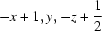
| Symmetry codes: (i) −x+1, y, −z+1/2; (ii) −x+1, −y+1, −z. |
Experimental details
| Crystal data | |
| Chemical formula | [CuI(C14H18N4S2)] |
| Mr | 496.88 |
| Crystal system, space group | Monoclinic, C2/c |
| Temperature (K) | 293 |
| a, b, c (Å) | 14.201 (5), 8.064 (5), 16.940 (5) |
| β (°) | 111.655 (5) |
| V (Å3) | 1803.0 (14) |
| Z | 4 |
| Radiation type | Mo Kα |
| µ (mm−1) | 3.16 |
| Crystal size (mm) | 0.33 × 0.24 × 0.21 |
| Data collection | |
| Diffractometer | Bruker APEXII CCD area-detector diffractometer |
| Absorption correction | Multi-scan (SADABS; Sheldrick, 1996) |
| Tmin, Tmax | 0.419, 0.515 |
| No. of measured, independent and observed [I > 2σ(I)] reflections | 5585, 2070, 1942 |
| Rint | 0.012 |
| (sin θ/λ)max (Å−1) | 0.649 |
| Refinement | |
| R[F2 > 2σ(F2)], wR(F2), S | 0.019, 0.053, 1.09 |
| No. of reflections | 2070 |
| No. of parameters | 103 |
| H-atom treatment | H-atom parameters constrained |
| Δρmax, Δρmin (e Å−3) | 0.51, −0.37 |
Computer programs: APEX2 (Bruker, 2005), SAINT (Bruker, 2005), SIR97 (Altomare et al., 1999), SHELXL97 (Sheldrick, 2008), SHELXTL (Sheldrick, 2008), WinGX (Farrugia, 1999).
| I1—Cu1 | 2.5191 (16) | Cu1—N2 | 2.0327 (16) |
| N2i—Cu1—N2 | 118.55 (10) | N2i—Cu1—I1 | 120.72 (5) |
| Symmetry code: (i) −x+1, y, −z+1/2. |
Acknowledgements
We thank Professor W.-T. Yu of Shan Dong University for his assistance with the X-ray structure determinations.
References
 Altomare, A., Burla, M. C., Camalli, M., Cascarano, G. L., Giacovazzo, C., Guagliardi, A., Moliterni, A. G. G., Polidori, G. & Spagna, R. (1999). J. Appl. Cryst. 32, 115–119. Web of Science CrossRef CAS IUCr Journals Google Scholar
Bruker (2005). APEX2 and SAINT. Bruker AXS Inc., Madison, Wisconsin, USA. Google Scholar
Catalano, V. J., Benett, B. L., Yson, R. L. & Noll, B. C. (2000). J. Am. Chem. Soc. 122, 10056–10057. Web of Science CSD CrossRef CAS Google Scholar
Farrugia, L. J. (1999). J. Appl. Cryst. 32, 837–838. CrossRef CAS IUCr Journals Google Scholar
Nishihara, H., Haruna, M. & Suhara, T. (1989). Optical Intergrated Circuits. McGraw-Hill, New York. Google Scholar
Roberto, D., Ugo, R., Bruni, S., Cariati, E., Cariati, F., Fantucci, P., Invernizzi, I., Quici, S., Ledoux, I. & Zyss, J. (2000). Organometallics, 19, 1775–1788. Web of Science CrossRef CAS Google Scholar
Sheldrick, G. M. (1996). SADABS. University of Göttingen, Germany. Google Scholar
Sheldrick, G. M. (2008). Acta Cryst. A64, 112–122. Web of Science CrossRef CAS IUCr Journals Google Scholar
Shi, W. J., Ruan, C. X., Li, Z., Li, M. & Li, D. (2008). CrystEngComm, 10, 778–783. Web of Science CSD CrossRef CAS Google Scholar
This is an open-access article distributed under the terms of the Creative Commons Attribution (CC-BY) Licence, which permits unrestricted use, distribution, and reproduction in any medium, provided the original authors and source are cited.
| CRYSTALLOGRAPHIC COMMUNICATIONS |


Previous studies have shown that the bonding interaction between closed-shell metal atoms or ions is gaining increasing attention (Catalano et al., 2000), there are a few reports of similar association in the case of alkyl copper (I) complexes. Heterocycle-based aromatic systems with conjugated multi-branched structure possess potential applications in optical image processing, all-optical switching, and integrated optical devices (Nishihara et al., 1989; Roberto et al., 2000). Pyrimidine is a π-electron deficient with its ionization potential value of 10.41 eV and metal complexes of such ligand has been reported (Shi et al., 2008). On the other hand, pyrimidine ring has well known reactivity in the positions 4 and 6, which can easily undergo reactions with an aromatic aldehyde in solvent-free condition. Therefore we pay our attention to the pyrimidine system. As part of our ongoing investigation on d10 ions and pyrimidine derivatives, the title compound, has been prepared and its crystal structure is presented here.
The molecular structure of the title compound shows that Cu atom coordinated in a triangle-planar configuration (Fig. 1) with two equal Cu—N and one Cu—I bonds (Table 1). The dihedral angles formed by the two pyrimidine rings (N1, C2, N2, C6, C5, C3 and N1A, C2A, N2A, C6A, C5A, C3A) is 88.01 (2)°. Each ligand, acting in a bidentate mode, bridges two Cu ions, resulting in the formation of polymeric zigzag chains. The crystal packing is mainly stabilized by van der Waals forces and π-π interactions, with the shortest distance of 3.938 (3)Å along c axis.