 | Acta Crystallographica Section E Acta Crystallographica Section E CRYSTALLOGRAPHIC COMMUNICATIONS |


 journal menu


organic compounds
| CRYSTALLOGRAPHIC COMMUNICATIONS |
 access
Methyl 1H-pyrrole-2-carboxylate

aDepartment Chemie und Biochemie, Ludwig-Maximilians-Universität, Butenandtstrasse 5–13, 81377 München, Germany
*Correspondence e-mail: [email protected]
The title compound, C6H7NO2, is essentially planar with a dihedral angle of 3.6 (3)° between the pyrrole ring and the methoxycarbonyl O/C/O/C plane. In the crystal structure, the N atom is a hydrogen-bond donor to the carboxylate C=O O atom of the neighboring molecule. These intermolecular hydrogen bonds lead to the formation of helical chains along the b axis.
Related literature
For related structures, see: Kerscher, Klüfers, Kügel & Müller (2007![[Kerscher, T., Klüfers, P., Kügel, W. & Müller, C. (2007). Acta Cryst. E63, o4779.]](../../../../../../logos/arrows/e_arr.gif "Kerscher, T., Klüfers, P., Kügel, W. & Müller, C. (2007). Acta Cryst. E63, o4779.") ); Kerscher, Klüfers & Kügel (2007). For graph-set analysis, see: Bernstein et al. (1995); Etter et al. (1990).
); Kerscher, Klüfers & Kügel (2007). For graph-set analysis, see: Bernstein et al. (1995); Etter et al. (1990).
![[Scheme 1]](is2445scheme1.gif)
Experimental
Crystal data
|
Data collection
|
Refinement
|
| ||||||||||||||||||||||
 ; (ii)
  .
. Data collection: CrysAlis CCD (Oxford Diffraction, 2006); cell refinement: CrysAlis RED (Oxford Diffraction, 2006); data reduction: CrysAlis RED; program(s) used to solve structure: SHELXS97 (Sheldrick, 2008); program(s) used to refine structure: SHELXL97 (Sheldrick, 2008); molecular graphics: ORTEPIII (Burnett & Johnson, 1996), ORTEP-3 (Farrugia, 1997) and Mercury (Macrae et al., 2006); software used to prepare material for publication: SHELXL97.
Supporting information
contains datablocks I, global. DOI: 10.1107/S1600536809030906/is2445sup1.cif
Structure factors: contains datablock I. DOI: 10.1107/S1600536809030906/is2445Isup2.hkl
The title compound was obtained by reaction of 228 mg (3.40 mmol) of pyrrole with 280 mg (1.70 mmol) phosgene imminium chloride in 6 ml of dry acetonitrile. After removal of the solvent, the remaining green solid was purified by column chromatoghraphy on silica with chloroform as of fraction five yielded the title compound as colorless crystals.
H atoms were calculated in ideal geometry, with Uiso(H) = 1.2Ueq(C or N) for all aromatic C- and N-bound H atoms, and with Uiso(H) = 1.5Ueq(C) for the methylgroup H atoms.
Data collection: CrysAlis CCD (Oxford Diffraction, 2006); cell CrysAlis RED (Oxford Diffraction, 2006); data reduction: CrysAlis RED (Oxford Diffraction, 2006); program(s) used to solve structure: SHELXS97 (Sheldrick, 2008); program(s) used to refine structure: SHELXL97 (Sheldrick, 2008); molecular graphics: ORTEPIII (Burnett & Johnson, 1996), ORTEP-3 (Farrugia, 1997) and Mercury 2.2 (Macrae et al., 2006); software used to prepare material for publication: SHELXL97 (Sheldrick, 2008).
![[Figure 1]](./is2445fig1thm.gif) | Fig. 1. The molecular structure of the title compound with atom labels and anisotropic displacement ellipsoids (drawn at 50% probability level) for non-H atoms. |
![[Figure 2]](./is2445fig2thm.gif) | Fig. 2. Strands formed by N–H···O hydrogen bonds along [0 1 0] in the crystal structure of the title compound, viewed along [1 0 0]. Symmetry codes: (i) -x, y + 1/2, 1/2 - z; (ii) x, y + 1, z; (iii) -x, y + 3/2, 1/2 - z. |
![[Figure 3]](./is2445fig3thm.gif) | Fig. 3. Strands formed by C–H···π contacts along [0 1 0] in the of the title compound, viewed along [0 0 1]. Symmetry codes: (i) 1 - x, y + 1/2, 1/2 - z; (ii) 1 - x, y - 1/2, z - 1/2; (iii) x, y - 1, z; (iv) 1 - x, y - 3/2, 1/2 - z; (v) x, y - 2, z. |
![[Figure 4]](./is2445fig4thm.gif) | Fig. 4. The strands formed by hydrogen bonding in the crystal structure are interconnected by the strands formed by C–H···π contacts. |
![[Figure 5]](./is2445fig5thm.gif) | Fig. 5. The packing of the title compound, viewed along [0 1 0]. |
| C6H7NO2 | F(000) = 264 |
| Mr = 125.13 | Dx = 1.395 Mg m−3 |
| Monoclinic, P21/c | Mo Kα radiation, λ = 0.71073 Å |
| Hall symbol: -P 2ybc | Cell parameters from 1091 reflections |
| a = 7.5346 (19) Å | θ = 4.0–27.5° |
| b = 5.4598 (14) Å | µ = 0.11 mm−1 |
| c = 14.730 (4) Å | T = 200 K |
| β = 100.55 (2)° | Platelet, colourless |
| V = 595.7 (3) Å3 | 0.38 × 0.16 × 0.06 mm |
| Z = 4 |
| Oxford Xcalibur KappaCCD diffractometer | 528 reflections with I > 2σ(I) |
| Radiation source: fine-focus sealed tube | Rint = 0.112 |
| Graphite monochromator | θmax = 25.5°, θmin = 4.0° |
| ω–scans | h = −9→9 |
| 2591 measured reflections | k = −6→6 |
| 1103 independent reflections | l = −17→17 |
| Refinement on F2 | Primary atom site location: structure-invariant direct methods |
| Least-squares matrix: full | Secondary atom site location: difference Fourier map |
| R[F2 > 2σ(F2)] = 0.070 | Hydrogen site location: inferred from neighbouring sites |
| wR(F2) = 0.176 | H-atom parameters constrained |
| S = 0.95 | w = 1/[σ2(Fo2) + (0.0745P)2] where P = (Fo2 + 2Fc2)/3 |
| 1103 reflections | (Δ/σ)max < 0.001 |
| 83 parameters | Δρmax = 0.27 e Å−3 |
| 0 restraints | Δρmin = −0.26 e Å−3 |
| C6H7NO2 | V = 595.7 (3) Å3 |
| Mr = 125.13 | Z = 4 |
| Monoclinic, P21/c | Mo Kα radiation |
| a = 7.5346 (19) Å | µ = 0.11 mm−1 |
| b = 5.4598 (14) Å | T = 200 K |
| c = 14.730 (4) Å | 0.38 × 0.16 × 0.06 mm |
| β = 100.55 (2)° |
| Oxford Xcalibur KappaCCD diffractometer | 528 reflections with I > 2σ(I) |
| 2591 measured reflections | Rint = 0.112 |
| 1103 independent reflections |
| R[F2 > 2σ(F2)] = 0.070 | 0 restraints |
| wR(F2) = 0.176 | H-atom parameters constrained |
| S = 0.95 | Δρmax = 0.27 e Å−3 |
| 1103 reflections | Δρmin = −0.26 e Å−3 |
| 83 parameters |
| x | y | z | Uiso*/Ueq | ||
| O1 | 0.0203 (3) | 0.7534 (4) | 0.08955 (19) | 0.0312 (8) | |
| O2 | −0.0644 (3) | 0.4755 (5) | 0.18723 (19) | 0.0331 (8) | |
| N1 | 0.2637 (4) | 0.2221 (6) | 0.1856 (2) | 0.0286 (9) | |
| H1 | 0.1960 | 0.1417 | 0.2183 | 0.034* | |
| C1 | 0.2176 (5) | 0.4370 (7) | 0.1405 (3) | 0.0248 (10) | |
| C5 | 0.0452 (5) | 0.5519 (7) | 0.1425 (3) | 0.0276 (10) | |
| C6 | −0.1459 (5) | 0.8847 (7) | 0.0877 (3) | 0.0378 (12) | |
| H6A | −0.2475 | 0.7701 | 0.0753 | 0.057* | |
| H6B | −0.1594 | 1.0093 | 0.0391 | 0.057* | |
| H6C | −0.1439 | 0.9640 | 0.1476 | 0.057* | |
| C3 | 0.4923 (5) | 0.3236 (7) | 0.1182 (3) | 0.0275 (10) | |
| H3 | 0.6054 | 0.3212 | 0.0984 | 0.033* | |
| C4 | 0.4295 (5) | 0.1506 (7) | 0.1726 (3) | 0.0300 (10) | |
| H4 | 0.4914 | 0.0065 | 0.1967 | 0.036* | |
| C2 | 0.3585 (5) | 0.5042 (7) | 0.0975 (3) | 0.0276 (10) | |
| H2 | 0.3638 | 0.6461 | 0.0608 | 0.033* |
| U11 | U22 | U33 | U12 | U13 | U23 | |
| O1 | 0.0235 (16) | 0.0309 (17) | 0.0388 (19) | 0.0084 (12) | 0.0042 (12) | 0.0051 (13) |
| O2 | 0.0241 (16) | 0.0352 (17) | 0.041 (2) | 0.0013 (13) | 0.0090 (14) | −0.0012 (14) |
| N1 | 0.025 (2) | 0.0251 (19) | 0.036 (2) | −0.0002 (15) | 0.0059 (15) | −0.0020 (16) |
| C1 | 0.024 (2) | 0.022 (2) | 0.028 (2) | −0.0012 (18) | 0.0041 (18) | −0.0015 (17) |
| C5 | 0.028 (2) | 0.022 (2) | 0.030 (2) | 0.0005 (18) | −0.0009 (19) | −0.0072 (18) |
| C6 | 0.034 (3) | 0.037 (3) | 0.041 (3) | 0.009 (2) | 0.004 (2) | 0.001 (2) |
| C3 | 0.026 (2) | 0.031 (2) | 0.026 (2) | 0.0016 (18) | 0.0079 (17) | −0.0016 (19) |
| C4 | 0.023 (2) | 0.029 (2) | 0.035 (3) | 0.0024 (19) | −0.0013 (18) | −0.0029 (19) |
| C2 | 0.030 (2) | 0.026 (2) | 0.026 (3) | −0.0026 (19) | 0.0051 (19) | 0.0019 (19) |
| O1—C5 | 1.341 (4) | C6—H6A | 0.9800 |
| O1—C6 | 1.439 (4) | C6—H6B | 0.9800 |
| O2—C5 | 1.221 (5) | C6—H6C | 0.9800 |
| N1—C4 | 1.356 (5) | C3—C4 | 1.377 (5) |
| N1—C1 | 1.362 (5) | C3—C2 | 1.403 (5) |
| N1—H1 | 0.8800 | C3—H3 | 0.9500 |
| C1—C2 | 1.382 (5) | C4—H4 | 0.9500 |
| C1—C5 | 1.447 (5) | C2—H2 | 0.9500 |
| C5—O1—C6 | 116.6 (3) | O1—C6—H6C | 109.5 |
| C4—N1—C1 | 109.8 (3) | H6A—C6—H6C | 109.5 |
| C4—N1—H1 | 125.1 | H6B—C6—H6C | 109.5 |
| C1—N1—H1 | 125.1 | C4—C3—C2 | 107.4 (3) |
| N1—C1—C2 | 107.7 (3) | C4—C3—H3 | 126.3 |
| N1—C1—C5 | 120.9 (3) | C2—C3—H3 | 126.3 |
| C2—C1—C5 | 131.4 (4) | N1—C4—C3 | 108.0 (3) |
| O2—C5—O1 | 123.9 (4) | N1—C4—H4 | 126.0 |
| O2—C5—C1 | 124.1 (4) | C3—C4—H4 | 126.0 |
| O1—C5—C1 | 112.0 (4) | C1—C2—C3 | 107.2 (3) |
| O1—C6—H6A | 109.5 | C1—C2—H2 | 126.4 |
| O1—C6—H6B | 109.5 | C3—C2—H2 | 126.4 |
| H6A—C6—H6B | 109.5 | ||
| C4—N1—C1—C2 | 0.0 (4) | C2—C1—C5—O1 | 2.9 (6) |
| C4—N1—C1—C5 | 179.3 (3) | C1—N1—C4—C3 | 0.3 (4) |
| C6—O1—C5—O2 | 0.7 (5) | C2—C3—C4—N1 | −0.4 (4) |
| C6—O1—C5—C1 | −179.0 (3) | N1—C1—C2—C3 | −0.2 (4) |
| N1—C1—C5—O2 | 4.1 (6) | C5—C1—C2—C3 | −179.4 (4) |
| C2—C1—C5—O2 | −176.8 (4) | C4—C3—C2—C1 | 0.4 (4) |
| N1—C1—C5—O1 | −176.2 (3) |
| D—H···A | D—H | H···A | D···A | D—H···A |
| N1—H1···O2i | 0.88 | 2.06 | 2.933 (4) | 171 |
| C4—H4···Cg1ii | 0.95 | 2.63 | 3.401 (5) | 139 |
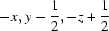
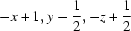
| Symmetry codes: (i) −x, y−1/2, −z+1/2; (ii) −x+1, y−1/2, −z+1/2. |
Experimental details
| Crystal data | |
| Chemical formula | C6H7NO2 |
| Mr | 125.13 |
| Crystal system, space group | Monoclinic, P21/c |
| Temperature (K) | 200 |
| a, b, c (Å) | 7.5346 (19), 5.4598 (14), 14.730 (4) |
| β (°) | 100.55 (2) |
| V (Å3) | 595.7 (3) |
| Z | 4 |
| Radiation type | Mo Kα |
| µ (mm−1) | 0.11 |
| Crystal size (mm) | 0.38 × 0.16 × 0.06 |
| Data collection | |
| Diffractometer | Oxford Xcalibur KappaCCD diffractometer |
| Absorption correction | – |
| No. of measured, independent and observed [I > 2σ(I)] reflections | 2591, 1103, 528 |
| Rint | 0.112 |
| (sin θ/λ)max (Å−1) | 0.606 |
| Refinement | |
| R[F2 > 2σ(F2)], wR(F2), S | 0.070, 0.176, 0.95 |
| No. of reflections | 1103 |
| No. of parameters | 83 |
| H-atom treatment | H-atom parameters constrained |
| Δρmax, Δρmin (e Å−3) | 0.27, −0.26 |
Computer programs: CrysAlis CCD (Oxford Diffraction, 2006), CrysAlis RED (Oxford Diffraction, 2006), SHELXS97 (Sheldrick, 2008), SHELXL97 (Sheldrick, 2008), ORTEPIII (Burnett & Johnson, 1996), ORTEP-3 (Farrugia, 1997) and Mercury 2.2 (Macrae et al., 2006).
| D—H···A | D—H | H···A | D···A | D—H···A |
| N1—H1···O2i | 0.88 | 2.06 | 2.933 (4) | 171 |
| C4—H4···Cg1ii | 0.95 | 2.63 | 3.401 (5) | 139 |
| Symmetry codes: (i) −x, y−1/2, −z+1/2; (ii) −x+1, y−1/2, −z+1/2. |
Acknowledgements
TK is indebted to the Hanns-Seidel Stiftung for a PhD grant funded by the German Bundesministerium für Bildung und Forschung.
References
 Bernstein, J., Davis, R. E., Shimoni, L. & Chang, N.-L. (1995). Angew. Chem. Int. Ed. Engl. 34, 1555–1573. CrossRef CAS Web of Science Google Scholar
Burnett, M. N. & Johnson, C. K. (1996). ORTEPIII. Report ORNL-6895. Oak Ridge National Laboratory, Tennessee, USA. Google Scholar
Etter, M. C., MacDonald, J. C. & Bernstein, J. (1990). Acta Cryst. B46, 256–262. CrossRef CAS Web of Science IUCr Journals Google Scholar
Farrugia, L. J. (1997). J. Appl. Cryst. 30, 565. CrossRef IUCr Journals Google Scholar
Kerscher, T., Klüfers, P. & Kügel, W. (2007). Acta Cryst. E63, o4217. Web of Science CSD CrossRef IUCr Journals Google Scholar
Kerscher, T., Klüfers, P., Kügel, W. & Müller, C. (2007). Acta Cryst. E63, o4779. Web of Science CSD CrossRef IUCr Journals Google Scholar
Macrae, C. F., Edgington, P. R., McCabe, P., Pidcock, E., Shields, G. P., Taylor, R., Towler, M. & van de Streek, J. (2006). J. Appl. Cryst. 39, 453–457. Web of Science CrossRef CAS IUCr Journals Google Scholar
Oxford Diffraction (2006). CrysAlis CCD and CrysAlis RED. Oxford Diffraction Ltd, Abingdon, Oxfordshire, England. Google Scholar
Sheldrick, G. M. (2008). Acta Cryst. A64, 112–122. Web of Science CrossRef CAS IUCr Journals Google Scholar
This is an open-access article distributed under the terms of the Creative Commons Attribution (CC-BY) Licence, which permits unrestricted use, distribution, and reproduction in any medium, provided the original authors and source are cited.
| CRYSTALLOGRAPHIC COMMUNICATIONS |


The title compound was prepared, in the attempt to create new complexing ligands, as a byproduct. The compound is quite simular to other compounds already published by our group (Kerscher, Klüfers, Kügel & Müller, 2007; Kerscher, Klüfers & Kügel, 2007).
In the molecule, a formic acid methyl ester is in the 2 position of the pyrrole ring (Fig. 1). With a torsion angle for C2–C1–C5–O1 of only about 2.9°, the molecule is, with the exception of the H atoms of the methyl group, nearly planar. Because of this small torsion angle, the molecule is not Cs symmetric.
The hydrogen bonds of the nitrogen to the carboxylate oxygen lead to a chain like hydrogen bonding system which can be described according to graph-set analysis (Etter et al., 1990; Bernstein et al., 1995) with a C(5) descriptor on the unitary level [the rpluto program (Cambridge Crystallographic Data Centre, England) was used for the graph set analyses; one of these strands is shown in Fig. 2].
Considering contacts whose range falls below the sum of van der Waals radii by only about 0.1 Å, a set of weak C–H···π interactions leads to the formation of a second system of strands along [0 1 0] which can be described by a C(2) descriptor (see Fig. 3).
The two strand systems alternate, which means two hydrogen bonding strands are interconnected by a strand of weak C–H···π contacts (this situation is illustrated in Fig. 4) and vice versa, two strands made of weak C–H···π contacts are interconnected by hydrogen bonding strands. This bonding pattern leads to sheet like structures normal to [0 0 1].
The molecular packing of the title compound is shown in Figure 5.