 | Acta Crystallographica Section E Acta Crystallographica Section E CRYSTALLOGRAPHIC COMMUNICATIONS |


 journal menu


organic compounds
| CRYSTALLOGRAPHIC COMMUNICATIONS |
 access
4,4′-(Phenylimino)dibenzaldehyde

aDepartment of Chemical Industry, Shandong Institute of Light Industry, Jinan 250353, People's Republic of China
*Correspondence e-mail: [email protected]
The of the title compound, C20H15NO2, contains one half-molecule with the central N atom and two C atoms of the benzene moiety lying on a twofold rotation axis. Weak C—H⋯O interactions join the molecules together into an infinite three-dimensional network.
Related literature
The title compound was obtained unintentionally as the product of an attempted purification of tris(4-formylphenyl)amine, which is used as a building block in materials chemistry (Thomas et al., 2005![[Thomas, M., Said, G., Mohamed, A., Mireille, B. & Olivier, M. (2005). Synthesis, pp. 1771-1774.]](../../../../../../logos/arrows/e_arr.gif "Thomas, M., Said, G., Mohamed, A., Mireille, B. & Olivier, M. (2005). Synthesis, pp. 1771-1774.") ). For hydrogen bonding, see: Krishnamohan Sharma & Desiraju (1994). =
). For hydrogen bonding, see: Krishnamohan Sharma & Desiraju (1994). =
![[Scheme 1]](jh2093scheme1.gif)
Experimental
Crystal data
|
Refinement
|
| ||||||||||||||||||||||
 ; (ii)
  .
. Data collection: SMART (Bruker, 2000); cell refinement: SAINT-Plus (Bruker, 2000); data reduction: SAINT-Plus; program(s) used to solve structure: SHELXTL (Sheldrick, 2008); program(s) used to refine structure: SHELXL97 (Sheldrick, 2008); molecular graphics: SHELXTL; software used to prepare material for publication: SHELXL97 and PLATON (Spek, 2009).
Supporting information
contains datablocks I, global. DOI: 10.1107/S1600536809031924/jh2093sup1.cif
Structure factors: contains datablock I. DOI: 10.1107/S1600536809031924/jh2093Isup2.hkl
Phosphorus oxychloride (POCl3) and N,N-dimethylformamide (DMF) were analytical reagent and used after the process of removing oxygen and water. Other organic solvents and common materials used for synthesis were used without further purification. The compound (I) was prepared by mixing 5.0 g triphenylamine and an ice-cooled mixture of POCl3(47.5 mL) and DMF(36.3 mL) under N2. The resulting mixture was stirred at 95°C for 4 h under N2. After cooling to room temperature,the mixture was poured into ice-water(1L),and basified with 1M NaOH. After filtration, the crude product was purified by with petroleum ether/ethyl acetate (8/1,in volume ratio) to yield I(yellow transparent crystal). Elemental analysis Calcd: C 79.72, H 5.02, N 4.65%. Found: C 79.81, H 5.16, N 4.57%.
All the H atoms were located in the difference Fourier map and all parameters are refined independently.
Data collection: SMART (Bruker, 2000); cell SAINT-Plus (Bruker, 2000); data reduction: SAINT-Plus (Bruker, 2000); program(s) used to solve structure: SHELXTL (Sheldrick, 2008); program(s) used to refine structure: SHELXL97 (Sheldrick, 2008); molecular graphics: SHELXTL (Sheldrick, 2008); software used to prepare material for publication: SHELXL97 (Sheldrick, 2008) and PLATON (Spek, 2009).
![[Figure 1]](./jh2093fig1thm.gif) | Fig. 1. The molecular structure of (I), with atom labels and 30% probability displacement ellipsoids for non-H atoms. C1I to C6I,C8I,C9I,C11I,O1I and H1I to H7I were created by GROW and the symmetry code of "I" is -x, +y, 0.5 - z. |
![[Figure 2]](./jh2093fig2thm.gif) | Fig. 2. The packing of (I), viewed down the b axis. |
| C20H15NO2 | Dx = 1.253 Mg m−3 |
| Mr = 301.33 | Melting point = 417–419 K |
| Orthorhombic, Pbcn | Mo Kα radiation, λ = 0.71073 Å |
| Hall symbol: -P 2n 2ab | Cell parameters from 378 reflections |
| a = 8.836 (2) Å | θ = 1.7–25.0° |
| b = 9.710 (2) Å | µ = 0.08 mm−1 |
| c = 18.621 (4) Å | T = 298 K |
| V = 1597.6 (6) Å3 | Block, yellow |
| Z = 4 | 0.32 × 0.18 × 0.08 mm |
| F(000) = 632 |
| Bruker SMART CCD area-detector diffractometer | 1412 independent reflections |
| Radiation source: fine-focus sealed tube | 1087 reflections with I > 2σ(I) |
| Graphite monochromator | Rint = 0.043 |
| π and ω scans | θmax = 25.0°, θmin = 2.2° |
| Absorption correction: multi-scan (SADABS; Bruker, 2000) | h = −10→10 |
| Tmin = 0.980, Tmax = 0.992 | k = −11→8 |
| 7399 measured reflections | l = −22→21 |
| Refinement on F2 | Primary atom site location: structure-invariant direct methods |
| Least-squares matrix: full | Secondary atom site location: difference Fourier map |
| R[F2 > 2σ(F2)] = 0.064 | Hydrogen site location: difference Fourier map |
| wR(F2) = 0.187 | All H-atom parameters refined |
| S = 1.07 | w = 1/[σ2(Fo2) + (0.0996P)2 + 0.4228P] where P = (Fo2 + 2Fc2)/3 |
| 1412 reflections | (Δ/σ)max < 0.001 |
| 136 parameters | Δρmax = 0.29 e Å−3 |
| 0 restraints | Δρmin = −0.30 e Å−3 |
| C20H15NO2 | V = 1597.6 (6) Å3 |
| Mr = 301.33 | Z = 4 |
| Orthorhombic, Pbcn | Mo Kα radiation |
| a = 8.836 (2) Å | µ = 0.08 mm−1 |
| b = 9.710 (2) Å | T = 298 K |
| c = 18.621 (4) Å | 0.32 × 0.18 × 0.08 mm |
| Bruker SMART CCD area-detector diffractometer | 1412 independent reflections |
| Absorption correction: multi-scan (SADABS; Bruker, 2000) | 1087 reflections with I > 2σ(I) |
| Tmin = 0.980, Tmax = 0.992 | Rint = 0.043 |
| 7399 measured reflections |
| R[F2 > 2σ(F2)] = 0.064 | 0 restraints |
| wR(F2) = 0.187 | All H-atom parameters refined |
| S = 1.07 | Δρmax = 0.29 e Å−3 |
| 1412 reflections | Δρmin = −0.30 e Å−3 |
| 136 parameters |
Geometry. All e.s.d.'s (except the e.s.d. in the dihedral angle between two l.s. planes) are estimated using the full covariance matrix. The cell e.s.d.'s are taken into account individually in the estimation of e.s.d.'s in distances, angles and torsion angles; correlations between e.s.d.'s in cell parameters are only used when they are defined by crystal symmetry. An approximate (isotropic) treatment of cell e.s.d.'s is used for estimating e.s.d.'s involving l.s. planes. |
Refinement. Refinement of F2 against ALL reflections. The weighted R-factor wR and goodness of fit S are based on F2, conventional R-factors R are based on F, with F set to zero for negative F2. The threshold expression of F2 > σ(F2) is used only for calculating R-factors(gt) etc. and is not relevant to the choice of reflections for refinement. R-factors based on F2 are statistically about twice as large as those based on F, and R- factors based on ALL data will be even larger. |
| x | y | z | Uiso*/Ueq | ||
| C1 | 0.0438 (3) | 0.5517 (3) | 0.31252 (11) | 0.0446 (6) | |
| C2 | 0.1601 (3) | 0.6013 (3) | 0.35553 (15) | 0.0587 (8) | |
| C3 | 0.1977 (4) | 0.5311 (3) | 0.41719 (16) | 0.0670 (9) | |
| C4 | 0.1216 (3) | 0.4133 (3) | 0.43801 (13) | 0.0593 (8) | |
| C5 | 0.0081 (3) | 0.3648 (3) | 0.39479 (14) | 0.0573 (7) | |
| C6 | −0.0305 (3) | 0.4314 (3) | 0.33246 (13) | 0.0499 (7) | |
| C7 | 0.0000 | 0.7700 (3) | 0.2500 | 0.0458 (8) | |
| C8 | 0.0651 (3) | 0.8417 (3) | 0.19405 (15) | 0.0581 (8) | |
| C9 | 0.0634 (4) | 0.9841 (3) | 0.19400 (18) | 0.0697 (9) | |
| C10 | 0.0000 | 1.0547 (5) | 0.2500 | 0.0712 (12) | |
| C11 | 0.1559 (5) | 0.3415 (4) | 0.50518 (16) | 0.0873 (12) | |
| N1 | 0.0000 | 0.6232 (3) | 0.2500 | 0.0528 (8) | |
| O1 | 0.2531 (4) | 0.3709 (3) | 0.54591 (13) | 0.1245 (12) | |
| H1 | 0.212 (3) | 0.682 (3) | 0.3407 (14) | 0.067 (8)* | |
| H2 | 0.271 (4) | 0.566 (4) | 0.4436 (17) | 0.089 (10)* | |
| H3 | −0.041 (3) | 0.282 (4) | 0.4107 (16) | 0.090 (10)* | |
| H4 | −0.111 (3) | 0.399 (3) | 0.3032 (13) | 0.059 (8)* | |
| H5 | 0.101 (4) | 0.248 (5) | 0.5133 (19) | 0.113 (13)* | |
| H6 | 0.106 (3) | 0.790 (3) | 0.1563 (16) | 0.071 (8)* | |
| H7 | 0.110 (3) | 1.031 (3) | 0.1554 (18) | 0.088 (10)* | |
| H8 | 0.0000 | 1.153 (6) | 0.2500 | 0.092 (15)* |
| U11 | U22 | U33 | U12 | U13 | U23 | |
| C1 | 0.0513 (14) | 0.0464 (14) | 0.0362 (12) | 0.0041 (11) | −0.0018 (10) | −0.0007 (10) |
| C2 | 0.0626 (17) | 0.0572 (17) | 0.0563 (16) | −0.0078 (14) | −0.0105 (13) | −0.0025 (14) |
| C3 | 0.0714 (19) | 0.073 (2) | 0.0566 (17) | 0.0136 (16) | −0.0257 (15) | −0.0160 (16) |
| C4 | 0.086 (2) | 0.0492 (15) | 0.0429 (14) | 0.0234 (14) | −0.0042 (14) | −0.0046 (12) |
| C5 | 0.0769 (19) | 0.0508 (16) | 0.0441 (14) | 0.0065 (14) | 0.0073 (14) | 0.0005 (12) |
| C6 | 0.0540 (15) | 0.0510 (15) | 0.0447 (13) | −0.0005 (12) | −0.0015 (12) | −0.0007 (12) |
| C7 | 0.0535 (19) | 0.0444 (19) | 0.0396 (17) | 0.000 | −0.0017 (15) | 0.000 |
| C8 | 0.0658 (17) | 0.0573 (18) | 0.0513 (15) | 0.0000 (13) | 0.0066 (13) | 0.0003 (13) |
| C9 | 0.081 (2) | 0.0585 (19) | 0.0696 (19) | −0.0096 (15) | 0.0021 (16) | 0.0158 (16) |
| C10 | 0.080 (3) | 0.044 (2) | 0.090 (3) | 0.000 | −0.005 (2) | 0.000 |
| C11 | 0.138 (3) | 0.077 (2) | 0.0460 (17) | 0.045 (2) | −0.017 (2) | −0.0119 (17) |
| N1 | 0.072 (2) | 0.0447 (17) | 0.0419 (15) | 0.000 | −0.0079 (14) | 0.000 |
| O1 | 0.181 (3) | 0.117 (2) | 0.0762 (16) | 0.059 (2) | −0.0570 (19) | −0.0115 (15) |
| C1—C2 | 1.389 (4) | C7—C8i | 1.379 (3) |
| C1—C6 | 1.391 (4) | C7—C8 | 1.379 (3) |
| C1—N1 | 1.410 (3) | C7—N1 | 1.425 (4) |
| C2—C3 | 1.376 (4) | C8—C9 | 1.383 (4) |
| C2—H1 | 0.95 (3) | C8—H6 | 0.93 (3) |
| C3—C4 | 1.383 (4) | C9—C10 | 1.368 (4) |
| C3—H2 | 0.88 (3) | C9—H7 | 0.95 (3) |
| C4—C5 | 1.369 (4) | C10—C9i | 1.368 (4) |
| C4—C11 | 1.464 (4) | C10—H8 | 0.95 (5) |
| C5—C6 | 1.372 (4) | C11—O1 | 1.181 (4) |
| C5—H3 | 0.96 (3) | C11—H5 | 1.04 (4) |
| C6—H4 | 0.95 (3) | N1—C1i | 1.410 (3) |
| C2—C1—C6 | 119.1 (2) | C8i—C7—C8 | 119.4 (4) |
| C2—C1—N1 | 120.6 (2) | C8i—C7—N1 | 120.32 (18) |
| C6—C1—N1 | 120.3 (2) | C8—C7—N1 | 120.32 (18) |
| C3—C2—C1 | 119.2 (3) | C7—C8—C9 | 120.1 (3) |
| C3—C2—H1 | 122.3 (16) | C7—C8—H6 | 117.3 (17) |
| C1—C2—H1 | 118.5 (16) | C9—C8—H6 | 122.6 (17) |
| C2—C3—C4 | 121.7 (3) | C10—C9—C8 | 120.3 (3) |
| C2—C3—H2 | 117 (2) | C10—C9—H7 | 121 (2) |
| C4—C3—H2 | 121 (2) | C8—C9—H7 | 119 (2) |
| C5—C4—C3 | 118.4 (3) | C9i—C10—C9 | 119.9 (4) |
| C5—C4—C11 | 119.3 (3) | C9i—C10—H8 | 120.1 (2) |
| C3—C4—C11 | 122.2 (3) | C9—C10—H8 | 120.1 (2) |
| C4—C5—C6 | 121.1 (3) | O1—C11—C4 | 125.8 (4) |
| C4—C5—H3 | 115.9 (19) | O1—C11—H5 | 117 (2) |
| C6—C5—H3 | 122.9 (19) | C4—C11—H5 | 116 (2) |
| C5—C6—C1 | 120.3 (3) | C1—N1—C1i | 121.0 (3) |
| C5—C6—H4 | 121.0 (16) | C1—N1—C7 | 119.50 (14) |
| C1—C6—H4 | 118.6 (16) | C1i—N1—C7 | 119.50 (14) |
| Symmetry code: (i) −x, y, −z+1/2. |
| D—H···A | D—H | H···A | D···A | D—H···A |
| C5—H3···O1ii | 0.96 (3) | 2.48 (3) | 3.396 (4) | 159 (3) |
| C9—H7···O1iii | 0.95 (3) | 2.55 (4) | 3.495 (4) | 173 (3) |
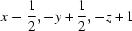
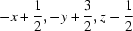
| Symmetry codes: (ii) x−1/2, −y+1/2, −z+1; (iii) −x+1/2, −y+3/2, z−1/2. |
Experimental details
| Crystal data | |
| Chemical formula | C20H15NO2 |
| Mr | 301.33 |
| Crystal system, space group | Orthorhombic, Pbcn |
| Temperature (K) | 298 |
| a, b, c (Å) | 8.836 (2), 9.710 (2), 18.621 (4) |
| V (Å3) | 1597.6 (6) |
| Z | 4 |
| Radiation type | Mo Kα |
| µ (mm−1) | 0.08 |
| Crystal size (mm) | 0.32 × 0.18 × 0.08 |
| Data collection | |
| Diffractometer | Bruker SMART CCD area-detector diffractometer |
| Absorption correction | Multi-scan (SADABS; Bruker, 2000) |
| Tmin, Tmax | 0.980, 0.992 |
| No. of measured, independent and observed [I > 2σ(I)] reflections | 7399, 1412, 1087 |
| Rint | 0.043 |
| (sin θ/λ)max (Å−1) | 0.594 |
| Refinement | |
| R[F2 > 2σ(F2)], wR(F2), S | 0.064, 0.187, 1.07 |
| No. of reflections | 1412 |
| No. of parameters | 136 |
| H-atom treatment | All H-atom parameters refined |
| Δρmax, Δρmin (e Å−3) | 0.29, −0.30 |
Computer programs: SMART (Bruker, 2000), SAINT-Plus (Bruker, 2000), SHELXTL (Sheldrick, 2008), SHELXL97 (Sheldrick, 2008) and PLATON (Spek, 2009).
| D—H···A | D—H | H···A | D···A | D—H···A |
| C5—H3···O1i | 0.96 (3) | 2.48 (3) | 3.396 (4) | 159 (3) |
| C9—H7···O1ii | 0.95 (3) | 2.55 (4) | 3.495 (4) | 173 (3) |
| Symmetry codes: (i) x−1/2, −y+1/2, −z+1; (ii) −x+1/2, −y+3/2, z−1/2. |
Acknowledgements
The authors thank the Shandong Distinguished Middle-aged and Young Scientist Encouragement and Reward Scheme (No. 2006BS04006) for financial support.
References
 Bruker (2000). SMART, SAINT-Plus and SADABS. Bruker AXS Inc., Madison, Wisconsin, USA. Google Scholar
Krishnamohan Sharma, C. V. & Desiraju, G. R. (1994). J. Chem. Soc. Perkin Trans. 2, pp. 2345–2352. Google Scholar
Sheldrick, G. M. (2008). Acta Cryst. A64, 112–122. Web of Science CrossRef CAS IUCr Journals Google Scholar
Spek, A. L. (2009). Acta Cryst. D65, 148–155. Web of Science CrossRef CAS IUCr Journals Google Scholar
Thomas, M., Said, G., Mohamed, A., Mireille, B. & Olivier, M. (2005). Synthesis, pp. 1771–1774. Google Scholar
This is an open-access article distributed under the terms of the Creative Commons Attribution (CC-BY) Licence, which permits unrestricted use, distribution, and reproduction in any medium, provided the original authors and source are cited.
| CRYSTALLOGRAPHIC COMMUNICATIONS |


The popularity of tris(4-formylphenyl)amine as a building block is rapidly growing in materials chemistry (Thomas et al., 2005). The title compound, (I) (Fig. 1), [C20H15NO2], was obtained unintentionally as the product of an attempted purification of tris(4-formylphenyl)amine.
The molecule of (I) has three phenyl rings, but the asymmetric unit contains only one half of (I). The ring (C7 to C10) makes a dihedral angle of 70.36 (8)° with ring (C1 to C6), and a dihedral angle of 70.22 (8)° with ring (C1i to C6i) (symmetry code: (i) -x, +y, 0.5 - z). The dihedral angle of the latter two is 66.66 (8)°.
The PLATON program (Spek, 2009) suggests that there are no classic hydrogen bonds, but there are weak C—H···O hydrogen bonds (Table 2, Krishnamohan Sharma & Desiraju, 1994) between carbonyl oxygen and H atoms on the adjacent molecules, which link them into infinite three-dimensional network[Fig. 2].