 | Acta Crystallographica Section E Acta Crystallographica Section E CRYSTALLOGRAPHIC COMMUNICATIONS |


 journal menu


metal-organic compounds
| CRYSTALLOGRAPHIC COMMUNICATIONS |
 access
Bis[2-(3,4-disulfanylphenyl)acetato]bis(2-methyl-1H-imidazole-κN3)zinc(II)

aEngineering Research Center for Clean Production of Textile Dyeing and Printing, Ministry of Education, Wuhan 430073, People's Republic of China
*Correspondence e-mail: [email protected]
In the title mononuclear zinc(II) complex, [Zn(C8H7O2S2)2(C4H6N2)2], the ZnII atom, lying on a twofold axis, is coordinated by two O atoms from two 2-(3,4-disulfanylphenyl)acetate anions and by two N atoms from 2-methylimidazole ligands in a distorted tetrahdral coordination. The is stabilized by intermolecular C—H⋯O and N—H⋯O hydrogen bonds and π–π interactions with a centroid–centroid distance of 3.6136 (16) Å.
Related literature
For general background to organometallic complexes and their applications, see: Sommerfeldt et al. (2008![[Sommerfeldt, H. M., Meermann, C., Tornroos, K. W. & Anwander, R. (2008). Inorg. Chem. 47, 4696-4705.]](../../../../../../logos/arrows/e_arr.gif "Sommerfeldt, H. M., Meermann, C., Tornroos, K. W. & Anwander, R. (2008). Inorg. Chem. 47, 4696-4705.") ); Huang et al. (2007); Neville et al. (2008). Zinc derivatives are of particular interest owing to their unique photosensitizing properties for photodynamic therapy, see: You et al. (2006); Shi et al. (2008); Xiao et al. (2008, 2009). For related structures, see: Yang et al. (2004); You et al. (2003, 2004); Qiu et al. (2004, 2007); Halcrow et al. (2000).
); Huang et al. (2007); Neville et al. (2008). Zinc derivatives are of particular interest owing to their unique photosensitizing properties for photodynamic therapy, see: You et al. (2006); Shi et al. (2008); Xiao et al. (2008, 2009). For related structures, see: Yang et al. (2004); You et al. (2003, 2004); Qiu et al. (2004, 2007); Halcrow et al. (2000).
![[Scheme 1]](rk2159scheme1.gif)
Experimental
Crystal data
|
Refinement
|
| ||||||||||||||||||||||
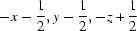 ; (ii)
  .
. Data collection: SMART (Bruker, 2000); cell refinement: SAINT (Bruker, 2000); data reduction: SAINT; program(s) used to solve structure: SHELXS97 (Sheldrick, 2008); program(s) used to refine structure: SHELXL97 (Sheldrick, 2008); molecular graphics: SHELXTL (Sheldrick, 2008); software used to prepare material for publication: SHELXTL.
Supporting information
contains datablocks global, I. DOI: 10.1107/S1600536809033893/rk2159sup1.cif
Structure factors: contains datablock I. DOI: 10.1107/S1600536809033893/rk2159Isup2.hkl
The 0.5 mmol of zinc oxide, 1 mmol of 3,4-dimercaptophenylacetic acid and 1 mmol of 2-methylimidazole were dissolved in 10 ml methanol. The result solution was heated to 423 K for 12 h. The reactor was cooled to room temperature at a rate of 10 K h-1. The mixture was filtered and held at room temperature for 8 d. Colourless block crystals were isolated in 32% yield.
The H atom bonded to N1 was located in a difference Fourier map and refined freely. All other H atoms were placed in geometrically idealized positions and constrained to ride on their parent atoms with C–H of 0.93Å for the aromatic H atoms, 0.96Å for the CH3 groups and S–H of 1.20Å. Uiso(H) values were set at 1.2 times Ueq(C) for aromatic H, 1.5 times Ueq(C) for CH3 and 1.5 times Ueq(S) for S–H groups.
Data collection: SMART (Bruker, 2000); cell SAINT (Bruker, 2000); data reduction: SAINT (Bruker, 2000); program(s) used to solve structure: SHELXS97 (Sheldrick, 2008); program(s) used to refine structure: SHELXL97 (Sheldrick, 2008); molecular graphics: SHELXTL (Sheldrick, 2008); software used to prepare material for publication: SHELXTL (Sheldrick, 2008).
![[Figure 1]](./rk2159fig1thm.gif) | Fig. 1. The asymmetric unit of I with the atom numbering scheme. Displacement ellipsoids are drawn at the 30% probability level. H atoms are presented as a small spheres of arbitrary radius. |
![[Figure 2]](./rk2159fig2thm.gif) | Fig. 2. A network is formed through C–H···O and N–H···O intermolecular hydrogen bonds. Dashed lines indicate hydrogen bonds. |
| [Zn(C8H7O2S2)2(C4H6N2)2] | F(000) = 1296 |
| Mr = 628.16 | Dx = 1.591 Mg m−3 |
| Monoclinic, C2/c | Mo Kα radiation, λ = 0.71073 Å |
| Hall symbol: -C 2yc | Cell parameters from 3063 reflections |
| a = 12.9599 (9) Å | θ = 2.3–26.7° |
| b = 9.3909 (6) Å | µ = 1.30 mm−1 |
| c = 21.5549 (12) Å | T = 298 K |
| β = 91.579 (2)° | Block, colourless |
| V = 2622.4 (3) Å3 | 0.30 × 0.20 × 0.20 mm |
| Z = 4 |
| Bruker APEXII area-detector diffractometer | 3260 independent reflections |
| Radiation source: fine-focus sealed tube | 3102 reflections with I > 2σ(I) |
| Graphite monochromator | Rint = 0.020 |
| ϕ and ω scans | θmax = 28.3°, θmin = 1.9° |
| Absorption correction: multi-scan (SADABS; Sheldrick, 1996) | h = −17→17 |
| Tmin = 0.697, Tmax = 0.782 | k = −12→12 |
| 15712 measured reflections | l = −28→28 |
| Refinement on F2 | Primary atom site location: structure-invariant direct methods |
| Least-squares matrix: full | Secondary atom site location: difference Fourier map |
| R[F2 > 2σ(F2)] = 0.041 | Hydrogen site location: inferred from neighbouring sites |
| wR(F2) = 0.125 | H atoms treated by a mixture of independent and constrained refinement |
| S = 1.12 | w = 1/[σ2(Fo2) + (0.0644P)2 + 4.9284P] where P = (Fo2 + 2Fc2)/3 |
| 3260 reflections | (Δ/σ)max = 0.001 |
| 175 parameters | Δρmax = 0.70 e Å−3 |
| 0 restraints | Δρmin = −0.60 e Å−3 |
| [Zn(C8H7O2S2)2(C4H6N2)2] | V = 2622.4 (3) Å3 |
| Mr = 628.16 | Z = 4 |
| Monoclinic, C2/c | Mo Kα radiation |
| a = 12.9599 (9) Å | µ = 1.30 mm−1 |
| b = 9.3909 (6) Å | T = 298 K |
| c = 21.5549 (12) Å | 0.30 × 0.20 × 0.20 mm |
| β = 91.579 (2)° |
| Bruker APEXII area-detector diffractometer | 3260 independent reflections |
| Absorption correction: multi-scan (SADABS; Sheldrick, 1996) | 3102 reflections with I > 2σ(I) |
| Tmin = 0.697, Tmax = 0.782 | Rint = 0.020 |
| 15712 measured reflections |
| R[F2 > 2σ(F2)] = 0.041 | 0 restraints |
| wR(F2) = 0.125 | H atoms treated by a mixture of independent and constrained refinement |
| S = 1.12 | Δρmax = 0.70 e Å−3 |
| 3260 reflections | Δρmin = −0.60 e Å−3 |
| 175 parameters |
Geometry. All s.u.'s (except the s.u. in the dihedral angle between two l.s. planes) are estimated using the full covariance matrix. The cell s.u.'s are taken into account individually in the estimation of s.u.'s in distances, angles and torsion angles; correlations between s.u.'s in cell parameters are only used when they are defined by crystal symmetry. An approximate (isotropic) treatment of cell s.u.'s is used for estimating s.u.'s involving l.s. planes. |
Refinement. Refinement of F2 against ALL reflections. The weighted R-factor wR and goodness of fit S are based on F2, conventional R-factors R are based on F, with F set to zero for negative F2. The threshold expression of F2 > σ(F2) is used only for calculating R-factors(gt) etc. and is not relevant to the choice of reflections for refinement. R-factors based on F2 are statistically about twice as large as those based on F, and R-factors based on ALL data will be even larger. |
| x | y | z | Uiso*/Ueq | ||
| C1 | 0.2396 (2) | 0.5043 (3) | 0.48533 (12) | 0.0379 (5) | |
| N1 | −0.07005 (15) | −0.0094 (2) | 0.29964 (10) | 0.0336 (4) | |
| O1 | −0.05381 (13) | 0.28914 (19) | 0.30382 (8) | 0.0365 (4) | |
| S1 | 0.28934 (7) | 0.42402 (10) | 0.55206 (4) | 0.0571 (2) | |
| H3A | 0.2872 | 0.2970 | 0.5459 | 0.086* | |
| Zn1 | 0.0000 | 0.13605 (4) | 0.2500 | 0.03067 (13) | |
| C2 | 0.2944 (2) | 0.6098 (3) | 0.45584 (13) | 0.0364 (5) | |
| H2 | −0.251 (3) | −0.178 (4) | 0.3375 (18) | 0.058 (10)* | |
| N2 | −0.18947 (19) | −0.1506 (2) | 0.33454 (12) | 0.0412 (5) | |
| O2 | 0.10600 (13) | 0.25971 (19) | 0.33887 (9) | 0.0366 (4) | |
| S2 | 0.41436 (6) | 0.66341 (9) | 0.48428 (4) | 0.0489 (2) | |
| H3B | 0.4310 | 0.7829 | 0.4676 | 0.073* | |
| C3 | 0.2536 (2) | 0.6715 (3) | 0.40205 (13) | 0.0403 (6) | |
| H3 | 0.2896 | 0.7431 | 0.3821 | 0.048* | |
| C4 | 0.1594 (2) | 0.6260 (3) | 0.37831 (13) | 0.0415 (6) | |
| H4 | 0.1317 | 0.6689 | 0.3427 | 0.050* | |
| C5 | 0.10476 (19) | 0.5171 (3) | 0.40649 (12) | 0.0361 (5) | |
| C6 | 0.1456 (2) | 0.4587 (3) | 0.46066 (12) | 0.0393 (5) | |
| H6 | 0.1093 | 0.3877 | 0.4808 | 0.047* | |
| C7 | 0.0069 (2) | 0.4586 (3) | 0.37719 (14) | 0.0422 (6) | |
| H7A | −0.0251 | 0.5320 | 0.3515 | 0.051* | |
| H7B | −0.0406 | 0.4356 | 0.4097 | 0.051* | |
| C8 | 0.02273 (18) | 0.3261 (3) | 0.33751 (11) | 0.0312 (4) | |
| C9 | −0.0334 (2) | −0.0732 (3) | 0.35314 (13) | 0.0417 (6) | |
| H9 | 0.0316 | −0.0587 | 0.3714 | 0.050* | |
| C10 | −0.1071 (2) | −0.1607 (3) | 0.37499 (15) | 0.0449 (6) | |
| H10 | −0.1024 | −0.2166 | 0.4106 | 0.054* | |
| C11 | −0.16510 (19) | −0.0582 (3) | 0.28945 (12) | 0.0370 (5) | |
| C12 | −0.2349 (2) | −0.0175 (4) | 0.23679 (16) | 0.0590 (9) | |
| H12A | −0.2573 | 0.0791 | 0.2420 | 0.088* | |
| H12B | −0.2938 | −0.0795 | 0.2355 | 0.088* | |
| H12C | −0.1987 | −0.0257 | 0.1987 | 0.088* |
| U11 | U22 | U33 | U12 | U13 | U23 | |
| C1 | 0.0419 (13) | 0.0362 (12) | 0.0355 (12) | −0.0028 (10) | −0.0015 (10) | −0.0026 (10) |
| N1 | 0.0279 (9) | 0.0342 (10) | 0.0390 (10) | −0.0042 (8) | 0.0047 (8) | −0.0016 (8) |
| O1 | 0.0281 (8) | 0.0389 (9) | 0.0421 (9) | 0.0006 (7) | −0.0039 (7) | −0.0082 (7) |
| S1 | 0.0623 (5) | 0.0593 (5) | 0.0487 (4) | −0.0145 (4) | −0.0168 (4) | 0.0159 (4) |
| Zn1 | 0.0238 (2) | 0.0328 (2) | 0.0354 (2) | 0.000 | 0.00027 (14) | 0.000 |
| C2 | 0.0337 (12) | 0.0335 (11) | 0.0419 (13) | −0.0027 (9) | 0.0013 (10) | −0.0070 (10) |
| N2 | 0.0345 (11) | 0.0364 (11) | 0.0533 (13) | −0.0079 (9) | 0.0095 (10) | 0.0012 (9) |
| O2 | 0.0286 (8) | 0.0360 (9) | 0.0449 (9) | 0.0012 (7) | −0.0033 (7) | −0.0036 (7) |
| S2 | 0.0354 (4) | 0.0513 (4) | 0.0595 (4) | −0.0100 (3) | −0.0046 (3) | −0.0066 (3) |
| C3 | 0.0433 (14) | 0.0345 (12) | 0.0433 (14) | −0.0051 (10) | 0.0040 (11) | 0.0005 (10) |
| C4 | 0.0476 (15) | 0.0379 (13) | 0.0387 (13) | 0.0003 (11) | −0.0022 (11) | −0.0006 (10) |
| C5 | 0.0334 (11) | 0.0335 (12) | 0.0413 (12) | −0.0001 (9) | 0.0012 (10) | −0.0105 (10) |
| C6 | 0.0409 (13) | 0.0356 (12) | 0.0416 (13) | −0.0060 (10) | 0.0032 (10) | −0.0028 (10) |
| C7 | 0.0337 (12) | 0.0407 (13) | 0.0519 (15) | 0.0020 (10) | −0.0028 (11) | −0.0135 (12) |
| C8 | 0.0306 (11) | 0.0303 (10) | 0.0327 (11) | −0.0026 (9) | 0.0011 (9) | −0.0005 (9) |
| C9 | 0.0318 (12) | 0.0472 (15) | 0.0461 (14) | 0.0008 (10) | 0.0006 (10) | 0.0051 (12) |
| C10 | 0.0420 (14) | 0.0423 (14) | 0.0507 (15) | 0.0018 (11) | 0.0056 (12) | 0.0103 (12) |
| C11 | 0.0317 (11) | 0.0370 (12) | 0.0424 (13) | −0.0046 (9) | 0.0055 (10) | −0.0045 (10) |
| C12 | 0.0418 (16) | 0.081 (2) | 0.0540 (18) | −0.0166 (16) | −0.0088 (13) | 0.0081 (17) |
| C1—C6 | 1.384 (4) | C3—C4 | 1.379 (4) |
| C1—C2 | 1.384 (4) | C3—H3 | 0.9300 |
| C1—S1 | 1.732 (3) | C4—C5 | 1.392 (4) |
| N1—C11 | 1.327 (3) | C4—H4 | 0.9300 |
| N1—C9 | 1.373 (3) | C5—C6 | 1.382 (4) |
| N1—Zn1 | 1.972 (2) | C5—C7 | 1.506 (3) |
| O1—C8 | 1.262 (3) | C6—H6 | 0.9300 |
| O1—Zn1 | 1.9858 (18) | C7—C8 | 1.527 (3) |
| S1—H3A | 1.2000 | C7—H7A | 0.9700 |
| Zn1—N1i | 1.972 (2) | C7—H7B | 0.9700 |
| Zn1—O1i | 1.9858 (18) | C9—C10 | 1.354 (4) |
| C2—C3 | 1.388 (4) | C9—H9 | 0.9300 |
| C2—S2 | 1.730 (3) | C10—H10 | 0.9300 |
| N2—C11 | 1.347 (4) | C11—C12 | 1.482 (4) |
| N2—C10 | 1.363 (4) | C12—H12A | 0.9600 |
| N2—H2 | 0.85 (4) | C12—H12B | 0.9600 |
| O2—C8 | 1.246 (3) | C12—H12C | 0.9600 |
| S2—H3B | 1.2000 | ||
| C6—C1—C2 | 120.2 (2) | C4—C5—C7 | 121.2 (3) |
| C6—C1—S1 | 119.2 (2) | C5—C6—C1 | 121.0 (2) |
| C2—C1—S1 | 120.6 (2) | C5—C6—H6 | 119.5 |
| C11—N1—C9 | 106.7 (2) | C1—C6—H6 | 119.5 |
| C11—N1—Zn1 | 126.04 (18) | C5—C7—C8 | 114.0 (2) |
| C9—N1—Zn1 | 127.18 (17) | C5—C7—H7A | 108.7 |
| C8—O1—Zn1 | 104.61 (15) | C8—C7—H7A | 108.7 |
| C1—S1—H3A | 109.5 | C5—C7—H7B | 108.7 |
| N1—Zn1—N1i | 92.29 (12) | C8—C7—H7B | 108.7 |
| N1—Zn1—O1 | 90.59 (8) | H7A—C7—H7B | 107.6 |
| N1i—Zn1—O1 | 173.13 (8) | O2—C8—O1 | 122.9 (2) |
| N1—Zn1—O1i | 173.13 (8) | O2—C8—C7 | 121.6 (2) |
| N1i—Zn1—O1i | 90.59 (8) | O1—C8—C7 | 115.5 (2) |
| O1—Zn1—O1i | 87.23 (11) | C10—C9—N1 | 109.0 (2) |
| C1—C2—C3 | 119.6 (2) | C10—C9—H9 | 125.5 |
| C1—C2—S2 | 120.9 (2) | N1—C9—H9 | 125.5 |
| C3—C2—S2 | 119.5 (2) | C9—C10—N2 | 106.4 (3) |
| C11—N2—C10 | 108.1 (2) | C9—C10—H10 | 126.8 |
| C11—N2—H2 | 120 (3) | N2—C10—H10 | 126.8 |
| C10—N2—H2 | 131 (3) | N1—C11—N2 | 109.8 (2) |
| C2—S2—H3B | 109.5 | N1—C11—C12 | 125.6 (3) |
| C4—C3—C2 | 119.6 (2) | N2—C11—C12 | 124.6 (2) |
| C4—C3—H3 | 120.2 | C11—C12—H12A | 109.5 |
| C2—C3—H3 | 120.2 | C11—C12—H12B | 109.5 |
| C3—C4—C5 | 121.4 (3) | H12A—C12—H12B | 109.5 |
| C3—C4—H4 | 119.3 | C11—C12—H12C | 109.5 |
| C5—C4—H4 | 119.3 | H12A—C12—H12C | 109.5 |
| C6—C5—C4 | 118.2 (2) | H12B—C12—H12C | 109.5 |
| C6—C5—C7 | 120.5 (2) | ||
| C11—N1—Zn1—N1i | −96.2 (2) | C6—C5—C7—C8 | −81.8 (3) |
| C9—N1—Zn1—N1i | 88.2 (2) | C4—C5—C7—C8 | 94.8 (3) |
| C8—O1—Zn1—O1i | −82.04 (15) | Zn1—O1—C8—O2 | −8.8 (3) |
| C6—C1—C2—C3 | 1.2 (4) | Zn1—O1—C8—C7 | 171.33 (18) |
| S1—C1—C2—C3 | 179.3 (2) | C5—C7—C8—O2 | 12.1 (4) |
| C6—C1—C2—S2 | −177.5 (2) | C5—C7—C8—O1 | −168.1 (2) |
| S1—C1—C2—S2 | 0.6 (3) | C11—N1—C9—C10 | 0.1 (3) |
| C1—C2—C3—C4 | −0.6 (4) | Zn1—N1—C9—C10 | 176.3 (2) |
| S2—C2—C3—C4 | 178.1 (2) | N1—C9—C10—N2 | 0.1 (3) |
| C2—C3—C4—C5 | −1.2 (4) | C11—N2—C10—C9 | −0.2 (3) |
| C3—C4—C5—C6 | 2.4 (4) | C9—N1—C11—N2 | −0.2 (3) |
| C3—C4—C5—C7 | −174.3 (2) | Zn1—N1—C11—N2 | −176.49 (17) |
| C4—C5—C6—C1 | −1.8 (4) | C9—N1—C11—C12 | 179.6 (3) |
| C7—C5—C6—C1 | 174.9 (2) | Zn1—N1—C11—C12 | 3.3 (4) |
| C2—C1—C6—C5 | 0.0 (4) | C10—N2—C11—N1 | 0.2 (3) |
| S1—C1—C6—C5 | −178.1 (2) | C10—N2—C11—C12 | −179.6 (3) |
| Symmetry code: (i) −x, y, −z+1/2. |
| D—H···A | D—H | H···A | D···A | D—H···A |
| C12—H12B···O1ii | 0.96 | 2.46 | 3.381 (4) | 161 |
| N2—H2···O2iii | 0.85 (4) | 1.94 (4) | 2.785 (3) | 176 (4) |
| Symmetry codes: (ii) −x−1/2, y−1/2, −z+1/2; (iii) x−1/2, y−1/2, z. |
Experimental details
| Crystal data | |
| Chemical formula | [Zn(C8H7O2S2)2(C4H6N2)2] |
| Mr | 628.16 |
| Crystal system, space group | Monoclinic, C2/c |
| Temperature (K) | 298 |
| a, b, c (Å) | 12.9599 (9), 9.3909 (6), 21.5549 (12) |
| β (°) | 91.579 (2) |
| V (Å3) | 2622.4 (3) |
| Z | 4 |
| Radiation type | Mo Kα |
| µ (mm−1) | 1.30 |
| Crystal size (mm) | 0.30 × 0.20 × 0.20 |
| Data collection | |
| Diffractometer | Bruker APEXII area-detector diffractometer |
| Absorption correction | Multi-scan (SADABS; Sheldrick, 1996) |
| Tmin, Tmax | 0.697, 0.782 |
| No. of measured, independent and observed [I > 2σ(I)] reflections | 15712, 3260, 3102 |
| Rint | 0.020 |
| (sin θ/λ)max (Å−1) | 0.667 |
| Refinement | |
| R[F2 > 2σ(F2)], wR(F2), S | 0.041, 0.125, 1.12 |
| No. of reflections | 3260 |
| No. of parameters | 175 |
| H-atom treatment | H atoms treated by a mixture of independent and constrained refinement |
| Δρmax, Δρmin (e Å−3) | 0.70, −0.60 |
Computer programs: SMART (Bruker, 2000), SAINT (Bruker, 2000), SHELXS97 (Sheldrick, 2008), SHELXL97 (Sheldrick, 2008), SHELXTL (Sheldrick, 2008).
| D—H···A | D—H | H···A | D···A | D—H···A |
| C12—H12B···O1i | 0.96 | 2.46 | 3.381 (4) | 160.8 |
| N2—H2···O2ii | 0.85 (4) | 1.94 (4) | 2.785 (3) | 176 (4) |
| Symmetry codes: (i) −x−1/2, y−1/2, −z+1/2; (ii) x−1/2, y−1/2, z. |
References
 Bruker (2000). SMART and SAINT. Bruker AXS Inc., Madison, Wisconsin, USA. Google Scholar
Halcrow, M. A., Kilner, C. A. & Thornton-Pett, M. (2000). Acta Cryst. C56, 1425–1426. Web of Science CSD CrossRef CAS IUCr Journals Google Scholar
Huang, Y.-L., Huang, M.-Y., Chan, T.-H., Chang, B. C. & Lii, K. L. (2007). Chem. Mater. 19, 3232–3237. Web of Science CSD CrossRef CAS Google Scholar
Neville, S. M., Halder, G. J., Chapman, K. W., Duriska, M. B., Southon, P. D., Cashion, J. D., Letard, J. F., Moubaraki, B., Murray, K. S. & Kepert, C. J. (2008). J. Am. Chem. Soc. 130, 2869–2876. Web of Science CSD CrossRef PubMed CAS Google Scholar
Qiu, X.-Y., Liu, Q.-X., Wang, Z.-G., Lin, Y.-S., Zeng, W.-J., Fun, H.-K. & Zhu, H.-L. (2004). Z. Kristallogr. New Cryst. Struct. 219, 150–152. CAS Google Scholar
Qiu, X.-Y., Liu, W.-S. & Zhu, H.-L. (2007). Z. Anorg. Allg. Chem. 633, 1480-1484. Web of Science CSD CrossRef CAS Google Scholar
Sheldrick, G. M. (1996). SADABS. University of Göttingen, Germany. Google Scholar
Sheldrick, G. M. (2008). Acta Cryst. A64, 112–122. Web of Science CrossRef CAS IUCr Journals Google Scholar
Shi, L., Fang, R.-Q., Xue, J.-Y., Xiao, Z.-P., Tan, S.-H. & Zhu, H.-L. (2008). Aust. J. Chem. 61, 288–296. Web of Science CSD CrossRef CAS Google Scholar
Sommerfeldt, H. M., Meermann, C., Tornroos, K. W. & Anwander, R. (2008). Inorg. Chem. 47, 4696–4705. Web of Science CSD CrossRef PubMed CAS Google Scholar
Xiao, Z.-P., Fang, F.-Q., Li, H.-Q., Xue, J.-Y., Zheng, Y. & Zhu, H.-L. (2008). Eur. J. Med. Chem. 43, 1828–1836. Web of Science CSD CrossRef PubMed CAS Google Scholar
Xiao, Z.-P., Yan, W.-B., Peng, X.-C., Zhang, A.-H. & Li, Z.-P. (2009). Z. Kristallogr. New Cryst. Struct. 224, 297–298. CAS Google Scholar
Yang, H.-L., You, Z.-L. & Zhu, H.-L. (2004). Acta Cryst. E60, m1213–m1214. Web of Science CSD CrossRef IUCr Journals Google Scholar
You, Z.-L., Lin, Y.-S., Liu, W.-S., Tan, M.-Y. & Zhu, H.-L. (2003). Acta Cryst. E59, m1025–m1027. Web of Science CSD CrossRef IUCr Journals Google Scholar
You, Z.-L., Shi, D.-H. & Zhu, H.-L. (2006). Inorg. Chem. Commun. 9, 642–644. Web of Science CSD CrossRef CAS Google Scholar
You, Z.-L., Zhu, H.-L. & Liu, W.-S. (2004). Acta Cryst. E60, m560–m562. Web of Science CSD CrossRef IUCr Journals Google Scholar
This is an open-access article distributed under the terms of the Creative Commons Attribution (CC-BY) Licence, which permits unrestricted use, distribution, and reproduction in any medium, provided the original authors and source are cited.
| CRYSTALLOGRAPHIC COMMUNICATIONS |


Numerous organometallic complexes have been designed for a number of potential applications, such as in synthetic chemistry (Sommerfeldt et al., 2008), as luminescence materials (Huang et al., 2007) and as magnetic materials (Neville et al., 2008). Zinc derivatives are particularly interesting owing to their unique photosensitizing properties for photodynamic therapy (You et al., 2006; Shi et al., 2008; Xiao et al., 2008; Xiao et al., 2009), magnetic circularly polarized luminescence and magnetic circular dichroism spectra. We have reported the structures of a few zinc(II) complexes (Yang et al., 2004; You et al., 2003, 2004; Qiu et al., 2007). As an extension of our work on the structural characterization of zinc compounds, we report the crystal structure of the title compound, (I), which has been determined in an attempt to understand the structural behaviour of sulfur containing ligands when coordinating to zinc carboxylates.
The present X-ray single-crystal diffraction study reveals that I, bis(3,4-dimercaptophenylaceto)-bis(2-methylimidazole-kappaN3)-zinc, consists of a Zn atom, two 3,4-dimercaptophenylaceto ligands and two 2-methylimidazole ligands. As shown on Fig. 1, the central Zn atom exhibits 4-coordination by two N atoms of position 3 from two imidazole molecules respectively and two O atoms from two 2-(3,4-disulfanylphenyl)acetate anions, forming a slightly distorted square plane. The distortion arises from the N1–Zn1–O1i axis, which is not perfectly standing in a line. The Zn–O distances is 1.9858 (18)Å is in accord with similar distance reported previously (You et al., 2004; Qiu et al., 2004). The Zn–N distance of 1.972 (2)Å is slightly shorter than other reported distances (Halcrow et al., 2000).
The H-bonding interactions occur between the N–H in imidazole as well as the methyl group (C12–H12B) as donors and O2 together with O1 atom of the carboxyl group as acceptors (Fig. 2, Table 1). These intermolecular H-bonds construct an infinite network. Concurrently, the network are solidated by weak intermolecular π-π interactions between C1-C6 ring and N1/C9/C10/N2/C11 rings with centre to centre distance of 3.6136 (16)Å.