 | Acta Crystallographica Section E Acta Crystallographica Section E CRYSTALLOGRAPHIC COMMUNICATIONS |


 journal menu


organic compounds
| CRYSTALLOGRAPHIC COMMUNICATIONS |
 access
Nicotinium hydrogen sulfate

aOrdered Matter Science Research Center, College of Chemistry and Chemical Engineering, Southeast University, Nanjing 210096, People's Republic of China
*Correspondence e-mail: [email protected]
The structure of title compound, C6H6NO2+·HSO4−, comprises discrete ions which are interconected by N—H⋯O and O—H⋯O hydrogen bonds, leading to a neutral one-dimensional network along [001]. These hydrogen bonds appear to complement the Coulombic interaction and help to stabilize the structure further.
Related literature
For simple molecular–ionic crystals containing organic cations and acid radicals (1:1 molar ratio), see: Czupiński et al. (2002![[Czupiński, O., Bator, G., Ciunik, Z., Jakubas, R., Medycki, W. & Świergiel, J. (2002). J. Phys. Condens. Matter, 14, 8497-8512.]](../../../../../../logos/arrows/e_arr.gif "Czupiński, O., Bator, G., Ciunik, Z., Jakubas, R., Medycki, W. & Świergiel, J. (2002). J. Phys. Condens. Matter, 14, 8497-8512.") ); Katrusiak & Szafrański (1999, 2006). For the structure of dinicotinium sulfate, see: Athimoolam & Rajaram (2005).
); Katrusiak & Szafrański (1999, 2006). For the structure of dinicotinium sulfate, see: Athimoolam & Rajaram (2005).
![[Scheme 1]](bx2233scheme1.gif)
Experimental
Crystal data
|
Refinement
|
| |||||||||||||||||||||||||||
 ; (ii)
  .
. Data collection: CrystalClear (Rigaku, 2005); cell refinement: CrystalClear; data reduction: CrystalClear; program(s) used to solve structure: SHELXS97 (Sheldrick, 2008); program(s) used to refine structure: SHELXL97 (Sheldrick, 2008); molecular graphics: SHELXTL (Sheldrick, 2008); software used to prepare material for publication: SHELXL97.
Supporting information
contains datablocks I, global. DOI: 10.1107/S1600536809034928/bx2233sup1.cif
Structure factors: contains datablock I. DOI: 10.1107/S1600536809034928/bx2233Isup2.hkl
Nicotinic acid (10 mmol) and 10% aqueous H2SO4 in a molar ratio of 1:1 were mixed and dissolved in water by heating to 323 K forming a clear solution. The reaction mixture was cooled slowly to room temperature, crystals of the title compound were formed, collected and washed with dilute aqueous H2SO4.
All H atoms were placed in calculated positions, with C—H = 0.93 Å, O—H = 0.85 Å and N—H = 0.86 Å, and refined using a riding model, with Uiso(H) = 1.2Ueq(C,N) and 1.5Ueq(O).
Data collection: CrystalClear (Rigaku, 2005); cell CrystalClear (Rigaku, 2005); data reduction: CrystalClear (Rigaku, 2005); program(s) used to solve structure: SHELXS97 (Sheldrick, 2008); program(s) used to refine structure: SHELXL97 (Sheldrick, 2008); molecular graphics: SHELXTL (Sheldrick, 2008); software used to prepare material for publication: SHELXL97 (Sheldrick, 2008).
![[Figure 1]](./bx2233fig1thm.gif) | Fig. 1. The asymmetric unit of the title compound with atom labels |
![[Figure 2]](./bx2233fig2thm.gif) | Fig. 2. The packing viewed along the a axis. Hydrogen bonds are drawn as dashed lines |
| C6H6NO2+·HSO4− | F(000) = 456 |
| Mr = 221.19 | Dx = 1.725 Mg m−3 |
| Monoclinic, P21/c | Mo Kα radiation, λ = 0.71073 Å |
| Hall symbol: -P 2ybc | Cell parameters from 1788 reflections |
| a = 8.2654 (17) Å | θ = 3.2–27.5° |
| b = 11.545 (2) Å | µ = 0.39 mm−1 |
| c = 9.4669 (19) Å | T = 293 K |
| β = 109.43 (3)° | Block, colorless |
| V = 851.9 (3) Å3 | 0.25 × 0.2 × 0.2 mm |
| Z = 4 |
| Rigaku SCXmini diffractometer | 1949 independent reflections |
| Radiation source: fine-focus sealed tube | 1788 reflections with I > 2σ(I) |
| Graphite monochromator | Rint = 0.029 |
| Detector resolution: 13.6612 pixels mm-1 | θmax = 27.5°, θmin = 3.2° |
| ω scans | h = −10→10 |
| Absorption correction: multi-scan (CrystalClear; Rigaku, 2005) | k = −14→14 |
| Tmin = 0.91, Tmax = 0.93 | l = −12→12 |
| 8643 measured reflections |
| Refinement on F2 | Primary atom site location: structure-invariant direct methods |
| Least-squares matrix: full | Secondary atom site location: difference Fourier map |
| R[F2 > 2σ(F2)] = 0.034 | Hydrogen site location: inferred from neighbouring sites |
| wR(F2) = 0.090 | H-atom parameters constrained |
| S = 1.14 | w = 1/[σ2(Fo2) + (0.0405P)2 + 0.3479P] where P = (Fo2 + 2Fc2)/3 |
| 1949 reflections | (Δ/σ)max = 0.001 |
| 127 parameters | Δρmax = 0.21 e Å−3 |
| 0 restraints | Δρmin = −0.49 e Å−3 |
| C6H6NO2+·HSO4− | V = 851.9 (3) Å3 |
| Mr = 221.19 | Z = 4 |
| Monoclinic, P21/c | Mo Kα radiation |
| a = 8.2654 (17) Å | µ = 0.39 mm−1 |
| b = 11.545 (2) Å | T = 293 K |
| c = 9.4669 (19) Å | 0.25 × 0.2 × 0.2 mm |
| β = 109.43 (3)° |
| Rigaku SCXmini diffractometer | 1949 independent reflections |
| Absorption correction: multi-scan (CrystalClear; Rigaku, 2005) | 1788 reflections with I > 2σ(I) |
| Tmin = 0.91, Tmax = 0.93 | Rint = 0.029 |
| 8643 measured reflections |
| R[F2 > 2σ(F2)] = 0.034 | 0 restraints |
| wR(F2) = 0.090 | H-atom parameters constrained |
| S = 1.14 | Δρmax = 0.21 e Å−3 |
| 1949 reflections | Δρmin = −0.49 e Å−3 |
| 127 parameters |
Geometry. All e.s.d.'s (except the e.s.d. in the dihedral angle between two l.s. planes) are estimated using the full covariance matrix. The cell e.s.d.'s are taken into account individually in the estimation of e.s.d.'s in distances, angles and torsion angles; correlations between e.s.d.'s in cell parameters are only used when they are defined by crystal symmetry. An approximate (isotropic) treatment of cell e.s.d.'s is used for estimating e.s.d.'s involving l.s. planes. |
Refinement. Refinement of F2 against ALL reflections. The weighted R-factor wR and goodness of fit S are based on F2, conventional R-factors R are based on F, with F set to zero for negative F2. The threshold expression of F2 > σ(F2) is used only for calculating R-factors(gt) etc. and is not relevant to the choice of reflections for refinement. R-factors based on F2 are statistically about twice as large as those based on F, and R- factors based on ALL data will be even larger. |
| x | y | z | Uiso*/Ueq | ||
| S1 | 0.75328 (5) | 0.70391 (3) | 0.56623 (4) | 0.02440 (13) | |
| O1 | 0.71400 (17) | 0.45258 (11) | 0.34210 (15) | 0.0396 (3) | |
| O2 | 0.87198 (17) | 0.40764 (11) | 0.57869 (13) | 0.0382 (3) | |
| H2B | 0.8839 | 0.4807 | 0.5877 | 0.057* | |
| O3 | 0.90270 (15) | 0.63375 (11) | 0.64101 (13) | 0.0340 (3) | |
| O4 | 0.59511 (16) | 0.64255 (12) | 0.54911 (14) | 0.0391 (3) | |
| O5 | 0.75643 (18) | 0.75578 (12) | 0.42787 (13) | 0.0395 (3) | |
| O6 | 0.76089 (19) | 0.81232 (11) | 0.66597 (13) | 0.0414 (4) | |
| H1 | 0.7597 | 0.7975 | 0.7581 | 0.062* | |
| N1 | 0.60598 (19) | 0.10546 (14) | 0.25572 (17) | 0.0366 (4) | |
| H1B | 0.5361 | 0.0840 | 0.1701 | 0.044* | |
| C4 | 0.75053 (19) | 0.25493 (14) | 0.41590 (17) | 0.0259 (3) | |
| C5 | 0.6393 (2) | 0.21802 (15) | 0.27984 (19) | 0.0312 (4) | |
| H5A | 0.5877 | 0.2715 | 0.2050 | 0.037* | |
| C3 | 0.8265 (2) | 0.17308 (15) | 0.52470 (19) | 0.0334 (4) | |
| H3A | 0.9031 | 0.1960 | 0.6169 | 0.040* | |
| C2 | 0.7879 (3) | 0.05679 (16) | 0.4957 (2) | 0.0422 (4) | |
| H2A | 0.8372 | 0.0013 | 0.5685 | 0.051* | |
| C6 | 0.7770 (2) | 0.38299 (15) | 0.43965 (18) | 0.0282 (3) | |
| C1 | 0.6761 (3) | 0.02450 (16) | 0.3583 (2) | 0.0414 (4) | |
| H1A | 0.6494 | −0.0532 | 0.3370 | 0.050* |
| U11 | U22 | U33 | U12 | U13 | U23 | |
| S1 | 0.0327 (2) | 0.0247 (2) | 0.01610 (19) | 0.00166 (15) | 0.00847 (15) | −0.00001 (13) |
| O1 | 0.0447 (7) | 0.0301 (7) | 0.0398 (7) | 0.0039 (6) | 0.0083 (6) | 0.0078 (5) |
| O2 | 0.0476 (7) | 0.0270 (6) | 0.0332 (7) | −0.0027 (5) | 0.0044 (5) | −0.0032 (5) |
| O3 | 0.0314 (6) | 0.0327 (6) | 0.0306 (6) | 0.0016 (5) | 0.0007 (5) | −0.0031 (5) |
| O4 | 0.0306 (6) | 0.0493 (8) | 0.0370 (7) | −0.0028 (6) | 0.0104 (5) | 0.0001 (6) |
| O5 | 0.0642 (9) | 0.0384 (7) | 0.0199 (6) | 0.0022 (6) | 0.0195 (6) | 0.0021 (5) |
| O6 | 0.0776 (10) | 0.0271 (6) | 0.0241 (6) | 0.0051 (6) | 0.0230 (6) | −0.0019 (5) |
| N1 | 0.0338 (8) | 0.0376 (8) | 0.0334 (8) | −0.0030 (6) | 0.0045 (6) | −0.0106 (6) |
| C4 | 0.0231 (7) | 0.0274 (8) | 0.0265 (8) | 0.0008 (6) | 0.0073 (6) | −0.0005 (6) |
| C5 | 0.0295 (8) | 0.0336 (9) | 0.0274 (8) | 0.0029 (7) | 0.0051 (6) | 0.0002 (7) |
| C3 | 0.0338 (9) | 0.0312 (9) | 0.0291 (8) | 0.0010 (7) | 0.0025 (7) | 0.0018 (7) |
| C2 | 0.0512 (11) | 0.0281 (9) | 0.0417 (11) | 0.0031 (8) | 0.0079 (8) | 0.0069 (8) |
| C6 | 0.0251 (7) | 0.0280 (8) | 0.0309 (8) | 0.0007 (6) | 0.0086 (6) | 0.0016 (6) |
| C1 | 0.0461 (11) | 0.0268 (9) | 0.0501 (11) | −0.0043 (8) | 0.0145 (9) | −0.0059 (8) |
| S1—O4 | 1.4478 (13) | N1—H1B | 0.8600 |
| S1—O5 | 1.4483 (12) | C4—C5 | 1.377 (2) |
| S1—O3 | 1.4493 (13) | C4—C3 | 1.385 (2) |
| S1—O6 | 1.5565 (12) | C4—C6 | 1.500 (2) |
| O1—C6 | 1.204 (2) | C5—H5A | 0.9300 |
| O2—C6 | 1.320 (2) | C3—C2 | 1.386 (3) |
| O2—H2B | 0.8501 | C3—H3A | 0.9300 |
| O6—H1 | 0.8921 | C2—C1 | 1.373 (3) |
| N1—C5 | 1.332 (2) | C2—H2A | 0.9300 |
| N1—C1 | 1.334 (2) | C1—H1A | 0.9300 |
| O4—S1—O5 | 112.85 (8) | N1—C5—H5A | 120.1 |
| O4—S1—O3 | 111.86 (8) | C4—C5—H5A | 120.1 |
| O5—S1—O3 | 113.83 (8) | C4—C3—C2 | 119.75 (16) |
| O4—S1—O6 | 108.30 (8) | C4—C3—H3A | 120.1 |
| O5—S1—O6 | 101.94 (7) | C2—C3—H3A | 120.1 |
| O3—S1—O6 | 107.28 (8) | C1—C2—C3 | 119.25 (17) |
| C6—O2—H2B | 108.9 | C1—C2—H2A | 120.4 |
| S1—O6—H1 | 115.3 | C3—C2—H2A | 120.4 |
| C5—N1—C1 | 122.94 (16) | O1—C6—O2 | 125.66 (16) |
| C5—N1—H1B | 118.5 | O1—C6—C4 | 122.57 (15) |
| C1—N1—H1B | 118.5 | O2—C6—C4 | 111.75 (14) |
| C5—C4—C3 | 118.73 (16) | N1—C1—C2 | 119.48 (17) |
| C5—C4—C6 | 117.62 (15) | N1—C1—H1A | 120.3 |
| C3—C4—C6 | 123.61 (15) | C2—C1—H1A | 120.3 |
| N1—C5—C4 | 119.85 (16) |
| D—H···A | D—H | H···A | D···A | D—H···A |
| O2—H2B···O3 | 0.85 | 1.83 | 2.6697 (18) | 169 |
| O6—H1···O5i | 0.89 | 1.73 | 2.6129 (17) | 170 |
| N1—H1B···O4ii | 0.86 | 2.11 | 2.843 (2) | 143 |
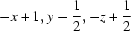
| Symmetry codes: (i) x, −y+3/2, z+1/2; (ii) −x+1, y−1/2, −z+1/2. |
Experimental details
| Crystal data | |
| Chemical formula | C6H6NO2+·HSO4− |
| Mr | 221.19 |
| Crystal system, space group | Monoclinic, P21/c |
| Temperature (K) | 293 |
| a, b, c (Å) | 8.2654 (17), 11.545 (2), 9.4669 (19) |
| β (°) | 109.43 (3) |
| V (Å3) | 851.9 (3) |
| Z | 4 |
| Radiation type | Mo Kα |
| µ (mm−1) | 0.39 |
| Crystal size (mm) | 0.25 × 0.2 × 0.2 |
| Data collection | |
| Diffractometer | Rigaku SCXmini diffractometer |
| Absorption correction | Multi-scan (CrystalClear; Rigaku, 2005) |
| Tmin, Tmax | 0.91, 0.93 |
| No. of measured, independent and observed [I > 2σ(I)] reflections | 8643, 1949, 1788 |
| Rint | 0.029 |
| (sin θ/λ)max (Å−1) | 0.649 |
| Refinement | |
| R[F2 > 2σ(F2)], wR(F2), S | 0.034, 0.090, 1.14 |
| No. of reflections | 1949 |
| No. of parameters | 127 |
| H-atom treatment | H-atom parameters constrained |
| Δρmax, Δρmin (e Å−3) | 0.21, −0.49 |
Computer programs: CrystalClear (Rigaku, 2005), SHELXS97 (Sheldrick, 2008), SHELXL97 (Sheldrick, 2008), SHELXTL (Sheldrick, 2008).
| D—H···A | D—H | H···A | D···A | D—H···A |
| O2—H2B···O3 | 0.85 | 1.83 | 2.6697 (18) | 169.1 |
| O6—H1···O5i | 0.89 | 1.73 | 2.6129 (17) | 170.2 |
| N1—H1B···O4ii | 0.86 | 2.11 | 2.843 (2) | 143.1 |
| Symmetry codes: (i) x, −y+3/2, z+1/2; (ii) −x+1, y−1/2, −z+1/2. |
Acknowledgements
This work was supported by a start-up grant from Southeast University to Professor Ren-Gen Xiong.
References
 Athimoolam, S. & Rajaram, R. K. (2005). Acta Cryst. E61, o2764–o2767. Web of Science CSD CrossRef IUCr Journals Google Scholar
Czupiński, O., Bator, G., Ciunik, Z., Jakubas, R., Medycki, W. & Świergiel, J. (2002). J. Phys. Condens. Matter, 14, 8497–8512. Google Scholar
Katrusiak, A. & Szafrański, M. (1999). Phys. Rev. Lett. 82, 576–579. Web of Science CrossRef CAS Google Scholar
Katrusiak, A. & Szafrański, M. (2006). J. Am. Chem. Soc. 128, 15775–15785. Web of Science CSD CrossRef PubMed CAS Google Scholar
Rigaku (2005). CrystalClear. Rigaku Corporation, Tokyo, Japan. Google Scholar
Sheldrick, G. M. (2008). Acta Cryst. A64, 112–122. Web of Science CrossRef CAS IUCr Journals Google Scholar
This is an open-access article distributed under the terms of the Creative Commons Attribution (CC-BY) Licence, which permits unrestricted use, distribution, and reproduction in any medium, provided the original authors and source are cited.
| CRYSTALLOGRAPHIC COMMUNICATIONS |


Recently, much attention has been devoted to simple molecular–ionic crystals containing organic cations and acid radicals (1:1molar ratio) due to the tunability of their special structural features and their interesting physical properties. (e.g. Czupiński et al., 2002; Katrusiak & Szafrański, 1999; Katrusiak & Szafrański, 2006) the crystal structure of dinicotinium sulfate compound have been reported (Athimoolam et al., 2005). In our laboratory, a compound containing protoned nicotinic acid and HSO4- anions has been synthesized, its crystal structure is reported herein.
The asymmetric unit of the title compound, C6H6NO2+.HSO4-, (Fig.1) consists of protoned nicotinic acid and HSO4- anions, the nicotinium cation is essentially planar. The protonation of the N site of the pyridine ring is demonstrated by the C—N bond distances and C—N—C bond angle. Usually, protonation on the aromatic ring leads to a slightly larger C—N—C bond angle (122.9 (2)°). Cations and anions are placed alternately and linked through intermolecular hydrogen bonds (Fig. 2 and Table 1). The structure of title compound C6H6NO2+.HSO4-, comprises discrete ions which are placed alternately and interconected by N—H···O and O—H···O hydrogen bonds leading to a neutral one-dimensional network along [001] direction. These hydrogen bonds appear to complement the Coulombic interaction and help to stabilize the structure further.