 | Acta Crystallographica Section E Acta Crystallographica Section E CRYSTALLOGRAPHIC COMMUNICATIONS |


 journal menu


organic compounds
| CRYSTALLOGRAPHIC COMMUNICATIONS |
 access
4-Acetylpyridinium hydrogen sulfate

aOrdered Matter Science Research Center, Southeast University, Nanjing 210096, People's Republic of China
*Correspondence e-mail: [email protected]
The of the title compound, C7H8NO+·HSO4−, consists of O—H⋯Ohydrogen-bonded extended chains of hydrogen sulfate anions. Each hydrogen sulfate anion is furthermore connected to one 4-acetylpyridinium cation via a hydrogen bond of the N—H⋯O type.
Related literature
For the synthesis of 4-acetylpyridine, see: Piner et al. (1934![[Piner, R. (1934). Ber. Deutsch Chem. Ges. B34, 4250-4251.]](../../../../../../logos/arrows/e_arr.gif "Piner, R. (1934). Ber. Deutsch Chem. Ges. B34, 4250-4251.") ). For the crystal structure of an adduct of 4-acetylpyridine with pentachlorophenol, see: Majerz et al. (1991). For the crystal structures of Zn and Ni complexes of 4-acetylpyridine, see: Pang et al. (1994); Steffen et al. (1977).
). For the crystal structure of an adduct of 4-acetylpyridine with pentachlorophenol, see: Majerz et al. (1991). For the crystal structures of Zn and Ni complexes of 4-acetylpyridine, see: Pang et al. (1994); Steffen et al. (1977).
![[Scheme 1]](im2126scheme1.gif)
Experimental
Crystal data
|
| ||||||||||||||||||||||
 ; (ii)
 Data collection: CrystalClear (Rigaku, 2005); cell refinement: CrystalClear; data reduction: CrystalClear; program(s) used to solve structure: SHELXS97 (Sheldrick, 2008); program(s) used to refine structure: SHELXL97 (Sheldrick, 2008); molecular graphics: SHELXTL (Sheldrick, 2008); software used to prepare material for publication: PRPKAPPA (Ferguson, 1999).
Supporting information
contains datablocks I, global. DOI: 10.1107/S1600536809035417/im2126sup1.cif
Structure factors: contains datablock I. DOI: 10.1107/S1600536809035417/im2126Isup2.hkl
4-Acetylpyridine was obtained according to the method described by Piner (1934). Reaction of equimolar amounts of 4-acetylpyridine and H2SO4 produced a precipitate. This was filtered off, dried and dissolved in 96% ethanol from which single crystals were grown by slow evaporation of the solvent at room temperature.
The H atom connected to O3 was discernible from difference electron-density map. Nevertheless, it was placed to the ideal position, with S1—O3—H angle tetrahedral, allowing the H atom to ride on the immediately preceding atom O3 and rotate about the S1—O3 bond, refined in a riding atom approximation with a constrained bond length of O—H = 0.82 Å. Positional parameters of the other H atoms were calculated geometrically with Car–H = 0.93 Å and CMe–H = 0.96 Å and were allowed to ride on the corresponding C atoms with Uiso(H) = 1.2 Ueq(C). In the absence of significant effects, 860 Friedel pairs were merged.
Data collection: CrystalClear (Rigaku, 2005); cell CrystalClear (Rigaku, 2005); data reduction: CrystalClear (Rigaku, 2005); program(s) used to solve structure: SHELXS97 (Sheldrick, 2008); program(s) used to refine structure: SHELXL97 (Sheldrick, 2008); molecular graphics: SHELXTL (Sheldrick, 2008); software used to prepare material for publication: PRPKAPPA (Ferguson, 1999).
![[Figure 1]](./im2126fig1thm.gif) | Fig. 1. Molecular structure of the title compound with the atomic numbering scheme. Displacement ellipsoids are drawn at the 30% probability level and all H atoms have been omitted for clarity. |
![[Figure 2]](./im2126fig2thm.gif) | Fig. 2. Crystal packing of the title compound, stacking along the b axis. Dashed lines indicate hydrogen bonds. |
| C7H8NO+·HSO4− | F(000) = 456 |
| Mr = 219.21 | Dx = 1.533 Mg m−3 |
| Orthorhombic, P212121 | Mo Kα radiation, λ = 0.71073 Å |
| Hall symbol: P 2ac 2ab | Cell parameters from 4231 reflections |
| a = 4.6454 (9) Å | θ = 3.6–27.6° |
| b = 9.597 (2) Å | µ = 0.34 mm−1 |
| c = 21.310 (4) Å | T = 298 K |
| V = 950.1 (3) Å3 | Prism, colourless |
| Z = 4 | 0.20 × 0.20 × 0.20 mm |
| Rigaku SCXmini diffractometer | 2156 independent reflections |
| Radiation source: fine-focus sealed tube | 1622 reflections with I > 2σ(I) |
| Graphite monochromator | Rint = 0.077 |
| Detector resolution: 13.6612 pixels mm-1 | θmax = 27.5°, θmin = 3.6° |
| ω scans | h = −6→6 |
| Absorption correction: multi-scan (CrystalClear; Rigaku, 2005) | k = −12→12 |
| Tmin = 0.935, Tmax = 0.935 | l = −27→27 |
| 9843 measured reflections |
| Refinement on F2 | Secondary atom site location: difference Fourier map |
| Least-squares matrix: full | Hydrogen site location: inferred from neighbouring sites |
| R[F2 > 2σ(F2)] = 0.053 | H-atom parameters constrained |
| wR(F2) = 0.170 | w = 1/[σ2(Fo2) + (0.1249P)2 + 1.8027P] where P = (Fo2 + 2Fc2)/3 |
| S = 0.93 | (Δ/σ)max < 0.001 |
| 2156 reflections | Δρmax = 0.38 e Å−3 |
| 129 parameters | Δρmin = −0.19 e Å−3 |
| 0 restraints | Absolute structure: Flack (1983), 860 Friedel pairs |
| Primary atom site location: structure-invariant direct methods | Absolute structure parameter: 0.2 (2) |
| C7H8NO+·HSO4− | V = 950.1 (3) Å3 |
| Mr = 219.21 | Z = 4 |
| Orthorhombic, P212121 | Mo Kα radiation |
| a = 4.6454 (9) Å | µ = 0.34 mm−1 |
| b = 9.597 (2) Å | T = 298 K |
| c = 21.310 (4) Å | 0.20 × 0.20 × 0.20 mm |
| Rigaku SCXmini diffractometer | 2156 independent reflections |
| Absorption correction: multi-scan (CrystalClear; Rigaku, 2005) | 1622 reflections with I > 2σ(I) |
| Tmin = 0.935, Tmax = 0.935 | Rint = 0.077 |
| 9843 measured reflections |
| R[F2 > 2σ(F2)] = 0.053 | H-atom parameters constrained |
| wR(F2) = 0.170 | Δρmax = 0.38 e Å−3 |
| S = 0.93 | Δρmin = −0.19 e Å−3 |
| 2156 reflections | Absolute structure: Flack (1983), 860 Friedel pairs |
| 129 parameters | Absolute structure parameter: 0.2 (2) |
| 0 restraints |
Geometry. All e.s.d.'s (except the e.s.d. in the dihedral angle between two l.s. planes) are estimated using the full covariance matrix. The cell e.s.d.'s are taken into account individually in the estimation of e.s.d.'s in distances, angles and torsion angles; correlations between e.s.d.'s in cell parameters are only used when they are defined by crystal symmetry. An approximate (isotropic) treatment of cell e.s.d.'s is used for estimating e.s.d.'s involving l.s. planes. |
Refinement. Refinement of F2 against ALL reflections. The weighted R-factor wR and goodness of fit S are based on F2, conventional R-factors R are based on F, with F set to zero for negative F2. The threshold expression of F2 > σ(F2) is used only for calculating R-factors(gt) etc. and is not relevant to the choice of reflections for refinement. R-factors based on F2 are statistically about twice as large as those based on F, and R- factors based on ALL data will be even larger. |
| x | y | z | Uiso*/Ueq | ||
| S1 | 0.9101 (2) | 0.18577 (10) | 0.16383 (5) | 0.0475 (3) | |
| O5 | −0.0805 (8) | 0.6665 (5) | 0.03394 (17) | 0.0853 (12) | |
| O1 | 1.0236 (7) | 0.3041 (3) | 0.19787 (16) | 0.0655 (9) | |
| N1 | 0.6303 (8) | 0.7352 (4) | 0.20080 (17) | 0.0573 (9) | |
| H1B | 0.7336 | 0.7648 | 0.2315 | 0.069* | |
| C3 | 0.3084 (8) | 0.6431 (4) | 0.10302 (18) | 0.0457 (9) | |
| C1 | 0.4610 (10) | 0.8250 (5) | 0.1713 (2) | 0.0614 (11) | |
| H1A | 0.4549 | 0.9175 | 0.1842 | 0.074* | |
| C6 | 0.1250 (13) | 0.5981 (6) | 0.0476 (2) | 0.0634 (13) | |
| C5 | 0.6477 (10) | 0.6005 (5) | 0.1849 (2) | 0.0548 (11) | |
| H5A | 0.7674 | 0.5403 | 0.2070 | 0.066* | |
| C4 | 0.4852 (9) | 0.5528 (5) | 0.1353 (2) | 0.0544 (11) | |
| H4A | 0.4949 | 0.4596 | 0.1236 | 0.065* | |
| C2 | 0.2960 (10) | 0.7819 (4) | 0.1223 (2) | 0.0546 (10) | |
| H2A | 0.1759 | 0.8446 | 0.1017 | 0.066* | |
| O2 | 0.6532 (7) | 0.2155 (4) | 0.1291 (2) | 0.0858 (12) | |
| O3 | 1.1265 (8) | 0.1454 (6) | 0.1117 (2) | 0.0968 (15) | |
| H3 | 1.2838 | 0.1802 | 0.1194 | 0.145* | |
| O4 | 0.8942 (13) | 0.0646 (4) | 0.2026 (2) | 0.1068 (15) | |
| C7 | 0.2139 (18) | 0.4694 (7) | 0.0132 (3) | 0.106 (2) | |
| H7A | 0.0795 | 0.4510 | −0.0200 | 0.160* | |
| H7B | 0.2166 | 0.3919 | 0.0417 | 0.160* | |
| H7C | 0.4026 | 0.4824 | −0.0042 | 0.160* |
| U11 | U22 | U33 | U12 | U13 | U23 | |
| S1 | 0.0356 (4) | 0.0481 (5) | 0.0588 (5) | −0.0017 (4) | −0.0011 (4) | −0.0066 (5) |
| O5 | 0.058 (2) | 0.121 (3) | 0.077 (2) | −0.004 (3) | −0.0169 (19) | 0.008 (2) |
| O1 | 0.069 (2) | 0.0471 (16) | 0.080 (2) | 0.0051 (15) | −0.0109 (17) | −0.0183 (15) |
| N1 | 0.046 (2) | 0.073 (2) | 0.0531 (19) | −0.0074 (18) | 0.0000 (17) | −0.0004 (17) |
| C3 | 0.0372 (18) | 0.054 (2) | 0.0459 (19) | −0.0021 (16) | 0.0076 (16) | 0.0062 (17) |
| C1 | 0.063 (3) | 0.049 (2) | 0.072 (3) | −0.003 (2) | 0.002 (2) | 0.000 (2) |
| C6 | 0.059 (3) | 0.083 (3) | 0.048 (2) | −0.016 (3) | 0.009 (2) | 0.003 (2) |
| C5 | 0.044 (2) | 0.066 (3) | 0.054 (2) | 0.007 (2) | −0.0010 (19) | 0.0119 (19) |
| C4 | 0.060 (3) | 0.045 (2) | 0.058 (2) | 0.0030 (19) | 0.014 (2) | 0.0029 (18) |
| C2 | 0.055 (2) | 0.047 (2) | 0.062 (2) | 0.0078 (19) | 0.001 (2) | 0.0075 (19) |
| O2 | 0.0428 (18) | 0.096 (3) | 0.118 (3) | 0.0099 (17) | −0.021 (2) | −0.021 (2) |
| O3 | 0.0471 (19) | 0.145 (4) | 0.098 (3) | −0.010 (2) | 0.001 (2) | −0.060 (3) |
| O4 | 0.137 (4) | 0.073 (2) | 0.110 (3) | −0.039 (3) | −0.028 (3) | 0.022 (2) |
| C7 | 0.128 (6) | 0.110 (5) | 0.081 (4) | 0.002 (5) | −0.020 (4) | −0.039 (4) |
| S1—O4 | 1.429 (4) | C1—C2 | 1.360 (6) |
| S1—O2 | 1.433 (4) | C1—H1A | 0.9300 |
| S1—O1 | 1.447 (3) | C6—C7 | 1.495 (8) |
| S1—O3 | 1.547 (4) | C5—C4 | 1.378 (6) |
| O5—C6 | 1.194 (7) | C5—H5A | 0.9300 |
| N1—C1 | 1.325 (6) | C4—H4A | 0.9300 |
| N1—C5 | 1.339 (6) | C2—H2A | 0.9300 |
| N1—H1B | 0.8600 | O3—H3 | 0.8200 |
| C3—C4 | 1.378 (6) | C7—H7A | 0.9600 |
| C3—C2 | 1.395 (6) | C7—H7B | 0.9600 |
| C3—C6 | 1.519 (6) | C7—H7C | 0.9600 |
| O4—S1—O2 | 114.7 (3) | C7—C6—C3 | 117.5 (5) |
| O4—S1—O1 | 111.6 (2) | N1—C5—C4 | 118.8 (4) |
| O2—S1—O1 | 113.9 (2) | N1—C5—H5A | 120.6 |
| O4—S1—O3 | 104.2 (3) | C4—C5—H5A | 120.6 |
| O2—S1—O3 | 102.7 (2) | C5—C4—C3 | 120.0 (4) |
| O1—S1—O3 | 108.7 (2) | C5—C4—H4A | 120.0 |
| C1—N1—C5 | 122.9 (4) | C3—C4—H4A | 120.0 |
| C1—N1—H1B | 118.5 | C1—C2—C3 | 119.5 (4) |
| C5—N1—H1B | 118.5 | C1—C2—H2A | 120.2 |
| C4—C3—C2 | 118.6 (4) | C3—C2—H2A | 120.2 |
| C4—C3—C6 | 123.0 (4) | S1—O3—H3 | 109.5 |
| C2—C3—C6 | 118.5 (4) | C6—C7—H7A | 109.5 |
| N1—C1—C2 | 120.1 (4) | C6—C7—H7B | 109.5 |
| N1—C1—H1A | 120.0 | H7A—C7—H7B | 109.5 |
| C2—C1—H1A | 120.0 | C6—C7—H7C | 109.5 |
| O5—C6—C7 | 123.8 (5) | H7A—C7—H7C | 109.5 |
| O5—C6—C3 | 118.8 (5) | H7B—C7—H7C | 109.5 |
| C5—N1—C1—C2 | −0.4 (7) | N1—C5—C4—C3 | −0.1 (6) |
| C4—C3—C6—O5 | 157.9 (4) | C2—C3—C4—C5 | −0.8 (6) |
| C2—C3—C6—O5 | −21.8 (6) | C6—C3—C4—C5 | 179.5 (4) |
| C4—C3—C6—C7 | −21.9 (6) | N1—C1—C2—C3 | −0.5 (7) |
| C2—C3—C6—C7 | 158.4 (5) | C4—C3—C2—C1 | 1.1 (6) |
| C1—N1—C5—C4 | 0.7 (7) | C6—C3—C2—C1 | −179.2 (4) |
| D—H···A | D—H | H···A | D···A | D—H···A |
| N1—H1B···O1i | 0.86 | 1.92 | 2.772 (5) | 172 |
| O3—H3···O2ii | 0.82 | 1.76 | 2.565 (5) | 166 |
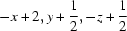
| Symmetry codes: (i) −x+2, y+1/2, −z+1/2; (ii) x+1, y, z. |
Experimental details
| Crystal data | |
| Chemical formula | C7H8NO+·HSO4− |
| Mr | 219.21 |
| Crystal system, space group | Orthorhombic, P212121 |
| Temperature (K) | 298 |
| a, b, c (Å) | 4.6454 (9), 9.597 (2), 21.310 (4) |
| V (Å3) | 950.1 (3) |
| Z | 4 |
| Radiation type | Mo Kα |
| µ (mm−1) | 0.34 |
| Crystal size (mm) | 0.20 × 0.20 × 0.20 |
| Data collection | |
| Diffractometer | Rigaku SCXmini diffractometer |
| Absorption correction | Multi-scan (CrystalClear; Rigaku, 2005) |
| Tmin, Tmax | 0.935, 0.935 |
| No. of measured, independent and observed [I > 2σ(I)] reflections | 9843, 2156, 1622 |
| Rint | 0.077 |
| (sin θ/λ)max (Å−1) | 0.649 |
| Refinement | |
| R[F2 > 2σ(F2)], wR(F2), S | 0.053, 0.170, 0.93 |
| No. of reflections | 2156 |
| No. of parameters | 129 |
| H-atom treatment | H-atom parameters constrained |
| Δρmax, Δρmin (e Å−3) | 0.38, −0.19 |
| Absolute structure | Flack (1983), 860 Friedel pairs |
| Absolute structure parameter | 0.2 (2) |
Computer programs: CrystalClear (Rigaku, 2005), SHELXS97 (Sheldrick, 2008), SHELXL97 (Sheldrick, 2008), SHELXTL (Sheldrick, 2008), PRPKAPPA (Ferguson, 1999).
| D—H···A | D—H | H···A | D···A | D—H···A |
| N1—H1B···O1i | 0.86 | 1.92 | 2.772 (5) | 172.0 |
| O3—H3···O2ii | 0.82 | 1.76 | 2.565 (5) | 166.0 |
| Symmetry codes: (i) −x+2, y+1/2, −z+1/2; (ii) x+1, y, z. |
Acknowledgements
The authors are grateful to the starter fund of Southeast University for financial support to buy the X-ray diffractometer.
References
 Ferguson, G. (1999). PRPKAPPA. University of Guelph, Canada. Google Scholar
Flack, H. D. (1983). Acta Cryst. A39, 876–881. CrossRef CAS Web of Science IUCr Journals Google Scholar
Majerz, I., Malarski, Z. & Sawka-Dobrowolska, W. (1991). J. Mol. Struct. 249,109–116. CSD CrossRef CAS Web of Science Google Scholar
Pang, L., Whitehead, M. A., Bermardinelli, G. & Lucken, E. A. C. (1994). J. Chem. Crystallogr. 24, 203–211. CSD CrossRef CAS Web of Science Google Scholar
Piner, R. (1934). Ber. Deutsch Chem. Ges. B34, 4250–4251. Google Scholar
Rigaku (2005). CrystalClear. Rigaku Corporation, Tokyo, Japan. Google Scholar
Sheldrick, G. M. (2008). Acta Cryst. A64, 112–122. Web of Science CrossRef CAS IUCr Journals Google Scholar
Steffen, W. L. & Palenik, G. J. (1977). Inorg. Chem. 16, 1119–1128. CSD CrossRef CAS Web of Science Google Scholar
This is an open-access article distributed under the terms of the Creative Commons Attribution (CC-BY) Licence, which permits unrestricted use, distribution, and reproduction in any medium, provided the original authors and source are cited.
| CRYSTALLOGRAPHIC COMMUNICATIONS |


4-Acetylpyridine may be used as a ligand in coordination compounds e.g. with Zn (Steffen & Palenik, 1977) or Ni (Pang et al., 1994). The crystal structure of 4-acetylpyridine together with pentachlorophenol is also known (Majerz et al., 1991).
The asymmetric unit of the title compound contains one 4-acetylpyridinium cation and one hydrogen sulfate anion (Fig 1). In the anion, the bond length of S1—O3 is 1.553 (6) Å compared to the average bond length of 1.438 (5) Å of the other S1—O bonds. It is therefore reasonable that the hydrogen atom of hydrogen sulfate is bonded to O3. The supramolecular structure consists of infinite chains of anions with one cation linked to each anion via an additional hydrogen bond (N1—H1B···O1 2.774 (8) Å, Fig 2).