 | Acta Crystallographica Section E Acta Crystallographica Section E CRYSTALLOGRAPHIC COMMUNICATIONS |


 journal menu


metal-organic compounds
| CRYSTALLOGRAPHIC COMMUNICATIONS |
 access
(2-Amino-4,6-dimethylpyrimidine-κN1)(2-amino-4-methylpyrimidine-κN1)silver(I) perchlorate

aDepartment of Chemistry, Mudanjiang Teachers College, Mudanjiang 157012, People's Republic of China
*Correspondence e-mail: [email protected]
Colourless crystals of the title mixed ligand complex, [Ag(C5H7N3)(C6H9N3)]ClO4, were obtained from a solution of 2-amino-4-methylpyrimidine, 2-amino-4,6-dimethylpyrimidine and silver perchlorate in water and methanol. The crystal structure is stabilized by intermolecular N—H⋯O and N—H⋯N hydrogen bonds and π–π stacking interactions of the aromatic rings of the two ligands [interplanar distance = 3.652 (10) Å]. The AgI atom shows a linear coordination [N—Ag—N = 174.6 (1)°].
Related literature
For N—Ag—N geometry, see: Greenwood & Earnshaw (1997![[Greenwood, N. N. & Earnshaw, A. (1997). In Chemistry of the Elements, 2nd ed. Oxford: Pergamon Press.]](../../../../../../logos/arrows/e_arr.gif "Greenwood, N. N. & Earnshaw, A. (1997). In Chemistry of the Elements, 2nd ed. Oxford: Pergamon Press.") ). For π–π stacking, see: Munakata et al. (2000). For silver coordination networks, see: Shimizu et al. (1999); Seward et al. (2004).
). For π–π stacking, see: Munakata et al. (2000). For silver coordination networks, see: Shimizu et al. (1999); Seward et al. (2004).
![[Scheme 1]](ng2621scheme1.gif)
Experimental
Crystal data
|
Refinement
|
|
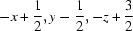 ; (ii)
 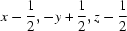 ; (iii)
 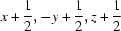 .
. Data collection: APEX2 (Bruker, 2005); cell refinement: SAINT (Bruker, 2005); data reduction: SAINT; program(s) used to solve structure: SHELXS97 (Sheldrick, 2008); program(s) used to refine structure: SHELXL97 (Sheldrick, 2008); molecular graphics: ORTEP-3 for Windows (Farrugia, 1997); software used to prepare material for publication: WinGX (Farrugia, 1999).
Supporting information
contains datablocks I, global. DOI: 10.1107/S1600536809035193/ng2621sup1.cif
Structure factors: contains datablock I. DOI: 10.1107/S1600536809035193/ng2621Isup2.hkl
A solution of 108 mg (1 mmol) 2-amino-4-methylpyrimidine and 123 mg (1 mmol) of 2-amino-4,6-dimethylpyrimidine in distilled water-CH3OH (1:1 v/v, 10 mL) was added to an aqueous solution of AgClO4 208 mg (1 mmol) in 3 ml distilled water at 333 K. A small amount of white precipitate was removed from the resulting solution. Prism colorless crystals were obtained by slow evaporation at room temperature over a period of 3 days.
All H atoms were placed in calculated positions and refined as riding, with C–H = 0.96–0.98 Å, and N–H = 0.86 Å, and Uiso(H) = 1.2 or 1.5Ueq(C,N). The final difference map had a peak near Ag1.
Data collection: APEX2 (Bruker, 2005); cell SAINT (Bruker, 2005); data reduction: SAINT (Bruker, 2005); program(s) used to solve structure: SHELXS97 (Sheldrick, 2008); program(s) used to refine structure: SHELXL97 (Sheldrick, 2008); molecular graphics: ORTEP-3 for Windows (Farrugia, 1997); software used to prepare material for publication: WinGX (Farrugia, 1999).
![[Figure 1]](./ng2621fig1thm.gif) | Fig. 1. The molecular structure with atom labels and 30% probability displacement ellipsoids for non-H atoms. |
![[Figure 2]](./ng2621fig2thm.gif) | Fig. 2. The packing diagram of molecules, viewed down the b axis, with the weak interactions shown as dashed lines. |
| [Ag(C5H7N3)(C6H9N3)]ClO4 | F(000) = 880 |
| Mr = 439.62 | Dx = 1.886 Mg m−3 |
| Monoclinic, P21/n | Mo Kα radiation, λ = 0.71073 Å |
| Hall symbol: -P 2yn | Cell parameters from 2795 reflections |
| a = 12.3952 (5) Å | θ = 2.6–32.8° |
| b = 7.8324 (4) Å | µ = 1.50 mm−1 |
| c = 15.9956 (5) Å | T = 120 K |
| β = 94.339 (3)° | Prism, colourless |
| V = 1548.47 (11) Å3 | 0.40 × 0.40 × 0.25 mm |
| Z = 4 |
| Bruker APEXII diffractometer | 2678 independent reflections |
| Radiation source: fine-focus sealed tube | 2254 reflections with I > 2σ(I) |
| Graphite monochromator | Rint = 0.028 |
| ϕ and ω scans | θmax = 25.0°, θmin = 2.6° |
| Absorption correction: multi-scan (SADABS; Bruker, 2005) | h = −14→14 |
| Tmin = 0.553, Tmax = 0.678 | k = −8→9 |
| 8880 measured reflections | l = −19→19 |
| Refinement on F2 | Primary atom site location: structure-invariant direct methods |
| Least-squares matrix: full | Secondary atom site location: difference Fourier map |
| R[F2 > 2σ(F2)] = 0.037 | Hydrogen site location: inferred from neighbouring sites |
| wR(F2) = 0.100 | H-atom parameters constrained |
| S = 1.07 | w = 1/[σ2(Fo2) + (0.0544P)2 + 2.3112P] where P = (Fo2 + 2Fc2)/3 |
| 2678 reflections | (Δ/σ)max = 0.001 |
| 211 parameters | Δρmax = 1.36 e Å−3 |
| 0 restraints | Δρmin = −0.53 e Å−3 |
| [Ag(C5H7N3)(C6H9N3)]ClO4 | V = 1548.47 (11) Å3 |
| Mr = 439.62 | Z = 4 |
| Monoclinic, P21/n | Mo Kα radiation |
| a = 12.3952 (5) Å | µ = 1.50 mm−1 |
| b = 7.8324 (4) Å | T = 120 K |
| c = 15.9956 (5) Å | 0.40 × 0.40 × 0.25 mm |
| β = 94.339 (3)° |
| Bruker APEXII diffractometer | 2678 independent reflections |
| Absorption correction: multi-scan (SADABS; Bruker, 2005) | 2254 reflections with I > 2σ(I) |
| Tmin = 0.553, Tmax = 0.678 | Rint = 0.028 |
| 8880 measured reflections |
| R[F2 > 2σ(F2)] = 0.037 | 0 restraints |
| wR(F2) = 0.100 | H-atom parameters constrained |
| S = 1.07 | Δρmax = 1.36 e Å−3 |
| 2678 reflections | Δρmin = −0.53 e Å−3 |
| 211 parameters |
Geometry. All e.s.d.'s (except the e.s.d. in the dihedral angle between two l.s. planes) are estimated using the full covariance matrix. The cell e.s.d.'s are taken into account individually in the estimation of e.s.d.'s in distances, angles and torsion angles; correlations between e.s.d.'s in cell parameters are only used when they are defined by crystal symmetry. An approximate (isotropic) treatment of cell e.s.d.'s is used for estimating e.s.d.'s involving l.s. planes. |
Refinement. Refinement of F2 against ALL reflections. The weighted R-factor wR and goodness of fit S are based on F2, conventional R-factors R are based on F, with F set to zero for negative F2. The threshold expression of F2 > σ(F2) is used only for calculating R-factors(gt) etc. and is not relevant to the choice of reflections for refinement. R-factors based on F2 are statistically about twice as large as those based on F, and R- factors based on ALL data will be even larger. |
| x | y | z | Uiso*/Ueq | ||
| Ag1 | 0.19079 (3) | 0.45483 (5) | 0.720510 (19) | 0.04423 (15) | |
| C1 | 0.1554 (4) | 0.3648 (7) | 0.3245 (3) | 0.0544 (12) | |
| H1A | 0.1108 | 0.2682 | 0.3087 | 0.082* | |
| H1B | 0.2261 | 0.3487 | 0.3051 | 0.082* | |
| H1C | 0.1235 | 0.4663 | 0.2998 | 0.082* | |
| C2 | 0.1644 (3) | 0.3818 (5) | 0.4169 (3) | 0.0373 (9) | |
| C3 | 0.0929 (3) | 0.3330 (5) | 0.5423 (2) | 0.0332 (9) | |
| C4 | 0.2530 (4) | 0.4782 (6) | 0.5433 (3) | 0.0398 (10) | |
| H4A | 0.3106 | 0.5345 | 0.5720 | 0.048* | |
| C5 | 0.2516 (4) | 0.4648 (6) | 0.4585 (3) | 0.0410 (10) | |
| H5A | 0.3073 | 0.5097 | 0.4294 | 0.049* | |
| C6 | 0.3056 (3) | 0.4035 (5) | 0.8973 (2) | 0.0316 (8) | |
| C7 | 0.1481 (3) | 0.5552 (5) | 0.9020 (3) | 0.0369 (9) | |
| C8 | 0.0587 (4) | 0.6489 (7) | 0.8581 (3) | 0.0566 (13) | |
| H8A | 0.0871 | 0.7365 | 0.8240 | 0.085* | |
| H8B | 0.0149 | 0.7000 | 0.8983 | 0.085* | |
| H8C | 0.0153 | 0.5717 | 0.8231 | 0.085* | |
| C9 | 0.1577 (4) | 0.5429 (6) | 0.9877 (3) | 0.0419 (10) | |
| H9A | 0.1075 | 0.5953 | 1.0197 | 0.050* | |
| C10 | 0.2424 (4) | 0.4521 (5) | 1.0253 (3) | 0.0380 (9) | |
| C11 | 0.2548 (5) | 0.4273 (8) | 1.1177 (3) | 0.0606 (14) | |
| H11A | 0.3269 | 0.4582 | 1.1384 | 0.091* | |
| H11B | 0.2420 | 0.3097 | 1.1307 | 0.091* | |
| H11C | 0.2037 | 0.4979 | 1.1437 | 0.091* | |
| N1 | 0.2212 (3) | 0.4824 (4) | 0.8553 (2) | 0.0319 (7) | |
| N2 | 0.3831 (3) | 0.3336 (4) | 0.8522 (2) | 0.0383 (8) | |
| H2A | 0.4366 | 0.2798 | 0.8774 | 0.046* | |
| H2B | 0.3785 | 0.3430 | 0.7985 | 0.046* | |
| N3 | 0.3176 (3) | 0.3841 (5) | 0.9803 (2) | 0.0365 (8) | |
| N4 | 0.1743 (3) | 0.4133 (4) | 0.5875 (2) | 0.0350 (8) | |
| N5 | 0.0136 (3) | 0.2635 (5) | 0.5824 (2) | 0.0455 (9) | |
| H5B | −0.0386 | 0.2113 | 0.5545 | 0.055* | |
| H5C | 0.0144 | 0.2708 | 0.6360 | 0.055* | |
| N6 | 0.0857 (3) | 0.3161 (4) | 0.4580 (2) | 0.0361 (8) | |
| Cl1 | 0.50494 (9) | 0.64276 (14) | 0.68793 (6) | 0.0412 (3) | |
| O1 | 0.4928 (3) | 0.6816 (5) | 0.6012 (2) | 0.0629 (10) | |
| O2 | 0.4001 (3) | 0.6130 (5) | 0.7187 (2) | 0.0617 (9) | |
| O3 | 0.5697 (3) | 0.4961 (5) | 0.7031 (3) | 0.0666 (10) | |
| O4 | 0.5523 (4) | 0.7822 (6) | 0.7327 (3) | 0.0775 (12) |
| U11 | U22 | U33 | U12 | U13 | U23 | |
| Ag1 | 0.0420 (2) | 0.0623 (3) | 0.02780 (19) | −0.00167 (16) | −0.00078 (13) | −0.00457 (14) |
| C1 | 0.062 (3) | 0.071 (3) | 0.030 (2) | −0.007 (3) | 0.003 (2) | 0.006 (2) |
| C2 | 0.044 (2) | 0.037 (2) | 0.031 (2) | 0.0077 (19) | 0.0058 (18) | 0.0064 (17) |
| C3 | 0.036 (2) | 0.035 (2) | 0.0282 (19) | 0.0065 (17) | 0.0038 (16) | 0.0023 (16) |
| C4 | 0.035 (2) | 0.043 (2) | 0.041 (2) | 0.0017 (19) | −0.0023 (18) | 0.0003 (19) |
| C5 | 0.041 (2) | 0.045 (2) | 0.038 (2) | −0.001 (2) | 0.0064 (19) | 0.0027 (19) |
| C6 | 0.036 (2) | 0.032 (2) | 0.0266 (19) | −0.0052 (17) | 0.0030 (16) | −0.0023 (15) |
| C7 | 0.038 (2) | 0.031 (2) | 0.041 (2) | −0.0037 (18) | 0.0006 (18) | −0.0006 (17) |
| C8 | 0.060 (3) | 0.062 (3) | 0.047 (3) | 0.008 (3) | 0.001 (2) | 0.007 (2) |
| C9 | 0.049 (3) | 0.038 (2) | 0.041 (2) | −0.005 (2) | 0.018 (2) | −0.0107 (19) |
| C10 | 0.045 (2) | 0.037 (2) | 0.032 (2) | −0.004 (2) | 0.0037 (18) | −0.0054 (17) |
| C11 | 0.074 (4) | 0.078 (4) | 0.031 (2) | 0.008 (3) | 0.009 (2) | −0.006 (2) |
| N1 | 0.0344 (17) | 0.0330 (17) | 0.0285 (16) | −0.0038 (14) | 0.0044 (14) | −0.0037 (13) |
| N2 | 0.0432 (19) | 0.047 (2) | 0.0250 (16) | 0.0066 (16) | 0.0074 (14) | 0.0008 (14) |
| N3 | 0.0381 (18) | 0.0430 (19) | 0.0288 (17) | −0.0001 (16) | 0.0050 (14) | −0.0035 (15) |
| N4 | 0.0326 (17) | 0.0402 (19) | 0.0318 (17) | 0.0028 (15) | −0.0010 (14) | 0.0000 (14) |
| N5 | 0.047 (2) | 0.063 (2) | 0.0269 (17) | −0.0130 (19) | 0.0049 (15) | −0.0005 (17) |
| N6 | 0.0416 (19) | 0.0403 (19) | 0.0264 (16) | 0.0019 (16) | 0.0011 (14) | 0.0031 (14) |
| Cl1 | 0.0467 (6) | 0.0444 (6) | 0.0331 (5) | −0.0052 (5) | 0.0068 (4) | 0.0038 (4) |
| O1 | 0.064 (2) | 0.090 (3) | 0.0356 (17) | −0.004 (2) | 0.0119 (16) | 0.0148 (17) |
| O2 | 0.053 (2) | 0.086 (3) | 0.049 (2) | −0.0050 (19) | 0.0193 (16) | 0.0121 (18) |
| O3 | 0.067 (2) | 0.058 (2) | 0.074 (3) | 0.0125 (18) | 0.000 (2) | 0.0080 (19) |
| O4 | 0.092 (3) | 0.077 (3) | 0.063 (2) | −0.031 (2) | −0.001 (2) | −0.007 (2) |
| Ag1—N4 | 2.146 (3) | C7—C8 | 1.465 (7) |
| Ag1—N1 | 2.171 (3) | C8—H8A | 0.9600 |
| C1—C2 | 1.479 (6) | C8—H8B | 0.9600 |
| C1—H1A | 0.9600 | C8—H8C | 0.9600 |
| C1—H1B | 0.9600 | C9—C10 | 1.370 (7) |
| C1—H1C | 0.9600 | C9—H9A | 0.9300 |
| C2—N6 | 1.322 (6) | C10—N3 | 1.330 (6) |
| C2—C5 | 1.387 (6) | C10—C11 | 1.487 (6) |
| C3—N5 | 1.330 (6) | C11—H11A | 0.9600 |
| C3—N6 | 1.351 (5) | C11—H11B | 0.9600 |
| C3—N4 | 1.352 (5) | C11—H11C | 0.9600 |
| C4—N4 | 1.347 (6) | N2—H2A | 0.8600 |
| C4—C5 | 1.360 (6) | N2—H2B | 0.8600 |
| C4—H4A | 0.9300 | N5—H5B | 0.8600 |
| C5—H5A | 0.9300 | N5—H5C | 0.8600 |
| C6—N3 | 1.334 (5) | Cl1—O4 | 1.409 (4) |
| C6—N1 | 1.350 (5) | Cl1—O3 | 1.412 (4) |
| C6—N2 | 1.359 (5) | Cl1—O1 | 1.417 (3) |
| C7—N1 | 1.344 (6) | Cl1—O2 | 1.443 (4) |
| C7—C9 | 1.370 (6) | ||
| N4—Ag1—N1 | 174.61 (13) | C7—C9—H9A | 120.6 |
| C2—C1—H1A | 109.5 | C10—C9—H9A | 120.6 |
| C2—C1—H1B | 109.5 | N3—C10—C9 | 121.0 (4) |
| H1A—C1—H1B | 109.5 | N3—C10—C11 | 117.4 (4) |
| C2—C1—H1C | 109.5 | C9—C10—C11 | 121.5 (4) |
| H1A—C1—H1C | 109.5 | C10—C11—H11A | 109.5 |
| H1B—C1—H1C | 109.5 | C10—C11—H11B | 109.5 |
| N6—C2—C5 | 121.4 (4) | H11A—C11—H11B | 109.5 |
| N6—C2—C1 | 117.3 (4) | C10—C11—H11C | 109.5 |
| C5—C2—C1 | 121.3 (4) | H11A—C11—H11C | 109.5 |
| N5—C3—N6 | 116.4 (4) | H11B—C11—H11C | 109.5 |
| N5—C3—N4 | 118.8 (4) | C7—N1—C6 | 116.6 (3) |
| N6—C3—N4 | 124.7 (4) | C7—N1—Ag1 | 121.4 (3) |
| N4—C4—C5 | 122.7 (4) | C6—N1—Ag1 | 121.2 (3) |
| N4—C4—H4A | 118.6 | C6—N2—H2A | 120.0 |
| C5—C4—H4A | 118.6 | C6—N2—H2B | 120.0 |
| C4—C5—C2 | 117.7 (4) | H2A—N2—H2B | 120.0 |
| C4—C5—H5A | 121.1 | C10—N3—C6 | 117.6 (4) |
| C2—C5—H5A | 121.1 | C4—N4—C3 | 115.8 (4) |
| N3—C6—N1 | 124.8 (4) | C4—N4—Ag1 | 116.4 (3) |
| N3—C6—N2 | 116.9 (4) | C3—N4—Ag1 | 127.7 (3) |
| N1—C6—N2 | 118.2 (3) | C3—N5—H5B | 120.0 |
| N1—C7—C9 | 121.1 (4) | C3—N5—H5C | 120.0 |
| N1—C7—C8 | 117.6 (4) | H5B—N5—H5C | 120.0 |
| C9—C7—C8 | 121.3 (4) | C2—N6—C3 | 117.6 (4) |
| C7—C8—H8A | 109.5 | O4—Cl1—O3 | 109.5 (3) |
| C7—C8—H8B | 109.5 | O4—Cl1—O1 | 109.9 (2) |
| H8A—C8—H8B | 109.5 | O3—Cl1—O1 | 111.1 (3) |
| C7—C8—H8C | 109.5 | O4—Cl1—O2 | 107.6 (3) |
| H8A—C8—H8C | 109.5 | O3—Cl1—O2 | 109.0 (3) |
| H8B—C8—H8C | 109.5 | O1—Cl1—O2 | 109.6 (2) |
| C7—C9—C10 | 118.8 (4) |
| D—H···A | D—H | H···A | D···A | D—H···A |
| N5—H5C···O4i | 0.86 | 2.32 | 3.131 (5) | 158 |
| N5—H5B···N3ii | 0.86 | 2.20 | 3.050 (5) | 172 |
| N2—H2B···O2 | 0.86 | 2.50 | 3.077 (5) | 126 |
| N2—H2A···N6iii | 0.86 | 2.30 | 3.147 (5) | 169 |
| C1—H1C···O4iv | 0.96 | 2.38 | 3.339 (7) | 177 |
| C4—H4A···O1 | 0.93 | 2.55 | 3.437 (6) | 160 |
| C4—H4A···O2 | 0.93 | 2.59 | 3.396 (6) | 145 |
| C8—H8C···O4i | 0.96 | 2.55 | 3.456 (7) | 157 |
| Symmetry codes: (i) −x+1/2, y−1/2, −z+3/2; (ii) x−1/2, −y+1/2, z−1/2; (iii) x+1/2, −y+1/2, z+1/2; (iv) x−1/2, −y+3/2, z−1/2. |
Experimental details
| Crystal data | |
| Chemical formula | [Ag(C5H7N3)(C6H9N3)]ClO4 |
| Mr | 439.62 |
| Crystal system, space group | Monoclinic, P21/n |
| Temperature (K) | 120 |
| a, b, c (Å) | 12.3952 (5), 7.8324 (4), 15.9956 (5) |
| β (°) | 94.339 (3) |
| V (Å3) | 1548.47 (11) |
| Z | 4 |
| Radiation type | Mo Kα |
| µ (mm−1) | 1.50 |
| Crystal size (mm) | 0.40 × 0.40 × 0.25 |
| Data collection | |
| Diffractometer | Bruker APEXII diffractometer |
| Absorption correction | Multi-scan (SADABS; Bruker, 2005) |
| Tmin, Tmax | 0.553, 0.678 |
| No. of measured, independent and observed [I > 2σ(I)] reflections | 8880, 2678, 2254 |
| Rint | 0.028 |
| (sin θ/λ)max (Å−1) | 0.595 |
| Refinement | |
| R[F2 > 2σ(F2)], wR(F2), S | 0.037, 0.100, 1.07 |
| No. of reflections | 2678 |
| No. of parameters | 211 |
| H-atom treatment | H-atom parameters constrained |
| Δρmax, Δρmin (e Å−3) | 1.36, −0.53 |
Computer programs: APEX2 (Bruker, 2005), SAINT (Bruker, 2005), SHELXS97 (Sheldrick, 2008), SHELXL97 (Sheldrick, 2008), ORTEP-3 for Windows (Farrugia, 1997), WinGX (Farrugia, 1999).
| D—H···A | D—H | H···A | D···A | D—H···A |
| N5—H5C···O4i | 0.86 | 2.32 | 3.131 (5) | 158 |
| N5—H5B···N3ii | 0.86 | 2.20 | 3.050 (5) | 172 |
| N2—H2B···O2 | 0.86 | 2.50 | 3.077 (5) | 126 |
| N2—H2A···N6iii | 0.86 | 2.30 | 3.147 (5) | 169 |
| Symmetry codes: (i) −x+1/2, y−1/2, −z+3/2; (ii) x−1/2, −y+1/2, z−1/2; (iii) x+1/2, −y+1/2, z+1/2. |
Acknowledgements
The author thanks the Natural Science Foundation of Heilongjiang Province for financial support.
References
 Bruker (2005). APEX2, SAINT and SADABS. Bruker AXS Inc., Madison, Wisconsin, USA. Google Scholar
Farrugia, L. J. (1997). J. Appl. Cryst. 30, 565. CrossRef IUCr Journals Google Scholar
Farrugia, L. J. (1999). J. Appl. Cryst. 32, 837–838. CrossRef CAS IUCr Journals Google Scholar
Greenwood, N. N. & Earnshaw, A. (1997). In Chemistry of the Elements, 2nd ed. Oxford: Pergamon Press. Google Scholar
Munakata, M., Wu, L. P. & Ning, G. L. (2000). Coord. Chem. Rev. 198, 171–203. Web of Science CrossRef CAS Google Scholar
Seward, C., Jia, W. L., Wang, R. Y., Enright, G. D. & Wang, S. (2004). Angew. Chem. Int. Ed. Engl. 43, 2933–2936. Web of Science CSD CrossRef PubMed CAS Google Scholar
Sheldrick, G. M. (2008). Acta Cryst. A64, 112–122. Web of Science CrossRef CAS IUCr Journals Google Scholar
Shimizu, G. K. H., Enright, G. D., Ratcliffe, C. I., Preston, K. F., Reid, J. L. & Ripmeester, J. A. (1999). Chem. Commun. pp. 1485–1486. Web of Science CSD CrossRef Google Scholar
This is an open-access article distributed under the terms of the Creative Commons Attribution (CC-BY) Licence, which permits unrestricted use, distribution, and reproduction in any medium, provided the original authors and source are cited.
| CRYSTALLOGRAPHIC COMMUNICATIONS |


The structure of the title compound (I) comprises of uncoordinated ClO4- anions and [Ag(2-amino-4-methylpyrimidine)(2-amino-4,6-dimethylpyrimidine)]+ cations. The central silver(I) ion, possessing its vacant s and p orbitals, coordinated to two nitrogen atoms from those two different pyrimidine derivative ligands, presenting nearly linear N-Ag-N geometry Greenwood et al., 1997). An one dimensional framework was built by multiple intermolecular N–H–N hydrogen bonds along one of the diagonals of a and c axial plane, while pi–pi stacking interaction of the aromatic rings with an interplane distance 3.65 Å stabilized the whole crystal structure (Munakata et al., 2000).