 | Acta Crystallographica Section E Acta Crystallographica Section E CRYSTALLOGRAPHIC COMMUNICATIONS |


 journal menu


organic compounds
| CRYSTALLOGRAPHIC COMMUNICATIONS |
 access
4-Methyl-2H-1,3-oxazine-2,6(3H)-dione

aDepartment of Chemistry, Bucknell University, Lewisburg, PA 17837, USA
*Correspondence e-mail: [email protected]
In the title compound, C5H5NO3, the planar (maximum deviation = 0.075 Å for the ring O atom) molecules form N—H⋯O hydrogen bonds in a zigzag chain (C—O⋯N bond angle ≃ 140°) between glide-related molecules.
Related literature
For synthetic background, see: Warren et al. (1975![[Warren, J. D., MacMillan, J. H. & Washburne, S. S. (1975). J. Org. Chem. 40, 743-746.]](../../../../../../logos/arrows/e_arr.gif "Warren, J. D., MacMillan, J. H. & Washburne, S. S. (1975). J. Org. Chem. 40, 743-746.") ); Rehberg & Glass (1995). For related structures, see: Copley et al. (2005); Parrish, Leuschner et al. (2009); Parrish, Tivitmahaisoon et al. 2009).
); Rehberg & Glass (1995). For related structures, see: Copley et al. (2005); Parrish, Leuschner et al. (2009); Parrish, Tivitmahaisoon et al. 2009).
![[Scheme 1]](pv2197scheme1.gif)
Experimental
Crystal data
|
Data collection
|
Refinement
|
| |||||||||||||||||
 .
. Data collection: XSCANS (Bruker, 1996); cell refinement: XSCANS (Bruker, 1996); data reduction: XSCANS (Bruker, 1996); program(s) used to solve structure: SHELXS97 (Sheldrick, 2008); program(s) used to refine structure: SHELXL97 (Sheldrick, 2008); molecular graphics: SHELXTL (Sheldrick, 2008); software used to prepare material for publication: SHELXTL (Sheldrick, 2008).
Supporting information
contains datablocks I, global. DOI: 10.1107/S1600536809034618/pv2197sup1.cif
Structure factors: contains datablock I. DOI: 10.1107/S1600536809034618/pv2197Isup2.hkl
Citraconic anhydride (3-methylfuran-2,5-dione, 2.0 ml, 22 mmol) and trimethylsilyl azide (3.0 ml, 23 mmol) were added to 10 ml dichloromethane at 273 K and stirred under nitrogen for 4 h. Upon warming to room temperature over night, a white precipitate formed. Ethanol (2.5 ml) was added, the mixture stirred 2 additional hours, and then the solvent was removed under reduced pressure to obtain the title compound; yield: 1.7 g (13 mmol, 59%). Crystals of the title compound were grown from a solution of acetone at room temperature by slow evaporation.
Hydrogen positions were calculated and refined using a riding model using the following C—H distances: methyl 0.96 Å, methylene 0.93 Å, and N—H 0.88 Å with Uiso(H) = 1.2Ueq(C5/N3) and 1.5Ueq(C7).
Data collection: XSCANS (Bruker, 1996); cell XSCANS (Bruker, 1996); data reduction: XSCANS (Bruker, 1996); program(s) used to solve structure: SHELXS97 (Sheldrick, 2008); program(s) used to refine structure: SHELXL97 (Sheldrick, 2008); molecular graphics: SHELXTL (Sheldrick, 2008); software used to prepare material for publication: SHELXTL (Sheldrick, 2008).
![[Figure 1]](./pv2197fig1thm.gif) | Fig. 1. The molecular structure of the title compound, with atom labels and 50% probability displacement ellipsoids for non-H atoms. |
![[Figure 2]](./pv2197fig2thm.gif) | Fig. 2. The packing of the title compound viewed down the a axis; intermolecular hydrogen bonds have been represented by dashed lines. |
| C5H5NO3 | F(000) = 264 |
| Mr = 127.1 | Dx = 1.505 Mg m−3 Dm = 1.46 Mg m−3 Dm measured by floatation in bromoform/hexane solution |
| Monoclinic, P21/n | Mo Kα radiation, λ = 0.71073 Å |
| Hall symbol: -P 2yn | Cell parameters from 20 reflections |
| a = 7.254 (3) Å | θ = 10–12.5° |
| b = 6.683 (2) Å | µ = 0.13 mm−1 |
| c = 11.689 (5) Å | T = 293 K |
| β = 98.11 (4)° | Plates, colorless |
| V = 561.0 (4) Å3 | 0.46 × 0.30 × 0.10 mm |
| Z = 4 |
| Bruker R3/V diffractometer | Rint = 0.012 |
| Radiation source: fine-focus sealed tube | θmax = 27.6°, θmin = 3.1° |
| Graphite monochromator | h = 0→9 |
| θ – 2θ scans | k = 0→8 |
| 1410 measured reflections | l = −15→15 |
| 1294 independent reflections | 3 standard reflections every 97 reflections |
| 910 reflections with I > 2σ(I) | intensity decay: none |
| Refinement on F2 | Primary atom site location: structure-invariant direct methods |
| Least-squares matrix: full | Secondary atom site location: difference Fourier map |
| R[F2 > 2σ(F2)] = 0.049 | Hydrogen site location: inferred from neighbouring sites |
| wR(F2) = 0.191 | H-atom parameters constrained |
| S = 0.93 | w = 1/[σ2(Fo2) + (0.1301P)2 + 0.1905P] where P = (Fo2 + 2Fc2)/3 |
| 1294 reflections | (Δ/σ)max = 0.005 |
| 83 parameters | Δρmax = 0.23 e Å−3 |
| 0 restraints | Δρmin = −0.24 e Å−3 |
| C5H5NO3 | V = 561.0 (4) Å3 |
| Mr = 127.1 | Z = 4 |
| Monoclinic, P21/n | Mo Kα radiation |
| a = 7.254 (3) Å | µ = 0.13 mm−1 |
| b = 6.683 (2) Å | T = 293 K |
| c = 11.689 (5) Å | 0.46 × 0.30 × 0.10 mm |
| β = 98.11 (4)° |
| Bruker R3/V diffractometer | Rint = 0.012 |
| 1410 measured reflections | 3 standard reflections every 97 reflections |
| 1294 independent reflections | intensity decay: none |
| 910 reflections with I > 2σ(I) |
| R[F2 > 2σ(F2)] = 0.049 | 0 restraints |
| wR(F2) = 0.191 | H-atom parameters constrained |
| S = 0.93 | Δρmax = 0.23 e Å−3 |
| 1294 reflections | Δρmin = −0.24 e Å−3 |
| 83 parameters |
Geometry. All e.s.d.'s (except the e.s.d. in the dihedral angle between two l.s. planes) are estimated using the full covariance matrix. The cell e.s.d.'s are taken into account individually in the estimation of e.s.d.'s in distances, angles and torsion angles; correlations between e.s.d.'s in cell parameters are only used when they are defined by crystal symmetry. An approximate (isotropic) treatment of cell e.s.d.'s is used for estimating e.s.d.'s involving l.s. planes. |
Refinement. Refinement of F2 against ALL reflections. The weighted R-factor wR and goodness of fit S are based on F2, conventional R-factors R are based on F, with F set to zero for negative F2. The threshold expression of F2 > σ(F2) is used only for calculating R-factors(gt) etc. and is not relevant to the choice of reflections for refinement. R-factors based on F2 are statistically about twice as large as those based on F, and R- factors based on ALL data will be even larger. |
| x | y | z | Uiso*/Ueq | ||
| O1 | 0.6042 (2) | 0.1383 (2) | 0.68042 (13) | 0.0466 (5) | |
| C2 | 0.4998 (3) | 0.2078 (3) | 0.58306 (19) | 0.0422 (5) | |
| O2 | 0.3337 (2) | 0.2161 (3) | 0.57888 (19) | 0.0694 (6) | |
| N3 | 0.5939 (2) | 0.2571 (3) | 0.49490 (14) | 0.0406 (5) | |
| H3 | 0.5305 | 0.2967 | 0.4312 | 0.049* | |
| C4 | 0.7833 (3) | 0.2477 (3) | 0.50089 (18) | 0.0392 (5) | |
| C5 | 0.8847 (3) | 0.1896 (3) | 0.59971 (19) | 0.0430 (5) | |
| H5 | 1.0137 | 0.1846 | 0.6048 | 0.052* | |
| C6 | 0.7988 (3) | 0.1357 (3) | 0.69668 (18) | 0.0435 (5) | |
| O6 | 0.8682 (3) | 0.0868 (3) | 0.79242 (15) | 0.0695 (7) | |
| C7 | 0.8619 (4) | 0.3002 (5) | 0.3938 (2) | 0.0630 (8) | |
| H7A | 0.9955 | 0.2979 | 0.4093 | 0.095* | |
| H7B | 0.8210 | 0.4317 | 0.3687 | 0.095* | |
| H7C | 0.8201 | 0.2050 | 0.3343 | 0.095* |
| U11 | U22 | U33 | U12 | U13 | U23 | |
| O1 | 0.0448 (9) | 0.0555 (10) | 0.0417 (8) | −0.0028 (7) | 0.0137 (6) | 0.0020 (7) |
| C2 | 0.0329 (10) | 0.0455 (12) | 0.0490 (11) | 0.0003 (8) | 0.0086 (8) | −0.0068 (9) |
| O2 | 0.0324 (9) | 0.0847 (14) | 0.0936 (15) | −0.0020 (9) | 0.0174 (9) | −0.0026 (11) |
| N3 | 0.0342 (9) | 0.0511 (10) | 0.0350 (9) | 0.0041 (7) | 0.0003 (7) | 0.0010 (7) |
| C4 | 0.0374 (10) | 0.0384 (10) | 0.0445 (11) | 0.0029 (8) | 0.0152 (8) | −0.0025 (9) |
| C5 | 0.0294 (9) | 0.0458 (12) | 0.0534 (12) | 0.0012 (9) | 0.0049 (8) | −0.0021 (10) |
| C6 | 0.0447 (11) | 0.0395 (11) | 0.0435 (11) | −0.0024 (9) | −0.0038 (9) | −0.0025 (9) |
| O6 | 0.0831 (14) | 0.0687 (13) | 0.0494 (10) | −0.0096 (10) | −0.0167 (9) | 0.0110 (9) |
| C7 | 0.0651 (16) | 0.0733 (18) | 0.0573 (14) | 0.0053 (13) | 0.0313 (12) | 0.0133 (13) |
| O1—C2 | 1.357 (3) | C4—C7 | 1.489 (3) |
| O1—C6 | 1.398 (3) | C5—C6 | 1.415 (3) |
| C2—O2 | 1.200 (3) | C5—H5 | 0.9300 |
| C2—N3 | 1.354 (3) | C6—O6 | 1.206 (3) |
| N3—C4 | 1.368 (3) | C7—H7A | 0.9600 |
| N3—H3 | 0.8600 | C7—H7B | 0.9600 |
| C4—C5 | 1.337 (3) | C7—H7C | 0.9600 |
| C2—O1—C6 | 123.50 (17) | C4—C5—H5 | 119.5 |
| O2—C2—N3 | 124.6 (2) | C6—C5—H5 | 119.5 |
| O2—C2—O1 | 119.2 (2) | O6—C6—O1 | 114.3 (2) |
| N3—C2—O1 | 116.10 (18) | O6—C6—C5 | 129.7 (2) |
| C2—N3—C4 | 124.08 (18) | O1—C6—C5 | 115.99 (18) |
| C2—N3—H3 | 118.0 | C4—C7—H7A | 109.5 |
| C4—N3—H3 | 118.0 | C4—C7—H7B | 109.5 |
| C5—C4—N3 | 118.95 (18) | H7A—C7—H7B | 109.5 |
| C5—C4—C7 | 124.5 (2) | C4—C7—H7C | 109.5 |
| N3—C4—C7 | 116.6 (2) | H7A—C7—H7C | 109.5 |
| C4—C5—C6 | 121.03 (19) | H7B—C7—H7C | 109.5 |
| C6—O1—C2—O2 | −175.5 (2) | N3—C4—C5—C6 | 0.9 (3) |
| C6—O1—C2—N3 | 6.7 (3) | C7—C4—C5—C6 | −177.8 (2) |
| O2—C2—N3—C4 | 179.7 (2) | C2—O1—C6—O6 | 173.2 (2) |
| O1—C2—N3—C4 | −2.6 (3) | C2—O1—C6—C5 | −6.9 (3) |
| C2—N3—C4—C5 | −1.1 (3) | C4—C5—C6—O6 | −177.3 (2) |
| C2—N3—C4—C7 | 177.7 (2) | C4—C5—C6—O1 | 2.8 (3) |
| D—H···A | D—H | H···A | D···A | D—H···A |
| N3—H3···O6i | 0.86 | 2.02 | 2.877 (3) | 173 |
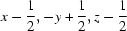
| Symmetry code: (i) x−1/2, −y+1/2, z−1/2. |
Experimental details
| Crystal data | |
| Chemical formula | C5H5NO3 |
| Mr | 127.1 |
| Crystal system, space group | Monoclinic, P21/n |
| Temperature (K) | 293 |
| a, b, c (Å) | 7.254 (3), 6.683 (2), 11.689 (5) |
| β (°) | 98.11 (4) |
| V (Å3) | 561.0 (4) |
| Z | 4 |
| Radiation type | Mo Kα |
| µ (mm−1) | 0.13 |
| Crystal size (mm) | 0.46 × 0.30 × 0.10 |
| Data collection | |
| Diffractometer | Bruker R3/V diffractometer |
| Absorption correction | – |
| No. of measured, independent and observed [I > 2σ(I)] reflections | 1410, 1294, 910 |
| Rint | 0.012 |
| (sin θ/λ)max (Å−1) | 0.651 |
| Refinement | |
| R[F2 > 2σ(F2)], wR(F2), S | 0.049, 0.191, 0.93 |
| No. of reflections | 1294 |
| No. of parameters | 83 |
| H-atom treatment | H-atom parameters constrained |
| Δρmax, Δρmin (e Å−3) | 0.23, −0.24 |
Computer programs: XSCANS (Bruker, 1996), SHELXS97 (Sheldrick, 2008), SHELXL97 (Sheldrick, 2008), SHELXTL (Sheldrick, 2008).
| D—H···A | D—H | H···A | D···A | D—H···A |
| N3—H3···O6i | 0.86 | 2.02 | 2.877 (3) | 173.4 |
| Symmetry code: (i) x−1/2, −y+1/2, z−1/2. |
Acknowledgements
The authors thank the National Science Foundation for grant No. ILI8951058.
References
 Bruker (1996). XSCANS. Bruker AXS Inc., Madison, Wisconsin, USA. Google Scholar
Copley, R. C. B., Deprez, L. S., Lewis, T. C. & Price, S. L. (2005). CrystEngComm, 7, 421–428. Web of Science CSD CrossRef CAS Google Scholar
Parrish, D., Glass, B., Rehberg, G. M. & Kastner, M. E. (2009). Acta Cryst. E65, o2356. Web of Science CSD CrossRef IUCr Journals Google Scholar
Parrish, D., Tivitmahaisoon, P., Rehberg, G. M. & Kastner, M. E. (2009). Acta Cryst. E65, o2355. Web of Science CSD CrossRef IUCr Journals Google Scholar
Rehberg, G. M. & Glass, B. M. (1995). Org. Prep. Proced. Int. 27, 651–652. CrossRef CAS Google Scholar
Sheldrick, G. M. (2008). Acta Cryst. A64, 112–122. Web of Science CrossRef CAS IUCr Journals Google Scholar
Warren, J. D., MacMillan, J. H. & Washburne, S. S. (1975). J. Org. Chem. 40, 743–746. CrossRef CAS Web of Science Google Scholar
This is an open-access article distributed under the terms of the Creative Commons Attribution (CC-BY) Licence, which permits unrestricted use, distribution, and reproduction in any medium, provided the original authors and source are cited.
| CRYSTALLOGRAPHIC COMMUNICATIONS |


The synthesis of derivatives of 3-oxauracil has previously been reported (Warren et al., 1975) and an improved synthesis of the unsubstituted 3-oxauracil was reported by Rehberg & Glass (1995). The structure of the unsubstituted 3-oxauracil and its monohydrate have been reported (Copley et al., 2005). Three derivatives of 3-oxauracil (4-methyl, 4-bromo, and 4,5-dichloro) have been prepared in our laboratory in route to the synthesis of 1-aza-1,3-butadienes. In this paper, we report the crystal structure of the title compound, (I).
In the title compound (Fig. 1) only one intermolecular H-bond is formed between N3 and O6 of glide-related molecules (details are given in Table 1). Although the molecules of (I) are planar, the H-bonding chains are staggered as shown in Figure 2. The hydrogen bonding networks in (I) differs significantly from the hydrogen bonding in 4,5-dichloro (Parrish, Leuschner et al., 2009) and 4-bromo (Parrish, Tivitmahaisoon et al., 2009) derivatives.