 | Acta Crystallographica Section E Acta Crystallographica Section E CRYSTALLOGRAPHIC COMMUNICATIONS |


 journal menu


organic compounds
| CRYSTALLOGRAPHIC COMMUNICATIONS |
 access
N,N′-Bis(2-quinolylcarbonyl)hydrazine

aCollege of Chemistry and Chemical Engineering, State Key Laboratory of Materials-oriented Chemical Engineering, Nanjing University of Technology, Nanjing 210009, People's Republic of China
*Correspondence e-mail: [email protected]
The title compound, C20H14N4O2, crystallizes in the orthorhombic system with a crystallographic twofold axis through the N—N bond. The molecule is non-planar and the dihedral angle between two amide groups is 74.9 (2)°. An intramolecular N—H⋯N hydrogen bond is present. In the crystal, the molecules are packed in chains running along the c axis through intermolecular N—H⋯O hydrogen bonds. These chains are further stabilized by intermolecular C—H⋯O hydrogen bonds and C—H⋯π interactions leading to the formation of a three-dimensional network.
Related literature
For general background to the chemistry of N,N′-diacylhydrazines, see: Zhao & Bruke (1997![[Zhao, H. & Bruke, T. R. J. (1997). Tetrahedron, 53, 4219-4230.]](../../../../../../logos/arrows/e_arr.gif "Zhao, H. & Bruke, T. R. J. (1997). Tetrahedron, 53, 4219-4230.") ); Knödler et al. (2004); Bernhardt et al. (2005). For the syntheses and structures of related compounds, see: Jasinskas et al. (1975); Shao et al. (1999); Xu et al. (2006); Zheng et al. (2007); Shanmuga Sundara Raj et al. (2000). For the synthesis of the title compound, see: Xie et al. (2009). For hydrogen-bond motifs, see: Bernstein et al. (1995);
); Knödler et al. (2004); Bernhardt et al. (2005). For the syntheses and structures of related compounds, see: Jasinskas et al. (1975); Shao et al. (1999); Xu et al. (2006); Zheng et al. (2007); Shanmuga Sundara Raj et al. (2000). For the synthesis of the title compound, see: Xie et al. (2009). For hydrogen-bond motifs, see: Bernstein et al. (1995);
![[Scheme 1]](rz2361scheme1.gif)
Experimental
Crystal data
|
Refinement
|
|
 ; (iii)
  ; (iv)
  .
. Data collection: APEX2 (Bruker, 2005); cell refinement: SAINT (Bruker, 2005); data reduction: SAINT; program(s) used to solve structure: SHELXS97 (Sheldrick, 2008); program(s) used to refine structure: SHELXL97 (Sheldrick, 2008); molecular graphics: SHELXTL (Sheldrick, 2008); software used to prepare material for publication: SHELXTL.
Supporting information
contains datablocks I, global. DOI: 10.1107/S1600536809037842/rz2361sup1.cif
Structure factors: contains datablock I. DOI: 10.1107/S1600536809037842/rz2361Isup2.hkl
The title compound was obtained unexpectedly in the synthesis of 3-methyl-4-(p-methylphenyl)-5-(2-quinolyl)-1,2,4-triazole by the reaction of N-formyl-N'-(2-quinolylcarbonyl)hydrazine (1 mmol) with 4,4'-dimethylphenylphosphazoanilide (1 mmol) in N,N-dimethylaniline (20 ml) at 463–473 K (Xie et al., 2009). It also can be prepared by literature method (Jasinskas et al., 1975). Diffraction quality crystals were obtained by recrystallization from ethanol (yield 31%).
All H atoms were located in a difference Fourier map and allowed to ride on their parent atoms at distances of 0.96Å (aromatic), 0.93Å (pyridyl), and with Uiso(H) values of 1.2 or 1.5 times of Ueq(C).
Data collection: APEX2 (Bruker, 2005); cell SAINT (Bruker, 2005); data reduction: SAINT (Bruker, 2005); program(s) used to solve structure: SHELXS97 (Sheldrick, 2008); program(s) used to refine structure: SHELXL97 (Sheldrick, 2008); molecular graphics: SHELXTL (Sheldrick, 2008); software used to prepare material for publication: SHELXTL (Sheldrick, 2008).
![[Figure 1]](./rz2361fig1thm.gif) | Fig. 1. The structure of the title compound showing 50% probability displacement ellipsoids and atom-numbering scheme [symmetry code: (i) 3/2 - x, 1/2 - y, z]. |
![[Figure 2]](./rz2361fig2thm.gif) | Fig. 2. The three-dimensional network formed via hydrogen bonds (dashed lines) and C—H···π interactions [symmetry code: (i) 1 - x, 1/2 + y, 1/2 - z]. |
| C20H14N4O2 | F(000) = 712 |
| Mr = 342.35 | Dx = 1.374 Mg m−3 |
| Orthorhombic, Pccn | Mo Kα radiation, λ = 0.71073 Å |
| Hall symbol: -P 2ab 2ac | Cell parameters from 28 reflections |
| a = 11.649 (4) Å | θ = 2.1–26.6° |
| b = 17.023 (6) Å | µ = 0.09 mm−1 |
| c = 8.349 (3) Å | T = 296 K |
| V = 1655.6 (10) Å3 | Block, colourless |
| Z = 4 | 0.26 × 0.12 × 0.08 mm |
| Bruker APEXII CCD diffractometer | 1629 independent reflections |
| Radiation source: fine-focus sealed tube | 816 reflections with I > 2σ(I) |
| Graphite monochromator | Rint = 0.082 |
| ω scans | θmax = 26.0°, θmin = 2.1° |
| Absorption correction: multi-scan (SADABS; Bruker, 2005) | h = −14→14 |
| Tmin = 0.976, Tmax = 0.993 | k = −21→18 |
| 10346 measured reflections | l = −9→10 |
| Refinement on F2 | Secondary atom site location: difference Fourier map |
| Least-squares matrix: full | Hydrogen site location: inferred from neighbouring sites |
| R[F2 > 2σ(F2)] = 0.046 | H-atom parameters constrained |
| wR(F2) = 0.115 | w = 1/[σ2(Fo2) + (0.0525P)2] where P = (Fo2 + 2Fc2)/3 |
| S = 0.95 | (Δ/σ)max < 0.001 |
| 1629 reflections | Δρmax = 0.17 e Å−3 |
| 119 parameters | Δρmin = −0.19 e Å−3 |
| 0 restraints | Extinction correction: SHELXL97 (Sheldrick, 2008), Fc*=kFc[1+0.001xFc2λ3/sin(2θ)]-1/4 |
| Primary atom site location: structure-invariant direct methods | Extinction coefficient: 0.011 (2) |
| C20H14N4O2 | V = 1655.6 (10) Å3 |
| Mr = 342.35 | Z = 4 |
| Orthorhombic, Pccn | Mo Kα radiation |
| a = 11.649 (4) Å | µ = 0.09 mm−1 |
| b = 17.023 (6) Å | T = 296 K |
| c = 8.349 (3) Å | 0.26 × 0.12 × 0.08 mm |
| Bruker APEXII CCD diffractometer | 1629 independent reflections |
| Absorption correction: multi-scan (SADABS; Bruker, 2005) | 816 reflections with I > 2σ(I) |
| Tmin = 0.976, Tmax = 0.993 | Rint = 0.082 |
| 10346 measured reflections |
| R[F2 > 2σ(F2)] = 0.046 | 0 restraints |
| wR(F2) = 0.115 | H-atom parameters constrained |
| S = 0.95 | Δρmax = 0.17 e Å−3 |
| 1629 reflections | Δρmin = −0.19 e Å−3 |
| 119 parameters |
Geometry. All e.s.d.'s (except the e.s.d. in the dihedral angle between two l.s. planes) are estimated using the full covariance matrix. The cell e.s.d.'s are taken into account individually in the estimation of e.s.d.'s in distances, angles and torsion angles; correlations between e.s.d.'s in cell parameters are only used when they are defined by crystal symmetry. An approximate (isotropic) treatment of cell e.s.d.'s is used for estimating e.s.d.'s involving l.s. planes. |
Refinement. Refinement of F2 against ALL reflections. The weighted R-factor wR and goodness of fit S are based on F2, conventional R-factors R are based on F, with F set to zero for negative F2. The threshold expression of F2 > σ(F2) is used only for calculating R-factors(gt) etc. and is not relevant to the choice of reflections for refinement. R-factors based on F2 are statistically about twice as large as those based on F, and R- factors based on ALL data will be even larger. |
| x | y | z | Uiso*/Ueq | ||
| O1 | 0.61559 (14) | 0.28662 (9) | 0.3812 (2) | 0.0651 (5) | |
| N1 | 0.69622 (14) | 0.44375 (10) | 0.1318 (2) | 0.0424 (5) | |
| N2 | 0.73777 (18) | 0.28973 (9) | 0.1733 (2) | 0.0605 (6) | |
| H2A | 0.7745 | 0.3197 | 0.1080 | 0.073* | |
| C1 | 0.62868 (17) | 0.40522 (13) | 0.2314 (3) | 0.0432 (6) | |
| C2 | 0.52811 (18) | 0.43630 (14) | 0.2994 (3) | 0.0520 (7) | |
| H2B | 0.4841 | 0.4063 | 0.3694 | 0.062* | |
| C3 | 0.49611 (18) | 0.51056 (15) | 0.2615 (3) | 0.0549 (7) | |
| H3A | 0.4290 | 0.5317 | 0.3037 | 0.066* | |
| C4 | 0.56521 (18) | 0.55552 (12) | 0.1576 (3) | 0.0450 (6) | |
| C5 | 0.5394 (2) | 0.63312 (13) | 0.1127 (3) | 0.0599 (7) | |
| H5A | 0.4739 | 0.6573 | 0.1530 | 0.072* | |
| C6 | 0.6091 (2) | 0.67300 (14) | 0.0114 (3) | 0.0663 (8) | |
| H6A | 0.5908 | 0.7243 | −0.0172 | 0.080* | |
| C7 | 0.7083 (2) | 0.63781 (14) | −0.0508 (3) | 0.0615 (7) | |
| H7A | 0.7552 | 0.6658 | −0.1205 | 0.074* | |
| C8 | 0.73620 (19) | 0.56297 (13) | −0.0097 (3) | 0.0498 (6) | |
| H8A | 0.8025 | 0.5401 | −0.0509 | 0.060* | |
| C9 | 0.66544 (17) | 0.51985 (12) | 0.0947 (3) | 0.0401 (6) | |
| C10 | 0.65956 (19) | 0.32223 (14) | 0.2702 (3) | 0.0471 (6) |
| U11 | U22 | U33 | U12 | U13 | U23 | |
| O1 | 0.0692 (11) | 0.0517 (10) | 0.0743 (13) | −0.0141 (9) | 0.0059 (10) | 0.0116 (10) |
| N1 | 0.0396 (11) | 0.0382 (11) | 0.0495 (12) | −0.0009 (8) | −0.0004 (9) | −0.0006 (9) |
| N2 | 0.0861 (15) | 0.0349 (10) | 0.0605 (14) | 0.0080 (12) | 0.0094 (12) | 0.0031 (10) |
| C1 | 0.0407 (13) | 0.0388 (13) | 0.0501 (15) | −0.0023 (11) | −0.0059 (11) | −0.0051 (11) |
| C2 | 0.0404 (14) | 0.0547 (17) | 0.0610 (17) | −0.0066 (12) | 0.0063 (12) | −0.0029 (13) |
| C3 | 0.0387 (13) | 0.0605 (18) | 0.0657 (17) | 0.0031 (12) | 0.0043 (12) | −0.0063 (14) |
| C4 | 0.0379 (13) | 0.0428 (14) | 0.0543 (16) | 0.0046 (10) | −0.0049 (11) | −0.0065 (12) |
| C5 | 0.0508 (15) | 0.0484 (16) | 0.080 (2) | 0.0138 (13) | −0.0026 (14) | −0.0058 (15) |
| C6 | 0.0691 (18) | 0.0403 (15) | 0.089 (2) | 0.0079 (13) | −0.0075 (16) | 0.0060 (15) |
| C7 | 0.0599 (16) | 0.0489 (16) | 0.076 (2) | −0.0021 (13) | 0.0032 (14) | 0.0091 (14) |
| C8 | 0.0459 (14) | 0.0458 (15) | 0.0577 (16) | 0.0004 (11) | 0.0014 (11) | 0.0027 (12) |
| C9 | 0.0362 (12) | 0.0358 (12) | 0.0483 (14) | 0.0012 (10) | −0.0064 (11) | −0.0033 (11) |
| C10 | 0.0489 (14) | 0.0433 (15) | 0.0491 (15) | −0.0100 (12) | −0.0030 (12) | −0.0013 (12) |
| O1—C10 | 1.220 (3) | C3—H3A | 0.9300 |
| N1—C1 | 1.319 (3) | C4—C5 | 1.406 (3) |
| N1—C9 | 1.379 (2) | C4—C9 | 1.417 (3) |
| N2—C10 | 1.338 (3) | C5—C6 | 1.354 (3) |
| N2—N2i | 1.382 (3) | C5—H5A | 0.9300 |
| N2—H2A | 0.8600 | C6—C7 | 1.401 (3) |
| C1—C2 | 1.405 (3) | C6—H6A | 0.9300 |
| C1—C10 | 1.493 (3) | C7—C8 | 1.359 (3) |
| C2—C3 | 1.355 (3) | C7—H7A | 0.9300 |
| C2—H2B | 0.9300 | C8—C9 | 1.406 (3) |
| C3—C4 | 1.409 (3) | C8—H8A | 0.9300 |
| C1—N1—C9 | 116.98 (18) | C6—C5—H5A | 119.7 |
| C10—N2—N2i | 123.0 (2) | C4—C5—H5A | 119.7 |
| C10—N2—H2A | 118.5 | C5—C6—C7 | 120.7 (2) |
| N2i—N2—H2A | 118.5 | C5—C6—H6A | 119.6 |
| N1—C1—C2 | 124.4 (2) | C7—C6—H6A | 119.6 |
| N1—C1—C10 | 117.6 (2) | C8—C7—C6 | 120.3 (2) |
| C2—C1—C10 | 118.0 (2) | C8—C7—H7A | 119.8 |
| C3—C2—C1 | 119.1 (2) | C6—C7—H7A | 119.8 |
| C3—C2—H2B | 120.5 | C7—C8—C9 | 120.3 (2) |
| C1—C2—H2B | 120.5 | C7—C8—H8A | 119.8 |
| C2—C3—C4 | 119.5 (2) | C9—C8—H8A | 119.8 |
| C2—C3—H3A | 120.2 | N1—C9—C8 | 118.5 (2) |
| C4—C3—H3A | 120.2 | N1—C9—C4 | 122.2 (2) |
| C5—C4—C3 | 123.5 (2) | C8—C9—C4 | 119.3 (2) |
| C5—C4—C9 | 118.7 (2) | O1—C10—N2 | 122.7 (2) |
| C3—C4—C9 | 117.8 (2) | O1—C10—C1 | 122.3 (2) |
| C6—C5—C4 | 120.6 (2) | N2—C10—C1 | 115.1 (2) |
| Symmetry code: (i) −x+3/2, −y+1/2, z. |
| D—H···A | D—H | H···A | D···A | D—H···A |
| N2—H2A···N1 | 0.86 | 2.31 | 2.689 (2) | 107 |
| N2—H2A···O1ii | 0.86 | 2.35 | 2.978 (3) | 130 |
| C5—H5A···O1iii | 0.93 | 2.45 | 3.177 (3) | 135 |
| C8—H8A···Cg1iv | 0.93 | 2.64 | 3.449 | 146 |
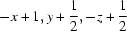
| Symmetry codes: (ii) −x+3/2, y, z−1/2; (iii) −x+1, y+1/2, −z+1/2; (iv) −x−1/2, y, z−3/2. |
Experimental details
| Crystal data | |
| Chemical formula | C20H14N4O2 |
| Mr | 342.35 |
| Crystal system, space group | Orthorhombic, Pccn |
| Temperature (K) | 296 |
| a, b, c (Å) | 11.649 (4), 17.023 (6), 8.349 (3) |
| V (Å3) | 1655.6 (10) |
| Z | 4 |
| Radiation type | Mo Kα |
| µ (mm−1) | 0.09 |
| Crystal size (mm) | 0.26 × 0.12 × 0.08 |
| Data collection | |
| Diffractometer | Bruker APEXII CCD diffractometer |
| Absorption correction | Multi-scan (SADABS; Bruker, 2005) |
| Tmin, Tmax | 0.976, 0.993 |
| No. of measured, independent and observed [I > 2σ(I)] reflections | 10346, 1629, 816 |
| Rint | 0.082 |
| (sin θ/λ)max (Å−1) | 0.617 |
| Refinement | |
| R[F2 > 2σ(F2)], wR(F2), S | 0.046, 0.115, 0.95 |
| No. of reflections | 1629 |
| No. of parameters | 119 |
| H-atom treatment | H-atom parameters constrained |
| Δρmax, Δρmin (e Å−3) | 0.17, −0.19 |
Computer programs: APEX2 (Bruker, 2005), SAINT (Bruker, 2005), SHELXS97 (Sheldrick, 2008), SHELXL97 (Sheldrick, 2008), SHELXTL (Sheldrick, 2008).
| O1—C10 | 1.220 (3) | N2—C10 | 1.338 (3) |
| N1—C1 | 1.319 (3) | N2—N2i | 1.382 (3) |
| N1—C9 | 1.379 (2) | ||
| C10—N2—N2i | 123.0 (2) | O1—C10—C1 | 122.3 (2) |
| O1—C10—N2 | 122.7 (2) | N2—C10—C1 | 115.1 (2) |
| Symmetry code: (i) −x+3/2, −y+1/2, z. |
| D—H···A | D—H | H···A | D···A | D—H···A |
| N2—H2A···N1 | 0.8600 | 2.3100 | 2.689 (2) | 107.00 |
| N2—H2A···O1ii | 0.8600 | 2.3500 | 2.978 (3) | 130.00 |
| C5—H5A···O1iii | 0.9300 | 2.4500 | 3.177 (3) | 135.00 |
| C8—H8A···Cg1iv | 0.9300 | 2.6400 | 3.449 | 146.00 |
| Symmetry codes: (ii) −x+3/2, y, z−1/2; (iii) −x+1, y+1/2, −z+1/2; (iv) −x−1/2, y, z−3/2. |
Acknowledgements
This work was funded by the National Natural Science Foundation of China (No. 20771059) and the Natural Science Foundation of Jiangsu Province (BK2008371).
References
 Bernhardt, P. V., Chin, P., Sharpe, P. C., Wang, J.-Y. C. & Richardson, D. R. (2005). J. Biol. Inorg. Chem. 10, 761–777. Web of Science CSD CrossRef PubMed CAS Google Scholar
Bernstein, J., Davis, R. E., Shimoni, L. & Chang, N.-L. (1995). Angew. Chem. Int. Ed. 34, 1555–1573. CrossRef CAS Web of Science Google Scholar
Bruker (2005). APEX2, SAINT and SADABS. Bruker AXS Inc., Madison, Wisconsin, USA. Google Scholar
Jasinskas, L., Urbonas, A. & Latakas, V. (1975). Liet. TSR Aukš. Mokyklu Mokslo Darb. Chem. Chem. Technol. 17, 143–145. CAS Google Scholar
Knödler, K., Fiedler, J. & Kaim, W. (2004). Polyhedron, 23, 701–707. Google Scholar
Shanmuga Sundara Raj, S., Yamin, B. M., Boshaala, A. M. A., Tarafder, M. T. H., Crouse, K. A. & Fun, H.-K. (2000). Acta Cryst. C56, 1011–1012. CSD CrossRef IUCr Journals Google Scholar
Shao, S., Zhu, D., Song, Y., You, X. Z., Shanmuga Sundara Raj, S. & Fun, H.-K. (1999). Acta Cryst. C55, 1841–1843. Web of Science CSD CrossRef CAS IUCr Journals Google Scholar
Sheldrick, G. M. (2008). Acta Cryst. A64, 112–122. Web of Science CrossRef CAS IUCr Journals Google Scholar
Xie, D.-J., Lu, W., Wang, Z.-X. & Zhu, D.-R. (2009). Acta Cryst. E65, o1177–o1178. Web of Science CSD CrossRef IUCr Journals Google Scholar
Xu, R.-H., Zhou, J., Xu, Y., Qi, L., Shen, X. & Zhu, D.-R. (2006). Acta Cryst. E62, o5234–o5235. Web of Science CSD CrossRef IUCr Journals Google Scholar
Zhao, H. & Bruke, T. R. J. (1997). Tetrahedron, 53, 4219–4230. CrossRef CAS Web of Science Google Scholar
Zheng, Z.-B., Wu, R.-T., Li, J.-K. & Sun, Y.-F. (2007). Acta Cryst. E63, o4658. Web of Science CSD CrossRef IUCr Journals Google Scholar
This is an open-access article distributed under the terms of the Creative Commons Attribution (CC-BY) Licence, which permits unrestricted use, distribution, and reproduction in any medium, provided the original authors and source are cited.
| CRYSTALLOGRAPHIC COMMUNICATIONS |


(Un)symmetrical N,N'-diacylhydrazines are of interest because they are the basic structural components in heterocyclic chemistry and may be used as bridging ligands in coordination chemistry (Zhao & Bruke, 1997; Knödler et al., 2004; Bernhardt et al., 2005). We have reported the structure of N,N'-bis(2-picolinoyl)hydrazine (Shao et al., 1999). As a continuation of our investigations of the structure of N,N'-diacylhydrazines and their derivatives, herein, we report the crystal structure of the title compound. It was first prepared by aroylation of 2-quinolylcarbonylhydrazine with 2-quinolinecarbonyl chloride in dry pyridine (Jasinskas et al., 1975).
The X-ray analysis of the title compound (Fig. 1) indicates that the molecule is non-planar. The dihedral angle between the quinolyl ring and the amide group is 15.3 (2)° and that between the amide groups is 74.9 (2)°. Similarly to N,N'-bis(2-picolinoyl)hydrazine, the asymmetric unit contains half the molecule and the other half is related by a crystallographic twofold axis passing through the N2—N2i bond [symmetry code: (i) 3/2 - x, 1/2 - y, z]. The bond lengths and angles (Table 1) in the structure are in the normal ranges (Xu et al., 2006; Zheng et al., 2007). The C10—N2—N2i—C10i torsion angle is -87.7 (2)°. The two carbonyl groups and the H atoms of the N—N bond are in a trans orientation with respect to each other. This conformation is due mainly to the intramolecular N—H···N hydrogen bonds.
In the crystal (Fig. 2), each molecule is connected to another by a pair of intermolecular N—H···O hydrogen bonds (Table 2) between the amide H atoms and the O atoms of neighbouring carbonyl groups to form a ten-membered ring with the graph-set motif C4R22(10) (Bernstein et al., 1995). The same feature is also found in N,N'-bis(2-picolinoyl)hydrazine and 1,2-dibenzoylhydrazine (Shanmuga Sundara Raj et al., 2000). Due to presence of these intermolecular N—H···O hydrogen bonds, the molecules are packed into chains running along the c axis. These chains are further stabilized by intermolecular C—H···O hydrogen bonds and C—H···π interactions (Table 2) leading to the formation of a three-dimensional network.