 | Acta Crystallographica Section E Acta Crystallographica Section E CRYSTALLOGRAPHIC COMMUNICATIONS |


 journal menu


inorganic compounds
| CRYSTALLOGRAPHIC COMMUNICATIONS |
 access
catena-Poly[[tetraaquacopper(II)]-μ-trithionato-κ2O:O′]

aDepartment of Chemistry, University of Malaya, 50603 Kuala Lumpur, Malaysia
*Correspondence e-mail: [email protected]
The title supramolecular polymer, [Cu(S3O6)(H2O)4]n, features a tetragonally distorted octahedral CuII centre within an O6 donor set with the longer Cu—O bonds linking the dication and the trithionate dianion. Extensive O—H⋯O hydrogen-bonding interactions connect the supramolecular chains into a three-dimensional network.
Related literature
For crystal structures containing the trithionate anion, see: Chun et al. (2000![[Chun, H., Jackson, W. G., McKeon, J. A., Somoza, F. B. Jr & Bernal, I. (2000). Eur. J. Inorg. Chem. pp. 189-193.]](../../../../../../logos/arrows/e_arr.gif "Chun, H., Jackson, W. G., McKeon, J. A., Somoza, F. B. Jr & Bernal, I. (2000). Eur. J. Inorg. Chem. pp. 189-193.") ); Díaz de Vivar et al. (2005); Ferrari et al. (1977). For related copper(II) structures with bridging di-sulfonato ligands, see: Charbonnier et al. (1977a,b); Pasquale et al. (2007); Wang et al. (2005).
); Díaz de Vivar et al. (2005); Ferrari et al. (1977). For related copper(II) structures with bridging di-sulfonato ligands, see: Charbonnier et al. (1977a,b); Pasquale et al. (2007); Wang et al. (2005).
![[Scheme 1]](hb5217scheme1.gif)
Experimental
Crystal data
|
Refinement
|
| ||||||||||||||||
|
 ; (iii)
 Data collection: APEX2 (Bruker, 2007); cell refinement: SAINT (Bruker, 2007); data reduction: SAINT; program(s) used to solve structure: SHELXS86 (Sheldrick, 2008); program(s) used to refine structure: SHELXL97 (Sheldrick, 2008); molecular graphics: DIAMOND (Brandenburg, 2006); software used to prepare material for publication: SHELXL97.
Supporting information
contains datablocks global, I. DOI: 10.1107/S1600536809047096/hb5217sup1.cif
Structure factors: contains datablock I. DOI: 10.1107/S1600536809047096/hb5217Isup2.hkl
The blue crystal used in the present study was harvested from the hydrothermal reaction of stoichiometric amounts of CuCl, SeS2, S, and N2H4.H2O. The reagents were heated to 420 K for 3 d in a 25 ml Teflon-lined stainless-steel autoclave. After the reaction, the bomb was cooled to room temperature. The solution was filtered and layered with methanol. After four weeks, blue needles of (I) were collected and dried in air.
The O-bound H-atoms were located in a difference Fourier map and were refined with O–H and H···H restraints of 0.840±0.001 Å and 1.39±0.01 Å, respectively, and with Uiso(H) = 1.5Ueq(O).
Data collection: APEX2 (Bruker, 2007); cell SAINT (Bruker, 2007); data reduction: SAINT (Bruker, 2007); program(s) used to solve structure: SHELXS86 (Sheldrick, 2008); program(s) used to refine structure: SHELXL97 (Sheldrick, 2008); molecular graphics: DIAMOND (Brandenburg, 2006); software used to prepare material for publication: SHELXL97 (Sheldrick, 2008).
![[Figure 1]](./hb5217fig1thm.gif) | Fig. 1. The asymmetric unit in (I) extended to show the coordination geometry about the Cu atom, showing displacement ellipsoids at the 50% probability level. Symmetry code: (i) 1 + x, y, 1 + z. |
![[Figure 2]](./hb5217fig2thm.gif) | Fig. 2. Supramolecular chain formation in (I). Colour code: Cu, brown; S, yellow; O, red; and H, green. |
![[Figure 3]](./hb5217fig3thm.gif) | Fig. 3. Supramolecular layer formation in (I) viewed in projection down the b axis. Chains shown in Fig. 2 are linked via O–H···O (orange dashed lines) hydrogen bonds. Colour code as for Fig. 2. |
![[Figure 4]](./hb5217fig4thm.gif) | Fig. 4. Unit-cell contents for (I) highlighting the 3-D network. The O–H···O hydrogen bonds are shown as orange dashed lines. Colour code as for Fig. 2. |
| [Cu(S3O6)(H2O)4] | F(000) = 660 |
| Mr = 327.78 | Dx = 2.037 Mg m−3 |
| Monoclinic, P21/n | Mo Kα radiation, λ = 0.71073 Å |
| Hall symbol: -P 2yn | Cell parameters from 6028 reflections |
| a = 7.1816 (1) Å | θ = 3.1–27.6° |
| b = 21.4405 (4) Å | µ = 2.66 mm−1 |
| c = 7.7286 (1) Å | T = 100 K |
| β = 116.092 (1)° | Needle, blue |
| V = 1068.75 (3) Å3 | 0.30 × 0.10 × 0.05 mm |
| Z = 4 |
| Bruker SMART APEXII diffractometer | 2434 independent reflections |
| Radiation source: sealed tube | 2291 reflections with I > 2σ(I) |
| Graphite monochromator | Rint = 0.020 |
| ϕ and ω scans | θmax = 27.5°, θmin = 1.9° |
| Absorption correction: multi-scan (SADABS; Sheldrick, 1996) | h = −9→9 |
| Tmin = 0.911, Tmax = 1 | k = −27→27 |
| 9081 measured reflections | l = −9→10 |
| Refinement on F2 | Primary atom site location: structure-invariant direct methods |
| Least-squares matrix: full | Secondary atom site location: difference Fourier map |
| R[F2 > 2σ(F2)] = 0.038 | Hydrogen site location: inferred from neighbouring sites |
| wR(F2) = 0.108 | H-atom parameters constrained |
| S = 1.03 | w = 1/[σ2(Fo2) + (0.0493P)2 + 7.019P] where P = (Fo2 + 2Fc2)/3 |
| 2434 reflections | (Δ/σ)max = 0.001 |
| 151 parameters | Δρmax = 1.47 e Å−3 |
| 12 restraints | Δρmin = −0.84 e Å−3 |
| [Cu(S3O6)(H2O)4] | V = 1068.75 (3) Å3 |
| Mr = 327.78 | Z = 4 |
| Monoclinic, P21/n | Mo Kα radiation |
| a = 7.1816 (1) Å | µ = 2.66 mm−1 |
| b = 21.4405 (4) Å | T = 100 K |
| c = 7.7286 (1) Å | 0.30 × 0.10 × 0.05 mm |
| β = 116.092 (1)° |
| Bruker SMART APEXII diffractometer | 2434 independent reflections |
| Absorption correction: multi-scan (SADABS; Sheldrick, 1996) | 2291 reflections with I > 2σ(I) |
| Tmin = 0.911, Tmax = 1 | Rint = 0.020 |
| 9081 measured reflections |
| R[F2 > 2σ(F2)] = 0.038 | 12 restraints |
| wR(F2) = 0.108 | H-atom parameters constrained |
| S = 1.03 | Δρmax = 1.47 e Å−3 |
| 2434 reflections | Δρmin = −0.84 e Å−3 |
| 151 parameters |
Geometry. All s.u.'s (except the s.u. in the dihedral angle between two l.s. planes) are estimated using the full covariance matrix. The cell s.u.'s are taken into account individually in the estimation of s.u.'s in distances, angles and torsion angles; correlations between s.u.'s in cell parameters are only used when they are defined by crystal symmetry. An approximate (isotropic) treatment of cell s.u.'s is used for estimating s.u.'s involving l.s. planes. |
Refinement. Refinement of F2 against ALL reflections. The weighted R-factor wR and goodness of fit S are based on F2, conventional R-factors R are based on F, with F set to zero for negative F2. The threshold expression of F2 > 2σ(F2) is used only for calculating R-factors(gt) etc. and is not relevant to the choice of reflections for refinement. R-factors based on F2 are statistically about twice as large as those based on F, and R- factors based on ALL data will be even larger. |
| x | y | z | Uiso*/Ueq | ||
| Cu | 0.19601 (7) | 0.85880 (2) | 0.51918 (6) | 0.01169 (14) | |
| O1 | 0.2615 (5) | 0.81059 (15) | 0.3309 (5) | 0.0268 (7) | |
| H1O | 0.1475 | 0.8079 | 0.2323 | 0.040* | |
| H2O | 0.3104 | 0.7753 | 0.3752 | 0.040* | |
| O2 | 0.2609 (5) | 0.93801 (15) | 0.4087 (5) | 0.0287 (7) | |
| H3O | 0.3791 | 0.9353 | 0.4120 | 0.043* | |
| H4O | 0.2480 | 0.9710 | 0.4611 | 0.043* | |
| O3 | 0.1488 (5) | 0.90825 (15) | 0.7159 (5) | 0.0264 (7) | |
| H5O | 0.1820 | 0.9459 | 0.7188 | 0.040* | |
| H6O | 0.0233 | 0.9046 | 0.6919 | 0.040* | |
| O4 | 0.1007 (5) | 0.77999 (16) | 0.6068 (5) | 0.0293 (7) | |
| H7O | 0.0526 | 0.7840 | 0.6876 | 0.044* | |
| H8O | 0.0311 | 0.7547 | 0.5190 | 0.044* | |
| S1 | −0.31167 (13) | 0.90509 (4) | 0.20735 (12) | 0.01136 (19) | |
| S2 | −0.27573 (13) | 0.94093 (4) | −0.03534 (11) | 0.00925 (18) | |
| S3 | −0.28093 (13) | 0.85804 (4) | −0.18661 (12) | 0.0127 (2) | |
| O5 | −0.1785 (4) | 0.85083 (12) | 0.2738 (4) | 0.0145 (5) | |
| O6 | −0.2390 (5) | 0.95873 (13) | 0.3340 (4) | 0.0194 (6) | |
| O7 | −0.5286 (4) | 0.89104 (14) | 0.1427 (4) | 0.0185 (6) | |
| O8 | −0.4614 (4) | 0.82243 (13) | −0.2060 (4) | 0.0168 (5) | |
| O9 | −0.0873 (4) | 0.82490 (13) | −0.0809 (4) | 0.0169 (5) | |
| O10 | −0.2992 (4) | 0.88484 (15) | −0.3653 (4) | 0.0207 (6) |
| U11 | U22 | U33 | U12 | U13 | U23 | |
| Cu | 0.0123 (2) | 0.0112 (2) | 0.0125 (2) | −0.00021 (15) | 0.00630 (17) | 0.00000 (15) |
| O1 | 0.0282 (16) | 0.0247 (15) | 0.0250 (16) | 0.0013 (13) | 0.0094 (13) | −0.0021 (12) |
| O2 | 0.0325 (17) | 0.0244 (16) | 0.0334 (18) | 0.0006 (13) | 0.0183 (15) | 0.0002 (13) |
| O3 | 0.0279 (16) | 0.0248 (15) | 0.0277 (16) | −0.0018 (12) | 0.0133 (14) | −0.0020 (12) |
| O4 | 0.0320 (17) | 0.0271 (16) | 0.0283 (17) | −0.0018 (13) | 0.0130 (14) | 0.0019 (13) |
| S1 | 0.0125 (4) | 0.0115 (4) | 0.0101 (4) | 0.0007 (3) | 0.0050 (3) | 0.0010 (3) |
| S2 | 0.0132 (4) | 0.0077 (4) | 0.0085 (4) | −0.0006 (3) | 0.0063 (3) | 0.0003 (3) |
| S3 | 0.0111 (4) | 0.0163 (4) | 0.0106 (4) | 0.0000 (3) | 0.0047 (3) | −0.0002 (3) |
| O5 | 0.0164 (13) | 0.0124 (12) | 0.0133 (12) | 0.0027 (10) | 0.0052 (10) | 0.0026 (9) |
| O6 | 0.0286 (15) | 0.0139 (13) | 0.0148 (13) | −0.0004 (11) | 0.0087 (11) | −0.0020 (10) |
| O7 | 0.0131 (13) | 0.0269 (15) | 0.0162 (13) | 0.0011 (11) | 0.0071 (11) | 0.0044 (11) |
| O8 | 0.0140 (12) | 0.0183 (13) | 0.0173 (13) | −0.0026 (10) | 0.0063 (10) | −0.0024 (10) |
| O9 | 0.0137 (12) | 0.0189 (13) | 0.0164 (13) | 0.0031 (10) | 0.0049 (10) | −0.0007 (10) |
| O10 | 0.0183 (13) | 0.0321 (16) | 0.0130 (13) | 0.0008 (12) | 0.0081 (11) | 0.0034 (11) |
| Cu—O3 | 2.001 (3) | O3—H6O | 0.8401 |
| Cu—O1 | 2.002 (3) | O4—H7O | 0.8401 |
| Cu—O2 | 2.045 (3) | O4—H8O | 0.8401 |
| Cu—O4 | 2.047 (3) | S1—O7 | 1.443 (3) |
| Cu—O5 | 2.524 (3) | S1—O5 | 1.449 (3) |
| Cu—O8i | 2.564 (3) | S1—O6 | 1.450 (3) |
| O1—H1O | 0.8401 | S1—S2 | 2.1450 (11) |
| O1—H2O | 0.8401 | S2—S3 | 2.1184 (12) |
| O2—H3O | 0.8401 | S3—O10 | 1.448 (3) |
| O2—H4O | 0.8401 | S3—O9 | 1.452 (3) |
| O3—H5O | 0.8401 | S3—O8 | 1.454 (3) |
| O3—Cu—O1 | 176.54 (14) | Cu—O4—H8O | 116.6 |
| O3—Cu—O2 | 91.32 (13) | H7O—O4—H8O | 111.9 |
| O1—Cu—O2 | 87.46 (13) | O7—S1—O5 | 113.51 (17) |
| O3—Cu—O4 | 89.60 (14) | O7—S1—O6 | 114.36 (18) |
| O1—Cu—O4 | 91.95 (14) | O5—S1—O6 | 114.32 (16) |
| O2—Cu—O4 | 174.05 (14) | O7—S1—S2 | 107.39 (12) |
| Cu—O1—H1O | 104.4 | O5—S1—S2 | 106.44 (12) |
| Cu—O1—H2O | 111.0 | O6—S1—S2 | 99.21 (12) |
| H1O—O1—H2O | 111.9 | S3—S2—S1 | 101.68 (5) |
| Cu—O2—H3O | 110.1 | O10—S3—O9 | 113.18 (17) |
| Cu—O2—H4O | 113.9 | O10—S3—O8 | 114.04 (17) |
| H3O—O2—H4O | 111.5 | O9—S3—O8 | 113.01 (17) |
| Cu—O3—H5O | 112.9 | O10—S3—S2 | 99.54 (13) |
| Cu—O3—H6O | 107.9 | O9—S3—S2 | 108.67 (12) |
| H5O—O3—H6O | 111.2 | O8—S3—S2 | 107.22 (12) |
| Cu—O4—H7O | 118.0 | ||
| O7—S1—S2—S3 | −78.83 (14) | S1—S2—S3—O10 | 168.90 (12) |
| O5—S1—S2—S3 | 43.05 (12) | S1—S2—S3—O9 | −72.54 (13) |
| O6—S1—S2—S3 | 161.92 (13) | S1—S2—S3—O8 | 49.91 (13) |
| Symmetry code: (i) x+1, y, z+1. |
| D—H···A | D—H | H···A | D···A | D—H···A |
| O1—H1o···O9 | 0.84 | 2.29 | 3.080 (5) | 157 |
| O1—H2o···O9ii | 0.84 | 2.25 | 3.071 (4) | 166 |
| O2—H3o···O10i | 0.84 | 2.44 | 3.079 (5) | 133 |
| O2—H4o···O6iii | 0.84 | 2.21 | 3.026 (4) | 165 |
| O3—H5o···O6iii | 0.84 | 2.16 | 2.987 (4) | 169 |
| O3—H6o···O10iv | 0.84 | 2.20 | 3.037 (5) | 174 |
| O4—H7o···O9iv | 0.84 | 2.56 | 3.383 (5) | 166 |
| O4—H8o···O8ii | 0.84 | 2.42 | 3.149 (4) | 146 |
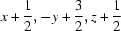
| Symmetry codes: (i) x+1, y, z+1; (ii) x+1/2, −y+3/2, z+1/2; (iii) −x, −y+2, −z+1; (iv) x, y, z+1. |
Experimental details
| Crystal data | |
| Chemical formula | [Cu(S3O6)(H2O)4] |
| Mr | 327.78 |
| Crystal system, space group | Monoclinic, P21/n |
| Temperature (K) | 100 |
| a, b, c (Å) | 7.1816 (1), 21.4405 (4), 7.7286 (1) |
| β (°) | 116.092 (1) |
| V (Å3) | 1068.75 (3) |
| Z | 4 |
| Radiation type | Mo Kα |
| µ (mm−1) | 2.66 |
| Crystal size (mm) | 0.30 × 0.10 × 0.05 |
| Data collection | |
| Diffractometer | Bruker SMART APEXII diffractometer |
| Absorption correction | Multi-scan (SADABS; Sheldrick, 1996) |
| Tmin, Tmax | 0.911, 1 |
| No. of measured, independent and observed [I > 2σ(I)] reflections | 9081, 2434, 2291 |
| Rint | 0.020 |
| (sin θ/λ)max (Å−1) | 0.650 |
| Refinement | |
| R[F2 > 2σ(F2)], wR(F2), S | 0.038, 0.108, 1.03 |
| No. of reflections | 2434 |
| No. of parameters | 151 |
| No. of restraints | 12 |
| H-atom treatment | H-atom parameters constrained |
| Δρmax, Δρmin (e Å−3) | 1.47, −0.84 |
Computer programs: APEX2 (Bruker, 2007), SAINT (Bruker, 2007), SHELXS86 (Sheldrick, 2008), SHELXL97 (Sheldrick, 2008), DIAMOND (Brandenburg, 2006).
| Cu—O3 | 2.001 (3) | Cu—O4 | 2.047 (3) |
| Cu—O1 | 2.002 (3) | Cu—O5 | 2.524 (3) |
| Cu—O2 | 2.045 (3) | Cu—O8i | 2.564 (3) |
| Symmetry code: (i) x+1, y, z+1. |
| D—H···A | D—H | H···A | D···A | D—H···A |
| O1—H1o···O9 | 0.84 | 2.29 | 3.080 (5) | 157 |
| O1—H2o···O9ii | 0.84 | 2.25 | 3.071 (4) | 166 |
| O2—H3o···O10i | 0.84 | 2.44 | 3.079 (5) | 133 |
| O2—H4o···O6iii | 0.84 | 2.21 | 3.026 (4) | 165 |
| O3—H5o···O6iii | 0.84 | 2.16 | 2.987 (4) | 169 |
| O3—H6o···O10iv | 0.84 | 2.20 | 3.037 (5) | 174 |
| O4—H7o···O9iv | 0.84 | 2.56 | 3.383 (5) | 166 |
| O4—H8o···O8ii | 0.84 | 2.42 | 3.149 (4) | 146 |
| Symmetry codes: (i) x+1, y, z+1; (ii) x+1/2, −y+3/2, z+1/2; (iii) −x, −y+2, −z+1; (iv) x, y, z+1. |
Acknowledgements
Dr Zhang Qichun, Nanyang Technological University, is gratefully thanked for the sample.
References
 Brandenburg, K. (2006). DIAMOND. Crystal Impact GbR, Bonn, Germany. Google Scholar
Bruker (2007). APEX2 and SAINT. Bruker AXS Inc., Madison, Wisconsin, USA. Google Scholar
Charbonnier, F., Faure, R. & Loiseleur, H. (1977a). Acta Cryst. B33, 3342–3345. CSD CrossRef CAS IUCr Journals Web of Science Google Scholar
Charbonnier, F., Faure, R. & Loiseleur, H. (1977b). Acta Cryst. B33, 3759–3761. CSD CrossRef CAS IUCr Journals Web of Science Google Scholar
Chun, H., Jackson, W. G., McKeon, J. A., Somoza, F. B. Jr & Bernal, I. (2000). Eur. J. Inorg. Chem. pp. 189–193. CrossRef Google Scholar
Díaz de Vivar, M. E., Baggio, S., Garland, M. T. & Baggio, R. (2005). Acta Cryst. C61, m289–m291. Web of Science CSD CrossRef IUCr Journals Google Scholar
Ferrari, M. B., Fava, G. G. & Pelizzi, C. (1977). Chem. Commun. p. 8. CrossRef Google Scholar
Pasquale, M. A., Bolzán, A. E., Güida, J. A., Piatti, R. C. V., Arvia, A. J., Piro, O. E. & Castellano, E. E. (2007). Solid State Sci. 9, 862–868. Web of Science CSD CrossRef CAS Google Scholar
Sheldrick, G. M. (1996). SADABS. University of Göttingen, Germany. Google Scholar
Sheldrick, G. M. (2008). Acta Cryst. A64, 112–122. Web of Science CrossRef CAS IUCr Journals Google Scholar
Wang, L., Yu, X.-L., Cai, J. & Huang, J.-W. (2005). J. Chem. Crystallogr. 35, 481–486. Web of Science CSD CrossRef CAS Google Scholar
This is an open-access article distributed under the terms of the Creative Commons Attribution (CC-BY) Licence, which permits unrestricted use, distribution, and reproduction in any medium, provided the original authors and source are cited.
| CRYSTALLOGRAPHIC COMMUNICATIONS |


The title compound, (I), was obtained from an hydrothernal synthesis (see Experimental) and characterized crystallographically. The asymmetric unit comprises a tetraaqua copper(II) cation and a trithionato dianion, Fig. 1. In the crystal structure, the ions are connected as each trithionato dianion bridges two CuII centres thereby forming a supramolecular chain, Fig. 2. The CuII centre exists in a tetragonally distorted O6 octahedron with the Cu—Oaqua bonds [2.047 (3) - 2.047 (3) Å] being significantly shorter than the Cu—Otrithionato bonds [2.524 (3) and 2.564 (3) Å]. The Cu atom lies 0.025 (2) out of the basal plane defined by the four aqua-O atoms (RMS = 0.080 Å) in the direction of the O8i atom, and the O5–Cu–O8i axial angle is 157.74 (10) ° for i: 1 + x, y, 1 + z. Within the trithionato dianion, the S1–S2 and S2–S3 bond distances are 2.1450 (11) and 2.1184 (12) Å, respectively, and the S1–S2–S3 angle is 101.68 (5) Å. In the crystal structure, there is a considerable number of hydrogen bonding interactions. These occur within the supramolecular chain as well as between chains to form a 2-D array in the ac plane, Fig. 3. Connections between layers lead to a 3-D network, Fig. 4.
Structures containing the trithionato dianion are comparatively rare, with only three such examples (Chun et al., 2000; Díaz de Vivar et al., 2005; Ferrari et al., 1977). In the same way, structures having [Cu(OH2)4]2+ centres bridged by bi-functional sulfonato ligands are uncommon (Charbonnier et al., 1977a, b; Pasquale et al., 2007; Wang et al., 2005).