 | Acta Crystallographica Section E Acta Crystallographica Section E CRYSTALLOGRAPHIC COMMUNICATIONS |


 journal menu


metal-organic compounds
| CRYSTALLOGRAPHIC COMMUNICATIONS |
 access
A polymorph of diaquabis(pyrazine-2-carboxylato-κ2N1,O)copper(II)

aThe State Key Laboratory of Electroanalytical Chemistry, Changchun Institute of Applied Chemistry, Chinese Academy of Sciences, Changchun 130022, People's Republic of China
*Correspondence e-mail: [email protected], [email protected]
The title compound, [Cu(C5H3N2O2)2(H2O)2], is a new polymorph of the previously reported compound [Klein et al. (1982![[Klein, C. L., Majeste, R. J., Trefonas, L. M. & O'Connor, C. J. (1982). Inorg. Chem. 21, 1891-1897.]](../../../../../../logos/arrows/e_arr.gif "Klein, C. L., Majeste, R. J., Trefonas, L. M. & O'Connor, C. J. (1982). Inorg. Chem. 21, 1891-1897.") ). Inorg. Chem. 21, 1891–1897]. The CuII atom, lying on an inversion center, is coordinated by two N atoms and two O atoms from two pyrazine-2-carboxylate ligands and by two water molecules in a distorted octahedral geometry with the water molecules occupying the axial sites. Intermolecular O—H⋯O, O—H⋯N and C—H⋯O hydrogen bonds connect the complex molecules into a two-dimensional layer parallel to (10
). Inorg. Chem. 21, 1891–1897]. The CuII atom, lying on an inversion center, is coordinated by two N atoms and two O atoms from two pyrazine-2-carboxylate ligands and by two water molecules in a distorted octahedral geometry with the water molecules occupying the axial sites. Intermolecular O—H⋯O, O—H⋯N and C—H⋯O hydrogen bonds connect the complex molecules into a two-dimensional layer parallel to (10 ), whereas the previously reported polymorph exhibits a three-dimensional hydrogen-bonded network.
Related literature
For general background to metal complexes of pyrazinecarboxylates, see: Dong et al. (2000); Kubota et al. (2006); Luo et al. (2004); Ptasiewicz-Bak et al. (1995). For the previously reported polymorph, see: Klein et al. (1982). For a related structure, see: Chutia et al. (2009).
![[Scheme 1]](is2480scheme1.gif)
Experimental
Crystal data
|
Refinement
|
| ||||||||||
| |||||||||||||||||||||||||||
 ; (ii)
  .
. Data collection: SMART (Bruker, 2007); cell refinement: SAINT (Bruker, 2007); data reduction: SAINT; program(s) used to solve structure: SHELXS97 (Sheldrick, 2008); program(s) used to refine structure: SHELXL97 (Sheldrick, 2008); molecular graphics: SHELXTL (Sheldrick, 2008) and Mercury (Macrae et al., 2006); software used to prepare material for publication: SHELXTL.
Supporting information
contains datablocks global, I. DOI: 10.1107/S1600536809045371/is2480sup1.cif
Structure factors: contains datablock I. DOI: 10.1107/S1600536809045371/is2480Isup2.hkl
Aqueous triethylamine (0.05 ml) was added to a suspending solution of Hpzc (0.012 g, 0.1 mmol) in H2O (7 ml), followed by dropwise addition of a solution of Cu(NO3)2.3H2O (0.024 g, 0.1 mmol) in H2O (3 ml). The mixture was stirred and sealed in a 15 ml Teflon-lined stainless steel autoclave and heated at 413 K for 3 d under autogenous pressure. When the mixture was cooled to room temperature, blue block crystals of the title compound were obtained (yield 0.029 g, 85% based on Cu).
H atoms of the pyrazine ring were positioned geometrically and refined as riding atoms, with C—H = 0.93 Å and with Uiso(H) = 1.2Ueq(C). H atoms of the water molecule were located in a difference Fourier map and refined as riding, with O—H = 0.82 Å and with Uiso(H) = 1.2Ueq(O).
Data collection: SMART (Bruker, 2007); cell SAINT (Bruker, 2007); data reduction: SAINT (Bruker, 2007); program(s) used to solve structure: SHELXS97 (Sheldrick, 2008); program(s) used to refine structure: SHELXL97 (Sheldrick, 2008); molecular graphics: SHELXTL (Sheldrick, 2008) and Mercury (Macrae et al., 2006); software used to prepare material for publication: SHELXTL (Sheldrick, 2008).
![[Figure 1]](./is2480fig1thm.gif) | Fig. 1. The molecular structure of the title compound. Displacement ellipsoids are drawn at the 30% probability level. [Symmetry code: (i) -x, 1 - y, 2 - z.] |
![[Figure 2]](./is2480fig2thm.gif) | Fig. 2. A part of the two-dimensional layer structure in the title compound. Dashed lines denote hydrogen bonds. |
| [Cu(C5H3N2O2)2(H2O)2] | F(000) = 350 |
| Mr = 345.76 | Dx = 1.864 Mg m−3 |
| Monoclinic, P21/n | Mo Kα radiation, λ = 0.71073 Å |
| Hall symbol: -P 2yn | Cell parameters from 2148 reflections |
| a = 6.7066 (12) Å | θ = 3.1–26.1° |
| b = 7.9041 (14) Å | µ = 1.81 mm−1 |
| c = 12.030 (2) Å | T = 293 K |
| β = 105.036 (2)° | Block, blue |
| V = 615.88 (19) Å3 | 0.29 × 0.25 × 0.20 mm |
| Z = 2 |
| Bruker SMART APEX CCD diffractometer | 1212 independent reflections |
| Radiation source: sealed tube | 1119 reflections with I > 2σ(I) |
| Graphite monochromator | Rint = 0.014 |
| ϕ and ω scans | θmax = 26.1°, θmin = 3.1° |
| Absorption correction: multi-scan (SADABS; Sheldrick, 1996) | h = −8→8 |
| Tmin = 0.626, Tmax = 0.711 | k = −8→9 |
| 3322 measured reflections | l = −7→14 |
| Refinement on F2 | Secondary atom site location: difference Fourier map |
| Least-squares matrix: full | Hydrogen site location: inferred from neighbouring sites |
| R[F2 > 2σ(F2)] = 0.024 | H-atom parameters constrained |
| wR(F2) = 0.071 | w = 1/[σ2(Fo2) + (0.0427P)2 + 0.1736P] where P = (Fo2 + 2Fc2)/3 |
| S = 1.10 | (Δ/σ)max < 0.001 |
| 1212 reflections | Δρmax = 0.24 e Å−3 |
| 98 parameters | Δρmin = −0.27 e Å−3 |
| 0 restraints | Extinction correction: SHELXL97 (Sheldrick, 2008), Fc*=kFc[1+0.001xFc2λ3/sin(2θ)]-1/4 |
| Primary atom site location: structure-invariant direct methods | Extinction coefficient: 0.015 (3) |
| [Cu(C5H3N2O2)2(H2O)2] | V = 615.88 (19) Å3 |
| Mr = 345.76 | Z = 2 |
| Monoclinic, P21/n | Mo Kα radiation |
| a = 6.7066 (12) Å | µ = 1.81 mm−1 |
| b = 7.9041 (14) Å | T = 293 K |
| c = 12.030 (2) Å | 0.29 × 0.25 × 0.20 mm |
| β = 105.036 (2)° |
| Bruker SMART APEX CCD diffractometer | 1212 independent reflections |
| Absorption correction: multi-scan (SADABS; Sheldrick, 1996) | 1119 reflections with I > 2σ(I) |
| Tmin = 0.626, Tmax = 0.711 | Rint = 0.014 |
| 3322 measured reflections |
| R[F2 > 2σ(F2)] = 0.024 | 0 restraints |
| wR(F2) = 0.071 | H-atom parameters constrained |
| S = 1.10 | Δρmax = 0.24 e Å−3 |
| 1212 reflections | Δρmin = −0.27 e Å−3 |
| 98 parameters |
| x | y | z | Uiso*/Ueq | ||
| Cu1 | 0.0000 | 0.5000 | 1.0000 | 0.03498 (16) | |
| O1 | −0.0727 (2) | 0.61455 (15) | 0.85150 (10) | 0.0366 (3) | |
| O2 | −0.1196 (2) | 0.56084 (18) | 0.66400 (11) | 0.0410 (3) | |
| N1 | 0.0637 (2) | 0.30822 (17) | 0.90970 (11) | 0.0281 (3) | |
| N2 | 0.0994 (2) | 0.0660 (2) | 0.74999 (14) | 0.0379 (4) | |
| C1 | 0.1310 (3) | 0.1525 (2) | 0.94293 (15) | 0.0323 (4) | |
| H1 | 0.1685 | 0.1252 | 1.0208 | 0.039* | |
| C2 | 0.1451 (3) | 0.0321 (2) | 0.86246 (19) | 0.0388 (4) | |
| H2 | 0.1880 | −0.0765 | 0.8874 | 0.047* | |
| C3 | 0.0352 (3) | 0.2226 (2) | 0.71834 (15) | 0.0334 (4) | |
| H3 | 0.0033 | 0.2509 | 0.6407 | 0.040* | |
| C4 | 0.0146 (2) | 0.3439 (2) | 0.79692 (14) | 0.0277 (4) | |
| C5 | −0.0665 (3) | 0.5207 (2) | 0.76592 (16) | 0.0299 (4) | |
| O1W | 0.3669 (2) | 0.63676 (18) | 1.04173 (12) | 0.0483 (4) | |
| H1A | 0.3551 | 0.7207 | 1.0796 | 0.058* | |
| H1B | 0.4636 | 0.5788 | 1.0781 | 0.058* |
| U11 | U22 | U33 | U12 | U13 | U23 | |
| Cu1 | 0.0529 (2) | 0.0279 (2) | 0.0235 (2) | 0.00894 (12) | 0.00891 (15) | −0.00016 (10) |
| O1 | 0.0516 (8) | 0.0285 (6) | 0.0285 (7) | 0.0070 (5) | 0.0085 (5) | 0.0008 (5) |
| O2 | 0.0550 (8) | 0.0383 (7) | 0.0252 (7) | 0.0039 (6) | 0.0022 (6) | 0.0042 (6) |
| N1 | 0.0298 (7) | 0.0275 (7) | 0.0256 (7) | 0.0002 (5) | 0.0050 (5) | 0.0003 (6) |
| N2 | 0.0438 (9) | 0.0331 (8) | 0.0380 (9) | 0.0012 (7) | 0.0127 (7) | −0.0059 (7) |
| C1 | 0.0343 (9) | 0.0327 (9) | 0.0287 (9) | 0.0030 (7) | 0.0059 (7) | 0.0043 (7) |
| C2 | 0.0417 (10) | 0.0292 (9) | 0.0468 (12) | 0.0066 (7) | 0.0139 (9) | 0.0022 (8) |
| C3 | 0.0356 (9) | 0.0352 (9) | 0.0287 (9) | −0.0023 (7) | 0.0073 (7) | −0.0023 (7) |
| C4 | 0.0271 (8) | 0.0292 (8) | 0.0258 (8) | −0.0022 (6) | 0.0049 (6) | −0.0005 (6) |
| C5 | 0.0299 (8) | 0.0287 (8) | 0.0292 (10) | −0.0006 (6) | 0.0039 (7) | 0.0010 (7) |
| O1W | 0.0578 (9) | 0.0406 (8) | 0.0456 (8) | 0.0054 (6) | 0.0116 (7) | −0.0037 (6) |
| Cu1—O1 | 1.9486 (12) | C1—C2 | 1.378 (3) |
| Cu1—N1 | 1.9753 (14) | C1—H1 | 0.9300 |
| Cu1—O1W | 2.6143 (14) | C2—H2 | 0.9300 |
| O1—C5 | 1.279 (2) | C3—C4 | 1.379 (2) |
| O2—C5 | 1.227 (2) | C3—H3 | 0.9300 |
| N1—C1 | 1.336 (2) | C4—C5 | 1.510 (2) |
| N1—C4 | 1.340 (2) | O1W—H1A | 0.82 |
| N2—C3 | 1.333 (3) | O1W—H1B | 0.82 |
| N2—C2 | 1.335 (3) | ||
| O1i—Cu1—O1 | 180.0 | N1—C1—H1 | 119.8 |
| O1i—Cu1—N1i | 83.73 (5) | C2—C1—H1 | 119.8 |
| O1—Cu1—N1i | 96.27 (5) | N2—C2—C1 | 122.29 (18) |
| O1i—Cu1—N1 | 96.27 (5) | N2—C2—H2 | 118.9 |
| O1—Cu1—N1 | 83.73 (5) | C1—C2—H2 | 118.9 |
| N1i—Cu1—N1 | 180.0 | N2—C3—C4 | 122.17 (16) |
| O1W—Cu1—N1 | 95.50 (5) | N2—C3—H3 | 118.9 |
| O1W—Cu1—O1 | 89.03 (5) | C4—C3—H3 | 118.9 |
| O1W—Cu1—N1i | 84.50 (5) | N1—C4—C3 | 120.37 (16) |
| O1W—Cu1—O1i | 90.97 (5) | N1—C4—C5 | 115.01 (15) |
| C5—O1—Cu1 | 114.57 (11) | C3—C4—C5 | 124.60 (16) |
| C1—N1—C4 | 118.16 (14) | O2—C5—O1 | 126.37 (16) |
| C1—N1—Cu1 | 130.31 (12) | O2—C5—C4 | 118.61 (16) |
| C4—N1—Cu1 | 111.33 (11) | O1—C5—C4 | 115.02 (15) |
| C3—N2—C2 | 116.61 (16) | H1A—O1W—H1B | 109 |
| N1—C1—C2 | 120.36 (16) |
| Symmetry code: (i) −x, −y+1, −z+2. |
| D—H···A | D—H | H···A | D···A | D—H···A |
| O1W—H1A···O2ii | 0.82 | 1.99 | 2.796 (2) | 168 |
| O1W—H1B···N2iii | 0.82 | 2.33 | 3.041 (2) | 145 |
| C1—H1···O2iii | 0.93 | 2.42 | 3.226 (2) | 144 |
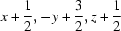
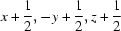
| Symmetry codes: (ii) x+1/2, −y+3/2, z+1/2; (iii) x+1/2, −y+1/2, z+1/2. |
Experimental details
| Crystal data | |
| Chemical formula | [Cu(C5H3N2O2)2(H2O)2] |
| Mr | 345.76 |
| Crystal system, space group | Monoclinic, P21/n |
| Temperature (K) | 293 |
| a, b, c (Å) | 6.7066 (12), 7.9041 (14), 12.030 (2) |
| β (°) | 105.036 (2) |
| V (Å3) | 615.88 (19) |
| Z | 2 |
| Radiation type | Mo Kα |
| µ (mm−1) | 1.81 |
| Crystal size (mm) | 0.29 × 0.25 × 0.20 |
| Data collection | |
| Diffractometer | Bruker SMART APEX CCD diffractometer |
| Absorption correction | Multi-scan (SADABS; Sheldrick, 1996) |
| Tmin, Tmax | 0.626, 0.711 |
| No. of measured, independent and observed [I > 2σ(I)] reflections | 3322, 1212, 1119 |
| Rint | 0.014 |
| (sin θ/λ)max (Å−1) | 0.618 |
| Refinement | |
| R[F2 > 2σ(F2)], wR(F2), S | 0.024, 0.071, 1.10 |
| No. of reflections | 1212 |
| No. of parameters | 98 |
| H-atom treatment | H-atom parameters constrained |
| Δρmax, Δρmin (e Å−3) | 0.24, −0.27 |
Computer programs: SMART (Bruker, 2007), SAINT (Bruker, 2007), SHELXS97 (Sheldrick, 2008), SHELXL97 (Sheldrick, 2008), SHELXTL (Sheldrick, 2008) and Mercury (Macrae et al., 2006), SHELXTL (Sheldrick, 2008).
| D—H···A | D—H | H···A | D···A | D—H···A |
| O1W—H1A···O2i | 0.82 | 1.99 | 2.796 (2) | 168 |
| O1W—H1B···N2ii | 0.82 | 2.33 | 3.041 (2) | 145 |
| C1—H1···O2ii | 0.93 | 2.42 | 3.226 (2) | 144 |
| Symmetry codes: (i) x+1/2, −y+3/2, z+1/2; (ii) x+1/2, −y+1/2, z+1/2. |
Acknowledgements
The authors thank Changchun Institute of Applied Chemistry for supporting this work.
References
 Bruker (2007). SMART and SAINT. Bruker AXS Inc., Madison, Wisconsin, USA. Google Scholar
Chutia, P., Kato, S., Kojima, T. & Satokawa, S. (2009). Polyhedron, 28, 370–380. Web of Science CSD CrossRef CAS Google Scholar
Dong, Y.-B., Smith, M. D. & zur Loye, H.-C. (2000). Inorg. Chem. 39, 1943–1949. Web of Science CSD CrossRef PubMed CAS Google Scholar
Klein, C. L., Majeste, R. J., Trefonas, L. M. & O'Connor, C. J. (1982). Inorg. Chem. 21, 1891–1897. CSD CrossRef CAS Web of Science Google Scholar
Kubota, Y., Takata, M., Matsuda, R., Kitaura, R., Kitagawa, S. & Kobayashi, T. C. (2006). Angew. Chem. Int. Ed. 45, 4932–4936. Web of Science CSD CrossRef CAS Google Scholar
Luo, J., Alexander, B., Wagner, T. R. & Maggard, P. A. (2004). Inorg. Chem. 43, 5537–5542. Web of Science CrossRef PubMed CAS Google Scholar
Macrae, C. F., Edgington, P. R., McCabe, P., Pidcock, E., Shields, G. P., Taylor, R., Towler, M. & van de Streek, J. (2006). J. Appl. Cryst. 39, 453–457. Web of Science CrossRef CAS IUCr Journals Google Scholar
Ptasiewicz-Bak, H., Leciejewicz, J. & Zachara, J. (1995). J. Coord. Chem. 36, 317–326. CrossRef CAS Web of Science Google Scholar
Sheldrick, G. M. (1996). SADABS. University of Göttingen, Germany. Google Scholar
Sheldrick, G. M. (2008). Acta Cryst. A64, 112–122. Web of Science CrossRef CAS IUCr Journals Google Scholar
This is an open-access article distributed under the terms of the Creative Commons Attribution (CC-BY) Licence, which permits unrestricted use, distribution, and reproduction in any medium, provided the original authors and source are cited.
| CRYSTALLOGRAPHIC COMMUNICATIONS |


Pyrazinecarboxylates have been extensively studied as excellent bridging ligands in the coordination chemistry research (Dong et al., 2000; Kubota et al., 2006; Luo et al., 2004; Ptasiewicz-Bak et al., 1995). The structure and magnetic properties of a copper(II) complex with the pyrazine-2-carboxylate (pzc) ligand (polymorph I) has been reported by Klein et al. (1982). We report here the structure of a new polymorph (polymorph II) of the title compound.
The polymorph II crystallizes in the monoclinic space group P21/n (polymorph I in P21/c). The CuII atom, lying on an inversion center, is six-coordinated in a distorted octahedral geometry, defined by two O atoms and two N atoms from two pzc ligands in the equatorial plane and two water molecules in the axial positions (Table 1 and Fig. 1). Weak coordination exists between the CuII center and the coordinated water molecule, with a Cu—O distance of 2.6143 (14) Å, due to Jahn-Teller effects. The bond lengths and angles are in normal ranges (Chutia et al., 2009; Klein et al., 1982). The coordinated water molecule donates its two H atoms to an uncoordinated carboxylate O atom and a pyrazine N atom of the neighboring molecules (Table 2 and Fig. 2). One complex molecule is linked to four neighboring molecules through these O—H···O and O—H···N hydrogen bonds, forming a two-dimensional layer in the (1 0 1) plane. Weak C—H···O hydrogen bond (Table 2) stabilizes the layer structure. In the previously reported polymorph I, the water molecule forms two O—H···O hydrogen bonds with a coordinated carboxylate O atom and an uncoordinated carboxylate O atom. One complex molecule is linked to six neighboring molecules, leading to a three-dimensional network.