 | Acta Crystallographica Section E Acta Crystallographica Section E CRYSTALLOGRAPHIC COMMUNICATIONS |


 journal menu


organic compounds
| CRYSTALLOGRAPHIC COMMUNICATIONS |
 access
N,N′-Bis(2-ammoniobenzyl)ethane-1,2-diammonium–nitrate–perchlorate (1/1.5/2.5)

aLaboratorio de Química Industrial, CELAES, Facultad de Ciencias Químicas, UANL, Pedro de Alba S/N, 66451 San Nicolás de los Garza, NL, Mexico, and bDEP Facultad de Ciencias Químicas, UANL, Guerrero y Progreso S/N, Col. Treviño, 64570 Monterrey, NL, Mexico
*Correspondence e-mail: [email protected]
The title compound, C16H26N44+·2.5ClO4−·1.5NO3−, is an organic salt in which the cation is a fully protonated tetramine. The cation lies on an inversion center and, as a consequence, both benzene rings are parallel. The central chain is found in an all-trans arrangement, a conformation different from that observed in the of the non-protonated molecule. The charges are balanced by a mixture of nitrate and perchlorate ions. One site is occupied by an ordered perchlorate ion, while the other contains both nitrate and perchlorate ions, with occupancies of 0.75 and 0.25, respectively. In the crystal, the NH2+ groups of the cation form N—H⋯O hydrogen bonds with the anions. The NH3+ groups also behave as donor groups, allowing the building of chains along [100], alternating cations and disordered anions being connected via N—H⋯O hydrogen bonds.
Related literature
For the structure of the free tetramine, see: Rodríguez de Barbarín et al. (2007![[Rodríguez de Barbarín, C., Bernès, S., Nájera, B., Elizondo, P. & Cerda, P. (2007). Acta Cryst. E63, o549-o550.]](../../../../../../logos/arrows/e_arr.gif "Rodríguez de Barbarín, C., Bernès, S., Nájera, B., Elizondo, P. & Cerda, P. (2007). Acta Cryst. E63, o549-o550.") ). For the use of polyaza ligands for depolymerization of poly(ethylene terephthalate), see: Carta et al. (2003); Parra et al. (2004); Pohorely et al. (2006).
). For the use of polyaza ligands for depolymerization of poly(ethylene terephthalate), see: Carta et al. (2003); Parra et al. (2004); Pohorely et al. (2006).
![[Scheme 1]](vm2008scheme1.gif)
Experimental
Crystal data
|
Data collection
|
Refinement
|
|
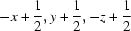 ; (iii)
 Data collection: XSCANS (Siemens, 1996); cell refinement: XSCANS; data reduction: XSCANS; program(s) used to solve structure: SHELXTL-Plus (Sheldrick, 2008); program(s) used to refine structure: SHELXTL-Plus; molecular graphics: SHELXTL-Plus and Mercury (Macrae et al., 2006); software used to prepare material for publication: SHELXTL-Plus.
Supporting information
contains datablocks I, global. DOI: 10.1107/S160053680904519X/vm2008sup1.cif
Structure factors: contains datablock I. DOI: 10.1107/S160053680904519X/vm2008Isup2.hkl
A 25 ml flask was charged with MnL(NO3)2 [279 mg; L is the free tetramine corresponding to the title cation (Rodríguez de Barbarín et al., 2007)] and ethanol (9 ml) and the mixture was stirred for 5 min., giving a white suspension. Salt Zn(ClO4)2.6H2O was added (919 mg) and the reaction further stirred for 3 min., affording a quite clear solution. Immediately, 200 mg of concentrated HCl was added, and the mixture turned to a translucent light yellow solution, which was cooled for 4 d. Light yellow-green crystals were formed over this period, which were isolated and washed with cold ethanol, diethyl ether and finally air dried. Yield 68% (26.2 mg), m.p. 160 °C (dec.). IR (KBr, cm-1) ν(CH2) 2942, 2787, ν(NO3) 1383, ν(ClO4) 1084, 940.
All H atoms were placed in idealized positions, with bond lengths fixed to 0.97 (methylene CH2), 0.93 (aromatic), 0.90 (NH2+) and 0.89 Å (NH3+). Isotropic displacement parameters for H atoms were calculated from displacements of parent atoms. Site occupation factors for nitrate N11 and perchlorate Cl2 anions (Fig. 1, inset) were first roughly refined and finally fixed to 3/4 and 1/4 in order to match the charges balance. The geometry for the nitrate ion was restrained to be flat and N—O bond lengths were restrained to 1.23 (1) Å. For the perchlorate, Cl—O bond lengths were restrained to 1.41 (1) Å.
Data collection: XSCANS (Siemens, 1996); cell XSCANS (Siemens, 1996); data reduction: XSCANS (Siemens, 1996); program(s) used to solve structure: SHELXTL-Plus (Sheldrick, 2008); program(s) used to refine structure: SHELXTL-Plus (Sheldrick, 2008); molecular graphics: SHELXTL-Plus (Sheldrick, 2008) and Mercury (Macrae et al., 2006); software used to prepare material for publication: SHELXTL-Plus (Sheldrick, 2008).
![[Figure 1]](./vm2008fig1thm.gif) | Fig. 1. The structure of the title compound, with displacement ellipsoids at the 30% probability level. Dashed lines represent hydrogen bonds in the asymmetric unit. The inset shows the anionic site with two disordered anions: nitrate N11 (occupancy = 3/4) and perchlorate Cl2 (occupancy = 1/4). |
![[Figure 2]](./vm2008fig2thm.gif) | Fig. 2. A part of the crystal structure of the title compound, with hydrogen bonds represented with dashed lines. Green anions are perchlorate and blue anions are nitrate. For the sake of clarity, some perchlorate ions have been omitted (hanging contacts). The crystal is viewed almost along [010]. |
| C16H26N44+·2.5ClO4−·1.5NO3− | F(000) = 638 |
| Mr = 616.05 | Dx = 1.697 Mg m−3 |
| Monoclinic, P21/n | Mo Kα radiation, λ = 0.71073 Å |
| Hall symbol: -P 2yn | Cell parameters from 73 reflections |
| a = 8.427 (3) Å | θ = 5.0–12.4° |
| b = 12.637 (3) Å | µ = 0.41 mm−1 |
| c = 11.834 (3) Å | T = 298 K |
| β = 106.97 (2)° | Irregular, pale yellow |
| V = 1205.4 (6) Å3 | 0.6 × 0.4 × 0.4 mm |
| Z = 2 |
| Siemens P4 diffractometer | Rint = 0.057 |
| Radiation source: fine-focus sealed tube | θmax = 25.1°, θmin = 2.4° |
| Graphite monochromator | h = −10→10 |
| ω scans | k = −15→15 |
| 6392 measured reflections | l = −14→14 |
| 2125 independent reflections | 3 standard reflections every 97 reflections |
| 1757 reflections with I > 2σ(I) | intensity decay: <1% |
| Refinement on F2 | Primary atom site location: structure-invariant direct methods |
| Least-squares matrix: full | Secondary atom site location: difference Fourier map |
| R[F2 > 2σ(F2)] = 0.050 | Hydrogen site location: inferred from neighbouring sites |
| wR(F2) = 0.119 | H-atom parameters constrained |
| S = 1.14 | w = 1/[σ2(Fo2) + (0.0221P)2 + 1.6735P] where P = (Fo2 + 2Fc2)/3 |
| 2125 reflections | (Δ/σ)max < 0.001 |
| 218 parameters | Δρmax = 0.25 e Å−3 |
| 8 restraints | Δρmin = −0.27 e Å−3 |
| 0 constraints |
| C16H26N44+·2.5ClO4−·1.5NO3− | V = 1205.4 (6) Å3 |
| Mr = 616.05 | Z = 2 |
| Monoclinic, P21/n | Mo Kα radiation |
| a = 8.427 (3) Å | µ = 0.41 mm−1 |
| b = 12.637 (3) Å | T = 298 K |
| c = 11.834 (3) Å | 0.6 × 0.4 × 0.4 mm |
| β = 106.97 (2)° |
| Siemens P4 diffractometer | Rint = 0.057 |
| 6392 measured reflections | 3 standard reflections every 97 reflections |
| 2125 independent reflections | intensity decay: <1% |
| 1757 reflections with I > 2σ(I) |
| R[F2 > 2σ(F2)] = 0.050 | 8 restraints |
| wR(F2) = 0.119 | H-atom parameters constrained |
| S = 1.14 | Δρmax = 0.25 e Å−3 |
| 2125 reflections | Δρmin = −0.27 e Å−3 |
| 218 parameters |
| x | y | z | Uiso*/Ueq | Occ. (<1) | |
| N1 | −0.1084 (4) | 0.6532 (2) | 0.2742 (2) | 0.0430 (7) | |
| H1A | −0.2090 | 0.6242 | 0.2538 | 0.065* | |
| H1B | −0.1163 | 0.7215 | 0.2897 | 0.065* | |
| H1C | −0.0445 | 0.6208 | 0.3381 | 0.065* | |
| C2 | −0.0347 (4) | 0.6416 (2) | 0.1763 (3) | 0.0326 (7) | |
| C3 | −0.1440 (4) | 0.6359 (2) | 0.0652 (3) | 0.0399 (8) | |
| H3A | −0.2578 | 0.6371 | 0.0546 | 0.048* | |
| C4 | −0.0826 (5) | 0.6283 (2) | −0.0310 (3) | 0.0434 (8) | |
| H4A | −0.1553 | 0.6235 | −0.1070 | 0.052* | |
| C5 | 0.0852 (5) | 0.6280 (3) | −0.0143 (3) | 0.0430 (8) | |
| H5A | 0.1263 | 0.6245 | −0.0791 | 0.052* | |
| C6 | 0.1929 (4) | 0.6327 (2) | 0.0979 (3) | 0.0394 (8) | |
| H6A | 0.3066 | 0.6313 | 0.1082 | 0.047* | |
| C7 | 0.1348 (4) | 0.6396 (2) | 0.1969 (3) | 0.0311 (7) | |
| C8 | 0.2604 (4) | 0.6487 (2) | 0.3159 (3) | 0.0371 (7) | |
| H8A | 0.2095 | 0.6834 | 0.3696 | 0.044* | |
| H8B | 0.3513 | 0.6928 | 0.3091 | 0.044* | |
| N9 | 0.3283 (3) | 0.5437 (2) | 0.3671 (2) | 0.0350 (6) | |
| H9A | 0.2457 | 0.5053 | 0.3806 | 0.042* | |
| H9B | 0.3660 | 0.5085 | 0.3140 | 0.042* | |
| C10 | 0.4644 (4) | 0.5534 (3) | 0.4787 (3) | 0.0380 (8) | |
| H10A | 0.4225 | 0.5862 | 0.5384 | 0.046* | |
| H10B | 0.5509 | 0.5985 | 0.4662 | 0.046* | |
| Cl1 | −0.00237 (10) | 0.35712 (6) | 0.40133 (7) | 0.0396 (2) | |
| O1 | −0.1221 (4) | 0.3829 (3) | 0.4604 (3) | 0.0752 (9) | |
| O2 | 0.0116 (4) | 0.4419 (2) | 0.3253 (2) | 0.0643 (8) | |
| O3 | 0.1540 (4) | 0.3438 (2) | 0.4887 (2) | 0.0648 (8) | |
| O4 | −0.0495 (4) | 0.2635 (2) | 0.3332 (3) | 0.0647 (8) | |
| Cl2 | 0.5512 (9) | 0.4371 (6) | 0.1804 (8) | 0.0358 (15) | 0.25 |
| O5 | 0.587 (4) | 0.5336 (15) | 0.244 (2) | 0.039 (7) | 0.25 |
| O6 | 0.5011 (19) | 0.4701 (12) | 0.0603 (8) | 0.083 (4) | 0.25 |
| O7 | 0.415 (4) | 0.394 (4) | 0.211 (4) | 0.083 (14) | 0.25 |
| O8 | 0.675 (2) | 0.3628 (14) | 0.186 (2) | 0.052 (5) | 0.25 |
| N11 | 0.5525 (14) | 0.4327 (9) | 0.2076 (9) | 0.068 (4) | 0.75 |
| O12 | 0.5925 (19) | 0.5250 (7) | 0.2380 (11) | 0.071 (4) | 0.75 |
| O13 | 0.4469 (14) | 0.3860 (9) | 0.2416 (13) | 0.056 (2) | 0.75 |
| O14 | 0.6277 (12) | 0.3811 (8) | 0.1526 (9) | 0.099 (3) | 0.75 |
| U11 | U22 | U33 | U12 | U13 | U23 | |
| N1 | 0.0417 (16) | 0.0511 (17) | 0.0434 (15) | 0.0065 (14) | 0.0236 (13) | 0.0043 (13) |
| C2 | 0.0406 (18) | 0.0254 (14) | 0.0364 (16) | 0.0035 (13) | 0.0186 (14) | 0.0037 (13) |
| C3 | 0.0373 (18) | 0.0331 (16) | 0.0472 (19) | 0.0030 (14) | 0.0089 (15) | 0.0045 (15) |
| C4 | 0.062 (2) | 0.0306 (16) | 0.0344 (17) | 0.0060 (16) | 0.0086 (16) | 0.0029 (14) |
| C5 | 0.065 (3) | 0.0361 (18) | 0.0336 (17) | 0.0020 (17) | 0.0231 (17) | 0.0038 (14) |
| C6 | 0.0451 (19) | 0.0333 (16) | 0.0475 (18) | −0.0014 (15) | 0.0255 (16) | 0.0056 (15) |
| C7 | 0.0393 (18) | 0.0221 (14) | 0.0347 (15) | −0.0016 (13) | 0.0153 (13) | 0.0033 (12) |
| C8 | 0.0392 (18) | 0.0305 (16) | 0.0421 (17) | −0.0037 (14) | 0.0128 (15) | −0.0009 (14) |
| N9 | 0.0333 (15) | 0.0368 (14) | 0.0337 (13) | −0.0012 (11) | 0.0081 (12) | −0.0022 (11) |
| C10 | 0.0333 (18) | 0.0418 (18) | 0.0355 (17) | −0.0007 (14) | 0.0047 (14) | −0.0050 (14) |
| Cl1 | 0.0461 (5) | 0.0334 (4) | 0.0467 (5) | −0.0010 (4) | 0.0250 (4) | 0.0020 (3) |
| O1 | 0.069 (2) | 0.088 (2) | 0.089 (2) | 0.0045 (17) | 0.0545 (18) | −0.0055 (18) |
| O2 | 0.084 (2) | 0.0519 (16) | 0.0603 (16) | −0.0161 (15) | 0.0263 (15) | 0.0158 (13) |
| O3 | 0.0577 (18) | 0.0691 (18) | 0.0606 (16) | 0.0068 (15) | 0.0065 (14) | −0.0013 (14) |
| O4 | 0.0669 (19) | 0.0407 (14) | 0.086 (2) | −0.0074 (13) | 0.0213 (16) | −0.0149 (14) |
| Cl2 | 0.028 (3) | 0.033 (3) | 0.051 (3) | −0.006 (2) | 0.018 (2) | −0.007 (2) |
| O5 | 0.039 (13) | 0.049 (16) | 0.039 (9) | 0.007 (10) | 0.026 (9) | 0.002 (9) |
| O6 | 0.105 (11) | 0.110 (10) | 0.037 (6) | −0.004 (9) | 0.027 (7) | 0.017 (7) |
| O7 | 0.059 (14) | 0.12 (2) | 0.08 (3) | −0.036 (15) | 0.030 (17) | −0.020 (16) |
| O8 | 0.029 (7) | 0.032 (6) | 0.094 (12) | 0.010 (6) | 0.019 (7) | −0.005 (7) |
| N11 | 0.070 (6) | 0.079 (7) | 0.060 (6) | 0.024 (5) | 0.026 (4) | −0.002 (4) |
| O12 | 0.082 (8) | 0.029 (4) | 0.118 (7) | −0.005 (4) | 0.055 (6) | −0.006 (4) |
| O13 | 0.060 (5) | 0.052 (3) | 0.062 (6) | −0.016 (3) | 0.028 (5) | −0.003 (3) |
| O14 | 0.104 (7) | 0.097 (5) | 0.122 (8) | 0.031 (4) | 0.075 (6) | −0.015 (5) |
| N1—C2 | 1.473 (4) | N9—C10 | 1.480 (4) |
| N1—H1A | 0.8900 | N9—H9A | 0.9000 |
| N1—H1B | 0.8900 | N9—H9B | 0.9000 |
| N1—H1C | 0.8900 | C10—C10i | 1.503 (6) |
| C2—C3 | 1.369 (4) | C10—H10A | 0.9700 |
| C2—C7 | 1.378 (4) | C10—H10B | 0.9700 |
| C3—C4 | 1.385 (5) | Cl1—O4 | 1.421 (3) |
| C3—H3A | 0.9300 | Cl1—O1 | 1.423 (3) |
| C4—C5 | 1.369 (5) | Cl1—O2 | 1.426 (3) |
| C4—H4A | 0.9300 | Cl1—O3 | 1.428 (3) |
| C5—C6 | 1.374 (5) | Cl2—O8 | 1.389 (9) |
| C5—H5A | 0.9300 | Cl2—O7 | 1.409 (10) |
| C6—C7 | 1.398 (4) | Cl2—O5 | 1.417 (10) |
| C6—H6A | 0.9300 | Cl2—O6 | 1.422 (9) |
| C7—C8 | 1.498 (4) | N11—O14 | 1.222 (8) |
| C8—N9 | 1.501 (4) | N11—O13 | 1.229 (8) |
| C8—H8A | 0.9700 | N11—O12 | 1.238 (8) |
| C8—H8B | 0.9700 | ||
| C2—N1—H1A | 109.5 | H8A—C8—H8B | 107.8 |
| C2—N1—H1B | 109.5 | C10—N9—C8 | 113.1 (2) |
| H1A—N1—H1B | 109.5 | C10—N9—H9A | 109.0 |
| C2—N1—H1C | 109.5 | C8—N9—H9A | 109.0 |
| H1A—N1—H1C | 109.5 | C10—N9—H9B | 109.0 |
| H1B—N1—H1C | 109.5 | C8—N9—H9B | 109.0 |
| C3—C2—C7 | 122.8 (3) | H9A—N9—H9B | 107.8 |
| C3—C2—N1 | 116.1 (3) | N9—C10—C10i | 110.7 (3) |
| C7—C2—N1 | 121.0 (3) | N9—C10—H10A | 109.5 |
| C2—C3—C4 | 119.0 (3) | C10i—C10—H10A | 109.5 |
| C2—C3—H3A | 120.5 | N9—C10—H10B | 109.5 |
| C4—C3—H3A | 120.5 | C10i—C10—H10B | 109.5 |
| C5—C4—C3 | 120.0 (3) | H10A—C10—H10B | 108.1 |
| C5—C4—H4A | 120.0 | O4—Cl1—O1 | 110.36 (19) |
| C3—C4—H4A | 120.0 | O4—Cl1—O2 | 109.21 (17) |
| C4—C5—C6 | 120.2 (3) | O1—Cl1—O2 | 109.82 (19) |
| C4—C5—H5A | 119.9 | O4—Cl1—O3 | 111.00 (17) |
| C6—C5—H5A | 119.9 | O1—Cl1—O3 | 107.96 (19) |
| C5—C6—C7 | 121.2 (3) | O2—Cl1—O3 | 108.46 (19) |
| C5—C6—H6A | 119.4 | O8—Cl2—O7 | 112 (2) |
| C7—C6—H6A | 119.4 | O8—Cl2—O5 | 121.0 (17) |
| C2—C7—C6 | 116.8 (3) | O7—Cl2—O5 | 105 (3) |
| C2—C7—C8 | 125.2 (3) | O8—Cl2—O6 | 104.3 (13) |
| C6—C7—C8 | 117.9 (3) | O7—Cl2—O6 | 110 (2) |
| C7—C8—N9 | 113.2 (2) | O5—Cl2—O6 | 103.4 (13) |
| C7—C8—H8A | 108.9 | O14—N11—O13 | 117.1 (12) |
| N9—C8—H8A | 108.9 | O14—N11—O12 | 121.2 (12) |
| C7—C8—H8B | 108.9 | O13—N11—O12 | 121.3 (12) |
| N9—C8—H8B | 108.9 | ||
| C7—C2—C3—C4 | −0.3 (5) | C5—C6—C7—C2 | −0.1 (4) |
| N1—C2—C3—C4 | 178.0 (3) | C5—C6—C7—C8 | −177.7 (3) |
| C2—C3—C4—C5 | −0.8 (5) | C2—C7—C8—N9 | 98.7 (3) |
| C3—C4—C5—C6 | 1.5 (5) | C6—C7—C8—N9 | −83.9 (3) |
| C4—C5—C6—C7 | −1.0 (5) | C7—C8—N9—C10 | 174.1 (3) |
| C3—C2—C7—C6 | 0.7 (4) | C8—N9—C10—C10i | −175.9 (3) |
| N1—C2—C7—C6 | −177.5 (3) | O8—Cl2—O6—O6ii | −79 (5) |
| C3—C2—C7—C8 | 178.2 (3) | O7—Cl2—O6—O6ii | 160 (6) |
| N1—C2—C7—C8 | −0.1 (4) | O5—Cl2—O6—O6ii | 48 (6) |
| Symmetry codes: (i) −x+1, −y+1, −z+1; (ii) −x+1, −y+1, −z. |
| D—H···A | D—H | H···A | D···A | D—H···A |
| N1—H1C···O2 | 0.89 | 2.32 | 2.856 (4) | 118 |
| N1—H1B···O13iii | 0.89 | 2.61 | 3.270 (13) | 132 |
| N9—H9B···O5 | 0.90 | 2.27 | 2.96 (3) | 133 |
| N9—H9B···O12 | 0.90 | 2.35 | 3.055 (15) | 136 |
| N9—H9A···O2 | 0.90 | 2.05 | 2.872 (4) | 151 |
| N9—H9A···O3 | 0.90 | 2.64 | 3.441 (4) | 149 |
| N9—H9B···O7 | 0.90 | 2.02 | 2.89 (5) | 163 |
| N9—H9B···O13 | 0.90 | 1.98 | 2.836 (13) | 157 |
| N1—H1A···O5iv | 0.89 | 2.04 | 2.91 (3) | 165 |
| N1—H1A···O12iv | 0.89 | 2.05 | 2.920 (13) | 164 |
| N1—H1B···O8iii | 0.89 | 1.90 | 2.78 (2) | 170 |
| N1—H1B···O14iii | 0.89 | 2.14 | 3.026 (11) | 174 |
| N1—H1C···O1v | 0.89 | 2.39 | 3.207 (4) | 153 |
| Symmetry codes: (iii) −x+1/2, y+1/2, −z+1/2; (iv) x−1, y, z; (v) −x, −y+1, −z+1. |
Experimental details
| Crystal data | |
| Chemical formula | C16H26N44+·2.5ClO4−·1.5NO3− |
| Mr | 616.05 |
| Crystal system, space group | Monoclinic, P21/n |
| Temperature (K) | 298 |
| a, b, c (Å) | 8.427 (3), 12.637 (3), 11.834 (3) |
| β (°) | 106.97 (2) |
| V (Å3) | 1205.4 (6) |
| Z | 2 |
| Radiation type | Mo Kα |
| µ (mm−1) | 0.41 |
| Crystal size (mm) | 0.6 × 0.4 × 0.4 |
| Data collection | |
| Diffractometer | Siemens P4 diffractometer |
| Absorption correction | – |
| No. of measured, independent and observed [I > 2σ(I)] reflections | 6392, 2125, 1757 |
| Rint | 0.057 |
| (sin θ/λ)max (Å−1) | 0.596 |
| Refinement | |
| R[F2 > 2σ(F2)], wR(F2), S | 0.050, 0.119, 1.14 |
| No. of reflections | 2125 |
| No. of parameters | 218 |
| No. of restraints | 8 |
| H-atom treatment | H-atom parameters constrained |
| Δρmax, Δρmin (e Å−3) | 0.25, −0.27 |
Computer programs: XSCANS (Siemens, 1996), SHELXTL-Plus (Sheldrick, 2008) and Mercury (Macrae et al., 2006).
| D—H···A | D—H | H···A | D···A | D—H···A |
| N9—H9A···O2 | 0.90 | 2.05 | 2.872 (4) | 151.1 |
| N9—H9B···O7 | 0.90 | 2.02 | 2.89 (5) | 162.8 |
| N9—H9B···O13 | 0.90 | 1.98 | 2.836 (13) | 157.3 |
| N1—H1A···O5i | 0.89 | 2.04 | 2.91 (3) | 165.2 |
| N1—H1A···O12i | 0.89 | 2.05 | 2.920 (13) | 164.1 |
| N1—H1B···O8ii | 0.89 | 1.90 | 2.78 (2) | 169.7 |
| N1—H1B···O14ii | 0.89 | 2.14 | 3.026 (11) | 173.6 |
| N1—H1C···O1iii | 0.89 | 2.39 | 3.207 (4) | 153.0 |
| Symmetry codes: (i) x−1, y, z; (ii) −x+1/2, y+1/2, −z+1/2; (iii) −x, −y+1, −z+1. |
Acknowledgements
The authors thank FCQ-UANL for supporting this work (Project No. 03–6375-QAA-08–017)
References
 Carta, D., Cao, G. & D'Angeli, C. (2003). Environ. Sci. Pollut. Res. Int. 10, 390–394. Web of Science CrossRef PubMed CAS Google Scholar
Macrae, C. F., Edgington, P. R., McCabe, P., Pidcock, E., Shields, G. P., Taylor, R., Towler, M. & van de Streek, J. (2006). J. Appl. Cryst. 39, 453–457. Web of Science CrossRef CAS IUCr Journals Google Scholar
Parra, J. B., Ania, C. O., Arenillas, A., Rubiera, F. & Pis, J. J. (2004). Appl. Surf. Sci. 238, 304–308. Web of Science CrossRef CAS Google Scholar
Pohorely, M., Vosecky, M., Hejdova, P., Puncochar, M., Skoblja, S., Staf, M., Vosta, J., Koutsky, B. & Svoboda, K. (2006). Fuel, 85, 2458–2468. Web of Science CrossRef CAS Google Scholar
Rodríguez de Barbarín, C., Bernès, S., Nájera, B., Elizondo, P. & Cerda, P. (2007). Acta Cryst. E63, o549–o550. Web of Science CSD CrossRef IUCr Journals Google Scholar
Sheldrick, G. M. (2008). Acta Cryst. A64, 112–122. Web of Science CrossRef CAS IUCr Journals Google Scholar
Siemens (1996). XSCANS. Siemens Analytical X-ray Instruments Inc., Madison, Wisconsin, USA. Google Scholar
This is an open-access article distributed under the terms of the Creative Commons Attribution (CC-BY) Licence, which permits unrestricted use, distribution, and reproduction in any medium, provided the original authors and source are cited.
| CRYSTALLOGRAPHIC COMMUNICATIONS |


Poly(ethylene terephthalate) (PET) is a thermoplastic material, which has been increasingly used in the industry during the last decades. Its low degradability makes this material highly contaminant to the environment (Carta et al., 2003). Currently, many efforts are devoted to reduce the amount of waste PET that reaches the landfillings. Some processes are able to recycle PET into highly valued carbon materials (Parra et al., 2004), used to generate heat and electricity (Pohorely et al., 2006). An interesting approach known as 'chemical recycling' is based on the depolymerization of PET through solvolytic chain cleavage. Five processes have been probed, with different depolymerizing agents: methanolysis, glycolysis, hydrolysis, aminolysis and ammonolysis. Several reactions used catalyst, among them zinc compounds.
Our group is involved in the search for reactions relevant to the chemical degradation of PET, using acyclic polyaza zinc complexes ZnLX2 (X = ClO4-, NO3-; L = polyaza ligand), which gave excellent results. The title salt appeared during an attempt to prepare a bimetallic catalyst. Previous works showed that complex CuL[CuCl4] can be obtained as the product of the transmetallation of MnL(NO3)2 with Cu(ClO4)2.6H2O in ethanol, with an excess of aqueous HCl. The same transmetallation procedure, using Zn(ClO4)2.6H2O in acidic ethanol afforded pale yellow crystals as a subproduct, which were identified as the title salt by X-ray diffraction.
The salt is composed of a tetracation and a mixture of nitrate and perchlorate anions (Fig. 1). The presence of both anions in the material was confirmed by IR spectroscopy, as spectra include characteristic vibrations for these ions. The cation is fully protonated and is placed on an inversion center. As a consequence, benzene rings are parallel by symmetry. The 6-membered chain linking the benzene fragments is found in the all-trans extended conformation, contrasting with the trans-gauche-trans conformation observed in the solid-sate for the non-protonated tetramine (Rodríguez de Barbarín et al., 2007). Anions are found in two sites. One site is occupied by a non disordered perchlorate, Cl1. The other site contains a mixture of nitrate (N11) and perchlorate (Cl2), with occupancies 3/4 and 1/4, respectively (Fig. 1, inset). Because they are involved in hydrogen bonds, anions do not present orientational disorder.
NH2+ and NH3+ groups have different functions regarding hydrogen bonding in the crystal. NH2+ donors groups are connected to anions within the asymmetric unit, forming N—H···O hydrogen bonds (Fig. 1). NH3+ groups also serve as donors for N—H···O hydrogen bonds, connecting symmetry related cations via anions, to form a one-dimensional supramolecular structure where cations and anions alternate in the [100] direction (Fig. 2).