Related literature
For background to metal organic framework structures, see: Lee et al. (2000![[Lee, E., Heo, J. & Kim, K. (2000). Angew. Chem. Int. Ed. 112, 2811-2813.]](../../../../../../logos/arrows/e_arr.gif "Lee, E., Heo, J. & Kim, K. (2000). Angew. Chem. Int. Ed. 112, 2811-2813.") ).
).
Experimental
Crystal data
[Cu2(C6H6N4)2(H2O)2]SO4 Mr = 527.50 Monoclinic, C 2/c a = 12.7597 (7) Å b = 14.8594 (7) Å c = 10.6375 (5) Å β = 114.777 (3)° V = 1831.22 (16) Å3 Z = 4 Mo Kα radiation μ = 2.49 mm−1 T = 273 K 0.12 × 0.10 × 0.08 mm
|
Data collection
Bruker APEXII CCD diffractometer Absorption correction: multi-scan (SADABS; Bruker, 2001) Tmin = 0.754, Tmax = 0.826 9619 measured reflections 1630 independent reflections 1522 reflections with I > 2σ(I) Rint = 0.023
|
| Cu1—N4 | 1.8953 (18) | | Cu1—N2 | 1.9006 (18) | | |
| D—H⋯A | D—H | H⋯A | D⋯A | D—H⋯A | | O1W—H1W⋯O2i | 0.819 (6) | 2.037 (8) | 2.848 (3) | 170 (5) | | O1W—H2W⋯O1ii | 0.82 (3) | 2.294 (14) | 3.072 (4) | 159 (4) | | N3—H3A⋯O1iii | 0.970 (14) | 1.794 (13) | 2.697 (3) | 153 (3) | | N1—H1A⋯O2iv | 0.972 (15) | 1.804 (9) | 2.743 (3) | 162 (3) | Symmetry codes: (i) -x+1, -y+1, -z+1; (ii)  ; (iii) ; (iii) 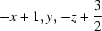 ; (iv) x-1, y-1, z. ; (iv) x-1, y-1, z.
| |
Data collection: APEX2 (Bruker, 2004); cell refinement: SAINT-Plus (Bruker, 2001); data reduction: SAINT-Plus; program(s) used to solve structure: SHELXS97 (Sheldrick, 2008); program(s) used to refine structure: SHELXL97 (Sheldrick, 2008); molecular graphics: SHELXTL (Sheldrick, 2008); software used to prepare material for publication: SHELXL97.
Supporting information
A mixture of 2,2'-diimidazole (1 mmol, 0.14 g), oxalic acid (1 mmol, 0.09 g), copper(II) sulfate pentahydrate (1 mmol, 0.25 g), and 10 ml H2O was heated to 443 K for one day in an autoclave. Red crystals were obtained after cooling to room temperature with a yield of 82%. Elemental Analysis. Calc. for C12H16Cu2N8O6S: C 27.30, H 3.03, N 21.23%; Found: C 27.15, H 2.95, N 21.11%. Under the given hydrothermal conditions, Cu(II) was apparently reduced to Cu(I), leading to the formation of the title complex.
All hydrogen atoms bound to carbon were refined using a riding model with C—H = 0.93 Å and Uiso(H) = 1.2Ueq(C). The H atoms of the water molecule were located from difference density maps and were refined with distance restraints of d(H–H) = 1.38 (2) Å, d(O–H) = 0.88 (2) Å, and with a fixed Uiso of 0.80 Å2. The H atoms on nitrogen atoms were located from difference density maps and were refined with distance restraints of d(N–H) = 0.97 (2) Å.
Data collection: APEX2 (Bruker, 2004); cell refinement: SAINT-Plus (Bruker, 2001); data reduction: SAINT-Plus (Bruker, 2001); program(s) used to solve structure: SHELXS97 (Sheldrick, 2008); program(s) used to refine structure: SHELXL97 (Sheldrick, 2008); molecular graphics: SHELXTL (Sheldrick, 2008); software used to prepare material for publication: SHELXL97 (Sheldrick, 2008).
Bis(µ-2,2'-biimidazole-
κ2N3:
N3')bis[aquacopper(I)] sulfate
top Crystal data top | [Cu2(C6H6N4)2(H2O)2]SO4 | F(000) = 1064 |
| Mr = 527.50 | Dx = 1.913 Mg m−3 |
| Monoclinic, C2/c | Mo Kα radiation, λ = 0.71073 Å |
| Hall symbol: -C 2yc | Cell parameters from 5587 reflections |
| a = 12.7597 (7) Å | θ = 0.0–0.0° |
| b = 14.8594 (7) Å | µ = 2.49 mm−1 |
| c = 10.6375 (5) Å | T = 273 K |
| β = 114.777 (3)° | Block, red |
| V = 1831.22 (16) Å3 | 0.12 × 0.10 × 0.08 mm |
| Z = 4 | |
Data collection top Bruker APEXII CCD
diffractometer | 1630 independent reflections |
| Radiation source: fine-focus sealed tube | 1522 reflections with I > 2σ(I) |
| Graphite monochromator | Rint = 0.023 |
| ϕ and ω scans | θmax = 25.0°, θmin = 2.2° |
Absorption correction: multi-scan
(SADABS; Bruker, 2001) | h = −15→15 |
| Tmin = 0.754, Tmax = 0.826 | k = −17→17 |
| 9619 measured reflections | l = −12→12 |
Refinement top | Refinement on F2 | Primary atom site location: structure-invariant direct methods |
| Least-squares matrix: full | Secondary atom site location: difference Fourier map |
| R[F2 > 2σ(F2)] = 0.025 | Hydrogen site location: inferred from neighbouring sites |
| wR(F2) = 0.073 | H atoms treated by a mixture of independent and constrained refinement |
| S = 1.00 | w = 1/[σ2(Fo2) + (0.047P)2 + 2.1669P]
where P = (Fo2 + 2Fc2)/3 |
| 1630 reflections | (Δ/σ)max = 0.008 |
| 148 parameters | Δρmax = 0.30 e Å−3 |
| 0 restraints | Δρmin = −0.45 e Å−3 |
Crystal data top | [Cu2(C6H6N4)2(H2O)2]SO4 | V = 1831.22 (16) Å3 |
| Mr = 527.50 | Z = 4 |
| Monoclinic, C2/c | Mo Kα radiation |
| a = 12.7597 (7) Å | µ = 2.49 mm−1 |
| b = 14.8594 (7) Å | T = 273 K |
| c = 10.6375 (5) Å | 0.12 × 0.10 × 0.08 mm |
| β = 114.777 (3)° | |
Data collection top Bruker APEXII CCD
diffractometer | 1630 independent reflections |
Absorption correction: multi-scan
(SADABS; Bruker, 2001) | 1522 reflections with I > 2σ(I) |
| Tmin = 0.754, Tmax = 0.826 | Rint = 0.023 |
| 9619 measured reflections | |
Refinement top | R[F2 > 2σ(F2)] = 0.025 | 0 restraints |
| wR(F2) = 0.073 | H atoms treated by a mixture of independent and constrained refinement |
| S = 1.00 | Δρmax = 0.30 e Å−3 |
| 1630 reflections | Δρmin = −0.45 e Å−3 |
| 148 parameters | |
Special details top Geometry. All e.s.d.'s (except the e.s.d. in the dihedral angle between two l.s. planes) are estimated using the full covariance matrix. The cell e.s.d.'s are taken into account individually in the estimation of e.s.d.'s in distances, angles and torsion angles; correlations between e.s.d.'s in cell parameters are only used when they are defined by crystal symmetry. An approximate (isotropic) treatment of cell e.s.d.'s is used for estimating e.s.d.'s involving l.s. planes. |
Refinement. Refinement of F2 against ALL reflections. The weighted R-factor wR and goodness of fit S are based on F2, conventional R-factors R are based on F, with F set to zero for negative F2. The threshold expression of F2 > σ(F2) is used only for calculating R-factors(gt) etc. and is not relevant to the choice of reflections for refinement. R-factors based on F2 are statistically about twice as large as those based on F, and R- factors based on ALL data will be even larger. |
Fractional atomic coordinates and isotropic or equivalent isotropic displacement parameters (Å2) top| | x | y | z | Uiso*/Ueq | |
| Cu1 | 0.01189 (3) | 0.265145 (18) | 0.63467 (3) | 0.04181 (14) | |
| S1 | 1.0000 | 0.76744 (5) | 0.7500 | 0.0392 (2) | |
| C1 | 0.03743 (17) | 0.45644 (13) | 0.7144 (2) | 0.0299 (4) | |
| C2 | 0.14997 (19) | 0.50798 (15) | 0.6214 (2) | 0.0379 (5) | |
| H2 | 0.1923 | 0.5464 | 0.5913 | 0.045* | |
| C3 | 0.1405 (2) | 0.41751 (15) | 0.6049 (2) | 0.0400 (5) | |
| H3 | 0.1766 | 0.3829 | 0.5616 | 0.048* | |
| C4 | −0.1342 (2) | 0.12062 (16) | 0.4636 (2) | 0.0411 (5) | |
| H4 | −0.1675 | 0.1563 | 0.3848 | 0.049* | |
| C5 | −0.1485 (2) | 0.03051 (16) | 0.4682 (2) | 0.0410 (5) | |
| H5 | −0.1917 | −0.0068 | 0.3944 | 0.049* | |
| C6 | −0.03621 (17) | 0.07952 (13) | 0.6765 (2) | 0.0302 (4) | |
| N1 | −0.08656 (15) | 0.00532 (12) | 0.6033 (2) | 0.0352 (4) | |
| N2 | −0.06269 (16) | 0.15125 (12) | 0.59369 (19) | 0.0356 (4) | |
| N3 | 0.08523 (15) | 0.53162 (11) | 0.69092 (19) | 0.0338 (4) | |
| N4 | 0.06894 (16) | 0.38469 (12) | 0.66225 (19) | 0.0350 (4) | |
| O1 | 0.9542 (2) | 0.71052 (14) | 0.8273 (3) | 0.0695 (6) | |
| O2 | 0.90665 (16) | 0.82506 (12) | 0.6552 (2) | 0.0561 (5) | |
| O1W | 0.1960 (2) | 0.18900 (17) | 0.6389 (3) | 0.0708 (6) | |
| H1W | 0.169 (3) | 0.191 (4) | 0.5542 (3) | 0.13 (2)* | |
| H2W | 0.2621 (13) | 0.208 (3) | 0.678 (3) | 0.082 (12)* | |
| H3A | 0.069 (2) | 0.5926 (7) | 0.710 (3) | 0.061 (8)* | |
| H1A | −0.079 (2) | −0.0551 (7) | 0.641 (3) | 0.060 (8)* | |
Atomic displacement parameters (Å2) top| | U11 | U22 | U33 | U12 | U13 | U23 |
| Cu1 | 0.0621 (2) | 0.01984 (19) | 0.0446 (2) | −0.00492 (11) | 0.02347 (16) | −0.00188 (10) |
| S1 | 0.0481 (5) | 0.0179 (4) | 0.0512 (5) | 0.000 | 0.0202 (4) | 0.000 |
| C1 | 0.0328 (10) | 0.0188 (9) | 0.0321 (10) | 0.0000 (8) | 0.0075 (8) | 0.0009 (8) |
| C2 | 0.0378 (11) | 0.0326 (11) | 0.0440 (12) | −0.0024 (9) | 0.0179 (10) | 0.0032 (9) |
| C3 | 0.0457 (12) | 0.0332 (12) | 0.0448 (13) | 0.0033 (10) | 0.0227 (10) | 0.0008 (10) |
| C4 | 0.0462 (12) | 0.0379 (12) | 0.0345 (11) | −0.0033 (10) | 0.0122 (10) | 0.0019 (10) |
| C5 | 0.0424 (12) | 0.0387 (13) | 0.0383 (12) | −0.0091 (10) | 0.0133 (10) | −0.0073 (10) |
| C6 | 0.0317 (10) | 0.0214 (10) | 0.0384 (11) | −0.0013 (8) | 0.0157 (8) | −0.0008 (8) |
| N1 | 0.0373 (9) | 0.0235 (9) | 0.0432 (10) | −0.0028 (7) | 0.0153 (8) | −0.0024 (8) |
| N2 | 0.0438 (10) | 0.0245 (9) | 0.0368 (10) | −0.0024 (7) | 0.0154 (8) | 0.0006 (7) |
| N3 | 0.0350 (9) | 0.0208 (9) | 0.0417 (10) | −0.0009 (7) | 0.0124 (8) | 0.0009 (7) |
| N4 | 0.0436 (10) | 0.0221 (9) | 0.0391 (10) | 0.0003 (7) | 0.0173 (8) | −0.0002 (7) |
| O1 | 0.1064 (17) | 0.0292 (9) | 0.0917 (16) | −0.0109 (11) | 0.0600 (14) | 0.0037 (10) |
| O2 | 0.0531 (10) | 0.0340 (9) | 0.0671 (12) | 0.0030 (8) | 0.0113 (9) | 0.0031 (8) |
| O1W | 0.0653 (14) | 0.0608 (14) | 0.0795 (17) | −0.0082 (11) | 0.0236 (12) | −0.0130 (12) |
Geometric parameters (Å, º) top | Cu1—N4 | 1.8953 (18) | C3—H3 | 0.9300 |
| Cu1—N2 | 1.9006 (18) | C4—C5 | 1.355 (3) |
| Cu1—Cu1i | 2.5956 (6) | C4—N2 | 1.377 (3) |
| S1—O1 | 1.462 (2) | C4—H4 | 0.9300 |
| S1—O1ii | 1.462 (2) | C5—N1 | 1.370 (3) |
| S1—O2ii | 1.4704 (18) | C5—H5 | 0.9300 |
| S1—O2 | 1.4704 (18) | C6—N2 | 1.333 (3) |
| C1—N4 | 1.339 (3) | C6—N1 | 1.347 (3) |
| C1—N3 | 1.345 (3) | C6—C6i | 1.446 (4) |
| C1—C1i | 1.447 (4) | N1—H1A | 0.972 (15) |
| C2—C3 | 1.355 (3) | N3—H3A | 0.970 (14) |
| C2—N3 | 1.366 (3) | O1W—H1W | 0.819 (6) |
| C2—H2 | 0.9300 | O1W—H2W | 0.82 (3) |
| C3—N4 | 1.383 (3) | | |
| | | |
| N4—Cu1—N2 | 173.20 (8) | N2—C4—H4 | 125.3 |
| N4—Cu1—Cu1i | 92.47 (6) | C4—C5—N1 | 106.3 (2) |
| N2—Cu1—Cu1i | 88.35 (6) | C4—C5—H5 | 126.9 |
| O1—S1—O1ii | 109.29 (18) | N1—C5—H5 | 126.8 |
| O1—S1—O2ii | 110.56 (13) | N2—C6—N1 | 110.22 (19) |
| O1ii—S1—O2ii | 108.83 (13) | N2—C6—C6i | 125.81 (12) |
| O1—S1—O2 | 108.83 (13) | N1—C6—C6i | 123.98 (13) |
| O1ii—S1—O2 | 110.56 (13) | C6—N1—C5 | 107.94 (18) |
| O2ii—S1—O2 | 108.77 (15) | C6—N1—H1A | 125.3 (18) |
| N4—C1—N3 | 110.28 (19) | C5—N1—H1A | 126.8 (18) |
| N4—C1—C1i | 126.55 (12) | C6—N2—C4 | 106.10 (18) |
| N3—C1—C1i | 123.17 (12) | C6—N2—Cu1 | 126.64 (15) |
| C3—C2—N3 | 106.5 (2) | C4—N2—Cu1 | 125.59 (15) |
| C3—C2—H2 | 126.7 | C1—N3—C2 | 108.11 (18) |
| N3—C2—H2 | 126.7 | C1—N3—H3A | 125.6 (17) |
| C2—C3—N4 | 109.4 (2) | C2—N3—H3A | 125.9 (17) |
| C2—C3—H3 | 125.3 | C1—N4—C3 | 105.68 (18) |
| N4—C3—H3 | 125.3 | C1—N4—Cu1 | 130.40 (15) |
| C5—C4—N2 | 109.4 (2) | C3—N4—Cu1 | 122.96 (15) |
| C5—C4—H4 | 125.3 | H1W—O1W—H2W | 115 (4) |
| Symmetry codes: (i) −x, y, −z+3/2; (ii) −x+2, y, −z+3/2. |
Hydrogen-bond geometry (Å, º) top | D—H···A | D—H | H···A | D···A | D—H···A |
| O1W—H1W···O2iii | 0.82 (1) | 2.04 (1) | 2.848 (3) | 170 (5) |
| O1W—H2W···O1iv | 0.82 (3) | 2.29 (1) | 3.072 (4) | 159 (4) |
| N3—H3A···O1v | 0.97 (1) | 1.79 (1) | 2.697 (3) | 153 (3) |
| N1—H1A···O2vi | 0.97 (2) | 1.80 (1) | 2.743 (3) | 162 (3) |
| Symmetry codes: (iii) −x+1, −y+1, −z+1; (iv) x−1/2, y−1/2, z; (v) −x+1, y, −z+3/2; (vi) x−1, y−1, z. |
Experimental details
| Crystal data |
| Chemical formula | [Cu2(C6H6N4)2(H2O)2]SO4 |
| Mr | 527.50 |
| Crystal system, space group | Monoclinic, C2/c |
| Temperature (K) | 273 |
| a, b, c (Å) | 12.7597 (7), 14.8594 (7), 10.6375 (5) |
| β (°) | 114.777 (3) |
| V (Å3) | 1831.22 (16) |
| Z | 4 |
| Radiation type | Mo Kα |
| µ (mm−1) | 2.49 |
| Crystal size (mm) | 0.12 × 0.10 × 0.08 |
| |
| Data collection |
| Diffractometer | Bruker APEXII CCD
diffractometer |
| Absorption correction | Multi-scan
(SADABS; Bruker, 2001) |
| Tmin, Tmax | 0.754, 0.826 |
No. of measured, independent and
observed [I > 2σ(I)] reflections | 9619, 1630, 1522 |
| Rint | 0.023 |
| (sin θ/λ)max (Å−1) | 0.595 |
| |
| Refinement |
| R[F2 > 2σ(F2)], wR(F2), S | 0.025, 0.073, 1.00 |
| No. of reflections | 1630 |
| No. of parameters | 148 |
| H-atom treatment | H atoms treated by a mixture of independent and constrained refinement |
| Δρmax, Δρmin (e Å−3) | 0.30, −0.45 |
Selected geometric parameters (Å, º) top| Cu1—N4 | 1.8953 (18) | Cu1—N2 | 1.9006 (18) |
| | | |
| N4—Cu1—N2 | 173.20 (8) | | |
Hydrogen-bond geometry (Å, º) top | D—H···A | D—H | H···A | D···A | D—H···A |
| O1W—H1W···O2i | 0.819 (6) | 2.037 (8) | 2.848 (3) | 170 (5) |
| O1W—H2W···O1ii | 0.82 (3) | 2.294 (14) | 3.072 (4) | 159 (4) |
| N3—H3A···O1iii | 0.970 (14) | 1.794 (13) | 2.697 (3) | 153 (3) |
| N1—H1A···O2iv | 0.972 (15) | 1.804 (9) | 2.743 (3) | 162 (3) |
| Symmetry codes: (i) −x+1, −y+1, −z+1; (ii) x−1/2, y−1/2, z; (iii) −x+1, y, −z+3/2; (iv) x−1, y−1, z. |
Acknowledgements
Financial support from the 973 Key Program of the MOST (2006CB932904, 2007CB815304), the National Natural Science Foundation of China (20873150, 20821061 and 50772113), the Chinese Academy of Sciences (KJCX2-YW-M05) and ShanDong Institute of Education is gratefully acknowledged.
References
 Bruker (2001). SAINT-Plus and SADABS. Bruker AXS Inc., Madison, Wisconsin, USA. Google Scholar
Bruker (2004). APEX2. Bruker AXS Inc., Madison, Wisconsin, USA. Google Scholar
Lee, E., Heo, J. & Kim, K. (2000). Angew. Chem. Int. Ed. 112, 2811–2813. CrossRef Google Scholar
Sheldrick, G. M. (2008). Acta Cryst. A64, 112–122. Web of Science CrossRef CAS IUCr Journals Google Scholar
This is an open-access article distributed under the terms of the Creative Commons Attribution (CC-BY) Licence, which permits unrestricted use, distribution, and reproduction in any medium, provided the original authors and source are cited.
 | CRYSTALLOGRAPHIC
COMMUNICATIONS |
ISSN: 2056-9890
Open

access


 journal menu



![[Scheme 1]](wm2276scheme1.gif)
![[Figure 1]](./wm2276fig1thm.gif)
![[Figure 2]](./wm2276fig2thm.gif)


The design and synthesis of metal-organic frameworks (MOFs) has attracted continuous research interest not only because of their appealing structural and topological novelties, but also due to their optical, electronic, magnetic, and catalytic properties, as well as their potential medical applications (Lee et al. 2000). Here, we report the structure of the title compound.
As shown in Figure 1, the Cu+ cation is coordianted by two N atoms from two 2,2'-diimidazole molecules, showing an almost linear coordination to Cu(I), the Cu—N bond lengths being 1.8953 (18) and 1.9006 (18) Å, respectively. The separation between the two Cu+ cores is 2.5956 (6) Å. Moreover, the water molecule exhibits a weak coordination to Cu(I) with a more remote distance of 2.591 (2) Å. Each two Cu(I) ions and two 2,2'-diimidazole molecules form one ten-membered ring molecle via a twofold axis as symmetry element. The dihedral angle between two symmetry-related 2,2'-diimidazole molecules is 23.6 (1) °. In the voids of the packing, there is an intricate hydrogen bonding of the type O—H···O and N—H···O, as shown in Figure 2 and Table 2.