 | Acta Crystallographica Section E Acta Crystallographica Section E CRYSTALLOGRAPHIC COMMUNICATIONS |


 journal menu


organic compounds
| CRYSTALLOGRAPHIC COMMUNICATIONS |
 access
2,4-Dichlorobenzaldehyde

aUniversity of Virginia, Department of Molecular Physiology & Biological Physics, 1340 Jefferson Park Avenue, Charlottesville, VA 22908, USA
*Correspondence e-mail: [email protected]
In the of the title compound, C7H4Cl2O, the molecules form a network of weak C—H⋯O interactions involving the aldehyde O atom and the ortho-H atom on the benzene ring together with C—H⋯O interactions between the formyl groups. Together, these connect the molecules into (10 ) layers, which are stabilized additionally by π–π stacking interactions of the benzene rings [centroid–centroid distance = 3.772 (1) Å]. The aldehyde group is twisted relative to the benzene ring by 7.94 (13)°.
Related literature
For applications of the title compound, see: Katagi (1988![[Katagi, T. (1988). J. Agric. Food Chem. 36, 344-349.]](../../../../../../logos/arrows/e_arr.gif "Katagi, T. (1988). J. Agric. Food Chem. 36, 344-349.") ); Wang et al. (2004). For a related structure, see: Gawlicka-Chruszcz et al. (2006).
); Wang et al. (2004). For a related structure, see: Gawlicka-Chruszcz et al. (2006).
![[Scheme 1]](gk2246scheme1.gif)
Experimental
Crystal data
|
Refinement
|
| ||||||||||||||||||||||
 ; (ii)
 Data collection: HKL-2000 (Otwinowski & Minor, 1997); cell refinement: HKL-2000; data reduction: HKL-2000; program(s) used to solve structure: SHELXS97 (Sheldrick, 2008) and HKL-3000SM (Minor et al., 2006); program(s) used to refine structure: SHELXL97 (Sheldrick, 2008) and HKL-3000SM; molecular graphics: HKL-3000SM, ORTEPIII (Burnett & Johnson, 1996), ORTEP-3 (Farrugia, 1997), Mercury (Macrae et al., 2006) and POV-RAY (The POV-RAY Team, 2004); software used to prepare material for publication: HKL-3000SM.
Supporting information
contains datablocks I, global. DOI: 10.1107/S160053680905435X/gk2246sup1.cif
Structure factors: contains datablock I. DOI: 10.1107/S160053680905435X/gk2246Isup2.hkl
2,4-dichlorobenzaldehyde was purchased from ALDRICH (99% purity, lot 08722CD). The compound was provided in crystalline form.
All hydrogen atoms were localized using the difference density Fourier map. Their positions and isotropic displacement parameters were refined.
Data collection: HKL-2000 (Otwinowski & Minor, 1997); cell HKL-2000 (Otwinowski & Minor, 1997); data reduction: HKL-2000 (Otwinowski & Minor, 1997); program(s) used to solve structure: SHELXS97 (Sheldrick, 2008) and HKL-3000SM (Minor et al., 2006); program(s) used to refine structure: SHELXL97 (Sheldrick, 2008) and HKL-3000SM (Minor et al., 2006); molecular graphics: HKL-3000SM (Minor et al., 2006), ORTEPIII (Burnett & Johnson, 1996), ORTEP-3 (Farrugia, 1997), Mercury (Macrae et al., 2006) and POV-RAY (The POV-RAY Team, 2004); software used to prepare material for publication: HKL-3000SM.
![[Figure 1]](./gk2246fig1thm.gif) | Fig. 1. The asymmetric unit of the reported structure. Displacement ellipsoids are drawn at the 50% probability level and hydrogen atoms are drawn as grey spheres of an arbitrary radius. |
![[Figure 2]](./gk2246fig2thm.gif) | Fig. 2. The molecular packing of 2,4-dichlorobenzaldehyde. Weak interactions, in which the oxygen atom participates, are shown as blue, dashed lines. |
| C7H4Cl2O | F(000) = 352 |
| Mr = 175.01 | Dx = 1.677 Mg m−3 |
| Monoclinic, P21/n | Mo Kα radiation, λ = 0.71074 Å |
| Hall symbol: -P 2yn | Cell parameters from 31891 reflections |
| a = 13.100 (1) Å | θ = 1.0–37.8° |
| b = 3.772 (1) Å | µ = 0.85 mm−1 |
| c = 15.332 (1) Å | T = 100 K |
| β = 113.797 (2)° | Block, colorless |
| V = 693.2 (3) Å3 | 0.40 × 0.10 × 0.10 mm |
| Z = 4 |
| Rigaku R-AXIS RAPID diffractometer | 3737 independent reflections |
| Radiation source: fine-focus sealed tube | 3221 reflections with I > 2σ(I) |
| Graphite monochromator | Rint = 0.063 |
| Detector resolution: 10 pixels mm-1 | θmax = 37.8°, θmin = 1.0° |
| ω scans | h = −22→22 |
| Absorption correction: multi-scan (Otwinowski et al., 2003) | k = −6→6 |
| Tmin = 0.90, Tmax = 0.92 | l = −26→24 |
| 6924 measured reflections |
| Refinement on F2 | Primary atom site location: structure-invariant direct methods |
| Least-squares matrix: full | Secondary atom site location: difference Fourier map |
| R[F2 > 2σ(F2)] = 0.036 | Hydrogen site location: difference Fourier map |
| wR(F2) = 0.114 | All H-atom parameters refined |
| S = 1.10 | w = 1/[σ2(Fo2) + (0.0708P)2 + 0.0197P] where P = (Fo2 + 2Fc2)/3 |
| 3737 reflections | (Δ/σ)max = 0.001 |
| 107 parameters | Δρmax = 0.67 e Å−3 |
| 0 restraints | Δρmin = −0.41 e Å−3 |
| C7H4Cl2O | V = 693.2 (3) Å3 |
| Mr = 175.01 | Z = 4 |
| Monoclinic, P21/n | Mo Kα radiation |
| a = 13.100 (1) Å | µ = 0.85 mm−1 |
| b = 3.772 (1) Å | T = 100 K |
| c = 15.332 (1) Å | 0.40 × 0.10 × 0.10 mm |
| β = 113.797 (2)° |
| Rigaku R-AXIS RAPID diffractometer | 3737 independent reflections |
| Absorption correction: multi-scan (Otwinowski et al., 2003) | 3221 reflections with I > 2σ(I) |
| Tmin = 0.90, Tmax = 0.92 | Rint = 0.063 |
| 6924 measured reflections |
| R[F2 > 2σ(F2)] = 0.036 | 0 restraints |
| wR(F2) = 0.114 | All H-atom parameters refined |
| S = 1.10 | Δρmax = 0.67 e Å−3 |
| 3737 reflections | Δρmin = −0.41 e Å−3 |
| 107 parameters |
Geometry. All e.s.d.'s (except the e.s.d. in the dihedral angle between two l.s. planes) are estimated using the full covariance matrix. The cell e.s.d.'s are taken into account individually in the estimation of e.s.d.'s in distances, angles and torsion angles; correlations between e.s.d.'s in cell parameters are only used when they are defined by crystal symmetry. An approximate (isotropic) treatment of cell e.s.d.'s is used for estimating e.s.d.'s involving l.s. planes. |
Refinement. Refinement of F2 against ALL reflections. The weighted R-factor wR and goodness of fit S are based on F2, conventional R-factors R are based on F, with F set to zero for negative F2. The threshold expression of F2 > σ(F2) is used only for calculating R-factors(gt) etc. and is not relevant to the choice of reflections for refinement. R-factors based on F2 are statistically about twice as large as those based on F, and R- factors based on ALL data will be even larger. |
| x | y | z | Uiso*/Ueq | ||
| Cl2 | 0.138241 (15) | 0.17792 (6) | 0.579292 (15) | 0.02422 (7) | |
| Cl1 | 0.558151 (16) | 0.15135 (6) | 0.840216 (14) | 0.02526 (7) | |
| C1 | 0.49878 (6) | −0.1166 (2) | 0.66074 (6) | 0.01968 (13) | |
| C3 | 0.35318 (6) | 0.1385 (2) | 0.70157 (6) | 0.02006 (14) | |
| C2 | 0.46410 (6) | 0.0484 (2) | 0.72565 (5) | 0.01980 (13) | |
| C6 | 0.41880 (6) | −0.1866 (2) | 0.56890 (6) | 0.02060 (14) | |
| C5 | 0.30765 (6) | −0.0964 (2) | 0.54240 (6) | 0.02080 (13) | |
| C4 | 0.27652 (6) | 0.0634 (2) | 0.60987 (5) | 0.01992 (13) | |
| O1 | 0.64561 (5) | −0.4059 (2) | 0.63526 (5) | 0.02975 (14) | |
| C7 | 0.61622 (6) | −0.2245 (2) | 0.68671 (6) | 0.02340 (14) | |
| H3 | 0.3319 (13) | 0.260 (4) | 0.7450 (12) | 0.038 (3)* | |
| H5 | 0.2576 (13) | −0.150 (4) | 0.4813 (13) | 0.042 (4)* | |
| H6 | 0.4423 (13) | −0.293 (5) | 0.5239 (12) | 0.046 (4)* | |
| H7 | 0.6686 (14) | −0.131 (4) | 0.7449 (13) | 0.041 (4)* |
| U11 | U22 | U33 | U12 | U13 | U23 | |
| Cl2 | 0.01697 (10) | 0.02944 (12) | 0.02558 (11) | 0.00285 (6) | 0.00789 (8) | 0.00236 (6) |
| Cl1 | 0.02130 (11) | 0.02926 (12) | 0.02104 (11) | −0.00059 (6) | 0.00422 (8) | −0.00518 (6) |
| C1 | 0.0165 (3) | 0.0207 (3) | 0.0213 (3) | −0.0005 (2) | 0.0071 (2) | −0.0007 (2) |
| C3 | 0.0190 (3) | 0.0209 (3) | 0.0206 (3) | 0.0003 (2) | 0.0083 (3) | −0.0003 (2) |
| C2 | 0.0182 (3) | 0.0203 (3) | 0.0195 (3) | −0.0014 (2) | 0.0062 (2) | −0.0017 (2) |
| C6 | 0.0189 (3) | 0.0226 (3) | 0.0206 (3) | −0.0002 (2) | 0.0082 (2) | −0.0008 (2) |
| C5 | 0.0185 (3) | 0.0229 (3) | 0.0195 (3) | −0.0007 (2) | 0.0061 (2) | −0.0008 (2) |
| C4 | 0.0168 (3) | 0.0209 (3) | 0.0215 (3) | 0.0001 (2) | 0.0071 (2) | 0.0016 (2) |
| O1 | 0.0214 (3) | 0.0378 (3) | 0.0304 (3) | 0.0045 (2) | 0.0108 (2) | −0.0046 (3) |
| C7 | 0.0178 (3) | 0.0266 (3) | 0.0251 (3) | −0.0001 (3) | 0.0080 (3) | −0.0013 (3) |
| Cl2—C4 | 1.7327 (7) | C3—H3 | 0.939 (17) |
| Cl1—C2 | 1.7343 (8) | C6—C5 | 1.3869 (11) |
| C1—C2 | 1.3961 (11) | C6—H6 | 0.950 (19) |
| C1—C6 | 1.3999 (11) | C5—C4 | 1.3930 (11) |
| C1—C7 | 1.4820 (11) | C5—H5 | 0.923 (18) |
| C3—C4 | 1.3877 (11) | O1—C7 | 1.2180 (11) |
| C3—C2 | 1.3893 (11) | C7—H7 | 0.946 (17) |
| C2—C1—C6 | 118.32 (7) | C1—C6—H6 | 118.6 (9) |
| C2—C1—C7 | 122.14 (7) | C6—C5—C4 | 118.43 (7) |
| C6—C1—C7 | 119.53 (7) | C6—C5—H5 | 118.4 (10) |
| C4—C3—C2 | 118.11 (7) | C4—C5—H5 | 123.2 (10) |
| C4—C3—H3 | 121.2 (10) | C3—C4—C5 | 122.11 (7) |
| C2—C3—H3 | 120.6 (10) | C3—C4—Cl2 | 118.26 (6) |
| C3—C2—C1 | 121.73 (7) | C5—C4—Cl2 | 119.62 (6) |
| C3—C2—Cl1 | 116.99 (6) | O1—C7—C1 | 123.05 (8) |
| C1—C2—Cl1 | 121.28 (6) | O1—C7—H7 | 121.4 (10) |
| C5—C6—C1 | 121.30 (7) | C1—C7—H7 | 115.5 (10) |
| C5—C6—H6 | 120.0 (9) | ||
| C4—C3—C2—C1 | −0.72 (12) | C1—C6—C5—C4 | −0.68 (12) |
| C4—C3—C2—Cl1 | 179.11 (6) | C2—C3—C4—C5 | −0.19 (12) |
| C6—C1—C2—C3 | 0.90 (12) | C2—C3—C4—Cl2 | −179.59 (6) |
| C7—C1—C2—C3 | −177.92 (8) | C6—C5—C4—C3 | 0.88 (12) |
| C6—C1—C2—Cl1 | −178.92 (6) | C6—C5—C4—Cl2 | −179.73 (6) |
| C7—C1—C2—Cl1 | 2.26 (11) | C2—C1—C7—O1 | 170.86 (9) |
| C2—C1—C6—C5 | −0.18 (12) | C6—C1—C7—O1 | −7.94 (13) |
| C7—C1—C6—C5 | 178.67 (7) |
| D—H···A | D—H | H···A | D···A | D—H···A |
| C7—H7···O1i | 0.946 (17) | 2.533 (17) | 3.4289 (11) | 158.0 (14) |
| C6—H6···O1ii | 0.950 (19) | 2.512 (17) | 3.2774 (11) | 137.8 (12) |
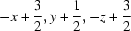
| Symmetry codes: (i) −x+3/2, y+1/2, −z+3/2; (ii) −x+1, −y−1, −z+1. |
Experimental details
| Crystal data | |
| Chemical formula | C7H4Cl2O |
| Mr | 175.01 |
| Crystal system, space group | Monoclinic, P21/n |
| Temperature (K) | 100 |
| a, b, c (Å) | 13.100 (1), 3.772 (1), 15.332 (1) |
| β (°) | 113.797 (2) |
| V (Å3) | 693.2 (3) |
| Z | 4 |
| Radiation type | Mo Kα |
| µ (mm−1) | 0.85 |
| Crystal size (mm) | 0.40 × 0.10 × 0.10 |
| Data collection | |
| Diffractometer | Rigaku R-AXIS RAPID diffractometer |
| Absorption correction | Multi-scan (Otwinowski et al., 2003) |
| Tmin, Tmax | 0.90, 0.92 |
| No. of measured, independent and observed [I > 2σ(I)] reflections | 6924, 3737, 3221 |
| Rint | 0.063 |
| (sin θ/λ)max (Å−1) | 0.862 |
| Refinement | |
| R[F2 > 2σ(F2)], wR(F2), S | 0.036, 0.114, 1.10 |
| No. of reflections | 3737 |
| No. of parameters | 107 |
| H-atom treatment | All H-atom parameters refined |
| Δρmax, Δρmin (e Å−3) | 0.67, −0.41 |
Computer programs: HKL-2000 (Otwinowski & Minor, 1997), SHELXS97 (Sheldrick, 2008) and HKL-3000SM (Minor et al., 2006), SHELXL97 (Sheldrick, 2008) and HKL-3000SM (Minor et al., 2006), HKL-3000SM (Minor et al., 2006), ORTEPIII (Burnett & Johnson, 1996), ORTEP-3 (Farrugia, 1997), Mercury (Macrae et al., 2006) and POV-RAY (The POV-RAY Team, 2004), HKL-3000SM.
| D—H···A | D—H | H···A | D···A | D—H···A |
| C7—H7···O1i | 0.946 (17) | 2.533 (17) | 3.4289 (11) | 158.0 (14) |
| C6—H6···O1ii | 0.950 (19) | 2.512 (17) | 3.2774 (11) | 137.8 (12) |
| Symmetry codes: (i) −x+3/2, y+1/2, −z+3/2; (ii) −x+1, −y−1, −z+1. |
Acknowledgements
This work was supported by contract GI11496 from HKL Research, Inc.
References
 Burnett, M. N. & Johnson, C. K. (1996). ORTEPIII. Report ORNL-6895. Oak Ridge National Laboratory, Tennessee, USA. Google Scholar
Farrugia, L. J. (1997). J. Appl. Cryst. 30, 565. CrossRef IUCr Journals Google Scholar
Gawlicka-Chruszcz, A., Zheng, H., Hyacinth, M., Cymborowski, M., Sabat, M. & Minor, W. (2006). Z. Kristallogr. New Cryst. Struct. 221, 545–546. CAS Google Scholar
Katagi, T. (1988). J. Agric. Food Chem. 36, 344–349. CrossRef CAS Web of Science Google Scholar
Macrae, C. F., Edgington, P. R., McCabe, P., Pidcock, E., Shields, G. P., Taylor, R., Towler, M. & van de Streek, J. (2006). J. Appl. Cryst. 39, 453–457. Web of Science CrossRef CAS IUCr Journals Google Scholar
Minor, W., Cymborowski, M., Otwinowski, Z. & Chruszcz, M. (2006). Acta Cryst. D62, 859–866. Web of Science CrossRef CAS IUCr Journals Google Scholar
Otwinowski, Z., Borek, D., Majewski, W. & Minor, W. (2003). Acta Cryst. A59, 228–234. Web of Science CrossRef CAS IUCr Journals Google Scholar
Otwinowski, Z. & Minor, W. (1997). Methods in Enzymology, Vol. 276, Macromolecular Crystallography, Part A, edited by C. W. Carter Jr & R. M. Sweet, pp. 307–326. New York: Academic Press. Google Scholar
Sheldrick, G. M. (2008). Acta Cryst. A64, 112–122. Web of Science CrossRef CAS IUCr Journals Google Scholar
The POV-RAY Team (2004). POV-RAY. http://www.povray.org/download/ . Google Scholar
Wang, S.-X., Tan, Z.-C., Di, Y.-Y., Xu, F., Zhang, H.-T., Sun, L.-X. & Zhang, T. (2004). J. Chem. Thermodyn. 36, 393–399. Web of Science CrossRef CAS Google Scholar
This is an open-access article distributed under the terms of the Creative Commons Attribution (CC-BY) Licence, which permits unrestricted use, distribution, and reproduction in any medium, provided the original authors and source are cited.
| CRYSTALLOGRAPHIC COMMUNICATIONS |


2,4-Dichlorobenzaldehyde is primarily used in the preparation of dyes, insecticides, herbicides, antiseptics and disinfectants (Wang et al., 2004). It is also used as an intermediate of organic synthesis of fungicide diniconazole (Katagi, 1988).
In the crystal structure of 2,4-dichlorobenzaldehyde (Fig. 1), the aldehyde group is twisted relative to the benzene ring with torsion angles C6—C1—C7—O1 and C2—C1—C7—O1 being -7.94 (13)° and 170.86 (9)°. These torsion angles are significantly smaller in comparison to the corresponding angles in 2,6-dichlorobenzaldehyde (Gawlicka-Chruszcz et al., 2006) which are -27.3° and 152.6° respectively. Significantly bigger twist of the aldehyde group in the case of 2,6-dichlorobenzaldehyde is caused by presence of the chlorine atoms in ortho positions.
The change of the position of chlorine atom causes that interactions in which chlorine atoms are involved in 2,4-dichlorobenzaldehyde and 2,6-dichlorobenzaldehyde differ significantly. In the case of 2,6-dichlorobenzaldehyde Cl2 was involved in weak interaction with hydrogen atom from neighboring benzene ring, while in 2,4-dichlorobenzaldehyde structure such interactions are not observed for any of the chlorine atoms. However, in the case of 2,4-dichlorobenzaldehyde, the chlorine atoms from neighboring molecules form short contacts with Cl1···Cl2 (1/2 + x,1/2 - y,1/2 + z) distance being 3.442Å (Fig. 2).
The weak O···H—C interactions (Table 1) between the aldehyde oxygen and the benzene hydrogen atoms connect molecules to form layers, which are additionally stabilized by stacking of benzene rings (Fig. 2). The oxygen atom from the aldehyde group plays a central role in the formation of weak interactions, and O1···H6—C6 (1 - x,-1 - y,1 - z) and O1···H7—C7 (1,5 - x,-1/2 + y,1.5 - z) distances are 2.51Å and 2.53Å respectively.