 | Acta Crystallographica Section E Acta Crystallographica Section E CRYSTALLOGRAPHIC COMMUNICATIONS |


 journal menu


organic compounds
| CRYSTALLOGRAPHIC COMMUNICATIONS |
 access
meso-1-{[2-(Propyl-1-sulfinyl)ethyl]sulfinyl}propane

aCHEMSOL, 1 Harcourt Road, Aberdeen AB15 5NY, Scotland, bCentro de Desenvolvimento Tecnológico em Saúde (CDTS), Fundação Oswaldo Cruz (FIOCRUZ), Casa Amarela, Campus de Manguinhos, Av. Brasil 4365, 21040-900, Rio de Janeiro, RJ, Brazil, cDepartamento de Quimica, ICEx, Universidade Federal de Minas Gerais, 31270-901 Belo Horizonte, MG, Brazil, and dDepartment of Chemistry, University of Malaya, 50603 Kuala Lumpur, Malaysia
*Correspondence e-mail: [email protected]
The title molecule, C8H18O2S2, is disposed about a centre of inversion implying an anti-disposition of the sulfinyl-O atoms; the terminal n-propyl group has an extended conformation. The crystal packing is dominated by C—H⋯O interactions, which lead to the formation of supramolecular arrays in the bc plane.
Related literature
For the structures of the of RS(=O)CH2CH2S(=O)R, see: Pelizzi et al. (1976![[Pelizzi, G., Michelon, G. & Bonivento, M. (1976). Cryst. Struct. Commun. 5, 617-620.]](../../../../../../logos/arrows/e_arr.gif "Pelizzi, G., Michelon, G. & Bonivento, M. (1976). Cryst. Struct. Commun. 5, 617-620.") ); Svinning et al. (1976); Chu & Madden (1978); Ternay et al. (1978); Cattalini et al. (1979); Li et al. (2002, 2004). For the preparation and separation of the steroisomers of the title compound, see: Hull & Bargar (1975); Li et al. (2005). For information on the use of bis-sulfoxides as a ligand, see: de Souza et al. (1995, 1997); Huang et al. (1986); Huang & Zhang (1986); Filgueiras & Marques (1985); Filgueiras et al. (1982); Bu et al. (2002); Li et al. (2005); Yapp et al. (1997).
); Svinning et al. (1976); Chu & Madden (1978); Ternay et al. (1978); Cattalini et al. (1979); Li et al. (2002, 2004). For the preparation and separation of the steroisomers of the title compound, see: Hull & Bargar (1975); Li et al. (2005). For information on the use of bis-sulfoxides as a ligand, see: de Souza et al. (1995, 1997); Huang et al. (1986); Huang & Zhang (1986); Filgueiras & Marques (1985); Filgueiras et al. (1982); Bu et al. (2002); Li et al. (2005); Yapp et al. (1997).
![[Scheme 1]](ez2201scheme1.gif)
Experimental
Crystal data
|
Refinement
|
| |||||||||||||||||||||||||||
 .
. Data collection: COLLECT (Hooft, 1998); cell refinement: DENZO (Otwinowski & Minor, 1997) and COLLECT; data reduction: DENZO and COLLECT; program(s) used to solve structure: SHELXS97 (Sheldrick, 2008); program(s) used to refine structure: SHELXL97 (Sheldrick, 2008); molecular graphics: ORTEP-3 (Farrugia, 1997) and DIAMOND (Brandenburg, 2006); software used to prepare material for publication: publCIF (Westrip, 2010).
Supporting information
contains datablocks general, I. DOI: 10.1107/S1600536810005799/ez2201sup1.cif
Structure factors: contains datablock I. DOI: 10.1107/S1600536810005799/ez2201Isup2.hkl
Compound (I) was prepared by a published method (Li et al., 2005) and had spectral and other parameters in agreement with published values (Li et al., 2005; Yapp et al., 1997). M.pt. 434-435 K. Lit. value 434-435 K (Hull & Bargar, 1975; Li et al., 2005). The sample used in the crystallographic study was grown from an ethanol solution of (I).
The C-bound H atoms were geometrically placed (C–H = 0.98–0.99 Å) and refined as riding with Uiso(H) = 1.2-1.5Ueq(C).
Data collection: COLLECT (Hooft, 1998); cell DENZO (Otwinowski & Minor, 1997) and COLLECT (Hooft, 1998); data reduction: DENZO (Otwinowski & Minor, 1997) and COLLECT (Hooft, 1998); program(s) used to solve structure: SHELXS97 (Sheldrick, 2008); program(s) used to refine structure: SHELXL97 (Sheldrick, 2008); molecular graphics: ORTEP-3 (Farrugia, 1997) and DIAMOND (Brandenburg, 2006); software used to prepare material for publication: publCIF (Westrip, 2010).
![[Figure 1]](./ez2201fig1thm.gif) | Fig. 1. The molecular structure of (I) showing the atom-labelling scheme and displacement ellipsoids at the 70% probability level. |
![[Figure 2]](./ez2201fig2thm.gif) | Fig. 2. A view of a supramolecular array in (I) in the bc plane. The C–H···O interactions are shown as blue dashed lines. Colour code: S, yellow; O, red; C, grey; and H, green. |
![[Figure 3]](./ez2201fig3thm.gif) | Fig. 3. View in projection down the c axis of the contents in (I). Colour code: S, yellow; O, red; C, grey; and H, green. |
| C8H18O2S2 | F(000) = 228 |
| Mr = 210.34 | Dx = 1.285 Mg m−3 |
| Monoclinic, P21/c | Mo Kα radiation, λ = 0.71073 Å |
| Hall symbol: -P 2ybc | Cell parameters from 19160 reflections |
| a = 11.9794 (9) Å | θ = 2.9–27.5° |
| b = 5.2190 (3) Å | µ = 0.45 mm−1 |
| c = 8.7618 (5) Å | T = 120 K |
| β = 97.191 (5)° | Plate, colourless |
| V = 543.48 (6) Å3 | 1.1 × 0.6 × 0.12 mm |
| Z = 2 |
| Nonius KappaCCD area-detector diffractometer | 1239 independent reflections |
| Radiation source: Enraf Nonius FR591 rotating anode | 1167 reflections with I > 2σ(I) |
| 10 cm confocal mirrors monochromator | Rint = 0.042 |
| Detector resolution: 9.091 pixels mm-1 | θmax = 27.5°, θmin = 3.4° |
| ϕ and ω scans | h = −12→15 |
| Absorption correction: multi-scan (SADABS; Sheldrick, 2007) | k = −6→6 |
| Tmin = 0.527, Tmax = 0.746 | l = −11→11 |
| 5666 measured reflections |
| Refinement on F2 | Primary atom site location: structure-invariant direct methods |
| Least-squares matrix: full | Secondary atom site location: difference Fourier map |
| R[F2 > 2σ(F2)] = 0.031 | Hydrogen site location: inferred from neighbouring sites |
| wR(F2) = 0.080 | H-atom parameters constrained |
| S = 1.06 | w = 1/[σ2(Fo2) + (0.0344P)2 + 0.4193P] where P = (Fo2 + 2Fc2)/3 |
| 1239 reflections | (Δ/σ)max = 0.001 |
| 56 parameters | Δρmax = 0.33 e Å−3 |
| 0 restraints | Δρmin = −0.35 e Å−3 |
| C8H18O2S2 | V = 543.48 (6) Å3 |
| Mr = 210.34 | Z = 2 |
| Monoclinic, P21/c | Mo Kα radiation |
| a = 11.9794 (9) Å | µ = 0.45 mm−1 |
| b = 5.2190 (3) Å | T = 120 K |
| c = 8.7618 (5) Å | 1.1 × 0.6 × 0.12 mm |
| β = 97.191 (5)° |
| Nonius KappaCCD area-detector diffractometer | 1239 independent reflections |
| Absorption correction: multi-scan (SADABS; Sheldrick, 2007) | 1167 reflections with I > 2σ(I) |
| Tmin = 0.527, Tmax = 0.746 | Rint = 0.042 |
| 5666 measured reflections |
| R[F2 > 2σ(F2)] = 0.031 | 0 restraints |
| wR(F2) = 0.080 | H-atom parameters constrained |
| S = 1.06 | Δρmax = 0.33 e Å−3 |
| 1239 reflections | Δρmin = −0.35 e Å−3 |
| 56 parameters |
Geometry. All s.u.'s (except the s.u. in the dihedral angle between two l.s. planes) are estimated using the full covariance matrix. The cell s.u.'s are taken into account individually in the estimation of s.u.'s in distances, angles and torsion angles; correlations between s.u.'s in cell parameters are only used when they are defined by crystal symmetry. An approximate (isotropic) treatment of cell s.u.'s is used for estimating s.u.'s involving l.s. planes. |
Refinement. Refinement of F2 against ALL reflections. The weighted R-factor wR and goodness of fit S are based on F2, conventional R-factors R are based on F, with F set to zero for negative F2. The threshold expression of F2 > 2σ(F2) is used only for calculating R-factors(gt) etc. and is not relevant to the choice of reflections for refinement. R-factors based on F2 are statistically about twice as large as those based on F, and R- factors based on ALL data will be even larger. |
| x | y | z | Uiso*/Ueq | ||
| S1 | 0.66819 (3) | −0.09909 (6) | 0.45405 (4) | 0.01305 (14) | |
| O1 | 0.64458 (10) | −0.37397 (19) | 0.40786 (13) | 0.0187 (3) | |
| C1 | 0.72083 (12) | 0.0560 (3) | 0.29375 (16) | 0.0149 (3) | |
| H1A | 0.6705 | 0.0192 | 0.1978 | 0.018* | |
| H1B | 0.7228 | 0.2438 | 0.3097 | 0.018* | |
| C2 | 0.83896 (12) | −0.0425 (3) | 0.27975 (17) | 0.0191 (3) | |
| H2A | 0.8363 | −0.2305 | 0.2646 | 0.023* | |
| H2B | 0.8885 | −0.0065 | 0.3765 | 0.023* | |
| C3 | 0.88818 (14) | 0.0828 (3) | 0.14553 (19) | 0.0246 (4) | |
| H3A | 0.8398 | 0.0455 | 0.0494 | 0.037* | |
| H3B | 0.9638 | 0.0147 | 0.1397 | 0.037* | |
| H3C | 0.8925 | 0.2686 | 0.1614 | 0.037* | |
| C4 | 0.53341 (12) | 0.0583 (3) | 0.44006 (15) | 0.0144 (3) | |
| H4A | 0.5438 | 0.2443 | 0.4589 | 0.017* | |
| H4B | 0.4924 | 0.0343 | 0.3358 | 0.017* |
| U11 | U22 | U33 | U12 | U13 | U23 | |
| S1 | 0.0150 (2) | 0.0110 (2) | 0.0135 (2) | 0.00060 (11) | 0.00307 (13) | 0.00048 (11) |
| O1 | 0.0238 (6) | 0.0087 (5) | 0.0244 (6) | 0.0012 (4) | 0.0066 (4) | 0.0004 (4) |
| C1 | 0.0176 (7) | 0.0133 (6) | 0.0147 (6) | −0.0002 (5) | 0.0048 (5) | 0.0007 (5) |
| C2 | 0.0179 (7) | 0.0221 (7) | 0.0181 (7) | 0.0014 (6) | 0.0057 (5) | 0.0005 (6) |
| C3 | 0.0210 (8) | 0.0325 (9) | 0.0217 (7) | −0.0031 (6) | 0.0078 (6) | 0.0010 (6) |
| C4 | 0.0167 (7) | 0.0111 (6) | 0.0162 (6) | 0.0018 (5) | 0.0049 (5) | 0.0013 (5) |
| S1—O1 | 1.5077 (10) | C2—H2B | 0.9900 |
| S1—C4 | 1.8018 (14) | C3—H3A | 0.9800 |
| S1—C1 | 1.8021 (14) | C3—H3B | 0.9800 |
| C1—C2 | 1.525 (2) | C3—H3C | 0.9800 |
| C1—H1A | 0.9900 | C4—C4i | 1.525 (3) |
| C1—H1B | 0.9900 | C4—H4A | 0.9900 |
| C2—C3 | 1.527 (2) | C4—H4B | 0.9900 |
| C2—H2A | 0.9900 | ||
| O1—S1—C4 | 106.20 (7) | H2A—C2—H2B | 107.9 |
| O1—S1—C1 | 106.88 (7) | C2—C3—H3A | 109.5 |
| C4—S1—C1 | 98.06 (6) | C2—C3—H3B | 109.5 |
| C2—C1—S1 | 109.27 (10) | H3A—C3—H3B | 109.5 |
| C2—C1—H1A | 109.8 | C2—C3—H3C | 109.5 |
| S1—C1—H1A | 109.8 | H3A—C3—H3C | 109.5 |
| C2—C1—H1B | 109.8 | H3B—C3—H3C | 109.5 |
| S1—C1—H1B | 109.8 | C4i—C4—S1 | 108.34 (13) |
| H1A—C1—H1B | 108.3 | C4i—C4—H4A | 110.0 |
| C1—C2—C3 | 111.67 (13) | S1—C4—H4A | 110.0 |
| C1—C2—H2A | 109.3 | C4i—C4—H4B | 110.0 |
| C3—C2—H2A | 109.3 | S1—C4—H4B | 110.0 |
| C1—C2—H2B | 109.3 | H4A—C4—H4B | 108.4 |
| C3—C2—H2B | 109.3 | ||
| O1—S1—C1—C2 | −71.04 (11) | O1—S1—C4—C4i | 65.40 (14) |
| C4—S1—C1—C2 | 179.23 (10) | C1—S1—C4—C4i | 175.68 (13) |
| S1—C1—C2—C3 | −179.93 (11) |
| Symmetry code: (i) −x+1, −y, −z+1. |
| D—H···A | D—H | H···A | D···A | D—H···A |
| C1—H1b···O1ii | 0.99 | 2.41 | 3.3035 (19) | 150 |
| C4—H4a···O1ii | 0.99 | 2.40 | 3.2751 (19) | 147 |
| C4—H4b···O1iii | 0.99 | 2.57 | 3.5124 (18) | 159 |
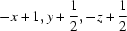
| Symmetry codes: (ii) x, y+1, z; (iii) −x+1, y+1/2, −z+1/2. |
Experimental details
| Crystal data | |
| Chemical formula | C8H18O2S2 |
| Mr | 210.34 |
| Crystal system, space group | Monoclinic, P21/c |
| Temperature (K) | 120 |
| a, b, c (Å) | 11.9794 (9), 5.2190 (3), 8.7618 (5) |
| β (°) | 97.191 (5) |
| V (Å3) | 543.48 (6) |
| Z | 2 |
| Radiation type | Mo Kα |
| µ (mm−1) | 0.45 |
| Crystal size (mm) | 1.1 × 0.6 × 0.12 |
| Data collection | |
| Diffractometer | Nonius KappaCCD area-detector diffractometer |
| Absorption correction | Multi-scan (SADABS; Sheldrick, 2007) |
| Tmin, Tmax | 0.527, 0.746 |
| No. of measured, independent and observed [I > 2σ(I)] reflections | 5666, 1239, 1167 |
| Rint | 0.042 |
| (sin θ/λ)max (Å−1) | 0.650 |
| Refinement | |
| R[F2 > 2σ(F2)], wR(F2), S | 0.031, 0.080, 1.06 |
| No. of reflections | 1239 |
| No. of parameters | 56 |
| H-atom treatment | H-atom parameters constrained |
| Δρmax, Δρmin (e Å−3) | 0.33, −0.35 |
Computer programs: , DENZO (Otwinowski & Minor, 1997) and COLLECT (Hooft, 1998), SHELXS97 (Sheldrick, 2008), SHELXL97 (Sheldrick, 2008), ORTEP-3 (Farrugia, 1997) and DIAMOND (Brandenburg, 2006), publCIF (Westrip, 2010).
| D—H···A | D—H | H···A | D···A | D—H···A |
| C1—H1b···O1i | 0.99 | 2.41 | 3.3035 (19) | 150 |
| C4—H4a···O1i | 0.99 | 2.40 | 3.2751 (19) | 147 |
| C4—H4b···O1ii | 0.99 | 2.57 | 3.5124 (18) | 159 |
| Symmetry codes: (i) x, y+1, z; (ii) −x+1, y+1/2, −z+1/2. |
Footnotes
‡Additional correspondence author, e-mail: [email protected].
Acknowledgements
The use of the EPSRC X-ray crystallographic service at the University of Southampton, England, and the valuable assistance of the staff there is gratefully acknowledged. JLW acknowledges support from CAPES and FAPEMIG (Brazil).
References
 Brandenburg, K. (2006). DIAMOND. Crystal Impact GbR, Bonn, Germany. Google Scholar
Bu, X.-H., Weng, W., Li, J.-R., Chen, W. & Zhang, R.-H. (2002). Inorg. Chem. 41, 413–415. Web of Science CSD CrossRef PubMed CAS Google Scholar
Cattalini, L., Michelon, G., Marangoni, G. & Pelizzi, G. (1979). J. Chem. Soc. Dalton Trans. pp. 96–101. CSD CrossRef Web of Science Google Scholar
Chu, S. S. C. & Madden, J. (1978). Acta Cryst. B34, 841–845. CSD CrossRef CAS IUCr Journals Web of Science Google Scholar
Farrugia, L. J. (1997). J. Appl. Cryst. 30, 565. CrossRef IUCr Journals Google Scholar
Filgueiras, C. A. L., Celso, C., Marques, E. V. & Johnson, B. F. G. (1982). Inorg. Chim. Acta, 59, 71–74. CrossRef CAS Web of Science Google Scholar
Filgueiras, C. A. L. & Marques, E. V. (1985). Transition Met. Chem. 10, 241–243. CrossRef CAS Web of Science Google Scholar
Hooft, R. W. W. (1998). COLLECT. Nonius BV, Delft, The Netherlands. Google Scholar
Huang, Z. & Zhang, Z. (1986). Wuji Huaxu Xuebaoe, 2, 64–71. CAS Google Scholar
Huang, Z., Zhang, R., Wang, J. & Zhang, Z. (1986). Wuji Huaxue Xuebaoe, 2, 54–59. CAS Google Scholar
Hull, C. M. & Bargar, T. W. (1975). J. Org. Chem. 40, 3152–3154. CrossRef CAS Web of Science Google Scholar
Li, J.-R., Bu, X.-H. & Zhang, R.-H. (2004). Inorg. Chem. 43, 237–244. Web of Science CSD CrossRef PubMed CAS Google Scholar
Li, J.-R., Bu, X.-H., Zhang, R.-H. & Ribas, J. (2005). Cryst. Growth Des. 5, 1919–1932. Web of Science CSD CrossRef CAS Google Scholar
Li, J.-R., Zhang, R.-H. & Bu, X.-H. (2002). Acta Cryst. E58, o911–o912. Web of Science CSD CrossRef IUCr Journals Google Scholar
Otwinowski, Z. & Minor, W. (1997). Methods in Enzymology, Vol. 276, Macromolecular Crystallography, Part A, edited by C. W. Carter Jr & R. M. Sweet, pp. 307–326. New York: Academic Press. Google Scholar
Pelizzi, G., Michelon, G. & Bonivento, M. (1976). Cryst. Struct. Commun. 5, 617–620. CAS Google Scholar
Sheldrick, G. M. (2007). SADABS. Bruker AXS Inc., Madison, Wisconsin, USA. Google Scholar
Sheldrick, G. M. (2008). Acta Cryst. A64, 112–122. Web of Science CrossRef CAS IUCr Journals Google Scholar
Souza, G. F. de, Filgueiras, C. A. L., Abras, A., Carvalho, C. C., Francisco, R. H. P. & Gambardella, M. T. Do. P. (1995). An. Ass. Bras. Quim. 44, 42–46. Google Scholar
Souza, G. F. de, Filgueiras, C. A. L., Hitchcock, P. B. & Nixon, J. F. (1997). Inorg. Chim. Acta, 261, 221–225. Google Scholar
Svinning, T., Mo, F. & Bruun, T. (1976). Acta Cryst. B32, 759–764. CSD CrossRef CAS IUCr Journals Web of Science Google Scholar
Ternay, A. L. Jr, Lin, J., Sutliff, T., Chu, S. S. C. & Chung, B. (1978). J. Org. Chem. 43, 3024–3031. CSD CrossRef CAS Web of Science Google Scholar
Westrip, S. P. (2010). publCIF. In preparation. Google Scholar
Yapp, D. T. T., Rettig, S. J., James, B. R. & Skov, K. A. (1997). Inorg. Chem. 36, 5635–5641. CSD CrossRef CAS Web of Science Google Scholar
This is an open-access article distributed under the terms of the Creative Commons Attribution (CC-BY) Licence, which permits unrestricted use, distribution, and reproduction in any medium, provided the original authors and source are cited.
| CRYSTALLOGRAPHIC COMMUNICATIONS |


Bis-sulfoxides such as the title compound, (I), have found use as ligands (de Souza et al., 1995, 1997; Huang et al., 1986; Huang & Zhang, 1986; Filgueiras & Marques, 1985; Filgueiras et al., 1982; Bu et al., 2002; Li et al., 2005; Yapp et al., 1997). Details on the preparation and the separation of steroisomers of (I) are available in the literature (Hull & Bargar 1975; Li et al. 2005). Crystallography shows the molecule of (I) is disposed about a centre of inversion, Fig. 1, and the n-propyl chain has an extended conformation as seen in the value of the S1–C1–C2–C3 torsion angle of S1–C1–C2–C3 of -179.93 (11) °. The anti-disposition of the sulfinyl-O atoms allow for the optimisation of C–H···O interactions in the crystal structure, Table 1. Thus, each sulfinyl-O1 associates with three methylene-H atoms to form a supramolecular array in the bc plane, Fig. 2, which stack along the a axis, Fig. 3.
The central core in (I), including its disposition about a centre of inversion, resembles that found in each of the reported meso-RS(═ O)CH2CH2S(═O)R structures, where R = Me (Svinning et al., 1976), Et (Li et al., 2004), Ph (Pelizzi, et al. 1976; Ternay et al. 1978; Cattalini et al., 1979), benzyl (Li et al. 2002), and mesityl (Chu & Madden, 1978), but not in their homo chiral stereoisomers where R = Ph (Ternay et al. 1978; Cattalini et al., 1979) and mesityl (Chu & Madden, 1978).