 | Acta Crystallographica Section E Acta Crystallographica Section E CRYSTALLOGRAPHIC COMMUNICATIONS |


 journal menu


organic compounds
| CRYSTALLOGRAPHIC COMMUNICATIONS |
 access
5-(4-Chlorophenyl)-6-isopropyl-5,6-dihydro-4H-pyrrolo[3,4-c]isoxazole

aSchool of Applied Chemical Engineering, Chonnam National University, Gwangju 500-757, Republic of Korea
*Correspondence e-mail: [email protected]
The title compound, C14H15ClN2O, contains an eight-membered 5,5-fused bicycle with two substituents. The dihedral angle between the nearly planar eight-membered ring [maximum deviation = 0.033 (2) Å] and the benzene ring is 25.0 (1)°. In the crystal structure, molecules are stacked in columns along the b axis and C—H⋯π interactions are observed between the columns.
Related literature
For the synthesis of the title compound, see: Kim & Lee (1994![[Kim, H. J. & Lee, J. H. (1994). Heterocycles, 38, 1383-1391.]](../../../../../../logos/arrows/e_arr.gif "Kim, H. J. & Lee, J. H. (1994). Heterocycles, 38, 1383-1391.") ). For the biological activity of isoxazoles, see: Boyd (1991); Kim et al. (1994, 1997, 1999); Lang & Lin (1984); Sutharchanadevi & Murugan (1996).
). For the biological activity of isoxazoles, see: Boyd (1991); Kim et al. (1994, 1997, 1999); Lang & Lin (1984); Sutharchanadevi & Murugan (1996).
![[Scheme 1]](is2594scheme1.gif)
Experimental
Crystal data
|
Refinement
|
| ||||||||||||||||||||||
 ; (ii)
  .
. Data collection: SMART (Bruker, 2000); cell refinement: SAINT (Bruker, 2000); data reduction: SAINT; program(s) used to solve structure: SHELXS97 (Sheldrick, 2008); program(s) used to refine structure: SHELXL97 (Sheldrick, 2008); molecular graphics: ORTEP-3 (Farrugia, 1997) and PLATON (Spek, 2009); software used to prepare material for publication: SHELXL97.
Supporting information
contains datablocks global, I. DOI: 10.1107/S1600536810034872/is2594sup1.cif
Structure factors: contains datablock I. DOI: 10.1107/S1600536810034872/is2594Isup2.hkl
A mixture of 3-methyl-1-nitrobutan-2-yl acetate (1.23 g, 7 mmol), 4-chloro-N-(prop-2-ynyl)aniline (3.48 g, 21 mmol) and K2CO3 (1.16 g, 8.4 mmol) in THF (20 ml) was stirred for 12 h at 25 °C. The mixture was concentrated in vacuo and column chromatographed (SiO2) by eluting with a mixture of n-hexane/EtOAc (5:1) to afford 4-chloro-N-(3-methyl-1-nitrobutan-2-yl)-N-(prop-2-ynyl)aniline (0.49 g, 25%). The title compound was prepared by the intramolecular nitrile oxide-alkyne of 4-chloro-N-(3-methyl-1-nitrobutan-2-yl)-N-(prop-2-ynyl)aniline in the presence of 4-chlorophenylisocyanate and triethylamine (Kim & Lee, 1994). Crystals suitable for X-ray analysis were obtained by slow evaporation from an n-hexane/CHCl3 solution.
H atoms were positioned geometrically and allowed to ride on their respective parent atoms [C—H = 0.95 (CH, sp2), 1.00 (CH, sp3), 0.99 (CH2) or 0.98 Å (CH3), and Uiso(H) = 1.2Ueq(C) or 1.5Ueq(methyl C)].
Data collection: SMART (Bruker, 2000); cell SAINT (Bruker, 2000); data reduction: SAINT (Bruker, 2000); program(s) used to solve structure: SHELXS97 (Sheldrick, 2008); program(s) used to refine structure: SHELXL97 (Sheldrick, 2008); molecular graphics: ORTEP-3 (Farrugia, 1997) and PLATON (Spek, 2009); software used to prepare material for publication: SHELXL97 (Sheldrick, 2008).
![[Figure 1]](./is2594fig1thm.gif) | Fig. 1. The structure of the title compound, with displacement ellipsoids drawn at the 50% probability level for non-H atoms. |
![[Figure 2]](./is2594fig2thm.gif) | Fig. 2. View of the unit-cell contents of the title compound. |
| C14H15ClN2O | F(000) = 552 |
| Mr = 262.73 | Dx = 1.346 Mg m−3 |
| Monoclinic, P21/c | Mo Kα radiation, λ = 0.71073 Å |
| Hall symbol: -P 2ybc | Cell parameters from 2659 reflections |
| a = 15.0037 (9) Å | θ = 2.6–27.1° |
| b = 6.2364 (4) Å | µ = 0.28 mm−1 |
| c = 15.5801 (9) Å | T = 200 K |
| β = 117.238 (1)° | Stick, pale yellow |
| V = 1296.16 (14) Å3 | 0.35 × 0.28 × 0.12 mm |
| Z = 4 |
| Bruker SMART 1000 CCD diffractometer | 3211 independent reflections |
| Radiation source: fine-focus sealed tube | 1907 reflections with I > 2σ(I) |
| Graphite monochromator | Rint = 0.043 |
| ϕ and ω scans | θmax = 28.3°, θmin = 2.6° |
| Absorption correction: multi-scan (SADABS; Bruker, 2000) | h = −19→20 |
| Tmin = 0.861, Tmax = 0.966 | k = −8→8 |
| 9224 measured reflections | l = −18→20 |
| Refinement on F2 | Primary atom site location: structure-invariant direct methods |
| Least-squares matrix: full | Secondary atom site location: difference Fourier map |
| R[F2 > 2σ(F2)] = 0.044 | Hydrogen site location: inferred from neighbouring sites |
| wR(F2) = 0.117 | H-atom parameters constrained |
| S = 1.07 | w = 1/[σ2(Fo2) + (0.0311P)2 + 0.6269P] where P = (Fo2 + 2Fc2)/3 |
| 3211 reflections | (Δ/σ)max = 0.001 |
| 165 parameters | Δρmax = 0.36 e Å−3 |
| 0 restraints | Δρmin = −0.44 e Å−3 |
| C14H15ClN2O | V = 1296.16 (14) Å3 |
| Mr = 262.73 | Z = 4 |
| Monoclinic, P21/c | Mo Kα radiation |
| a = 15.0037 (9) Å | µ = 0.28 mm−1 |
| b = 6.2364 (4) Å | T = 200 K |
| c = 15.5801 (9) Å | 0.35 × 0.28 × 0.12 mm |
| β = 117.238 (1)° |
| Bruker SMART 1000 CCD diffractometer | 3211 independent reflections |
| Absorption correction: multi-scan (SADABS; Bruker, 2000) | 1907 reflections with I > 2σ(I) |
| Tmin = 0.861, Tmax = 0.966 | Rint = 0.043 |
| 9224 measured reflections |
| R[F2 > 2σ(F2)] = 0.044 | 0 restraints |
| wR(F2) = 0.117 | H-atom parameters constrained |
| S = 1.07 | Δρmax = 0.36 e Å−3 |
| 3211 reflections | Δρmin = −0.44 e Å−3 |
| 165 parameters |
Geometry. All e.s.d.'s (except the e.s.d. in the dihedral angle between two l.s. planes) are estimated using the full covariance matrix. The cell e.s.d.'s are taken into account individually in the estimation of e.s.d.'s in distances, angles and torsion angles; correlations between e.s.d.'s in cell parameters are only used when they are defined by crystal symmetry. An approximate (isotropic) treatment of cell e.s.d.'s is used for estimating e.s.d.'s involving l.s. planes. |
Refinement. Refinement of F2 against ALL reflections. The weighted R-factor wR and goodness of fit S are based on F2, conventional R-factors R are based on F, with F set to zero for negative F2. The threshold expression of F2 > σ(F2) is used only for calculating R-factors(gt) etc. and is not relevant to the choice of reflections for refinement. R-factors based on F2 are statistically about twice as large as those based on F, and R- factors based on ALL data will be even larger. |
| x | y | z | Uiso*/Ueq | ||
| Cl1 | 0.53029 (5) | 0.72970 (11) | 0.07428 (5) | 0.0460 (2) | |
| O1 | 0.17957 (13) | 1.1528 (3) | 0.45555 (12) | 0.0468 (5) | |
| N1 | 0.25711 (13) | 0.8986 (3) | 0.24578 (13) | 0.0292 (4) | |
| N2 | 0.17208 (15) | 1.2612 (3) | 0.37156 (14) | 0.0400 (5) | |
| C1 | 0.31613 (16) | 0.8552 (4) | 0.20076 (15) | 0.0284 (5) | |
| C2 | 0.32447 (17) | 1.0003 (4) | 0.13595 (16) | 0.0317 (5) | |
| H2 | 0.2857 | 1.1280 | 0.1193 | 0.038* | |
| C3 | 0.38835 (17) | 0.9599 (4) | 0.09593 (16) | 0.0341 (5) | |
| H3 | 0.3940 | 1.0608 | 0.0530 | 0.041* | |
| C4 | 0.44355 (17) | 0.7739 (4) | 0.11838 (16) | 0.0327 (5) | |
| C5 | 0.43342 (16) | 0.6228 (4) | 0.17806 (16) | 0.0333 (5) | |
| H5 | 0.4696 | 0.4918 | 0.1911 | 0.040* | |
| C6 | 0.37017 (16) | 0.6630 (4) | 0.21896 (16) | 0.0316 (5) | |
| H6 | 0.3634 | 0.5586 | 0.2600 | 0.038* | |
| C7 | 0.27190 (18) | 0.7731 (4) | 0.33222 (17) | 0.0341 (5) | |
| H7A | 0.3437 | 0.7411 | 0.3738 | 0.041* | |
| H7B | 0.2335 | 0.6372 | 0.3140 | 0.041* | |
| C8 | 0.23192 (17) | 0.9227 (4) | 0.38036 (16) | 0.0322 (5) | |
| C9 | 0.21539 (18) | 0.9522 (4) | 0.45747 (17) | 0.0412 (6) | |
| H9 | 0.2271 | 0.8481 | 0.5060 | 0.049* | |
| C10 | 0.20329 (16) | 1.1175 (4) | 0.33080 (16) | 0.0298 (5) | |
| C11 | 0.21313 (16) | 1.1144 (4) | 0.23924 (15) | 0.0279 (5) | |
| H11 | 0.2625 | 1.2261 | 0.2426 | 0.034* | |
| C12 | 0.11400 (17) | 1.1478 (4) | 0.14745 (16) | 0.0325 (5) | |
| H12 | 0.1255 | 1.1103 | 0.0909 | 0.039* | |
| C13 | 0.0833 (2) | 1.3827 (4) | 0.13769 (19) | 0.0464 (7) | |
| H13A | 0.0713 | 1.4239 | 0.1922 | 0.070* | |
| H13B | 0.0218 | 1.4036 | 0.0772 | 0.070* | |
| H13C | 0.1369 | 1.4716 | 0.1373 | 0.070* | |
| C14 | 0.03096 (18) | 1.0035 (4) | 0.14450 (19) | 0.0488 (7) | |
| H14A | 0.0132 | 1.0470 | 0.1951 | 0.073* | |
| H14B | 0.0542 | 0.8544 | 0.1551 | 0.073* | |
| H14C | −0.0280 | 1.0161 | 0.0813 | 0.073* |
| U11 | U22 | U33 | U12 | U13 | U23 | |
| Cl1 | 0.0449 (4) | 0.0560 (4) | 0.0462 (4) | 0.0075 (3) | 0.0287 (3) | −0.0022 (3) |
| O1 | 0.0517 (11) | 0.0585 (12) | 0.0343 (10) | 0.0084 (9) | 0.0233 (9) | −0.0015 (9) |
| N1 | 0.0326 (10) | 0.0275 (10) | 0.0298 (10) | 0.0036 (8) | 0.0164 (8) | 0.0050 (8) |
| N2 | 0.0474 (12) | 0.0423 (12) | 0.0348 (11) | 0.0057 (10) | 0.0226 (10) | 0.0010 (10) |
| C1 | 0.0285 (12) | 0.0294 (12) | 0.0256 (12) | −0.0007 (10) | 0.0109 (9) | −0.0007 (9) |
| C2 | 0.0340 (13) | 0.0306 (12) | 0.0314 (13) | 0.0048 (10) | 0.0158 (10) | 0.0041 (10) |
| C3 | 0.0370 (13) | 0.0362 (14) | 0.0310 (13) | −0.0029 (11) | 0.0172 (11) | 0.0018 (10) |
| C4 | 0.0322 (12) | 0.0364 (13) | 0.0315 (13) | 0.0016 (11) | 0.0163 (10) | −0.0042 (10) |
| C5 | 0.0312 (12) | 0.0306 (13) | 0.0340 (13) | 0.0033 (10) | 0.0115 (10) | −0.0008 (10) |
| C6 | 0.0300 (12) | 0.0314 (12) | 0.0308 (12) | 0.0003 (10) | 0.0117 (10) | 0.0027 (10) |
| C7 | 0.0414 (13) | 0.0312 (13) | 0.0331 (13) | 0.0030 (11) | 0.0199 (11) | 0.0064 (10) |
| C8 | 0.0317 (12) | 0.0369 (13) | 0.0291 (12) | −0.0003 (11) | 0.0148 (10) | 0.0034 (10) |
| C9 | 0.0400 (14) | 0.0509 (16) | 0.0330 (14) | 0.0066 (12) | 0.0171 (11) | 0.0067 (12) |
| C10 | 0.0264 (11) | 0.0332 (13) | 0.0294 (12) | −0.0006 (10) | 0.0124 (10) | −0.0002 (10) |
| C11 | 0.0275 (11) | 0.0290 (12) | 0.0286 (12) | −0.0002 (10) | 0.0139 (9) | 0.0017 (9) |
| C12 | 0.0322 (13) | 0.0359 (13) | 0.0283 (12) | 0.0036 (10) | 0.0128 (10) | 0.0030 (10) |
| C13 | 0.0456 (15) | 0.0455 (16) | 0.0449 (16) | 0.0111 (13) | 0.0180 (13) | 0.0129 (13) |
| C14 | 0.0350 (14) | 0.0522 (17) | 0.0492 (16) | −0.0046 (13) | 0.0106 (12) | 0.0032 (13) |
| Cl1—C4 | 1.749 (2) | C7—H7A | 0.9900 |
| O1—C9 | 1.356 (3) | C7—H7B | 0.9900 |
| O1—N2 | 1.431 (2) | C8—C9 | 1.346 (3) |
| N1—C1 | 1.385 (3) | C8—C10 | 1.398 (3) |
| N1—C11 | 1.482 (3) | C9—H9 | 0.9500 |
| N1—C7 | 1.484 (3) | C10—C11 | 1.500 (3) |
| N2—C10 | 1.303 (3) | C11—C12 | 1.534 (3) |
| C1—C6 | 1.401 (3) | C11—H11 | 1.0000 |
| C1—C2 | 1.403 (3) | C12—C14 | 1.521 (3) |
| C2—C3 | 1.385 (3) | C12—C13 | 1.522 (3) |
| C2—H2 | 0.9500 | C12—H12 | 1.0000 |
| C3—C4 | 1.374 (3) | C13—H13A | 0.9800 |
| C3—H3 | 0.9500 | C13—H13B | 0.9800 |
| C4—C5 | 1.380 (3) | C13—H13C | 0.9800 |
| C5—C6 | 1.387 (3) | C14—H14A | 0.9800 |
| C5—H5 | 0.9500 | C14—H14B | 0.9800 |
| C6—H6 | 0.9500 | C14—H14C | 0.9800 |
| C7—C8 | 1.485 (3) | ||
| C9—O1—N2 | 108.68 (17) | C10—C8—C7 | 111.13 (19) |
| C1—N1—C11 | 120.72 (17) | C8—C9—O1 | 109.8 (2) |
| C1—N1—C7 | 119.44 (18) | C8—C9—H9 | 125.1 |
| C11—N1—C7 | 114.75 (16) | O1—C9—H9 | 125.1 |
| C10—N2—O1 | 103.03 (18) | N2—C10—C8 | 114.6 (2) |
| N1—C1—C6 | 120.6 (2) | N2—C10—C11 | 133.3 (2) |
| N1—C1—C2 | 121.8 (2) | C8—C10—C11 | 112.02 (19) |
| C6—C1—C2 | 117.59 (19) | N1—C11—C10 | 100.43 (17) |
| C3—C2—C1 | 121.0 (2) | N1—C11—C12 | 113.51 (18) |
| C3—C2—H2 | 119.5 | C10—C11—C12 | 114.16 (17) |
| C1—C2—H2 | 119.5 | N1—C11—H11 | 109.5 |
| C4—C3—C2 | 120.0 (2) | C10—C11—H11 | 109.5 |
| C4—C3—H3 | 120.0 | C12—C11—H11 | 109.5 |
| C2—C3—H3 | 120.0 | C14—C12—C13 | 111.1 (2) |
| C3—C4—C5 | 120.6 (2) | C14—C12—C11 | 112.28 (19) |
| C3—C4—Cl1 | 120.21 (18) | C13—C12—C11 | 110.13 (19) |
| C5—C4—Cl1 | 119.21 (18) | C14—C12—H12 | 107.7 |
| C4—C5—C6 | 119.7 (2) | C13—C12—H12 | 107.7 |
| C4—C5—H5 | 120.1 | C11—C12—H12 | 107.7 |
| C6—C5—H5 | 120.1 | C12—C13—H13A | 109.5 |
| C5—C6—C1 | 121.0 (2) | C12—C13—H13B | 109.5 |
| C5—C6—H6 | 119.5 | H13A—C13—H13B | 109.5 |
| C1—C6—H6 | 119.5 | C12—C13—H13C | 109.5 |
| N1—C7—C8 | 101.51 (17) | H13A—C13—H13C | 109.5 |
| N1—C7—H7A | 111.5 | H13B—C13—H13C | 109.5 |
| C8—C7—H7A | 111.5 | C12—C14—H14A | 109.5 |
| N1—C7—H7B | 111.5 | C12—C14—H14B | 109.5 |
| C8—C7—H7B | 111.5 | H14A—C14—H14B | 109.5 |
| H7A—C7—H7B | 109.3 | C12—C14—H14C | 109.5 |
| C9—C8—C10 | 103.8 (2) | H14A—C14—H14C | 109.5 |
| C9—C8—C7 | 145.0 (2) | H14B—C14—H14C | 109.5 |
| C9—O1—N2—C10 | 0.3 (2) | C7—C8—C9—O1 | 175.2 (3) |
| C11—N1—C1—C6 | 170.09 (19) | N2—O1—C9—C8 | 0.1 (3) |
| C7—N1—C1—C6 | 16.6 (3) | O1—N2—C10—C8 | −0.5 (3) |
| C11—N1—C1—C2 | −9.7 (3) | O1—N2—C10—C11 | 177.8 (2) |
| C7—N1—C1—C2 | −163.2 (2) | C9—C8—C10—N2 | 0.6 (3) |
| N1—C1—C2—C3 | 176.2 (2) | C7—C8—C10—N2 | −176.7 (2) |
| C6—C1—C2—C3 | −3.7 (3) | C9—C8—C10—C11 | −178.10 (19) |
| C1—C2—C3—C4 | 1.0 (3) | C7—C8—C10—C11 | 4.6 (3) |
| C2—C3—C4—C5 | 2.2 (3) | C1—N1—C11—C10 | −153.36 (19) |
| C2—C3—C4—Cl1 | −175.91 (18) | C7—N1—C11—C10 | 1.3 (2) |
| C3—C4—C5—C6 | −2.7 (3) | C1—N1—C11—C12 | 84.4 (2) |
| Cl1—C4—C5—C6 | 175.43 (17) | C7—N1—C11—C12 | −121.0 (2) |
| C4—C5—C6—C1 | 0.0 (3) | N2—C10—C11—N1 | 178.2 (2) |
| N1—C1—C6—C5 | −176.7 (2) | C8—C10—C11—N1 | −3.5 (2) |
| C2—C1—C6—C5 | 3.2 (3) | N2—C10—C11—C12 | −60.0 (3) |
| C1—N1—C7—C8 | 156.14 (19) | C8—C10—C11—C12 | 118.3 (2) |
| C11—N1—C7—C8 | 1.2 (2) | N1—C11—C12—C14 | 65.4 (2) |
| N1—C7—C8—C9 | −178.9 (3) | C10—C11—C12—C14 | −48.9 (3) |
| N1—C7—C8—C10 | −3.4 (2) | N1—C11—C12—C13 | −170.28 (18) |
| C10—C8—C9—O1 | −0.4 (3) | C10—C11—C12—C13 | 75.4 (2) |
| Cg1 is the centroid of the C1–C6 ring. |
| D—H···A | D—H | H···A | D···A | D—H···A |
| C5—H5···Cg1i | 0.95 | 2.65 | 3.405 (3) | 136 |
| C9—H9···Cg1ii | 0.95 | 2.62 | 3.392 (3) | 138 |
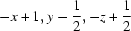
| Symmetry codes: (i) −x+1, y−1/2, −z+1/2; (ii) x, −y+3/2, z+1/2. |
Experimental details
| Crystal data | |
| Chemical formula | C14H15ClN2O |
| Mr | 262.73 |
| Crystal system, space group | Monoclinic, P21/c |
| Temperature (K) | 200 |
| a, b, c (Å) | 15.0037 (9), 6.2364 (4), 15.5801 (9) |
| β (°) | 117.238 (1) |
| V (Å3) | 1296.16 (14) |
| Z | 4 |
| Radiation type | Mo Kα |
| µ (mm−1) | 0.28 |
| Crystal size (mm) | 0.35 × 0.28 × 0.12 |
| Data collection | |
| Diffractometer | Bruker SMART 1000 CCD diffractometer |
| Absorption correction | Multi-scan (SADABS; Bruker, 2000) |
| Tmin, Tmax | 0.861, 0.966 |
| No. of measured, independent and observed [I > 2σ(I)] reflections | 9224, 3211, 1907 |
| Rint | 0.043 |
| (sin θ/λ)max (Å−1) | 0.667 |
| Refinement | |
| R[F2 > 2σ(F2)], wR(F2), S | 0.044, 0.117, 1.07 |
| No. of reflections | 3211 |
| No. of parameters | 165 |
| H-atom treatment | H-atom parameters constrained |
| Δρmax, Δρmin (e Å−3) | 0.36, −0.44 |
Computer programs: SMART (Bruker, 2000), SAINT (Bruker, 2000), SHELXS97 (Sheldrick, 2008), SHELXL97 (Sheldrick, 2008), ORTEP-3 (Farrugia, 1997) and PLATON (Spek, 2009).
| Cg1 is the centroid of the C1–C6 ring. |
| D—H···A | D—H | H···A | D···A | D—H···A |
| C5—H5···Cg1i | 0.95 | 2.65 | 3.405 (3) | 136 |
| C9—H9···Cg1ii | 0.95 | 2.62 | 3.392 (3) | 138 |
| Symmetry codes: (i) −x+1, y−1/2, −z+1/2; (ii) x, −y+3/2, z+1/2. |
Acknowledgements
This study was supported by financially Chonnam National University (2008).
References
 Boyd, G. V. (1991). Prog. Heterocyl. Chem. 3, 166–185. CAS Google Scholar
Bruker (2000). SADABS, SMART and SAINT. Bruker AXS Inc., Madison, Wisconsin, USA. Google Scholar
Farrugia, L. J. (1997). J. Appl. Cryst. 30, 565. CrossRef IUCr Journals Google Scholar
Kim, H. J., Hwang, K.-J. & Lee, J. H. (1994). Biosci. Biotechnol. Biochem. 58, 1191–1192. CrossRef CAS Web of Science Google Scholar
Kim, H. J., Hwang, K.-J. & Lee, J. H. (1997). Bull. Korean Chem. Soc. 18, 534–540. CAS Google Scholar
Kim, H. J., Jang, J. Y., Chung, K. H. & Lee, J. H. (1999). Biosci. Biotechnol. Biochem. 63, 494–499. Web of Science CrossRef CAS Google Scholar
Kim, H. J. & Lee, J. H. (1994). Heterocycles, 38, 1383–1391. CAS Google Scholar
Lang, A. & Lin, Y. (1984). Comprehensive Heterocyclic Chemistry, Vol. 6, edited by A. R. Katritzky, pp. 1–130. Oxford: Pergamon Press. Google Scholar
Sheldrick, G. M. (2008). Acta Cryst. A64, 112–122. Web of Science CrossRef CAS IUCr Journals Google Scholar
Spek, A. L. (2009). Acta Cryst. D65, 148–155. Web of Science CrossRef CAS IUCr Journals Google Scholar
Sutharchanadevi, M. & Murugan, R. (1996). Comprehensive Heterocyclic Chemistry, Vol. 3, edited by A. R. Katritzky, C. W. Rees & E. F. V. Scriven, pp. 221–260. New York: Pergamon. Google Scholar
This is an open-access article distributed under the terms of the Creative Commons Attribution (CC-BY) Licence, which permits unrestricted use, distribution, and reproduction in any medium, provided the original authors and source are cited.
| CRYSTALLOGRAPHIC COMMUNICATIONS |


Isoxazole derivatives bearing various substituents are known to have diverse biological activities in pharmaceutical and agricultural areas (Lang & Lin, 1984; Boyd, 1991). Dihydropyrrolo[3,4-c]isoxazole, a fused bicyclic isoxazole, is interesting to develop a new lead compound as a plant fungicide because bicyclic isoxazoles such as dihydrofuro[3,4-c]isoxazole and dihydropyrano[3,4-c]isoxazole derivatives particularly have fungicidal activities against some plant pathogens (Kim et al., 1994, 1997, 1999). The title compound was prepared by the known method (Kim & Lee, 1994) with a minor modification.
The title compound, C14H15ClN2O, is an 8-membered 5,5-fused bicycle with two substituents (Fig. 1). The dihedral angle between the nearly planar 8-membered ring [maximum deviation of 0.033 (2) Å for C7] and the benzene ring [maximum deviation of 0.023 (2) Å for C1] is 25.0 (1)°. In the crystal structure, the molecules are stacked in columns along the b axis (Fig. 2), and display C—H···Cg1 (the centroid of ring C1–C6) interactions (Table 1).