 | Acta Crystallographica Section E Acta Crystallographica Section E CRYSTALLOGRAPHIC COMMUNICATIONS |


 journal menu


metal-organic compounds
| CRYSTALLOGRAPHIC COMMUNICATIONS |
 access
catena-Poly[[(1,10-phenanthroline)copper(II)]-μ-oxalato]

aZhongshan Polytechnic, Zhongshan, Guangdong 528404, People's Republic of China, and bSchool of Basic Science, East China Jiaotong University, Nanchang 330013, People's Republic of China
*Correspondence e-mail: [email protected]
In the title coordination polymer, [Cu(C2O4)(C12H8N2)]n, the CuII atom is six-coordinated by four O atoms from two oxalate ligands and two N atoms from one 1,10-phenanthroline (phen) ligand in a distorted octahedral coordination geometry. The oxalate anions act as bis-bidentate ligands, bridging the Cu–phen units in zigzag chains extending parallel to [100]. Interchain C—H⋯O hydrogen bonding and π–π stacking interactions [centroid–centroid distance = 3.7439 (17) Å] assemble neighboring chains, forming a three-dimensional supramolecular network.
Related literature
For the topologies and potential applications as functional materials of metal coordination polymers, see: Benneli & Gatteschi (2002![[Benneli, C. & Gatteschi, D. (2002). Chem. Rev. 102, 2369-2388.]](../../../../../../logos/arrows/e_arr.gif "Benneli, C. & Gatteschi, D. (2002). Chem. Rev. 102, 2369-2388.") ); Qin et al. (2005); Qiu et al. (2007).
); Qin et al. (2005); Qiu et al. (2007).
![[Scheme 1]](zl2304scheme1.gif)
Experimental
Crystal data
|
|
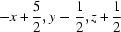 ; (ii)
 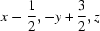 ; (iii)
 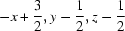 ; (iv)
 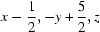 .
. Data collection: APEX2 (Bruker, 2004); cell refinement: SAINT (Bruker, 2004); data reduction: SAINT; program(s) used to solve structure: SHELXS97 (Sheldrick, 2008); program(s) used to refine structure: SHELXL97 (Sheldrick, 2008); molecular graphics: XP in SHELXTL (Sheldrick, 2008); software used to prepare material for publication: SHELXTL.
Supporting information
contains datablocks I, global. DOI: 10.1107/S1600536810035440/zl2304sup1.cif
Structure factors: contains datablock I. DOI: 10.1107/S1600536810035440/zl2304Isup2.hkl
A sample of cupric acetate (0.0399 g, 0.20 mmol), oxalic acid (0.1015 g, 0.50 mmol), 1,10-phenanthroline (0.2523 g, 0.50 mmol), were added to water (10 ml). The resultant mixture was sealed in a 25 ml stainless steel reactor with a Teflon liner and kept under autogenous pressure at 413 K for 78 h, and then cooled to room temperature at a rate of 0.5 K/min. Colorless blocky crystals of the title compound suitable for single-crystal X-ray diffraction analyses formed in a yield of approximately 65%.
All H atoms were placed at calculated positions and were treated as riding on the parent C atoms with C—H = 0.93 Å, and with Uiso(H) = 1.2 (C).
Data collection: APEX2 (Bruker, 2004); cell SAINT (Bruker, 2004); data reduction: SAINT (Bruker, 2004); program(s) used to solve structure: SHELXS97 (Sheldrick, 2008); program(s) used to refine structure: SHELXL97 (Sheldrick, 2008); molecular graphics: XP in SHELXTL (Sheldrick, 2008); software used to prepare material for publication: SHELXTL (Sheldrick, 2008).
![[Figure 1]](./zl2304fig1thm.gif) | Fig. 1. ORTEP represention of atom numbering diagram for the title complex, showing 30% probability displacement ellipsoids. Symmetry code: (i) –1/2 + x, 2.5–y, z. |
![[Figure 2]](./zl2304fig2thm.gif) | Fig. 2. View of the three-dimensional structure of the title compound. |
| [Cu(C2O4)(C12H8N2)] | F(000) = 668 |
| Mr = 331.76 | Dx = 1.782 Mg m−3 |
| Orthorhombic, Pna21 | Mo Kα radiation, λ = 0.71073 Å |
| Hall symbol: P 2c -2n | Cell parameters from 2618 reflections |
| a = 9.1445 (8) Å | θ = 2.5–27.0° |
| b = 10.1443 (9) Å | µ = 1.78 mm−1 |
| c = 13.3294 (11) Å | T = 298 K |
| V = 1236.50 (18) Å3 | Block, blue |
| Z = 4 | 0.42 × 0.35 × 0.29 mm |
| Bruker APEXII CCD area-detector diffractometer | 2618 independent reflections |
| Radiation source: fine-focus sealed tube | 2373 reflections with I > 2σ(I) |
| Graphite monochromator | Rint = 0.021 |
| ϕ and ω scan | θmax = 27.0°, θmin = 2.5° |
| Absorption correction: multi-scan (SADABS; Sheldrick, 2008) | h = −8→11 |
| Tmin = 0.544, Tmax = 0.612 | k = −10→12 |
| 6811 measured reflections | l = −16→15 |
| Refinement on F2 | Secondary atom site location: difference Fourier map |
| Least-squares matrix: full | Hydrogen site location: inferred from neighbouring sites |
| R[F2 > 2σ(F2)] = 0.024 | H-atom parameters constrained |
| wR(F2) = 0.059 | w = 1/[σ2(Fo2) + (0.0289P)2] where P = (Fo2 + 2Fc2)/3 |
| S = 1.04 | (Δ/σ)max = 0.001 |
| 2618 reflections | Δρmax = 0.29 e Å−3 |
| 190 parameters | Δρmin = −0.30 e Å−3 |
| 1 restraint | Absolute structure: Flack (1983), 1217 Friedel pairs |
| Primary atom site location: structure-invariant direct methods | Absolute structure parameter: 0.019 (14) |
| [Cu(C2O4)(C12H8N2)] | V = 1236.50 (18) Å3 |
| Mr = 331.76 | Z = 4 |
| Orthorhombic, Pna21 | Mo Kα radiation |
| a = 9.1445 (8) Å | µ = 1.78 mm−1 |
| b = 10.1443 (9) Å | T = 298 K |
| c = 13.3294 (11) Å | 0.42 × 0.35 × 0.29 mm |
| Bruker APEXII CCD area-detector diffractometer | 2618 independent reflections |
| Absorption correction: multi-scan (SADABS; Sheldrick, 2008) | 2373 reflections with I > 2σ(I) |
| Tmin = 0.544, Tmax = 0.612 | Rint = 0.021 |
| 6811 measured reflections |
| R[F2 > 2σ(F2)] = 0.024 | H-atom parameters constrained |
| wR(F2) = 0.059 | Δρmax = 0.29 e Å−3 |
| S = 1.04 | Δρmin = −0.30 e Å−3 |
| 2618 reflections | Absolute structure: Flack (1983), 1217 Friedel pairs |
| 190 parameters | Absolute structure parameter: 0.019 (14) |
| 1 restraint |
Geometry. All e.s.d.'s (except the e.s.d. in the dihedral angle between two l.s. planes) are estimated using the full covariance matrix. The cell e.s.d.'s are taken into account individually in the estimation of e.s.d.'s in distances, angles and torsion angles; correlations between e.s.d.'s in cell parameters are only used when they are defined by crystal symmetry. An approximate (isotropic) treatment of cell e.s.d.'s is used for estimating e.s.d.'s involving l.s. planes. |
Refinement. Refinement of F2 against ALL reflections. The weighted R-factor wR and goodness of fit S are based on F2, conventional R-factors R are based on F, with F set to zero for negative F2. The threshold expression of F2 > σ(F2) is used only for calculating R-factors(gt) etc. and is not relevant to the choice of reflections for refinement. R-factors based on F2 are statistically about twice as large as those based on F, and R- factors based on ALL data will be even larger. |
| x | y | z | Uiso*/Ueq | ||
| C1 | 0.6938 (3) | 0.9764 (3) | −0.04988 (19) | 0.0407 (6) | |
| H1 | 0.6652 | 1.0617 | −0.0662 | 0.049* | |
| Cu1 | 0.87241 (3) | 1.09675 (2) | 0.11815 (4) | 0.03062 (9) | |
| N1 | 0.9474 (2) | 0.9310 (2) | 0.18929 (17) | 0.0352 (5) | |
| O1 | 1.0814 (2) | 1.12990 (18) | 0.02682 (14) | 0.0377 (4) | |
| C2 | 0.6422 (3) | 0.8724 (3) | −0.1095 (2) | 0.0486 (7) | |
| H2 | 0.5818 | 0.8883 | −0.1643 | 0.058* | |
| N2 | 0.7802 (2) | 0.9598 (2) | 0.02762 (16) | 0.0325 (4) | |
| O2 | 0.98329 (19) | 1.21773 (18) | 0.20589 (13) | 0.0377 (4) | |
| C3 | 0.6829 (3) | 0.7475 (3) | −0.0849 (2) | 0.0472 (7) | |
| H3 | 0.6506 | 0.6770 | −0.1237 | 0.057* | |
| O3 | 1.1635 (2) | 1.36277 (17) | 0.21108 (14) | 0.0358 (4) | |
| C4 | 0.7727 (3) | 0.7242 (2) | −0.0022 (2) | 0.0386 (6) | |
| O4 | 1.2795 (2) | 1.25638 (18) | 0.04136 (14) | 0.0376 (4) | |
| C5 | 0.8190 (3) | 0.8351 (2) | 0.05270 (19) | 0.0321 (5) | |
| C6 | 0.9086 (2) | 0.8194 (2) | 0.13957 (17) | 0.0307 (6) | |
| C7 | 0.9518 (3) | 0.6918 (3) | 0.1703 (2) | 0.0404 (6) | |
| C8 | 0.9027 (3) | 0.5816 (2) | 0.1130 (4) | 0.0500 (7) | |
| H8 | 0.9293 | 0.4971 | 0.1330 | 0.060* | |
| C9 | 0.8186 (4) | 0.5967 (2) | 0.0306 (3) | 0.0485 (7) | |
| H9 | 0.7899 | 0.5226 | −0.0055 | 0.058* | |
| C10 | 1.0386 (3) | 0.6850 (3) | 0.2567 (2) | 0.0498 (7) | |
| H10 | 1.0723 | 0.6038 | 0.2794 | 0.060* | |
| C11 | 1.0740 (4) | 0.7970 (3) | 0.3077 (3) | 0.0555 (8) | |
| H11 | 1.1295 | 0.7922 | 0.3660 | 0.067* | |
| C12 | 1.0266 (3) | 0.9184 (3) | 0.2720 (2) | 0.0471 (7) | |
| H12 | 1.0515 | 0.9940 | 0.3076 | 0.056* | |
| C13 | 1.1578 (3) | 1.2130 (2) | 0.07154 (19) | 0.0303 (5) | |
| C14 | 1.0979 (3) | 1.2700 (2) | 0.17167 (19) | 0.0288 (5) |
| U11 | U22 | U33 | U12 | U13 | U23 | |
| C1 | 0.0439 (15) | 0.0420 (14) | 0.0362 (14) | 0.0018 (12) | −0.0088 (12) | −0.0036 (12) |
| Cu1 | 0.03102 (14) | 0.02964 (14) | 0.03119 (13) | −0.00071 (10) | −0.00153 (13) | −0.00414 (16) |
| N1 | 0.0315 (11) | 0.0393 (11) | 0.0347 (12) | 0.0005 (9) | −0.0041 (9) | −0.0007 (9) |
| O1 | 0.0370 (10) | 0.0409 (9) | 0.0350 (10) | −0.0020 (8) | 0.0025 (8) | −0.0107 (8) |
| C2 | 0.0555 (19) | 0.0558 (17) | 0.0346 (15) | 0.0010 (14) | −0.0120 (13) | −0.0089 (13) |
| N2 | 0.0336 (10) | 0.0323 (10) | 0.0317 (11) | 0.0008 (8) | −0.0013 (9) | −0.0039 (9) |
| O2 | 0.0365 (11) | 0.0433 (10) | 0.0335 (10) | −0.0101 (8) | 0.0092 (8) | −0.0118 (9) |
| C3 | 0.0500 (18) | 0.0539 (17) | 0.0376 (16) | −0.0090 (14) | −0.0026 (14) | −0.0157 (13) |
| O3 | 0.0382 (10) | 0.0329 (9) | 0.0361 (10) | −0.0043 (8) | 0.0007 (8) | −0.0064 (8) |
| C4 | 0.0393 (14) | 0.0370 (13) | 0.0395 (15) | −0.0068 (11) | 0.0064 (11) | −0.0096 (12) |
| O4 | 0.0363 (10) | 0.0388 (9) | 0.0377 (10) | −0.0026 (8) | 0.0102 (8) | −0.0030 (8) |
| C5 | 0.0320 (13) | 0.0337 (13) | 0.0307 (13) | −0.0018 (11) | 0.0058 (11) | −0.0035 (10) |
| C6 | 0.0288 (12) | 0.0328 (12) | 0.0305 (16) | 0.0004 (9) | 0.0055 (9) | −0.0016 (9) |
| C7 | 0.0375 (14) | 0.0414 (15) | 0.0424 (15) | 0.0040 (12) | 0.0059 (12) | 0.0067 (12) |
| C8 | 0.0599 (17) | 0.0306 (12) | 0.0593 (18) | 0.0031 (10) | 0.011 (2) | 0.0032 (18) |
| C9 | 0.0581 (18) | 0.0317 (15) | 0.056 (2) | −0.0092 (12) | 0.0074 (16) | −0.0072 (13) |
| C10 | 0.0491 (18) | 0.0495 (18) | 0.0509 (19) | 0.0092 (13) | 0.0012 (14) | 0.0111 (14) |
| C11 | 0.0519 (19) | 0.068 (2) | 0.0465 (19) | 0.0056 (17) | −0.0099 (15) | 0.0107 (17) |
| C12 | 0.0499 (17) | 0.0496 (16) | 0.0417 (16) | 0.0011 (13) | −0.0124 (13) | −0.0052 (13) |
| C13 | 0.0327 (13) | 0.0285 (12) | 0.0296 (12) | 0.0062 (10) | −0.0010 (11) | 0.0017 (10) |
| C14 | 0.0293 (12) | 0.0297 (12) | 0.0274 (12) | 0.0011 (10) | −0.0030 (10) | −0.0022 (11) |
| C1—N2 | 1.311 (3) | O3—Cu1ii | 2.3135 (18) |
| C1—C2 | 1.403 (4) | C4—C5 | 1.407 (3) |
| C1—H1 | 0.9300 | C4—C9 | 1.428 (4) |
| Cu1—O2 | 1.9753 (18) | O4—C13 | 1.263 (3) |
| Cu1—O4i | 1.9973 (19) | O4—Cu1ii | 1.9973 (19) |
| Cu1—N2 | 2.024 (2) | C5—C6 | 1.428 (3) |
| Cu1—N1 | 2.049 (2) | C6—C7 | 1.414 (3) |
| Cu1—O1 | 2.2909 (19) | C7—C10 | 1.401 (4) |
| Cu1—O3i | 2.3135 (18) | C7—C8 | 1.426 (5) |
| N1—C12 | 1.325 (4) | C8—C9 | 1.350 (6) |
| N1—C6 | 1.359 (3) | C8—H8 | 0.9300 |
| O1—C13 | 1.247 (3) | C9—H9 | 0.9300 |
| C2—C3 | 1.360 (5) | C10—C11 | 1.363 (4) |
| C2—H2 | 0.9300 | C10—H10 | 0.9300 |
| N2—C5 | 1.356 (3) | C11—C12 | 1.390 (4) |
| O2—C14 | 1.260 (3) | C11—H11 | 0.9300 |
| C3—C4 | 1.395 (4) | C12—H12 | 0.9300 |
| C3—H3 | 0.9300 | C13—C14 | 1.554 (3) |
| O3—C14 | 1.234 (3) | ||
| N2—C1—C2 | 123.5 (2) | C3—C4—C9 | 124.7 (3) |
| N2—C1—H1 | 118.3 | C5—C4—C9 | 118.4 (3) |
| C2—C1—H1 | 118.3 | C13—O4—Cu1ii | 118.13 (17) |
| O2—Cu1—O4i | 93.34 (8) | N2—C5—C4 | 122.6 (2) |
| O2—Cu1—N2 | 173.31 (8) | N2—C5—C6 | 117.0 (2) |
| O4i—Cu1—N2 | 91.68 (9) | C4—C5—C6 | 120.4 (2) |
| O2—Cu1—N1 | 93.68 (8) | N1—C6—C7 | 123.3 (2) |
| O4i—Cu1—N1 | 172.68 (8) | N1—C6—C5 | 116.9 (2) |
| N2—Cu1—N1 | 81.49 (9) | C7—C6—C5 | 119.8 (2) |
| O2—Cu1—O1 | 78.18 (7) | C10—C7—C6 | 116.2 (2) |
| O4i—Cu1—O1 | 88.46 (7) | C10—C7—C8 | 125.5 (3) |
| N2—Cu1—O1 | 97.55 (7) | C6—C7—C8 | 118.3 (3) |
| N1—Cu1—O1 | 95.01 (8) | C9—C8—C7 | 121.7 (3) |
| O2—Cu1—O3i | 89.80 (7) | C9—C8—H8 | 119.1 |
| O4i—Cu1—O3i | 77.92 (7) | C7—C8—H8 | 119.1 |
| N2—Cu1—O3i | 95.57 (7) | C8—C9—C4 | 121.3 (3) |
| N1—Cu1—O3i | 100.03 (8) | C8—C9—H9 | 119.3 |
| O1—Cu1—O3i | 161.33 (6) | C4—C9—H9 | 119.3 |
| C12—N1—C6 | 117.9 (2) | C11—C10—C7 | 120.2 (3) |
| C12—N1—Cu1 | 130.30 (19) | C11—C10—H10 | 119.9 |
| C6—N1—Cu1 | 111.77 (16) | C7—C10—H10 | 119.9 |
| C13—O1—Cu1 | 108.21 (16) | C10—C11—C12 | 119.6 (3) |
| C3—C2—C1 | 118.2 (3) | C10—C11—H11 | 120.2 |
| C3—C2—H2 | 120.9 | C12—C11—H11 | 120.2 |
| C1—C2—H2 | 120.9 | N1—C12—C11 | 122.7 (3) |
| C1—N2—C5 | 118.1 (2) | N1—C12—H12 | 118.6 |
| C1—N2—Cu1 | 129.22 (18) | C11—C12—H12 | 118.6 |
| C5—N2—Cu1 | 112.62 (16) | O1—C13—O4 | 125.2 (2) |
| C14—O2—Cu1 | 118.30 (16) | O1—C13—C14 | 117.7 (2) |
| C2—C3—C4 | 120.6 (3) | O4—C13—C14 | 117.1 (2) |
| C2—C3—H3 | 119.7 | O3—C14—O2 | 124.9 (2) |
| C4—C3—H3 | 119.7 | O3—C14—C13 | 118.5 (2) |
| C14—O3—Cu1ii | 108.00 (16) | O2—C14—C13 | 116.6 (2) |
| C3—C4—C5 | 116.9 (2) |
| Symmetry codes: (i) x−1/2, −y+5/2, z; (ii) x+1/2, −y+5/2, z. |
| D—H···A | D—H | H···A | D···A | D—H···A |
| C11—H11···O4iii | 0.93 | 2.51 | 3.416 (4) | 166 |
| C9—H9···O1iv | 0.93 | 2.49 | 3.160 (3) | 129 |
| C2—H2···O2v | 0.93 | 2.52 | 3.136 (3) | 124 |
| C1—H1···O4i | 0.93 | 2.56 | 3.072 (3) | 115 |
| Symmetry codes: (i) x−1/2, −y+5/2, z; (iii) −x+5/2, y−1/2, z+1/2; (iv) x−1/2, −y+3/2, z; (v) −x+3/2, y−1/2, z−1/2. |
Experimental details
| Crystal data | |
| Chemical formula | [Cu(C2O4)(C12H8N2)] |
| Mr | 331.76 |
| Crystal system, space group | Orthorhombic, Pna21 |
| Temperature (K) | 298 |
| a, b, c (Å) | 9.1445 (8), 10.1443 (9), 13.3294 (11) |
| V (Å3) | 1236.50 (18) |
| Z | 4 |
| Radiation type | Mo Kα |
| µ (mm−1) | 1.78 |
| Crystal size (mm) | 0.42 × 0.35 × 0.29 |
| Data collection | |
| Diffractometer | Bruker APEXII CCD area-detector diffractometer |
| Absorption correction | Multi-scan (SADABS; Sheldrick, 2008) |
| Tmin, Tmax | 0.544, 0.612 |
| No. of measured, independent and observed [I > 2σ(I)] reflections | 6811, 2618, 2373 |
| Rint | 0.021 |
| (sin θ/λ)max (Å−1) | 0.639 |
| Refinement | |
| R[F2 > 2σ(F2)], wR(F2), S | 0.024, 0.059, 1.04 |
| No. of reflections | 2618 |
| No. of parameters | 190 |
| No. of restraints | 1 |
| H-atom treatment | H-atom parameters constrained |
| Δρmax, Δρmin (e Å−3) | 0.29, −0.30 |
| Absolute structure | Flack (1983), 1217 Friedel pairs |
| Absolute structure parameter | 0.019 (14) |
Computer programs: APEX2 (Bruker, 2004), SAINT (Bruker, 2004), SHELXS97 (Sheldrick, 2008), SHELXL97 (Sheldrick, 2008), XP in SHELXTL (Sheldrick, 2008), SHELXTL (Sheldrick, 2008).
| D—H···A | D—H | H···A | D···A | D—H···A |
| C11—H11···O4i | 0.93 | 2.51 | 3.416 (4) | 165.5 |
| C9—H9···O1ii | 0.93 | 2.49 | 3.160 (3) | 128.9 |
| C2—H2···O2iii | 0.93 | 2.52 | 3.136 (3) | 124.1 |
| C1—H1···O4iv | 0.93 | 2.56 | 3.072 (3) | 115.2 |
| Symmetry codes: (i) −x+5/2, y−1/2, z+1/2; (ii) x−1/2, −y+3/2, z; (iii) −x+3/2, y−1/2, z−1/2; (iv) x−1/2, −y+5/2, z. |
Acknowledgements
This work was supported financially by Zhongshan Polytechnic.
References
 Benneli, C. & Gatteschi, D. (2002). Chem. Rev. 102, 2369–2388. Web of Science PubMed Google Scholar
Bruker (2004). APEX2 and SMART. Bruker AXS Inc., Madison, Wisconsin, USA. Google Scholar
Flack, H. D. (1983). Acta Cryst. A39, 876–881. CrossRef CAS Web of Science IUCr Journals Google Scholar
Qin, C., Wang, X. L., Wang, E. B. & Su, Z. M. (2005). Inorg. Chem. 44, 7122–7129. Web of Science CSD CrossRef PubMed CAS Google Scholar
Qiu, Y. C., Wang, K. N., Liu, Y., Deng, H., Sun, F. & Cai, Y. P. (2007). Inorg. Chim. Acta, 360, 1819–1824. Web of Science CSD CrossRef CAS Google Scholar
Sheldrick, G. M. (2008). Acta Cryst. A64, 112–122. Web of Science CrossRef CAS IUCr Journals Google Scholar
This is an open-access article distributed under the terms of the Creative Commons Attribution (CC-BY) Licence, which permits unrestricted use, distribution, and reproduction in any medium, provided the original authors and source are cited.
| CRYSTALLOGRAPHIC COMMUNICATIONS |


The design and construction of metal coordination polymers based on metal ions and multifunctional bridging ligands is of great interest due to their intriguing topologies and potential applications as functional materials (Benneli & Gatteschi, 2002; Qiu et al., 2007). Copper, with its variable coordination numbers and flexible coordination geometry, provides unique opportunities for the discovery of unusual networks in this interesting and challenging field (Qin et al., 2005). We chose oxalate ligands as organic spacers since this rigid molecule has proven to be able to establish a bridge between metal centers. Herein, we present the structure of the title compound, [Cu(C2O4)(C12H8N2)]n.
The CuII atom exhibits a distorted octahedral configuration coordinated by four oxygen atoms from two oxalate ligands (Cu—O = 1.9753 (18)-2.3135 (18) Å) and two nitrogen atoms from one 1,10-phenanthroline ligand (Cu—N = 2.024 (2) and 2.049 (2) Å) (Fig. 1). The oxalate ligands bridge adjacent Cu-phen units to form a one-dimensional zigzag chain along the a-axis of the unit cell. The Cu—Cu separation is 5.529 (2) Å. Interchain π-π stacking interactions between phen ligands in neighboring chainslead to the formation of sheets of connected chains in the ab-plane. The centroid to centroid distances between neighboring 1,10-phenanthroline ligands is 3.7439 (17) Å [ring (C4-C9) to ring (N2, C1 to C5) (symmetry code: –1/2+x, 3/2–y, z)]. C–H···O hydrogen bonds interconnect these sheets to extend to a three-dimensional supramolecular network motif (Table 1; Fig. 2).