 | Acta Crystallographica Section E Acta Crystallographica Section E CRYSTALLOGRAPHIC COMMUNICATIONS |


 journal menu


metal-organic compounds
| CRYSTALLOGRAPHIC COMMUNICATIONS |
 access
catena-Poly[[diaquabis(3-methylpyridine-κN)cobalt(II)]-μ-sulfato-κ2O:O′]

aDepartment of Chemistry, Quaid-I-Azam University, Islamabad 45320, Pakistan, bDepartment of Chemistry, Youngstown State University, 1 University Plaza, Youngstown, Ohio 44555, USA, and cDepartment of Chemistry, Faculty of Science, University of Malaya, Lembah Pantai, 50603 Kuala Lumpur, Malaysia
*Correspondence e-mail: [email protected]
The environment of the CoII ion in the title compound, [Co(SO4)(C6H7N)2(H2O)2]n, exhibits an octahedral configuration with the two 3-methylpyridine ligands lying in cis positions with respect to each other and trans to the two coordinated water molecules. The axial positions are occupied by O atoms of the sulfate ions. Co and S atoms occupy special positions (twofold axis, 4c). Neighboring CoII ions are covalently connected with each other through the sulfate ions, thus creating infinite polymeric chains that run along the c axis. The water molecules are connected with neighboring sulfate ions through strong O—H⋯O hydrogen bonds. Intramolecular hydrogen bonds parallel to the propagation direction of the chains stabilize the polymeric chains, and intermolecular hydrogen bonds between chains connect neighboring chains with each other, thus leading to polymeric double chains.
Related literature
For the complexation of cobalt ions by sulfate, see: Das et al. (2009![[Das, B. K., Bora, S. J., Bhattacharyya, M. K. & Barman, R. K. (2009). Acta Cryst. B65, 467-473.]](../../../../../../logos/arrows/e_arr.gif "Das, B. K., Bora, S. J., Bhattacharyya, M. K. & Barman, R. K. (2009). Acta Cryst. B65, 467-473.") ); Majumder et al. (2005); Masuhara et al. (2007); Zhong et al. (2006); Zhong et al. (2011); Dietz et al. (2009); Wu et al. (2008); Carlucci et al. (2003); Ali et al. (2005); Vreshch et al. (2003).
); Majumder et al. (2005); Masuhara et al. (2007); Zhong et al. (2006); Zhong et al. (2011); Dietz et al. (2009); Wu et al. (2008); Carlucci et al. (2003); Ali et al. (2005); Vreshch et al. (2003).
![[Scheme 1]](fi2108scheme1.gif)
Experimental
Crystal data
|
Refinement
|
| ||||||||||||||||||||||
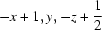 ; (ii)
 Data collection: SMART (Bruker, 2002); cell refinement: SAINT-Plus (Bruker, 2003); data reduction: SAINT-Plus; program(s) used to solve structure: SHELXTL (Sheldrick, 2008); program(s) used to refine structure: SHELXTL; molecular graphics: Mercury (Macrae et al., 2008); software used to prepare material for publication: publCIF (Westrip, 2010).
Supporting information
contains datablocks I, global. DOI: 10.1107/S1600536811025815/fi2108sup1.cif
Structure factors: contains datablock I. DOI: 10.1107/S1600536811025815/fi2108Isup2.hkl
Potassium O-n-butyl xanthate (1.00 g, 0.53 mmol) was dissolved in acetone (20 mL) and placed in a three-necked round bottom flask fitted with a reflux condenser, a magnetic stirrer and a vacuum line. Co(NO3)2.6H2O (0.78 g, 2.70 mmol) was added directly into the reaction flask. The contents were stirred to dissolve the salt completely. About 30 ml of 3-methylpyridine was added and stirring was continued for another hour. Any insoluble matter was removed by filtration, and slow evaporation of the reaction mixture at room temperature yielded 60% of red needles of the title compound as the unexpected product. m.p. = 373 K. Elemental analysis: Found (Calc.) for C12H18N2CoO6S: C 38.64 (38.20); H 4.66 (4.80); N 7.51 (7.42).
Water hydrogen atoms were located in the difference density Fourier map and their position were refined with an O–H distance restraint of 0.84 Å within a standard deviation of 0.02 Å. All other hydrogen atoms were placed in calculated positions and all H atoms were refined riding on the respective with an isotropic displacement parameter 1.5 (methyl, hydroxyl) or 1.2 times (aromatic) that of the adjacent carbon or oxygen atom.
Data collection: SMART (Bruker, 2002); cell SAINT-Plus (Bruker, 2003); data reduction: SAINT-Plus (Bruker, 2003); program(s) used to solve structure: SHELXTL (Sheldrick, 2008); program(s) used to refine structure: SHELXTL (Sheldrick, 2008); molecular graphics: Mercury (Macrae et al., 2008); software used to prepare material for publication: publCIF (Westrip, 2010).
![[Figure 1]](./fi2108fig1thm.gif) | Fig. 1. Thermal ellipsoid representation of the title compound with atom numbering scheme. Displacement elliposoids are at the 50% level, hydrogen atoms are shown as spheres of arbitrari radii. Symmetry operators: (i) -x + 1, y, -z + 1/2; (ii) -x + 1, y, -z + 3/2. |
![[Figure 2]](./fi2108fig2thm.gif) | Fig. 2. One of the infinite double chains formed by the title compound. View down the b-axis. O—H···O hydrogen bonds are symbolized as blue dashed lines. |
![[Figure 3]](./fi2108fig3thm.gif) | Fig. 3. Packing arrangement of the title compound. H atoms have been omitted for clarity. |
| [Co(SO4)(C6H7N)2(H2O)2] | Dx = 1.539 Mg m−3 |
| Mr = 377.27 | Melting point: 373 K |
| Orthorhombic, Pbcn | Mo Kα radiation, λ = 0.71073 Å |
| Hall symbol: -P 2n 2ab | Cell parameters from 5623 reflections |
| a = 15.132 (2) Å | θ = 2.4–30.5° |
| b = 16.687 (2) Å | µ = 1.21 mm−1 |
| c = 6.4503 (9) Å | T = 100 K |
| V = 1628.7 (4) Å3 | Needle, red |
| Z = 4 | 0.60 × 0.12 × 0.12 mm |
| F(000) = 780 |
| Bruker SMART APEX CCD diffractometer | 2028 independent reflections |
| Radiation source: fine-focus sealed tube | 1892 reflections with I > 2σ(I) |
| Graphite monochromator | Rint = 0.034 |
| ω scans | θmax = 28.3°, θmin = 1.8° |
| Absorption correction: multi-scan (SADABS in SAINT-Plus; Bruker, 2003) | h = −20→19 |
| Tmin = 0.786, Tmax = 0.865 | k = −22→22 |
| 15656 measured reflections | l = −8→8 |
| Refinement on F2 | Primary atom site location: structure-invariant direct methods |
| Least-squares matrix: full | Secondary atom site location: difference Fourier map |
| R[F2 > 2σ(F2)] = 0.027 | Hydrogen site location: inferred from neighbouring sites |
| wR(F2) = 0.075 | H atoms treated by a mixture of independent and constrained refinement |
| S = 1.08 | w = 1/[σ2(Fo2) + (0.0404P)2 + 0.7529P] where P = (Fo2 + 2Fc2)/3 |
| 2028 reflections | (Δ/σ)max = 0.001 |
| 108 parameters | Δρmax = 0.57 e Å−3 |
| 2 restraints | Δρmin = −0.32 e Å−3 |
| [Co(SO4)(C6H7N)2(H2O)2] | V = 1628.7 (4) Å3 |
| Mr = 377.27 | Z = 4 |
| Orthorhombic, Pbcn | Mo Kα radiation |
| a = 15.132 (2) Å | µ = 1.21 mm−1 |
| b = 16.687 (2) Å | T = 100 K |
| c = 6.4503 (9) Å | 0.60 × 0.12 × 0.12 mm |
| Bruker SMART APEX CCD diffractometer | 2028 independent reflections |
| Absorption correction: multi-scan (SADABS in SAINT-Plus; Bruker, 2003) | 1892 reflections with I > 2σ(I) |
| Tmin = 0.786, Tmax = 0.865 | Rint = 0.034 |
| 15656 measured reflections |
| R[F2 > 2σ(F2)] = 0.027 | 2 restraints |
| wR(F2) = 0.075 | H atoms treated by a mixture of independent and constrained refinement |
| S = 1.08 | Δρmax = 0.57 e Å−3 |
| 2028 reflections | Δρmin = −0.32 e Å−3 |
| 108 parameters |
Geometry. All e.s.d.'s (except the e.s.d. in the dihedral angle between two l.s. planes) are estimated using the full covariance matrix. The cell e.s.d.'s are taken into account individually in the estimation of e.s.d.'s in distances, angles and torsion angles; correlations between e.s.d.'s in cell parameters are only used when they are defined by crystal symmetry. An approximate (isotropic) treatment of cell e.s.d.'s is used for estimating e.s.d.'s involving l.s. planes. |
Refinement. Refinement of F2 against ALL reflections. The weighted R-factor wR and goodness of fit S are based on F2, conventional R-factors R are based on F, with F set to zero for negative F2. The threshold expression of F2 > σ(F2) is used only for calculating R-factors(gt) etc. and is not relevant to the choice of reflections for refinement. R-factors based on F2 are statistically about twice as large as those based on F, and R- factors based on ALL data will be even larger. |
| x | y | z | Uiso*/Ueq | ||
| C1 | 0.59471 (10) | 0.18494 (8) | 0.0429 (2) | 0.0210 (3) | |
| H1 | 0.5466 | 0.1895 | −0.0509 | 0.025* | |
| C2 | 0.65854 (10) | 0.12686 (8) | 0.0035 (2) | 0.0236 (3) | |
| C3 | 0.72901 (10) | 0.12145 (9) | 0.1412 (3) | 0.0250 (3) | |
| H3 | 0.7745 | 0.0832 | 0.1193 | 0.030* | |
| C4 | 0.73227 (10) | 0.17218 (9) | 0.3100 (3) | 0.0268 (3) | |
| H4 | 0.7800 | 0.1691 | 0.4054 | 0.032* | |
| C5 | 0.66527 (9) | 0.22760 (9) | 0.3387 (2) | 0.0224 (3) | |
| H5 | 0.6675 | 0.2617 | 0.4564 | 0.027* | |
| C6 | 0.65160 (13) | 0.07315 (11) | −0.1835 (3) | 0.0384 (4) | |
| H6A | 0.6325 | 0.0196 | −0.1399 | 0.058* | |
| H6B | 0.7094 | 0.0694 | −0.2513 | 0.058* | |
| H6C | 0.6084 | 0.0955 | −0.2808 | 0.058* | |
| Co1 | 0.5000 | 0.325574 (15) | 0.2500 | 0.01344 (10) | |
| N1 | 0.59730 (8) | 0.23485 (7) | 0.20607 (18) | 0.0175 (2) | |
| O1 | 0.59964 (7) | 0.41307 (6) | 0.21413 (16) | 0.0177 (2) | |
| H1A | 0.5893 (14) | 0.4584 (10) | 0.263 (3) | 0.027* | |
| H1B | 0.6013 (12) | 0.4199 (11) | 0.088 (2) | 0.027* | |
| O2 | 0.52369 (7) | 0.32565 (5) | 0.57274 (15) | 0.0183 (2) | |
| O3 | 0.42370 (6) | 0.42849 (6) | 0.69346 (15) | 0.0181 (2) | |
| S1 | 0.5000 | 0.37749 (3) | 0.7500 | 0.01309 (12) |
| U11 | U22 | U33 | U12 | U13 | U23 | |
| C1 | 0.0248 (7) | 0.0188 (6) | 0.0192 (6) | 0.0005 (5) | −0.0001 (5) | −0.0020 (5) |
| C2 | 0.0287 (7) | 0.0185 (6) | 0.0234 (7) | 0.0004 (5) | 0.0057 (6) | −0.0018 (5) |
| C3 | 0.0221 (7) | 0.0199 (7) | 0.0329 (8) | 0.0042 (5) | 0.0066 (6) | 0.0021 (6) |
| C4 | 0.0212 (7) | 0.0271 (8) | 0.0320 (8) | 0.0017 (6) | −0.0033 (6) | 0.0009 (6) |
| C5 | 0.0222 (7) | 0.0236 (7) | 0.0215 (7) | −0.0002 (5) | −0.0025 (5) | −0.0027 (5) |
| C6 | 0.0487 (10) | 0.0320 (9) | 0.0346 (9) | 0.0125 (8) | 0.0008 (8) | −0.0145 (8) |
| Co1 | 0.01657 (15) | 0.01387 (15) | 0.00988 (14) | 0.000 | 0.00000 (8) | 0.000 |
| N1 | 0.0185 (6) | 0.0168 (5) | 0.0173 (5) | 0.0001 (4) | 0.0008 (4) | −0.0007 (4) |
| O1 | 0.0224 (5) | 0.0159 (5) | 0.0148 (5) | −0.0010 (4) | −0.0002 (4) | −0.0017 (4) |
| O2 | 0.0258 (5) | 0.0187 (5) | 0.0105 (5) | 0.0047 (4) | 0.0004 (4) | −0.0012 (3) |
| O3 | 0.0200 (5) | 0.0184 (5) | 0.0159 (4) | 0.0032 (4) | −0.0009 (4) | −0.0012 (4) |
| S1 | 0.0168 (2) | 0.0135 (2) | 0.0090 (2) | 0.000 | 0.00065 (14) | 0.000 |
| C1—N1 | 1.3427 (18) | C6—H6C | 0.9800 |
| C1—C2 | 1.392 (2) | Co1—O1 | 2.1115 (10) |
| C1—H1 | 0.9500 | Co1—O1i | 2.1115 (10) |
| C2—C3 | 1.391 (2) | Co1—O2i | 2.1124 (10) |
| C2—C6 | 1.506 (2) | Co1—O2 | 2.1124 (10) |
| C3—C4 | 1.380 (2) | Co1—N1 | 2.1308 (12) |
| C3—H3 | 0.9500 | Co1—N1i | 2.1308 (12) |
| C4—C5 | 1.385 (2) | O1—H1A | 0.835 (15) |
| C4—H4 | 0.9500 | O1—H1B | 0.820 (15) |
| C5—N1 | 1.3431 (19) | O2—S1 | 1.4779 (10) |
| C5—H5 | 0.9500 | O3—S1 | 1.4799 (10) |
| C6—H6A | 0.9800 | S1—O2ii | 1.4779 (10) |
| C6—H6B | 0.9800 | S1—O3ii | 1.4799 (10) |
| N1—C1—C2 | 123.71 (14) | O1i—Co1—O2 | 90.73 (4) |
| N1—C1—H1 | 118.1 | O2i—Co1—O2 | 179.93 (5) |
| C2—C1—H1 | 118.1 | O1—Co1—N1 | 89.05 (5) |
| C3—C2—C1 | 117.41 (13) | O1i—Co1—N1 | 177.82 (4) |
| C3—C2—C6 | 121.76 (14) | O2i—Co1—N1 | 89.23 (4) |
| C1—C2—C6 | 120.82 (14) | O2—Co1—N1 | 90.82 (4) |
| C4—C3—C2 | 119.45 (13) | O1—Co1—N1i | 177.82 (4) |
| C4—C3—H3 | 120.3 | O1i—Co1—N1i | 89.05 (5) |
| C2—C3—H3 | 120.3 | O2i—Co1—N1i | 90.82 (4) |
| C3—C4—C5 | 119.27 (15) | O2—Co1—N1i | 89.23 (4) |
| C3—C4—H4 | 120.4 | N1—Co1—N1i | 89.44 (6) |
| C5—C4—H4 | 120.4 | C1—N1—C5 | 117.75 (12) |
| N1—C5—C4 | 122.40 (14) | C1—N1—Co1 | 121.65 (10) |
| N1—C5—H5 | 118.8 | C5—N1—Co1 | 120.56 (9) |
| C4—C5—H5 | 118.8 | Co1—O1—H1A | 116.7 (15) |
| C2—C6—H6A | 109.5 | Co1—O1—H1B | 103.1 (13) |
| C2—C6—H6B | 109.5 | H1A—O1—H1B | 104.9 (17) |
| H6A—C6—H6B | 109.5 | S1—O2—Co1 | 136.19 (6) |
| C2—C6—H6C | 109.5 | O2—S1—O2ii | 108.35 (8) |
| H6A—C6—H6C | 109.5 | O2—S1—O3ii | 109.76 (6) |
| H6B—C6—H6C | 109.5 | O2ii—S1—O3ii | 109.58 (5) |
| O1—Co1—O1i | 92.51 (6) | O2—S1—O3 | 109.58 (5) |
| O1—Co1—O2i | 90.73 (4) | O2ii—S1—O3 | 109.76 (6) |
| O1i—Co1—O2i | 89.22 (4) | O3ii—S1—O3 | 109.79 (8) |
| O1—Co1—O2 | 89.22 (4) | ||
| N1—C1—C2—C3 | −0.6 (2) | N1i—Co1—N1—C1 | 65.61 (10) |
| N1—C1—C2—C6 | −179.69 (15) | O1—Co1—N1—C5 | 61.84 (11) |
| C1—C2—C3—C4 | 0.8 (2) | O2i—Co1—N1—C5 | 152.59 (11) |
| C6—C2—C3—C4 | 179.90 (15) | O2—Co1—N1—C5 | −27.36 (11) |
| C2—C3—C4—C5 | −0.1 (2) | N1i—Co1—N1—C5 | −116.59 (12) |
| C3—C4—C5—N1 | −1.0 (2) | O1—Co1—O2—S1 | 78.59 (9) |
| C2—C1—N1—C5 | −0.4 (2) | O1i—Co1—O2—S1 | −13.91 (9) |
| C2—C1—N1—Co1 | 177.45 (11) | N1—Co1—O2—S1 | 167.62 (9) |
| C4—C5—N1—C1 | 1.2 (2) | N1i—Co1—O2—S1 | −102.95 (10) |
| C4—C5—N1—Co1 | −176.65 (11) | Co1—O2—S1—O2ii | 138.72 (11) |
| O1—Co1—N1—C1 | −115.96 (11) | Co1—O2—S1—O3ii | −101.66 (9) |
| O2i—Co1—N1—C1 | −25.22 (11) | Co1—O2—S1—O3 | 18.98 (11) |
| O2—Co1—N1—C1 | 154.83 (11) |
| Symmetry codes: (i) −x+1, y, −z+1/2; (ii) −x+1, y, −z+3/2. |
| D—H···A | D—H | H···A | D···A | D—H···A |
| O1—H1B···O3i | 0.82 (2) | 1.86 (2) | 2.6652 (15) | 166 (2) |
| O1—H1A···O3iii | 0.84 (2) | 1.92 (2) | 2.7331 (14) | 165 (2) |
| Symmetry codes: (i) −x+1, y, −z+1/2; (iii) −x+1, −y+1, −z+1. |
Experimental details
| Crystal data | |
| Chemical formula | [Co(SO4)(C6H7N)2(H2O)2] |
| Mr | 377.27 |
| Crystal system, space group | Orthorhombic, Pbcn |
| Temperature (K) | 100 |
| a, b, c (Å) | 15.132 (2), 16.687 (2), 6.4503 (9) |
| V (Å3) | 1628.7 (4) |
| Z | 4 |
| Radiation type | Mo Kα |
| µ (mm−1) | 1.21 |
| Crystal size (mm) | 0.60 × 0.12 × 0.12 |
| Data collection | |
| Diffractometer | Bruker SMART APEX CCD diffractometer |
| Absorption correction | Multi-scan (SADABS in SAINT-Plus; Bruker, 2003) |
| Tmin, Tmax | 0.786, 0.865 |
| No. of measured, independent and observed [I > 2σ(I)] reflections | 15656, 2028, 1892 |
| Rint | 0.034 |
| (sin θ/λ)max (Å−1) | 0.666 |
| Refinement | |
| R[F2 > 2σ(F2)], wR(F2), S | 0.027, 0.075, 1.08 |
| No. of reflections | 2028 |
| No. of parameters | 108 |
| No. of restraints | 2 |
| H-atom treatment | H atoms treated by a mixture of independent and constrained refinement |
| Δρmax, Δρmin (e Å−3) | 0.57, −0.32 |
Computer programs: SMART (Bruker, 2002), SAINT-Plus (Bruker, 2003), SHELXTL (Sheldrick, 2008), Mercury (Macrae et al., 2008), publCIF (Westrip, 2010).
| D—H···A | D—H | H···A | D···A | D—H···A |
| O1—H1B···O3i | 0.820 (15) | 1.862 (15) | 2.6652 (15) | 166.0 (18) |
| O1—H1A···O3ii | 0.835 (15) | 1.918 (16) | 2.7331 (14) | 164.8 (18) |
| Symmetry codes: (i) −x+1, y, −z+1/2; (ii) −x+1, −y+1, −z+1. |
Acknowledgements
This project was financed by the University of Malaya, UMRG grant: RG097/10AET. The X-ray diffractometer was funded by NSF Grant 0087210, Ohio Board of Regents Grant CAP-491, and Youngstown State University.
References
 Ali, H. M., Puvaneswary, S. & Ng, S. W. (2005). Acta Cryst. E61, m474–m475. Web of Science CSD CrossRef IUCr Journals Google Scholar
Bruker (2002). SMART. Bruker AXS Inc., Madison, Wisconsin, USA. Google Scholar
Bruker (2003). SAINT-Plus and SADABS. Bruker AXS Inc., Madison, Wisconsin, USA. Google Scholar
Carlucci, L., Ciani, G., Proserpio, D. M. & Rizzato, S. (2003). CrystEngComm, 5, 190–199. Web of Science CSD CrossRef CAS Google Scholar
Das, B. K., Bora, S. J., Bhattacharyya, M. K. & Barman, R. K. (2009). Acta Cryst. B65, 467–473. Web of Science CSD CrossRef CAS IUCr Journals Google Scholar
Dietz, C., Seidel, R. W. & Oppel, I. M. (2009). Z. Kristallogr. New Cryst. Struct. 224, 509–511. CAS Google Scholar
Macrae, C. F., Bruno, I. J., Chisholm, J. A., Edgington, P. R., McCabe, P., Pidcock, E., Rodriguez-Monge, L., Taylor, R., van de Streek, J. & Wood, P. A. (2008). J. Appl. Cryst. 41, 466–470. Web of Science CrossRef CAS IUCr Journals Google Scholar
Majumder, A., Choudhury, C.R., Mitra, S., Marschner, C. & Baumgartner, J. (2005). Z. Naturforsch. Teil B, 60, 99–105. CAS Google Scholar
Masuhara, N., Hayami, S., Motokawa, N., Shuto, A., Inoue, K. & Maeda, Y. (2007). Chem. Lett. 36, 90–91. Web of Science CSD CrossRef CAS Google Scholar
Sheldrick, G. M. (2008). Acta Cryst. A64, 112–122. Web of Science CrossRef CAS IUCr Journals Google Scholar
Vreshch, V. D., Chernega, A. N., Howard, J. A. K., Sieler, J. & Domasevitch, K. V. (2003). Dalton Trans. pp. 1707–1711. Web of Science CSD CrossRef Google Scholar
Westrip, S. P. (2010). J. Appl. Cryst. 43, 920–925. Web of Science CrossRef CAS IUCr Journals Google Scholar
Wu, B.-L., Zhang, P., Niu, Y.-Y., Zhang, H.-Y., Li, Z.-J. & Hou, H.-W. (2008). Inorg. Chim. Acta, 361, 2203–2209. Web of Science CSD CrossRef CAS Google Scholar
Zhong, K.-L., Pan, X.-X., Cao, G.-Q. & Chen, L. (2011). Acta Cryst. E67, m43. Web of Science CSD CrossRef IUCr Journals Google Scholar
Zhong, K.-L., Zhu, Y.-M. & Lu, W.-J. (2006). Acta Cryst. E62, m631–m633. Web of Science CSD CrossRef IUCr Journals Google Scholar
This is an open-access article distributed under the terms of the Creative Commons Attribution (CC-BY) Licence, which permits unrestricted use, distribution, and reproduction in any medium, provided the original authors and source are cited.
| CRYSTALLOGRAPHIC COMMUNICATIONS |


Sulfate coordination to cobalt ions may be divided into three commonly reported modes: monodentate (Das et al.,2009, Majumder et al., 2005), bidentate (Masuhara et al.., 2007, Zhong et al.,2006, 2011) or bidentate-bridged metal to metal coordination (Dietz et al., 2009, Wu et al., 2008, Carlucci et al., 2003, Ali et al., 2005, Vreshch et al., 2003). The last mode of coordination is particularly common where the sulfate ion acts as a bridge that links two cobalt ions to form an extended polymeric structure. Further evidence for the different modes of sulfate coordination is reflected in the infra-red absorption spectrum due to the reduction in symmetry in sulfate coordination.
In the title compound, the cobalt(II) complex exhibits octahedral symmetry with the two 3-methylpyridine ligands lying in cis position with respect to each other, and trans to the two coordinated water molecules. The axial positions are occupied by oxygen atoms of the sulfate ions. Both Co and S occupy special positions (two-fold axis, Wyckoff position 4c). Neighboring cobalt ions are covalently connected with each other through the sulfate ions thus creating infinite polymeric chains that stretch parallel to the c axis direction. The water molecules are connected with neighboring sulfate ions through strong O—H···O hydrogen bonds. Intramolecular hydrogen bonds parallel to the propagation direction of the chains stabilize the polymeric chains, and intermolecular hydrogen bonds between chains connect neighboring strains with each other, thus leading to polymeric double chains.