
Acta Crystallographica
Section A FOUNDATIONS AND ADVANCES


 menu


research papers
| FOUNDATIONS ADVANCES |
 access
Spin-point-group symmetry and classification of non-relativistic spin splitting in non-collinear magnetic structures: identification of high-order spin-splitting types (ℓ = 5, 7 and 9)

aDepartment of Physics, Faculty of Science and Technology, Universidad del Pais Vasco UPV/EHU, Bilbao, Spain, bFaculty of Science and Technology, Universidad del Pais Vasco UPV/EHU, Bilbao, Spain, cDepartment of Physics Engineering, Hacettepe University, 06800 Ankara, Türkiye, and dMaterials Genome Institute, Shanghai University, 200444 Shanghai, People's Republic of China
*Correspondence e-mail: [email protected], [email protected]
A comprehensive study of the possible types of non-relativistic spin splitting of electronic bands in coplanar and non-coplanar magnetic structures is presented on the basis of spin-group theory. As a first step, we enumerate and tabulate all possible non-equivalent spin point groups (SpPGs) which can be expressed as a direct product of a non-trivial part and a spin-only group limited to be the intrinsic (trivial) one, or augmented by the time-reversal operation. This tabulation, which includes the listing of symmetry operations for each group, is now available as an online database (SPGENPOS) in the Bilbao Crystallographic Server. A total of 1249 non-equivalent SpPGs are listed in SPGENPOS. This extends previous enumerations, in which the possible presence of time reversal in the magnetic point group was not taken into account, thus overlooking the full SpPG symmetry associated with the numerous magnetic structures which have a magnetic space group of type IV. For each of the listed coplanar and non-coplanar SpPGs, the spin splitting that is symmetry allowed is analyzed in detail using the program STENSOR also in the Bilbao Crystallographic Server. Except for the SpPGs that include the operation 1′, i.e. the combined operation of time reversal and space inversion, all other coplanar and non-coplanar SpPGs allow spin splitting at some order in a power expansion of the electron wavevector components. We find that, depending on the SpPG, spin-splitting terms can appear with the lowest-order monomials ranging from ℓ = 0 to 9, with the exception of ℓ = 8. This contrasts with the collinear case, where the lowest order is not higher than ℓ = 6, and where the presence of time-reversal symmetry forbids any spin splitting. For the newly identified spin textures with powers ℓ = 5, 7 and 9, which are possible in some non-centrosymmetric SpPGs, the functional form of the spin splitting in terms of the components of the crystal momentum is given. One example of a real material, LaMnAu5, showing ℓ = 5 spin splitting, is identified.
Keywords: spin point groups; SPGENPOS; magnetic point groups; spin splitting in electronic bands; spin–orbit coupling; Bilbao Crystallographic Server.
1. Introduction
The development of magnetic structures whose electronic bands exhibit non-relativistic spin splitting is a major objective in the field of magnetic materials science, owing to its potential relevance for possible spintronics applications (Hayami et al., 2019 ; Yuan et al., 2020; Mazin et al., 2021). A major breakthrough towards this target has been the introduction of the concept of altermagnetism (Šmejkal et al., 2022a; Šmejkal et al., 2022b; Mazin, 2022; Krempaský et al., 2024; Bhowal & Spaldin, 2024), differentiating a class of compensated collinear magnetic states that have magnetic point groups (MPGs) lacking both the operation of time-reversal (TR) symmetry
 and TR combined with space inversion
 . These systems exhibit a remarkable even-parity spin splitting in the absence of spin–orbit coupling (SOC), which enables the occurrence of the anomalous Hall effect and promotes phenomena of potential interest for device applications, such as spin transport driven by applied electric fields or temperature gradients (González-Hernández et al., 2021; Cui et al., 2023; Han et al., 2024). Within altermagnets, one can further distinguish materials having a spin splitting of so-called d, g and i character, indicating a spin splitting near the Γ point of the Brillouin zone (
 = 0) that, at lowest order, can be expressed as a homogeneous polynomial of degree
l in the components of , with
l = 2, 4, 6, respectively. The case
l = 0 corresponds to ferromagnetic (FM) materials, which exhibit spin splitting at the center of the Brillouin zone even in the absence of SOC.
Recently, the concept of altermagnetism has been extended to non-collinear non-centrosymmetric magnetic states (Yuan et al. 2021; Hellenes et al. 2024), which allow for non-relativistic spin splittings with
l = 1 (type p) or
l = 3 (type f). These magnets are characterized by a spin splitting that changes sign upon inversion of the crystal momentum . Hellenes et al. (2024) and Priessnitz et al. (2026) pointed out that p-wave magnets preserve TR as a point-group symmetry operation and, in fact, the search for materials of this type has been formulated under this symmetry constraint. On the other hand, although some works on compensated magnets with non-relativistic spin splittings briefly mention the possibility of systems where the allowed lowest-order spin splitting has h character (
l = 5) (Yu et al., 2025; Priessnitz et al., 2026), other studies have argued (Ezawa, 2025) that such states are impossible. Interestingly, by combining low-energy modeling with density functional theory (DFT), Dsouza et al. (2026) have recently proposed that the superconductor FeSe should exhibit h-wave spin splitting, based on a theoretical crystal structure deduced from DFT calculations. In a subsequent work, Ezawa (2026) proposes a dimensional-extension construction from two to three dimensions and derives explicit functional forms for some higher-order odd-parity spin splittings. These recent developments further highlight the growing interest in this class of spin splittings. To the best of our knowledge, however, the highest odd-parity value of
l reported so far for an experimental magnetic structure remains  .
In this work we present a comprehensive analysis of the possible types of SOC-free spin splitting in non-collinear magnetic structures from the perspective of spin-group symmetry (Chen et al., 2024; Jiang et al., 2024; Xiao et al., 2024). The application of spin-point-group symmetry allows us to resolve in any tensor property which part of the tensor is not necessarily SOC assisted, provided that the spin arrangement does not suffer some lowering of its spin-group symmetry due to SOC (Etxebarria et al., 2025). Consequently, we have first established and tabulated all possible non-equivalent spin point groups (SpPGs) which can be expressed as a direct product of a non-trivial part and a spin-only group limited to be the intrinsic (trivial) one, or augmented by the TR operation. The antitranslations, which combine TR with a translation, are very common, as they are present in the symmetry of all structures with magnetic space groups (MSGs) of type IV and, therefore, their MPG and their SpPG necessarily include TR. We have then used the program STENSOR (https://cryst.ehu.eus/cgi-bin/cryst/programs/spingroups/stensor.pl) (Elcoro et al., 2026) to obtain, for all the tabulated coplanar and non-coplanar SpPGs, their symmetry constraints on the possible band spin splitting around the Γ point of the Brillouin zone.
The structure of the paper is as follows. In Section 2 we present and explain the enumeration and tabulation of the SpPGs, including the notation and conventions that will be used. The database SPGENPOS (https://cryst.ehu.eus/cgi-bin/cryst/programs/spingroups/spgenpos.pl), available in the Bilbao Crystallographic Server, where this tabulation is hosted, is also described. Section 3 is devoted to outlining the method used to identify the different types of spin splittings, which are then discussed in Section 4 for the 1127 tabulated non-collinear SpPGs. Finally, in Section 5 we draw our conclusions.
2. Enumeration and tabulation of spin point groups. The database SPGENPOS
The operations  of a SpPG combine a proper or improper spin rotation, represented by the matrix U, and a proper or improper spatial rotation, represented by the matrix R. The operations U act on the spin components
(u,v,w) defined with respect to a spin basis that in general is fully independent of the basis used for the operations R acting on the spatial coordinates
(x,y,z). The SpPG associated with a magnetic structure is formed by all pairs that are present in the operations
 defining the spin space group of the structure, where
 is a spatial translation.
A SpPG may have spin-only operations of the type  , which form the so-called spin-only subgroup denoted by PSO. The spin space group of most magnetic structures is such that the SpPG, PS, can be expressed as the direct product of two subgroups:

where PNT is a group enumerated by Litvin (1977) and termed `non-trivial' SpPGs, with the idea that the spin-only groups PSO could only be the `trivial' spin-only groups, which are intrinsic to the collinear or the coplanar spin arrangements (Litvin, 1977).
However, magnetic structures may have more complex PSO groups if their spin space groups include a spin-translation subgroup (Chen et al., 2024), formed by operations of the type  , with a non-zero translation and U different from the identity. In such cases, additional point-group operations derived from these space-group operations must be included in its SpPG. Antitranslations associated with any magnetic structure having a MSG of type IV are operations of this type, and imply the presence of the TR operation
 in PSO. More generally, spin space groups may contain spin-translation operations with spin operations
 giving place to enlarged spin-only subgroups PSO. In such cases, the validity of equation (1) can even fail. This corrects the general basis on which the enumeration by Litvin (1977) was done, and our assumption about the general validity of equation (1) in previous publications (Etxebarria et al., 2025; Elcoro et al., 2026). A simple example of a SpPG for which equation (1) does not hold is given in Section S1.4 of the supporting information. In this respect see also Appendix B of Shinohara et al. (2024) and Section S1.5 in the supporting information. The potential impossibility of a direct product decomposition given by equation (1) for point groups contrasts with the case of space groups, where the only spin-only subgroups are the intrinsic ones (associated with either the collinearity or the coplanarity), and where an equation analogous to equation (1) is always fulfilled.
Thus, when dealing with spin-point-group symmetry, there are cases in which SpPGs cannot be generated by applying equation (1) to one of the 598 so-called `non-trivial' SpPGs and the corresponding PSO. In practice, however, in most of the observed magnetic structures the lattice periodicity either remains the same as that of the paramagnetic phase or is reduced by a factor two, which favors the validity of equation (1). Therefore, the 598 groups enumerated by Litvin can be taken as the set of all possible non-equivalent point groups which lack spin-only operations except the identity. The SpPGs of most of the observed magnetic structures can then be derived from them by taking the direct product with the relevant spin-only subgroup PSO.
In summary, although equation (1) is not valid for all mathematically possible SpPGs, it is fulfilled by those of a majority of the observed magnetic structures, and its systematic application generates most of the SpPGs which are relevant in practice. We have therefore enumerated and listed all non-equivalent SpPGs generated from the 598 PNT groups by applying equation (1) with the intrinsic PSO subgroup and with this group augmented with TR. If PSO is different from the identity, different PNT groups multiplied by the same PSO can lead to equivalent SpPGs, and this issue has been taken into account in the enumeration. The resulting SpPGs can be then divided into the following subsets, according to the spin-only group PSO considered (see Section S1 of the supporting information for notation):
(1) Intrinsic collinear PSO:  (all rotations around the spin direction, which is taken along w in the spin basis, and all mirror planes containing this direction).
This results in 90 collinear SpPGs, isomorphic with the 90 non-gray MPGs (Liu et al., 2022). These SpPGs span all possible spin-point-group symmetries of collinear magnetic structures with MSG of type I or III.
(2) Intrinsic collinear PSO with TR:  =
 .
This results in 32 additional collinear SpPGs (isomorphic with the 32 gray MPGs). These SpPGs span all possible spin-point-group symmetries of collinear magnetic structures with an MSG of type IV.
(3) Intrinsic coplanar PSO:
mw1 ( ).
This results in 253 coplanar SpPGs (Liu et al., 2022). These groups span all possible spin-point-group symmetries of coplanar magnetic structures with MSG of type I or III, provided that its spin space group does not include a spin-translation subgroup. This latter condition is fulfilled by a majority of magnetic structures of type I and III, where the magnetic order maintains the lattice of the paramagnetic phase.
(4) Intrinsic coplanar PSO with TR:
2w/mw1 =  .
This results in 114 additional coplanar SpPGs (see Table S3 in the supporting information for a list of equivalences when is added to the intrinsic coplanar PSO). These groups span most of the spin-point-group symmetries of coplanar magnetic structures with a MSG of type IV, where the magnetic lattice differs from the paramagnetic one by only a doubling of the primitive unit cell.
(5) Intrinsic non-coplanar PSO: it includes only the identity  .
This results in 598 non-coplanar SpPGs coinciding with the 598 PNT groups. These groups describe all non-coplanar magnetic structures with MSGs of type I or III, provided that their spin space groups do not include some spin-translation subgroups. This latter condition is fulfilled by a majority of the magnetic structures of type I or III, where the magnetic order maintains the lattice of the paramagnetic phase, forbidding any spin-translation group.
(6) Intrinsic non-coplanar PSO with TR:  .
This results in 162 non-coplanar SpPGs. (see Table S2 in the supporting information for a list of equivalences when the operation is added to the non-trivial SpPGs). These groups span most of the possible spin-point-group symmetries of non-coplanar magnetic structures with MSG of type IV, where the magnetic ordering decreases the lattice periodicity with respect to the paramagnetic phase by only a factor 2.
Table 1 summarizes the classification of the resulting 1249 distinct SpPGs. Detailed tables for each of these groups, including a full list of symmetry operations, are available via the SPGENPOS program (https://cryst.ehu.eus/cgi-bin/cryst/programs/spingroups/spgenpos.pl) of the Bilbao Crystallographic Server. The SpPGs are identified using both an extension of the Hermann–Mauguin symbols, similar to that used by Litvin (1977), and a numerical labeling scheme. A full detailed explanation of the contents of SPGENPOS can be found in the supporting information. This tabulation of SpPGs available in SPGENPOS complements previous enumerations (Liu et al., 2022; Schiff et al., 2025), where only SpPGs without TR were considered, so that the spin-point-group symmetries of all magnetic structures with antitranslations in their magnetic symmetry were ignored. As about 40% of the known commensurate magnetic structures are of this type (Gallego et al., 2016), this left a considerable number of magnetic materials out of the spin-point-group framework.
|
|||||||||||||||||||||||
Note that the SpPGs tabulated in SPGENPOS, as stressed above, do not exhaust all possible SpPGs, although they cover by far the most common cases. To these, one must add the SpPGs that cannot be expressed in the form of equation (1) as well as those that, despite satisfying equation (1), have a PSO different from those considered in this tabulation. Although relatively uncommon, there are known examples of real materials where this happens (see Sections S1.4 and S1.5 in the supporting information). This category includes, for example, certain helimagnetic structures with magnetic order whose periodicity is incommensurate with the lattice periodicity, in which PSO may contain  operations, where
 is an arbitrary-angle rotation about a fixed axis. In general, in incommensurate materials, the spin superspace group will consist of operations of the type
 , with τ representing a phase shift of the modulation. However, their corresponding point groups share the same structure as in commensurate materials, although they may contain spin-only operations originating from operations of the type
 , where
 is a lattice translation. In these materials, non-trivial spin-only operations are expected to occur more frequently than in the commensurate case.
3. Method for the spin-splitting analysis
The spin splitting of the energy bands can be considered to arise from an effective Zeeman field  , which depends on the wavevector and the band index. For a particular band, the direction of the spin polarization and the magnitude of the non-relativistic spin splitting at a given are determined by the direction and magnitude of at that point (Radaelli, 2024). The general features of the field can be determined using symmetry arguments, by imposing the condition that, in the absence of SOC, it is constrained to remain invariant under the SpPG operations .
 transforms as a spin magnetization, i.e.
 , whereas the wavevector becomes
 , where
det(U) denotes the determinant of the matrix U (Etxebarria et al., 2025; Elcoro et al., 2026). Therefore, the invariance condition of under the SpPG is written as

Using equation (2), we can derive in a straightforward manner some properties for the spin splittings, which are broadly applicable, as they originate from operations such as ,  and/or , which are common operations of both the SpPGs and corresponding MPGs, or from spin-only operations that are present in all collinear or coplanar SpPGs. We briefly outline some of these simple general points – some of them rather well known – that follow directly from equation (2), taking into account that the MPG of a magnetic structure is always a subgroup of its SpPG, and, therefore, the MPG operations are also SpPG operations:
(i) If the space inversion operation  is present in the MPG, i.e. the group is centrosymmetric, then
 , and the spin splitting, relativistic or not, can only be of even parity.
(ii) If the TR operation is present in the MPG, then  , and the spin splitting, relativistic or not, can only be of odd parity. Considering point (i) above, this means that centrosymmetric groups with TR imply no spin splitting in any case [see point (iii) below].
(iii) The presence of the operation  in the MPG (often denoted as parity–time or PT symmetry) forbids any spin splitting in any case since equation (2) implies
 , forcing
 . The same operation also prevents any macroscopic magnetization (Etxebarria et al., 2025). This is the case of the so-called non-spin-split pure antiferromagnets (Liu et al., 2026).
(iv) Non-magnetic structures are symmetric for TR. Consequently, spin splitting is only permitted in non-centrosymmetric structures, since inversion symmetry would imply the presence of the operation , which leads to , as indicated in point (iii). Moreover, in these non-centrosymmetric non-magnetic structures, the spin splitting can arise exclusively due to SOC, as the SpPGs of such structures also contain operations of the type for arbitrary rotations U, which enforce in the absence of SOC.
(v) For collinear structures the spin-only group,  , already ensures that is parallel to the spin direction. Choose the spin direction along the third axis in the spin plane (w axis), then
 in equation (2) directly yields
 , where u, v and w form a mutually orthogonal set of axes in the spin space. The constraint of the spin-only operation
 , with m parallel to the w axis, also forces
 . This means that collinear structures can only have spin splittings of even parity in . If, in addition, the point group of the collinear structure includes TR, then from point (iv) we have that
 , which leads to . Therefore, collinear structures whose point group includes the TR operation do not allow non-relativistic spin splitting and thus any experimentally observed splitting must be SOC assisted.
(vi) For coplanar structures the components of within the spin plane are even in , whereas the component perpendicular to the plane is odd in . Indeed, by choosing the spin plane perpendicular to the w axis in the spin space, the coplanar spin-only operation  imposes =
 . As a result,
 and
 must be even functions of , while . If TR symmetry is also present, then , the electronic spin polarization is perpendicular to the spin plane, and the spin splitting is necessarily of odd parity.
In points (v) and (vi) we have supposed, as is usual, that there is no orbital contribution to the magnetic moments, since if such a contribution were present, spin splittings of odd parity in collinear structures would be allowed (Leeb & Knolle, 2026).
Having recapitulated these general properties for the effective spin-splitting field , we now turn to the detailed analysis of the possible types of spin splitting. These types can be characterized by the minimum degree
l that is symmetry allowed in a power expansion of in terms of the components of the electron wavevector. Thus, we write as a Taylor series around  ,

where  are the components of the wavevector , and
T(n) is a tensor of rank
n+1 symmetric in indices
 . The transformation laws of these tensors
T(n) under a symmetry operation are deduced from those of and . The components of the transformed tensors
 are given by


The transformation laws (4) and (5) can be compactly expressed using the generalized Jahn symbol for the transformation properties of a tensor (Etxebarria et al., 2025). This notation combines the letters M and V with the modifiers e and a. Under an operation , the tensor transforms according to the labels in its Jahn symbol: matrix R is used for V, while matrix U is used for M. The letters e and a specify whether a sign change occurs when R or U, respectively, represent improper operations. Thus, e indicates that the tensor is even under spatial inversion, and a indicates that it is odd under TR. Square or curly brackets are added sometimes to denote symmetry or anti-symmetry between pairs of indices (if  ). Accordingly, is of type M, of type aV, whereas
T(n) is of type M[V
n] when n is even, and of type aM[V
n] when n is odd.
Equations (4) and (5) allow for the systematic identification of the type of non-relativistic spin splitting permitted by each SpPG. The spin-splitting type is simply determined by the smallest index
l for which the tensor
T(l) is non-zero. If  , the system is FM (s-wave);
 corresponds to a p-wave magnet;
 corresponds to a d-wave magnet, and so on. Note that, although the `wave type' has been here defined by the lowest value of
l, which usually gives the main contribution, this does not preclude the existence of higher-order non-vanishing tensors
T(n) (
 ). It is also possible that all
T(n) vanish, i.e. that the spin splitting is zero. As mentioned above, this arises in SpPGs that include the operation and corresponds to the non-spin-split pure antiferromagnets (Liu et al., 2026). In these systems neither macroscopic magnetization nor spin splitting is allowed, even in the presence of SOC, since the operation also belongs to the corresponding MPG of the structure.
4. Classification of non-relativistic spin splittings
4.1. Coplanar SpPGs
For each coplanar SpPG, the forms of the tensors
T(l) allowed by the corresponding symmetry were obtained using the program STENSOR (https://cryst.ehu.eus/cgi-bin/cryst/programs/spingroups/stensor.pl) (Elcoro et al., 2026), a computational tool integrated into the Bilbao Crystallographic Server and designed for the automatic calculation of symmetry-adapted tensors under SpPG symmetry. The program is directly accessible from SPGENPOS. A summary of the results is presented in Table 2, which lists the number of SpPGs for each spin-splitting type. For comparison, the well known results for collinear SpPGs are also shown in Table 3. As can be seen, among the coplanar SpPGs analyzed, there exist examples that allow non-relativistic spin splitting with waves ranging from to  , with the exception of
 . This constitutes the most noticeable difference with respect to the collinear case, where
l = 0, 2, 4 and 6 span all possible minimal orders in the spin splitting (Table 3). In particular, the h-wave (
 ) occurs for five coplanar SpPGs, all of them tetragonal with TR and necessarily non-centrosymmetric. This explicitly shows that the argument linking h-waves to fivefold rotational symmetry is incorrect in the work of Ezawa (2025). Likewise, j-wave splitting (
 ) appears for five hexagonal (non-centrosymmetric) SpPGs with TR, and
l-wave splitting () for four cubic (non-centrosymmetric) SpPGs with TR. This also contrasts with the collinear case, where spin splitting is forbidden if the point group includes TR.
|
||||||||||||||||||||||||||||||||||||||||||||||||||||||


|
||||||||||||||||||||||||||||||
Table 4 provides a more detailed account of the SpPGs that permit these `exotic' spin-splitting types. The expressions for the splittings with these symmetries are also indicated (except for a constant) in the same table. Fig. 1 shows schematically the splitting for h-, j- and l-waves close to . The shape of the curves is complicated as it corresponds to the high
l values. The complete results for the 367 coplanar SpPGs are given in the supporting information (Tables S6 and S7). For even-parity modes the electronic polarization lies always on the spin plane ( ) while for odd-parity splittings it is perpendicular (). This contrasts with the collinear case, where the polarization is always along the spin direction.
|
|||||||||||||||||||||||||||||||||||
 in the group labels indicates that P
 ,
 and
 . For
 and
 (12.130.65.

 (13.147.76.
 (14.169.87.
 (15.199.102.
 (24.338.155.

 (25.394.181.
 (25.406.185.
 (26.419.193.
 (27.453.209.
 (31.552.236.

 (31.555.237.
 (30.559.238)
 (32.574.248.

|
Figure 1
Schematic representation of the SOC-free spin splittings near the center of the Brillouin zone for the (a) h-wave, (b) j-wave and (c) l-wave in coplanar magnets. Red (blue) curves indicate positive (negative) splittings. The electronic polarization is perpendicular to the spin plane. The components of the wavevector are in arbitrary units. |
It is also noteworthy that the lowest-order splitting can be odd with low values of
l (1 and 3) even in the absence of . In fact, as indicated in Table 2, there is a considerable number of examples where this occurs (36 cases for the p-wave and 17 for the f-wave). This implies that the TR operation is not required to suppress the lower-order even tensors [
T(0) for the p-wave,
T(0) and
T(2) for the f-wave], as these tensors can be constrained to be null by other symmetry operations. Evidently, the inclusion of TR symmetry significantly increases the number of cases with odd-parity splittings, as it automatically suppresses all
T(n) with even n. In particular, high
l-waves (h, j,
l) only happen if TR is present.
With the exception of the group  (13.159.80.P1′) the SpPGs listed in Table 4 share the general feature that the symmetry of spin space is much lower than the lattice symmetry. The case of is completely different since, except for the coplanar intrinsic spin-only operation
 , it corresponds exactly to a MPG, namely
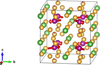
 (No. 13.2.45). Motivated by this coincidence, we carried out a search in MAGNDATA (Gallego et al., 2016), where the MPGs of all listed compounds are available, with the aim of identifying a real material showing h-wave spin splitting. There is only one entry in the entire database possessing this MPG and also being coplanar: LaMnAu5 (entry 1.839), which indeed has . The structure of this magnetic phase, as determined by powder neutron diffraction (Siebeneichler et al., 2024), is shown in Fig. 2. The SpPG of this structure is therefore either or higher, and one can then expect, according to Table 4, that its non-relativistic spin-splitting type must be either or higher. It can be checked, however, that the SpPG symmetry is indeed higher than simply
 . Introducing the structural data into FindSpinGroup (Yu et al., 2026), the spin space group results in 129.23.2.1.P in the notation of Chen et al. (2024), or in the generalized Hermann–Mauguin notation:

The SpPG corresponding to this spin space group is generated by adding the operation  to the MPG mentioned above. This SpPG does not appear in Table 4, because this group cannot be expressed as the direct product of one of the 598 non-trivial point groups and a spin-only group (see Section S1.4 in the supporting information). This higher symmetry does not modify, however, the final results for the spin-splitting type. LaMnAu5 therefore constitutes a real example of an experimental structure that has a SpPG symmetry with h-wave non-relativistic spin splitting.
|
Figure 2
Magnetic structure of LaMnAu5. Yellow, green and purple spheres represent Au, La and Mn atoms, respectively. Magnetic moments are indicated by arrows. |
4.2. Non-coplanar SpPGs
Table 5 shows the number of non-coplanar SpPGs for each spin-splitting type. The types of splitting modes are the same as those found for coplanar SpPGs:
l = 0–9 except . The full results are given in the supporting information (Tables S4 and S5). Here we restrict ourselves to commenting on some differences with respect to the coplanar case:
|
||||||||||||||||||||||||||||||||||||||||||||||||||||||
(i) In general, the electronic polarization has all three components non-zero ( ) for even-parity and odd-parity splitting types. Depending on the particular SpPG, special polarization configurations may also occur.
(ii) The h-wave can take place without the presence of TR in the point group. As indicated in Table 5, there is one SpPG with this characteristic, the cubic non-coplanar group  (32.589). The functional form of this h-wave is somewhat different from that of the coplanar cases. If the components of are referred to the
 cubic unit-cell vectors, we have

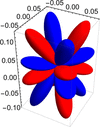
where C is a global constant, and the components of are expressed in an orthonormal basis with (001) along the hexagonal spin-space direction. The polarization direction is therefore on the plane perpendicular to the hexagonal axis of the spin operations. The same dependence may also occur for other non-coplanar groups with TR (Table S5 in the supporting information). Fig. 3 shows schematically the dependence of
Bu on the direction around the Γ point of the Brillouin zone, which can be compared with Fig. 1(a). The function corresponds to the sum of two h-waves of the type found in coplanar structures,  =
 .
|
Figure 3
Schematic representation of Bu near the center of the Brillouin zone for the h-wave of the cubic non-coplanar group (32.589). Red (blue) curves indicate positive (negative) splittings. The components of the wavevector are in arbitrary units. |
(iii) The presence of TR in the point group is required to raise the splitting type to the two highest
l values ( ). These splittings occur in two hexagonal and two cubic non-centrosymmetric groups, respectively.
Table 6 shows the non-coplanar SpPGs with TR which permit the existence of h-, j- and
l-waves. In the orthonormal reference frame
(u,v,w) of spin space in which the spin operations are defined, patterns near have either three or two non-zero components.
|
||||||||||||||||||||||||||||||||||||||||||||
 ) are arbitrary constants.
 (12.130.1′)

 (15.199.1′)

 (29.546.1′)


 (31.555.1′)

 (32.589.1′)

 (24.338.1′)

 (27.453.1′)

 (30.559.1′)

 (32.574.1′)

5. Conclusions
In summary, we have carried out a systematic symmetry analysis of non-relativistic spin splitting in non-collinear magnetic structures using spin-group theory.
As a first step, a comprehensive enumeration and classification of non-equivalent SpPGs has been carried out, including those that contain the TR operation. This tabulation, which extends previous work, is freely available in the Bilbao Crystallographic Server with the name SPGENPOS.
The symmetry constraints on the spin splitting under each of these 1249 tabulated SpPGs have been determined applying the program STENSOR, also in the Bilbao Crystallographic Server. This analysis shows that, in contrast with collinear systems, the presence of TR in the point group is not sufficient in general to forbid any spin splitting. Non-collinear systems, therefore, allow a much broader range of spin-splitting behaviors than collinear magnets, with spin-splitting waves ranging from to , except for . In particular, we demonstrate that h-, j- and
l-waves can occur in coplanar and non-coplanar structures with specific tetragonal, hexagonal and cubic SpPGs. A preliminary survey of MAGNDATA has identified one coplanar tetragonal compound with non-relativistic spin splitting. These results disprove arguments linking these waves to the requirement of rotational symmetries of order
l, which would be incompatible with crystalline lattices. Moreover, we have found that odd-parity waves of low order (mainly p and f, and in one non-coplanar case an h-wave) may arise in SpPGs without TR symmetry.
These results point to a relatively unexplored class of materials with non-relativistic spin splitting and could help broaden the range of magnetic states with potential relevance for applications or of fundamental interest.
Supporting information
Description of the new tool SPGENPOS hosted in the Bilbao Crystallographic Sever. Tables of equivalences between spin point groups after the addition of time-reversal (TR) symmetry to collinear, coplanar and non-coplanar spin point groups. Tables of leading terms in the expansion series of the effective magnetic field for each coplanar, coplanar+TR, non-coplanar and non-coplanar+TR spin point groups. DOI: https://doi.org/10.1107/S2053273326010636/cam5018sup1.pdf
Acknowledgements
We thank Hana Schiff and Paul McClarty for helpful discussion about the tabulation of the spin point groups.
Conflict of interest
The authors declare that there are no conflicts of interest.
References
 Bhowal, S. & Spaldin, N. A. (2024). Phys. Rev. X 14, 011019.
Google Scholar
Chen, X., Ren, J., Zhu, Y., Yu, Y., Zhang, A., Liu, P., Li, J., Liu, Y., Li, C. & Liu, Q. (2024). Phys. Rev. X 14, 031038.
Google Scholar
Cui, Q., Zeng, B., Cui, P., Yu, T. & Yang, H. (2023). Phys. Rev. B 108, L180401.
CrossRef
Google Scholar
Dsouza, R., Kreisel, A., Andersen, B. M., Agterberg, D. F. & Christensen, M. H. (2026). Phys. Rev. B 113, 144509.
CrossRef
Google Scholar
Elcoro, L., Etxebarria, J., Perez-Mato, J. M. & Tasci, E. S. (2026). J. Appl. Cryst. 59, 640–647.
CrossRef
CAS
IUCr Journals
Google Scholar
Etxebarria, J., Perez-Mato, J. M., Tasci, E. S. & Elcoro, L. (2025). Acta Cryst. A81, 317–338.
Web of Science
CrossRef
IUCr Journals
Google Scholar
Ezawa, M. (2025). Phys. Rev. B 111, 125420.
CrossRef
Google Scholar
Ezawa, M. (2026). Phys. Rev. B 114, 115404.
CrossRef
Google Scholar
Gallego, S. V., Perez-Mato, J. M., Elcoro, L., Tasci, E. S., Hanson, R. M., Momma, K., Aroyo, M. I. & Madariaga, G. (2016). J. Appl. Cryst. 49, 1750–1776.
Web of Science
CrossRef
CAS
IUCr Journals
Google Scholar
González-Hernández, R., Šmejkal, L., Výborný, K., Yahagi, Y., Sinova, J., Jungwirth, T. & Železný, J. (2021). Phys. Rev. Lett. 126, 127701.
PubMed
Google Scholar
Han, L., Fu, X., Peng, R., Cheng, X., Dai, J., Liu, L., Li, Y., Zhang, Y., Zhu, W., Bai, H., Zhou, Y., Liang, S., Chen, C., Wang, Q., Chen, X., Yang, L., Zhang, Y., Song, C., Liu, J. & Pan, F. (2024). Sci. Adv. 10, eadn0479.
CrossRef
PubMed
Google Scholar
Hayami, S., Yanagi, Y. & Kusunose, H. (2019). J. Phys. Soc. Jpn 88, 123702.
CrossRef
Google Scholar
Hellenes, A. B., Jungwirth, T., Jaeschke-Ubiergo, R., Chakraborty, A., Sinova, J. & Šmejkal, L. (2024). arXiv:2309.01607.
Google Scholar
Jiang, Y., Song, Z., Zhu, T., Fang, Z., Weng, H., Liu, Z.-X., Yang, J. & Fang, C. (2024). Phys. Rev. X 14, 031039.
Google Scholar
Krempaský, J., Šmejkal, L., D'Souza, S. W., Hajlaoui, M., Springholz, G., Uhlířová, K., Alarab, F., Constantinou, P. C., Strocov, V., Usanov, D., Pudelko, W. R., González-Hernández, R., Birk Hellenes, A., Jansa, Z., Reichlová, H., Šobáň, Z., Gonzalez Betancourt, R. D., Wadley, P., Sinova, J., Kriegner, D., Minár, J., Dil, J. H. & Jungwirth, T. (2024). Nature 626, 517–522.
PubMed
Google Scholar
Leeb, V. & Knolle, J. (2026). Phys. Rev. Lett. 137, 106701.
CrossRef
PubMed
Google Scholar
Litvin, D. B. (1977). Acta Cryst. A33, 279–287.
CrossRef
IUCr Journals
Web of Science
Google Scholar
Liu, P., Li, J., Han, J., Wan, X. & Liu, Q. (2022). Phys. Rev. X 12, 021016.
Google Scholar
Liu, Y., Chen, X., Yu, Y., Etxebarria, J., Perez-Mato, J. M. & Liu, Q. (2026). Nature 652, 869–873.
CrossRef
CAS
PubMed
Google Scholar
Mazin, I. (2022). Phys. Rev. X 12, 040002.
Google Scholar
Mazin, I. I., Koepernik, K., Johannes, M. D., González-Hernández, R. & Šmejkal, L. (2021). Proc. Natl Acad. Sci. USA 118, e2108924118.
CrossRef
PubMed
Google Scholar
Priessnitz, J., Hellenes, A. B., Comin, R. & Šmejkal, L. (2026). arXiv:2603.19107.
Google Scholar
Radaelli, P. G. (2024). Phys. Rev. B 110, 214428.
Web of Science
CrossRef
Google Scholar
Schiff, H., Corticelli, A., Guerreiro, A., Romhányi, J. & McClarty, P. (2025). SciPost Phys. 18, 109.
CrossRef
Google Scholar
Shinohara, K., Togo, A., Watanabe, H., Nomoto, T., Tanaka, I. & Arita, R. (2024). Acta Cryst. A80, 94–103.
CrossRef
IUCr Journals
Google Scholar
Siebeneichler, S., Ovchinnikov, A., Sheptyakov, D. & Mudring, A.-V. (2024). Chem. Mater. 36, 3546–3554.
CrossRef
CAS
Google Scholar
Šmejkal, L., Sinova, J. & Jungwirth, T. (2022a). Phys. Rev. X 12, 031042.
Google Scholar
Šmejkal, L., Sinova, J. & Jungwirth, T. (2022b). Phys. Rev. X 12, 040501.
Google Scholar
Xiao, Z., Zhao, J., Li, Y., Shindou, R. & Song, Z.-D. (2024). Phys. Rev. X 14, 031037.
Google Scholar
Yu, Y., Chen, X., Zhu, Y., Li, Y., Xiong, R., Li, J., Liu, Y. & Liu, Q. (2026). arXiv:2604.21397.
Google Scholar
Yu, Y., Lyngby, M. B., Shishidou, T., Roig, M., Kreisel, A., Weinert, M., Andersen, B. M. & Agterberg, D. F. (2025). Phys. Rev. Lett. 135, 046701.
CrossRef
PubMed
Google Scholar
Yuan, L.-D., Wang, Z., Luo, J.-W., Rashba, E. I. & Zunger, A. (2020). Phys. Rev. B 102, 014422.
Web of Science
CrossRef
Google Scholar
This is an open-access article distributed under the terms of the Creative Commons Attribution (CC-BY) Licence, which permits unrestricted use, distribution, and reproduction in any medium, provided the original authors and source are cited.
| FOUNDATIONS ADVANCES |